
Our readers keep the lights on and my morning glass full of iced black tea. As an Amazon Associate, I earn from qualifying purchases.
Specs are compiled from manufacturer listings and verified buyer reviews and can change over time — please confirm the key details on the product page before buying.
Your garage can hit triple digits in summer and drop below freezing in winter, and a standard fridge is not rated for that swing. A garage-ready refrigerator is rated to keep food cold outside the normal indoor temperature range. That rating is the difference between a second fridge that survives a July heat wave and one that quits by August.
I’m Min — the founder and writer behind Gadgets Feed. This guide is built by comparing the manufacturers’ published specifications and the patterns across verified customer reviews, so you get each pick’s real strengths and trade-offs instead of marketing spin.
Expect the trade-offs spelled out plainly: capacity against footprint, automatic defrost against manual, and how low each unit can go. Your pick depends on if you need serious bulk storage or a compact second box. This breakdown of the best basic refrigerator for garage use settles that choice for you.
Our Picks at a Glance
How To Choose The Best Basic Refrigerator For Garage
A garage fridge faces dust, 0-110°F temperature swings, and long stretches where nobody opens the door. Pick for the rated temperature range first, then pick for cubic feet.
Start With The Rated Temperature Range
This spec separates a true garage unit from a kitchen fridge you rolled into the shed. The rated range is the surrounding air temperature the fridge can handle. The KoolMore is rated for 0-110°F, and the Kenmore top-mount holds steady from 45°F to 110°F. Outside those limits, the compressor (the motor that does the cooling) works harder and food safety gets shaky.
Decide Between A Refrigerator And A Convertible
A convertible unit switches between fridge mode and freezer mode on demand. That flexibility pays off if your storage changes by the season — bulk frozen meat in winter, drinks and produce in summer. A straight refrigerator is simpler and usually gives you more usable fridge space for the same footprint.
Weigh Auto Defrost Against Manual
Auto defrost (also called no-frost) melts built-up ice on its own, so you never chip at a frozen wall. Manual defrost means you empty the box and do that job yourself. A garage door opens less often, so frost builds more slowly — but it still builds.
Check The Footprint Before The Capacity
Big cubic footage means nothing if the unit will not clear your garage door or fit your wall. Measure the depth with the door open, not just closed. The KoolMore needs 42.3 inches of clearance when its door swings wide.
Quick Comparison
| Model | Best For | Capacity | Defrost | Garage Temp Range | Amazon |
|---|---|---|---|---|---|
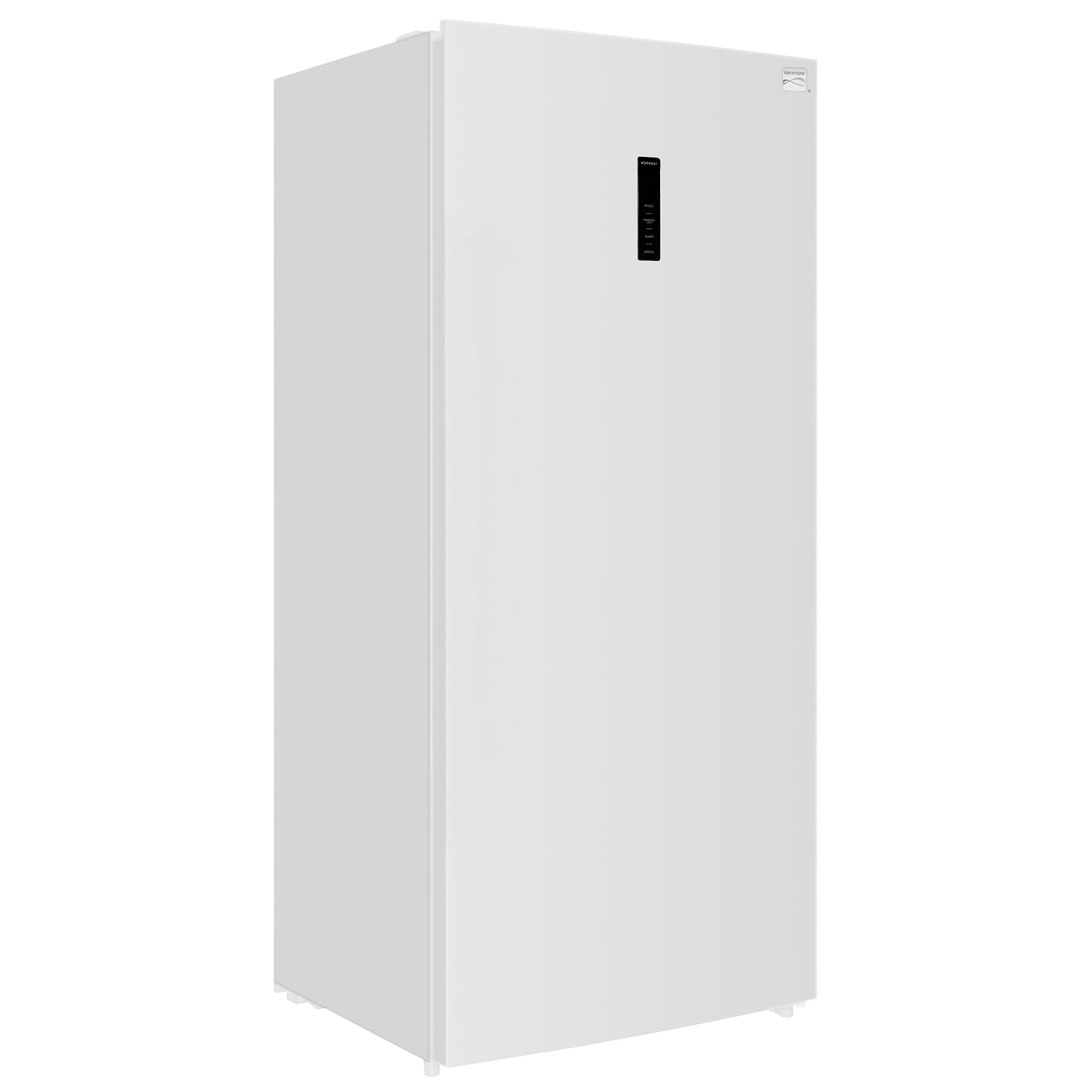
| Kenmore 21.0 Cu. Ft. Convertible Upright★ Best Overall | Bulk storage and hunting-lodge hauls | 21 cubic feet | Automatic (no-frost) | Varying temps (maker states garage-ready) | Amazon |
| Kenmore 20.2 Cu. Ft. Top Mount | A full second kitchen fridge in the garage | 20.2 cubic feet | Automatic | 45°F to 110°F | Amazon |
| Kenmore 14.0 Cu. Ft. Convertible Upright | Tight garages and cabins | 13.78 cubic feet | Automatic | Varying temps (maker states garage-ready) | Amazon |
| KoolMore 7 Cu. Ft. Convertible Upright | Small spaces and budget-minded buyers | 7.1 cubic feet | Manual | 0°F to 110°F | Amazon |
In‑Depth Reviews
1. Kenmore Upright Convertible Refrigerator / Freezer, 21.0 Cu. Ft.
Our pick — 4.5+★ from 20+ verified ratings; the strongest balance of quality and price.
The upright that swallows a bulk-store run whole and flips to a freezer when the season turns.
The 21 cubic feet earns this the top slot: it is the largest box here by a wide margin, and the maker states it holds up to 735 lbs of food. A full grocery haul disappears inside without a game of Tetris. That is 21 cubic feet versus 7.1 cubic feet for the KoolMore — and it matters every single week if you stock deep.
The one-touch conversion is the real trick. A digital panel with an LED display (a lit screen you tap to set the mode) switches between refrigeration and freezing without unloading anything. A quick freeze mode chills fresh items fast. One unit covers winter meat storage and summer drink overflow, so you skip buying two appliances. Total no-frost auto defrost handles the ice for you, so no scraping a frozen wall on a Saturday.
Kenmore backs it with a 2-year warranty plus built-in “door open” and “high temperature” alarms. The second one earns its keep in a garage, where a door left ajar in July is how food spoils. It carries EnergyStar certification (a government efficiency label) to keep running costs in check. The caveat is size and heft: it stands 74.6 inches tall, 33.1 inches wide, and 30.8 inches deep, and weighs 180 pounds. Measure your clearance, then plan for a helper on delivery day.
What earns the top slot
- 21 cubic feet holds up to 735 lbs of food — the biggest box here by far
- One-touch fridge-to-freezer switch covers both seasons with one unit
- No-frost auto defrost means no manual ice scraping
- High-temperature and door-open alarms suit an unattended garage
What to plan around
- 180 pounds and 74.6 inches tall — moving it is a two-person job
- The maker does not publish a specific low-end temperature figure
Built for: big families, hunters, and anyone storing serious volume who wants one appliance to do both jobs.
Think twice if: your garage wall is tight — the 33.1-inch width and 180-pound weight need room and muscle.
2. Kenmore 20.2 Cu. Ft. 30″ Wide Top Mount Refrigerator
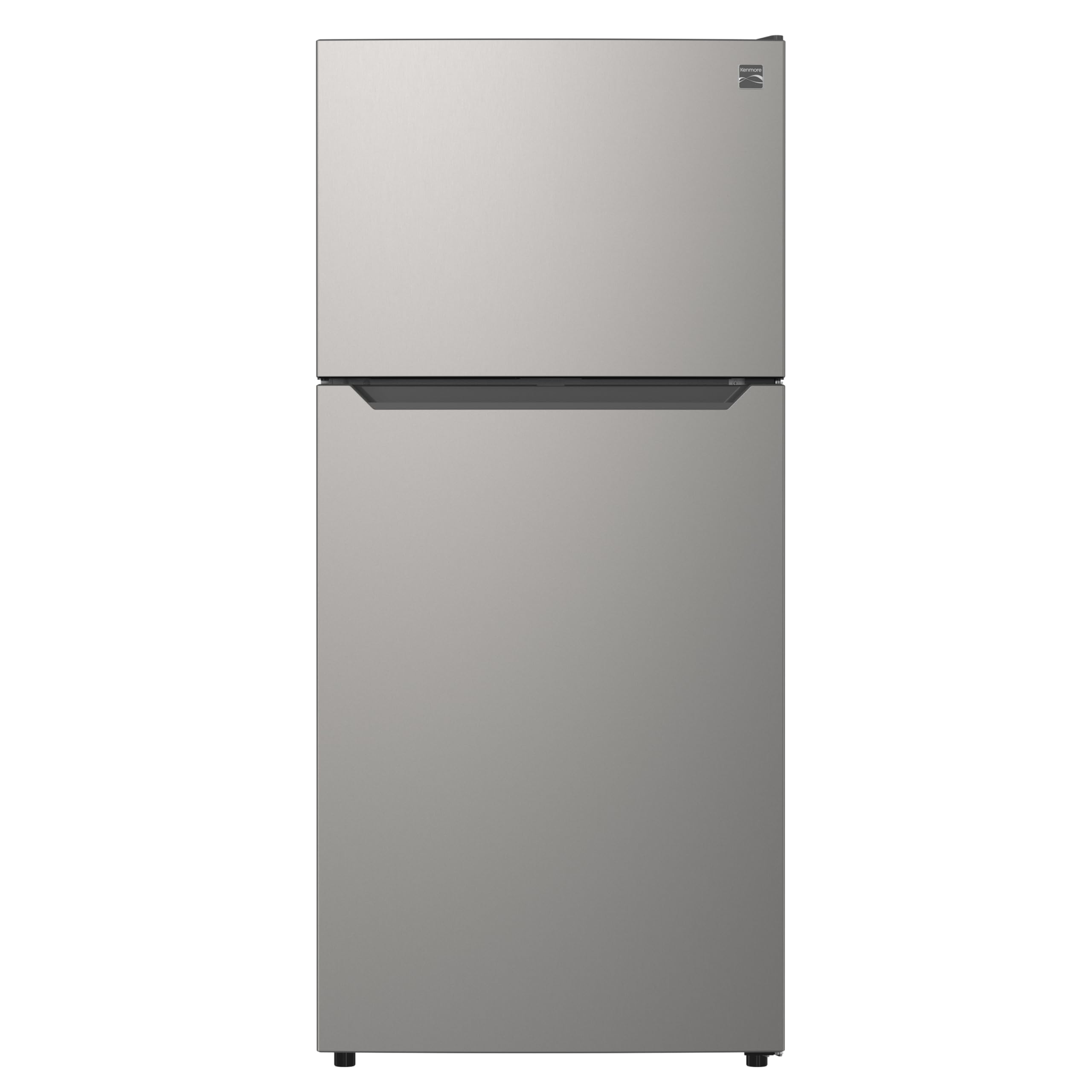
A full-size family fridge that happens to be rated for the temperature swings of a garage.
Its inverter compressor (a motor that holds a steady temperature instead of switching fully on and off) is why this pick runs quieter and cools more evenly than the KoolMore. Buyers report performance and quiet operation most often, along with the roomy drink and produce space. You get 20.2 cubic feet split into a 5.09-cubic-foot freezer and the rest fridge. That is 20.2 cubic feet versus 21 cubic feet for the convertible above, but laid out as a conventional fridge with a freezer on top.
Tempered spill-proof glass shelves adjust for sheet cakes and party trays, and 6 clear bins include a gallon bin for the big stuff. A built-in temperature sensor keeps it consistent from 45°F to 110°F, so your food holds steady through a hot July. The fingerprint-resistant metallic steel finish hides shed dust and handprints better than a plain white box. Auto defrost handles the ice.
Two trade-offs matter. It uses 382 kilowatt hours a year (kWh — the unit your power bill charges by) versus 333 for the smaller KoolMore, so it costs more to run. And long-term reliability is the recurring gripe across owner feedback, so keep the warranty paperwork somewhere you will find it.
Where it justifies the mid-range jump: 20.2 cubic feet plus an inverter compressor and a rated 45°F-to-110°F range is the closest thing here to a full kitchen fridge that tolerates a garage. The fingerprint-resistant finish is a small daily win in a dusty space.
The honest wrinkle: reliability is the mixed note in owner feedback, and it drinks more energy per year than the compact KoolMore. If your garage routinely sits near the cold limit, check your local winter lows against that 45°F floor first.
3. Kenmore Upright Convertible Refrigerator / Freezer, 14.0 Cu. Ft.

The leaner convertible for cabins and tight corners, built on the same switchable layout as the big one.
At 204 kWh a year with a 5-star BEE energy rating (India’s efficiency star label, where more stars mean lower running cost), this is the cheapest of the group on paper to run year-round. That matters in a room you are not heating or cooling. Capacity is 13.78 cubic feet (the maker rounds it to 14), spread across 4 door compartments and 4 removable, repositionable shelves. You set the interior up around what you actually store.
It is essentially the 21-cubic-foot convertible above with a smaller cavity. It keeps the convertible core: a digital control panel with LED display, one-touch fridge-to-freezer switching, a quick freeze mode, and total no-frost auto defrost so ice never needs scraping. That makes it a strong choice when a full-size box would eat your whole garage wall, or when this is going into a cottage or mudroom.
Garage duty is covered by premium insulation and sealing the maker says holds up in varying temperatures, plus bright LED interior lighting so you can find things in a dim shed. The one thing to keep in mind is the shallow track record — relatively few buyers have weighed in on this size. You are leaning on the published specs and the shared design with its larger sibling. A smaller household will find it plenty roomy; anyone restocking in bulk weekly will feel the squeeze.
Reach for it when: the space is tight but you still want freezer-to-fridge flexibility and the best energy figure in this lineup.
Look elsewhere if: you need to pack in bulk hauls every week — 13.78 cubic feet fills faster than the big convertible.
4. KoolMore 7 Cu. Ft. Garage Ready Convertible Upright

The small, cheap, genuinely cold box that fits where a full fridge never could.
Here is the spec that matters most in a garage: this box is rated to run from 0°F to 110°F in the surrounding air. That is a wider published band than the Kenmore top-mount’s 45°F-to-110°F floor, so a bitter winter does not sideline it. Capacity is 7.1 cubic feet versus 21 cubic feet for the convertible above. Go in knowing this is a second, supplementary box, not a family’s main cold storage.
Convertible mode does real work. It swings between refrigerator (34-50°F) and freezer (-11-10°F), with a stated 180-minute conversion time. Set it to fridge for drinks and produce, flip it to freezer for a bulk meat buy. A mechanical control (simple dials, fewer things to fail) replaces the digital panel. The body is metal inside and out, with glass shelves and a stainless-steel finish. The door is reversible, so you hang it either way to suit your wall.
The cold itself wins people over. Owners mention it keeps things frozen solid and holds temperature without fuss. Value is the more debated point — some call it a nice little freezer for the money, others want more for the spend. It sips 333 kilowatt hours a year. The catch is manual defrost: unlike every other pick here, you empty it and defrost by hand periodically, so budget an afternoon now and then. Its 3.5+ star standing also trails the bigger Kenmores.
Why it earns a spot
- Rated for 0°F to 110°F — the widest published cold-end range here
- Reversible door lets you fit it against either garage wall
- Convertible fridge/freezer with a stated 180-minute switch
- 333 kWh a year keeps running costs modest
The bits to accept
- Manual defrost — you empty and scrape it by hand
- 7.1 cubic feet is a supplemental box, not main storage
- Mechanical dials instead of a digital display
Best fit: a small garage, a workshop, or an apartment where you need a genuine extra cold box and want freezer flexibility without spending big.
Not the one if: you refuse to defrost by hand — the manual system is the price of the low cost.
Understanding the Specs
Garage-Ready Temperature Range
This is the ambient range — the air temperature around the unit, not the temperature inside it — that the fridge is rated to run in. A kitchen fridge assumes a fairly stable indoor room; a garage can swing hard. The wider and lower the rated range, the better the box copes with a cold snap or a heat wave. Check your own garage’s worst summer and winter temperatures against the published range before you buy.
Cubic Feet (Capacity)
Cubic feet measures usable interior volume. Bigger numbers mean more food, but also more footprint and more weight to move. A 21-cubic-foot upright stores a full bulk run; a 7-cubic-foot box is a supplement. Match capacity to how much you actually stock, not to how much you could theoretically stock.
Auto vs. Manual Defrost
Auto defrost (no-frost) melts internal ice on its own so you never empty the unit. Manual defrost means ice builds up and you clear it by hand. A garage door opens less, so frost is slower — but with manual defrost it is still a chore you own.
Annual Energy Consumption (kWh)
Kilowatt hours per year tells you roughly what the fridge will add to your electricity bill. Lower is cheaper to run. A second fridge runs constantly, so this figure matters more than it does on a kitchen appliance you open a dozen times a day.
FAQ
What does garage ready actually mean on a refrigerator?
Will a garage refrigerator work in freezing winter temperatures?
How big a refrigerator do I need for a garage?
Is auto defrost worth it over manual defrost?
Can a convertible freezer be used as a refrigerator every day?
How much does a garage refrigerator add to my electric bill?
Do I need to leave space around a garage refrigerator?
What is the difference between a top-mount fridge and an upright convertible?
Are glass shelves better than wire shelves in a garage fridge?
Final Thoughts: The Verdict
The basic refrigerator for garage worth buying first is the Kenmore 21.0 Cu. Ft. Convertible Upright because it is the only unit here that covers both bulk fridge and bulk freezer duty in one box, with no-frost auto defrost and garage alarms built in. If you want a conventional full-size fridge and freezer layout instead, the Kenmore 20.2 Cu. Ft. Top Mount gives you the quiet inverter compressor and a rated 45°F-to-110°F range. And for a small garage or a tight budget, the KoolMore 7 Cu. Ft. keeps things frozen at the widest published cold-end range on the list.
How We Picked
We do not accept paid placement. Every pick is matched to a real buyer and a real use-case; we do not hands-on test units.
Sources & Methodology
Specifications: manufacturer listings and product documentation. Review insights: verified customer reviews, as of November 2026. Pricing: not shown on this page (it changes often); check the current price via the retailer link.
As an Amazon Associate, Gadgets Feed earns from qualifying purchases. This does not affect which products we feature.