
Our readers keep the lights on and my morning glass full of iced black tea. As an Amazon Associate, I earn from qualifying purchases.
Specs are compiled from manufacturer listings and verified buyer reviews and can change over time — please confirm the key details on the product page before buying.
Replacing a shut-off valve on a water line depends on one decision first: how the valve connects to your pipe. That choice, not the brass, is what makes a job take twenty minutes or two hours. A push-to-connect valve snaps onto PEX, copper, CPVC, PE-RT or HDPE (five common pipe types) with no soldering and no glue. A threaded NPT valve (NPT means standard tapered pipe threads) screws onto standard pipe threads and needs tape or paste. Get the end type right and the rest of the install falls into place.
I’m Min — the founder and writer behind Gadgets Feed. This guide is built by comparing the manufacturers’ published specifications and the patterns across verified customer reviews, so you get each pick’s real strengths and trade-offs instead of marketing spin.
Below you will find nine 3/4 inch valves sorted by what they actually do best — push-fit speed, threaded brass value, stainless pressure handling, or PVC serviceability. One note before you scroll: this list uses flexible matching for 3/4 inch nominal size, so a pick may be listed as 3/4 inch, 3/4″, or 0.75 inch even when the listing words differ. The nearest same-type size serves the same purpose, and every pick here is genuinely a 3/4 ball valve by nominal bore.
Our Picks at a Glance


How To Choose The Best 3/4 Ball Valve
Almost every 3/4 inch ball valve on a shelf looks the same from three feet away: a brass or plastic body, a lever, two ends. The differences that matter are all in the ends and the internals. Work through the four points below before you buy and you will not end up with a valve that will not fit your pipe.
Match the connection to your pipe first
A push-to-connect end (also called push-fit) slides over the pipe and grips it with an internal collar — no flame, no flux, no drying time. That is the fastest route on PEX, copper, CPVC, PE-RT and HDPE, and it is the only route worth considering if the line is wet and you cannot shut the house down. A threaded end is National Pipe Thread, usually written NPT, which is the tapered thread standard on brass and iron pipe. It needs thread tape or paste and a wrench. Slip socket ends are for solvent-welded PVC and are glued rather than screwed. Buying the wrong one is the single most common way these jobs stall.
Understand what “full port” buys you
Full port means the hole through the ball is the same size as the inside of the pipe, so water passes without a squeeze. On a 3/4 inch line that keeps flow up and pressure drop down. A reduced-port valve has a narrower bore and throttles the line even when fully open. If you are feeding a fixture, a hose bib or an irrigation zone, full port is the spec to insist on.
Read the pressure rating in the right units
WOG stands for water, oil and gas — the non-shock pressure a valve handles across those media. WSP is the lower working steam pressure, and PSIG is gauge pressure for saturated steam. You will see both figures on the same valve, and they are not interchangeable. For a household water line, the WOG number is the one that applies. For a compressor drain or a steam run, look at the steam figure.
Pick the body material for the job, not the price tag
Lead-free brass is the normal choice for potable water and general plumbing. 304 stainless handles higher pressure and harsher service. PVC suits pools, irrigation and aquarium plumbing where corrosion resistance matters more than heat tolerance. Check the temperature range too, because a PVC valve and a brass valve do not live in the same conditions.
Quick Comparison
| Model | Best For | Connection | Max Pressure | Body Material | Amazon |
|---|---|---|---|---|---|
| SharkBite Max UR22185A★ Best Overall | Fastest install on mixed pipe | Push Fit | 250 PSI | Forged DZR Brass | Amazon |
| Eastman 20047LFBest Value | Everyday threaded brass | 3/4 in. IPS | 600 psi | Brass with Teflon seal | Amazon |
| DERNORD 304 StainlessTop Performer | High-pressure water, oil and gas | 3/4″ NPT | 1000 psi | 304 Stainless Steel | Amazon |
| REVALVED Full Port Brass | Chrome ball, multi-medium lines | Female NPT | 600 psi WOG | Forged Brass | Amazon |
| Boltigen True Union PVC | Pools, irrigation, easy servicing | Slip Socket | 150 psi | PVC, SCH80 | Amazon |
| Midwest Control MBB-75 | Natural gas and vacuum service | 3/4″ NPT MxF | 600 psi CWP | Forged Brass | Amazon |
| Sphagaceae NPT Brass Valve | Potable water, oil and gas lines | Female 3/4″ NPT | 40 bar | Brass with steel handle | Amazon |
| VALFLUIDS Forged LF Brass | Drinking water and compressor drains | Female NPT | 600 PSI WOG | Lead-Free Brass | Amazon |
| Midline Valve 822MF256 | Replacing a male-to-female valve | 3/4 in. FIP x MIP | 600 PSI WOG | DZR Lead-Free Brass | Amazon |
In‑Depth Reviews
1. SharkBite Max 3/4 Inch Ball Valve UR22185A
Our pick — 4.5+★ from 700+ verified ratings; the strongest balance of quality and price.
The valve you can install with wet hands, no torch and no waiting.
SharkBite Max is the pick for anyone swapping a shut-off on mixed pipe — PEX, copper, CPVC, PE-RT, SDR-9 HDPE, in any combination. The push-to-connect end is the whole story: you push the pipe in and a reinforced stainless steel collar locks the cartridge in place. No soldering, no glue, no extra tools. It can even go onto a wet line, so a drip you cannot fully stop does not block the repair. That rating is 4.5+ stars across 700+ ratings, and the reason is simple — it removes the worst part of plumbing, which is the flame and the wait.
What decides whether it fits your job is the pressure ceiling: it is rated to 200 degrees F and 250 PSI (pounds per square inch), with a 2K maximum burst (2K is a burst-pressure rating). On a residential water line that is plenty of headroom. Compare that with the DERNORD stainless valve in this list, which carries a 1000 psi maximum operating pressure — if you are plumbing a compressor manifold or a high-pressure test rig, that stainless unit is the one, and this SharkBite is not the tool for it. The body is forged DZR brass (a corrosion-resistant brass) with a stainless collar, and it is lead free, so it meets the same standards for commercial and residential work.
There is also the flow question. Because no PEX tube liner is required, the fitting does not narrow the path on copper or CPVC — you get a full-open bore instead of a choked one. Set against the Eastman threaded valve, this is the heavier part: 9.6 ounces versus 8 ounces. What wins people over is the speed. The ease of the install is the thing that gets talked about most, and the quality holds up alongside it. Anyone who has spent an evening sweating a joint that refused to seal will take the push-fit premium.
Where It Earns Its Place
- Snaps onto PEX, copper, CPVC, PE-RT or HDPE in any mix, with no soldering or glue
- Works on a wet line, so an active drip does not stop the repair
- No PEX liner needed, so flow stays unrestricted on copper and CPVC
- Lead-free forged DZR brass rated to 200 degrees F and 250 PSI
Where It Stops
- Costs more than a plain threaded brass valve of the same size
- Its 250 PSI ceiling is well under the 1000 psi stainless pick, so it is not for high-pressure service
- Push fittings are a one-time grip — cut the pipe back if you ever need to redo the joint
Go for it if: your pipe is PEX, copper, CPVC, PE-RT or HDPE and you want the shut-off done today without a torch.
Pass if: you are running high-pressure air or test rigs where the 1000 psi stainless valve is the honest choice.
2. Eastman 3/4 Inch IPS Heavy Duty Full Port Ball Valve 20047LF
A plain threaded brass valve that does the boring job without asking for attention.
This is the valve for the standard case: a 3/4 in. IPS connection at each end, screwed onto existing pipe as a shut-off or inline valve in a water system. The full port design keeps the bore matched to the pipe so flow stays up and the pressure drop stays down. The handle is stamped steel with a vinyl coating, which gives you a grip that does not chew your palm when you are turning it in a tight spot. Inside, a Teflon seal does the work, and the brass body is built to sit in hot, high-pressure conditions rather than just tolerate them. It is the most-praised quality in the reviews — owners describe it as well-built and genuinely heavy-duty.
The numbers to know are 600 WOG and 150 PSIG for saturated steam. WOG means water, oil and gas pressure, and PSIG means pounds per square inch gauge. In plain terms, 600 is the non-shock water, oil and gas pressure it will take, and 150 is a separate lower figure for steam service — so do not read the 600 and assume the same for steam. For a house water line it is generous headroom. On size, this is the smaller body of the two brass rivals: 2.2 x 1.97 x 1.1 inches against the SharkBite at 5.62 x 2.46 x 1.4 inches. That is a large difference in bulk for a valve that has to fit between a joist and a pipe run. It is also the lighter of the two at 8 ounces versus 9.6 ounces. Neither figure is a problem — you just get a tighter package.
Two things are worth flagging honestly. The effort to turn it is the split point in feedback: plenty of owners find it opens and closes smoothly, but it can take real force the first time you close it, so grip the handle properly rather than flicking it. The threading draws mixed notes as well, which usually means tape and paste applied properly rather than a bad thread. Fit and durability hold up, and the valve is backed by UPC approval, CSA certification (two plumbing safety standards) and compliance with potable water standards. For the money, this is the workhorse of the threaded group.
Straight read: if your pipe is already threaded IPS and you want a full port brass valve that will not need replacing, this covers it at the lowest outlay in the group.
The honest catch: the first open-to-close turn can be stiff, so plan to use two hands and the full lever rather than a quick flick.
Reach for this if: you are replacing a threaded brass valve on a water line and want the full port bore without paying push-fit money.
Look elsewhere if: you need a valve that turns with no effort at all, or you are joining PEX where no thread exists.
3. DERNORD Stainless Steel 304 Ball Valve, Full Port (3/4″ NPT)
The pressure ceiling here is 1000 psi — far above anything a house line will ever see.
If your job involves compressed air, oil, gas or a test setup rather than a domestic water line, the number that separates this DERNORD valve from the brass crowd is its 1000 psi maximum working pressure for water, oil and gas. Put beside the PVC true-union valve in this list, rated at 150 psi max, the gap is enormous — this is a valve built for service the plastic and standard brass units are not rated for. The body and ball are 304 stainless steel (a corrosion-resistant steel grade), and it is a full port design (the opening matches the pipe bore, so flow is not narrowed) with female NPT ports on both ends. There is also a locking device on the heavy-duty handle, so you can pin the lever rather than trusting friction to hold a line closed.
Temperature is the other half of the spec sheet, and it is where a stainless valve earns its keep. The stated range runs from -60 F to 450 F on the body, with a fluid temperature range of -20 F to 410 F. That span covers cold outdoor runs and hot service in the same part. Because it is a two-piece body joined by threads, you can take the valve apart to service it rather than cutting it out of the line. Quality and functionality are what owners consistently describe, and the value angle holds — the valve body is reported to hold up well even for buyers comparing it against pricier options.
There is a real trade-off to weigh. Stainless threaded joints need care with tape and paste, and a stainless body is not the cheap option in this group. It is also overkill for a simple under-sink shut-off on copper, where a brass valve does the same day-to-day job. But if you are plumbing a compressor manifold, an air header or anything that might see high pressure or wide temperature swings, this is the valve in the lineup built for it. Tape or paste on the NPT threads is what keeps this stainless body leak-free for the long run.
Built for: air, oil and gas lines, compressor drops and any run where 1000 psi of headroom is the point.
Not for: a simple domestic water shut-off where a brass valve at 600 psi already covers you.
4. REVALVED Full Port 3/4 in. Brass Ball Valve

A chrome ball and a grip-coated lever, aimed at water, air or gas in one valve.
The detail that sets this one apart is the ball itself: it is chrome-plated, which is the surface that does the sealing work every time you turn the lever. The connector is a female threaded NPT end for a secure, leak-free joint, and the body is forged brass that is corrosion resistant and free of lead and harmful materials. You get a 90-degree safety grip-coated handle, so the travel from on to off is a quarter turn with a surface that does not slip under a wet hand. The maker lists it for residential and plumbing use across water, air or gas piping, which is a wider spread than a potable-water-only valve.
On pressure, this is a 600 psi WOG valve, and the listing also states 150 PSI WSP — the steam figure. That pairing is the same pattern as the other brass valves here, and it means the 600 applies to water, oil and gas while steam service sits at the lower number. The full port design keeps the bore open. Quality and functionality are what owners describe most, and no leaks are reported at the outset, with the operation described as smooth. Installation notes go both ways, which in practice usually means how much room you have around the fitting rather than a fault in the valve.
Where this one asks you to think is on value and long-term durability. Some buyers feel it is priced above what a plain brass valve should cost, and the durability feedback is split, so it is not the pick for someone who wants the cheapest possible part. There is a 30-day money-back guarantee behind it, which takes some of the risk out of trying it. If you want one valve type on the shelf that can handle air, water or gas, this is a reasonable single answer — just do not expect it to be the bargain of the group.
What it does well: a chrome-plated ball, a quarter-turn grip handle and a forged lead-free brass body rated for water, air or gas.
What to weigh: value and durability draw mixed views, so it suits someone who wants one multi-medium valve over the cheapest per-unit price.
Pick it for: a residential line that might carry water, air or gas and where a chrome ball and grip handle matter to you.
Skip it for: a strict budget build where a plainer brass valve covers the same water-only job.
5. Boltigen 3/4 Inch True Union PVC Ball Valve, 2-Pack
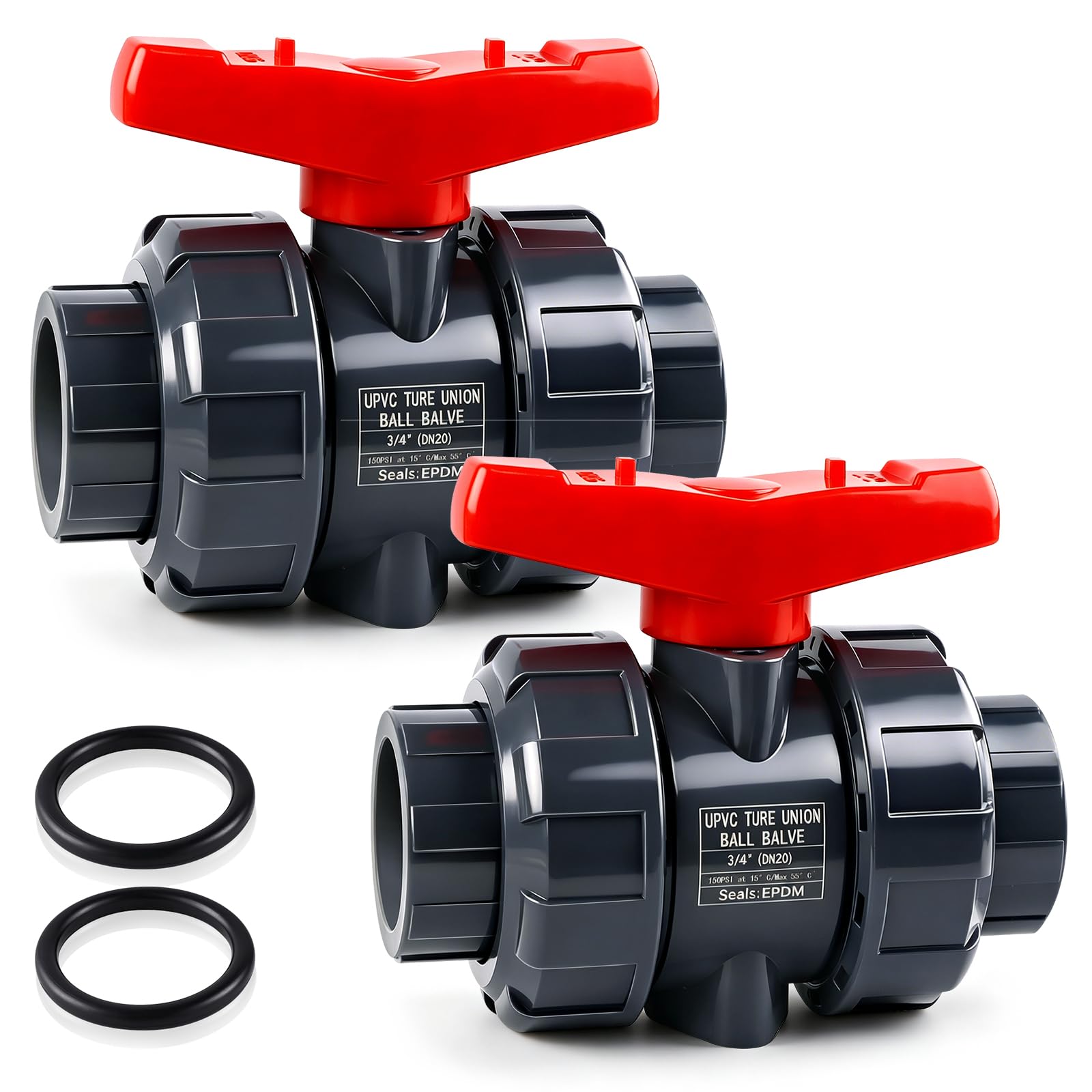
A union on both sides means you can pull this valve apart without cutting pipe.
Pool owners and irrigation installers get the most out of this one, because the true union design puts a disconnect on each side. When you need to clean the line, service the valve or swap a part, you unscrew the unions instead of cutting into your PVC run. That is the single most useful feature here, and it is the reason a two-pack makes sense for anyone with more than one zone. The body is PVC in SCH80 (Schedule 80, a thicker-wall PVC), the seals are EPDM O-rings (a rubber seal) with PTFE seats (a slick plastic seat), and the connection is a standard 3/4 inch slip socket for solvent welding. Installation is among the most praised things about it, alongside the overall build.
Then there is the pressure rating, and it is the honest limit of this valve: 150 PSI max, with a maximum temperature of 131 degrees F (55 degrees C). Compare that with the DERNORD stainless valve at 1000 psi and you see immediately that this is a different class of part. For a backyard pool loop, garden irrigation, a marine aquarium or a sump pump, 150 PSI is the right tool for the job. For a compressor line or a high-pressure water system, it is not. Know which job you are doing before you buy, because the plastic body and the brass valve are not substitutes for one another.
The package also includes spare replacement O-rings, which is unusual and genuinely helpful because the seal is the part that eventually wears. You need to solvent-weld the sockets properly, since this is not a threaded or push-fit valve. Ease of use is the one split point — a quarter turn is a quarter turn, but if the valve has sat closed for a season it can need a firm hand the first time. Work the lever firmly and the quarter-turn frees up. For a plastic valve, this is a well-equipped choice with the servicing advantage built in.
Right choice when: you are on PVC in a pool, irrigation, aquarium or sump setup and you want to service the valve without cutting.
Wrong choice when: your line runs high pressure or hot service above 131 degrees F, where brass or stainless belongs.
6. Midwest Control MBB-75 600 PSI CWP 3/4″ NPT MxF Brass Ball Valve

Built for gas control and vacuum service, not for the kitchen tap.
Start with the warning because it saves you a return: this valve is not for use in potable water systems. What it is for is natural gas control, compressed air and vacuum service, and the listing spells out a vacuum rating to 29.9 inches of mercury. The body is heavy-duty forged brass, the ends are 3/4 inch NPT with a male-to-female configuration, and the port is full. It carries UL, CSA, FM and CE approvals, and the pressure figures are 600 PSI CWP with 150 WSP. If you are fitting a gas shut-off, those approvals are the reason to look here rather than at a generic brass valve.
The thread note matters more than usual with this one. These are NPT threads and they are explicitly not compatible with 3/4 inch garden hose threads, so do not buy it for an outdoor spigot expecting a hose to screw on. The male-to-female layout also means you need the matching pipe arrangement on both sides. Owners describe it as well-made and strong, and the natural gas use case comes up directly — shutting off gas completely is the outcome people care about. Build quality is noted alongside it.
Two honest caveats. Leak feedback is mixed, some report clean joints and some report leaks, which in a gas context points straight back to proper thread sealant and torque rather than the part. Value also splits, so it is not the budget buy of the list. Weigh it against the VALFLUIDS lead-free valve if your job is drinking water — that one is built for potable lines and this one is not. Here, you are paying for approvals and a gas-rated body.
What It Is Built For
- Natural gas control plus vacuum service down to 29.9 inches of mercury
- Forged brass body with a full port 3/4 inch NPT male-to-female layout
- UL, CSA, FM and CE approved for gas work
- Rated 600 PSI CWP and 150 WSP
What To Know First
- Not for potable water systems
- NPT threads will not accept a 3/4 inch garden hose thread
- Leak and value feedback both split, so proper sealant and torque are on you
The one for: gas lines, compressed air and vacuum runs where UL and CSA approvals are what you need to see.
Not the one for: drinking water, or any spigot you want to screw a garden hose onto.
7. Sphagaceae 3/4 NPT Female Threaded Brass Ball Valve

An all-brass full port valve with the paperwork for drinking water.
The reason to consider this Sphagaceae valve for a water line is the compliance stack: NSF compliant, UPC approved, CSA certified, and it complies with lead-free guidelines for potable water applications. That last point is the one that matters most if the valve sits on a line you drink from. The body is all brass, the handle is blue vinyl-covered steel, and the connection is female-to-female 3/4 inch NPT, which forms a pipe seal with tape or paste. It is a standard full port heavy-duty valve at 0.77 lbs, so the bore stays open through the whole turn.
The pressure spec is worth reading in two parts. The maximum working pressure is listed as 40 bar, and the maximum allowable operating temperature is 200 degrees F, with a steam rating of 150 PSIG. Those are separate figures for separate service — do not read the working pressure and assume it holds the same for steam. Inside, PTFE seals are there to resist corrosion and extend the life of the valve. The lever gives you on and off control in a quarter turn, and the NPT threads are designed for installation without special tools.
One thing to be honest about: this is a newer listing with a smaller review base than the established names here, and it carries a 4.5+ rating. That is a good score, but it means less owner history to lean on than the SharkBite or the Eastman. If you need the most proven track record and the widest feedback, the higher-rated picks above are the safer shortlist. If the potable-water certifications are the deciding factor for you, this valve covers them and lists a wide application range across water, air, oil and gas.
Why it belongs here: certified for potable water with PTFE seals, a full port bore and a vinyl-covered lever, at 0.77 lbs in the hand.
Fair warning: a smaller review base than the top picks, so you are leaning on certifications more than on owner history.
Suits you if: the valve is going on a drinking-water line and NSF, UPC, CSA and lead-free compliance are your must-haves.
Think twice if: you would rather buy from a valve with thousands of installs behind it.
8. VALFLUIDS Full Port Forged LF Brass Ball Valve (3/4 Inch)

A blowout-proof stem and PTFE seats on a lead-free brass body, with the paperwork for drinking water.
For a plain water line replacement, the internals here are the selling point. The stem is blowout-proof, which is the safety detail you want on a valve that holds back a live line — the stem cannot be pushed out by pressure. The seats are PTFE, the body is a two-piece full port design, and the connections are female NPT at 3/4 inch on both ends. It is lead-free brass that the maker says meets all federal and state standards, and the working medium is listed as drinking water. CSA and CUPC approvals back that up.
The rating reads 150 PSI WSP and 600 PSI WOG across the 1/2 inch to 2 inch range. Read it the same way as the other brass valves: the 600 is the water, oil and gas figure and the 150 is the steam figure. On a domestic water run that is more headroom than you will use. Owners describe it as well-built and working perfectly, and the drain-valve use on an air compressor comes up directly as a use case, so it is trusted beyond just plumbing. Durability is noted alongside quality.
Two points to keep in view. Leak feedback splits, so treat the joints as a sealant-and-torque job rather than a screw-it-on-and-hope job — same as every threaded brass valve. The purchase experience also draws mixed notes, which is about the buying side rather than the brass itself. Compare it with the Midline valve at similar money and the difference is the connection: this is female NPT at both ends, while the Midline is male-to-female. Pick by the pipe you already have, not by the label.
Made for: a drinking-water line replacement where a blowout-proof stem and a lead-free body are the priorities.
Not ideal for: anyone expecting the joints to seal without careful tape and torque.
9. Midline Valve 822MF256 Premium Brass Full Port Ball Valve 3/4 in. FIP x MIP

One end screws on, the other screws in — the direct swap for a male-to-female valve.
The layout is what makes this Midline pick useful. FIP x MIP means one end is a female iron pipe thread and the other is male, so it drops into a run where a valve has a male thread on one side and a female on the other. That is a common replacement situation, and buying a female-to-female valve for it just means adding an adapter you did not want. Beyond the ends, it is a full port DZR lead-free brass body (full port means the opening matches the pipe bore) with a vinyl lever handle for easy water shut-off. CSA and UPC approvals are listed, and the connections are described as secure and leak-free.
The working figures are 150 PSI WSP and 600 PSI WOG, with a working temperature range of -20 F to 300 F. That span covers cold outdoor runs and hot water lines without a change of part. Owners describe perfectly machined threads and good value, and the handle position can be reversed to suit the installation — which is a small thing until you are in a tight cabinet and the lever fouls the wall. A reversible lever saves you when a fixed handle fouls the cabinet wall.
The caution is thread quality, which draws mixed feedback. With an FIP x MIP valve, one end is male and threads into a fitting, so sealant and torque discipline matter even more than on a two-female valve. Sealant and correct torque on the male end make this a clean, CSA- and UPC-approved swap. Miss it and you will chase a drip. Compare with the VALFLUIDS valve and the internal spec is similar, but the connection differs — so choose by which threads you actually need to mate with.
Why It Fits The Job
- FIP x MIP ends match a male-to-female replacement without adapters
- DZR lead-free brass with a full port bore and a vinyl lever handle
- Rated 150 PSI WSP and 600 PSI WOG across -20 F to 300 F
- Reversible handle position helps in tight cabinets
- CSA and UPC approved
What To Watch
- Thread quality draws mixed notes, so sealant and torque matter
- The mixed male-female ends only help if your pipe run is set up that way
Buy it when: you are replacing a valve with one male and one female connection and want the direct fit.
Hold off if: both of your pipe ends are female, where a two-female valve is the simpler answer.
Understanding the Specs
Connection Type: Push-Fit vs NPT vs Socket
Push-fit, or push-to-connect, grips the pipe with an internal collar and needs no flame or glue. It suits PEX, copper, CPVC, PE-RT and HDPE, and it is the only practical choice if the line cannot be fully shut off. NPT, or National Pipe Thread, is a tapered thread that seals with tape or paste and is the standard on brass pipe. Socket ends are for solvent-welded PVC. Matching your existing pipe to the right one is the first decision you make.
Pressure Rating: WOG, WSP and PSI
WOG means water, oil and gas — the non-shock pressure a valve holds across those media. WSP is the lower working steam pressure, and PSIG is gauge pressure. A valve listed at 600 PSI WOG and 150 WSP will take 600 on a water line but only 150 in steam service, so read both numbers rather than the biggest one. For a house water line, the WOG figure is the one that applies to your install.
Full Port vs Reduced Port
Full port means the opening through the ball matches the inside of the pipe, so flow stays unrestricted and pressure drop stays low. A reduced-port valve narrows the path even when fully open. On a 3/4 inch line feeding a fixture, a hose bib or an irrigation zone, full port is the spec that keeps the flow you paid for.
Body Material and Temperature Range
Lead-free brass is the workhorse for potable water and general plumbing. 304 stainless handles higher pressure and wider temperature swings. PVC suits pools, irrigation and aquariums where corrosion resistance matters more than heat. Always check the temperature range with the material, because a PVC valve and a brass valve do not live in the same conditions.
FAQ
Will a 3/4 inch ball valve fit my existing pipe?
Can I install a push-to-connect valve on a line that is still wet?
What does WOG mean on a 3/4 ball valve?
Is a full port valve better than a reduced port one?
Can I use a brass ball valve on natural gas?
What is the difference between a true union PVC valve and a standard one?
Will a 3/4 inch NPT valve fit a garden hose?
How do I stop a threaded brass valve from leaking at the joint?
What pressure rating does a 3/4 ball valve need for a home water line?
Can I service or take apart a 3/4 ball valve instead of replacing it?
Do I need a lead-free valve for drinking water?
Final Thoughts: The Verdict
For most people replacing a 3/4 inch shut-off, the SharkBite Max UR22185A is the pick that removes the most friction — it pushes onto PEX, copper, CPVC, PE-RT or HDPE in any combination with no soldering, works on a wet line, and holds a 250 PSI rating at 200 degrees F. That combination of push-fit speed, wet-line capability and a 250 PSI rating is why it tops this list. If your pipe is already threaded and you want the full port brass valve at the lowest outlay, the Eastman 20047LF is the workhorse. And for a gas line or a high-pressure air run, the DERNORD stainless valve at 1000 psi and the Midwest Control MBB-75 with its gas approvals are the two that belong on that job. Match the end type to your pipe, then read the WOG figure for water or the WSP figure for steam.
How We Picked
We do not accept paid placement. Every pick is matched to a real buyer and a real use-case; we do not hands-on test units.
Sources & Methodology
Specifications: manufacturer listings and product documentation. Review insights: verified customer reviews. Pricing: not shown on this page (it changes often); check the current price via the retailer link.
As an Amazon Associate, Gadgets Feed earns from qualifying purchases. This does not affect which products we feature.