
Our readers keep the lights on and my morning glass full of iced black tea. As an Amazon Associate, I earn from qualifying purchases.
Specs are compiled from manufacturer listings and verified buyer reviews and can change over time — please confirm the key details on the product page before buying.
You want the neighbor’s trampoline out of your sightline before next summer. That is the whole job. A privacy tree that takes a decade to fill in is not a privacy tree. This guide separates the varieties that genuinely add serious height per season from the ones whose “fast growing” label is wishful thinking, and pairs each with the planting reality you will face.
I’m Min — the founder and writer behind Gadgets Feed. This guide is built by comparing the manufacturers’ published specifications and the patterns across verified customer reviews, so you get each pick’s real strengths and trade-offs instead of marketing spin.
Arborvitae, willow, and wax myrtle all behave very differently in year one, and shipping size matters as much as growth rate. Below you will find the 5 privacy trees that grow fast enough to build a real screen, plus four more worth knowing.
Our Picks at a Glance


How To Choose The Best 5 Privacy Trees That Grow Fast
The mistake almost everyone makes is buying on the growth figure alone. A tree listed at 3-5 feet per year once settled will spend its first season putting roots down instead. What you are really shopping for is how much intact root and soil arrives in the box, and whether the variety survives your winter.
Start with your hardiness zone, not the photo
A hardiness zone (a number telling you the coldest winter a plant survives) is the first filter. Thuja Green Giant handles zones 5-9 in most listings here, American Pillar goes down to zone 3, and Austree willow sits in zones 4-8. Planting outside your zone is the most common reason a hedge fails, and most of these growers void the guarantee when you do.
Decide if you need evergreen or summer-only screening
Arborvitae holds its foliage year-round, so the screen works in February. Willow is deciduous — it drops leaves in autumn, and the listing itself says the dense summer foliage naturally thins in winter. If your privacy problem is a pool next door used in July, willow is plenty; if it is a lit window in January, choose arborvitae.
Match the plant count to your actual fence line
Spacing decides the count. American Pillar wants 2.5 to 3 feet between trunks for a hedge in 2 to 3 years. The 10-pack of Thuja Green Giant asks for 6 to 7 feet apart for a quick screen, and the larger-spec Green Giant listings suggest every 5 feet. Measure your run, divide by the recommended spacing, and buy the count that fills it — not the count that looks generous.
Quick Comparison
| Model | Best For | Growth Rate | Mature Height | Hardiness Zone | Amazon |
|---|---|---|---|---|---|
| Thuja Green Giant ~Lot of 30~ 18++ inches★ Best Overall | Planting a long boundary in one order | 2-3 feet per year | 30-50 feet | 5-9 | Amazon |
| Brighter Blooms Thuja Green Giant, 2-3 ft.Best Warranty Support | Buying one plant with a warranty | 3-5 feet per year | — | — | Amazon |
| Perfect Plants Thuja Green Giant, 1 Gal (5-Pack)Best Soil-Proof Pick | Clay soil and low upkeep | Fast growing (per listing) | Up to 60 feet | 5-9 | Amazon |
| Greenwood American Pillar Arborvitae, 2X Quart Pots | Narrow gaps and tight patios | 3+ feet per year after year one | 20-30 feet | 3-8 | Amazon |
| 10 Thuja Green Giant Arborvitae 7-10 inches | Filling a short run on a budget | 3 feet per year | 40 feet | 5-9 | Amazon |
| Thuja Green Giant, 10 Live Plants (Florida Foliage) | Commercial-scale planting | Fast growing (per listing) | — | — | Amazon |
| Wax Myrtle, Extra Large 3 Gallon | Coastal wind and dry spells | Fast growing (per listing) | — | — | Amazon |
| 50 Austree Hybrid Willow Trees | Maximum height, fastest | 10-15 feet per year | — | 4-8 | Amazon |
| 50 Aussie Hybrid Willow Cuttings | Windbreaks on open acreage | Several feet per favorable season | — | — | Amazon |
In‑Depth Reviews
1. Thuja Green Giant Arborvitae ~Lot of 30~ 3 inch Shipping 18++ inches Tall
Our pick — 4.5+★ from 100+ verified ratings; the strongest balance of quality and price.
Thirty plants that already stand knee-high, so you skip the twig stage entirely.
This is the pick that solves the two problems at once. You get height on arrival — each plant ships in a 3 inch deep pot with soil at 18++ inches tall — and you get enough of them to line a real boundary in a single delivery. A bare cutting means waiting for a trunk; this arrives as a small tree already in soil.
The growth side is where it earns the top slot. The listing puts established growth at 2-3 feet per year, and the mature footprint is 30-50 feet tall at 12-16 feet wide. It handles zones 5-9, tolerates drought once the root system is mature, and the grower notes deer resistance and resistance to most insects. Spacing is the number to write down: every 5 feet for a privacy screen.
Buyers care most about survival, and growth and plant quality come up far more than anything else in the feedback. The tone across those comments is that these arrive healthy and take off. Value comes up repeatedly too, which makes sense once you spread the cost across thirty plants. The honest caveat is on the box: it does not ship to Arizona. The grower is also upfront that a regular watering schedule is what establishes the mature root system in year one.
Where this one wins
- 18++ inches tall in a 3 inch pot on arrival — visible screening from day one
- Thirty plants for a full fence run without reordering
- Deer resistant and resistant to most insects, per the grower
- Zones 5-9 with drought tolerance once established
Before you click buy
- Will not ship to Arizona
- Year-one watering is on you — the grower calls for a regular schedule
- Mature width of 12-16 feet means it needs real room to spread
Buy this if: you have a long boundary to cover and want plants that arrive with height already on them.
Pass if: you live in Arizona, or your strip is too narrow to accommodate a 12-16 foot spread.
2. Brighter Blooms Thuja Green Giant Arborvitae, 2-3 ft.
One plant, two to three feet of it, and a warranty that covers the shipping trip.
If you only need to patch a gap rather than build a wall, this is the simplest route. A single plant arrives at 2-3 feet tall — taller than most of the multi-packs here, which ship around 18 inches or less. The listing puts established growth at 3-5 feet per year, the quickest arborvitae figure in this set.
The warranty is the real differentiator and worth reading properly. Brighter Blooms guarantees the plant arrives true to type and healthy, and covers transit damage — but not cosmetic leaf damage. Their explanation is fair: leaves yellow or dry in heat or darkness as a natural protective response, so you trim them and wait for new foliage.
Plant quality and health are what buyers talk about most, and the general read is that these arrive strong. Two things come in more mixed, honestly: size runs from taller than advertised to smaller than expected, and durability splits between trees that settle in well and a few that did not make it through year one. That is normal for live plants shipped bare of context — your soil and watering decide the rest. Note the shipping block: no AK, AZ, HI, or OR.
What you pay for: a taller starting plant plus an actual guarantee attached to it. That combination is not standard across the multi-packs in this list.
Set expectations on: the leaf-yellowing rule. It is the clause people misread, and knowing it upfront turns a disappointment into a five-minute trim job.
Right call when: you are filling one or two spots and want the safety net of a warranty behind the plant.
Look elsewhere when: you need volume — one plant per order gets expensive fast for a full hedge line.
3. Perfect Plants Thuja Green Giant Arborvitae, 1 Gal (5-Pack), Privacy Trees
Five gallon-potted giants built for clay, and a scent straight off a Christmas tree.
This Green Giant covers zones 5-9 (the USDA cold-hardiness zones, a map of the lowest winter temperatures a plant survives), which the listing frames as growable almost anywhere in the United States. If your soil is heavy clay and other trees have sulked, buyers specifically say this one settles in anyway — healthy plants in clay soil is a recurring theme in the feedback.
The mature numbers are the biggest here. It tops out up to 60 feet tall and 20 feet wide at full maturity, in a wide-bottomed pyramidal shape — and it can be pruned to hold at whatever size you want. Five gallon pots give it a root mass that a bare cutting cannot match. The foliage has dense, dark green colour and, per the listing, smells like Christmas trees when the leaves are broken.
Health, appearance, value, and size all land on the positive side of the feedback, with moist soil on arrival called out as a plus. The one honest thread to weigh is lifespan — a portion of buyers report trees that did not thrive, so plan on the first month of watering being non-negotiable. Compared with the bare-root ten packs, the gallon pots here give you a genuine head start.
The case for five gallons
- Zones 5-9 — the widest range in this arborvitae lineup
- Reported to grow well in clay soil
- Up to 60 feet tall and 20 feet wide, prunable to size
- Arrives with moist soil already in the pot
What to plan around
- Some buyers lose trees despite best efforts — live plants carry that risk
- 20 feet of mature width needs real clearance from a fence
- Five plants only covers a short run
Strong fit for: heavy clay ground and a short boundary where five established pots do the job.
Wrong tool for: a long hedge line, where five plants leaves you short.
4. Live Trees – American Pillar Arborvitae Tree + Thuja Occidentalis – [Qty: 2X Quart Pots]

The slim column that blocks a pool view without eating half your yard.
Most privacy trees fail because they grow wide as well as tall, and you run out of border. The American Pillar is the answer to that specific problem. It matures at 20-30 feet tall with a narrow growth habit — the listing calls it ideal for blocking views to pools, neighbours, patios and decks.
The growth claim is stated with a source: according to the grower and developer, plant a 1 to 2 foot tall specimen and after the first year planted it begins growing at least 3 feet each year. Space them 2.5 to 3 feet apart and the hedge closes in 2 to 3 years. It handles zones 3-8, the coldest-tolerant arborvitae here, and is listed as deer resistant, disease resistant and low maintenance.
What buyers consistently report is healthy plants on arrival — that is the strongest positive theme in the feedback — and good value once you stack it against the two potted plants you get. The honest caveat is on the size and growth side, where experiences split between plants that settle in and some that do not. Greenwood’s packaging is genuinely careful, though: roots coated in hydrating gel and wrapped in moist paper, and the guarantee runs 14 days from delivery.
The narrow-habit advantage: a 20-30 foot ceiling on height with a slim profile means you can screen a patio edge where a 12-16 foot spread simply will not fit.
The catch to accept: two quart pots is a start, not a finished hedge. You are buying years two and three, not this month.
Reach for this if: your planting strip is tight and you need the screen to go up, not out.
Keep looking if: you want instant coverage — this is a 2 to 3 year hedge build.
5. 10 Thuja Green Giant Arborvitae 7-10 inches Tall Trees

Ten potted starts in soil, and a proven track record buyers keep coming back to.
Ten plants that ship potted in their own soil and container is a different proposition to a bundle of bare sticks. These start smaller at 7-10 inches, then the listing promises 3 feet per year with a mature height to 40 feet and 15 feet wide. Hardy in zones 5-9, and space them 6 to 7 feet apart for a quick screen.
This is where the two Green Giant ten-packs part ways. Compared with the Florida Foliage ten-pack, this one carries the harder numbers on the page — a stated 3 feet per year and a stated 40 foot ceiling — while the other leaves both unstated. For a buyer scanning specs, that clarity is worth something.
Owner experience is the strongest argument. Plant quality is comfortably the most-praised thing about this listing, with value for money a clear second. The pattern is buyers comparing it favourably to larger pots and finding they did not need to pay for the bigger size. The honest split is on the first month: size and colour run both ways, with some plants arriving bigger and greener than promised and others yellowed or smaller. There is a five-day guarantee, and it is void if you plant outside your zone, so check the map before ordering.
Why it holds up
- 3 feet per year and a 40 foot mature height, both stated
- Ten potted plants in soil, not bare cuttings
- Hardy across zones 5-9
- Buyers repeatedly call it an affordable swap for bigger pots
Where it asks patience
- 7-10 inches on arrival is genuinely small — you are raising it
- Five-day guarantee is short and void outside your zone
- Colour and size on arrival vary between orders
The sensible buy for: a short run where ten plants cover the gap and you accept a slow first spring.
Think twice if: you want the boundary screened this season — 7-10 inches does not do that.
6. Thuja Green Giant | 10 Live Plants | Thuja standishii x plicata | Fast Growing Evergreen Trees
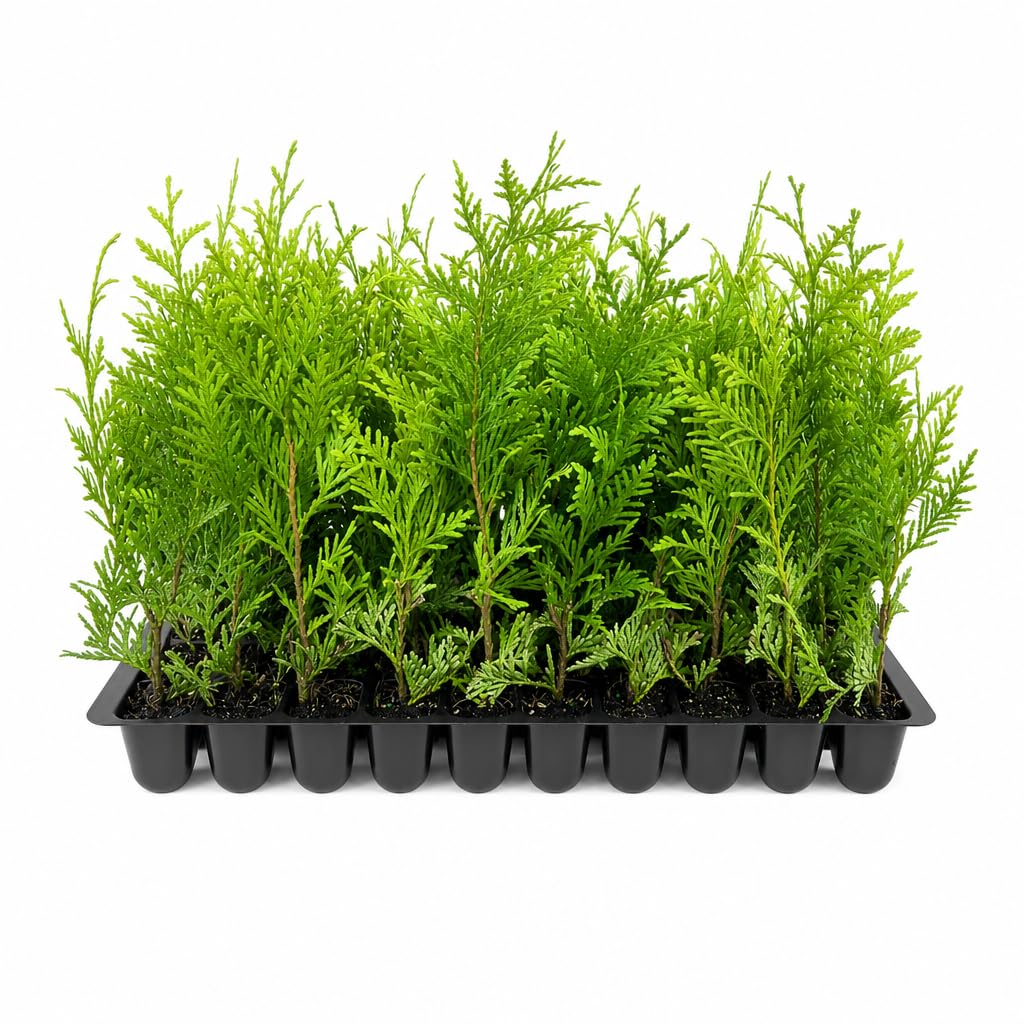
Ten live giants aimed at driveways, borders, and commercial runs.
Florida Foliage positions this squarely at scale — yards, driveways, and commercial landscapes, plus hedges and windbreaks. Ten live plants of Thuja standishii x plicata, the same hybrid as the rest of the Green Giant lineup here, with feathery green foliage that holds through the year.
Care is where it is most specific and most useful. It thrives in full sun to partial shade and in a variety of soil types with minimal care, but the listing is blunt that consistent or frequent irrigation is required during the critical first month after installation. That single line is the difference between a hedge and a row of dead sticks for most first-time planters.
Plant quality is the thing that holds up best in the feedback, and the general theme is that people get a solid specimen. Health and survival are more divided — some report strong survival rates, others high losses — and a small number mention plants turning brown. Two reasons to pause: the listing leaves growth rate, mature height, and hardiness zone unstated, and it does not give you a zone match to check before ordering. Compared with the 30-plant lot above, you are buying less certainty and fewer plants per head.
Best used for: the bigger landscaping job where ten plants at once makes sense and you are on site to water daily for that first month.
Worth knowing: no stated zone or mature size means you should confirm suitability with the seller before you buy, not after.
Made for: a driveway line or commercial border where someone is around to run the hose in month one.
Not for: a set-and-leave planting, given the first-month irrigation call-out.
7. Wax Myrtle | 1 Extra Large Trade 3 Gallon Plant | Myrica Cerifera
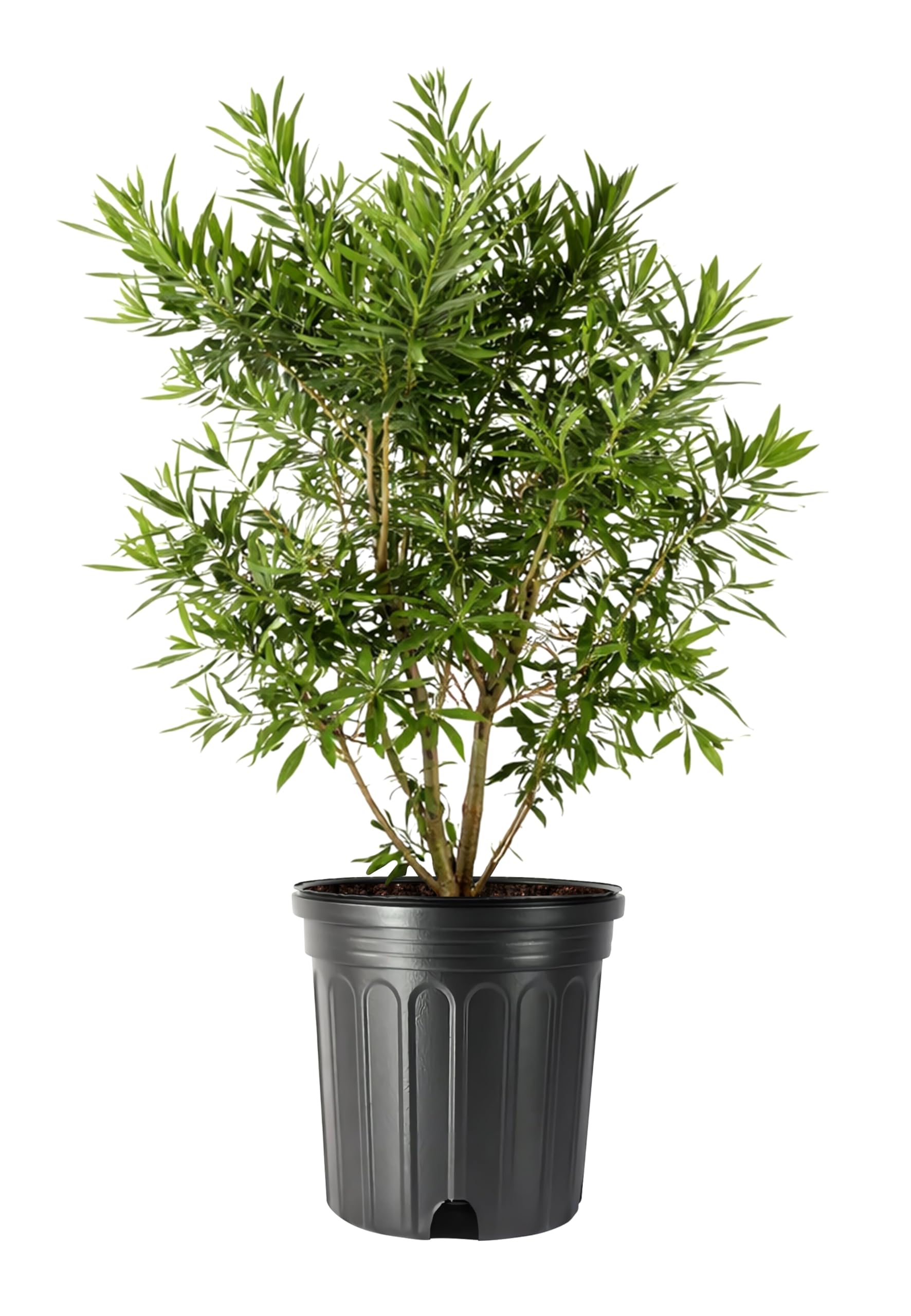
A three-gallon shrub with aromatic leaves that shrugs off salt air and dry spells.
Wax Myrtle is the odd one out here and earns its place on toughness rather than speed. It is a fast-growing evergreen shrub with aromatic foliage, and it adapts to both coastal and inland environments — which is exactly what you want on a windy shoreline lot where arborvitae scorches. It also handles diverse soil conditions and is listed as drought tolerant and low maintenance.
You get one Extra Large trade 3 gallon plant, which is a substantial root mass to put in the ground. For a single gap or a corner screen, that beats nursing ten tiny starts. The foliage is evergreen, so the screen works in winter, and the aroma is a bonus you do not get from a thuja.
The buying experience is where to set expectations. Quality and transplant success are the positives buyers raise — plants that go in the ground and settle. Health and appearance swing hard the other way for some, with plants that failed within a week and specimens that looked worse than expected. Size is the other recurring note, with a clear strain of feedback that the plant is smaller than the photo implies. A 3 gallon trade plant is not a tree — treat it as a shrub you are establishing.
Where Wax Myrtle earns its spot
- Handles both coastal and inland conditions
- Drought tolerant and low maintenance once in
- Evergreen with aromatic foliage
- Arrives as one substantial 3 gallon trade plant
Set your expectations here
- Arrives smaller than the listing image suggests
- Survival reports vary widely between orders
- One plant covers one gap, not a fence line
Pick it when: you are near the coast or on dry ground and need something that tolerates both.
Skip it when: you need volume quickly — one gallon-sized shrub will not screen much on its own.
8. 50 Austree Hybrid Willow Trees, Fastest Growing Shade or Privacy Tree

Ten to fifteen feet in a single year — nothing else here touches that number.
If the question is purely how fast, this wins outright. The listing claims 10-15 feet a year, against the 2-3 feet a year of the Green Giant lots and the 3 feet a year of the American Pillar. Even the Aussie willow cuttings below only promise several feet per favourable season. That is a different order of speed entirely.
You get 50 live trees, easy-to-grow instructions, video links, and low-maintenance claims. Hardy in zones 4-8 with full sun. It also earns its keep on the environmental side — producing oxygen and filtering the air, per the listing.
Rooting is the thing to understand before you commit, and it is the most-discussed topic in the feedback. The split is genuine: some cuttings sprout vigorously and some sit there. Quality itself is praised. The wise approach with willow is to order 50, plant more than you need, and let the strongest ones carry the hedge. That is not a flaw in the product so much as the nature of woody cuttings — and buying 50 in one go is precisely what makes the strategy work.
The speed argument: nothing else in this guide can put a 10-15 foot screen up in one season. And 50 trees lets you overplant and thin later.
The honest trade-off: willow is deciduous. You get an aggressive summer screen and bare branches in winter — plan the planting so the summer coverage is what matters.
Built for: a big property with room to spare and a privacy problem that only exists in the growing season.
Not the one for: a small suburban strip — 50 willows want room, sun, and water.
9. 50 Aussie Hybrid Willow Tree Cuttings for Windbreaks and Privacy Hedges
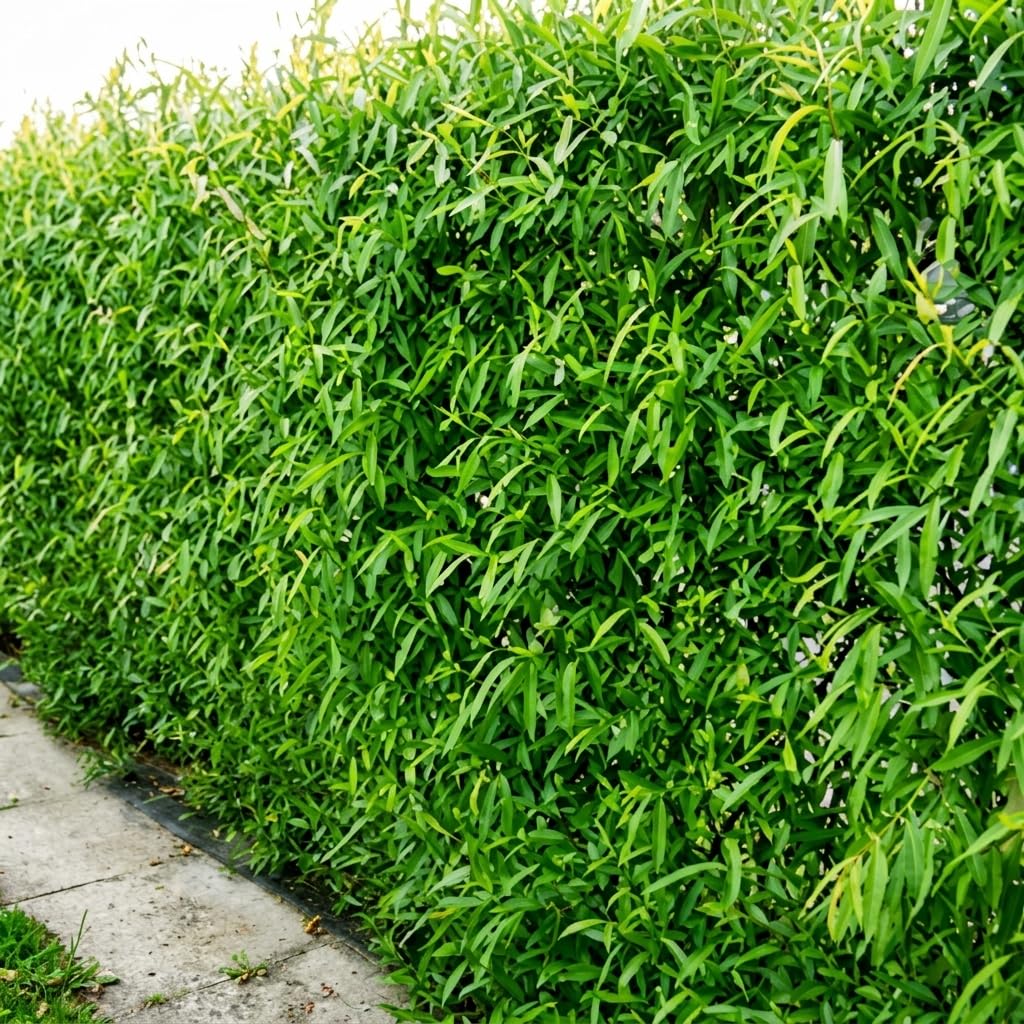
Woody stems you can root in a bucket of water before they ever hit soil.
This is the most forgiving experiment in the guide, because you can fail cheaply. Fifty woody stem cuttings can develop roots in clean water or prepared moist soil, which means you can start them indoors, see which ones throw roots, and only plant the winners. Change the water regularly during indoor propagation and transplant once a healthy root system forms.
Where they belong is spelled out clearly: expansive residential properties, rural boundaries, and open acreage with room to mature. The listing is also honest about the seasonal side — dense summer foliage for screening, leaves dropping naturally through autumn and winter. Expect several feet of growth in favourable seasons rather than a fixed annual number.
Owner feedback is dominated by one theme: growth. That is the most-discussed topic by a wide margin, and it is genuinely mixed — some see fast results, others see rooting that stalls. The positive side is solid, with quality the most-praised trait and viability and size both landing well. Where it gets specific: cuttings reportedly reach 3 to 6 feet tall within three months in the good cases. The listing also warns against planting near sewer lines, foundations, drainage systems, and underground utilities — take that seriously with a willow.
Why the cuttings make sense
- Can root in water first, so you sort the winners before planting
- 50 cuttings for a rural boundary or windbreak
- Quality is the most consistently praised trait
- Cuttings reported reaching 3 to 6 feet within three months in good conditions
Know before you dig
- Rooting success genuinely varies between cuttings
- Deciduous — no winter screening
- Roots mean it stays away from sewer lines and foundations
Right for you if: you own open land, want a windbreak, and like the idea of rooting cuttings in water first.
Wrong for you if: you need year-round privacy or your lot sits over drainage.
Understanding the Specs
Growth rate per year
The number that sells these trees is usually measured once the plant is established, not in its first season in your yard. A Green Giant listed at 2-3 feet per year is describing a settled root system; the first year after planting goes into roots. Feed in spring and fall with a balanced fertilizer as the listings suggest, and the rate kicks in from the following season.
Hardiness zone
A hardiness zone tells you the coldest winter a plant tolerates. Green Giant listings range from zones 5-9 depending on the variety, the American Pillar goes down to zone 3, and Austree willow sits at 4-8. Planting outside your zone is what voids most of these guarantees, so check the map before you order rather than after the first frost.
Spacing between trunks
Spacing is what turns a row of trees into a screen. Tight spacing closes the gap faster: 2.5 to 3 feet apart for American Pillar, 5 feet for a Green Giant privacy screen, 6 to 7 feet for the ten-pack of potted Green Giants. Buy your plant count from the spacing, not from the bundle size that looks generous on the page.
Plant start type
A 3 inch pot with soil, a quart pot, a gallon pot, and a bare cutting are four different starting points. Pot-grown plants arrive with a root mass and soil already around them, which is why gallon pots settle faster. Bare cuttings are cheaper per plant and let you root first and plant later, but they ask more patience and more of your attention in the first month.
Evergreen versus deciduous
Evergreen means the screen works in winter — arborvitae and wax myrtle both hold foliage year-round. Deciduous means summer coverage only; both willow listings state plainly that leaves drop in autumn. Match this to when your privacy problem actually exists, not to which tree grows fastest.
Mature height and width
Height gets the attention but width decides whether it fits. A Green Giant reaches 30-50 feet tall at 12-16 feet wide; the Perfect Plants listing takes it to 60 feet tall and 20 feet wide; the American Pillar stays narrow at 20-30 feet tall. If your border is tight, the narrow column is the one that will not crowd the fence.
FAQ
How fast do these privacy trees actually grow in the first year?
Will a privacy tree survive winter in my zone?
How far apart should I space arborvitae for a hedge?
Do I need to prune Thuja Green Giant trees?
What is the difference between willow cuttings and potted arborvitae?
Can I root willow cuttings in water before planting them?
How much watering do new privacy trees need?
Are these fast growing privacy trees deer resistant?
Why did my order not ship to my state?
How tall will a Green Giant arborvitae get at full maturity?
Final Thoughts: The Verdict
For most yards, start with the 30-plant Thuja Green Giant lot, because it solves both halves of the problem at once. You get plants that arrive at 18++ inches tall in soil, and enough of them to line a real boundary in one order. Its 2-3 feet per year is not the fastest figure in this guide, but it is the one you can actually plant at scale.
If raw height in one season is the whole point, the 50 Austree Hybrid Willows at 10-15 feet a year are in a different league — just accept a bare winter. And if your planting strip is tight, the American Pillar Arborvitae gives you a 20-30 foot screen on a narrow habit that will not crowd the fence line.
How We Picked
We do not accept paid placement. Every pick is matched to a real buyer and a real use-case; we do not hands-on test units.
Sources & Methodology
Specifications: manufacturer listings and product documentation. Review insights: verified customer reviews, as of November 2026. Pricing: not shown on this page (it changes often); check the current price via the retailer link.
As an Amazon Associate, Gadgets Feed earns from qualifying purchases. This does not affect which products we feature.