
Our readers keep the lights on and my morning glass full of iced black tea. As an Amazon Associate, I earn from qualifying purchases.
Specs are compiled from manufacturer listings and verified buyer reviews and can change over time — please confirm the key details on the product page before buying.
Most affordable projectors lie about brightness, and that is the first thing to understand before you buy. A machine marketed as “3500 brightness” can be dimmer than one honestly rated at 920 lumens, so the number printed on the box matters far less than whether the maker states it in ANSI or ISO terms. That single distinction separates a projector that looks bright in your room from one that washes out. This guide covers nine affordable home projectors that hold up in real rooms, and it explains which one suits which kind of buyer.
I’m Min — the founder and writer behind Gadgets Feed. This guide is built by comparing the manufacturers’ published specifications and the patterns across verified customer reviews, so you get each pick’s real strengths and trade-offs instead of marketing spin.
You will see brightness, native resolution, auto-focus behavior and built-in streaming compared side by side, so the pick matches your room, your wall and your patience for setup. Every pick here is backed by verified owner reviews, so this shortlist of budget home projector options reflects how the machines actually perform.
Our Picks at a Glance
How To Choose The Best Budget Home Projector
A home projector turns one wall into a cinema, but only if its brightness and throw suit your room. Brightness, resolution and setup automation decide whether that happens. These are the specs that actually matter.
Read the brightness label like a skeptic
Brightness is measured in lumens, and the honest figures are quoted as ANSI or ISO lumens. A rating written plainly as “1500 ANSI lumens” tells you roughly how much light reaches the wall. A vague “3500 brightness” claim with no standard named usually means nothing at all. If your room gets any daylight, higher honest lumens keep the picture from washing out — the 2000 ANSI lumen rating on the HAPPRUN 2000 model is the ceiling of this group for that reason. In a dark bedroom, even 200 ISO lumens can look good on a modest screen.
Native resolution versus 4K support
Almost every projector here is native 1080P, meaning the panel itself draws 1920 x 1080 pixels. “4K supported” or “4K decoding” means the projector can accept a 4K signal but still shows it at 1080P. That is fine for movies and sports. It matters when you read small on-screen text or use a projector for slides. Do not pay extra expecting true 4K pixels in this tier — every pick here draws 1920 x 1080.
Auto focus and keystone save your evenings
Keystone correction squares up a picture that hits the wall at an angle, so it stops looking like a trapezoid. Auto focus sharpens the image without you turning a lens ring. Together they decide whether setup takes two minutes or an evening of manual adjustment. Several picks here add obstacle avoidance, which shrinks the image to dodge a light switch or shelf, and auto screen fit, which sizes the picture to your screen. If you move the projector between rooms or point it at the ceiling, prioritize auto focus, auto keystone and obstacle avoidance.
Quick Comparison
| Model | Best For | Brightness | Native Resolution | Smart Platform | Amazon |
|---|---|---|---|---|---|
| TOPTRO X9 Pro★ Best Overall | All-round home theater | 920 ISO lm | 1920 x 1080 | VIDAA OS | Amazon |
| Aurzen D1R airBest for Travel | Room-to-room portability | 300 ANSI lm | 1920 x 1080 | Roku TV | Amazon |
| HP MC425Most Portable | Camping and travel | 200 ISO lm | 1920 x 1080 | Android TV | Amazon |
| LYNCAST 1500 ANSI | Big backyard screen | 1500 ANSI lm | 1920 x 1080 | Android 14 | Amazon |
| HAPPRUN 1500 Smart | Streaming without a stick | 1500 ANSI lm | 1920 x 1080 | Built-in apps | Amazon |
| iWIMIUS P65 | Bookshelf-sized setup | 700 lm | 1920 x 1080 | Smart OS | Amazon |
| HAPPRUN Google TV | Voice-first browsing | 400 lm | 1920 x 1080 | Google TV | Amazon |
| Aurzen BOOM 3 | Sound-first movie nights | 500 ANSI lm | 1920 x 1080 | Smart TV OS | Amazon |
| HAPPRUN 2000 ANSI | Bright rooms | 2000 ANSI lm | 1920 x 1080 | Streaming via stick | Amazon |
In‑Depth Reviews
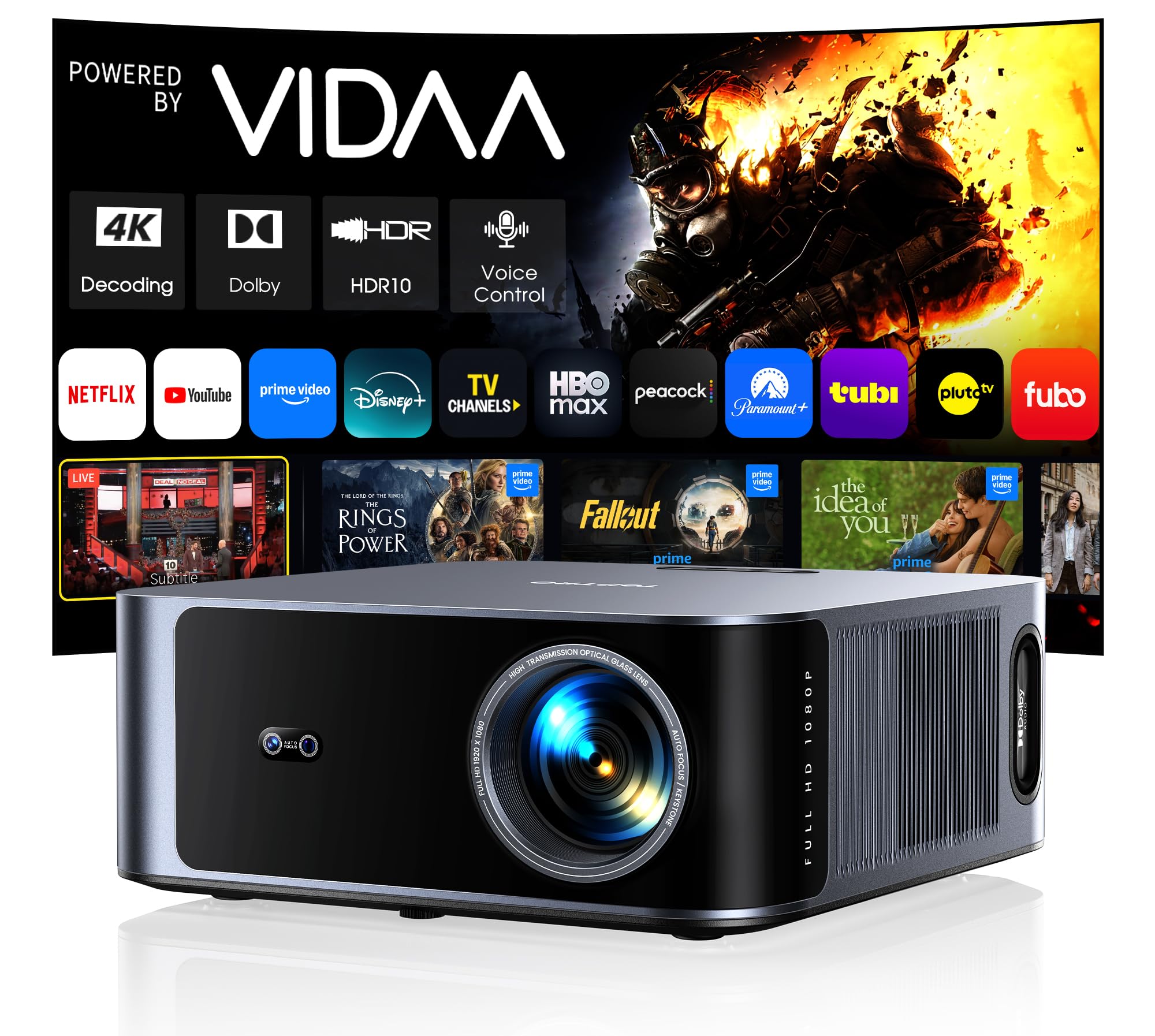
1. TOPTRO X9 Pro 4K Smart Projector
Our pick — 4.5+★ from 750+ verified ratings; the strongest balance of quality and price.
The honest-lumen hero that skips inflated brightness claims and still fills a wall.
What makes this the pick to beat is a brightness figure you can trust: 920 ISO lumens, a rating taken to a real standard rather than a padded marketing number. TOPTRO even points out this beats projectors claiming “3500 brightness,” and that kind of honesty is rare in this price band. The crowd favorite backs it up at 4.5+ stars across 750+ owners, and it earns that score on picture and build rather than hype.
Under the hood you get native 1080P (a true 1920 x 1080 panel), 4K video decoding for higher-resolution files, HDR10 for better contrast, and a 130% NTSC color gamut that pushes richer reds and greens. Two 20W speakers with Dolby Audio handle sound without a soundbar, and two-way Bluetooth 5.4 lets you either feed a soundbar or use the projector as a standalone speaker. AirPlay 2 and HomeKit support mean iPhone and Mac users cast natively, with no third-party app in the way.
Setup is where it quietly wins. An AI sensor and camera module auto-focus and correct keystone (the trapezoid slant you get when the projector sits off-center) in about 3 seconds, and obstacle avoidance plus auto screen fit resize the picture around your wall. The VIDAA smart OS runs Netflix, YouTube and Prime Video pre-loaded, adds 1,000+ live channels, and its makers claim it stays fast without the data tracking of typical Android systems. One caveat worth knowing: 4K-labeled content still plays at native 1080P, which is normal for this tier but worth setting expectations around.
Where it pulls ahead
- Honest 920 ISO lumen rating that survives a lit room far better than inflated claims.
- Dual 20W Dolby speakers plus Bluetooth so a soundbar is optional.
- Three-second auto focus and keystone make ceiling or shelf placement painless.
Keep in mind
- 4K content displays at native 1080P, so it is not true 4K.
- Premium-tier pricing puts it above the rest of this shortlist.
Made for: buyers who want the best all-round picture and sound in one box and will pay a little more for honesty on the spec sheet.
Think twice if: you only ever watch in a pitch-dark bedroom — a cheaper, dimmer pick covers that fine.
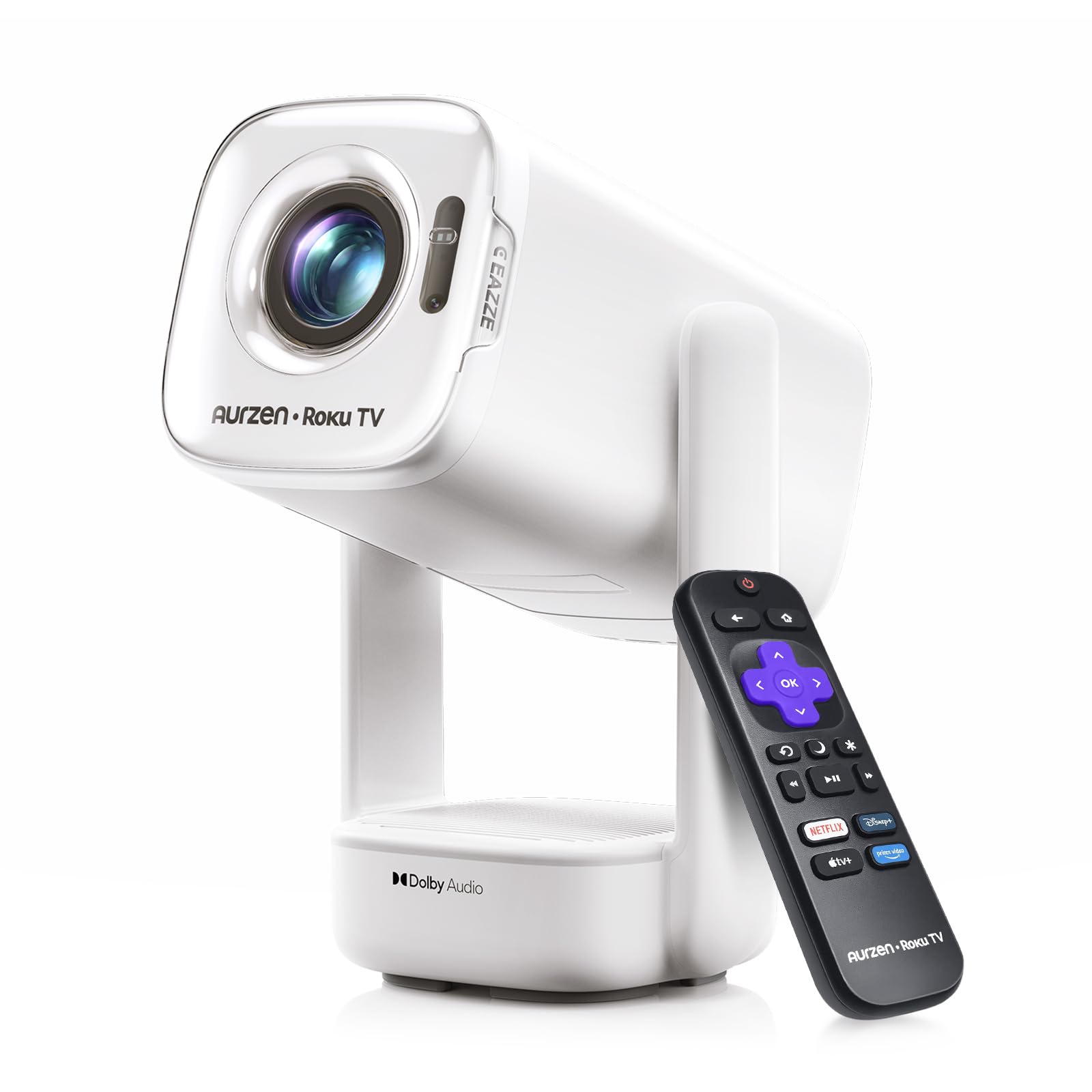
2. Aurzen Roku TV D1R air Portable Projector
The carry-anywhere streamer that runs off a power bank and sets up on a gimbal.
You can carry this projector from the bedroom to the living room to a campsite without hunting for an outlet. It weighs 2.60 lb and measures 5.35 x 4.33 x 10.12 inches, so it slips into a backpack. It runs from a 65W+ USB-C PD power source (a USB-C charger that pushes at least 65 watts) — a compatible wall charger, a laptop charger or a power bank. One catch: it needs a source with 20V/3.25A output and a 5A E-Marker USB-C cable (a cable with a chip that tells the charger it can carry 5 amps) to run properly.
Roku TV is baked right in, which means you power on, connect to WiFi, and stream Netflix, Prime Video, Hulu, YouTube and Apple TV plus 500+ free channels without adding a dongle or a TV stick. Picture is native 1080P through an LCD panel at 300 ANSI lumens, best in a dim room or outdoors at night. Six picture modes (Roku, Vivid, Standard, Eco, Movie, Sports) let you tune the look, and an 80-inch screen lands at roughly 7.26 ft of throw distance. The Roku mobile app doubles as a remote and supports voice entry.
Day to day, the gimbal stand (a pivoting mount that holds its angle) is the detail you will notice. It rotates smoothly with damping and stays where you put it, and the power cable enters at the bottom so it never snags as you swing the image onto a ceiling. Twin 5W speakers sit in the base rather than the body, which gives them a bigger chamber and cleaner dialogue. Fan noise runs 29-35 dB at one meter (about the level of a quiet conversation) depending on mode — audible in a silent room, easy to ignore under dialogue. The honest trade-off: 300 ANSI lumens (a brightness measure) means daylight viewing needs blackout shades, so plan for evenings or dark rooms.
Reach for this if: your projector has to travel and you value a fuss-free Roku interface over raw brightness.
Skip the power bank: unless it delivers 65W+ over USB-C PD, since a weaker bank cannot run the projector at all.
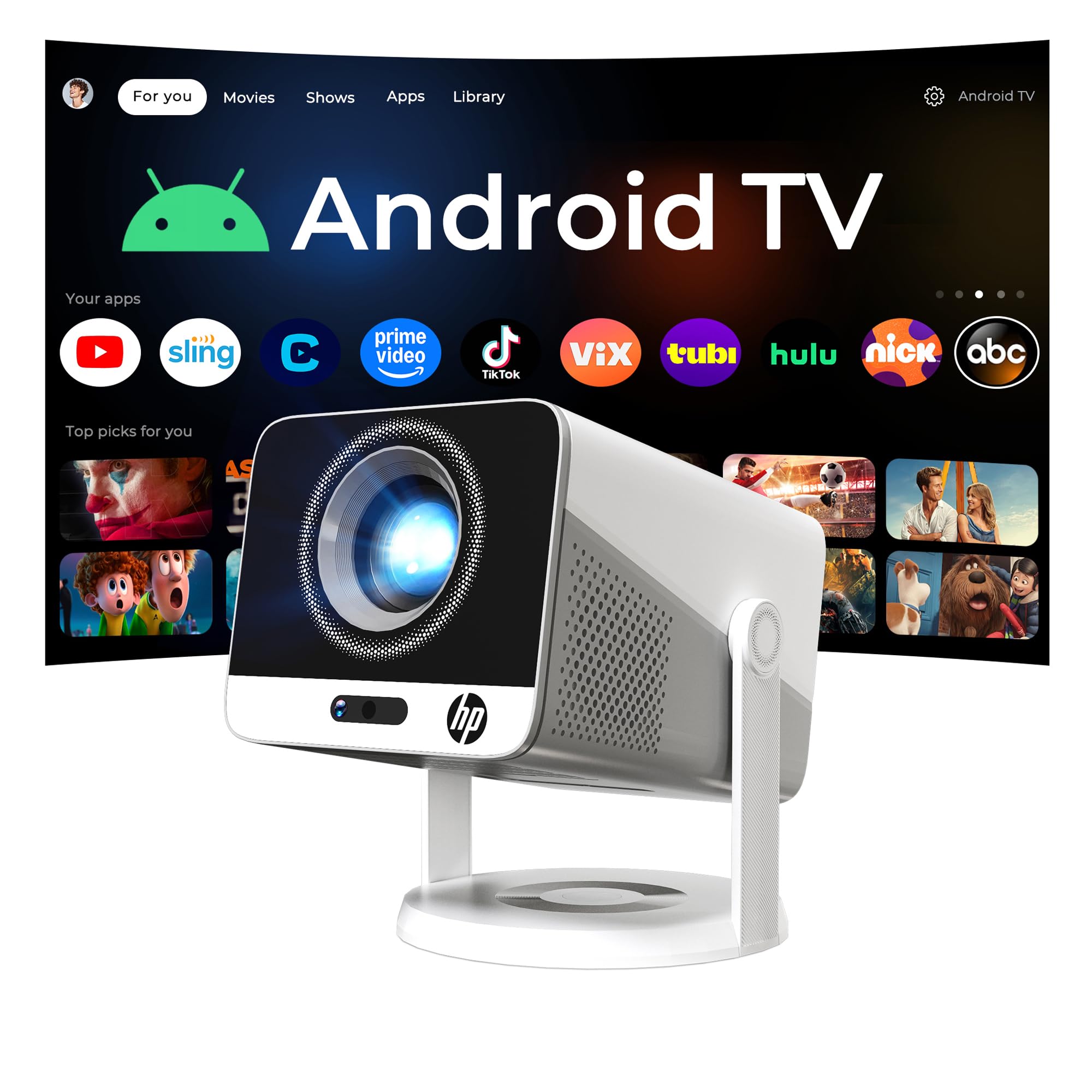
3. HP MC425 FHD Projector with Apps
A pocket-sized HP that swivels to your ceiling and sips power from a power bank.
One spec changes how you use a projector: a 90° rotating body. Point it forward at a wall, tilt it up at a slanted ceiling, or aim it at an outdoor screen with no tripod at all. That single hinge makes ceiling viewing genuinely casual. It pairs with a short-throw 0.8:1 ratio (it throws a big image from close to the wall), so it fills a small bedroom where you cannot back the machine up far.
Power comes in over USB-C PD 3.0 at 20V / 3.25A, and the maker requires a 65W or higher power bank for outdoor use, since anything below 65W cannot feed it. Running draw sits at 55W, and it is native 1080P with 4K support at 200 ISO lumens, bright enough for a dark room and not much else. Android TV is built in, so Netflix, Prime Video, YouTube, Disney+ and Tubi launch with no extra stick, and there is a sleep timer for drifting off mid-film.
Inside it runs Android 14 with WiFi 6 for less lag on streaming and Bluetooth 5.4 for pairing headphones or a soundbar, plus auto focus and auto keystone to square the image quickly. Dual HiFi stereo speakers cover casual viewing. The honest catch: 200 ISO lumens is the dimmest rating on this list, so treat it as a nighttime and camping companion rather than a living-room main screen. It is a niche pick, but for travel and ceiling projection it has no equal here.
Built for wanderers: the rotating body, 0.8:1 throw and power-bank compatibility make this the one that goes camping and still casts onto a tent wall.
The dim-room rule: at 200 ISO lumens it wants darkness — daytime viewing in a bright room will look washed out.
Best matched to: campers, renters and anyone who wants the picture on the ceiling without mounting hardware.
Look elsewhere if: your room has windows you cannot close — you will want more honest lumens.
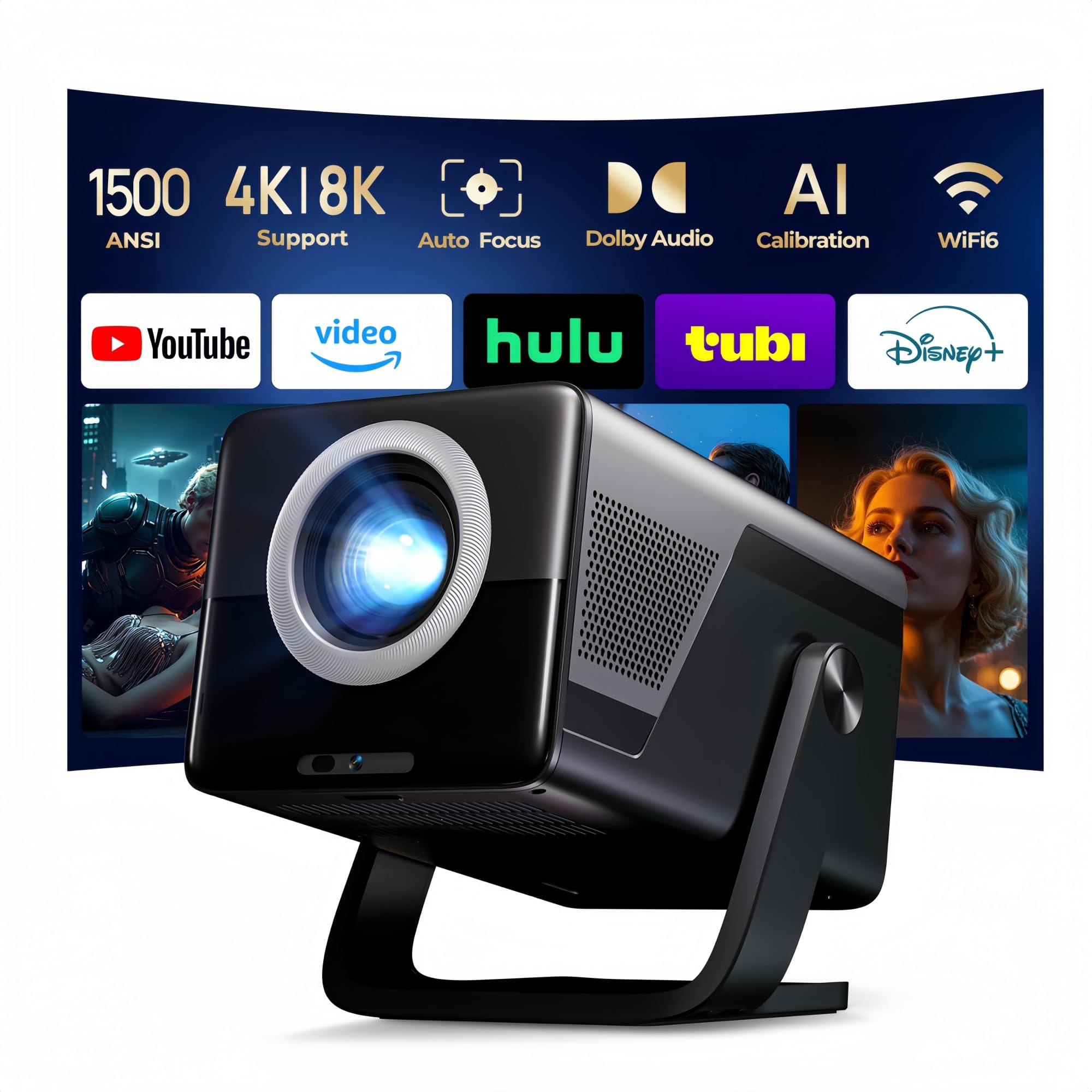
4. LYNCAST 1500 ANSI Smart Projector
A 1500 ANSI lumen machine that holds a bright picture up to a 200-inch screen.
For a backyard movie night or a lit living room, brightness is the whole game, and this delivers 1500 ANSI lumens with native 1080P and 4K/8K decoding. Compare that to the 300 ANSI of the Aurzen D1R air above and the gap is enormous — this one stays visible in far less forgiving light. It also carries a 100,000-hour lamp life claim and a short 1.08:1 throw ratio, so a small dorm or apartment can still throw a large image.
Behind the picture sits an 18000:1 contrast ratio, 10-bit color depth and a 93% color gamut, which together keep dark scenes from going muddy. An upgraded H726 chip makes the interface snappier. Android 14 with the Play Store opens 10,000+ apps and 800+ free live channels, and the built-in apps include Netflix, Prime Video, YouTube, Tubi and Disney+. The 180° rotating body lets you push the image onto a ceiling, and the 20W HiFi speakers with Dolby Atmos and Hi-Res Audio mean you may not need a soundbar at all.
WiFi 6 keeps mirroring smooth, and the Lumina Go app turns your phone into a remote with a touchpad and keyboard. The smart remote adds voice and an air mouse for faster searching. The honest trade-off is compatibility — several owners note the Play Store not behaving as expected, so app-based streaming can be hit or miss compared to a dedicated stick. If you mainly cast from a phone or use a TV stick, that snag will not touch you.
What you gain
- 1500 ANSI lumens keeps the picture bright deep into a well-lit room.
- 180° rotation and 1.08:1 throw suit small spaces and ceiling viewing.
- Dolby Atmos 20W speakers cut the need for extra audio gear.
What to watch
- Built-in Play Store app compatibility is inconsistent for some owners.
- 4K and 8K sources still resolve at native 1080P.
Pick this for: light-filled rooms and outdoor screenings where honest brightness is non-negotiable.
Pair it with: a streaming stick if you lean on app-store apps rather than casting from your phone.
5. HAPPRUN 1500 ANSI Smart Projector

Streams everything without a stick and scales up to a 300-inch wall.
This one leans hard into being a complete package: 1500 ANSI lumens, native 1080P with 4K decoding, and apps like Netflix, Prime Video and YouTube already installed. No dongle, no extra stick, no switching inputs. It also scales from 40 inches to a 300-inch display, and a 50%–100% zoom lets you resize the picture without physically moving the unit. For a home-theater wall, that range is generous.
Owners consistently rate the picture and brightness as excellent for the money, and setup is described as surprisingly easy. Dolby-certified HiFi dual speakers handle built-in sound with more punch than most projectors in this group. Dual-band WiFi plus WiFi 6 keeps mirroring fast, and Bluetooth 5.2 lets you fire audio to a sound system or headphones for private viewing. Auto focus refocuses when it detects a position change, with manual fine-tuning on the remote when you nudge it.
At 2.5 lb and described as 75% smaller than comparable models, it is easy to move between rooms or sit on a tripod. The honest trade-off shows up in connectivity: some owners find the wireless handoff less reliable than a wired connection, so a HDMI cable for a TV stick is the safest route if you want rock-solid streaming. For everyone else, the built-in apps do the job.
The all-in-one win: pre-loaded Netflix, Prime Video and YouTube plus 10,000+ videos mean you unbox and watch, no extra purchases.
The honest snag: connectivity earns mixed notes, and a wired stick sidesteps it entirely.
Reach for this if: you want the simplest possible setup with the biggest screen range in the group.
Keep a cable handy if: you stream heavily and want the most reliable connection every time.
6. iWIMIUS P65 Smart Projector

Shelf-sized, quiet, and bright enough to survive a little daylight.
The P65 hides its capability in a small body — described as the length of an iPad at 9.2 inches and the width of a hand at 3.1 inches. That footprint matters because it slips onto a bookshelf or side table where bigger projectors will not sit. Brightness comes in at 700 lumens with native 1080P and 4K support, and HDR10 for better contrast. For a compact unit in a dim-to-moderate room, that is a workable balance.
The smart OS handles built-in apps for Netflix, Prime Video, YouTube and TikTok plus an app store, and regular over-the-air updates keep things current. Audio is 20W HiFi with Dolby and AI sound balancing, plus Dialogue Enhancement to keep voices clear during action scenes. Two-way Bluetooth 5.2 lets it double as a standalone speaker, and HDMI ARC makes a soundbar connection a single cable. It runs quiet, rated under 30dB.
Setup is well-controlled: auto focus, auto keystone, smart obstacle avoidance, screen alignment and 50–100% zoom all work to sharpen the picture fast. It accepts ceiling, table, tripod or wall mounting. The honest trade-off is the app experience — owners find the image quality impressive and it works well for indoor uses like a golf simulator, but built-in app navigation is not as polished as a dedicated streaming stick. Keep expectations reasonable there and the rest holds up.
Good fit for: tight spaces, bookshelf setups and quiet-room viewing where a small footprint beats raw brightness.
Not for: sunlit rooms — 700 lumens wants a dim space to look its best.
7. HAPPRUN Google TV Projector

Officially licensed Google TV with a voice remote built for lazy searching.
The headline here is that Google TV is officially licensed, not a lookalike. Netflix, Prime Video, YouTube and Hulu load without extra hardware, and holding the voice button lets you open an app, search a title, adjust volume or even check the weather by speech. For a household where nobody wants to type on a remote, that alone is a reason to pick it. Picture is native 1080P at 400 lumens with a 2000:1 contrast ratio, and a built-in 5W speaker handles sound.
WiFi 6 keeps streaming stable and Bluetooth 5.2 lets you pipe audio to a soundbar or headphones for private viewing. It mounts on a ceiling, desktop or tripod, and at 7.8 x 7.8 x 3.85 inches it tucks away easily. Wider device support covers USB drives, phones, computers, tablets and consoles, so plugging in is straightforward.
Owners rate the picture and setup well, with the licensed Google TV interface and app access a recurring bright spot. Keep brightness in perspective though: at 400 lumens, sound and brightness both draw mixed notes from owners — the picture shines in a dim room and fades in a sunlit one. If you treat it as an evening living-room projector and let the voice remote do the work, it delivers.
Why buy it: official Google TV plus true voice control makes navigating apps about as easy as a streaming box, without one.
Realistic lighting: 400 lumens means dim-room viewing — sound and brightness get mixed reviews, so do not expect a sunlit-room performer.
Best for households: where finding a show should take one spoken sentence, not five minutes of scrolling.
Only in a dim room: the 400-lumen rating keeps this a nighttime projector.
8. Aurzen BOOM 3 Smart Projector

A projector with 36W of sound that treats the audio as seriously as the picture.
Most projectors in this price band squeak; this one belts. The 2.2 channel 36W speakers with genuine stereo audio go after crisp highs, strong mids and real bass, and buyers report that sound quality is the standout. The trade is brightness: it runs 500 ANSI lumens with native 1080P (a 1920 x 1080 picture), 4K support and HDR10 (a format that widens the contrast between bright and dark scenes). That is plenty for a dark room, but short of the 1500 ANSI lumens on the LYNCAST above in brighter light.
You get three devices in one shell: a big-screen smart TV, a speaker and a TV stick. Its own smart OS (the software that runs the apps) carries built-in Netflix, Prime Video and YouTube plus an app store and open browser. AI focus uses 9 directional gyros (motion sensors that detect tilt) for instant auto focus, so the picture sharpens itself when you move the unit. 6D keystone with obstacle avoidance and screen alignment squares the picture to any wall angle, and a 50–100% zoom resizes it without moving the unit.
Connection is generous: two HD ports, two USB ports and a 3.5mm headphone jack cover sticks, laptops, consoles and phones. Dual-band WiFi plus Bluetooth 5.2 makes mirroring quick and lets it act as a standalone speaker. The honest caveats live in the app and color experience: the app store is described as limited, and performance and color quality draw mixed notes. Use a TV stick for copyrighted apps and set color to taste, and the audio remains the star.
What it does best
- 36W stereo speakers make it the loudest-sounding pick in the group.
- 6D keystone plus obstacle avoidance adapts to any wall angle.
- Two HD and two USB ports give plenty of wired options.
Where it falls short
- App store is limited, so a TV stick helps for copyrighted content.
- 500 ANSI lumens trails the brightest picks in well-lit rooms.
Choose this when: room-filling audio matters as much as the image and you watch after dark.
Be ready to add: a TV stick if you rely on niche apps, since the built-in store is slim.
9. HAPPRUN 2000 ANSI 4K Decoding Projector

The 2000 ANSI lumen brute that laughs at a lit room.
If daylight keeps sabotaging your movie nights, this is the answer: 2000 ANSI lumens, the brightest honest rating on this list. Combine that with a 20000:1 contrast ratio and 95% color gamut and the picture holds up in rooms where dimmer projectors wash out. Native 1080P with 4K decoding means high-resolution sources play back sharply at 1080P. Brightness this high tends to forgive a room with lamps on, which is rare in this tier.
Setup is fast and hands-off: auto focus and 6D auto keystone give a straight image within about 5 seconds of powering on, and the unit adds AI obstacle avoidance and auto screen alignment. Place it on a table, bedstand, wall mount or ceiling and it adapts. WiFi 6 keeps mirroring stable, and the 8W HiFi speaker plus bidirectional Bluetooth 5.2 means you can use it as a Bluetooth speaker for music from your phone when it is not screening films.
Owners describe the picture as bright and clear even with lights on, and auto focus and Bluetooth connections as reliable. Ports cover HDMI x2, USB x2, AV and a 3.5mm jack, with a 300-inch display and 50% zoom for bigger rooms. Two honest caveats: auto focus needs the machine roughly perpendicular to the wall (it fails past about a 15° angle), and copyrighted apps like Disney+, Prime Video and Hulu must be watched through a stick or dongle. Set it up straight, add a stick for those apps, and it delivers.
The headline spec: 2000 ANSI lumens makes it the one to choose when the room is bright and you refuse to draw the curtains.
Setup discipline: keep it perpendicular to the wall — past about 15° the autofocus can miss — and use a stick for copyrighted apps.
This is your pick if: your viewing space stays lit and you want the brightest honest picture for the money.
Budget for: a streaming stick for Disney+, Prime Video and Hulu, which the projector cannot run on its own.
Understanding the Specs
ANSI and ISO lumens
These are the two honest ways to state brightness — light measured by a real standard. When a listing quotes “1500 ANSI lumens” or “920 ISO lumens,” you are comparing like with like. A claim of “3500 brightness” with no standard named is a marketing figure and usually means far less light reaches the wall. Higher honest lumens handle daylight better, so a 2000 ANSI lumen unit like the HAPPRUN 2000 beats a 200 ISO lumen pick in a lit room.
Native resolution versus decoding
Native resolution is the actual pixel grid the projector draws — here, 1920 x 1080 across this list. “4K decoding” or “4K supported” means the projector accepts a higher-resolution signal but still displays it at native 1080P. That is fine for film and sport. It matters if you read fine on-screen text, where true 1080P sharpness counts more than a 4K label.
Keystone correction and auto focus
Keystone correction squares up the slanted trapezoid you get when the projector is off-center, and auto versions do it without your input. Auto focus keeps the image sharp as you move the unit or change distance. The projector asks for a level surface: on the HAPPRUN 2000, autofocus fails past about a 15° angle, so place it square to the wall.
Throw ratio
Throw ratio is the distance to the wall compared with the picture width. A lower ratio like 0.8:1 throws a bigger image from closer, which suits small rooms; the HP MC425 uses this. A 1.08:1 ratio on the LYNCAST still handles tight spaces, and the Aurzen D1R air suggests an 80-inch screen at roughly 7.26 ft of distance.
FAQ
Can a budget home projector really replace a TV?
What is the difference between 4K supported and native 1080P?
How bright does a budget home projector need to be for a dark room?
Do I need a streaming stick if the projector has built-in apps?
Can I power a projector from a power bank for camping?
How do I fix a slanted or blurry projector image?
How large a screen can these projectors throw?
Is a higher ANSI lumen number always better?
Will these projectors work with a phone or a gaming console?
How long will a budget home projector last?
Final Thoughts: The Verdict
For most people, the budget home projector winner is the TOPTRO X9 Pro. It pairs a 920 ISO lumen rating (a brightness measure) with native 1080P, 40W Dolby audio and three-second auto focus, so picture, sound and setup all hold up. If daylight is your enemy, grab the HAPPRUN 2000 ANSI for the brightest honest picture here. For a projector that travels to a tent or a ceiling, reach for the HP MC425 with its 90° rotating body and power-bank power. Whichever you pick, match its honest lumen rating to your room’s light first.
How We Picked
We do not accept paid placement. Every pick is matched to a real buyer and a real use-case; we do not hands-on test units.
Sources & Methodology
Specifications: manufacturer listings and product documentation. Review insights: verified customer reviews, as of November 2026. Pricing: not shown on this page (it changes often); check the current price via the retailer link.
As an Amazon Associate, Gadgets Feed earns from qualifying purchases. This does not affect which products we feature.