
Our readers keep the lights on and my morning glass full of iced black tea. As an Amazon Associate, I earn from qualifying purchases.
Specs are compiled from manufacturer listings and verified buyer reviews and can change over time — please confirm the key details on the product page before buying.
If you are buying for a parent who forgets whether they took their lunchtime pills, an automatic dispenser locks the month’s medication in a drum and rotates only the due compartment into the opening when the alarm sounds. The short answer is that the Bluetooth Automatic Pill Dispenser for Elderly with Alarm (Green) is the pick that fits the most households, because it combines a press-to-open lid with room for a full two weeks of bulky supplements. Everything below explains which of the nine dispensers suits which kind of forgetfulness, hands, and caregiver setup.
I’m Min — the founder and writer behind Gadgets Feed. This guide is built by comparing the manufacturers’ published specifications and the patterns across verified customer reviews, so you get each pick’s real strengths and trade-offs instead of marketing spin.
Rotating carousel models beep, flash, and lock the lid so only a key holder can get in — the difference between brands is how many alarms a day they fire and whether the tray is built for arthritic hands. The best automatic pill dispenser is the one whose alarm count, lock position, and compartment size match the person taking the pills.
Our Picks at a Glance
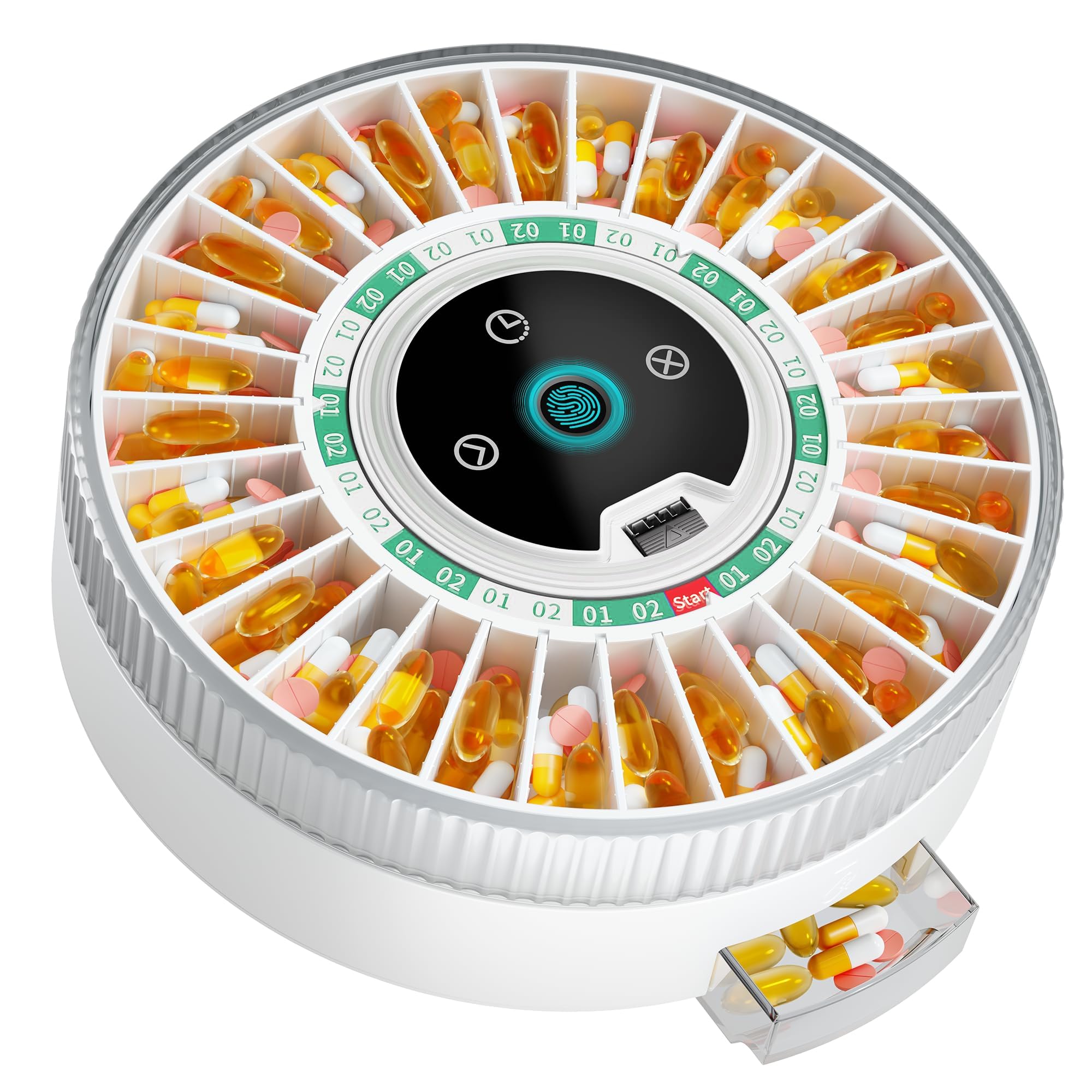
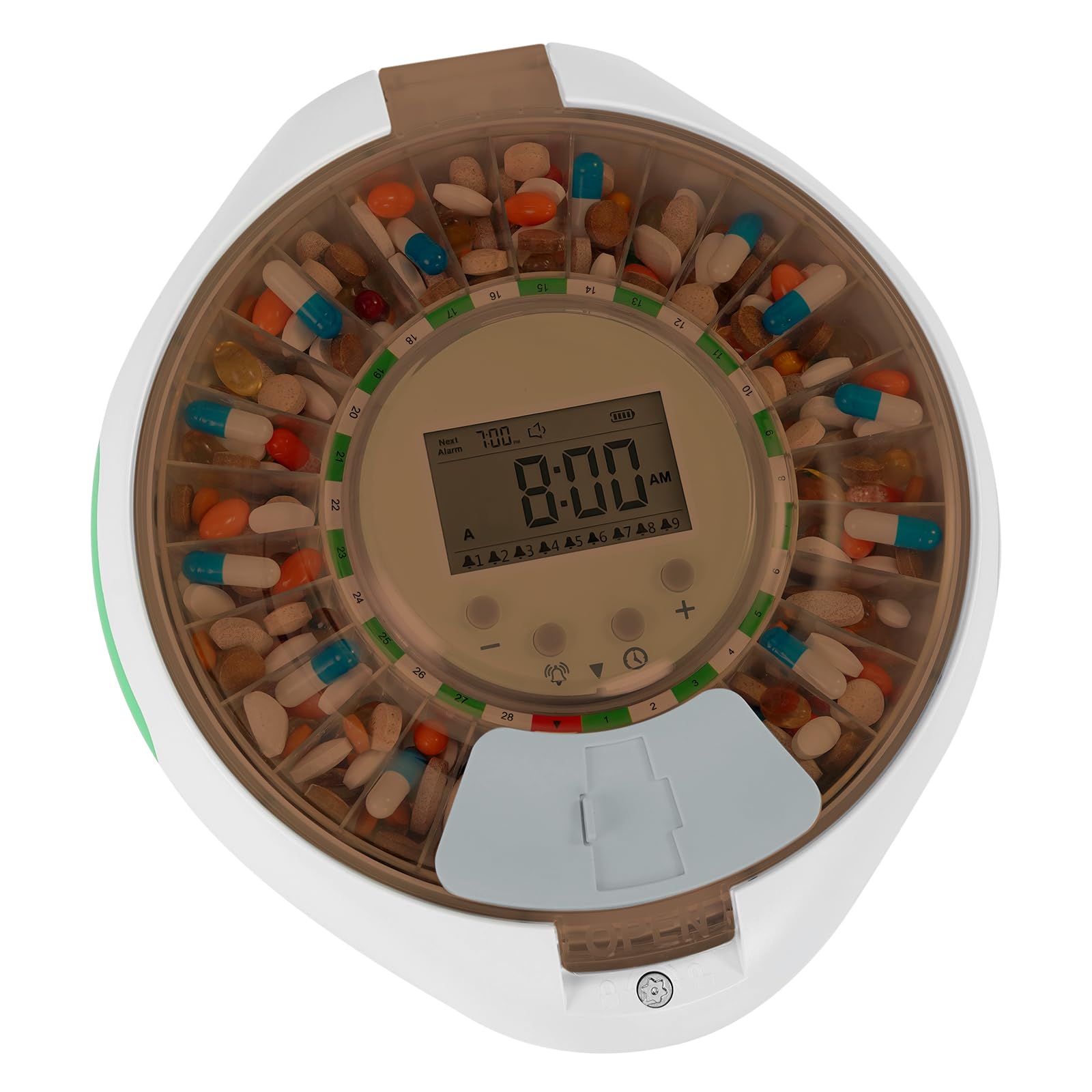
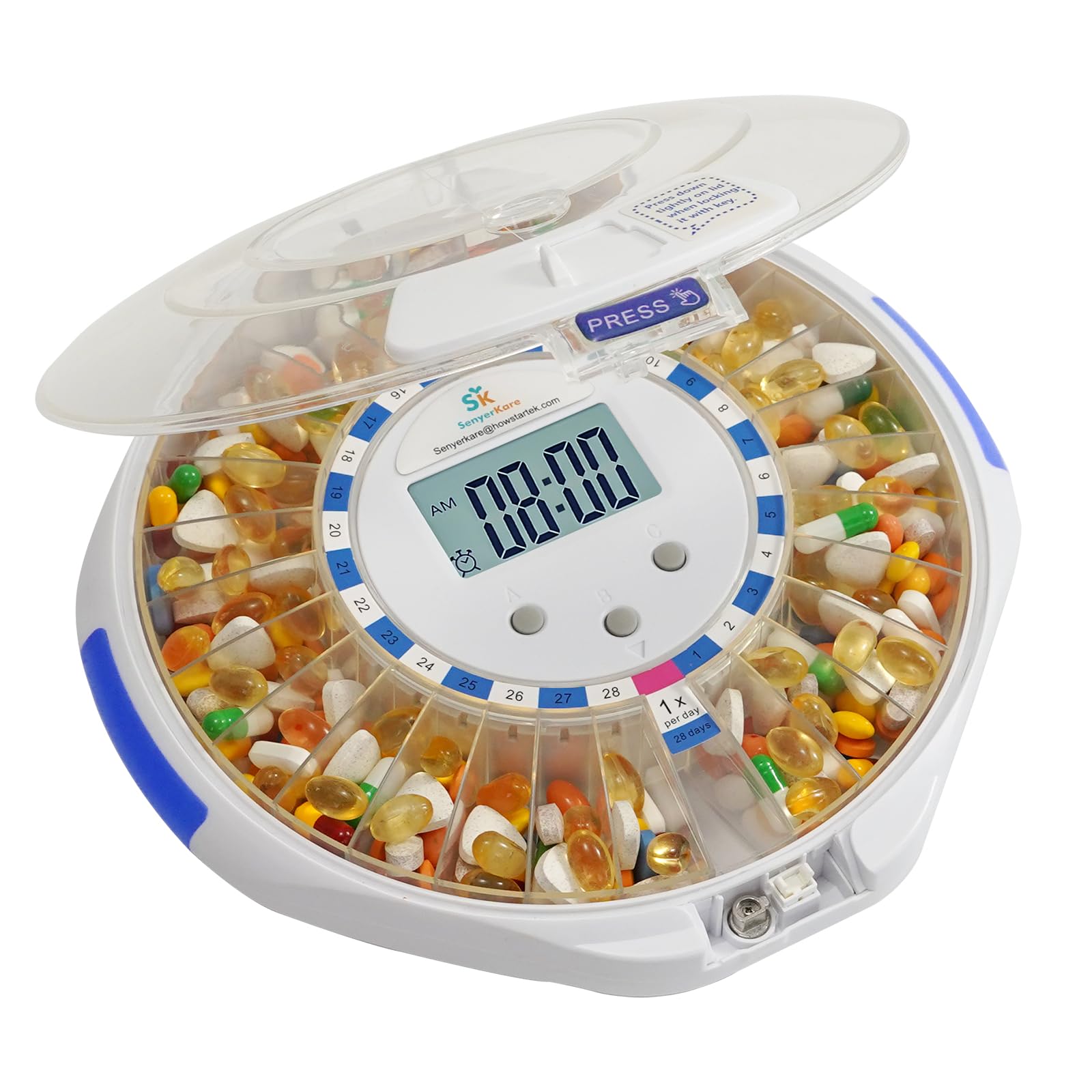
How To Choose The Best Automatic Pill Dispenser
These devices are not pill boxes with a buzzer taped on. A carousel sits inside a locked drum, and at alarm time a motor turns the drum so the single due compartment lines up with an opening. You then slide the window and tip the unit over. That mechanical cycle is what stops double-dosing, so the shopping decisions all come down to how that cycle fits the person’s day and hands.
Count the doses before you count the features
Alarm count is the first filter because it decides whether the machine fits the prescription at all. A once-a-day tablet user is fine with a six-alarm unit that only has a few slots switched on. Someone on breakfast, lunch, dinner, bedtime, and an overnight dose needs more. The JULOS in this list fires up to 9 daily alarms against up to 6 on the 28-Day Timed Alarms model — a real ceiling difference, not decoration. Programming extra alarms you will never use is harmless; running out of them is not.
Work out where the lock lives
Every dispenser here ships with a physical key, and that key’s location changes your refill routine. Rear-lock drums force a caregiver to flip the whole loaded unit to reach the barrel, and that is how pills spill and mix. Front and top-mounted locks — the JULOS and EziMedPil both use one — let you open up, lift the lid, and refill without turning the drum upside down. The second thing to check is whether one key covers both the medication lid and the battery cover, since a wandering battery is the quiet way a schedule dies.
Decide if you want an app or just four buttons
Smart dispensers pair with your phone over Bluetooth so a caregiver can program doses remotely and see whether a slot was taken. That is useful when the person lives alone and family live across town. It also means a phone, a pairing step, and a battery that has to be charged. The simpler units run on AA batteries and are programmed with 3 or 4 labeled buttons in the room. If the person setting it up finds apps confusing, the simpler path wins.
Size the compartments to the actual pills
Compartment volume is where a dispenser quietly fails. A slot rated for 24 aspirin-sized tablets swallows small pills, vitamins, and most capsules, but a large fish oil softgel is a different animal. Gummy-style capsules are the other sticking risk — the manufacturer of the slide-door model explicitly advises against them. Know the biggest pill in the regimen before you commit.
Quick Comparison
| Model | Best For | Daily Alarms | Lock Location | Weight | Amazon |
|---|---|---|---|---|---|
| Bluetooth Automatic Pill Dispenser (Green)★ Best Overall | Two-week supply with press-to-open access | — | Top / lid | 2.2 pounds | Amazon |
| JULOS Automatic Pill Dispenser with Top Safety LockMost Alarms Per Day | Complex multi-dose schedules up to nine times a day | Up to 9 | Front-mounted key | 1.9 pounds | Amazon |
| 28-Day Automatic Pill Dispenser with Timed AlarmsSimplest Setup | No-app, three-button simplicity for independent seniors | Up to 6 | Locking cover, 2 keys | 1.9 pounds | Amazon |
| Automatic Pill Dispenser for Elderly with Alarm (Clear Lid) | Budget entry into locked, timed dispensing | 1x to 6x | Locking lid | 1.87 pounds | Amazon |
| EziMedPil 28-Day Automatic Pill Dispenser | Caregivers who want a top lock plus tweezers for loading | Up to 9 | Top lock | 1.9 pounds | Amazon |
| 28-Day Automatic Pill Dispenser with Frosted Privacy Lid | Keeping medications out of sight in a shared home | Up to 9 | Top-panel key | 1.93 pounds | Amazon |
| LiveFine 28-Day Locking Automatic Pill Dispenser | Tried-and-trusted carousel with a manual key | Customizable alert rings | Manual key lock | 1 pound | Amazon |
| Colorwing Smart Pill Dispenser | Remote caregiver control with fingerprint and key lock | Customizable via app | Fingerprint + mechanical key | 3.06 pounds | Amazon |
| 28-Day Dispenser with Slide-Door Cup | Weak grip or shaky hands — pills drop into a cup | — | Locking lid | 3.62 pounds | Amazon |
In‑Depth Reviews
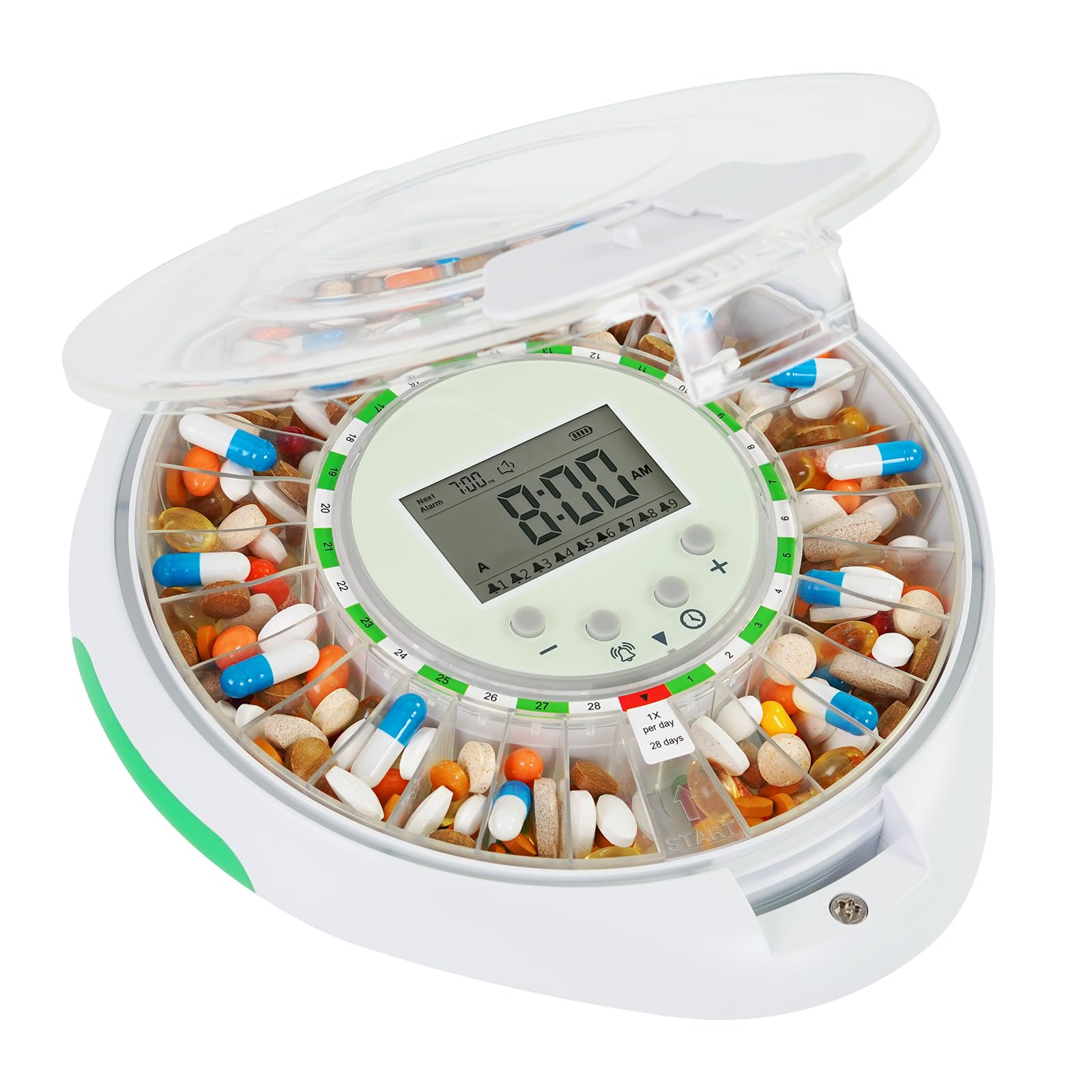
1. Bluetooth Automatic Pill Dispenser for Elderly with Alarm (Green)
Our pick — 4.5+★ from 600+ verified ratings; the strongest balance of quality and price.
The dispenser that skips the drum-flip entirely: press the lid, take the dose.
Most carousel dispensers ask the user to tip a loaded machine upside down to get a pill out. This one is built around the opposite idea — a press-to-open design that removes the need to lift the whole unit, which is exactly why it lands at the top for households where arthritis or weak grip is the daily obstacle. At 2.2 pounds it has enough heft to stay put on a nightstand while a shaky hand presses down on it.
Capacity is the other half of the win. It holds a full two weeks of medication at once, and the roomy interior is the trait that wins people over most — it comfortably swallows bulky supplements that choke a slim weekly organizer. Durability shows up right behind capacity: the housing holds up to frequent opening and closing, which matters because a dispenser gets yanked open twice a day, every day. Carrying it from the kitchen to the bedroom for a weekend is genuinely practical too.
The catch is the learning curve. Setting the schedule draws more mixed reaction than anything else here, and the value question follows close behind — several buyers clearly expected easier setup at this end of the range. The device does the dispensing job well once programmed; getting it programmed is the part that needs an unhurried caregiver with the manual open. Confused users have been known to fight any dispenser’s menu, so plan to sit with it once.
What earns it the top slot
- Press-to-open design means no lifting or inverting the unit — the friendliest access for arthritic hands.
- Two weeks of storage with enough depth for bulky supplements, not just small tablets.
- Sturdy build rated to survive constant open-and-close cycles.
- Bluetooth pairing lets a caregiver check in remotely.
Where it asks for patience
- Programming is the most-discussed weak point — budget a calm half hour for the first setup.
- Two-week capacity means refilling twice a month instead of once.
- 2.2 pounds versus 1.87 pounds for the clear-lid model, so it is not a pocket travel unit.
Best fit: a parent with stiff or painful hands who lives close enough that a fortnightly refill visit is easy.
Think twice: if nobody nearby can sit through the initial programming session, the three-button models are kinder.
2. JULOS Automatic Pill Dispenser with Alarm & Top Safety Lock for Elderly
Nine alarms a day and nine matching rings — for the schedule that will not fit in six.
Complex regimens are the whole reason this unit exists. It programs up to 9 customizable daily reminders, against up to 6 on the 28-Day Timed Alarms model in this list. Early morning, breakfast, lunch, dinner, bedtime, and an overnight dose all fit. So does the seventh and eighth. Chronic-care patients and post-surgery recovery schedules get room to breathe here where a six-alarm drum would force a compromise.
The physical design reads like it was drawn by someone who has watched a caregiver struggle. The lock sits on the front panel, so you open up without flipping the loaded drum — no spilled, mixed pills. Ergonomic touches go further: a gently curved lid gives a secure grip for moving or inverting the device, and when the alarm sounds you slide the drug window, tip it over, and pour. The oversized bright LCD shows time and alarm status in jumbo text, readable by low-vision users across a room.
Nine interchangeable dosage rings ship in the box to match the nine alarms, and the removable carousel makes refilling fast. Each of the 28 compartments takes up to 24 aspirin-sized tablets, so prescriptions, vitamins, and fish oil can share one tray. Setup runs on four buttons with symbol markings, three volume levels including mute, three ringtones, and a 12/24-hour toggle — all saved through battery changes. Four AA batteries are included, and at 1.9 pounds it stays portable.
What to plan around: there is no phone app here, so every alarm change happens on the unit itself. That is a feature for app-averse families and a limitation for remote caregivers. The reward is a dispenser that never needs a subscription, a password, or a pairing step.
Reach for this if: the prescription runs to seven, eight, or nine doses a day and six alarms would leave gaps.
Look elsewhere if: a family member needs to change doses from another city — the Colorwing covers that instead.
3. 28-Day Automatic Pill Dispenser with Timed Alarms & Safety Lock for Seniors
No app, no Wi-Fi, three labeled buttons — the senior-friendly path to a locked 28-day drum.
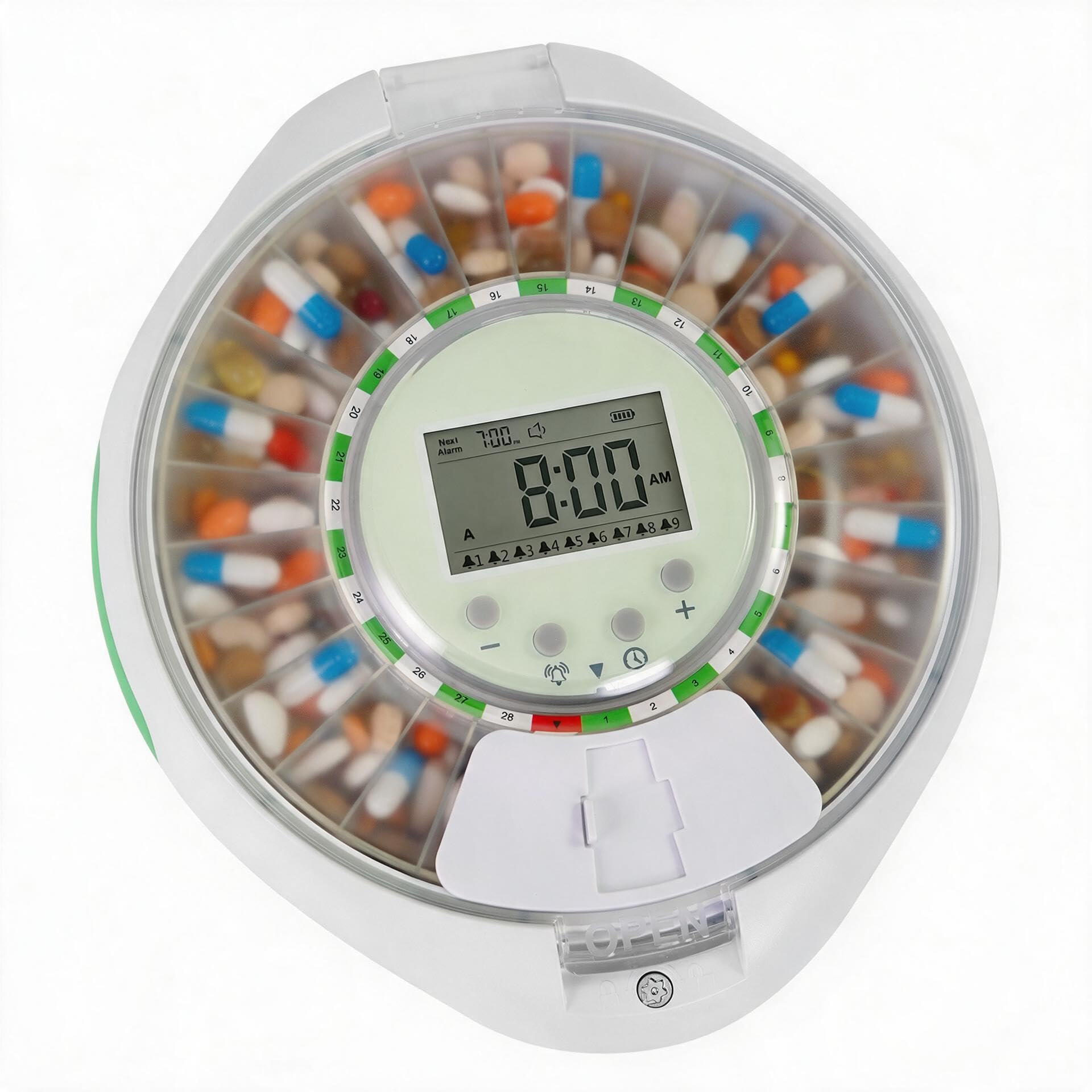
Nothing about this dispenser needs a smartphone. Three clearly labeled buttons set the time, the daily dose count, and the volume, and the settings survive a battery swap. That is the whole setup. Once programmed it delivers audio and visual alerts up to 6 times daily, so an independently living senior can run the routine without anyone hovering. The transparency of that routine is where it shines — the transparent lid lets you inspect upcoming doses without opening the machine, and the detachable carousel makes monthly loading quick.
Capacity is generous by design: each of the 28 slots holds up to 24 pills, which the maker totals at up to 672 tablets across the month. Six easy-fill dose rings adapt the drum to whatever regimen is in play. The locking cover and the two included keys keep dementia patients from double-dosing, and the carousel rotates on its own so the right pill is waiting at the opening when the beep and flash begin. A single slide opens the dosing window. Cordless on four included AA batteries, it runs for up to 4 months, with a battery-low indicator to flag the swap.
The recurring friction is programming complexity. Some find the three-button flow straightforward and others find it complicated — a split verdict that usually depends on who is doing the setup and whether they read the manual first. Put it in a quiet room with the instructions and it settles fast. Try to wing it in thirty seconds at the kitchen counter and it will fight back.
Editor’s note on the design: this is the model that best protects independence, because it makes the senior the operator rather than the passenger. The keys stay with whoever is responsible for refills, and the alert does the reminding.
Suits: a household that wants a locked 28-day tray with no app, no Wi-Fi, and no recurring fee.
One caveat: six alarms is the ceiling, so a schedule with a late-night dose may need the JULOS instead.
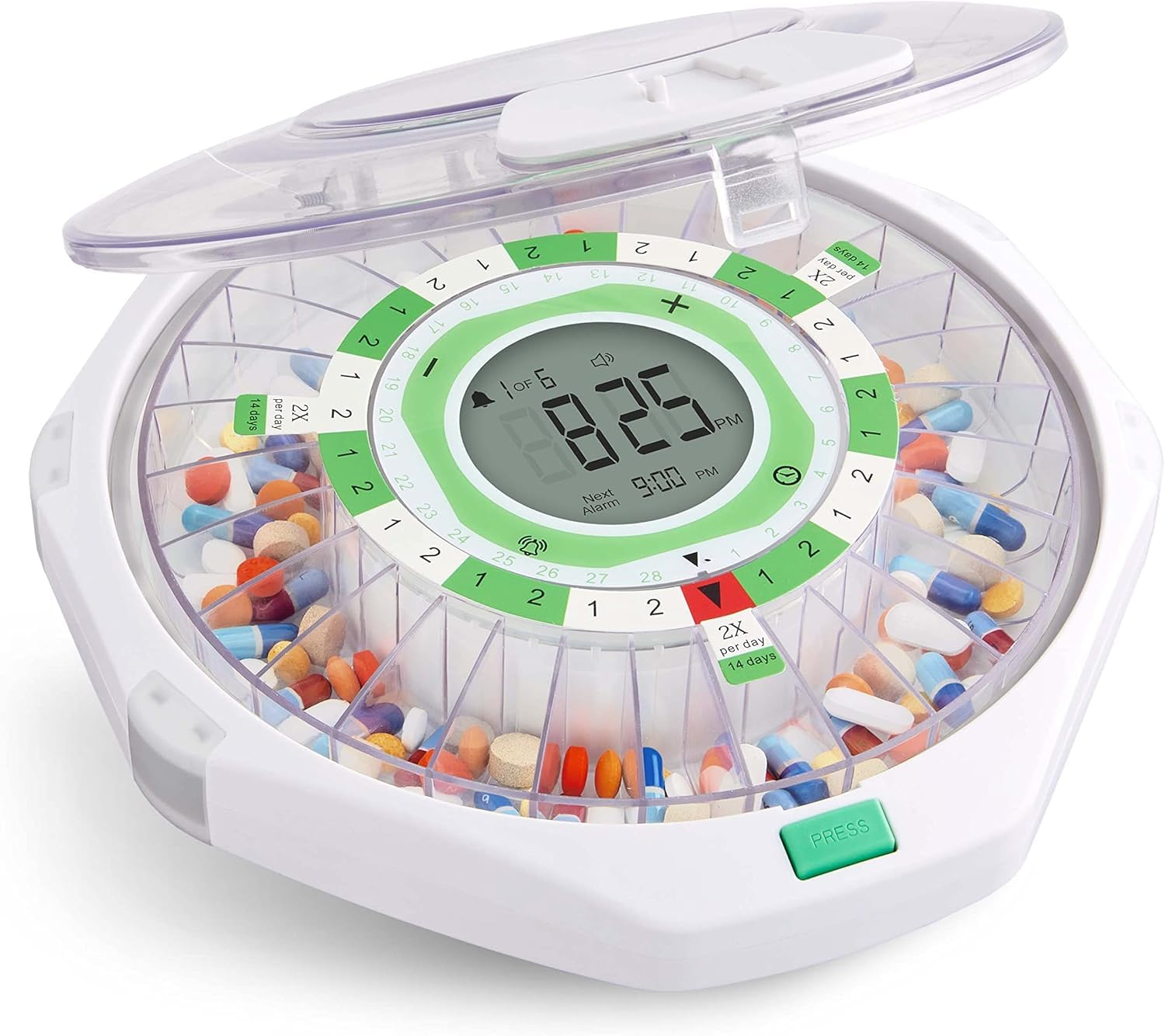
4. Automatic Pill Dispenser for Elderly with Alarm, Lock 28-Day Medication Dispenser (Clear Lid)
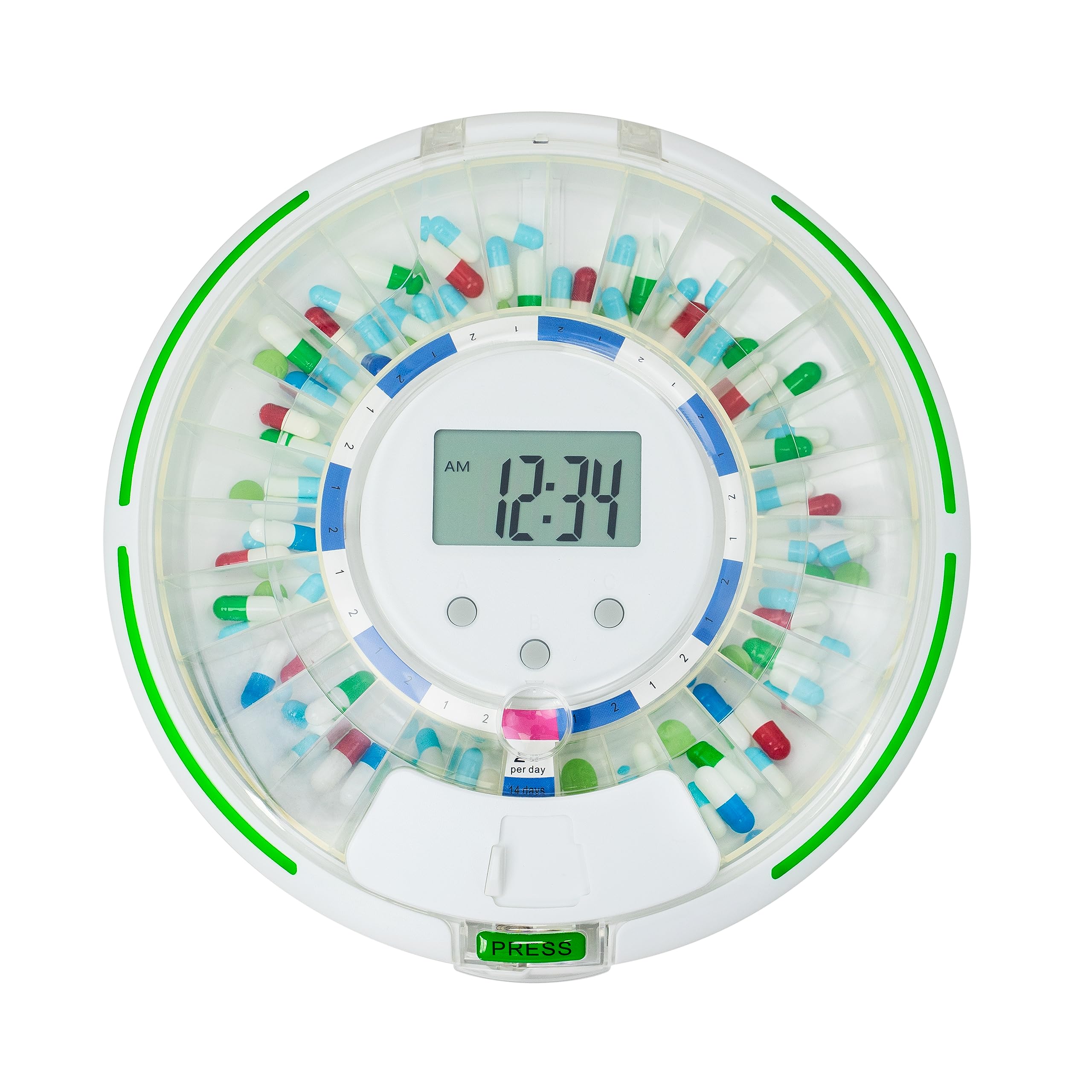
The entry ticket into locked, timed dispensing — 28 days, six alerts, no app anywhere.
If you are testing whether an automatic dispenser actually changes the routine, this is the least risky place to start. It does the core job: 28 compartments locked under a clear lid, dispensing with audio and visual alerts anywhere from 1 to 6 times daily, with six dosage templates to match different regimens. The clear lid means you can see how many days of pills are left in one glance, which kills the classic “did I already refill this?” guesswork.
Owners’ strongest praise lands on functionality — the machine does what it promises and lets you stop worrying about the schedule. The reminder job is handled well: the alerts push the routine along without a caregiver having to send a text. It is among the lightest units in the roundup at 1.87 pounds, so it moves from bathroom shelf to bedside table without a second thought.
Reliability is the honest qualifier. Reports split between working well for months and hitting issues, which is the pattern you expect from an entry-tier build rather than a premium one. Treat the lid gently, keep it away from a wet bathroom counter, and the dispenser earns its keep. Just do not expect the fit and finish of the Colorwing or the slide-door model at this tier.
Where the money goes
- A full 28-day locked tray from the budget end of the range.
- Configurable 1x to 6x daily alerts, so a once-a-day user is not nagged six times.
- Clear lid makes remaining supply visible without open up.
- A lighter build than the premium drums at 1.87 pounds.
What you give up
- Build consistency is the most-discussed doubt — go in expecting a basic housing.
- No Bluetooth, no app, no remote monitoring.
- Six templates is the alarm ceiling here.
Picks it up if: you want to try lock-and-alert dispensing without committing to a premium machine.
Holds off if: the user needs nine alerts a day or a phone-based check-in.
5. EziMedPil 28-Day Automatic Pill Dispenser with Alarm & Top Lock for Seniors
Loading day stops being a bare-fingered chore — this one ships a pair of tweezers.
Refill day is the unglamorous half of pill management, and the tweezers in the box are a small but smart answer. They keep the loading hygienic and pull a wrongly placed pill out of a deep compartment without a fight. That sits alongside nine interchangeable dosage rings matched to up to 9 custom daily alarms — where rival dispensers typically cap at 6 rings; this one matches every reminder to a dedicated ring.
Security is built around a top-mounted lock, not a rear barrel. That means open up takes one motion instead of flipping a loaded drum and risking a spill and a mixture. The same key also secures the battery cover, so a confused user cannot quietly remove the batteries and kill the schedule. Ergonomic details for limited hand strength are thought through too: a curved lid for grip, a bright LCD with large lettering, and a slide-open drug window that ends with the user tipping the unit to take the dose.
Reminders flash as well as beep, which suits hearing-impaired users, and the audible side covers visually impaired users. Each of the 28 compartments holds up to 24 aspirin-sized tablets. Power comes from four included AA batteries with a low-battery icon on the LCD. It is the mount-and-go sibling of the JULOS, at a slightly smaller footprint, and 1.9 pounds.
One honest limit: like every drum in this list, it asks a caregiver to keep track of the key. If neither senior can hold onto a physical key, the fingerprint lock on the Colorwing is the alternative to weigh.
Best for: the caregiver who does the filling and wants the loading process to be clean and fast.
Not the widest fit: anyone who needs app-based oversight will want the Colorwing instead.
6. 28-Day Automatic Pill Dispenser with Lock for Elderly, Frosted Privacy Lid
The frosted lid does something the clear drums cannot — it keeps a medical routine behind closed doors.
A locked drum with a clear lid puts the whole prescription on display for any visitor at the kitchen table. This unit swaps that for a frosted lid that hides the pills while still letting you check remaining stock at a glance. For anyone who dislikes advertising their medications to grandchildren or guests, that is a real reason to pick it over the transparent models. The absence of an app is the second half of the pitch: no Wi-Fi, no phone, four labeled buttons to set the time, alarms, and volume.
Behind the frosted plastic sits a serious security package. A top-panel lock lets you open up in one motion rather than flipping the loaded drum, and a single key covers both the medication compartment and the battery cover — so pills stay out of reach and the batteries do not wander off. Nine customizable daily alarms cover a routine running from breakfast through a late-night dose, and nine interchangeable rings match them, tuning every slot to its own dose.
The 28-slot tray takes up to 24 aspirin-sized tablets per compartment and easily swallows large fish oil softgels and calcium tablets, and the quick-remove carousel cuts refill sessions down to minutes. Four AA batteries are included, and the maker rates them for 2-3 months of use with a low-battery icon flashing before the end — handy if you want to plan a battery swap around a holiday. It arrives with nine rings, two keys, the batteries, and a manual.
Choose this when: discretion matters and the routine runs to six, seven, or more doses a day.
Weigh the alternative: a clear lid does show upcoming doses more openly — those models are better if a caregiver needs to eyeball the tray from across the room.
7. LiveFine 28-Day Locking Automatic Pill Dispenser with Alarm, Clear Lid
The veteran carousel — nine rings, a jumbo screen, and a reputation built over a lot of monthly refills.
If you want the model with the longest track record in this roundup, this is it. The LiveFine has 400+ ratings and holds 4.0+ stars, and its fans are the most emphatic in this roundup — reviewers repeatedly call it a life saver. That devotion comes from a carousel that fires its alarms and opens its locked tray month after month without drama.
The security arrangement is the simple version. A manual key locks the tray, and that is the whole system — no app, no battery in the key, nothing to forget to charge. Nine dosage rings adapt the drum to a regimen, alerts can be audio, visual, or both, with three beep patterns and adjustable volume for whoever is nearby. The jumbo LCD display shows time, upcoming alarms, and battery status in one look, readable by a low-vision user at arm’s reach.
Setup is the recurring friction. Some owners find the three-button interface steep enough that they need to bring in a family member. The other honest gripes are a pill occasionally sticking in a slot and a lock that some find fiddly — treat both as a break-in period rather than a guarantee of trouble. The 3.62-pound slide-door model is the alternative if any of that gives you pause.
What the years of reviews actually prove: the dispenser is reliable enough that people trust it with a parent’s routine, which is the highest bar a pill dispenser faces. Pair it with a real refill routine and it earns its keep.
It wins for: the buyer who wants a proven, no-frills carousel and does not need an app.
You should skip it: if programming menus tend to defeat the person setting it up — the three-button simplicity of the 28-Day Timed Alarms is gentler.
8. Colorwing Smart Pill Dispenser for Seniors — 31-Slot Bluetooth Dispenser
Two locks, one fingerprint — and a phone app that lets you check in from across town.
This is the pick for the family where nobody lives close. It pairs with a phone over Bluetooth 5.0, so doses can be scheduled, reminders checked, and intake tracked remotely through a free companion app with no subscription. The dual-lock design is the other headline: fingerprint scanning releases pills only at preset times, and a physical backup key covers forgotten schedules. Together that is a stronger barrier to impulsive access than a key alone, which matters in homes with dementia patients.
The hardware matches the ambition. A 1200mAh battery charges fully in 2 hours and runs 30+ days in energy-smart mode. The 31-slot carousel organizes a full month or a weekly plan, with 7 reversible dose rings for custom schedules. Reminders are unusually personal: you can record your own voice (“Mom, time for medicine”) or pick from 3 alert tones. For arthritic hands there is a patented press-release picker that means no lifting is required — access is palm-activated.
The honest trade-offs come from the same sophistication. At 3.06 pounds it is heavy for a dispenser, partly because of that rechargeable battery and dual-lock hardware. Reviews note a lock lid and overall durability that some find less consistent than the price implies, and the setup can need a helping hand. The maker claims 90%+ of setup issues resolve within 4 hours via video guides, so a single caregiver session with the videos usually clears the pairing hurdle.
Why remote families pick it
- Bluetooth 5.0 app control with intake tracking and no subscription.
- Fingerprint release plus a mechanical backup key — two layers of protection.
- Voice reminders in your own words are more motivating than a beep.
- 31 slots and 7 reversible rings for a full month or a weekly plan.
Costs of the tech
- 3.06 pounds — heavy to move around the house.
- Setup leans on an app and a phone, which excludes the most phone-averse users.
- Lid closure and long-term durability draw mixed notes on the review pages.
Built for: adult children managing a parent’s medications from another city.
Skip the app: if the person on the receiving end has no smartphone and no willing tech helper.
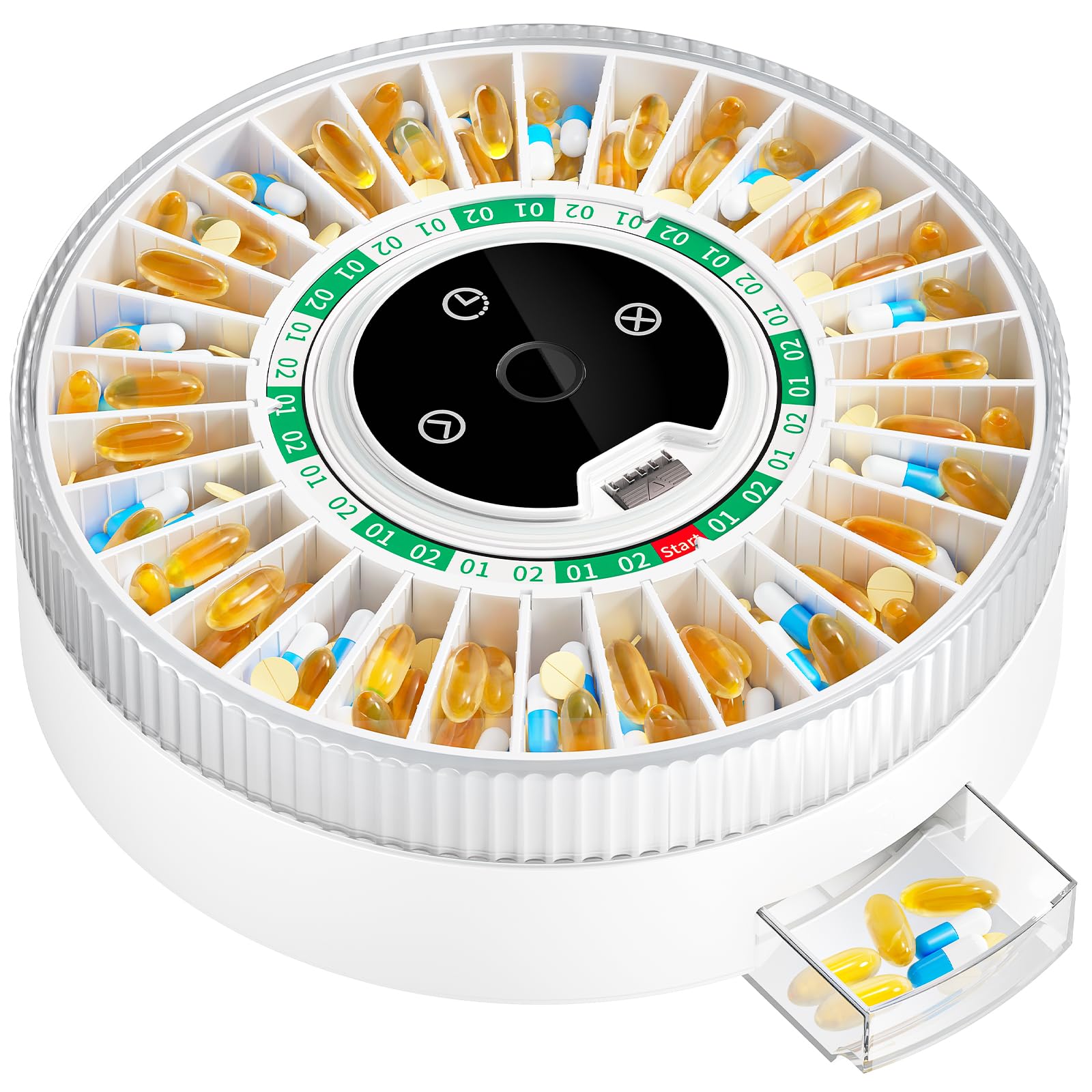
9. 28-Day Automatic Pill Dispenser — One-Press Slide-Door Cup with Dual Desiccants

Pills drop straight into a cup — no tipping, no shaking, no chasing a tablet across the floor.
Weak grip and shaky hands are a genuinely different problem from forgetfulness, and this dispenser is the only one in the list built around it. A slide-door tray drops the pill directly into a cup instead of asking you to invert a loaded drum. Anyone who has watched a parent tip a carousel and scatter a week of tablets on the carpet will understand why that single design choice matters. Note that add-on trays are not supported — the cup is the system.
The reminder setup is flexible in a way the simpler units are not. You choose sound-only, light-only, or sound and light together, and that choice suits a hearing-impaired user as readily as a low-vision one. A bright LED ring and clear beeps do the work in low light or a noisy kitchen. Moisture protection gets its own engineering: a water-resistant lid, a sealing silicone structure, and dual desiccant chambers to keep pills stable in damp air, which is the detail that matters in a steamy bathroom or a warm climate.
Capacity is where the honest reviews split. The 28 large compartments are sized for real pill counts — up to 16 calcium tablets at 0.79 inches, 14 vitamins at 0.31 inches, and 13 capsules at 0.75 inches — and owners’ strongest praise lands on overall quality. But some find the compartments smaller than they expected, and gummy-style capsules stick, so this is not the pick for a regimen of large gummies. It is also explicitly not for nursing homes or assisted living facilities; it is a home-use machine.
The plain-English verdict: buy it for the access mechanism, not the compartment depth. If the biggest pill in the routine is a large softgel or a gummy, measure it against the slot before you commit.
Choose it for: tremor, weak grip, or a hand that cannot hold and invert a loaded drum.
Elsewhere: if gummy capsules are part of the daily routine, the sticking risk says pick a different tray.
Understanding the Specs
Daily alarms and dosage rings
An alarm count tells you how many times a day the drum will open the door; the rings are the plastic inserts that shape each slot to a dose size. The two numbers usually match — a 9-alarm dispenser ships with 9 rings. Pick a unit whose alarm ceiling is at least one higher than the real prescription, so a new dose ordered by the doctor does not require a different machine. A six-alarm drum is the common standard, and the JULOS, EziMedPil, and frosted-lid models all go higher.
Lock position and key security
Every dispenser locks the tray, and the difference is where the barrel sits. A front or top lock is faster and tidier than a rear lock, because you are not flipping a loaded tray to reach it. One key should cover both the medication lid and the battery cover, which stops a confused user from quietly removing the batteries and stopping the schedule. None of this replaces supervision — it just adds a physical barrier between a curious or confused hand and the whole month of pills.
Compartment capacity
The standard figure is 24 aspirin-sized tablets per slot across 28 slots, which works out to a month of small pills. That rating is not a promise about your fish oil. If the routine includes large softgels or thick calcium tablets, check the maker’s own sizing — the slide-door model lists its compartment limits in inches for exactly this reason.
Reminder style and power
Alerts come as beeps, flashes, or both. Dual audio and visual is the safest setup for a senior whose hearing or sight is fading, since one channel covers for the other. Power is almost always four AA batteries, which keeps the unit portable and independent of a wall outlet. A low-battery icon is standard and worth checking — a dispenser that dies mid-month is worse than no dispenser at all.
FAQ
Can an automatic pill dispenser stop someone with dementia from taking a double dose?
How many alarms a day do I actually need?
Will these dispensers fit large fish oil capsules and big calcium tablets?
Do I need Wi-Fi or an app to use one of these?
How long do the batteries last and what happens when they run low?
Where should the lock be on an automatic pill dispenser?
Can these dispensers be taken on a trip or moved between rooms?
Are automatic pill dispensers suitable for nursing homes and assisted living?
What is the difference between an automatic pill dispenser and a weekly pill organizer?
Is the automatic pill dispenser worth it for mild forgetfulness?
Final Thoughts: The Verdict
For most households, the automatic pill dispenser that solves the problem cleanly is the Bluetooth Automatic Pill Dispenser for Elderly with Alarm (Green) — a press-to-open lid that skips the drum-flip, two weeks of room for bulky supplements, and a build rated for constant opening. If the prescription runs to seven, eight, or nine doses a day, the JULOS handles the densest schedule here with nine alarms and nine matching rings. And for a caregiver checking in from another city, the Colorwing is the one to reach for, with Bluetooth scheduling, a fingerprint release, and a mechanical key as backup.
The honest nudge: pick the model whose alarm ceiling and compartment size match the actual pills, then program it with the caregiver in one unhurried session. The LiveFine, with 400+ ratings and 4.0+ stars, is the safest no-app carousel if you want a dispenser you do not have to think about.
How We Picked
We do not accept paid placement. Every pick is matched to a real buyer and a real use-case; we do not hands-on test units.
Sources & Methodology
Specifications: manufacturer listings and product documentation. Review insights: verified customer reviews, as of November 2026. Pricing: not shown on this page (it changes often); check the current price via the retailer link.
As an Amazon Associate, Gadgets Feed earns from qualifying purchases. This does not affect which products we feature.