
Our readers keep the lights on and my morning glass full of iced black tea. As an Amazon Associate, I earn from qualifying purchases.
Specs are compiled from manufacturer listings and verified buyer reviews and can change over time — please confirm the key details on the product page before buying.
You want a cinema-sized 4K picture, but you do not want a projector hanging from your ceiling or a dark room all day. Ultra short throw laser projectors solve exactly that: they sit inches from the wall and throw a huge image upward. The catch is that brightness, contrast, and throw distance vary a lot between models, and those three numbers decide whether the picture looks like a TV or a washed-out wall. Below is the honest shortlist, ordered so the strongest all-rounder sits first.
I’m Min — the founder and writer behind Gadgets Feed. This guide is built by comparing the manufacturers’ published specifications and the patterns across verified customer reviews, so you get each pick’s real strengths and trade-offs instead of marketing spin.
Some units are built for a bright living room and others are built for a dedicated dark theater, so matching the projector to your room matters more than any single spec. This breakdown of the 4k ultra short throw laser projector market keeps that room-fit question front and center.
Our Picks at a Glance

How To Choose The Best 4K Ultra Short Throw Laser Projector
Most buyers get this wrong the same way: they chase the biggest lumen number and ignore the wall. An ultra short throw projector has a fixed throw ratio, which is the relationship between how far it sits from the wall and how big the picture gets. Change the distance and you change the image size — you cannot just zoom your way out of a bad cabinet depth.
Check the throw ratio before anything else
A 0.25:1 ratio is a common UST figure and means the projector sits roughly 8.5 inches back for a 100-inch image, stretching to about 12.8 inches for 150 inches. Measure your media console depth first. If the cabinet is too shallow, you either move the unit forward on a slider or accept a smaller screen.
Brightness and contrast decide day versus night
Brightness is measured in lumens — the raw light output that fights room light. Contrast ratio is the gap between the brightest white and darkest black the projector can produce. A high contrast number means dark scenes keep detail instead of turning to gray mud. For a living room with windows, brightness usually wins the argument; for a blacked-out theater room, contrast carries the picture.
Laser light source versus a lamp
A laser engine runs cool, reaches full brightness instantly, and holds color longer than an old lamp bulb. Triple-laser designs skip the color wheel entirely, which is why they can cover a wide color gamut — the range of colors the projector can reproduce. Look for the gamut figure (BT.2020 or DCI-P3) if rich color matters to you.
Quick Comparison
| Model | Best For | Brightness | Contrast Ratio | Resolution | Amazon |
|---|---|---|---|---|---|
| AWOL VISION LTV-3000 Pro★ Best Overall | All-round home theater | 2000 lm | 2500:1 | 3840 x 2160 | Amazon |
| XGIMI MIRA ProBrightest Punch | All-day any-room viewing | 3000 lm | 20000:1 | 3840 x 2160 | Amazon |
| Hisense PT1 | Google TV streaming built in | 2500 lm | 3000:1 | 3840 x 2160 | Amazon |
| NexiGo Aurora Pro | Gamers on a big screen | 2400 lm | at least 3000:1 | 3840 x 2160 | Amazon |
| NexiGo Aurora Pro MKII | Deep blacks in a dark room | 2400 lm | 30000:1 | 3840 x 2160 | Amazon |
| Epson Lifestudio Grand Plus | Bright rooms and sports | 4000 lm | 5,000,000:1 (pixels, as listed) | 3840 x 2160 | Amazon |
In‑Depth Reviews
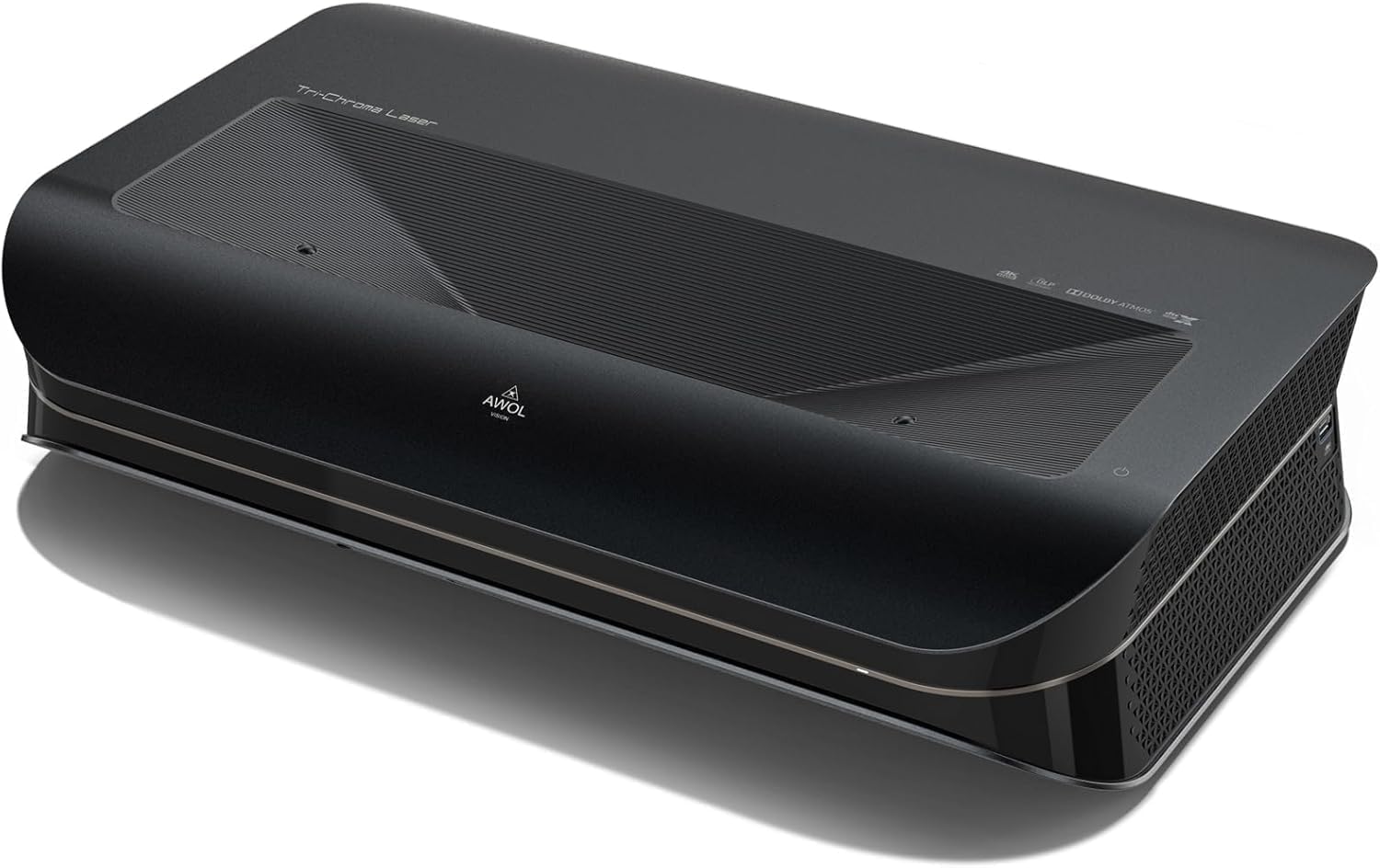
1. AWOL VISION LTV-3000 Pro 4K 3D Ultra Short Throw Triple Laser Projector
Our pick — 4.0+★ from 200+ verified ratings; the strongest balance of quality and price.
The triple-laser centerpiece that puts a 150-inch cinema in a cabinet’s depth
This is the one most buyers land on, and the reason is the picture. A triple-laser light engine — three separate lasers for red, green and blue with no color wheel — covers 107% BT.2020 and 147% DCI-P3. That is digital-cinema-level color range, so foliage and skin tones stay lifelike instead of going flat and green.
AWOL also builds a center channel speaker right into the projector. Dialogue then maps to the screen instead of the corner of the room, which fixes the odd “voices coming from my left” effect of standard setups. Pair it with an ALR screen (ambient light rejecting — a screen that pushes room light away from the viewers) and the picture holds up during the day.
The catch is a familiar one in this category: the fixed 0.25:1 throw ratio wants roughly 8.54 inches for a 100-inch image and 12.84 inches for 150. If your console is shallow or your wall is tight, plan on AWOL’s motorized slider. This one also rewards a dark room; bright spaces need that ALR screen to keep the 2000 lm output from washing out.
What earns the crown
- Triple-laser color at 107% BT.2020 and 147% DCI-P3
- Built-in center channel speaker for on-screen dialogue
- Dolby Vision and HDR10+ support for dynamic contrast
What to plan around
- Fixed 0.25:1 throw wants a deep console or a slider
- 2000 lm needs an ALR screen in a bright room
Go for it if: you want the richest all-round home theater picture and can give it a dark-ish wall.
Think twice if: your cabinet is shallow and you do not want to add a slider.
2. XGIMI MIRA Pro Ultra Short Throw Laser Projector, 4K UHD, 3000 ISO Lumens
The daylight fighter built to stay visible with the curtains open
If your projector will live in a bright living room, start with the number 3000. The MIRA Pro pushes 3000 ISO lumens out of an RGB triple-laser engine, and it beats the AWOL LTV-3000 Pro’s 2000 lm on raw output. That 3000-lumen output is what lets you watch a daytime game without drawing the shades.
The contrast story is even wider. XGIMI lists a 20,000:1 contrast ratio against the AWOL’s 2500:1, which is a very large gap in how black levels hold up in a dark scene. On top of that you get 36W Harman Kardon speakers with Dolby Audio and DTS Virtual:X, plus built-in Google TV so there is no streaming stick to plug in. There is a 1ms low latency mode here too, which matters if you plan on gaming.
Now the honest part. Owner chatter around this model flags reliability as the recurring concern, and value opinions split. Weigh that if you want the longest trouble-free runway. For an all-day room where brightness is the whole point, it still earns its slot.
Where it wins: The 3000 lm output and 20,000:1 contrast make it the daylight specialist of the group, and 36W Harman Kardon sound means no extra speaker bar on day one.
What gives me pause: Reliability comes up as the weak spot in owner feedback, so buy from a seller with a clean return path.
Made for: a sunlit family room where the picture has to survive the afternoon.
Pass if: you want the longest track record and prefer a darker, dedicated room.
3. Hisense PT1 Ultra Short Throw Triple Laser Projector, 4K UHD, Google TV

A streaming-first laser TV that treats the wall like a giant smart screen
Hisense ships the PT1 with Google TV already loaded, so you open Netflix, a sports app and a guide without plugging in anything extra. That convenience is the hook. The picture side is no slouch either: three pure color lasers, 2500 ANSI lumens and a 3000:1 contrast ratio, with Dolby Vision handling the dynamic tone mapping frame by frame.
The upscaler is a real perk for anyone with an older library. Hisense’s 4K AI Upscaler rebuilds standard-definition content toward 4K, so a dusty old movie does not look like a fuzzy mess on a 150-inch wall. There is also 3D support and a 240 refresh rate for fast motion, and Dolby Atmos inside the chassis.
Fair warning on the edges. The sound and overall functionality get split reactions from buyers — some love the built-in audio, others find the smart layer clumsy. Budget a decent soundbar if audio depth matters, and treat the on-board apps as a bonus rather than the whole plan.
The streaming angle: Google TV built in saves you a device and a cable, and the 4K AI Upscaler squeezes more detail out of older sources than the rest of this list.
The honest gap: Audio and smart-platform polish split opinions, so a soundbar and a streaming backup are wise.
Right for: someone who wants one box for apps, 3D and a big screen without add-ons.
Look elsewhere if: deep sound from the start is a must for you.
4. NexiGo Aurora Pro, Ultra Short Throw 4K Tri-Color Laser Projector

The console gamer’s UST, with an 8ms input lag that keeps shooters honest
Most projectors are built for movies and treat gaming as an afterthought. The Aurora Pro flips that. It supports 4K at 120Hz with an 8ms input lag — the delay between your button press and the on-screen action — which is fast enough that a racing game or shooter does not feel like you are steering a boat.
Under the hood is an ALPD 4.0 RGB+ engine with a native 3000:1 contrast ratio, and dynamic laser dimming that deepens blacks further. NexiGo claims its dynamic laser dimming cuts the black level by more than 60% while saving over 30% energy. There is Dolby Vision and HDR10+ on board, plus 60W of stereo sound from two 15W woofers and two 15W tweeters.
Where it asks for patience is longevity. Reliability is one of the mixed points in owner feedback, with some units reported to fail after a year of use, and value splits both ways. Buy it for the 8ms lag and 4K@120Hz, and go in with a warranty plan.
The gaming advantage: An 8ms input lag and 4K@120Hz make it the pick for console and PC play on a huge wall.
The risk to weigh: Long-term reliability is mixed in owner reports, so factor in the warranty.
Best for: gamers who want a 120Hz wall and can accept a bit of risk.
Not the one if: you want the deepest black levels in a dark theater room.
5. NexiGo Aurora Pro MKII, 4K Tri-Color Laser UST Projector

A contrast monster that makes dark scenes feel like a real theater
If your room has shades, the MKII is the one that rewards it. Its Scene Adapt Engine combines a dynamic iris with laser dimming to reach over 30,000:1 contrast — a huge jump over the 3000:1 that the standard Aurora Pro lists. Dark scenes keep their shadow detail instead of sliding into gray, and it also trims energy use by about 70%.
The ALPD 5.0 laser engine carries 2,400 lumens, a 107% BT.2020 gamut and ΔE≈1 color accuracy, which is a tight color-accuracy figure meaning the on-screen color tracks the source closely. Better still, the 0.21:1 throw ratio is the shortest here. Its 0.21:1 ratio needs less wall clearance than the AWOL’s 0.25:1 to fill 150 inches, which helps in a compact cinema room.
Two things to know. The lens is rated for 30,000 hours, so you are not swapping bulbs, but gamers should note that the 4.2ms to 8ms low latency comes via the gaming mode. And compatibility, especially 3D, is a mixed point in owner reports, so confirm your specific source works.
Why dark-room fans want it
- Over 30,000:1 contrast for deep blacks
- Short 0.21:1 throw needs less clearance
- 30,000-hour laser life
The fine print
- 3D compatibility is a mixed report
- Low latency only in gaming mode
Pick this: for a dedicated dark room where black levels decide the picture.
Skip if: you mostly watch with the lights on, where that contrast edge fades.
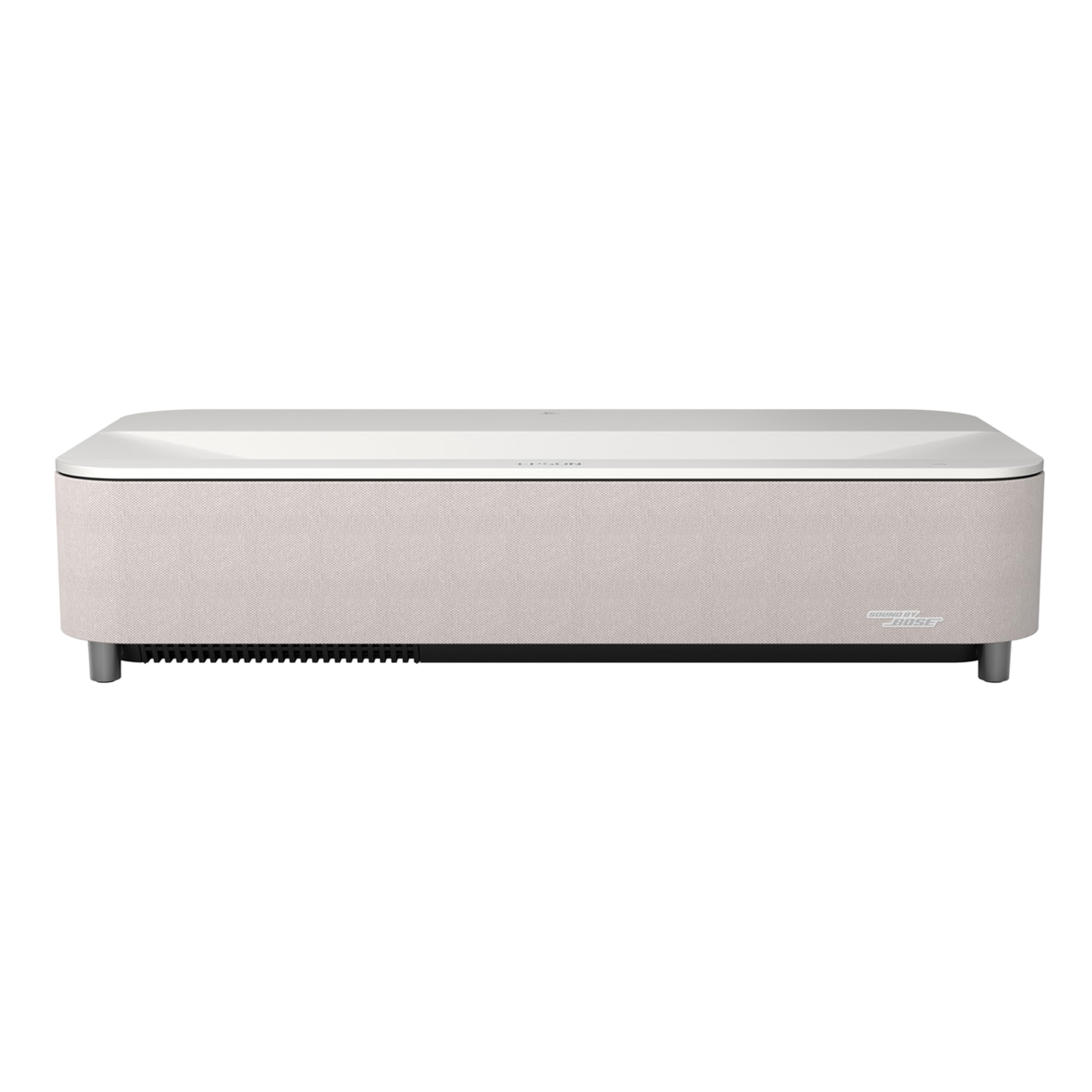
6. Epson Lifestudio Grand Plus Ultra Short Throw Laser Projector
The light-cannon for sunlit rooms, with Bose audio baked in
Epson’s answer to the living-room problem is raw light. The 3-chip 3LCD engine puts out 4,000 lumens of color brightness and 4,000 lumens of white brightness — the highest output here by a wide margin over the 2000 lm AWOL. That is what keeps the picture punchy with the shades up and a lamp on.
It uses Epson’s 4K Display Technology to put a full 8.29 million pixels on screen with HDR10 color, and it throws up to 150 inches. Audio comes from Sound by Bose, so the built-in sound has real bass. For gaming and gear there are three HDMI ports with ALLM — auto low-latency mode — for a console handshake without fiddling in menus.
The thing to plan for is size. Its footprint is listed at 27.4 by 13.4 by 6.2 inches, so it wants a wide, dedicated console rather than a bookshelf. And the contrast figure on the listing is given as 5,000,000:1 pixels, a different style of measurement from the others here, so weigh it on brightness rather than comparing that number directly.
Its whole case: 4,000 lumens of matched color and white brightness make it the strongest daylight performer, and three HDMI ports with ALLM keep consoles happy.
The trade: A large 27.4-inch-wide body needs a proper console, and the dark-scene black level is not the reason to buy it.
For you if: your wall faces windows and you want brightness to win.
Not for you if: you are chasing contrast in a blacked-out theater.
Understanding the Specs
Throw Ratio Explained
Think of throw ratio as the projector’s distance-to-wall rule. A 0.25:1 figure means the unit sits about 8.54 inches back for a 100-inch picture and about 12.84 inches for 150. Because it is fixed, your cabinet depth sets your screen size. Measure first, then move the unit forward or back on a slider if needed.
Lumens Versus Contrast
Lumens measure light output and decide whether the picture survives room light. Contrast ratio compares blackest black to brightest white and decides how much detail a dark scene keeps. Bright rooms lean on lumens; dark rooms reward contrast.
Laser Engines and Color Gamut
A triple-laser engine skips the color wheel and fires red, green and blue separately. Gamut figures like BT.2020 and DCI-P3 describe the range of color it can show. Higher gamut means richer, more lifelike color.
Input Lag and Refresh Rate
Input lag is the delay between your press and the on-screen reaction, measured in milliseconds (ms). Refresh rate is how many times per second the picture updates, measured in Hz. Lower lag and higher refresh keep fast games smooth.
FAQ
How close does an ultra short throw projector sit to the wall?
Do I need an ALR screen with a laser TV?
Is a triple laser better than a single laser?
Which projector is best for gaming?
Can these projectors replace a TV for everyday viewing?
How long does a laser light source last?
What does contrast ratio actually change in a dark scene?
Do these projectors support 3D and Dolby Vision?
Will a 4K UST projector work with my game console and soundbar?
How big a picture can these projectors throw?
Final Thoughts: The Verdict
For most people, the 4k ultra short throw laser projector winner is the AWOL VISION LTV-3000 Pro because its triple-laser color covers 107% BT.2020 and 147% DCI-P3, with a built-in center speaker that keeps dialogue on screen. If you want to fight daylight, grab the Epson Lifestudio Grand Plus and its 4,000 lumens. And for a dark room where black levels rule, the NexiGo Aurora Pro MKII is the one to reach for.
How We Picked
We do not accept paid placement. Every pick is matched to a real buyer and a real use-case; we do not hands-on test units.
Sources & Methodology
Specifications: manufacturer listings and product documentation. Review insights: verified customer reviews, as of November 2026. Pricing: not shown on this page (it changes often); check the current price via the retailer link.
As an Amazon Associate, Gadgets Feed earns from qualifying purchases. This does not affect which products we feature.