
Our readers keep the lights on and my morning glass full of iced black tea. As an Amazon Associate, I earn from qualifying purchases.
Specs are compiled from manufacturer listings and verified buyer reviews and can change over time — please confirm the key details on the product page before buying.
You want a 55-inch screen that fills the room without turning into a grey wash in daytime light, and you want to know which one actually does it. The short answer: Mini-LED sets from Roku and Hisense give you the brightest daylight picture for the money, while OLED from Sony and LG give you the deepest blacks for dark-room movie nights. Everything below is sorted by what each panel genuinely does well.
I’m Min — the founder and writer behind Gadgets Feed. This guide is built by comparing the manufacturers’ published specifications and the patterns across verified customer reviews, so you get each pick’s real strengths and trade-offs instead of marketing spin.
The details that decide a 55-inch panel are brightness, local dimming zones, and refresh rate — not the badge on the bezel. Here is how each 55″ tv in this list actually behaves in a real living room.
Our Picks at a Glance
How To Choose The Best 55″ TV
A 55-inch set is the size most living rooms can actually take. Sit roughly the same distance from it as you would from a dining table across the room, and the picture fills your view without making you turn your head. What separates a good one from a great one is not size — it is how the panel handles light.
Bright room or dark room decides the panel type
If your TV faces a window, you need a panel that fights glare. Mini-LED (a backlight built from thousands of tiny LEDs behind the screen) can push brightness high enough that daylight stops washing the picture out. OLED (a panel where every pixel makes its own light) gives you perfect black, but dims against a sunlit window. Choose by the room you actually watch in, not by the spec sheet.
Dimming zones are the real contrast story on LED sets
A local dimming zone is a patch of backlight that can dim on its own while the rest stays bright. More zones means tighter control around bright objects against dark backgrounds, so you see less of a glow halo around subtitles and streetlights. This is the number to compare between Mini-LED models, and it matters far more than a marketing name on the box.
Refresh rate, in plain terms
Refresh rate is how many times per second the screen redraws, measured in hertz (Hz). Higher hertz keeps fast pans, hockey rushes, and racing games from smearing. For movies a 60Hz set is fine. For console gaming or live sport, 120Hz and up is the difference between looking sharp and looking soupy.
The streaming interface you are marrying
Every smart TV commits you to a main screen — Roku, Google TV, Fire TV, or LG’s webOS. That home screen is what greets you every time you power on. Roku is the least cluttered, Google TV leans hardest on search across apps, and Fire TV leans hardest on Alexa voice. Pick the platform whose home screen you can live with past month three.
Quick Comparison
| Model | Best For | Panel Type | Refresh Rate | Smart Platform | Amazon |
|---|---|---|---|---|---|
| Roku 55-Inch Plus Series★ Best Overall | Best overall value | Mini-LED QLED | — | RokuTV | Amazon |
| Philips 7985 Series AmbilightBest Wall Glow | Ambient wall glow | QLED | 120 PMR | Roku TV | Amazon |
| TCL 55″ T7 SeriesBest for Gamers | Gaming on a budget | QLED | 120Hz | Google TV | Amazon |
| Hisense E7 Cinema Series | Cinema look on a side table | Hi-QLED Mini-LED | 144Hz | Fire TV | Amazon |
| Hisense U7 Mini-LED | Bright rooms and tricky glare | Hi-QLED Mini-LED | 165Hz | Fire TV | Amazon |
| Samsung QN70H Neo QLED | Color volume fans | Neo QLED Mini-LED | — | Samsung Smart TV | Amazon |
| TCL 55″ QM7L SQD-Mini LED | Deep blacks from an LED | SQD-Mini LED | 144Hz | Google TV | Amazon |
| Samsung S90F OLED | Both movies and console games | OLED | 144Hz | Samsung Smart TV | Amazon |
| LG C6 OLED evo | Fast action and gaming | OLED | 165Hz | webOS | Amazon |
| Sony BRAVIA XR8B OLED | Movie-night purists | OLED | — | Google TV | Amazon |
| Sony BRAVIA 8 II QD-OLED | No-compromise color | QD-OLED | — | Google TV | Amazon |
In‑Depth Reviews
1. Roku 55-Inch Plus Series Smart TV
Our pick — 4.5+★ from 800+ verified ratings; the strongest balance of quality and price.
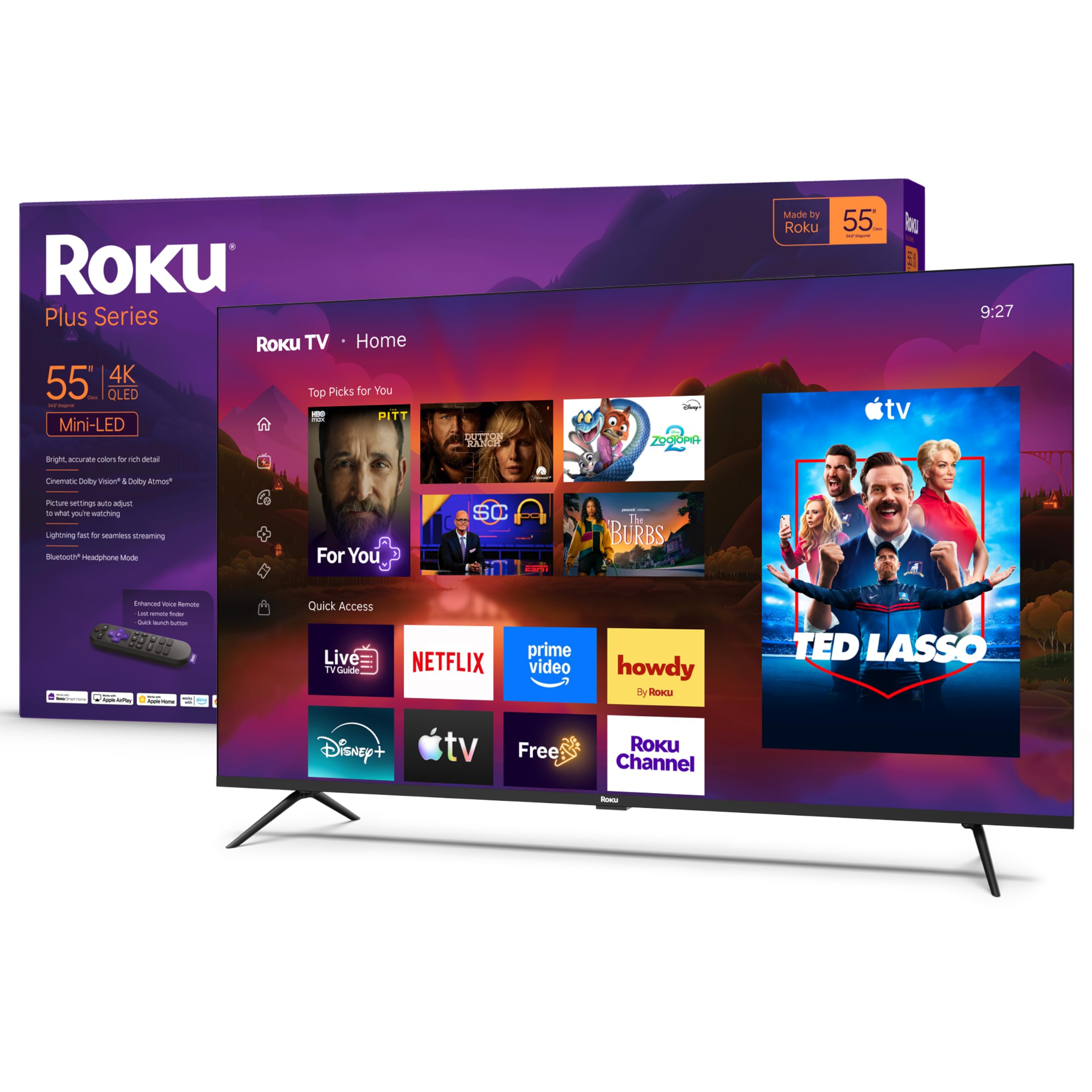
Mini-LED backlighting and a QLED screen for a price that reads like a mistake.
This set puts thousands of tiny LEDs behind the screen and layers QLED color on top, so dark scenes stay dark and bright highlights actually pop. That is the same basic recipe premium sets use. Dolby Vision then tunes compatible content scene by scene, which is why nighttime shows stop looking flat and grey.
Where it wins people over is the whole package rather than one hero spec. The Home Screen is short and uncluttered, one remote covers every app, and the enhanced voice remote includes a lost-remote finder — which sounds like a gimmick until the remote vanishes into the couch. Sharing photos and music from an iPhone over Apple AirPlay works without a dongle, and Roku Smart Picture Max uses AI to clean up weaker signals automatically.
Audio deserves its own line. There is a built-in subwoofer and Dolby Atmos, plus Bluetooth Headphone Mode so you can listen loud at 1 a.m. without waking anyone. The catch is honest and it is the same on nearly every LED set: it is bright and colorful, not pitch-black, so a dedicated dark-room viewer will still see some glow around bright objects. Owners lean heavily on picture and value, which tracks with a 4.5+ star crowd favorite across 800+ ratings.
What earns the top spot
- Mini-LED backlight with QLED color and Dolby Vision on a value-tier set
- Built-in subwoofer and Dolby Atmos, with Bluetooth Headphone Mode for quiet viewing
- Roku interface is the least cluttered of the major platforms, and one remote runs everything
- Apple AirPlay plus Siri, Alexa and Google Assistant voice control
Where it asks you to compromise
- Bright-room and dark-room contrast cannot match an OLED’s true black
- No native 144Hz figure listed, so serious console gamers should look at the Hisense E7
The everyday pick: a first good TV for a living room with mixed lighting, or a second set where the Roku layout does the work for you.
Hold off if: you watch exclusively in a blacked-out room and true black matters more than brightness.
2. Philips 55-Inch Class 7985 Series Ambilight
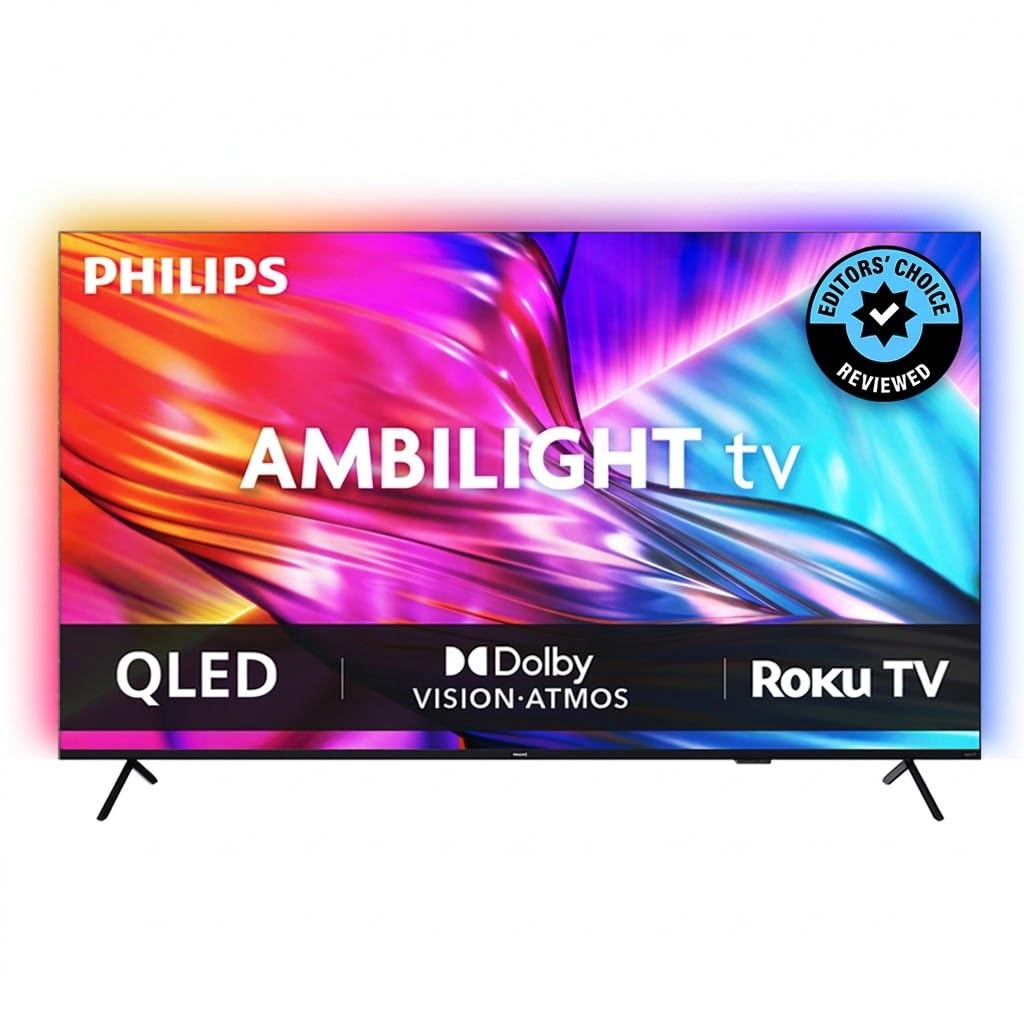
LED lights on the back of the panel paint your wall in whatever color is on screen.
Ambilight is the whole reason to look here. Rear LEDs read the 55-inch screen and throw matching color onto the wall behind it, and Follow Audio mode pulses that light with your music. A static glow can stay on after the TV is off, which turns the wall into a soft lamp in the evening.
Underneath the trick is a real 4K QLED panel at 3840 x 2160 resolution, with quantum dot color widening the range of brightness and contrast. Dolby Vision, HDR10 and HLG tune compatible content, and 120 PMR keeps sports smooth. That PMR figure is a motion rating rather than a native refresh rate, so read it as “smooth enough for football,” not as a 120Hz gaming panel. Four HDMI inputs take a cable box, a console, a soundbar and a streaming stick at once, and HDMI 1 carries eARC for a soundbar.
Roku is baked in, so you get the same simple home screen as the top pick, with 500+ free live channels for news and movies. Sound comes from two built-in Dolby Atmos speakers that keep dialogue clear, and Bluetooth 5 handles phone streaming. Buyers keep coming back to the picture and to the ambient lights specifically. It carries a 4.5+ star score, and it is the newer listing of the group — worth knowing if you like a longer track record.
Best for a bare wall: the Ambilight effect does more for perceived picture size than any panel spec, and it is the rare feature that everyone in the room notices.
One footnote: Ambilight is the show here, and the panel itself is QLED rather than Mini-LED, so peak brightness cannot match the Hisense U7.
Choose it for: a dark-walled media corner where the glow turns movie night into an event.
skip it if: you need maximum brightness against a sunlit window.
3. TCL 55 Inch T7 Series QLED Google TV
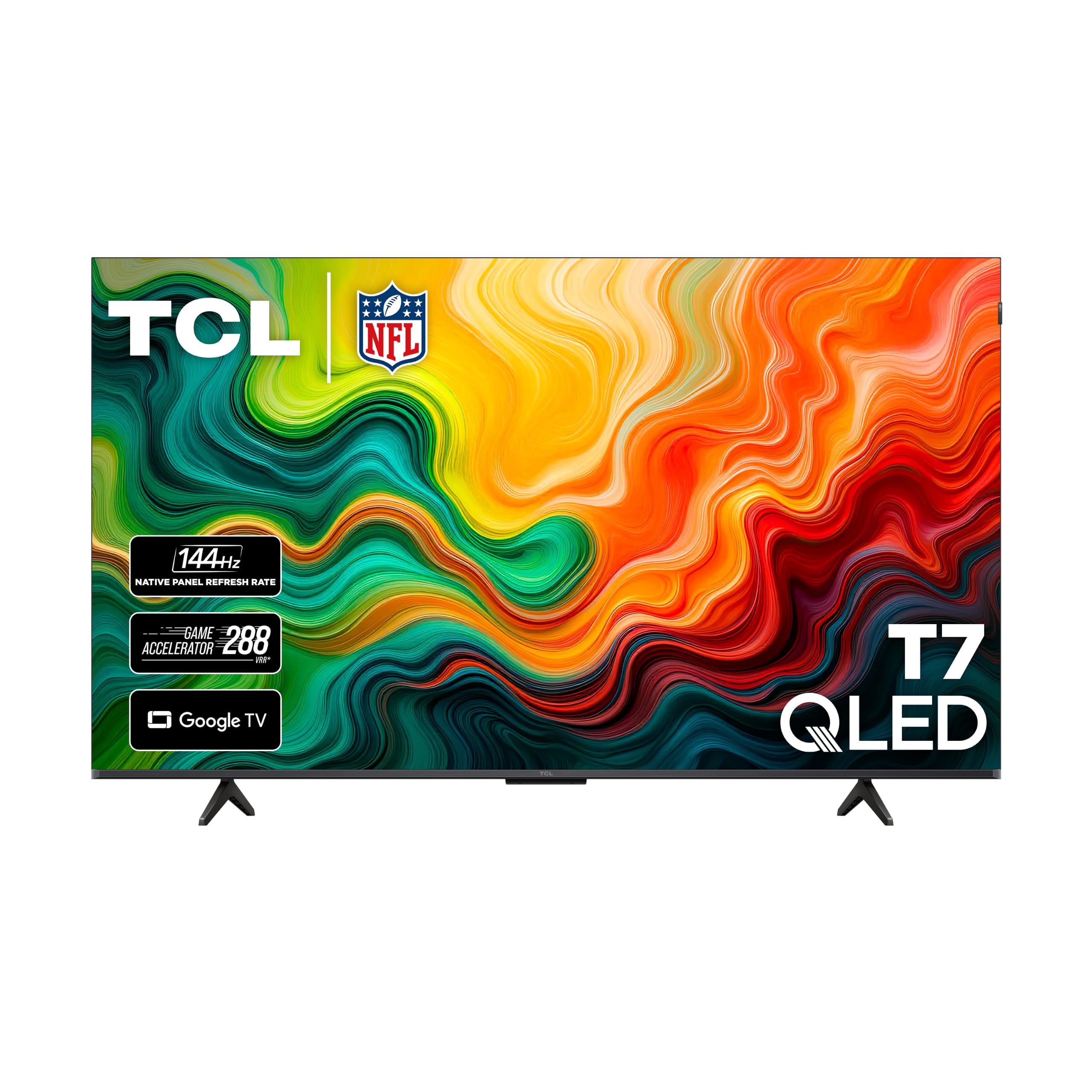
A 120Hz panel that treats a game console like it means it.
The number that matters here is 120Hz. A native 120Hz refresh rate keeps fast pans and racing lines clean, and a 240Hz variable gaming refresh rate pushes that further when a console can feed it. Compare that to the Hisense E7’s 144Hz panel and the Hisense leads on raw refresh — but at this price the T7 is where smooth gaming starts.
Picture is a QLED panel covering nearly the entire DCI-P3 color space, which is the color range filmmakers grade against, so what you see is close to what was intended. The TCL AIPQ Pro processor handles color, contrast and clarity automatically, and HDR PRO+ supports Dolby Vision, HDR10+, HDR10 and HLG. Motion Rate 480 with MEMC frame insertion (extra frames inserted between real ones) smooths live sport. Four HDMI inputs include one with eARC for a soundbar, and Dolby Atmos audio handles the spatial side.
Google TV is the platform, and it is the most search-forward of the bunch — type or speak a title and it hunts across apps. Chromecast and Apple AirPlay 2 are both built in for phone casting, and Wi-Fi 5 keeps streaming stable. The recurring honest gripe is reliability: a few sets shut off at random. That sits alongside a strong picture-and-value consensus, so treat it as a “buy from a seller with easy returns” pick rather than a warning.
For the console crowd: 120Hz native plus 240Hz variable gaming refresh is the spec gamers actually feel in a fast shooter.
Trade-off to know: Wi-Fi 5 rather than a newer wireless standard, so a wired Ethernet run is the safer bet for the heaviest streaming.
Right fit: a bedroom or den where a console and a streaming stick share the same panel.
Look elsewhere if: you want the absolute highest refresh rate — the Hisense U7 runs to 165Hz.
4. Hisense 55″ E7 Cinema Series Hi-QLED Mini-LED
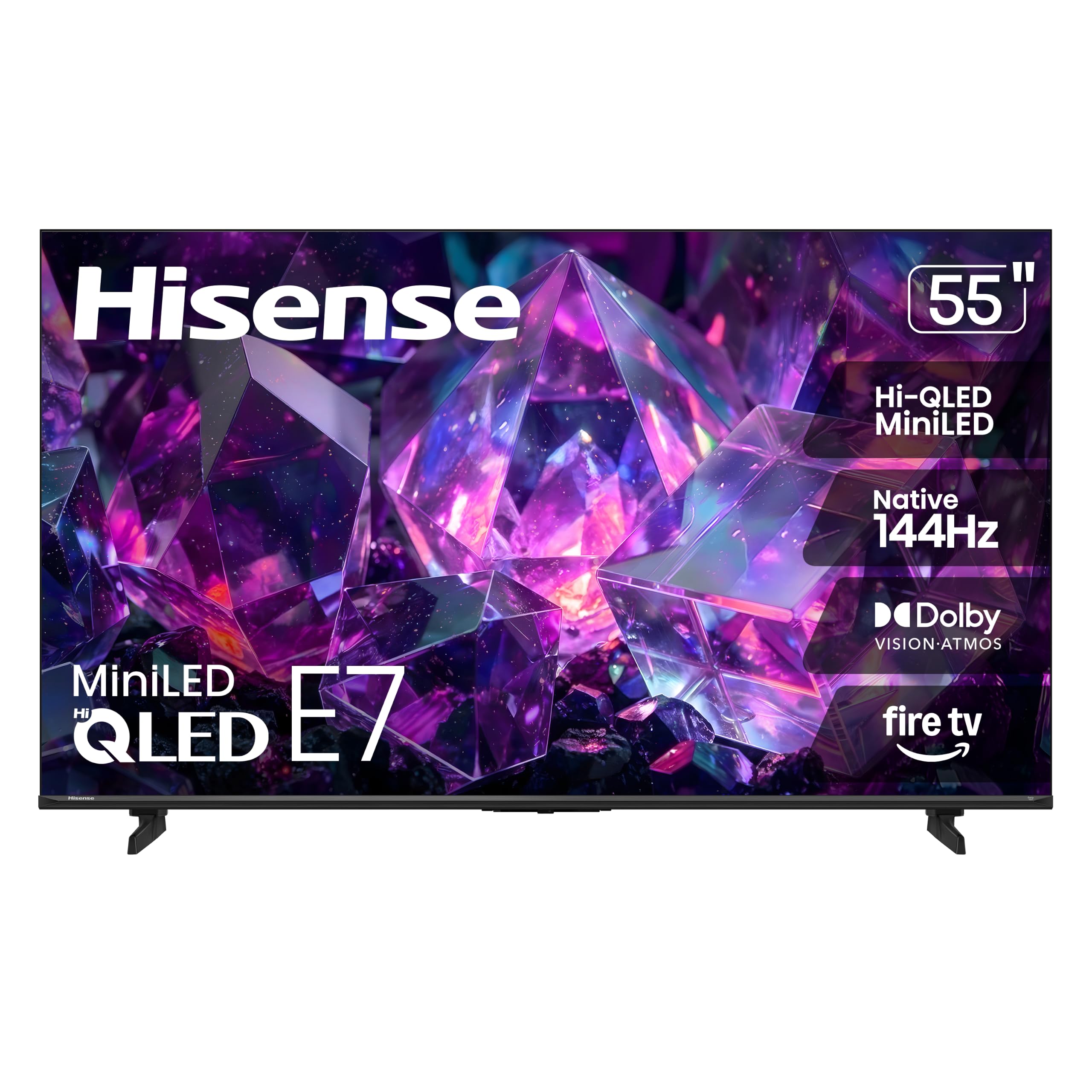
Thousands of Mini-LED zones plus a native 144Hz panel, aimed straight at movie night.
Start with the frame rate. A native 144Hz refresh rate beats the TCL T7’s 120Hz panel, so fast camera moves and competitive games hold sharper edges. That is the clearest head-to-head advantage in this group, and it is why gamers and sports fans keep landing here.
You get deep shadows and bright highlights because Mini-LED backlighting uses thousands of precise light zones. The TV covers all the main HDR formats (high dynamic range, which adds detail in bright and dark scenes): Dolby Vision IQ, HDR10+ Adaptive, HDR10 and HLG. An AI light sensor reads the room and adjusts the backlight in real time, so the picture stays clear when afternoon sun hits the screen and again at night. Filmmaker Mode locks the original aspect ratio, color, frame rate and sound, so you watch a movie as the director set it. AI Smooth Motion with MEMC (motion smoothing that reduces blur on fast-moving scenes) handles tricky panning shots.
Fire TV is the platform with Alexa+ voice built in, and Bluetooth 5.4 covers headphones and speakers. The honest note that shows up is a small share of sets that stop working within days of setup. That is a defect story, not a picture-quality story — it is exactly what a return window is for, and the picture consensus otherwise runs strong on color and contrast.
Where it shines: bright, punchy HDR with an AI brightness sensor doing the room-reading for you.
The practical caveat: Fire TV leans hard on voice, so if you dislike Alexa prompts, the Roku-based picks are calmer to live with.
Made for: a family room where sports, streaming shows and a console all share one screen.
Not the one if: you want the calmest interface over the fastest panel.
5. Hisense 55″ U7 Mini-LED ULED Gaming Fire TV
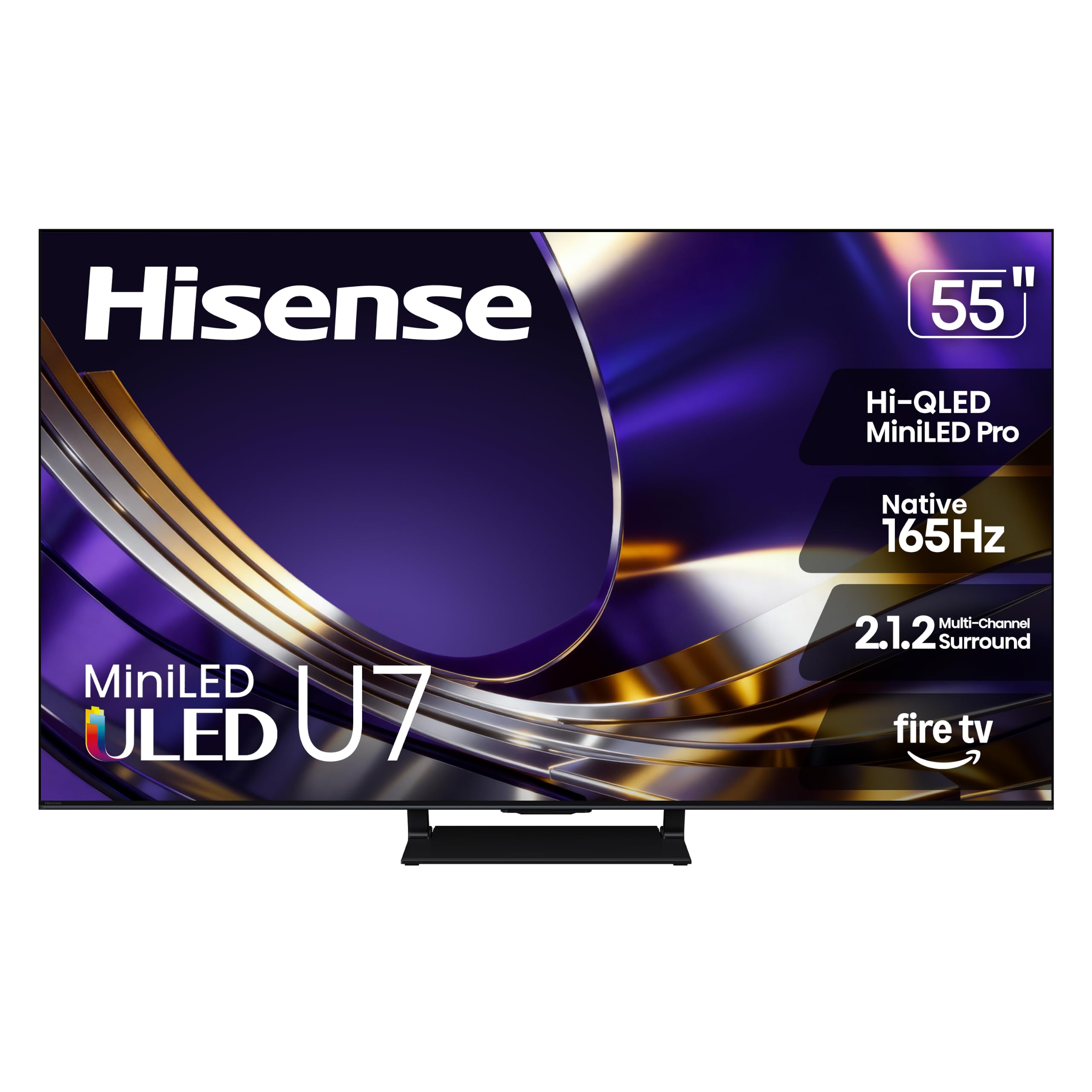
The set for a sun-drenched room, with a glare layer and 165Hz behind it.
If your TV sits opposite a window, the anti-reflection coating is what you are buying. It is a dual-layer screen treatment that goes beyond the single-layer designs most sets use, and it keeps the picture crisp when afternoon sun or overhead lights hit the glass. That coating is the fix for the glare complaint that dominates bright living rooms.
Dark scenes keep their detail while bright areas shine, thanks to Mini-LED Pro with up to 3000 local dimming zones (patches of backlight that dim independently) and up to 3000 nits of peak brightness (a measure of how bright the screen can push). The Hi-View AI Engine Pro analyzes each scene and adjusts color, contrast and detail on the fly. Native 165Hz is the highest refresh rate in this group — above the Hisense E7’s 144Hz and well above the TCL T7’s 120Hz — so fast action stays smooth.
Audio is a step up too: a 2.1.2 multi-channel surround system tuned by Devialet, a French audio brand, plus Dolby Atmos. Owners describe it as a beast on sound and picture, and the anti-glare work in bright rooms gets called out specifically. HDR covers Dolby Vision IQ and Atmos, and IMAX Enhanced is on board for compatible films. A 4.0+ star score across 400+ ratings backs the consensus.
Why it stands out
- Dual-layer anti-reflection treatment for rooms with real glare
- Up to 3000 local dimming zones and up to 3000 nits peak brightness
- Native 165Hz — the fastest refresh rate in this lineup
- 2.1.2 surround tuned by Devialet with Dolby Atmos
What to weigh first
- Premium-tier positioning means it costs more than the Roku Plus Series
- Fire TV interface is Alexa-forward and less neutral than Roku
This is your set if: a sliding door or big window sits opposite the screen and you are tired of watching reflections.
Think twice if: you watch in a dark room and want the deepest possible black — that is the TCL QM7L’s job.
6. Samsung 55-Inch Class QN70H Neo QLED
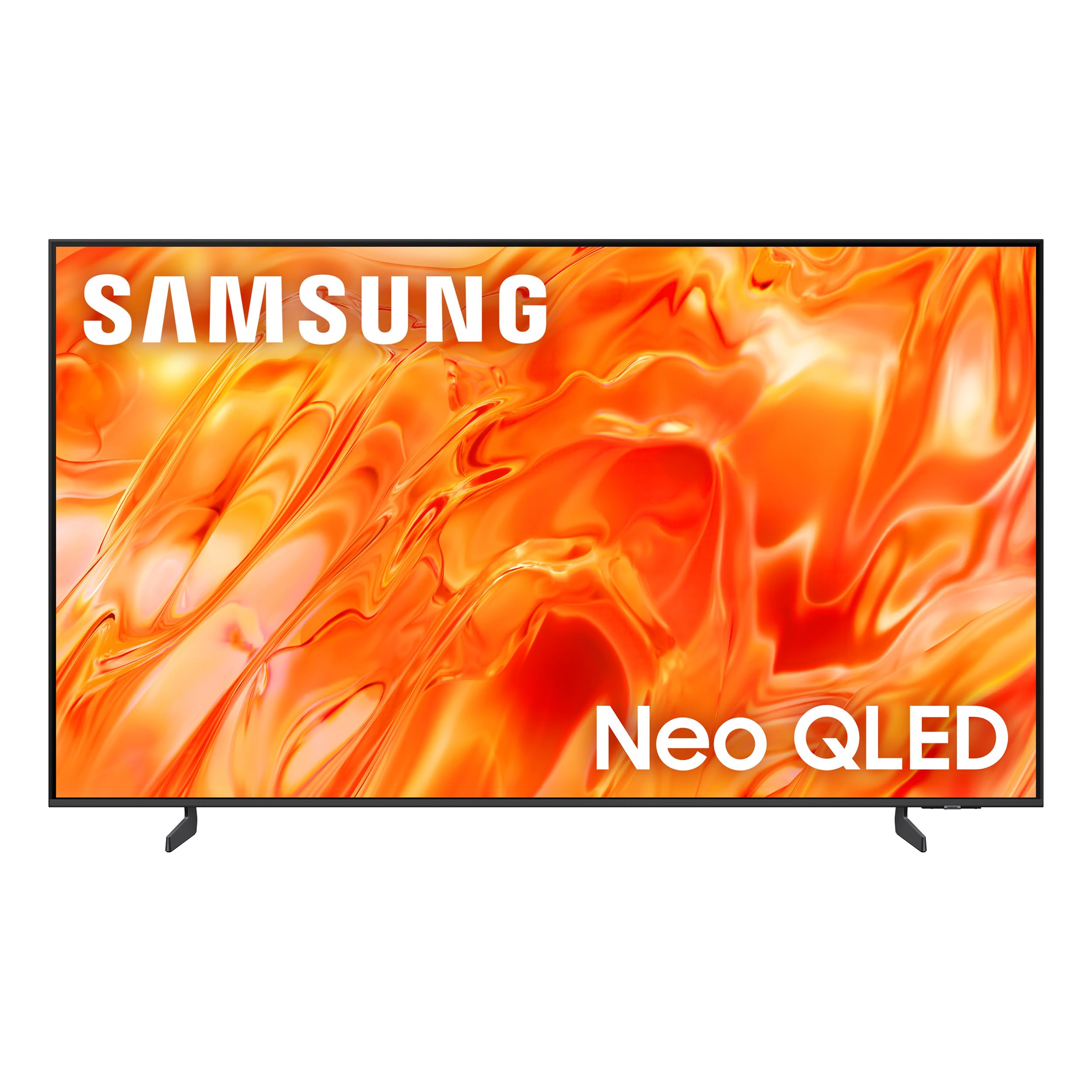
Quantum Dots that hold their color at any brightness level you throw at them.
Samsung’s claim here is 100% color volume with Quantum Dot, meaning the nano-sized dots can display the entire color spectrum at any brightness level. In practice that means a bright sky in a sports broadcast keeps its blue instead of washing toward white. It is the most color-focused panel in this list.
Neo QLED Mini-LED backlighting improves contrast so dark scenes stay legible and bright scenes glow, and the NQ4 AI Processor upscales lower-quality sources to 4K. Color Booster Pro shifts hues in real time for a richer look. Built-in speakers and Game Mode cover the basics, and Bluetooth 5.3 handles headphones. Energy use is listed at 103 kwh, the lowest annual figure in this lineup — worth a thought if the TV runs all evening.
The remote is the recurring complaint, described in the strongest terms buyers use about remotes. Picture quality, by contrast, is the thing people defend. It scores 4.0+ stars, and the honest read is that the panel does its job while the clicker is the weak link. The size comments are mixed and mostly about handling during setup rather than what you see on screen.
Colour is the pitch: full-spectrum Quantum Dot output keeps saturated scenes saturated instead of bleaching them out at high brightness.
The catch: the remote is the most-disliked part of this set, so budget for a replacement or a universal remote on day one.
Worth it for: animated films and sports where color intensity is the whole point.
Not ideal if: the remote in your hand matters as much as the picture on the wall.
7. TCL 55 Inch QM7L Series SQD-Mini LED
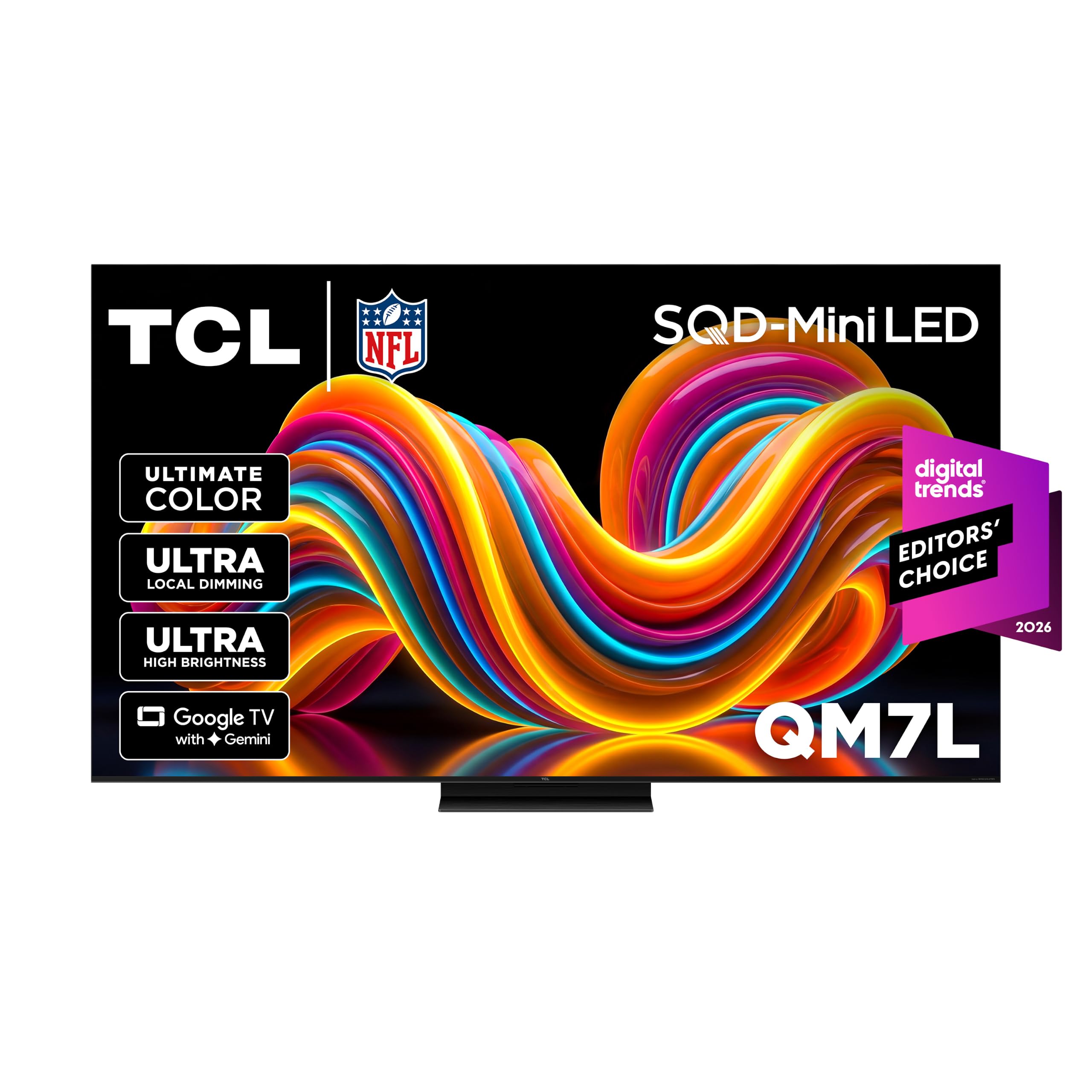
Up to 2,100+ dimming zones doing their best OLED impression — without the OLED price.
The headline is the dimming. Up to LD2100 Precise Dimming Series gives this panel up to 2,100+ separately controlled local dimming zones, which is how an LED set gets close to OLED black levels. Pair that with the HVA 2.0 Pro anti-reflective panel and dark scenes stay dark while bright objects stay sharp at the edges.
Color gets its own engineering story: a TCL Ultra Color Filter with fine 5 nanometer particles, versus standard 60 nanometer particles, for tighter color accuracy. The SQD-Mini LED system layers the TCL Deep Color System and Halo Control System together to control the glow around bright objects. A 144Hz refresh rate keeps motion clean, and the TCL Game Pack adds Game Accelerator 288 VRR, a Game Bar and AMD FreeSync Premium Pro for consoles.
Audio is by Bang & Olufsen, with optional wireless subwoofer and satellite speakers if you want to build out a surround setup. Google TV with Gemini handles discovery by chat rather than endless scrolling. Sound, brightness and setup all draw steady praise, and the picture consensus notes color detail deep enough that stars look like real twinkling stars. Reliability draws a mixed note, so weigh the return policy. Four-point-four stars overall.
Why it matters: 2,100+ dimming zones is the number that decides whether an LED set looks flat or cinematic, and this is the zone champion of the group.
Small print: Bang & Olufsen audio is a name worth having, but the optional wireless subwoofer and satellites are extras, not included.
Pick this if: you want near-OLED black levels but refuse to pay OLED prices or worry about panel life.
Different route if: you want the absolute best black — that remains a true OLED’s territory.
8. LG 55 inch Class OLED evo AI C6

Over 8.3 million pixels that switch themselves off for true black, at 0.1ms.
Count the pixels. Over 8.3 million self-lit pixels switch off individually for Perfect Black, which is a kind of darkness an LED backlight simply cannot produce. A 0.1ms response time and up to 165Hz refresh rate put it at the top of this group for gaming reaction, and NVIDIA G-Sync and AMD FreeSync Premium both smooth out frame pacing.
The a11 AI Processor Gen 3 handles Brightness Booster and AI Director Processing. LG’s own comparison is worth knowing: against the LG a9 AI Processor Gen8, this one delivers 5.6x greater AI neural processing, 50% faster operation and 70% improved graphics. Dolby Vision and Dolby Atmos both appear, FILMMAKER MODE with Ambient Light Technology keeps director intent intact, and OLED CARE works to protect the display over time. webOS brings Gemini and access to over 400 free channels on LG Channels plus over 10,000 movies and shows on demand.
Two honest notes. Brightness splits opinion — some find it much brighter, while others see a lot of reflection, because OLED panels do not push light the way Mini-LED does. And the remote and interface draw the harshest words in the reviews. Picture and color, meanwhile, are exactly why people buy it.
The gamer’s case: 0.1ms response with G-Sync and FreeSync is a genuinely different feel in a fast shooter.
Fair warning: put this in a bright room and reflections will be your daily annoyance — it wants dimmer light.
Built for: a gaming desk-and-couch setup in a room you can actually darken.
Wrong pick if: your living room has floor-to-ceiling glass and you watch during the day.
9. Samsung 55-Inch Class S90F OLED Smart TV

128 neural networks doing the upscaling, and 144Hz keeping the games smooth.
The processor is the story. The NQ4 AI Gen3 runs 128 neural networks (layers of pattern-matching math) to upscale everything to 4K and to boost brightness scene by scene. That means a lower-quality stream gets cleaned up rather than left soft. It also transforms standard content to HDR-like quality with brighter highlights and clearer detail — useful when half your library is not actually HDR.
For gaming, VRR works at up to 4K 144Hz, and the AI processor smooths the motion of fast-moving balls and on-screen text so sports stay readable. Dolby Vision is on board, Alexa is built in, and the set carries a 4.0+ star score across 600+ ratings — the largest review base of any premium pick here. Picture and color are what people defend most, with perfect contrast and clean whites and blacks.
There are two honest caveats. Some units fail to power up at all, and the remote divides opinion — simple and intuitive to some, horrible to others. Weigh those against a return window. Also worth noting: this is the 2025 model, so it is one generation behind the newest naming.
Strengths worth paying for
- 128 neural networks with AI upscaling and HDR-like transformation of standard content
- Up to 4K 144Hz VRR gaming with motion smoothing for live sport
- Perfect contrast with clean whites and deep blacks
- Alexa built in, no extra device needed
Reasons to hesitate
- Remote and interface divide opinion sharply
- Some units reported failing to power up from the start
balance for: a household that splits its evenings between Netflix, live sports and a console.
Consider the Sony instead if: you want the most natural skin tones and studio-tuned movie modes.
10. Sony 55 Inch BRAVIA XR8B OLED Google TV

Studio calibrated modes from Netflix and Prime Video, tuned to look like the edit bay.
Sony’s pitch is calibration, not raw brightness. Over 8 million self-lit pixels produce pure black with high brightness, and the XR Processor enhances color, contrast and clarity in real time. Where it differs is the studio calibrated picture modes designed specifically for Netflix and Prime Video — you see the film the way the colorist signed off on it.
There are PlayStation 5 exclusives here too: Auto HDR Tone Mapping and Auto Genre Picture Mode adjust the picture automatically when a PS5 is connected. Acoustic Surface Audio+ is on board, along with Dolby Vision, Atmos, IMAX Enhanced and DTS:X for a cinema-shaped sound stage. Google TV with Google Assistant handles apps, and Apple AirPlay 2 and Google Cast both cast from a phone.
The trade-offs are real but specific. Brightness draws mixed notes, and this is not the set for a sunlit room. More seriously, some units randomly turn off and restart. Against that, deep blacks and natural skin tones are the thing buyers defend hardest, and it holds 4.5+ stars across a healthy base of reviews.
The film-lover’s angle: studio calibrated modes and Acoustic Surface Audio+ are built for watching a movie start to finish, not for scrolling.
Watch out for: intermittent random restarts are the reliability note worth testing inside your return window.
For you if: you own a PS5 and care about seeing films as graded.
Pass if: your room is bright all day or you cannot tolerate a restart glitch.
11. Sony 55 Inch BRAVIA 8 II QD-OLED Google TV

Quantum Dots on an OLED panel, for colors that look lit from inside the screen.
This is the top of the tree. Over 8 million self-lit pixels produce pure black at Sony’s highest OLED brightness, and a Quantum Dot panel with XR Triluminos Max adds billions of accurate real-world colors. Put simply, an OLED gives you darkness and a Quantum Dot layer gives you saturation — this set has both.
The rest of the package is stacked. The XR Processor with AI enhances color, contrast and clarity in real time, Google TV with Google Assistant handles discovery, and Apple AirPlay 2 and Google Cast are both supported. Dolby Vision and Atmos join IMAX Enhanced and DTS:X for a cinematic sound and picture match. The SONY PICTURES CORE app brings movies included and access to the largest IMAX Enhanced collection. A built-in mic switch lets you cut the microphone, and an ECO Dashboard tracks power use.
It is handpicked by Amazon, and the buyer consensus calls it best in class for nuanced picture quality. Two caveats: brightness is not as high as some expect, and sound quality splits opinion — a soundbar is the sensible add-on. It scores 4.0+ stars. If you want the single best picture in this lineup and can live with less peak brightness than a Mini-LED, this is the one.
What puts it at the top
- QD-OLED panel combining pure black with Quantum Dot color depth
- Sony’s highest OLED brightness with XR Processor AI enhancement
- IMAX Enhanced, DTS:X, Dolby Vision and Atmos together
- Built-in mic switch and ECO Dashboard for privacy and power awareness
The honest counters
- Brightness below Mini-LED rivals, so a sunlit room will fight it
- Built-in sound draws mixed reactions — plan for a soundbar
The no-compromise choice: a dark media room where color accuracy and black level are the whole point.
Spend less if: brightness matters more than perfect blacks — the Hisense U7 delivers far more light.
Understanding the Specs
Mini-LED and local dimming zones
Mini-LED means the backlight is built from thousands of tiny LEDs instead of a few big ones. Local dimming zones are groups of those LEDs that can dim independently, so a dark patch of screen stays dark while a bright patch stays bright. More zones generally means tighter control and fewer glow halos around subtitles or streetlights. An OLED panel skips this entirely, because every pixel makes its own light and can switch fully off.
Refresh rate and motion rating
Refresh rate in hertz is how many times per second the panel redraws. Native 120Hz and 144Hz panels keep fast pans and games clean. Be careful with numbers like 120 PMR or Motion Rate 480 — those are motion-smoothing ratings, not the panel’s native refresh rate. If gaming is the goal, look for the native figure, and check for VRR (variable refresh rate, which matches the panel to the console’s frame output).
HDR formats explained
HDR means high dynamic range — a wider spread between the darkest and brightest parts of a picture. Dolby Vision and HDR10+ are dynamic formats that adjust scene by scene. HDR10 and HLG are the baseline formats. A set that supports Dolby Vision, HDR10+ and HLG covers essentially everything you will stream, which is why the format list matters more than the badge.
Brightness and glare handling
Peak brightness, measured in nits, decides whether a picture survives daylight. Anti-reflection coatings matter just as much because they cut the mirror image of a window out of your screen. OLED sets produce perfect black but do not push as much light as Mini-LED, so room lighting should shape your choice more than any spec sheet number.
FAQ
Is a 55-inch TV big enough for a living room?
Should I pick Mini-LED or OLED for a bright room?
What does native refresh rate mean versus a motion rate number?
Do I need 120Hz or 144Hz for a game console?
How many HDMI ports should a 55-inch TV have?
Does a 55-inch TV need a soundbar?
Will a 55-inch TV fit on a standard media console?
Can I wall-mount any 55-inch TV on this list?
Is Google TV better than Roku for finding shows?
How long should a 55-inch TV last before replacing it?
Final Thoughts: The Verdict
For most people, the 55″ tv winner is the Roku 55-Inch Plus Series because Mini-LED backlighting, QLED color, a built-in subwoofer and the least cluttered smart platform land together at a value-tier position. If your room fights daylight, grab the Hisense 55″ U7 — its anti-reflection layer and native 165Hz panel cover glare and fast motion in one move. And for a darkened room where black level is everything, the Sony BRAVIA 8 II QD-OLED is the one to reach for.
One nudge before you decide: the Roku Plus Series carries the highest-scoring mix of picture quality and value in this lineup, and that is the safest place to put your money if you are buying your only television. Decide by your room’s light first, then by panel type — that order keeps you from overpaying for brightness you don’t need or shortchanging a sunlit room.
How We Picked
We do not accept paid placement. Every pick is matched to a real buyer and a real use-case; we do not hands-on test units.
Sources & Methodology
Specifications: manufacturer listings and product documentation. Review insights: verified customer reviews, as of November 2026. Pricing: not shown on this page (it changes often); check the current price via the retailer link.
As an Amazon Associate, Gadgets Feed earns from qualifying purchases. This does not affect which products we feature.