
Our readers keep the lights on and my morning glass full of iced black tea. As an Amazon Associate, I earn from qualifying purchases.
Specs are compiled from manufacturer listings and verified buyer reviews and can change over time — please confirm the key details on the product page before buying.
You want one handheld that already has the games inside it — no cartridges, no downloads, no subscription. That is exactly what an all-in-one game console is, and the short answer is this: the X36 Ultra gives you the biggest built-in library and the most modern screen for the money, so it wins for most people. The rest of this guide is about matching the right unit to your hands, your kids, and your kind of play.
I’m Min — the founder and writer behind Gadgets Feed. This guide is built by comparing the manufacturers’ published specifications and the patterns across verified customer reviews, so you get each pick’s real strengths and trade-offs instead of marketing spin.
Every unit below stores its games on internal memory or a bundled memory card, so the moment it charges you are playing. Screen size, battery hours, and the number of built-in games are the three numbers that decide which one fits you. Here is the honest shortlist behind the best all-in-one game console.
Our Picks at a Glance

How To Choose The Best All-In-One Game Console
The whole appeal here is that the games ship on internal memory or a bundled card, so there is nothing to download. So the real question is not “what can it play” — it is “which library and which screen suit the person holding it.” Work through these four points and you will land on the right unit quickly.
Game count versus game quality
A bigger built-in library only helps if the emulator runs those games without stutter. A curated 100-game set that runs at full speed beats a bloated library that drops frames. The 28,000+ games on the X36 Ultra matter because the console pairs them with a quad-core processor, so the volume is actually usable. On a kids’ console, fewer games with a printed guide in the manual often keeps a young player happier.
Screen size and panel type decide how readable the games are in your hands
Screen size here runs from a pocket 2.75 inches up to a full 7 inches, and that gap changes how the console feels in your hands. A small vertical panel keeps the unit tiny in a bag, while a 4-inch IPS panel — an IPS screen being a type of LCD that holds its colors when you tilt it — makes text and sprites readable without squinting. Resolution matters too: a 720×720 panel is noticeably sharper than a 640×480 one at the same size, so small text stays crisp instead of blurry.
Battery hours, not just battery size
A bigger mAh number (milliamp-hours, the measure of how much charge the battery stores) usually means longer play, but the chip draws power too. The practical figure to compare is the advertised playtime — 5 hours on the entry kids’ units versus 8 to 10 hours on the mid-range machines. On a transatlantic flight, that 5-to-10-hour gap is the difference between one charge and a dead screen.
Android or Linux — pick your priority
Some units run full Android with Wi-Fi, which lets you open YouTube or TikTok between games. Others run Linux, a leaner system built purely for emulators and retro titles. Android gives you streaming and browsing; Linux tends to boot faster and stay focused on gaming. Neither is better — it depends on if you want a media gadget or a dedicated retro player.
Quick Comparison
| Model | Best For | Built-in Games | Screen | Battery | Amazon |
|---|---|---|---|---|---|
| X36 Ultra Retro Handheld★ Best Overall | Biggest library plus a sharp screen | 28000+ | 4.2″ 720×720 IPS | 3500mAh | Amazon |
| Anbernic RG40XX HBest Big Screen | Big screen and ergonomic grip | 5000+ | 4.0″ IPS | 3200mAh, 8 hours | Amazon |
| Atari Gamestation GoLiving-Room Centerpiece | Living-room showpiece with licensed Atari | 200+ | 7″ full color | Built-in rechargeable | Amazon |
| RG35XX Pro | Dual joysticks for fighting games | 4353 | 3.5″ 640×480 IPS | 3200mAh, 8 hours | Amazon |
| WDYQJE Retro Handheld | Longest battery in the lineup | 18000+ | 4.0″ 720×720 IPS | 4000mAh, 10 hours | Amazon |
| Atari Pocket Player | Collector’s pocket unit | 100 | 2.75″ vertical | 4 AA batteries | Amazon |
| Douddy 32 Bit Handheld | Kids’ first console | 139 | 3.0″ IPS | 5 hours | Amazon |
| SNONBROS QS8 | Car-trip standby for children | 220 | 3.5″ IPS | 1800mAh, 6 hours | Amazon |
| JJFUN Handheld | Tiny, toddler-friendly travel toy | 200+ | 3.5″ LCD | 5 hours | Amazon |
In‑Depth Reviews
1. X36 Ultra Retro Handheld Game Console
Our pick — 4.5+★ from 650+ verified ratings; the strongest balance of quality and price.
The only pick that pairs a 28000+ game library with a 4.2-inch 720×720 IPS screen.
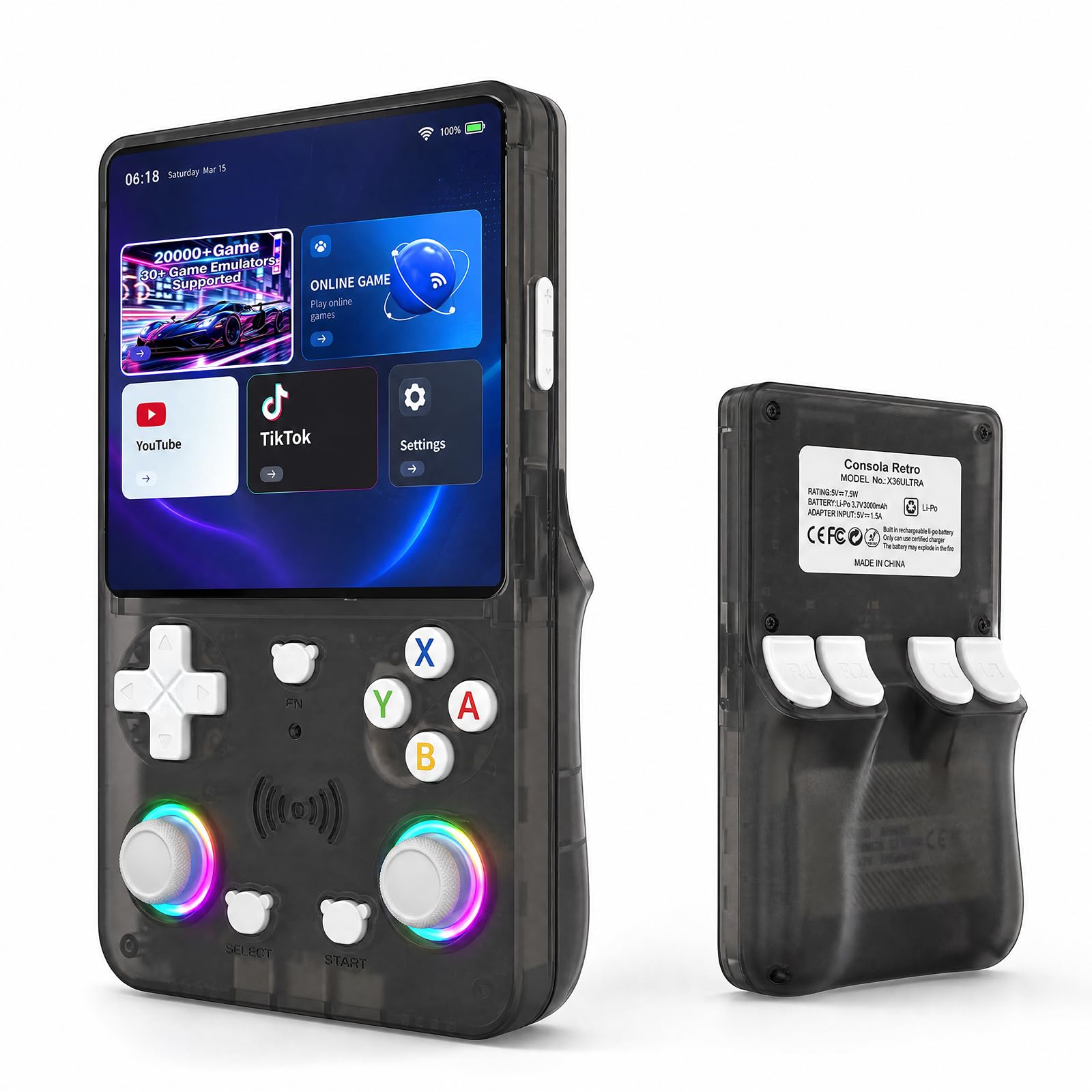
The headline is a library of 28000+ games sitting on the device, and that is not exaggerated filler — it is the same ballpark as the 28000+ figure the maker quotes for the built-in collection, versus 4353 on the RG35XX Pro and 5000+ on the Anbernic above. The 4.2-inch 720×720 IPS panel is also the clearest of the pocket-size group, with OCA lamination (an adhesive layer that glues the glass to the screen) that cuts glare and color shift, so the screen stays readable outdoors. What wins people over, backed by 29 quality mentions in the review pages, is that the volume of games survives contact with daily play rather than turning into a laggy mess.
It is not just a game box, either. Inside is a Qualcomm Gen1 quad-core CPU with a Mali 450 GPU and full Android 10 with built-in Wi-Fi, so between sessions you can drop into YouTube or TikTok. The 3500mAh lithium battery tops up in 2 hours over Type-C, so a quick charge gets you back to playing between sessions. A pair of RGB glowing joysticks handles the directional work, and the eye-care panel is tuned to reduce eye strain for long sessions.
Storage is where you plan ahead: a modest 1GB RAM + 8GB EMMC handles the base load, but a TF card slot takes expansion from 16GB to 256GB for extra games and videos. At 210g it slips into a pocket without a bulge. The trade-off is that you are managing a card and an Android app layer — it is more device to learn than a single-purpose Linux machine.
Where the X36 shines
- 28000+ built-in games on one device — no downloads, no discs
- Crisp 4.2″ 720×720 IPS screen with OCA lamination to cut glare
- Full Android 10 + Wi-Fi opens streaming alongside retro titles
- 3500mAh battery with 2-hour Type-C charging
What to keep in mind
- Only 1GB RAM + 8GB base storage — a TF card is likely needed
- Android plus emulator apps means more setup than a Linux handheld
Your move if: you want the largest built-in library in this lineup paired with the sharpest small screen and don’t mind a memory card.
Pass if: you want a pure retro machine with zero Android learning curve.
2. Anbernic RG40XX H Retro Handheld Game Console
A 4-inch screen and a body built to sit in your hands, not dangle from your fingertips.
Start with the panel: a 4.0-inch IPS display with OCA full lamination and a 640×480 resolution that renders retro sprites cleanly with true-to-life color, so old games look sharp instead of washed out. That is the same 4-inch class as the WDYQJE unit, but where the Anbernic leans in is the whole hand feel — a 200g body that fits comfortably in a pocket and a controller layout that mixes buttons with a joystick. What buyers latch onto is the build — 62 device-quality mentions and 14 for the screen say the body and the panel both land above expectations.
Under the shell runs a quad-core ARM Cortex-A53 with a quad-core PowerVR SGX544MP GPU and 1GB of RAM, which keeps system response quick when you scroll a large library or boot a heavier emulator. The library itself sits on a 64GB TF card preloaded with 5000+ games on a Linux system that accepts more titles in the correct format. Connectivity is generous: HD output to a TV, a vibration motor, Wi-Fi online pairing, and support for 2.4G wireless and wired controllers for two-player sessions.
The 3200mAh polymer lithium-ion battery is rated up to 8 hours of continuous play. The honest caveat is coverage: the preloaded set omits some familiar first-party Nintendo staples, and a few owners note games occasionally stopping mid-session — so treat it as a strong curated collection, not a complete one.
Screen that impresses: the 4-inch IPS panel looks better than expected in person, and the 16 million color RGB joystick lighting lets you pick a glow.
Fit note: if certain famous Nintendo series are the whole reason you are buying, check the game list first — this library does not carry them.
Reach for this if: you want a bigger 4-inch view with a proper controller layout for two-player Wi-Fi fights.
Look elsewhere if: your must-have list is built around Nintendo titles.
3. My Arcade Atari Gamestation Go
The one that turns a shelf into an arcade, with a 7-inch screen and licensed Atari in the box.
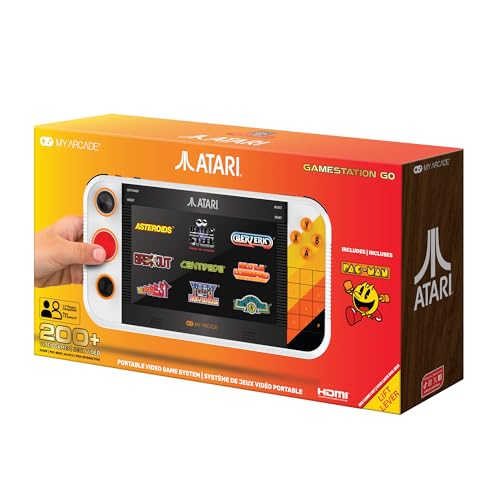
No other unit here has a 7-inch full-color display, and that single number changes who this is for — it is a sit-down, two-handed machine, not a pocket player. The library is 200+ built-in games, and the appeal is authenticity: officially licensed titles that span Atari 2600, 5200 and 7800 originals, Atari Arcade, Atari Recharged, M-Network, and Balls of Steel pinball tables, with PAC-MAN and licensed Jaleco and PIKO Interactive games rounded in. For a fan of that era, the nostalgia is the product — and it shows in the review pages, where 31 nostalgia mentions sit right behind 37 for gameplay.
What makes it feel like a cabinet is the control deck: an integrated paddle, d-pad, trak-ball, numeric keypad, bumpers, and classic A/B/X/Y gamepad buttons let you play each title the way it was originally designed. It outputs over HDMI to a TV and carries built-in Wi-Fi for easy updates, and it runs on a built-in rechargeable battery so it is not tethered to a wall. Game save options let you pick up where you left off.
Be clear-eyed about the fit. Build quality draws mixed feedback — the plastic does not feel premium to everyone — and the control set and game selection split opinion. This is a collector’s showpiece and family-arcade piece, priced at the top of this group, so buy it for the Atari legacy and the TV hookup, not for a cutting-edge screen.
The Atari argument: licensed 2600, 5200, 7800, Arcade and Recharged titles plus PAC-MAN in one unit — the widest officially licensed retro wall you can plug into a TV.
Size the trade-off: the shell and controls feel ordinary for the top-tier spend; treat this as memorabilia with HDMI, not a premium build.
Built for: the Atari generation who wants the 7-inch console on a coffee table and on a TV over HDMI.
skip it if: you need a pocket unit or a metal-feeling chassis.
4. RG35XX Pro Handheld Game Console

Twin joysticks on a pocket console — the setup that finally makes fighting games playable.
Two joysticks on a handheld this small is the whole point. The H700 quad-core ARM Cortex-A53 chip runs at 1.5GHz with a dual-core G31 MP2 GPU, tuned specifically to solve frame dropping, so the 4353 games on the bundled 64GB card actually hold their frame rate under pressure. That dedicated hardware is what earns the 52 game-quality mentions that lead the review pages for this unit — people notice the games run right.
The 3.5-inch IPS panel uses full viewing angle and OCA full lamination at 640×480, protected by tempered glass for scratch and drop resistance. Unlike the bigger Anbernic above, this one keeps a compact case that slips into a pocket at 6.56 ounces. Connectivity is surprisingly full: HDMI output to a TV, Wi-Fi online pairing and streaming, a vibration motor, and support for 2.4G wireless and wired controllers. The Linux system accepts more emulators and game formats, and it covers 30+ simulators.
Power comes from a 3200mAh battery rated up to 8 hours, recharged over USB Type-C. The caveat that keeps it off the top step is long-run reliability — a portion of buyers report units that stop working over time, and battery life is the weakest rep in its review pages. It is a great pick if you want the dual-stick layout and a huge card in your hand today.
The dual-stick edge
- Two joysticks plus a d-pad erase the clumsiness of one-thumb retro play
- H700 quad-core 1.5GHz chip built to stop frame dropping
- 4353 games on a 64GB card, 30+ simulators, HDMI and Wi-Fi included
The honest limits
- Battery stamina is the most-complained area for this model
- Long-term reliability is uneven in a slice of buyer reports
Go for it when: two joysticks and a big preloaded card matter more to you than a top-tier screen.
Consider the X36 instead if: you want the bigger 28000+ library and a sharper 720×720 panel.
5. WDYQJE Retro Handheld Game Console

Ten hours on a charge — the one that keeps going through the longest travel day in this lineup.
The figure that sets this unit apart is a 4000mAh rechargeable battery rated up to 10 hours of gameplay — the longest advertised runtime among these picks, longer than the 5 hours of the kids’ 32-bit unit. Pair that with a 4.0-inch IPS panel with scratch-resistant tempered glass at 720×720 resolution, and you have a sharper travel screen than the RG35XX Pro’s 640×480, on a body that stays pocketable.
The brain is a 1.5GHz 64-bit RK3326 CPU with a Linux-based ARM64 quad-core Cortex-A35, built to run smooth emulated play. Storage is 64GB of built-in memory with an expandable TF slot, so 18000+ classic games come preloaded and you can add more without touching the internet. What wins people over is the out-of-box experience — the picture comes up sharp, the menu is straightforward, and 24 quality mentions back up that it feels well-built.
Built-in speakers and a 3.5mm headphone jack cover audio. The recurring caution is reliability: a slice of owners mention a unit that suddenly stops working, so buy knowing a warranty matter is possible rather than certain. For pure battery endurance and a bright HD screen, it still leads its class here.
Endurance play: a 4000mAh cell rated up to 10 hours means a full trip day on one charge — no wall hunting mid-flight.
Where it wobbles: reliability is mixed in the review pages, and a rare unit gives out early; the strong majority keep playing.
Best suited to: frequent travelers who want the longest single-charge runtime and a sharp 4-inch screen.
Not the pick if: rock-solid long-term reliability is your deal-winner.
6. My Arcade Atari Pocket Player
A tiny vertical Atari cabinet you can hold in one hand, made for the shelf and the trip.
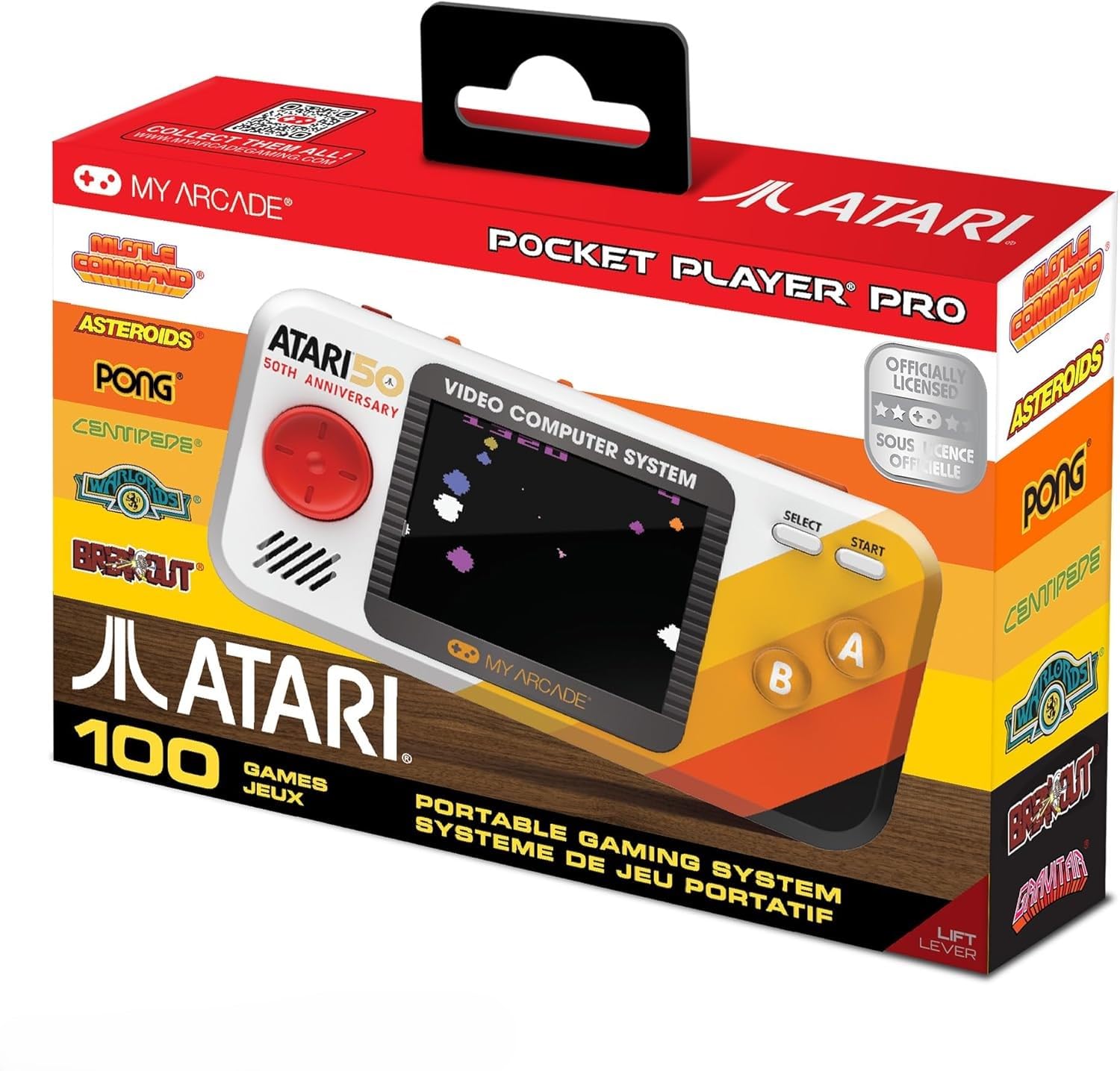
This is the most collectible unit here, and the story is the point. It carries 100 officially licensed Atari games — Pong, Yars Revenge, Breakout, Asteroids, Centipede, Missile Command and more — on a pocket-sized 2.75-inch full-color vertical display, with a 3.5mm headphone jack and a built-in speaker with volume control. The gameplay is fun for trips, and 14 nostalgia mentions show exactly why buyers reach for it: it feels like holding the original era.
The controls are button-based with brightness adjustment for different light. Power is the key difference from every other pick: it runs on 4 AA batteries (not included) or a USB-C cable (not included), and the maker stresses using standard non-rechargeable batteries. That means no built-in lithium cell to worry about — you swap AAs and keep going. It speaks nine languages in the user guide, a nod to its collector reach.
Two honest fit notes. The screen is genuinely small at 2.75 inches, and the graphics are not arcade-perfect to every purist — Amazon’s read of buyer feedback calls both mixed. Quality draws the most discussion of any aspect here, and some buyers felt it did not feel premium. But those who want the Atari badge and the pocket vertical format get it, wrapped in an attractive shell.
Worth it for: the Atari collector who wants an authentic vertical-format pocket piece and is fine with AA batteries.
Think twice if: you expect a large screen or precise arcade-accurate graphics — this is the small-format nostalgia unit.
7. Douddy 32 Bit Handheld Games for Kids

A small hands-first console that packs 139 games and a rechargeable battery into a light shell.
This is built for a child’s grip. It houses 139 handpicked 32-bit games split across genres like Casual, Puzzle and Sports, so a young player can jump straight in without a steep learning curve. The 3.0-inch IPS screen gives vivid color and a clear interface for the size, and — the detail parents care about — it comes with a printed game guide in the manual to help a beginner master each title. Engagement is the whole game, and 117 gameplay mentions say it keeps kids busy for hours.
Unlike the AA-powered Atari Pocket Player, this one is fully rechargeable via USB-C, so no disposable battery runs. Its arcade-style joystick gives more precise control than a plain button cluster, and the ergonomic body is sized for small hands. It plays indoors, travels well as a carry toy, and ships with the console, a lithium battery, a USB-C cable and the manual.
Set expectations on the screen and battery — both draw mixed feedback, and a few buyers hit a screen that stopped working or a unit that would not charge. The battery is rated 5 hours, so it is a solid single outing rather than a whole-day companion. For a first console that entertains a child without complex setup, it earns its keep.
Why kids take to it
- 139 games across Casual, Puzzle and Sports with a printed game guide
- Rechargeable via USB-C — no disposable batteries to keep buying
- Small, ergonomic shell with an arcade-style joystick for small hands
Where it asks for care
- 5-hour battery rating means a single outing, not a full day
- Screen and charge reliability are the weakest points in buyer feedback
Pick this for: a first-time young gamer who needs few rules and instant play with a rechargeable battery.
Look past it if: you need a long runtime or a large screen for older players.
8. SNONBROS Portable Video Game Console for Kids
A built-in kickstand and a mute button — details that make it the easiest to hand to a child on a road trip.
Where most units just sit in your palm, this one has a built-in kickstand that props it up for hands-free play on any surface, so a kid can set it on a tray table and watch. There are 220 preloaded games across puzzles, action, sports and logic — no Wi-Fi, no ads, no downloads required. That offline design is why it fits car trips and flights so naturally, and 75 gameplay mentions plus 22 for value confirm buyers find it does the job.
The 3.5-inch IPS display has three adjustable brightness levels so it works in a sunny car or a dim waiting room, and the volume knob plus a one-key mute give you control in a library or clinic. Plug in headphones and your child gets a private space without disturbing anyone. The rechargeable battery is 1800mAh rated at 6+ hours, and the whole thing is compact enough to fit a backpack or pocket.
Two trade-offs to know going in: the battery actually lasts a shorter stretch than the rating for some, and durability draws mixed feedback, with a rare unit failing early. It is a superb little travel toy at a budget-friendly place in this list — just not a rugged one.
The travel win: a kickstand, three brightness levels, and one-key mute make it the most considerate console to hand a child in a shared space.
Treat with care: mixed durability feedback suggests it is not built for drops, and battery life runs below the 6+ hour figure for some.
Made for: parents who want a self-contained, offline car-trip game that props up on its own.
Skip if: it will live in a rough-and-tumble bag, where durability may not keep up.
9. JJFUN Handheld Games for Kids with 200+ Retro Games
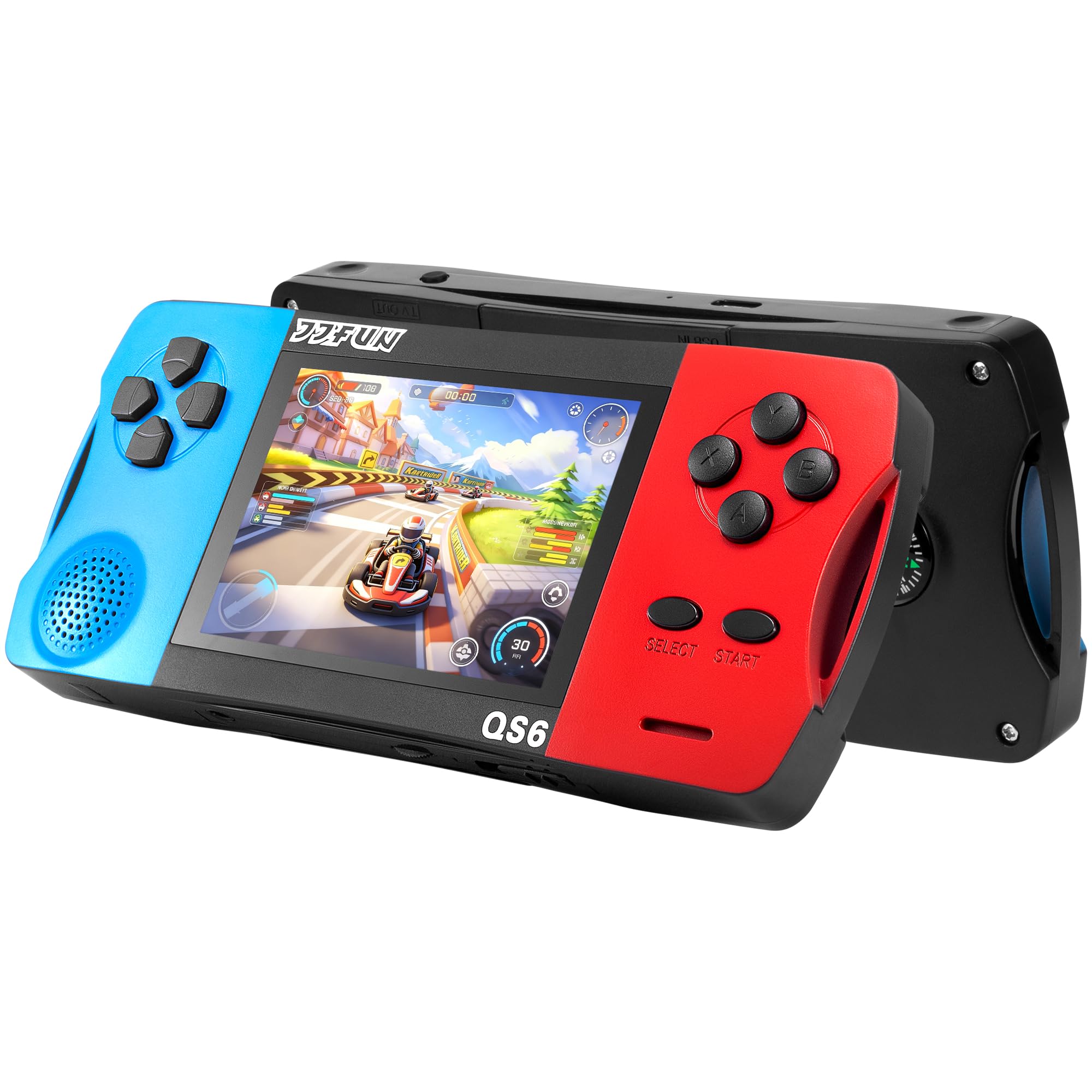
The simplest way to hand a young child 200+ games with zero internet and almost no setup.
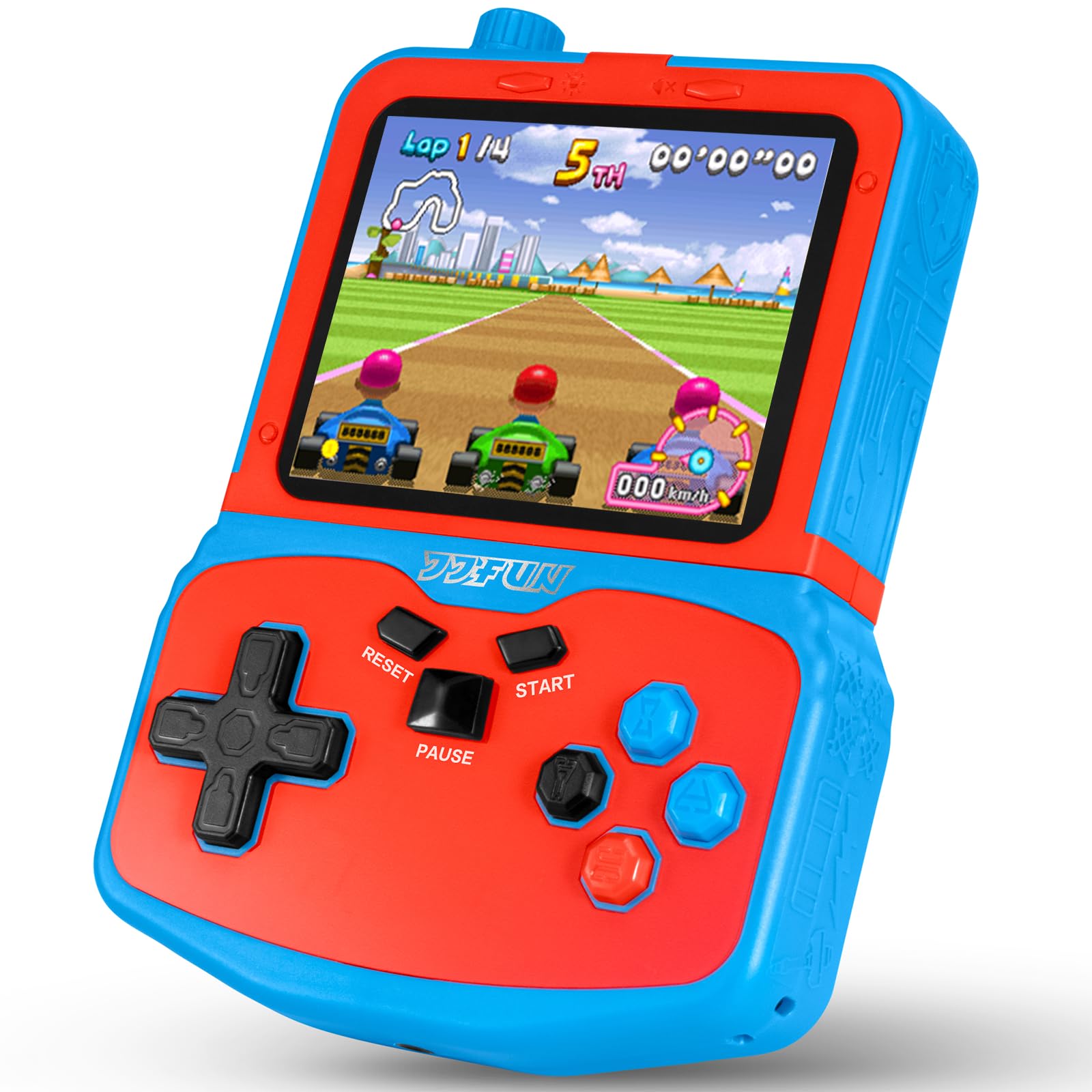
Built squarely for long car rides, flights and family trips, this one leans into being an offline travel toy: 200+ classic retro games on a 3.5-inch LCD screen, no Wi-Fi or internet needed to start playing. At 0.25kg it stays light for small hands, and the battery is rated 5 hours — long enough for a journey leg. Game quality is what stands out, backed by 46 mentions in the review pages, so the titles themselves hold up for kids.
It ships with the console, a charging cable and a user manual, and the age range is listed broadly as 3–70 years old, reflecting its family-toy positioning. There is no iOS-style setup here — charge it, pick a game, and let the child learn the controls. The buttons keep young players engaged, and it holds a little one’s attention without a screen that needs managing.
Be realistic about the budget spot in this list. Functionality and value draw mixed feedback, with a small number of units reported not working and some feeling it was not worth the spend. A 3.5-inch LCD panel and 5-hour battery also trail the IPS-screen and 8-to-10-hour units above. Buy it as a low-cost starter for a small child, not as a serious retro machine.
The smart buy for: a grandparent or parent wanting an offline, up-and-running gift for a young child with next to no setup.
Know the ceiling: the LCD screen and 5-hour battery are the entry-level spec here, and a rare unit arrives faulty.
Understanding the Specs
Built-in Games and Emulators
An all-in-one console stores the games on internal memory or a bundled memory card — that is what “plug and play” really means. The count can run from 100 on the Atari Pocket Player to 28000+ on the X36 Ultra. That number is the raw library size, not a guarantee every title runs smoothly. A “simulator” (or emulator) is the software that mimics the old hardware, so an all-in-one unit that lists 30+ simulators can run many classic systems from one device. The practical question is whether the chip is strong enough — a quad-core processor keeps those games from stuttering.
Screen Size, Resolution, and IPS
Size and resolution both matter, because a 720×720 panel stays crisp where a 640×480 one blurs small text. IPS (in-plane switching) is a panel type that keeps colors steady when you tilt the console — crucial on a handheld you hold at an angle. Resolution describes how many pixels it shows: a 720×720 panel is sharper than a 640×480 one at a similar size. Full OCA lamination glues the glass directly to the screen to cut glare. A vertical 2.75-inch panel stays tiny in a pocket, while a 7-inch display turns the unit into a sit-down machine.
Battery Capacity and Playtime
Battery capacity in mAh (milliamp-hours) measures how much charge the battery holds, and it usually predicts longer play — 1800mAh is smaller than 4000mAh. But the chip draws power too, so the advertised playtime is the number to compare directly: 5, 6, 8, or 10 hours on these picks. Some units, like the Atari Pocket Player, run on AA batteries instead of a built-in lithium cell, so there is nothing to charge — just swap cells. For a long flight, compare the advertised playtime directly: 5 hours on the kids’ units versus 8 to 10 on the mid-range machines.
Storage and Memory Cards
Storage is where the games physically live, measured in gigabytes. A unit with a 64GB card preloaded is ready from the start, while a slimmer 8GB base like the X36 Ultra relies on a TF card (a tiny memory card, also called microSD) to hold a bigger collection. Android units add RAM — the working memory the system uses while running — and more RAM keeps menus snappy. If you plan to add your own games, check that the unit has a card slot you can expand.
FAQ
Do I need Wi-Fi or a subscription to play an all-in-one game console?
How many built-in games is enough for a child?
Will a 3.5-inch screen be too small for adults?
Can I add my own games to these handhelds?
How long does the battery actually last on a long flight?
Is an Android handheld better than a Linux one?
Can these consoles connect to a TV?
Are the preloaded games the same on every console?
Do these handhelds come with a charger or batteries included?
What age are these all-in-one consoles really made for?
Final Thoughts: The Verdict
The all-in-one game console that suits most people is the X36 Ultra, because it stacks the largest built-in library (28000+ games) on the sharpest pocket screen and still adds Android streaming — the widest single gadget here. If a bigger 4-inch view and a proper controller layout matter more, take the Anbernic RG40XX H. And for the longest single-charge runtime on a travel day, the WDYQJE with its 10-hour battery is the one to reach for. Any of the three makes a genuinely easy, no-download starting point — just match the screen and battery to how you actually play.
How We Picked
We do not accept paid placement. Every pick is matched to a real buyer and a real use-case; we do not hands-on test units.
Sources & Methodology
Specifications: manufacturer listings and product documentation. Review insights: verified customer reviews, as of November 2026. Pricing: not shown on this page (it changes often); check the current price via the retailer link.
As an Amazon Associate, Gadgets Feed earns from qualifying purchases. This does not affect which products we feature.