
Our readers keep the lights on and my morning glass full of iced black tea. As an Amazon Associate, I earn from qualifying purchases.
Specs are compiled from manufacturer listings and verified buyer reviews and can change over time — please confirm the key details on the product page before buying.
Holding 12x steady in your hands is hard, and that one fact decides most of this list. A 12×50 gives you a 50mm objective lens (the big front glass that gathers light) and 12x magnification (the image arrives twelve times closer than your naked eye sees it). That combo is exactly what you need to pick an animal out of thick timber at last light. It is also the recipe for a shaky, dim picture if the glass, the coatings, and the eye relief are not built to match. Buy the wrong pair and you get a heavy tube that fogs in the rain and leaves you squinting.
I’m Min — the founder and writer behind Gadgets Feed. This guide is built by comparing the manufacturers’ published specifications and the patterns across verified customer reviews, so you get each pick’s real strengths and trade-offs instead of marketing spin.
Below you’ll find the light-gathering, eye-relief, and weatherproofing details that actually separate these nine optics, laid out so you can match a pair to your hunt rather than to a spec sheet. Every pick here is a true 12×50 — no 10x, no 42mm — so the comparison stays honest as a set of 12×50 binoculars for hunting.
Our Picks at a Glance


How To Choose The Best 12X50 Binoculars For Hunting
The magnification and the objective size are already fixed — you asked for 12×50, and every pair here delivers it. What changes from one model to the next is how much light reaches your eye, how comfortably the eyecups sit against your face, and how well the body survives a wet morning in a treestand. Those three things decide whether you actually see the animal or just see a blurry brown shape.
Exit pupil: the number that decides your last hour of light
The exit pupil is the little bright disc of light that leaves the eyepiece and enters your eye — think of it as the window your pupil looks through. A 4.2mm exit pupil is a healthy size for hunting because it keeps the image bright when the sun drops. It is also forgiving if your head moves slightly on the stock. Anything noticeably smaller makes the picture go dark the moment the light fades.
Eye relief and eyeglass wearers
Eye relief is the distance between the lens and your eye where the full picture appears — measured in millimeters. If you wear glasses, a short figure forces you to press the eyecups into your frames to see the whole view. A longer eye relief lets you keep your glasses on and still get the full circle. Twist-up or turn-and-slide eyecups add another layer of adjustment for the same reason.
Coatings and prism glass
Fully multi-coated lenses mean every air-to-glass surface has a coating to cut glare and let more light through. Dielectric or phase coatings on the prisms keep colors vivid and stop the image going soft at the edges. ED (extra-low dispersion) glass goes further and cancels chromatic aberration — the colored fringe that shows up on a white-tailed buck against a gray sky. None of these make a pair heavier; they just make it sharper.
Weatherproofing for real hunts
Fogproof means the inside of the tube is purged with a dry gas and sealed so moisture cannot condense on the prism when you carry it from a warm truck into cold air. Waterproof ratings like IPX7 mean the body survives rain, splashes, and a dunking. A rubber-armored chassis adds grip when your hands are wet or gloved.
Quick Comparison
| Model | Best For | Exit Pupil | Eye Relief | Waterproof / Fogproof | Amazon |
|---|---|---|---|---|---|
| Vortex Viper HD 12×50★ Best Overall | All-around hunting | 4.2 mm | 16 mm | Argon purged, o-ring sealed | Amazon |
| Leupold BX-4 Pro Guide HD 12×50 Gen 2Top Performer | Premium glass | 4.17 mm | — | Waterproof and fogproof | Amazon |
| Nikon PROSTAFF P7 12×50Best Field of View | Wide field scanning | 4.2 mm | 16.4 mm | Waterproof and fogproof | Amazon |
| Pentax Jupiter 12×50 | Budget entry | 4.2 mm | 11 mm | — | Amazon |
| Bushnell Prime 12×50 | Wet-weather value | 4.2 mm | — | IPX7 waterproof | Amazon |
| Bushnell R5 12×50 | Long-range glass | 4.17 mm | 13.5 mm | IPX7 waterproof | Amazon |
| Leupold BX-1 McKenzie HD 12×50 | Light carry | 4.1 mm | — | Waterproof and fogproof | Amazon |
| Celestron Nature DX ED 12×50 | Color-true views | 4.1 mm | 14.3 mm | Waterproof, nitrogen purged | Amazon |
| Athlon Argos G2 HD 12×50 | Bright field glass | 4.17 mm | 16 mm | — | Amazon |
In‑Depth Reviews
1. Vortex Viper HD Roof Prism Binoculars 12×50
Our pick — 4.5+★ from 450+ verified ratings; the strongest balance of quality and price.
The all-around 12×50 for hunters who want sharp glass, argon purging, and a transferable lifetime warranty in one pair.
What wins people over here is build quality — it is the thing the review pages praise most by a wide margin. That matters in a hunting binocular because a bump against a treestand rail should not end your morning. Vortex backs it with an unlimited, unconditional, lifetime VIP warranty that transfers if you sell the pair on, and that promise is a real part of what you are buying.
Colors stay vivid and edges stay sharp rather than soft, thanks to fully multi-coated optics with a dielectric prism coating (a mirror layer on the prism that boosts light reflection). A 16mm eye relief (the distance your eye sits behind the lens) is generous enough that glasses wearers can keep their frames on. That sits well ahead of the Pentax Jupiter’s 11mm — a meaningful gap when you are trying to get a full circle of view in a hurry. The exit pupil (the bright circle of light your eye sees) measures 4.2mm, so the image stays bright as dusk settles over a field.
The body is rubber-armored with thumb indents shaped for a steady grip, and argon purging with o-ring seals keeps fog off the inside of the glass. A locking right-eye diopter lets you set each barrel to your own eyes and forget it. The included GlassPak chest harness carries the weight off your neck all day, which is the difference between a comfortable sit and a sore one.
What’s the catch? The 5.5-degree apparent angle of view is narrower than several picks here, so your sweep across a hillside covers less ground per glance. Some owners find the size and weight a compromise worth knowing about before you commit. It is the trade for the compact, armored build.
Where it earns its place
- Lifetime VIP warranty that transfers with the binoculars
- 16mm eye relief works well with glasses
- GlassPak chest harness included for all-day carry
Worth knowing first
- 5.5-degree apparent angle of view is on the narrow side
- Size and weight leave some owners wanting lighter
Buy this one if: you want one pair that handles glass quality, weather, and warranty in a single purchase.
Think twice if: you sweep huge open country and need the widest possible view per glance.
2. Leupold BX-4 Pro Guide HD Binoculars, 12x50mm Gen 2 (184763)
The premium 12×50 with a 65.2-degree apparent field that lets you judge an animal’s mass at 400 yards.
Start with the view: this binocular carries a 65.2-degree apparent angle of view, which is the widest figure among the picks here and a big part of why it feels so easy to use. Panning across a ridge, you cover more ground with each pass instead of inching the tubes sideways. Leupold’s Elite Optical System is the marketing name for the lens and coating package that pushes light transmission up and glare down.
Owners describe optical quality that competes with glass far above its class, with visibility reported out to 400 yards. That is real long-range capability — the kind of reach that lets you judge an animal’s mass instead of just seeing that something is there. Guard-ion lens coating sheds water, dirt, and fingerprints, so a thumbprint wiped off in the field does not smear into a permanent haze.
The open-bridge, dual-hinge frame keeps the body slim and light at 1.8 pounds, which carries well on a sling through a long stalk. It is waterproof and fogproof, and the hydrophobic coating handles the wet side of a cold morning. A diopter of +/- 3 or +/- 4 lets you tune it to your eyes.
Here is the honest trade: the highest optical quality on this list comes at the highest price of the group. Eye relief is not published in the spec sheet, so if you wear glasses, confirm that figure before you buy. For everyone else, the glass does the talking.
The field view: a 65.2-degree apparent field means you sweep country fast and still get a crisp, glare-controlled image at the edges.
Fit check: 1.8 pounds keeps it off your shoulder fatigue list, though the eyeglass-wearer eye relief figure needs confirming before purchase.
Worth it for: the hunter who judges trophies at distance and refuses to accept a soft edge.
Hold off if: your budget is tight or you depend on a published eye relief number for glasses.
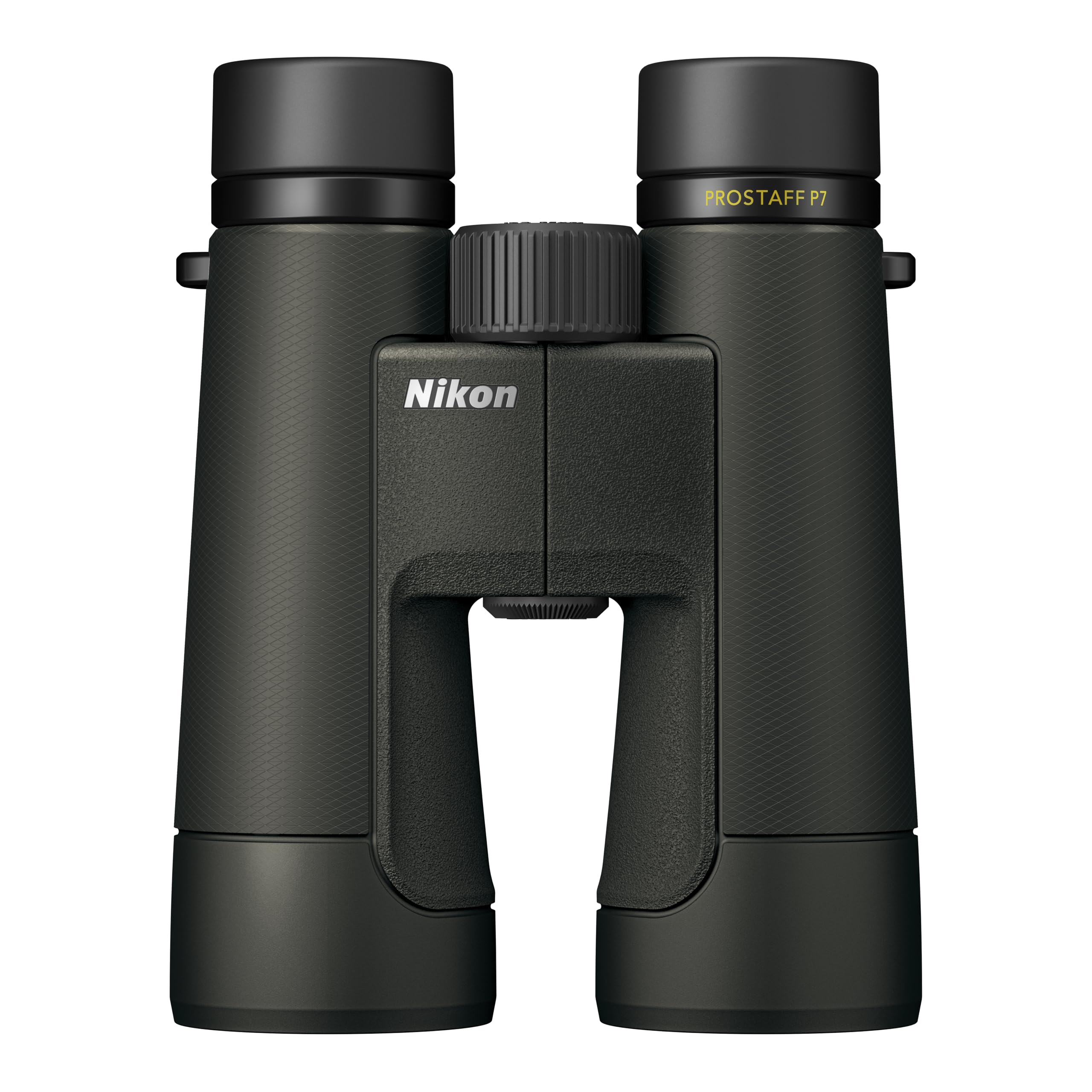
3. Nikon PROSTAFF P7 12×50 Binocular
16.4mm eye relief and turn-and-slide eyecups let glasses wearers keep their frames on and still see the full circle.
The number that jumps off this sheet is the 293-foot field of view — the width of the scene you see at a standing distance, and wide enough to catch movement in your peripheral vision while you glass. A 60.8-degree apparent angle of view backs that up. For still-hunting where you catch a flicker of an ear and then stop to study it, a wide picture is a real advantage.
Eye relief is 16.4mm, the longest published figure in this group, and it pairs with turn-and-slide rubber eyecups that click into position. Translation: eyeglass wearers can keep their glasses on and still see the whole circle. Multilayer-coated lenses and a 50mm objective lens keep the image bright as light fades, and the 4.2mm exit pupil is right in line with the best here.
The body is aluminum and rubber, waterproof and fogproof, with a central focus knob that is quick to grab with gloves on. A locking diopter holds your eye-to-eye setting. The 12x magnification is honest — detail on a distant animal rather than a blurry guess.
What is not in the numbers? That is not a flaw in the glass, just a fair caveat on how much crowd wisdom you get to borrow.
What makes it easy to live with
- 293-foot field of view is the widest here
- 16.4mm eye relief is the longest published in the group
- Turn-and-slide eyecups click for a glasses-friendly fit
What to weigh
- Shorter review track record than the established picks
- Wide field of view means less magnification focus per glance
Made for: the hunter who wears glasses and still wants a wide, bright picture.
Less ideal for: buyers who want a long, well-worn review history before they commit.
4. Celestron Nature DX ED 12×50 Premium Long-Range Binoculars
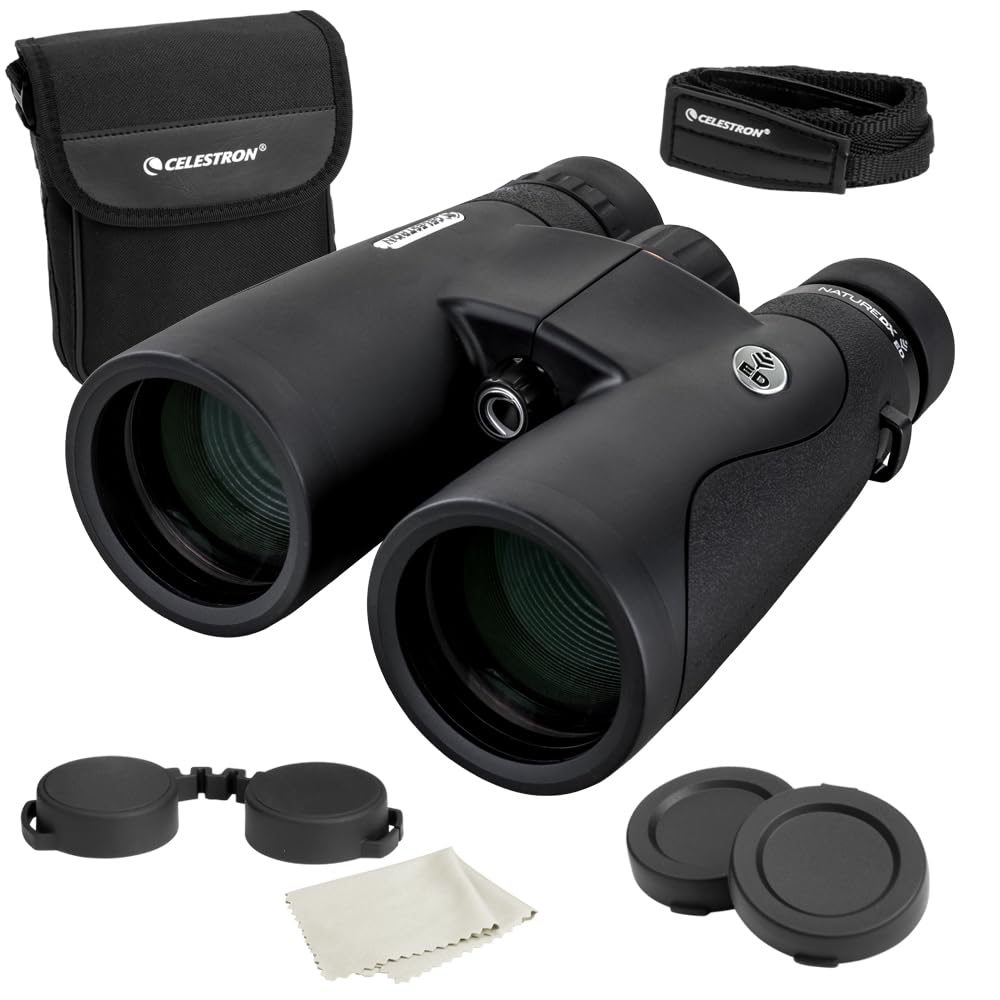
ED objective glass cancels the colored fringe that plain lenses show on a buck against a gray January sky.
The reason to look at this one is the ED (extra-low dispersion) objective glass. It targets chromatic aberration — the colored fringe that shows up around a subject when plain glass cannot bring all wavelengths into focus at once. Swap out a pair without ED for this and the antlers stop glowing purple at the edges. Owned by hunters and birders alike, the optical quality is the consensus strength.
BaK-4 prisms with dielectric and phase coatings keep light transmission high and the image sharp to the edge. The exit pupil measures 4.1mm, a touch smaller than the 4.2mm of the Bushnell Prime but still plenty for dawn and dusk. Eye relief is 14.3mm and the 50mm objective lens pulls in the light you need when the shadows stretch.
Rubber-armored polycarbonate housing, waterproof and nitrogen-purged, handles rain, snow, and humidity. There is a built-in tripod adapter socket, so you can mount it on a standard tripod (adapter sold separately) for extended glassing without shake. It is backed by a Limited Lifetime US Warranty.
The two things to weigh: the apparent angle of view is listed at 4.8 degrees, notably tighter than the Bushnell R5’s 57 degrees, so your sweep covers less country. And the focus mechanism draws mixed feedback — some find it smooth, others less so. Weight opinions split too, with some describing it as lightweight and others as heavy. None of that undercuts the glass; it just means you should try the focus feel yourself if you can.
The ED advantage: color fringing disappears from high-contrast subjects, so a far-off animal reads true rather than rimmed in purple.
The honest caveat: a tighter apparent field and a focus wheel that some love and some don’t — and the tripod socket needs an adapter you buy separately.
Pick it for: a clear, color-accurate image on high-contrast game at a mid-range price.
Pass if: you sweep wide open country and want maximum view per glance.
5. Athlon Optics 12×50 Argos G2 HD Gray Binoculars

A magnesium chassis that sheds weight while ESP dielectric prisms reflect over 99% of the light to your eye.
Owner feedback keeps coming back to quality, and the ESP dielectric coating is the reason. It is a multi-layer prism coating that reflects over 99% of the light to your eyes, so the image arrives bright with accurate color reproduction — exactly what you want when the forest floor is dim and the target is in shadow. XPL coating adds a protective layer on the exterior lenses against dirt, oil, and scratches. That matters on a hunt where you set the glass down on rock or branch.
The magnesium chassis gives you the strength of metal while shedding weight, so a full day on a sling is less punishing. Eye relief is 16mm, generous enough for glasses, and the 4.17mm exit pupil sits right alongside the Bushnell R5’s 4.17mm — both keep the picture bright as the light drops. A 49-degree apparent angle of view and a 4.9-degree field of view round out the picture.
Covered by an Athlon Lifetime Unlimited warranty — no receipt required, no registration needed, and 100% transferable. That removes the paperwork worry when you buy.
The honest limit: focus draws mixed feedback, with some owners finding it difficult to focus on their first try. It is a matter of feel rather than a defect. If you are patient and dial it in, the rest of the package is a lot of brightness and metal for the money.
Why it earns a spot
- ESP dielectric coating reflects over 99% of light for a bright, color-true image
- Magnesium chassis keeps weight down without losing strength
- Transferable lifetime warranty with no receipt or registration
Where it asks patience
- Some owners find the focus difficult to dial in
- 49-degree apparent field is unremarkable
Suits you if: you want a bright, light, metal-bodied pair with a low-maintenance lifetime warranty.
Reconsider if: you insist on a focus wheel that grabs you right from the start.
6. Bushnell R5 12×50 Binoculars
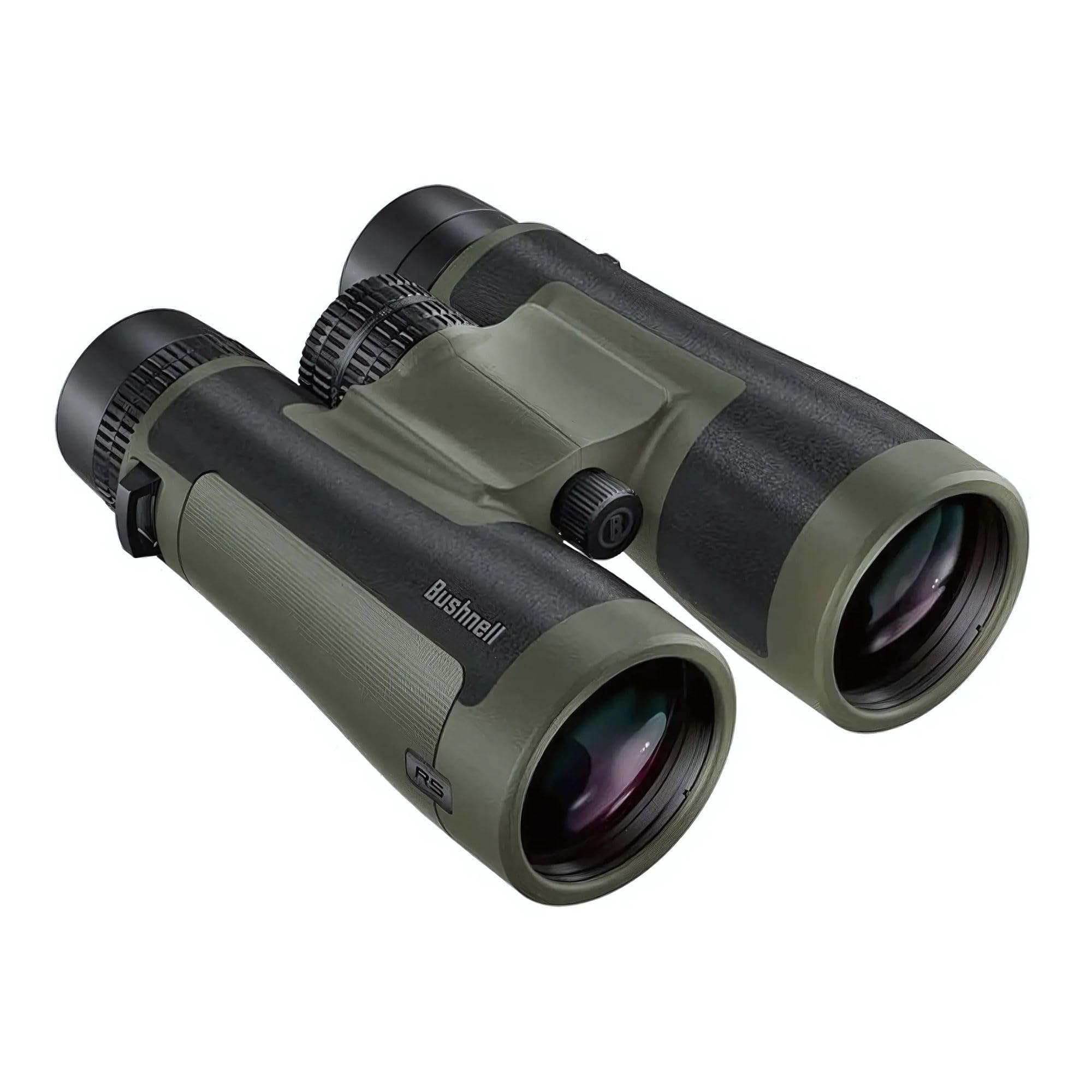
A 57-degree apparent field and Phase 3 prism coatings make this the pick for sweeping open ridge country.
If you glass across open country, start here. The 57-degree apparent angle of view (how wide the picture looks through the eyepiece) is the widest of the roof-prism picks in this group. So you cover more ground per sweep than you do with the Celestron at 4.8 degrees — one of the bigger view-width gaps in the list. Phase 3 coatings and dielectric prism coatings work together to cut light loss and distortion, delivering vivid color and sharp views in every condition.
EXO Barrier is Bushnell’s exclusive permanent coating on the exterior lens surfaces, repelling water, oil, fog, dust, and debris. Wipe it off with a sleeve and the image stays clear — a real advantage in the field. IPX7 waterproofing means the body is fully sealed against rain, splashes, and even accidental submersion. A 13.5mm eye relief and 4.17mm exit pupil complete the optical picture, with continuous diopter adjustment.
The shockproof, rubber-overmolded body is built for a season of bumps, and a Vault LITE binocular harness and comfort neck strap are included so you can carry it two ways from day one.
The trade-off: 13.5mm eye relief is shorter than the Vortex’s 16mm, so glasses wearers may need to press in a little closer to get the full circle. And the model is newer to market, so the owner base is smaller. Neither takes away from the glass — it is a fair reason to confirm the fit yourself.
The scan advantage: a 57-degree apparent field covers more ridge line per sweep than several picks here, and Phase 3 coatings keep it bright.
The fit note: 13.5mm eye relief is shorter than the Vortex’s 16mm — glasses wearers should test the eyecup position.
Reach for this: if glassing wide country for long, moving game is the way you hunt.
Size up elsewhere: if your glasses demand the longest eye relief available.
7. Leupold BX-1 McKenzie HD Binoculars, 12x50mm (181175)

An open-bridge Leupold with BAK 4 prisms that carries light on a sling all day.
What people keep coming back to with this pair is the Leupold name and what it stands for — the quality reputation and the bargain it represents at this tier are the two things owners talk about. An open-bridge, roof-prism design lets you wrap your hands around the barrel for a firm, low-profile grip, and the frame is described as extremely lightweight and ergonomic. Carry it all day and it does not become a chore.
BAK 4 prisms deliver a perfectly round exit pupil with virtually no edge distortion, and the 4.1mm exit pupil keeps the image usable when the light drops. Fully multi-coated lenses push brightness and color fidelity. The body is aluminum and waterproof and fogproof, backed by Leupold’s customer care.
If you want a well-known brand’s glass and ergonomics without paying premium-tier money, this is the one to shortlist. It is a straightforward hunting binocular with no gimmicks.
The thing to check: at 4.1mm the exit pupil is the smallest in this group, so the brightest end of twilight is where it gives up a little to the 4.2mm and 4.17mm picks. Eye relief is not published, so glasses wearers should confirm it before ordering. The 41.67-degree apparent angle of view is also narrower than most here — for a compact carry that is the trade.
Strong points
- Open-bridge design for a firm, low-profile grip
- BAK 4 prisms give a round exit pupil with little edge distortion
- Leupold quality and value at this tier
Check before buying
- 4.1mm exit pupil is the smallest here for true dusk light
- 41.67-degree apparent field is narrow for wide scanning
Best matched to: a hunter who values light, comfortable carry and a trusted brand name.
Look past it if: you want the widest picture and brightest dusk image in the group.
8. Bushnell Prime 12×50 Binocular, IPX7 Waterproof

IPX7 sealing and a 4.2mm exit pupil make this the weatherproof entry-level 12×50.
Weatherproofing is the lead feature here. IPX7 waterproofing means the body survives rain, splashes, and being dropped in a puddle, and the aluminum build is fully multi-coated for a brighter image than the price might suggest. The 4.2mm exit pupil matches the Vortex and Pentax figure — actually 4.2mm against the Leupold BX-1’s 4.1mm — so it holds up in fading light better than you would expect at this tier.
Manual focus keeps things simple, and the included covers and case mean you can take it from the start and go. It is a sound first pair for a new hunter or a spare that stays in the truck.
The limits are what you would expect at the entry tier. The owner feedback base is thinner, so there is less crowd wisdom to draw on, and eye relief is not published — check that if you wear glasses. This is not the pair for a dedicated trophy hunter chasing the last five minutes of legal light. It is the one for a hunter who needs a real 12×50 that handles weather without a premium spend.
What you get: IPX7 sealing, a 4.2mm exit pupil, and a fully multi-coated aluminum body at the entry tier.
What you don’t: a published eye relief figure or a deep owner history — and it is not built for the very last minutes of light.
A fair first pair for: the new hunter who wants a weatherproof 12×50 without a premium spend.
Not the pick if: you hunt the final minutes of legal light and want every scrap of brightness.
9. Pentax Jupiter 12×50 Porro Prism Binocular

The porro-prism budget pick that gathers light through a big front lens.
Porro prisms place the glass in a stepped, offset shape rather than a straight tube, and Pentax pairs that here with a large-aperture objective lens for strong light-gathering. The optical elements are multi-coated to cut unwanted reflection, which is why the image comes through brighter than the price bracket suggests. The 4.2mm exit pupil matches the Vortex and Bushnell Prime figure, so low light is not a weak point.
The exterior rubber coating gives a firm hold and helps prevent slippage with wet hands, and the focus ring is easy to reach. There is an optional TP-3 tripod adapter for mounting it up for long glassing sessions. A 50-degree apparent angle of view and a 98-meter field of view give you a workable sweep across a field.
At this tier, this is the pair to grab if the budget is the deciding factor and you still want real 12×50 light-gathering.
Weatherproofing is not spelled out on the spec sheet, so treat it as a fair-weather or covered-use binocular rather than a rain-soaked one. Add that the porro-prism shape is bulkier than a roof-prism tube, and this is best for the hunter who wants the most light for the least money and hunts dry conditions.
The budget case
- Large-aperture lens with multi-coated elements for bright views
- 4.2mm exit pupil holds up in fading light
- Rubber coating for a firm, non-slip hold
Where it limits you
- 11mm eye relief is the shortest here — hard for glasses
- Weatherproofing is not specified, so keep it out of heavy rain
A smart entry buy if: light-gathering for the money is the top priority and you hunt dry country.
skip it if: you wear glasses or regularly hunt in wet weather.
Understanding the Specs
Apparent Angle of View
This is how much of the world you see through the eyepiece at once, expressed in degrees — think of it as the width of the window you are looking through. A wider figure lets you sweep a hillside faster and catch movement at the edge of the frame. A narrower figure gives you a tighter, more focused picture per glance. Neither is wrong; it depends on whether you scan open country or study a single patch of timber.
Exit Pupil
The exit pupil is the bright disc of light that leaves the eyepiece and enters your eye, measured in millimeters. A larger figure keeps the image bright when the light drops and is more forgiving if your eye is not perfectly centered. A smaller figure can still be sharp, but it demands more precise eye placement and gives up brightness at the very end of the day.
Coatings: Fully Multi-Coated vs Dielectric
Fully multi-coated means every air-to-glass surface has an anti-reflective coating, which cuts glare and lets more light pass through. Dielectric or phase coatings sit on the prisms inside and keep colors vivid and the edge sharp. ED glass goes a step further and cancels the colored fringe that shows up on high-contrast subjects.
Waterproof and Fogproof
Fogproof means the tube is purged with a dry gas and sealed, so moisture cannot condense inside when you carry it from a warm truck into cold air. Waterproof ratings like IPX7 mean the body survives rain, splashes, and an accidental dunk. Together they are what let you keep using the binocular in real weather instead of babying it.
FAQ
Is 12×50 too much magnification to hold steady by hand?
Can you use 12×50 binoculars with glasses on?
What is the difference between 12×50 and 10×42 binoculars?
How do I stop my binoculars fogging up on a cold morning?
Do ED lenses really matter for hunting?
Are porro prism binoculars worse than roof prism for hunting?
What does IPX7 waterproof actually mean on a binocular?
Is a chest harness better than a neck strap for hunting?
How do I set the diopter on hunting binoculars?
Do I need a tripod adapter for 12×50 binoculars?
Final Thoughts: The Verdict
For most hunters, the 12×50 binoculars for hunting winner is the Vortex Viper HD 12×50. It combines proven build quality, a generous 16mm eye relief, argon purging (gas inside the tube that stops fogging), and a transferable lifetime warranty in one pair. That makes it the crowd favorite that holds up across the most owner experience in this group. If you want the widest, brightest premium view and judge animals at long range, reach for the Leupold BX-4 Pro Guide HD Gen 2 with its 65.2-degree apparent field. And if glasses stay on your face all day, the Nikon PROSTAFF P7 and its 16.4mm eye relief are the comfortable pick.
How We Picked
We do not accept paid placement. Every pick is matched to a real buyer and a real use-case; we do not hands-on test units.
Sources & Methodology
Specifications: manufacturer listings and product documentation. Review insights: verified customer reviews, as of November 2026. Pricing: not shown on this page (it changes often); check the current price via the retailer link.
As an Amazon Associate, Gadgets Feed earns from qualifying purchases. This does not affect which products we feature.