
Our readers keep the lights on and my morning glass full of iced black tea. As an Amazon Associate, I earn from qualifying purchases.
Specs are compiled from manufacturer listings and verified buyer reviews and can change over time — please confirm the key details on the product page before buying.
A trickle charger is a small box that feeds a battery just enough current to hold it at full charge while it sits unused — over winter, in storage, or between rides. The pick that saves you the most money is the one with a real desulfation mode, because sulfation — the crust that builds on lead plates when a battery is left flat — is what quietly kills stored batteries. Below, you’ll find the strongest picks sorted by what you actually need, from a desulfating workhorse for long-term storage to a compact maintainer that slips into a saddlebag.
I’m Min — the founder and writer behind Gadgets Feed. This guide is built by comparing the manufacturers’ published specifications and the patterns across verified customer reviews, so you get each pick’s real strengths and trade-offs instead of marketing spin.
You’ll learn which features actually protect a battery, how amperage and smart charging stages matter, and which chargers fit your garage, your motorcycle, or your boat. These are the trickle battery charger models I’d trust to keep a battery alive through storage season.
Our Picks at a Glance


How To Choose The Best Trickle Battery Charger
A trickle charger has one job: keep a battery topped off without boiling away its electrolyte. That means the smartest pick depends less on charging speed and more on how well it protects a battery sitting unused. Focus on these three things.
Match the voltage and battery type first
Get the voltage match right before anything else. A 12V battery needs a 12V charger, and a 6V motorcycle or lawn-mower battery needs a charger with a 6V mode — a 12V-only unit won’t work on it. The charger’s output voltage is printed plainly in the specs, so read that line before you buy. Then check which chemistry it supports. Most units here handle standard lead-acid, AGM (absorbed glass mat, a sealed battery that won’t spill) and gel cells; a few also handle lithium (LiFePO4), and that matters if your bike or RV runs a lithium battery.
Prioritize smart charging stages over raw amperage
A tiny 1-amp trickle charger is not a slow, dumb unit — most of these run a staged program. The charger starts with a bulk charge, shifts into an absorption phase (where voltage is held high until the battery fills), then drops to a float or maintenance mode (a low voltage that holds the battery steady without overcharging). More stages means smoother treatment and less risk of cooking the battery. Amperage here is measured in amps or milliamps (1,000 milliamps equals 1 amp), and the range across these picks runs from 800mA to 5A. A small amperage suits a motorcycle or a battery you’re storing; a higher amperage recovers a car battery faster.
Check the safety and convenience features
Reverse-polarity protection stops a unit from damaging itself or the battery if you hook the clamps up backwards. A 24-hour or 72-hour safety timer cuts the charge if a weak battery won’t come back to full voltage, which prevents overcharging. Desulfation pushes high-frequency pulses into the plates to break up the sulfation crust, and it’s the feature that turns a “dead” stored battery back into a usable one. Then look at the connectors: clamps for a quick jump, ring terminals that bolt permanently to the battery posts so you can plug in with one click, and the cable length. A long cord saves you dragging the charger across the garage floor.
Quick Comparison
| Model | Best For | Output Amperage | Voltage | Battery Types | Amazon |
|---|---|---|---|---|---|
| 1500 12V-1.5A Smart Trickle Charger & Desulfator★ Best Overall | Long-term storage and winterizing | 1.5 A | 12V | Flooded, AGM, deep-cycle, marine | Amazon |
| Battery Charger Automatic 6V 12V 1.5ACompact Pick | Motorcycle and small-battery value | 1.5 A | 6V / 12V | AGM, Gel, SLA, VRLA, flooded lead-acid | Amazon |
| MOTOPOWER MP00205ABest Value | Simple plug-and-forget maintenance | 800 mA | 12V | Flooded, sealed, AGM, gel | Amazon |
| Suuwer 2A 12V Trickle Charger | Long-cable reach and lithium support | 2 A | 12V | Lead-acid, AGM, gel, LiFePO4 | Amazon |
| NEXPEAK 1.75A 6V/12V Smart Maintainer | LCD status visibility and repair mode | 1.75 A | 6V / 12V | Flooded, gel, AGM, SLA, VRLA | Amazon |
| NOCO GENIUS1 | Recovering dead batteries, all-rounder | 1 A | 6V / 12V | Lead-acid, AGM, gel, LiFePO4 | Amazon |
| Schumacher SC1609 | Faster car-battery recovery | 5 A | 6V / 12V | AGM, gel, deep-cycle | Amazon |
| CRAFTSMAN CMXCESM259 | Wall-mounted garage setup | 1.5 A | 6V / 12V | Standard, AGM, gel, deep-cycle | Amazon |
| CTEK CT5 | Premium reconditioning and lithium | 1.1 A | 12V | Lead-acid, AGM, LiFePO4 | Amazon |
In‑Depth Reviews
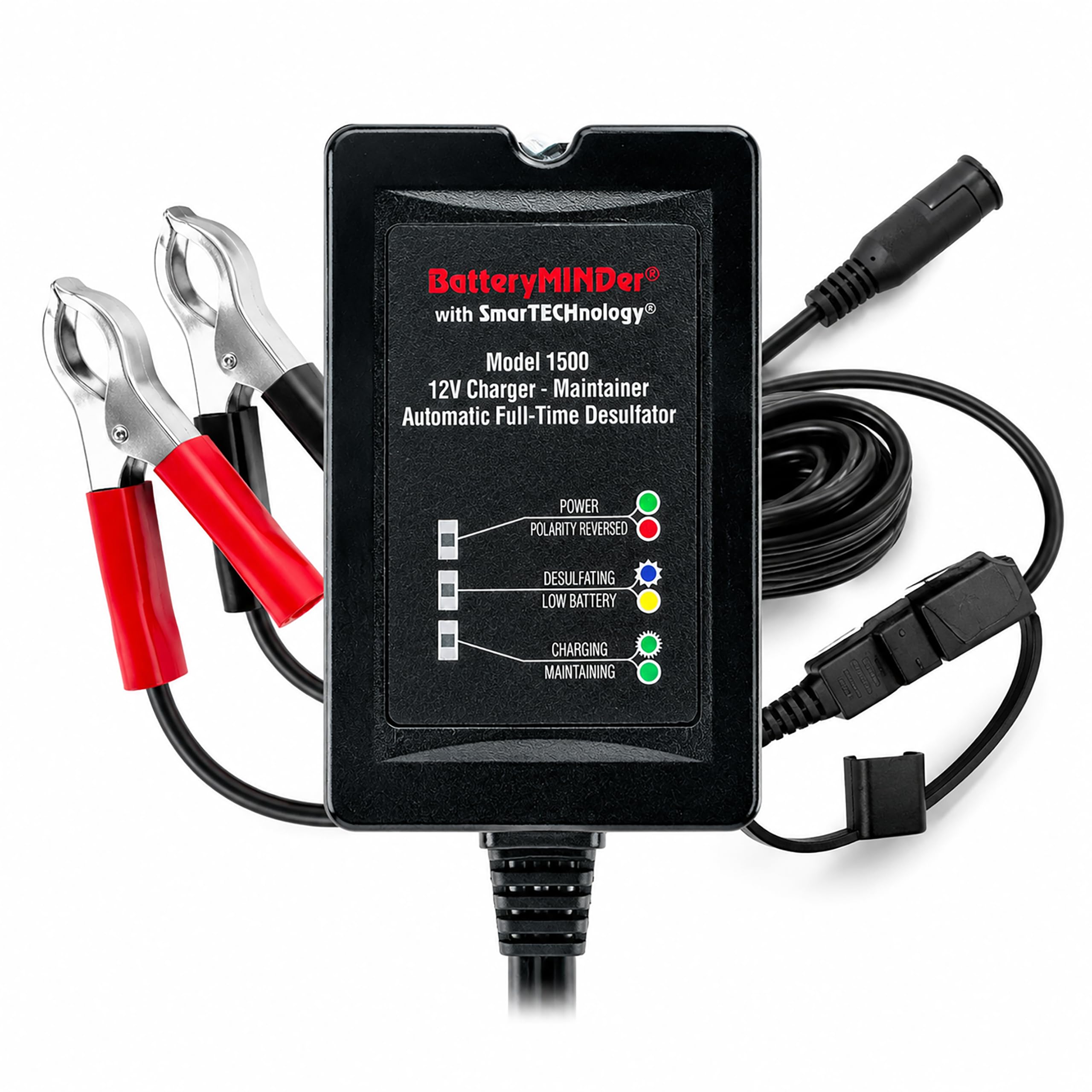
1. 1500 12V-1.5A Smart Trickle Charger, Battery Maintainer, and Battery Desulfator
Our pick — 4.5+★ from 700+ verified ratings; the strongest balance of quality and price.
The storage-season specialist that fights sulfation while your battery sits untouched.
If your battery dies every spring after sitting in a cold garage, this is the pick built for exactly that problem. Its defining feature is a full-time automatic high-frequency pulse desulfator (a circuit that sends rapid pulses into the plates to break up the lead-sulfate crust) that runs the whole time the charger is connected. The maker claims this pulse treatment can extend battery life up to four times versus an unmaintained new battery. A built-in ambient temperature sensor adjusts voltage based on how hot or cold the garage gets, so a summer shed and a winter barn both get the right charge.
Owners trust it most for the thing it does quietly over months. Keeping batteries topped off and maintaining stored deep-cycle units through the off-season is what the reviews keep circling back to, and plenty connect it to an RV or boat battery they don’t touch for months. The unit handles flooded, sealed maintenance-free starter, deep-cycle, Optima sealed AGM and marine batteries, and it can maintain up to four batteries at a time when wired in parallel with separately sold Y-connectors. A 120-volt input keeps it on standard household power.
Understand the trade-off before you buy. It’s a maintainer first, so the 1.5-amp output is gentle rather than fast — plan on overnight or multi-day recovery, not a quick top-up before a ride. It’s also the heaviest unit here at 16 ounces with a footprint of 2.7 by 8.7 by 6.7 inches, so it wants a shelf spot rather than a saddlebag. Two more numbers to weigh: its 120-volt input is matched by the TPE unit’s 12-volt listed input, while the TPE is smaller at 1.37 by 1.96 by 3.3 inches and lighter at 9.9 ounces.
What earns it first place
- Runs its desulfator full time, not just during charging — the strongest anti-sulfation setup on this list
- Temperature sensor keeps the charge correct in freezing or baking storage conditions
- Maintains up to four batteries in parallel with optional Y-connectors
- Handles the widest battery menu here, from deep-cycle marine to Optima AGM
Where it asks patience
- 1.5 A output is slow for reviving a deeply drained car battery
- 16 ounces and a wide footprint — not a pocketable unit
Reach for this if: your batteries go into long storage and you want the sulfation fought the whole time.
Think twice if: you need a fast overnight recovery on a big, dead car battery.
2. Battery Charger Automatic 6V 12V 1.5A, Trickle Charger
A tiny dual-voltage box that handles 6V and 12V and won’t overcharge a weak battery.
Here’s the compact deal: this unit measures just 1.37 by 1.96 by 3.3 inches and weighs 9.9 ounces — small enough to tuck in a tail bag. Compare that to the BatteryMINDer 1500’s 16 ounces, and it’s clearly the easier one to carry. Despite the small body it takes both 6V and 12V lead-acid batteries, and it’ll charge a battery of up to 40AH while maintaining one up to 60AH. If your garage holds a mower battery and a motorcycle battery side by side, this one box serves both.
Inside runs an MCU chip (a small microcontroller that manages the charge), taking the battery through five stages: qualification, soft start, bulk charge, absorption and maintenance. A 72-hour safety timer starts whenever the charger is on and cuts the charge on a marginal battery that won’t recover, then flips to float mode once the voltage is right. Protection covers overvoltage, overcurrent, short circuit, reverse connection and overheat. Connecting and disconnecting after a ride is genuinely quick, which is the ease that wins people over.
What holds it back is scope. It’s aimed squarely at small batteries — motorcycles, ATVs, lawn mowers, boats, SUVs — with that 40AH ceiling, so a big truck or a bank of deep-cycle batteries is a job it wasn’t built for. Note too that its listed 12-volt input is a lower figure than the 120-volt input on the BatteryMINDer and the Suuwer, so confirm it matches your outlet reality.
What buyers prize: quality and easy connection come up again and again — the quick-connect convenience after a ride is the star. The automatic five-stage MCU program keeps it simple for anyone who doesn’t want to fuss with settings.
The honest caveat: the 1.5-amp output is a maintainer pace, not a fast charge, and the 40AH charging ceiling rules out big-bank work.
Suits you if: you want one small, light charger for a motorcycle, mower and ATV.
Skip if: you need to service a large truck bank.
3. MOTOPOWER MP00205A 12V 800mA Automatic Battery Charger
The cheap, tiny 12V keeper that generator owners reach for by habit.
Picture a 12-volt lead-acid battery that spends the winter under a tarp. This 800mA (0.8-amp) unit keeps it there without drama — it charges, maintains and desulfates, then drops to maintenance once the battery is full. The charge tops out at 14.4V and holds at 13.6V for long stretches to avoid gassing and extend life, and a 24-hour timer terminates the charge if a battery won’t climb above 14V. It draws zero output in standby, so it won’t drain the battery it’s hooked to, and the clamps are spark-proof on connection.
Where this one earns its keep is simplicity and price confidence. Just plug it in, clamp onto the terminals and walk away — the desulfation runs automatically during charging with no buttons to press. It’s built for all 12-volt lead-acid flooded or sealed maintenance-free batteries, both AGM and gel, and it’s a favorite for generator batteries left idle. Compact size and easy connection are the everyday wins, and the value side is overwhelmingly well received.
The honest limits sit in the amperage and the long-haul durability stories. At 800mA it’s the slowest performer here — the lowest output in this lineup — so it’s for maintaining, not a fast rescue. Some units have stopped working over months of use, and reliability is the field where it draws a mixed reputation, so treat it as a low-cost maintainer rather than a lifetime investment. That said, buyers overwhelmingly feel the value justifies it.
The honest wins
- 800mA circuit charges to 14.4V and maintains at 13.6V without manual steps
- 24-hour timer and spark-proof clamps cover the basic safety bases
- Zero standby output means no battery drain while connected
- Generous value for an all-in-one charger, maintainer and desulfator
Weigh before you buy
- 800mA is the slowest output on this list
- Some units failed within months, and reliability is mixed
Top pick for: keeping a generator or spare 12V battery topped off on a tight budget.
Look elsewhere if: you’re relying on it to recover a deeply drained battery fast.
4. Suuwer 2A 12V Trickle Charger, Smart Battery Charger & Maintainer

When your battery sits far from an outlet, this one has the reach and the amperage to spare.
This is the highest-amperage smart unit in the smaller lineup — 2 amps, matching the amperage the Suuwer lists against the BatteryMINDer 1500’s 1.5A. That pushes more current toward a slow drain and pairs with a 12-foot DC power cord, so you can reach a bumper, a boat or a trailer without stringing an extension lead. The 4-step program — initialization, bulk charge, absorption and float — manages the battery automatically, and temperature compensation adjusts voltage to the surrounding climate.
Its range is what separates it from the pack. It handles lead-acid, flooded, sealed maintenance-free AGM and gel, AND lithium (LiFePO4) — a chemistry the BatteryMINDer 1500 doesn’t list. That makes it useful if you’ve moved to a lithium battery for weight or longevity. Protection covers reverse polarity, short circuit, overcurrent and overvoltage, and the LED indicators spell out the state in color: flashing red for a bad connection, solid red for charging, flashing green for full, solid green for float maintenance. The large battery clip and O-ring terminals make connecting a motorcycle or car battery quick work.
Here’s where patience is required. Charging speed draws a mixed verdict — some find it keeps the battery at full charge with no fuss, others find it slow. There’s also a note of flimsy wiring and LED indicators that blink on and off, which is the kind of thing to keep an eye on. It’s not the smallest unit either, at 12.48 ounces.
The standout: a 12-foot cable plus lithium support makes it the most flexible for odd parking spots — the furthest reach of any pick here.
Honest expectation: some units have lasted under four months and the wires feel thin, so it’s a value pick rather than a fortified build.
Ideal if: your battery lives far from a wall outlet or you’ve switched to lithium.
Not the one if: you want the most bulletproof long-term build on the shelf.
5. NEXPEAK 1.75A Car Battery Charger, 6V & 12V Smart Maintainer
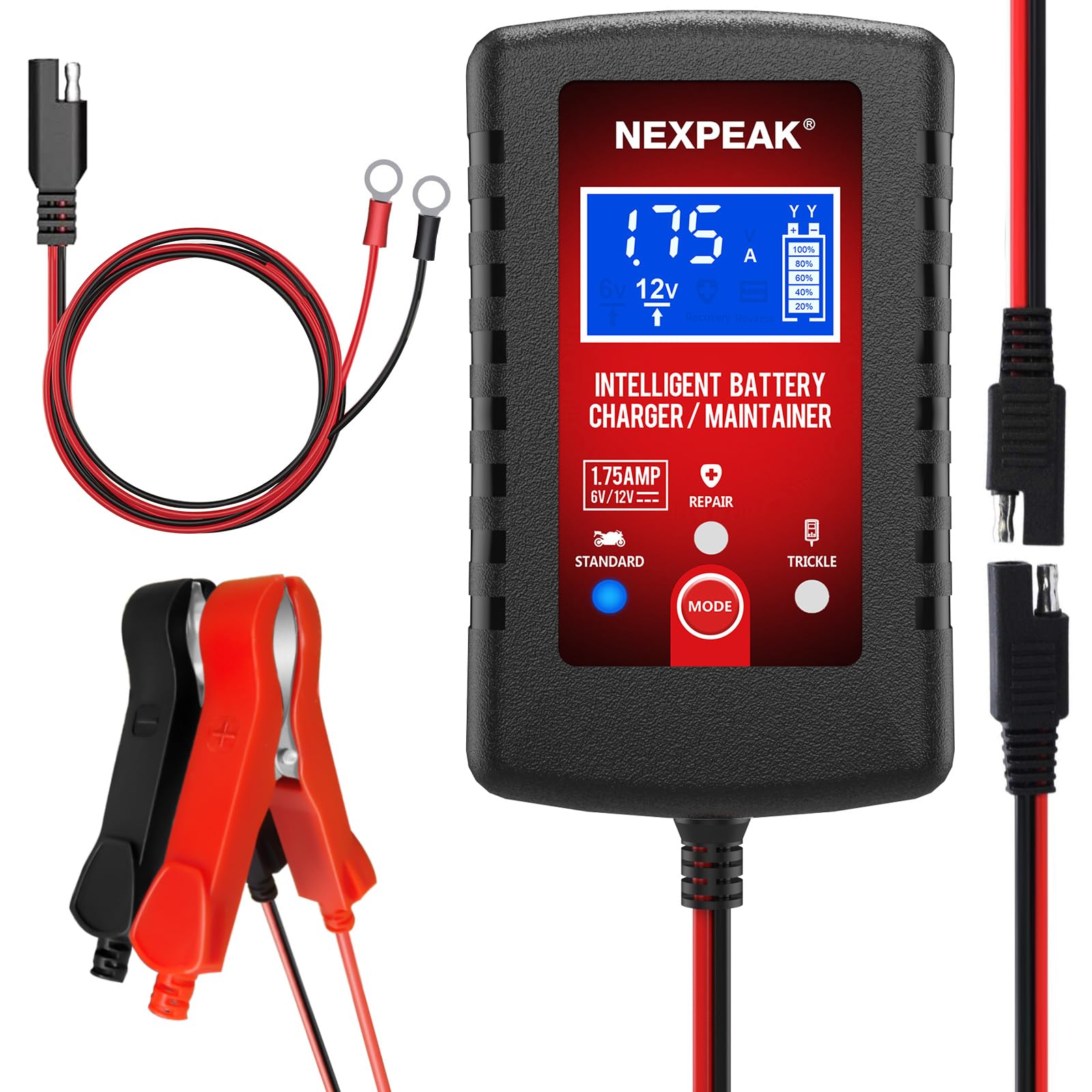
The one that shows you what’s happening, stage by stage, on a small LCD screen.
Most trickle chargers ask you to trust a blinking light. This one puts the numbers on screen — an LCD (light-emitting display) that reads out the charging status, the percentage, the voltage and the current. If you like knowing whether your motorcycle battery is at 40 percent or 90 percent, this is the pick that tells you. Under the screen it runs a 7-stage program from desulfurization through trickle and float charging, and the REPAIR mode is built to bring back old or idle batteries that have lost their oomph.
The 1.75-amp output sits between the small 800mA units and the 2-amp Suuwer. It works with 6V and 12V batteries across flooded, gel, AGM, SLA and VRLA chemistries, and covers cars, golf carts, motorcycles, boats, lawn mowers, ATVs and UTVs. STD mode cuts power once full, while trickle mode holds the battery at 12.5V. A long list of protections covers short circuit, overload, low and high voltage, overcharge, over-temperature, reverse connection and over-current — the “plug it and forget it” safety most buyers want.
The nit worth knowing: the 6.6-foot cord is shorter than the Suuwer’s 12-foot reach, and there’s a quirk where you must press and hold the MODE button for five seconds to force 12V mode. The 8-hour typical charge time means it’s a managing unit, not a hot-shot charger.
Why the screen sells it
- Live LCD readout of status, percentage, voltage and current
- 7-stage program with a repair mode for idle batteries
- Full protection suite from reverse-connection to over-temperature
- Handles both 6V and 12V chemistries
Small trade-offs
- 6.6-foot cord is shorter than some competitors’ reach
- Forcing 12V takes a 5-second button hold
Built for: the owner who wants to see the state of charge at a glance.
Think twice if: you need a long cable run to the car.
6. NOCO GENIUS1 1A 6/12V Smart Battery Charger

The crowd favorite that starts a charge from as low as 1 volt and won’t quit on a dead battery.
The GENIUS1 wins the popularity contest here — 4.0+ stars across a very large base of owners — and the reason is range. It’ll charge a battery from as low as 1 volt, and its Force Mode lets you manually push charge into a completely dead battery down to zero volts. That means the neglected battery in the corner of the garage has a real chance. It’s an all-in-one charger, maintainer, trickle charger and desulfator, and it works on 6V and 12V lead-acid (AGM, gel, SLA, VRLA) plus lithium (LiFePO4).
The brains inside are what sell it to tinkerers. An integrated thermal sensor adjusts the charge as the garage warms or cools, preventing overcharging in heat and undercharging in cold. Precision pulse charging detects and reverses sulfation and acid stratification (layers of uneven acid that build up when a battery sits). When a battery is full it switches to maintenance and can stay connected indefinitely. A 110-inch DC cable gives generous reach, and the package includes clamps with integrated eyelet terminals plus a 3-year warranty.
The catch is the amperage. At 1 amp, it’s a maintainer’s pace — a 10-hour charge time — so don’t expect fast overnight recovery on a big, deeply drained truck battery. It’s also the most-reviewed unit here, and while most owners are happy, a small number have received doa or failing units. The 4.0+ star average is still high across a very large crowd.
The headline: recovering dead batteries from 1 volt, or zero with Force Mode, is the capability that turns this into the go-to for neglected batteries.
Realistic limit: the 1-amp output is a slow, careful charge, not a fast one.
Pick it if: you have a neglected or deeply discharged battery you’re trying to save.
skip it if: overnight speed is your priority over careful, long-hold charging.
7. Schumacher Electric SC1609 5A 6V/12V Battery Charger & Maintainer

The 5-amp muscle of this lineup, for when you want a car battery back quickly.
Amperage is the number that earns this one its spot. At 5 amps, it’s the highest output on this entire list — the strongest current to push a depleted battery back toward full. A microprocessor-controlled system automatically detects the battery voltage and adjusts the amperage to charge at the right pace. That control is why a fast unit can still walk a battery up carefully rather than just blasting current into it. It handles standard AGM, gel and deep-cycle batteries across cars, motorcycles, lawn mowers, boats and power-sports vehicles.
Owners prize its quality and its charging speed, and the speed shows itself on bigger batteries. The 6V/12V dual voltage means it serves a mower battery and a car battery. Included are 18-inch quick-connect ring leads and a 5-foot output cable, and the molded plastic casing has mounting slots so you can bolt it to a wall or workbench. Reverse hook-up protection guards against damage from a wrong connection, and the clamps are non-sparking.
Where it differs from the smaller picks: this is a charge-and-maintain tool, not a desulfation specialist — there’s no pulse-repair language in its specs. It’s also the newest kind of unit in a small garden of fans, with fewer reviews than the popular picks. The 5-foot cable is shorter than the Suuwer’s 12-foot reach, so it wants to live near the battery.
Where it leads
- 5 A output — the highest amperage here for faster car-battery recovery
- Microprocessor auto-adjusts voltage and amperage
- Mounting slots for a wall or workbench install
- Non-sparking clamps and reverse hook-up protection
What to weigh
- 5-foot cable is short for distant batteries
- No dedicated desulfator mode in the listed specs
The right call if: you’ve got a garage with an outlet nearby and want a car battery topped up quickly.
Not ideal if: you need long-cable convenience or active sulfation repair.
8. CRAFTSMAN 1.5A Car Battery Charger & Maintainer, 6V/12V – CMXCESM259

A familiar garage name with a 1.5-amp brain that also reconditions tired batteries.
If you’ve got a spot on the shed wall and a mower that sits all winter, this one is built for a fixed home. It charges, maintains and reconditions in one 1.5-amp box, and its advanced desulfation mode is meant to extend battery life. It handles gas and diesel vehicles across 6V and 12V, including standard, AGM, gel and deep-cycle types. Reverse polarity protection keeps the battery and the vehicle safe if the clamps go on backwards, and a 6-foot power cord plus 5-foot booster cables give it room to reach. Mounting slots let you fix it permanently outside your work area.
What the reviews keep coming back to is it simply working — a zero-turn mower battery that comes back, a battery that’s fully charged by morning. Functionality and quality carry it. It’s a charge-and-maintain unit with reconditioning rather than a multi-stage pulse specialist, and at 1.5 pounds it’s lighter than the 1500 at 16 ounces. The quick-connect battery clamps and ring connectors are included.
One honest wrinkle: value for money is a mixed field in the feedback, so some owners feel they paid a touch more than they’d like for what’s a basic 1.5-amp unit. It has fewer reviews than the big-name crowd, and at a 1.5-pound body it’s a garage fixture rather than something you carry out to the driveway.
The fit: a wall-mounted, plug-and-leave setup for a mower, ATV or spare car battery that lives in one place.
The trade-off: 1.5 amps and a value score that’s split — it’s a solid basic, not a standout bargain.
Fits you if: you want a recognizable brand and a permanent wall-mounted spot.
Look around if: top value for a 1.5-amp unit is your deciding factor.
9. CTEK CT5 12V Automotive Battery Charger

The premium slider that earns its keep with a recondition mode and a long warranty.
High owners’ regard and a long warranty — 4.5+ stars and a 5-year limited warranty — are the case for paying up here. It’s a fully automatic 12V charger with a normal mode tune for all lead-acid batteries including AGM, and a Recond mode (recondition) for bringing deeply discharged batteries back. It also charges 12V lithium (LiFePO4) batteries, matching the lithium support the Suuwer and NOCO units offer. The 1.1-amp output is gentle and careful — the sort of low, steady current that keeps a stored motorcycle or JetSki battery healthy.
What people value is consistency and how well it keeps batteries full and extends their life. It’s suited to motorcycles, ATVs, JetSkis and snowmobiles — the smaller powersport batteries that live in the off-season. In the box you get comfort-connect clamps and quarter-inch eyelets plus a storage bag, so you can leave the eyelets on the battery and click in quickly. A 120-volt input keeps it on household power, and the 2.5 by 7 by 1.5-inch body is slim enough to store easily.
The straightforward caveat is the premium positioning — some owners feel it’s a bit pricey for what it does, and the 1.1-amp limit means it’s a maintainer, not a fast charger. It’s also built for the small powersport class, so if you need to revive a big car battery quickly, look to the higher-amperage picks instead.
Why go premium
- Recond mode for bringing deeply discharged batteries back
- 5-year limited warranty — the longest coverage on this list
- Handles both lead-acid and 12V lithium (LiFePO4)
- Comfort-connect clamps and eyelets for quick hookup
What premium costs you
- Some owners find it a little expensive for the job
- 1.1 A is a gentle maintainer pace, not a fast charger
It’s for you if: you want the most polished, longest-warranty maintainer for a powersport battery.
Look elsewhere if: you need high amperage to revive a big car battery fast.
Understanding the Specs
Amperage (Amps and Milliamps)
Amperage measures how much current the charger feeds into the battery, and it’s the single number that sets the pace. 1,000 milliamps equals 1 amp, so a unit rated at 800mA is a 0.8-amp trickle. A low figure, like the 800mA MOTOPOWER or the 1-amp NOCO, is built to hold a battery steady for long periods — perfect for a motorcycle or a spare battery in storage, and gentle enough to leave connected indefinitely. A higher figure, like the Schumacher’s 5 amps, pushes recovery faster, which suits a car battery that needs topping before the weekend. Choose the amperage by what you’re doing: maintaining wants low and slow, recovering wants higher.
Voltage and Battery Chemistry
Voltage has to match your battery, or the charger won’t work. A 12V car or motorcycle battery needs a 12V output; a 6V battery needs a charger with a 6V mode. Many picks here cover both, which is why they suit a mixed garage. Chemistry is the second half: standard lead-acid, AGM and gel all fall under sealed lead-acid handling, and most units here cover them. Only some — the Suuwer, the NOCO and the CTEK — also handle lithium (LiFePO4), the lighter battery chemistry more riders use. If your battery is lithium, confirm that word is in the specs before you buy.
FAQ
Will a 12V trickle charger work on my motorcycle battery without damaging it?
Can a trickle charger really revive a completely dead battery?
How long can I leave a trickle charger connected to a battery?
Do I need a 6V mode if I only have 12V batteries?
What does desulfation actually do to a battery?
Is a higher amperage charger always better for a car battery?
Will these chargers work with AGM batteries?
Can I use a trickle charger on a lithium LiFePO4 battery?
Why does my charger have a safety timer and when does it matter?
What is the difference between a trickle charger and a battery maintainer?
Final Thoughts: The Verdict
For most garages, the winner is the BatteryMINDer 1500, because its full-time desulfator and temperature sensor fight the sulfation that kills stored batteries — the exact work a trickle charger exists to do. If you want the crowd favorite that can revive a battery from as low as 1 volt, grab the NOCO GENIUS1. And for a powersport battery that wants premium care with a recondition mode and a 5-year warranty, the CTEK CT5 is the one to reach for.
The honest nudge: decide whether your job is recovering a drained battery or maintaining a stored one, because that single choice — not the badge on the box — separates the right pick from the wrong one here. Match the amperage and voltage to your battery, and any of these nine will hold it far longer than leaving it to sit.
How We Picked
We do not accept paid placement. Every pick is matched to a real buyer and a real use-case; we do not hands-on test units.
Sources & Methodology
Specifications: manufacturer listings and product documentation. Review insights: verified customer reviews, as of November 2026. Pricing: not shown on this page (it changes often); check the current price via the retailer link.
As an Amazon Associate, Gadgets Feed earns from qualifying purchases. This does not affect which products we feature.