
Our readers keep the lights on and my morning glass full of iced black tea. As an Amazon Associate, I earn from qualifying purchases.
Specs are compiled from manufacturer listings and verified buyer reviews and can change over time — please confirm the key details on the product page before buying.
You want more bass and clearer vocals from your factory stereo, but you do not want to spend much or blow your speakers doing it. Most budget car amps advertise big peak wattage numbers, but the honest number that matters — RMS power (the watts the amp can deliver continuously) — is far lower. This guide ranks nine budget-friendly amps by their real RMS output, so you can match one to your speakers, your sub, and your alternator.
I’m Min — the founder and writer behind Gadgets Feed. This guide is built by comparing the manufacturers’ published specifications and the patterns across verified customer reviews, so you get each pick’s real strengths and trade-offs instead of marketing spin.
You will see which amps are stable at 2 ohms, which ones bridge to a single sub, and which ones run cool enough to tuck under a seat. Here is a straight-talking walk through the strongest picks for a budget car amp.
Our Picks at a Glance


How To Choose The Best Budget Car Amp
Start with the number you can actually use: RMS watts per channel, not the peak figure printed in big letters. An amp that honestly makes 100 watts RMS per channel at 2 ohms will drive a set of door speakers far louder and cleaner than a flimsy amp promising thousands of peak watts.
Match the ohm load to your speakers
Ohms measure the electrical load your speakers put on the amp (a lower number is a harder load). An amp rated 2-ohm stable can safely run two 4-ohm speakers in parallel per channel. If it is only 4-ohm stable, wire your speakers differently or you risk tripping the amp into protection mode.
Decide between full-range and subwoofer duty
A full-range amp powers door speakers, tweeters, and in some cases a small sub through a crossover. A dedicated sub amp, like a monoblock, sends all its power to one subwoofer. Pick based on whether you are upgrading clarity or chasing thump.
Plan for heat and electrical draw
Class A/B amps (the traditional design) run hotter and pull more current than Class D amps (a newer switching design that wastes less power as heat). In a tight space under a seat, a compact Class D unit is easier to live with.
Quick Comparison
| Model | Best For | RMS / Peak Power | Channels | Ohm Stability | Amazon |
|---|---|---|---|---|---|
| Taramps TS 400X4★ Best Overall | Clean full-range power on a budget | 400W RMS | 4 | 2 ohm | Amazon |
| PRV Audio QS400.4Compact Pick | Mini builds and motorcycles | 4 x 100W RMS | 4 | 2 ohm | Amazon |
| Pyle PLA2378Best Value | Big-number shoppers on a budget | 2000W peak | 2 | Bridgeable | Amazon |
| ORION CBA1500.2 | Bass boost on a two-channel | 1500W max | 2 | 2 ohm | Amazon |
| Recoil DI550.4 | Four channels with real headroom | 1040W max / 130W x 4 RMS | 4 | 2 ohm | Amazon |
| BOSS R6002 | Reliable all-rounder for speakers or subs | 1200W max | 2 | 2 to 8 ohm | Amazon |
| ORION CBA2000.4 | Powering four door speakers | 2000W max / 75W x 4 RMS | 4 | 2/4 ohm | Amazon |
| Planet Audio PL2000.1M | Single subwoofer duty | 2000W max / 1000W @ 4 ohm | 1 | 2 to 8 ohm | Amazon |
| Pioneer GM-A5702 | Clean two-channel clarity | 1000W max / 240W x 2 RMS | 2 | 2 ohm | Amazon |
In‑Depth Reviews
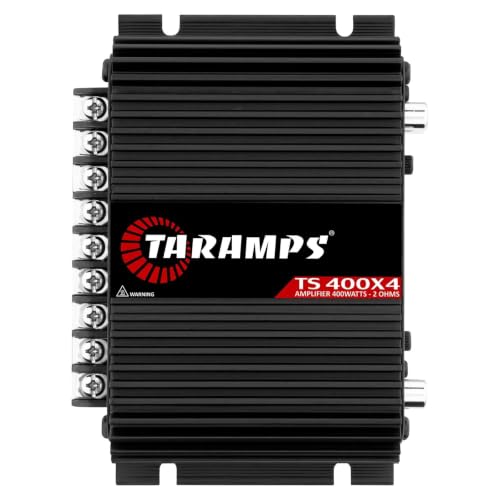
1. Taramps TS 400X4 Black 2 Ohms 400W RMS 4-Channel Car Audio Amplifier
Our pick — 4.5+★ from 500+ verified ratings; the strongest balance of quality and price.
The compact four-channel that delivers honest power without eating your trunk space or your dash budget.
What you get here is a true four-channel full-range amp that puts 400W RMS to work. It delivers 4 x 100W at 2 Ohms, or you can bridge it to 2 x 200W at 4 Ohms for a sub. That is real continuous power, not a peak number dressed up for the box — which is the whole reason this one leads the list at 4.5+ stars across 500+ ratings.
The install side is built for flexibility. High-level auto turn-on means it wakes up from your factory head unit’s speaker signal, and RCA inputs cover an aftermarket stereo too. A built-in crossover (a filter that splits highs and lows) gives you HPF, LPF, and Full Range modes, so it can drive tweeters, door speakers, or a compact sub without extra hardware.
What wins people over is the sheer output-to-size ratio. This is a Class D design, a switching amp that wastes less energy as heat, and it is light enough at 15.84 ounces to mount almost anywhere. Compare that to the Pyle PLA2378, which is listed at 5.7 pounds and 14.99 x 11.47 x 3.28 inches — a far bulkier box. The catch is the terminal layout: a few installs get called confusing, so read the wiring diagram twice before you power up.
Why this earns the top spot
- 400W RMS across four channels with 2 x 200W bridged option
- Class D efficiency keeps heat and current draw low
- Auto turn-on works with factory and aftermarket stereos
- Just 15.84 ounces for easy hidden mounting
Where it asks patience
- Terminal labeling trips up a few first-time installs
- Power is honest but modest — not a sub-only monster
Strongest all-rounder: if you want clean four-channel power for door speakers plus a small sub, this is the one to beat.
Think twice if: you are chasing wall-shaking bass from a single big sub — a dedicated monoblock suits that job better.
2. PRV Audio QS400.4 2 Ohm Mini Compact 4 Channel Car Audio Amplifier
A palm-sized four-channel amp for builds where there is simply no room for a full-size box.
This is the smallest chassis here — 4 wide by 5.40 long by 2 inches tall — and it still pushes 4 x 100 watts RMS at 2 ohms. Set against the Pyle PLA2378’s 14.99 x 11.47 x 3.28 inches, the size gap is dramatic. That makes it a natural fit for motorcycles, ATVs, and cramped dash cavities where a normal amp will not go.
PRV builds it around Class D Brazilian technology, a switching design that stays efficient so it does not tax your vehicle’s electrical system. Bridging two channels doubles the power to 2 x 200 watts RMS at a minimum of 4 ohms per bridged channel, so it can turn two door speakers or a small sub into a real upgrade.
Owners come away impressed by the build for the size. The most-praised quality is how solid this little aluminum unit feels, and the sound output earns plenty of praise too — it drives aftermarket speakers well, and one owner notes it holds up in noisy motorcycle installations. Spend less and you get a good honest amp here; just know the 4.0+ star reputation reflects a compact form factor with modest reserves, not a subwoofer killer.
Built to hide away: the mini footprint and aluminum body make it the easiest amp in this list to tuck into tight spaces.
The honest limit: 100 watts per channel is clean for door speakers but runs out of steam if you feed heavy subwoofer duty.
Reach for this if: space is your tightest constraint and you want solid four-channel sound in a motorcycle or mini build.
Look elsewhere if: you need big sub output — step up to a larger Class D with deeper reserves.
3. Pyle 2 Channel Car Stereo Amplifier – 2000W Dual Channel Bridgeable PLA2378
A silver-plated-RCA dual-channel that brings real value — as long as you read the power label carefully.
The headline is a 2000-watt bridgeable output, and for a mid-range price you get a full features list: a MOSFET power supply, switchable bass boost, variable gain, and a configurable electronic crossover. The silver-plated RCA ports are there to cut signal loss, and a subsonic filter removes low-end interference so your speakers stay clean.
What earns the most applause is the value for money, followed closely by how well the features actually function. Buyers report the clear mids land well and two 12-inch subs work fine bridged. Thermal, overload, and short-circuit protection keep the amp and your car safe from a wiring slip.
Here is where you should temper expectations: the 2000W figure is peak, not RMS continuous. Some owners note it does not reach the 1000-to-2000-watt range the box implies, and a few report it running hot under heavy loads. Read it as a strong budget dual-channel for everyday speakers and light sub duty, not a competition amp — and it is a bigger box at 5.7 pounds, so plan the mounting spot.
Feature-per-dollar winner: bass boost, crossover, and protection circuitry all present at a value-tier price with solid mids for the money.
Good match for: budget builders who want crossover control and bridgeable sub-friendly wiring without spending much.
Set expectations if: you expect true continuous 2000W — this one hedges on peak numbers.
4. ORION CBA1500.2 Cobalt High Efficiency 2-Channel Class A/B Amp, 1500W

A two-channel Class A/B built around bass control, with a remote knob so you can dial the low end from the driver’s seat.
Look at the max output: this amp lists 1500 Watts, while the Recoil DI550.4 lists 1040 watts. On the two-channel side, it runs 750 x 2 MAX at 2 ohms or 375 x 2 MAX at 4 ohms, and it adds a remote bass knob plus a 2-way protection circuit. Frequency response spans 10Hz to 30kHz.
Class A/B topology (the traditional amp design that runs more current but produces strong, full sound) and a MOSFET power supply supply the muscle. Hi and low level inputs mean it works with either a factory head unit or an aftermarket RCA setup, and it is 2-ohm stable for flexible speaker wiring.
The honest caveat is power: the recurring gripe is that it does not deliver the advertised 750 watts RMS, so size it as a strong-value bass driver rather than a brute. Reliability feedback leans cautious too, so mount it where it gets airflow and confirm the warranty. If you want the remote knob and real bass shaping for a reasonable price, it earns the spot.
Control at your fingertips: the remote bass knob is the standout — you tune low-end punch on the fly without reaching for the trunk.
Sized honestly: treat the listed power as max, not continuous RMS, and plan for cooling clearance.
Where it shines: powering a sub or speakers when you want a bass knob on the dash and the freedom to wire down to 2 ohm (a lower resistance that lets the amp push more power).
Skip if: you need a verified RMS figure you can bank on — this one is a max-power listing.
5. Recoil DI550.4 Full-Range Class-D 4-Channel Car Audio Amplifier 1040W

Four channels of clean Class D power that finally give your door speakers the headroom they deserve.
You get real power for front and rear speakers at once: RMS (continuous, clean power) 130 watts x 4 channels at 2 ohm, RMS 80 watts x 4 at 4 ohm, and bridged RMS 260 watts x 2 at 4 ohm, with peak power 260 watts x 4. That extra headroom over a two-channel amp is the whole point — it covers front and rear speakers at once, unlike the Pyle PLA2378’s two-channel layout.
Class D stays efficient, and Recoil backs it with a high-speed MOSFET power supply and four-way protection circuitry so it can run at high levels for extended stretches. Gain, LPF, HPF, crossover, and bass EQ give you tuning latitude, and the stated operating temperature of 85 °C plus efficient heatsinks speak to cooling care.
What wins people over most is the build — it feels overbuilt for a budget amp — followed by sound quality, where vocals come through with sharp clarity. The compact 7.48 x 5.90 x 1.77 inch chassis fits neatly, and one owner reports it keeps Hertz speakers singing. With a 4.0+ star reputation and a 1-year warranty covering factory defects, it is the safest four-channel step-up here. The trade-off: it is a mid-range spend, so it suits buyers planning to keep their system a while.
Strongest selling points
- 130W x 4 RMS at 2 ohm with a 260W x 2 bridged option
- Four-way protection and a high-speed MOSFET supply
- Full tuning stack: gain, LPF, HPF, crossover, bass EQ
- Compact 7.48 x 5.90 x 1.77 inch footprint
The other side of the coin
- Pricier than the entry two-channels on this list
- Class D’s compact reserves still cap big sub duty
Money well placed: for a four-speaker system you intend to keep, the build quality and headroom here are worth the step up.
Hold off if: you only need one sub fed — a dedicated monoblock is more efficient for that.
6. BOSS Audio Systems R6002 2 Channel 1200 Output Class A/B Car Amplifier

A do-it-all two-channel that swings from door speakers to subs, with reliability that carries the reputation.
This one is a full-range Class A/B amp listing 600 max x 2 at 2 ohms, 300 max x 2 at 4 ohms, and 1200 max bridged at 4 ohms. Because it handles 2 to 8 ohms, you can run speakers or subwoofers off the same box — a flexibility the fixed two-channel layout of the Orion CBA1500.2 does not spell out as widely.
Its strong suit is reliability, and that is the trait buyers call out first. Value for money is a close second — owners describe it as a genuine bargain. Sound quality lands well, especially at 4 ohms, and the install is straightforward. A clean 0.01% THD at RMS output and a 102 dB signal-to-noise ratio back the clean-sound claims.
Two things to plan around. It is a fair-sized unit at 12.28 x 10.44 x 2.25 inches and 5.86 pounds, so measure your mounting spot. And while some owners mention it stays cool, others note overheating under hard use — give it airflow and you are set. At 4.0+ stars across 600+ ratings, most buyers are happy.
Why it lasts: the reliability reputation, backed by MOSFET power supply design and dual 25-amp ATO fuses, makes it the low-drama choice.
Pick it for: a single amp that can drive speakers today and a sub tomorrow, with a record of dependable running.
Plan for space if: your mounting area is tight — this is one of the larger boxes here.
7. ORION CBA2000.4 Cobalt High Efficiency 4-Channel Class A/B Amp, 2000W

A four-channel speaker amp tuned to keep constant high-power loads running without noise or overheating.
Orion rates it 75W RMS x 4 at 2 ohms and 40W RMS x 4 at 4 ohms, with a 2000W max and frequency response of 10 to 30kHz. It is engineered for a continuous 2/4-ohm load, which makes it a fit for speakers that demand steady power. Low-pass and high-pass filters, bass boost, and a MOSFET supply round out the tuning.
Customers note the performance first, and the sound quality follows — it earns praise as a clean-sounding Class A/B four-channel (a traditional amp design known for smooth sound). The 2-way protection circuitry (it guards against faults like shorts and overheating) and metal body add confidence, and low-level RCA inputs (the standard plug-in jacks) keep the signal chain simple for an aftermarket head unit.
Being straight with you: reliability feedback swings negative, so mount it where it can breathe and buy with a return window in mind. Think of it as a speaker-focused amp for four door speakers where you want a Class A/B warmth and plenty of tuning, rather than a car you want to fill with sub bass. At 4.0+ stars it has a loyal following among speaker-focused builders.
What it does well
- 75W RMS x 4 at 2 ohm for steady speaker power
- LPF, HPF, and bass boost for real tuning
- Low-level RCA inputs for clean installs
- 2-way protection circuitry
What to weigh
- Reliability feedback is mixed — factor in a warranty check
- Sub-bass duty is not its strength
Built for speakers: four door speakers driven steadily is exactly what this Class A/B four-channel is designed to do.
Look past it if: your goal is one big subwoofer — go monoblock instead.
8. Planet Audio PL2000.1M 2000 High Output Monoblock Car Amplifier

One channel, all subwoofer, with a remote knob so you shape the bass from where you sit.
A monoblock dedicates all its output to a single sub — here, 2000 max x 1 at 2 ohms or 1000 max x 1 at 4 ohms. It is a Class A/B design, handles 2 to 8 ohms, and throws in a variable low-pass crossover, variable bass boost, and variable gain. A remote subwoofer control is included in the box.
The low-pass crossover and bass boost let you tune exactly where your sub plays, and the 103 dB signal-to-noise ratio and 0.01% THD at RMS output point to clean low-end delivery. Owners do rave about the sound, with the bass handling heavy-hitting music with ease.
Go in clear-eyed on power: the recurring gripe is that it does not deliver the claimed 2000 watts, and overheating shows up under long, loud sub runs. So make sure the sub you pair it with is efficient and give the amp room to cool. The 6-year parts and labor support is a bright spot for the cautious buyer. It is the right tool for a single-sub build, not a full-range system driver.
Tuned for thump: remote control plus variable bass boost and low-pass makes dialing in one sub simple.
Treat the rating as max peak: plan around less than 2000 watts of continuous output, and prioritize airflow.
Go here when: you run exactly one subwoofer and want built-in bass tuning and a remote controller in the box.
Pass over if: you need to drive speakers too — this mono amp feeds a sub only.
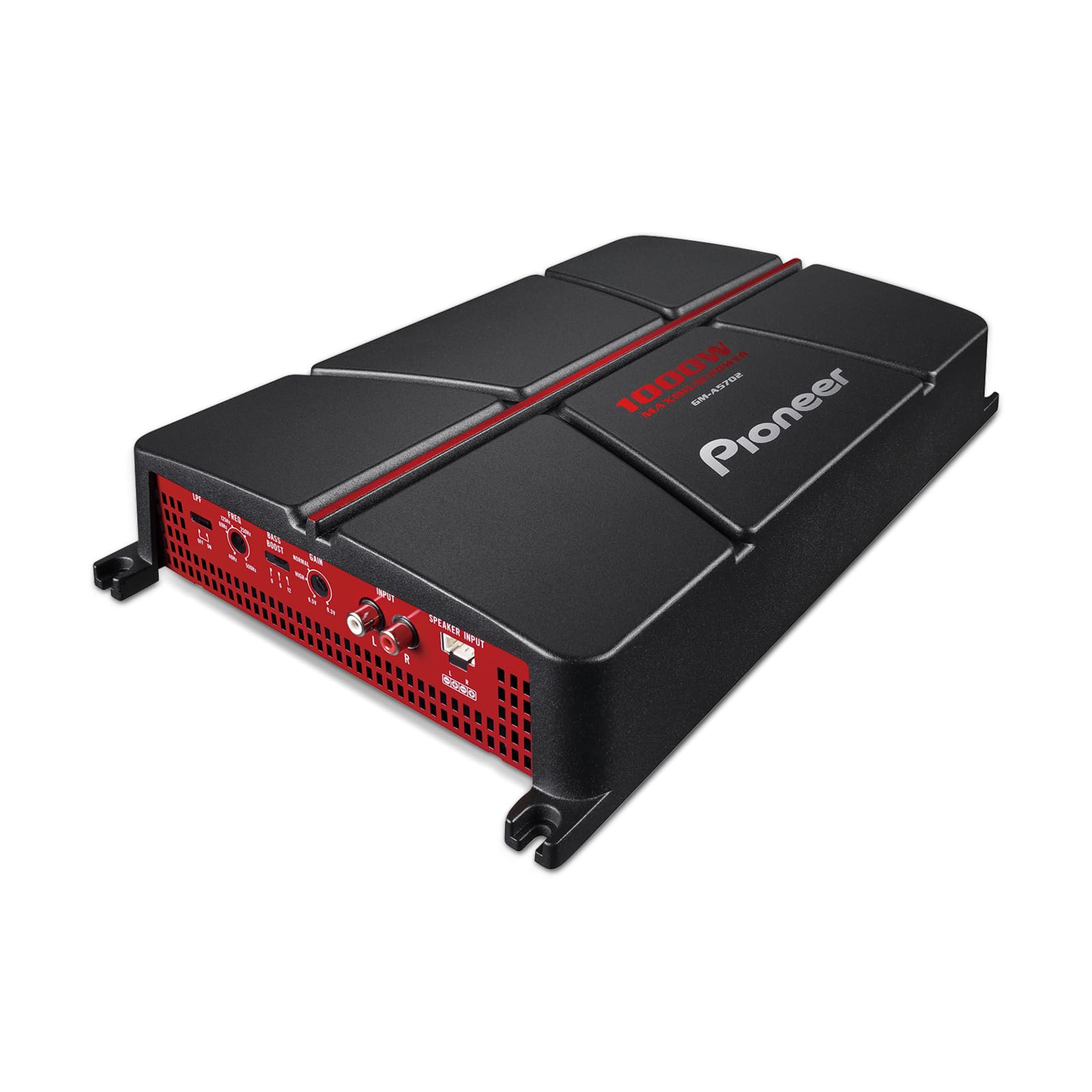
9. Pioneer GM-A5702 1000W Max Class AB Bridgeable 2-Channel Car Amplifier
A two-channel from a home-brand name, tuned for clean sub and speaker clarity at volume.
The headline spec is 1000 watts max, with an honest 240 watts RMS x 2 at 2 ohms or 480 watts RMS x 1 in bridged mode. The variable low-pass filter sharpens subwoofer performance while reducing distortion — exactly the part serious listeners check before buying a two-channel. Adjustable bass boost lets you tune the low end to taste.
This is the priciest pick here, and Pioneer’s Class AB design is pitched at a power-and-efficiency balance that keeps output consistent. The clear, focused bass is where it wins buyers over — the sound quality and power both draw consistent praise, and it pairs well with popular 8-inch subs.
The honest wrinkle: reliability feedback is mixed, and overheating is the recurring complaint, so mount it with airflow. Run it as a clean two-channel for speakers or a bridged sub, not a stress-tested competition amp. At 4.0+ stars it carries the strongest score on the list, which is the real reason to consider spending more here.
Clarity-first build: the variable low-pass filter and adjustable bass boost make it easy to get clean, focused bass that blends with your system.
Worth it for: buyers who want a brand-name two-channel with strong clarity and are happy to pay a little more for it.
Weigh the heat if: your install spot is cramped — give this Class A/B amp room to breathe.
Understanding the Specs
RMS watts versus peak watts
RMS (root mean square) is the continuous power an amp can deliver, while peak is the brief maximum. An amp rated at 100W RMS per channel is generally more musical than one that just shouts a big peak number. Match your RMS figure to your speakers’ power handling and you stay safe.
Class D versus Class A/B
Class A/B amps run more current and produce a warm, full sound, but they generate more heat. Class D amps switch on and off rapidly and waste less energy as heat, so they run cooler and take up less space. Both are worth owning; pick based on space and current draw.
2-ohm stability and bridging
An amp that is 2-ohm stable can drive two 4-ohm speakers wired in parallel per channel. Bridging ties two channels into one for double the power to a single sub. Check the minimum and maximum supply voltage — most here run on a 12-volt car system.
Crossovers and filters
An HPF (high-pass filter) blocks low frequencies from tiny speakers so they stay clear; an LPF (low-pass filter) blocks highs from a sub. Adjustable bass boost lets you thicken the low end, and variable gain matches the amp’s input to your head unit’s signal.
FAQ
Can a budget car amp power both door speakers and a subwoofer?
What does 2-ohm stable mean for my speakers?
Do I need a separate amp for a subwoofer if I already have a four-channel amp?
Why do budget amps advertise big peak watts but make less RMS?
Will a compact amp overheat in a tight space?
What is the difference between a monoblock and a multi-channel amp?
Can I install a budget car amp myself?
Does bridging an amp really double the power?
What gauge power wire does a budget car amp need?
Final Thoughts: The Verdict
For most buyers, the budget car amp winner is the Taramps TS 400X4 because it gives you 400W RMS (continuous, clean power) across four channels, bridges to a sub, and stays light enough to hide away — with the strongest reputation on the list at 4.5+ stars. If you need the smallest possible chassis, the PRV Audio QS400.4 fits where nothing else will. And for a single sub with a remote bass knob, reach for the Planet Audio PL2000.1M. Match the amp’s real RMS figure and ohm stability (how low a resistance it can safely drive) to your speakers first — then let the brand follow.
How We Picked
We do not accept paid placement. Every pick is matched to a real buyer and a real use-case; we do not hands-on test units.
Sources & Methodology
Specifications: manufacturer listings and product documentation. Review insights: verified customer reviews, as of November 2026. Pricing: not shown on this page (it changes often); check the current price via the retailer link.
As an Amazon Associate, Gadgets Feed earns from qualifying purchases. This does not affect which products we feature.