
Our readers keep the lights on and my morning glass full of iced black tea. As an Amazon Associate, I earn from qualifying purchases.
Specs are compiled from manufacturer listings and verified buyer reviews and can change over time — please confirm the key details on the product page before buying.
Most cheap inflatable paddle boards wobble underfoot, and that wobble is what makes beginners give up on the water. The fix is a board 34 inches wide or more, pumped to its full psi rating so the deck stays firm, and priced low enough to leave room for a decent leash. That is the whole game with an affordable stand up paddle board: deck width and air pressure first, accessories second.
I’m Min — the founder and writer behind Gadgets Feed. This guide is built by comparing the manufacturers’ published specifications and the patterns across verified customer reviews, so you get each pick’s real strengths and trade-offs instead of marketing spin.
Below you’ll find the picks that actually hold a line in chop, sorted by what they do best. Every board here is measured on width, weight capacity, and packed weight, so you can match one to your body and your car. If you want the short answer, the Roc 10′ 6″ is the safest bet in this affordable stand up paddle board field, and the wider FLYPARK boards are the ones to buy for families and anglers.
Our Picks at a Glance

How To Choose The Best Affordable Stand Up Paddle Board
Two specs decide whether you will love your first paddle board or sell it in a month: deck width in inches and rated psi. Everything else — the backpack, the paddle, the camera mount — is a bonus you can upgrade later. Buy for width and psi first and you will not regret the rest.
Width is your balance, measured in inches
A board measured at 32 inches wide gives you a narrow strip to stand on. One at 35 inches gives you three more inches of forgiveness on each side, which is the difference between catching a wobble and going in. Beginners, anyone over 200 pounds, and anyone paddling with a dog should start at 34 inches or wider.
Narrower boards are not bad — a 32-inch deck glides faster than a 35-inch one. But speed matters in year three, not on day one. The FLYPARK family board sits at 35 inches, and the difference against the 32-inch Retrospec Weekender is the first thing you feel stepping on.
Pressure rating and stiffness
Inflatable boards are rated in psi (pounds per square inch, the pressure inside the tube). A board pumped to its full rating feels close to a hard board underfoot. Under-inflate it and the deck bows in the middle, which is exactly where you stand.
Check the pump too. A dual-action pump pushes air on both the up and the down stroke, so you finish inflation faster. A single-action pump works fine — it just takes more strokes and more patience.
Weight capacity versus packed weight
Weight capacity is how many pounds the board floats safely. Packed weight is how many pounds you carry from the car to the water. These pull in opposite directions: high-capacity boards tend to be wider and a bit heavier. If you paddle alone from a beach parking lot, portability wins. If two adults or a large dog share the deck, capacity wins.
Look past the accessory list
A bundle with a backpack, dry bag, and repair wrench looks generous until the bag has no padding or the pump gauge sticks. What you actually need on day one is a working pump, a paddle you can adjust, and a safety leash. Everything else is a nice-to-have.
Quick Comparison
| Model | Best For | Deck Width | Max Weight | Board Weight | Amazon |
|---|---|---|---|---|---|
| Roc 10′ 6″ Inflatable SUP★ Best Overall | Most first-time buyers | 33 in | 350 lbs | — | Amazon |
| DAMA 11′ Inflatable SUPEasy Starter | Teens and lighter paddlers | 34 in | 400 lbs | — | Amazon |
| FLYPARK 11′ x 35″ Family SUPFamily & Fishing Pick | Families and anglers | 35 in | 430 lbs | 19 lbs | Amazon |
| Retrospec Weekender | Solo paddlers who hike in | 32 in | 275 lbs | 17.5 lbs | Amazon |
| ZLX 11’6″ Wide SUP | Heavier riders and yoga | 35 in | 550 lbs | — | Amazon |
| FLYPARK 11′ x 34″ SUP | Colour-matched family board | 34 in | 420 lbs | 19 lbs | Amazon |
| MYBOAT 11’6″ x 35″ SUP | Flat-water fishing trips | 35 in | 450 lbs | — | Amazon |
| ATPROSS 11’6″ Kayak-Seat SUP | Long days and seated paddling | 35 in | 450 lbs | — | Amazon |
| Tuxedo Sailor 10’6″ SUP | Yoga and lighter loads | 33.9 in | 330 lbs | — | Amazon |
In‑Depth Reviews
1. Roc Inflatable Stand Up Paddle Board 10′ 6″ with Premium SUP Accessories
Our pick — 4.5+★ from 18,000+ verified ratings; the strongest balance of quality and price.
The board that made this category credible with normal buyers, and the one I’d hand a first-timer without hesitation.
Start with the number that decides everything: 33 inches of deck width, which is wide enough that you stop thinking about falling and start thinking about where you’re paddling. It carries a 350-pound limit, so a grown adult plus a cooler plus a small dog still has room inside the spec. And it is 126 inches long, which is what gives it the straight tracking you want on open water rather than tight circles near the shore.
Owners are unusually consistent about two things: it goes up quickly, settling in around 10 minutes with the included pump, and it shrugs off scuffs. The board is made from PVC (the same tough plastic used in inflatable boats) that the maker claims is 50% stronger than competitors’ material — a manufacturer claim, not a lab result. A 3-year manufacturer warranty backs it, which is longer than most of this list offers.
The honest catch is the glide. A 33-inch board tracks beautifully but pushes more water than a sleek touring shape, so if you are chasing distance records across a lake, this is not that board. It is also the most popular board here by a wide margin — 4.5+ stars across 18,000+ ratings — and that popularity pricing keeps it firmly in the mid-range bracket, which is exactly why it wins.
Where it earns its keep
- 33 in across is the balance — stable for beginners without feeling like a barge
- 350 lb capacity covers a full adult plus gear with room in reserve
- Up in about 10 minutes and finished in roughly the same, so the car-to-water gap stays short
- 3-year manufacturer warranty on the whole board pack
Where it asks something of you
- Slower glide than narrow touring shapes on long open crossings
- You must hit the full pressure recommendation or the deck feels soft in the middle
- Every accessory ships in one bundle, so a single damaged piece means using customer service
My call: Buy this if you want one board that does lakes, rivers, and beach days without a learning curve.
Worth knowing: Anyone under 300 pounds who wants flat-out speed on open water will prefer a narrower, longer shape.
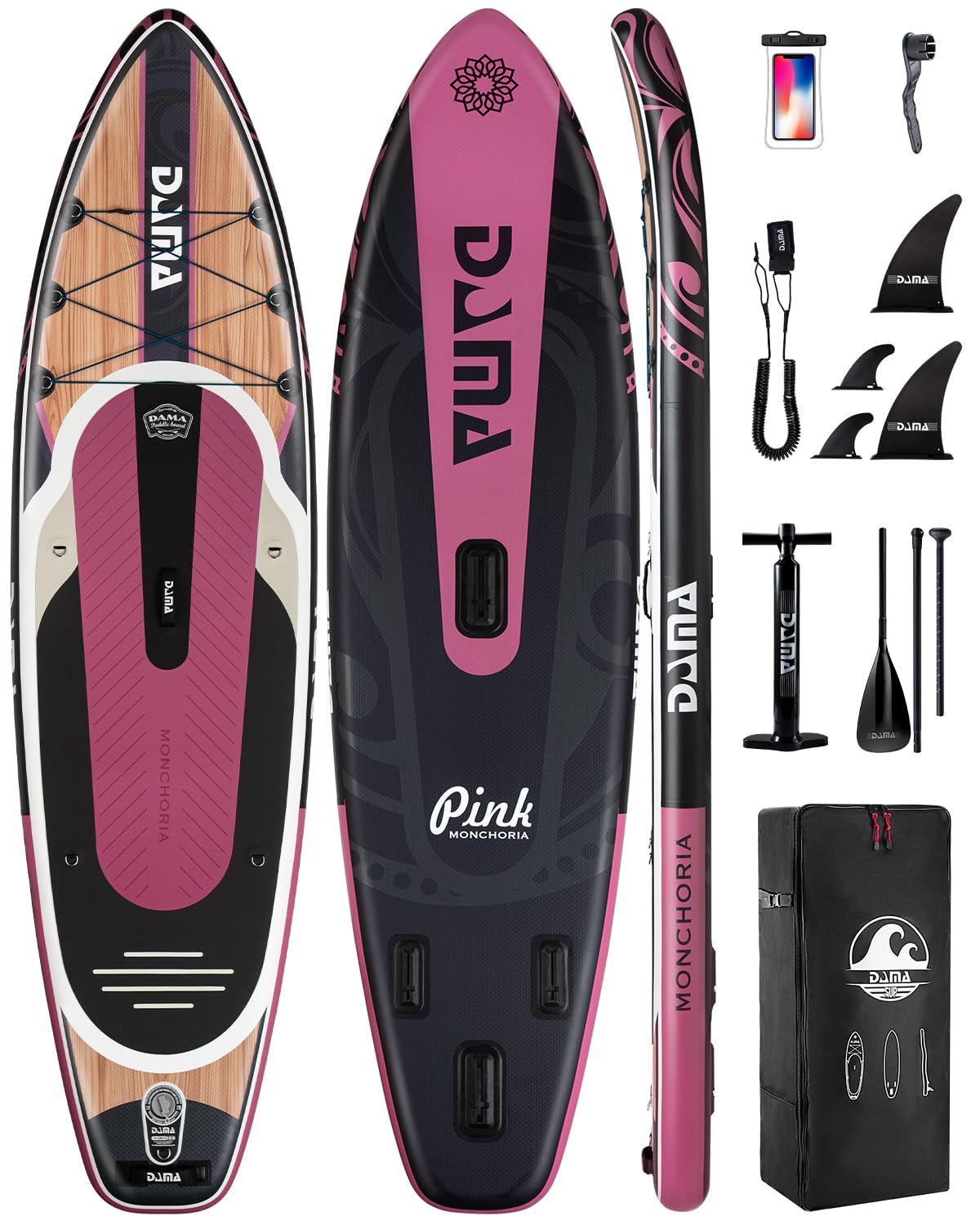
2. DAMA 11′ x 34″ x 6″ Inflatable Stand Up Paddle Board
A 400-pound deck with a kayak seat option, built for the teen who wants to bring a friend along.
Here is the thing about the DAMA: the deck is 34 inches wide and rated to 400 pounds, so it takes one adult and one teenager without either of them clinging to the rails. The maker states the board handles 1 to 3 people or a pet, and the hidden steel D-rings let you bolt on a kayak seat (sold separately) when you want to sit and paddle instead of stand.
The quad-tail fin setup — four small fins at the tail instead of one large center fin — is the interesting part. Fewer fins at the back means quicker pivots, which suits a board steered by a lighter rider. The pump includes a measuring hose with psi markings, so a teenager filling it alone can actually see when they’ve hit the mark.
What buyers consistently praise is how ready-to-go the bundle is: pump, paddle, leash, backpack, and fins all arrive together, and the design draws compliments. The recurring note is weight — the packed board is a two-hand carry rather than a one-arm toss, and a couple of owners find the bag awkward on longer walks. Its review history is thinner than the big names here, so treat it as a solid choice for casual family use rather than a battle-tested workhorse.
What the fin layout buys you: Faster turn-in and easier self-correction for a lighter paddler, which is why this one suits teenagers learning to steer.
What you trade: Less straight-line tracking in wind than a single deep center fin, so crosswinds need more paddle corrections.
Reach for this if: You want a bright, roomy board for teens and mixed-age family paddling with seat flexibility.
Look elsewhere if: You paddle long open stretches alone and want minimal correction work.
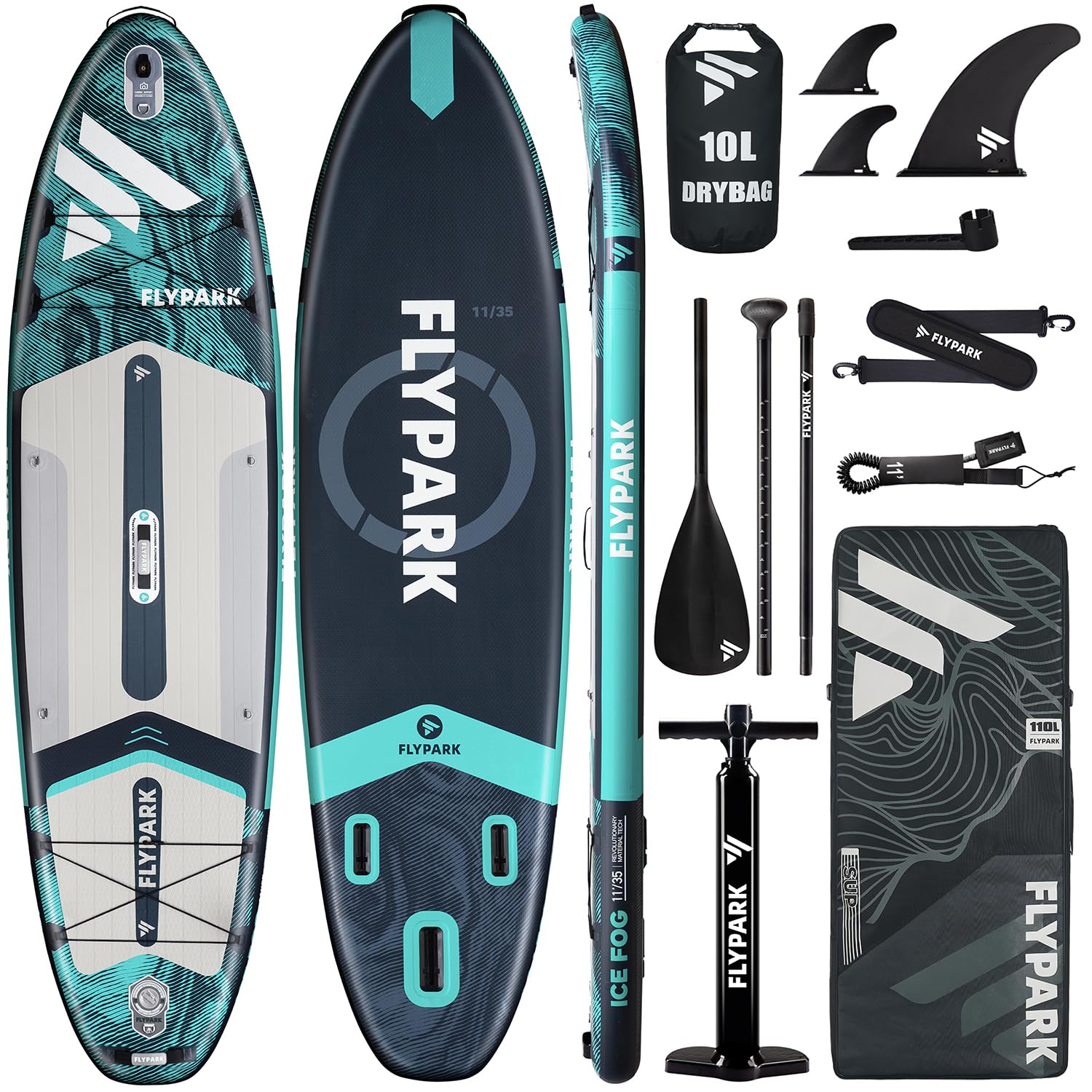
3. FLYPARK 11′ x 35″ Fishing & Family Inflatable Paddle Board
Three inches of extra deck width and 430 pounds of capacity — this is the family barge that still folds into a backpack.
Compare it directly to the Roc above: this FLYPARK measures 35 inches wide against the Roc’s 33, and it carries 430 pounds against the Roc’s 350. That extra width and capacity is the whole point — it lets a parent and a child share the deck, and it lets you add a cooler, a rod holder, and a dry bag without watching the board sink lower in the water. At 132 inches long it is also 6 inches longer than the Roc’s 126, which helps it hold a straight line when you’re casting rather than cruising.
The build is marine-grade PVC with drop-stitch construction (thousands of internal threads that lock the top and bottom surfaces a fixed distance apart, which is what keeps the deck flat instead of ballooning). The EVA deck pad — a foam layer with a square-cube texture for grip — is what gives beginners confidence when the board leans. You get a built-in M6 camera mount, a rod holder, dual 4-point bungees front and rear, a 10L dry bag, and a 110L backpack to haul it all.
The trade-off is weight: this is a 19-pound board, and unlike the Retrospec Weekender at 17.5 pounds it is not the one you’ll sling over one shoulder for a mile-long hike. Owners put it up in roughly 9 minutes to 12 psi and report the deck stays firm season after season. If your paddling happens within a short walk of the car, that weight is irrelevant — if it doesn’t, it matters.
The keeper feature: A 35-inch deck that three people can genuinely share is rare in this bracket, and the dual bungees plus camera mount turn it into a fishing platform rather than a toy.
The honest limit: Anything this wide and this loaded needs to be carried by two people, or one person making two trips.
Best match: Families and anglers who drive to the water and want one board that does both jobs.
Not for: Solo paddlers who hike to remote put-ins and count every pound.
4. Retrospec Weekender Inflatable Paddle Board
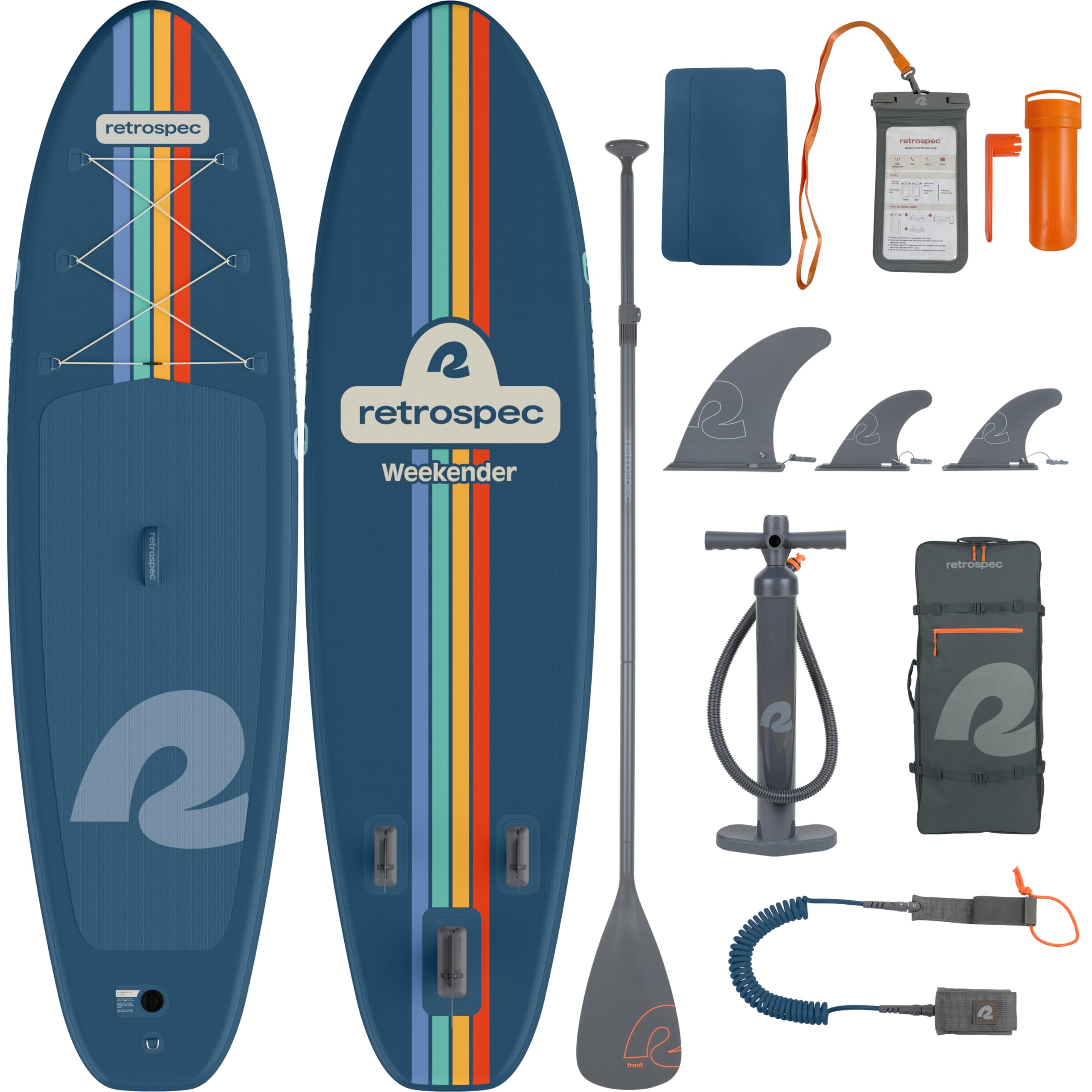
The lightest board on this list, and the one that rolls small enough to live in a car trunk.
At 17.5 pounds this is the easiest board here to move from the driveway to the shoreline, and that number is the reason it exists. It packs into a backpack-sized roll, so no roof rack and no garage wall bracket. Set against the FLYPARK family board’s 19 pounds, it is the lighter of the two, and that gap is what you feel on the third trip back to the car.
It runs narrower at 32 inches, which is exactly the trade: less deck under your feet, more glide through the water. The 275-pound capacity is the lowest on this list, so a solo adult plus a dry bag fits comfortably, but two adults will be at or past the limit. It caps at 15 psi and ships with a dual-action pump, and buyers report getting it up in a few minutes.
Build-wise it uses AerGlide-Lite PVC and a brushed EVA deck pad that is softer on bare feet than a textured pad — a real detail for anyone paddling barefoot in warm water. What the reviews keep circling back to is how well the finish holds up and how much people like the colour schemes. What sells it short is that the lightest build is not the stiffest under a heavy rider, so if you are near the 275-pound limit, the deck will flex more than on the 430-pound FLYPARK.
Why it’s the traveller’s pick: Under 18 pounds and it rolls to backpack size, so the board lives in your trunk instead of your garage.
The limit you should hear: A 275-pound ceiling and a 32-inch deck make it a solo board — bring a passenger and you are out of spec.
Pick this one if: You paddle alone, value a light carry, and launch from whatever beach the car reaches.
Think twice if: Anyone in the household is over 275 pounds or regularly paddles with a pet.
5. ZLX 11’6″ x 35″ Inflatable Paddle Board for Adults
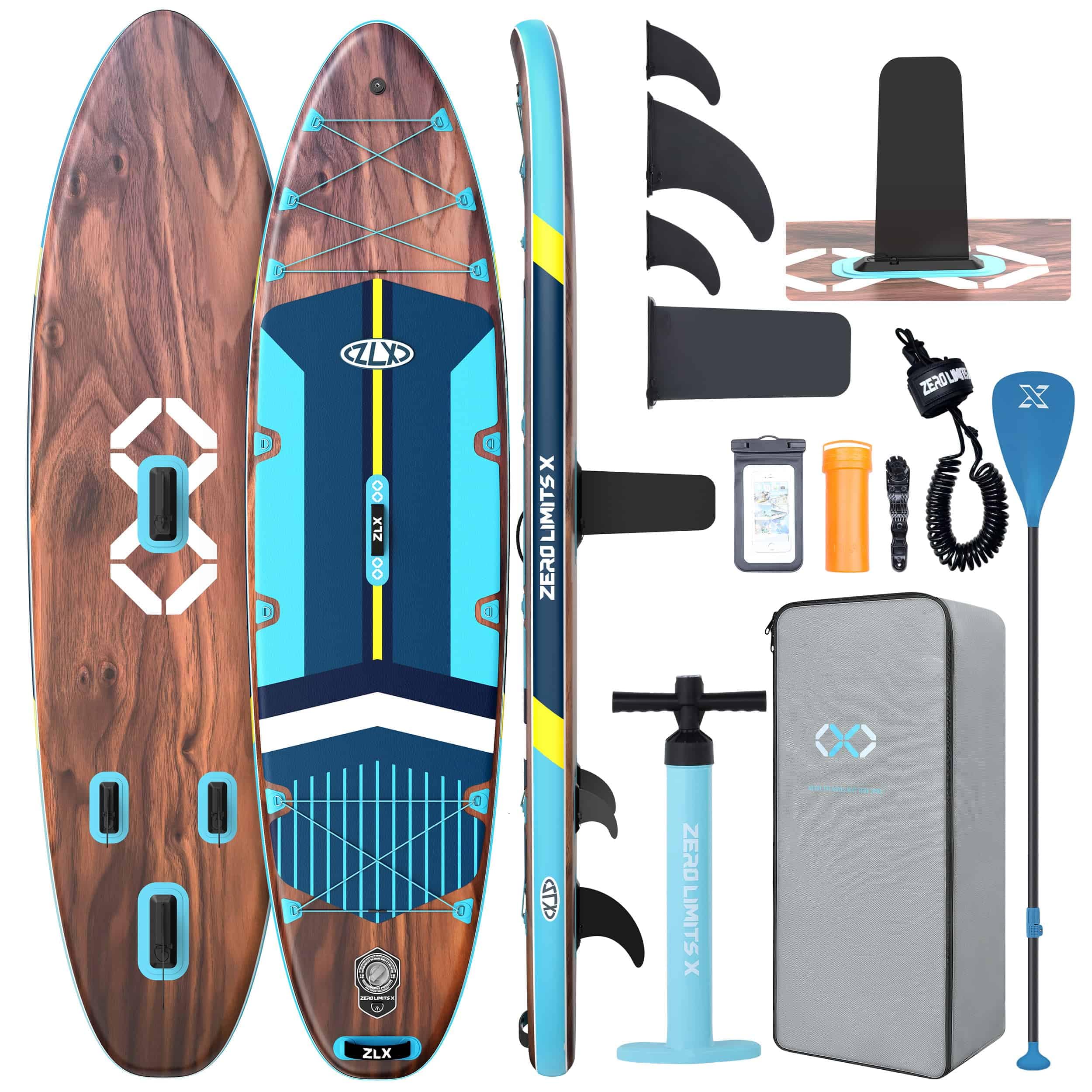
550 pounds of rated capacity on a 35-inch deck, built for the paddler who keeps being told boards aren’t rated for them.
That 550-pound figure is the highest capacity in this article, and it matters for larger riders, two adults, or anyone paddling with a big dog. It sits on a 35-inch wide, 138-inch long deck, so the size matches the rating instead of just being a number on a spec sheet. It is also the board here that most clearly fits bigger people, an observation the review pages keep repeating.
The feature that separates it is the StabilTrac center fin, a balance fin that the maker says reduces sideways drift — the side-to-side slide you get in chop or when your stroke goes crooked. Whether the claim holds at the stated amount, the middle fin is a real physical addition, and reviewers single it out as the reason the board feels steady under uneven paddling. You get 14 stainless steel D-rings, a camera mount, and a non-slip EVA deck, plus a waterproof phone pouch and repair patches in the kit.
Two things in the review pages are mixed rather than glowing: durability and inflation. The maker says the included upgraded pump fills in under 8 minutes, and some owners agree, while others find the pump less cooperative than expected. There is also the physical reality of a 35-inch, 138-inch board — it is a lot of material to haul, and the packed bundle is not the light pick here. For a heavy rider who wants to stop worrying about capacity, that trade is worth it.
The case for the ZLX
- 550 lb capacity — the highest rating in this whole roundup
- 35 in wide and 138 in long, so the size matches the load rating
- StabilTrac balance fin aimed squarely at sideways drift
- 14 stainless D-rings plus a camera mount for gear
What to expect going in
- Mixed reports on the pump and on long-term durability
- Big deck means a heavier bundle to carry and store
- Wide shape trades top speed for steadiness
Go for it when: Capacity is your blocker and you want to paddle two-up or with a large dog.
Skip the upgrade if: You are a light solo paddler who wants the fastest, easiest board to carry.
6. FLYPARK 11′ x 34″ Inflatable Paddle Board for Adults
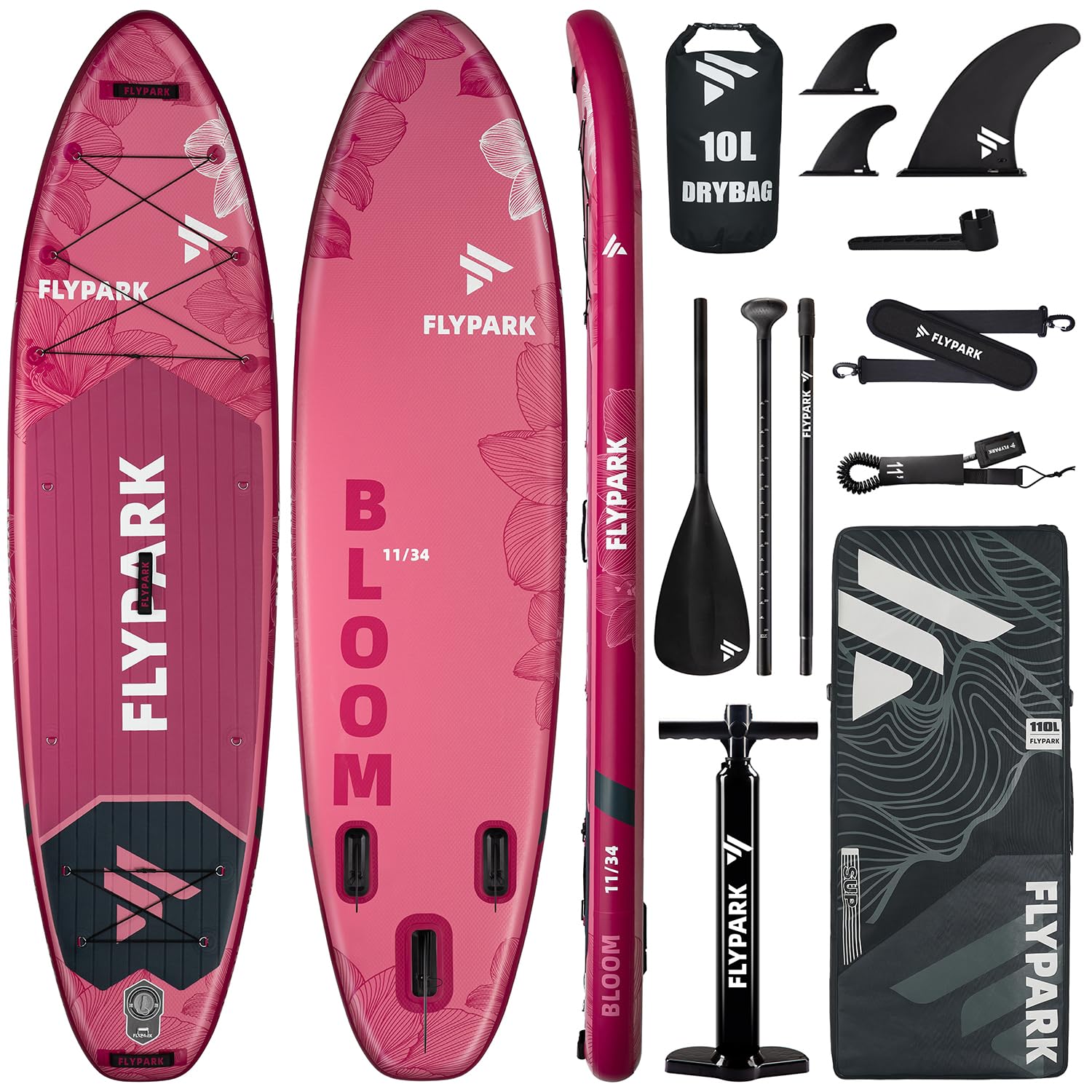
The pink one that still carries three adults and 420 pounds of gear without arguing.
This is the same 11-foot, 6-inch-thick FLYPARK platform as the family board above, narrowed to 34 inches and rated to 420 pounds for up to three adults. If you are choosing between the two, the difference is a single inch of width and 10 pounds of capacity — the 35-inch version is the better fishing deck, and this 34-inch version is the easier all-rounder to paddle for a light adult.
Where it stands apart is the colour. The Bloom pink finish gets real praise in the review pages, which is unusual — most board feedback ignores the paint entirely. That matters if the board needs to look good stored in a living room or if it’s a gift. Beneath the paint it’s the same marine-grade PVC with drop-stitch construction and the square-cube EVA deck pad, so grip and rigidity are the same standard as the rest of the line.
Storage is well handled: a 6-point front bungee plus 4-point rear tie-downs hold a cooler or a dry bag, and 4 center D-rings accept a shoulder strap or kayak seat. The 8-piece kit ships with the 110L backpack, 10L dry bag, dual-action pump, and safety leash. The catch is that nothing about this board is built for speed — a 34-inch deck on a marine-grade PVC hull is a stable platform, not a racer, and the 19-pound packed weight means the hike-in crowd should look at the 17.5-pound Retrospec instead.
Why buyers pick it: A 420-pound capacity family board that doesn’t look like every other grey inflatable on the beach.
The fine print: Same weight and same width constraints as its 35-inch sibling — no lighter, no faster.
The right buyer: Anyone who wants a roomy family board and cares what it looks like rolled up in the corner.
Wrong buyer: Paddlers chasing glide or a one-arm carry up a trail.
7. MYBOAT 11’6″ x 35″ Extra Wide Inflatable Paddle Board

A 35-inch casting platform with a 450-pound rating, three carry handles, and a camera mount up front.
This one gives you a 35-inch wide, 138-inch long deck rated to 450 pounds, plus three handles at the front, middle, and rear so two people can carry it and one person can lift the middle. The nose camera mount is positioned for hands-free shooting while you cast, and the kit includes a 5L waterproof bag, a floating phone case, a 100L backpack, and a shoulder strap.
The build is military-grade drop-stitch fabric in PVC, which is the same construction class as the FLYPARK boards here and is meant to survive lake, beach, and even faster water. The rocker and width combination favors a stable standing position over rapid turns — this is a board you anchor and fish from, not one you carve with.
The one part reviewers are split on is the pump. Some praise its dual-action output, and others describe malfunctions that made setup frustrating. That’s worth knowing before your first trip, because a finicky pump will dampen an otherwise straightforward launch. Owners otherwise describe the board as roomy enough for a small cooler and solid underfoot. Buy it for the fishing layout; just budget a little patience for that first inflation.
The standout layout: Three handles and a nose camera mount are small choices that separate a fishing board from a general cruiser.
Where it wobbles: Pump consistency, by the maker’s own accessory list and in owner feedback.
Suits you if: You want a wide, high-capacity deck set up for rods, cameras, and long afternoons on flat water.
Better elsewhere if: You mostly paddle hard and fast and never stop to cast.
8. ATPROSS 11’6″ Inflatable Paddle Board with Kayak Seat
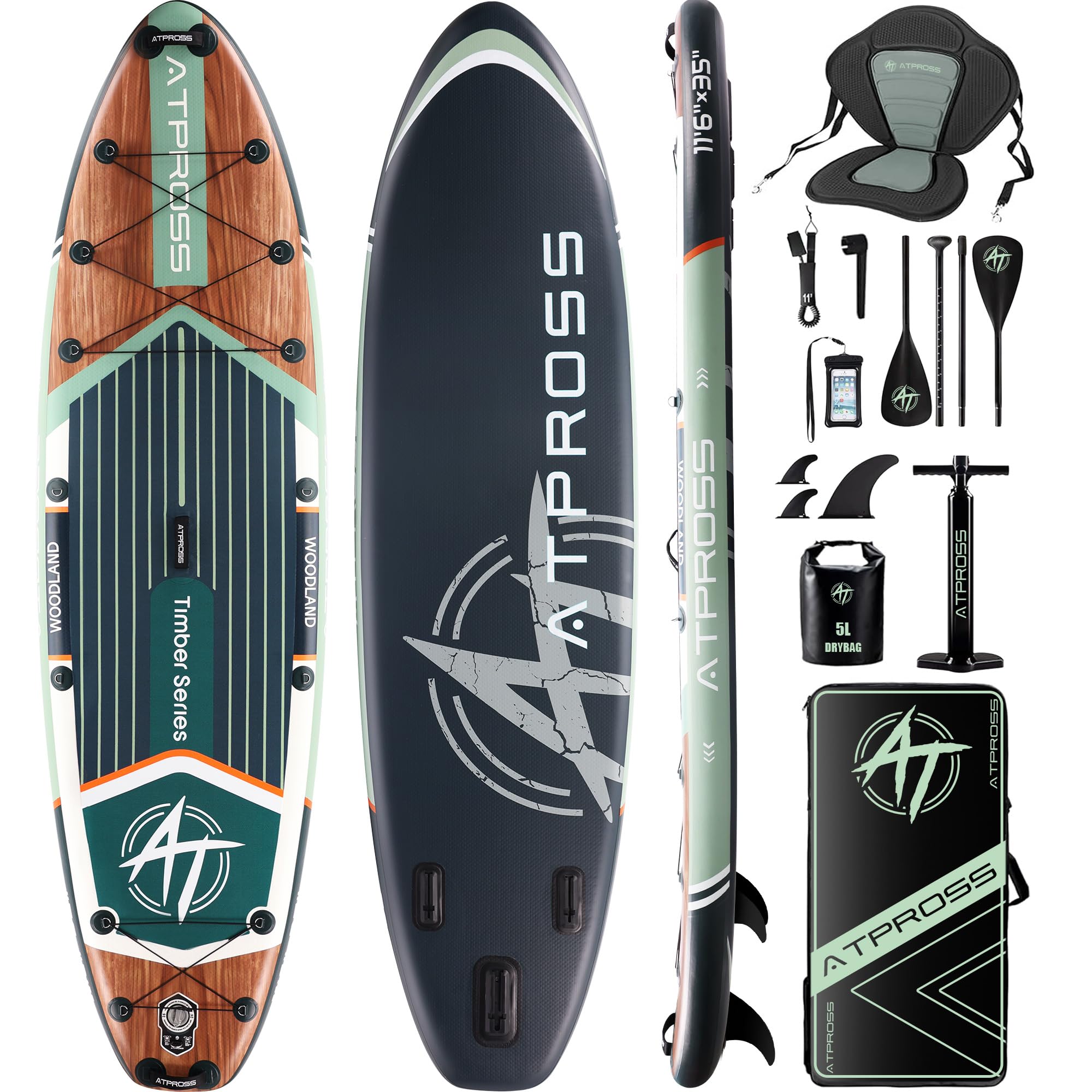
The board that becomes a kayak in seconds, thanks to an inflatable seat that clips on and off without tools.
Most boards here sell you a kayak seat as an optional extra. This one includes an ergonomic inflatable seat with high-density cushioning, mounted on a tool-free QuickLink system so you can convert from stand-up paddling to seated kayak cruising and back again. For anyone whose back starts complaining after 45 minutes of standing, that is a genuine feature rather than a marketing bullet.
The platform underneath is a 35-inch wide deck rated to 450 pounds, built from double-layer PVC with a reinforced sidewall to resist rocks and sand, and it ships with a 600D Oxford backpack, single and dual paddles, ankle leash, two-way hand pump, repair cylinder, waterproof phone bag, and a 5L dry bag. The extra width is what keeps it steady when you shift into a seated position, which is when most boards feel tippy.
Credit where it’s due on the design too — owners mention getting compliments on the appearance, and the deck has plenty of room to stand. The caveats are durability and inflation, both of which come back mixed in the review pages rather than uniformly good. Treat it as a strong value package for relaxed paddling instead of a board built for rough water and hard use.
The conversion trick: A tool-free inflatable kayak seat included in the box is the most useful thing here for long days on the water.
Keep your expectations level: Durability and inflation feedback runs mixed, so buy it as a leisure board, not an expedition one.
Choose it for: Mixed sessions where you want to stand, sit, and switch without carrying two craft.
Leave it for: Paddlers who demand predictable setup every single launch.
9. Tuxedo Sailor Inflatable Paddle Board 10’6″ with Accessories

A patterned deck with scribed yoga lines, built for the paddler who treats the board as a floating mat.
Yoga on a paddle board needs two things: grip and reference points. This board has both, with a large EVA deck pad covered in positional scribing lines to line up your feet and hands, plus side handles for balance during poses. The pad design is closer to a mat than the usual textured foam, and the pattern itself — pink, purple, and blue with lotus, stars, and moon motifs — is the most decorative finish in this roundup.
On the numbers, it measures 10 feet 6 inches long and 33.9 inches wide, with a 330-pound capacity. That is a lighter rating than the 430 and 450-pound FLYPARK and MYBOAT boards, so it suits one adult and a small passenger rather than a full family. The triple-fin arrangement uses the center fin for stability and turns, with the side fins adding acceleration, and all three are removable for storage.
What buyers consistently like is how much fun it is for summer sessions and how easily it transports in its backpack-style bag. The mixed areas are inflation and durability, so it is a board to use carefully rather than drag across gravel. Owner bias runs light here too — this is a board chosen for its looks and its yoga pad, and it does that job well.
Its niche done right: The scribed yoga deck is a real design choice, not a pattern, and it makes balance work easier to repeat.
The compromise: A 330 lb rating and mixed durability feedback mean this is a gentle-use board.
Ideal for: Yoga paddlers and casual summer cruisers who want a deck that looks as good as it grips.
Not ideal for: Two full-size adults or anyone near 330 pounds.
Understanding the Specs
Deck Width (32″ to 35″)
Width is the single most useful number on the box. It’s the flat standing strip from rail to rail, and each extra inch buys you forgiveness when a wake or a wobble hits. Boards around 32 inches, like the Retrospec Weekender, feel quick but demand balance. Boards at 35 inches, like the FLYPARK family deck, feel planted and suit beginners, yoga, and dogs. Pick your width based on how confident you are on day one, not how good you hope to be by summer.
Weight Capacity in Pounds
This is the maximum load the board floats safely, and it counts everything — you, your gear, your cooler, your dog. A 275-pound rating is a solo board. A 430 or 450-pound rating takes an adult plus a passenger. Leave headroom; paddling right at the limit makes the board sit low and push water. Heavier riders should start at 430 pounds or more rather than assuming a wide board is automatically strong enough.
PSI and Dual-Action Pumps
PSI means pounds per square inch, the air pressure inside the board. Inflatable boards need to be pumped to their rated pressure to feel stiff; under-inflated, the deck dips where you stand. A dual-action pump pushes air on both strokes so you finish sooner. The Retrospec lists 15 psi as its maximum, and one FLYPARK owner measured about 9 minutes to reach 12 psi with the included pump — a useful benchmark for how long your first setup will take.
Drop-Stitch, PVC, and EVA
Drop-stitch is the internal thread structure that holds the top and bottom of the board a fixed distance apart, which is why an inflatable can feel rigid. PVC is the tough outer plastic. EVA is the foam deck pad you stand on, and its texture decides grip. Marine-grade PVC resists salt and sun, while a brushed EVA pad is gentler on bare feet. None of these are marketing terms — they’re the three materials that decide how the board feels under you.
FAQ
How wide should my first inflatable paddle board be?
Can two adults share one of these paddle boards?
How long does it take to inflate an inflatable SUP?
What PSI should I pump my board to?
Is an inflatable paddle board stable enough for yoga?
Do I need a center fin or a quad-fin setup?
Can I paddle one of these boards in the ocean?
How much does an inflatable paddle board weigh when packed?
What accessories should come in the box?
Will a paddle board fit in my car?
Final Thoughts: The Verdict
For most people, the affordable stand up paddle board to buy is the Roc 10′ 6″. It has the widest safety margin for a beginner — 33 inches of deck, a 350-pound rating, a 3-year manufacturer warranty, and a track record of 4.5+ stars across 18,000+ ratings. That combination is difficult to beat at any tier.
If you paddle with family or fish from the deck, take the FLYPARK 11′ x 35″ — its extra width and 430-pound capacity are the reason. For a light solo carry that lives in your trunk, the Retrospec Weekender at 17.5 pounds is the one to reach for. And if capacity has been the thing holding you back, the ZLX at 550 pounds was built for exactly that problem.
How We Picked
We do not accept paid placement. Every pick is matched to a real buyer and a real use-case; we do not hands-on test units.
Sources & Methodology
Specifications: manufacturer listings and product documentation. Review insights: verified customer reviews, as of November 2026. Pricing: not shown on this page (it changes often); check the current price via the retailer link.
As an Amazon Associate, Gadgets Feed earns from qualifying purchases. This does not affect which products we feature.