
Our readers keep the lights on and my morning glass full of iced black tea. As an Amazon Associate, I earn from qualifying purchases.
Specs are compiled from manufacturer listings and verified buyer reviews and can change over time — please confirm the key details on the product page before buying.
You are buying a rack to hold expensive gear, so the first thing to settle is load capacity, not U-height. A 4-post rack that flexes sideways when you patch a cable is worse than a shorter model that sits rock solid. Every pick below is a genuine four-post open frame, and the differences that matter are depth range, steel weight, caster rating, and how the cage-nut holes line up.
I’m Min — the founder and writer behind Gadgets Feed. This guide is built by comparing the manufacturers’ published specifications and the patterns across verified customer reviews, so you get each pick’s real strengths and trade-offs instead of marketing spin.
Some racks mount in minutes and some fight you on every screw hole, and that gap decides how your install day goes. This breakdown of the 4 post rack field focuses on depth adjustment, load ratings, and the assembly quirks buyers actually hit.
Our Picks at a Glance


How To Choose The Best 4 Post Rack
Start with what you are actually bolting in. A home lab with a single tower server and a switch needs far less steel than a rack holding a UPS, a full-depth server, and a stack of drives. Get that list written down before you compare a single spec.
Measure your deepest piece of gear first
Depth is the spec that disqualifies racks fastest. A chassis that needs 34 inches of rail-to-rail space simply will not slide into a frame that tops out at 24 inches. Look for a rack with an adjustable depth range in inches, and check the numbers against your longest device, not your shortest. Racks that adjust in 1-inch increments give you finer control over where the front and rear posts land.
Decide between a fixed floor frame and a rolling one
A rack on casters lets you pull it away from the wall to reach rear ports and cabling. The trade-off is that wheels carry far less weight than leveling feet planted on the floor. Manufacturers usually publish both figures separately — one for rolling and a higher one for static load on feet. Choose casters if you need access to the back panel often, and feet if the rack will stay put under heavy gear.
Understand square holes versus round holes
Square holes take cage nuts, which snap into the opening and give you a threaded point for a screw. They are the standard for network and server gear and let you mount almost anything with the right nut. Round holes are tapped directly into the post and suit specific audio or legacy equipment. Some racks give you round beams on one side and square on the other, which is handy if your gear is a mix of IT and stereo hardware.
Plan for sway before you load it up
An open frame is four posts and cross members, so it can flex laterally unless something braces it. Horizontal mounting rails, a ventilated top panel, or casters with brakes all add stiffness. If the rack will sit against a wall and never move, sway matters less. If it lives on a garage floor and gets bumped, look for L rails or reinforced top and bottom plates.
Quick Comparison
| Model | Best For | Rack Units | Depth | Load Capacity | Amazon |
|---|---|---|---|---|---|
| RAISING ELECTRONICS 42U Open Frame Rack★ Best Overall | Tall home lab builds | 42U | 22–34 in | 950 lbs | Amazon |
| VEVOR 20U Open Frame Server RackBest Value | Tight spaces, wall or floor | 20U | 23–40 in | 200 lbs ground / 150 lbs wall | Amazon |
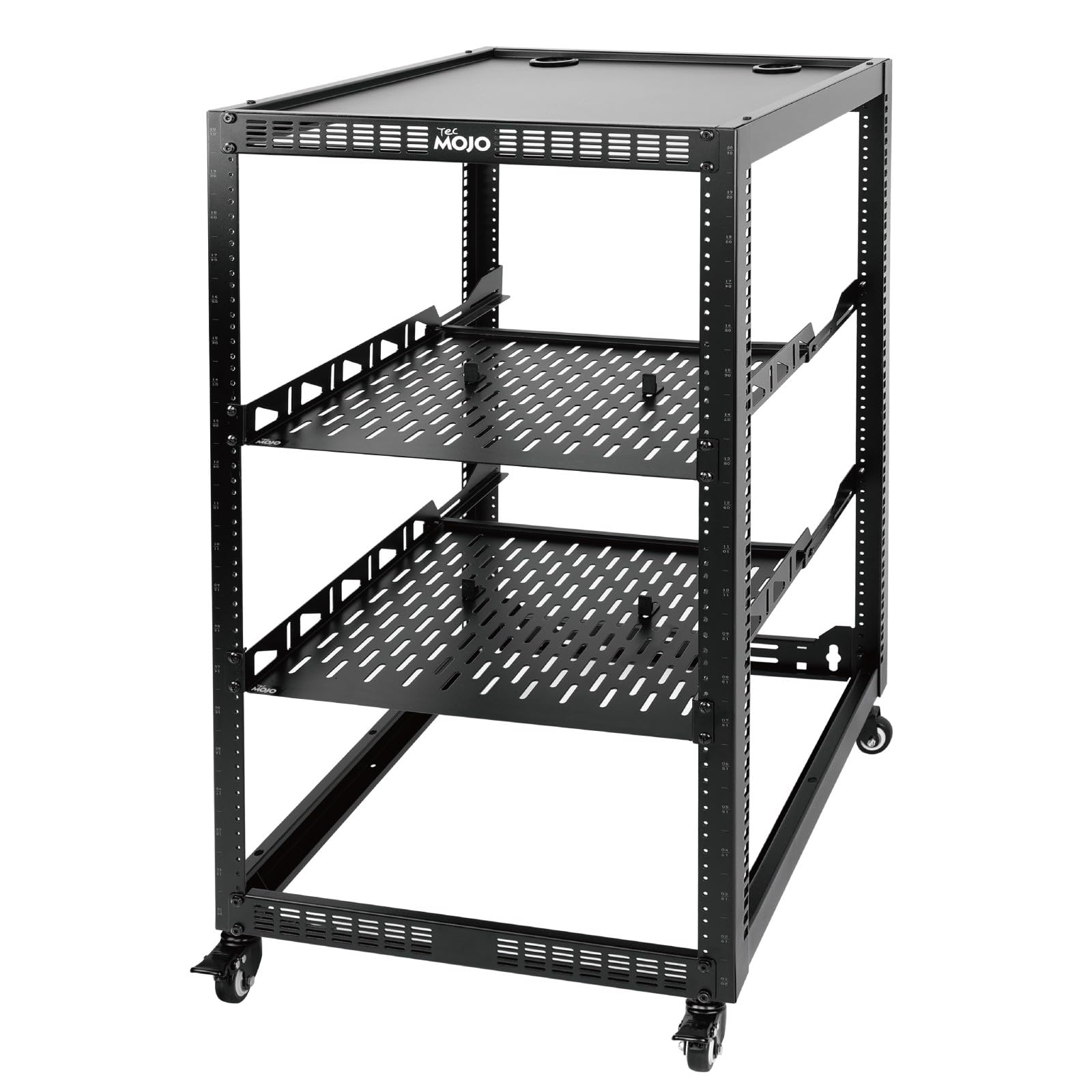
| TECMOJO 20U Open Frame Network RackBest for AV and IT | AV and IT gear together | 20U | 20.2 in fixed | — | Amazon |
| RackPath 25U Open Frame Server Rack | Heavy servers on a budget | 25U | 22.7–40.7 in | 1323 lbs | Amazon |
| RIVECO 18U Adjustable Depth Rack | Rigid home lab floor stand | 18U | 24–38 in | 1700 lbs | Amazon |
| Sysracks 32U Open Frame Server Rack | Tall, deep, airflow-first setups | 32U | 24–37 in | 460 lbs | Amazon |
| NavePoint 25U 4-Post Open Frame Rack | Wide depth flexibility | 25U | 22–40 in | — | Amazon |
| RIVECO 25U Network Rack with Top Cover | Mixed AV and network gear | 25U | 21.7 in fixed | 500 lbs / 400 lbs on casters | Amazon |
| NavePoint 42U 4-Post Server Rack | Full-size data center builds | 42U | 600/800/1000 mm presets | 881 lbs | Amazon |
| Tripp Lite 45U 4-Post Open Frame Rack | Long-haul installs with growth room | 45U | 22–36 in | 1000 lbs | Amazon |
In‑Depth Reviews
1. RAISING ELECTRONICS Server Rack 4 Post Open Frame 42U
Our pick — 4.5+★ from 350+ verified ratings; the strongest balance of quality and price.
Forty-two units of vertical room in an aluminum frame light enough for two people to stand up.
If you are building a home lab with a lot of gear and no plans to move it, this is the frame to beat. The 42U height gives you serious room to grow — more than double the 18U of the RIVECO rack further down — while the aluminum construction keeps it at 61 pounds, lighter than the 62-pound Sysracks 32U despite carrying ten more rack units. You get 950 lbs of rated capacity across an assembled 78-inch tall frame, and the posts adjust from 22 to 34 inches in 1-inch increments so you can dial the depth to your server chassis instead of settling.
What wins people over is the build — the professional-grade feel of the steel and the easy assembly are the two things buyers bring up again and again. Square screw holes mean standard cage nuts and M6 screws behave the way you expect, and the box ships with both. Racks this tall normally feel top-heavy; this one assembles straight and stays square as you load it from the bottom up.
The catch is lateral movement. This is an open frame with no side panels, and the rack will sway left and right if you push it sideways rather than rolling it forward. Anchor it or brace it if it lives somewhere with foot traffic. Also confirm your deepest chassis fits the 34-inch max — a full-depth enterprise server may need more.
What earns its place up top
- 42U of vertical space for a growing home lab
- Aluminum frame at 61 lbs — lighter than several shorter steel racks
- 22–34 in adjustable depth in 1-inch steps
- 950 lbs capacity with square holes, M6 screws, and cage nuts included
Where it asks for your patience
- No side bracing, so it sways if pushed sideways
- 34 in max depth rules out the deepest full-size servers
Best for: anyone with a stack of servers, switches, and patch panels who wants one tall frame and plenty of headroom.
Skip if: your gear lives in a walkway where the rack gets bumped, or you need more than 34 inches of mounting depth.
2. VEVOR 20U Open Frame Server Rack
One rack that mounts to a wall or rolls on the floor, with 23 to 40 inches of depth to play with.
Two mounting options in one frame is the reason this one sells. You can bolt it to a wall at 150 lbs capacity or stand it on the floor at 200 lbs, which makes it the practical pick for a closet, a retail back room, or a classroom where floor space is tight. The 23-to-40-inch adjustable depth range stretches further than the RAISING rack’s 34-inch ceiling, so deeper equipment has somewhere to go.
The carbon steel frame carries 20U of gear, and the box is genuinely loaded: 145 M5 screws, four casters, ten M6 cage nuts, expansion screws, a grounding wire, and a manual. There is also a top panel that gives you a flat shelf for odds and ends. Buyers get real function out of it for the money, and the roller design means you can reposition it without lifting.
Be honest with yourself about the weight limit before ordering. 200 lbs on the floor is a fraction of what steel frames like the RackPath 25U carry at 1323 lbs, so a UPS plus a few heavy servers will strain it. Assembly is the other sticking point — the directions are thin and some buyers wrestle with the screws, so give yourself a clear afternoon.
What it gets right: real flexibility for a small setup — wall mount for space saving, floor stand with casters for access, and a depth range that handles most mid-size gear.
Where it thins out: 200 lbs floor capacity and a mixed assembly experience mean this suits light loads and patient builders, not a rack full of heavy servers.
Reach for this if: you need to get a handful of network devices off the floor in a small room and want the option to hang it on a wall.
Look elsewhere if: your load includes a UPS or multiple full-depth servers — the 200 lb rating will feel tight.
3. TECMOJO 20U Open Frame Network Rack
Comes with the shelves and stops you would otherwise buy separately, so the rack is usable the day it lands.
Most racks in this list are bare frames — you buy the shelves later. TECMOJO bundles two ventilated 1U shelves, four anti-slip shelf stops, four velcro straps, and a full set of mounting screws. For audio and video gear that does not bolt to rails, those shelves are the whole point. The alloy steel frame stands 35 inches tall and holds 20U, and the top panel gives you extra surface for a small monitor or set-top box.
Build quality is where this one earns its keep — the solidity of the steel and the smooth assembly are the strongest notes in the feedback. It is also noticeably more compact than the tall frames here: at 35 inches in height it is barely more than half the 78-inch reach of the RAISING rack, which matters if the rack has to sit under a shelf or in a low basement.
Two things to check before you commit. The depth is fixed at 20.2 inches, so a deep server chassis will overhang the posts — this is a short-gear rack. And hole alignment is the recurring complaint: the threaded holes sit on the front and back of the posts on some units, and buyers report difficulty lining hardware up, so dry-fit your first shelf before tightening anything.
The bundle is the buy: shelves, stops, straps, and hardware in one box turns a frame purchase into a ready-to-fill rack.
Check the depth: 20.2 inches fixed is short by rack standards — ideal for switches, patch panels, and AV receivers, wrong for long servers.
Your pick when: the rack is going to hold amps, receivers, switches, and short-depth gear and you would rather not shop for shelves separately.
Think twice if: you own long server chassis or you are not comfortable chasing alignment on the mounting posts.
4. RackPath 25U Open Frame Server Rack

Cold rolled steel that takes 1323 pounds and still rolls on casters — the load rating is the headline.
Here is the number that separates this rack from almost everything else on the page: 1323 lbs of rated capacity. That is more than six times the 200 lbs the VEVOR 20U carries on the floor, and it means you can fill all 25U with a UPS, several drive-heavy servers, and a stack of switches without watching the frame sag. The 22.7-to-40.7-inch adjustable depth covers nearly the full range of 19-inch equipment, and the cold rolled steel wears a black electro-static powder coat that resists scuffs.
The open frame design gives you full access to the rear for cabling and servicing, and the bundle is complete — four heavy duty casters, eight cable management hooks, and 50 M6 screws and cage nuts. Sturdiness is the trait that comes up most in the feedback, and it is the right one for a frame built to hold heavy servers. EIA/ECA-310 compatibility means standard 19-inch gear drops straight in.
The mounting hardware itself draws some mixed notes — the screws and nuts do the job but are not the premium stuff. That is a small annoyance on a rack this capable, and swapping in your own cage nuts costs little. Just budget for the 51.2 lb frame arriving as a flat package you assemble.
Standout strength
- 1323 lbs capacity — built for genuinely heavy servers
- 22.7–40.7 in depth range covers nearly everything 19-inch
- Cold rolled steel with powder coat finish
- Eight cable hooks and 50 M6 screws and cage nuts included
Small trade-offs
- Bundled mounting hardware is functional rather than premium
- Arrives flat-packed and needs full assembly
Built for: a lab with real weight in it — servers, UPS units, and storage that would strain a lighter frame.
The honest exception: if your gear is light and you would rather not assemble a steel frame, this is more rack than you need.
5. RIVECO 18U Adjustable Depth Server Rack
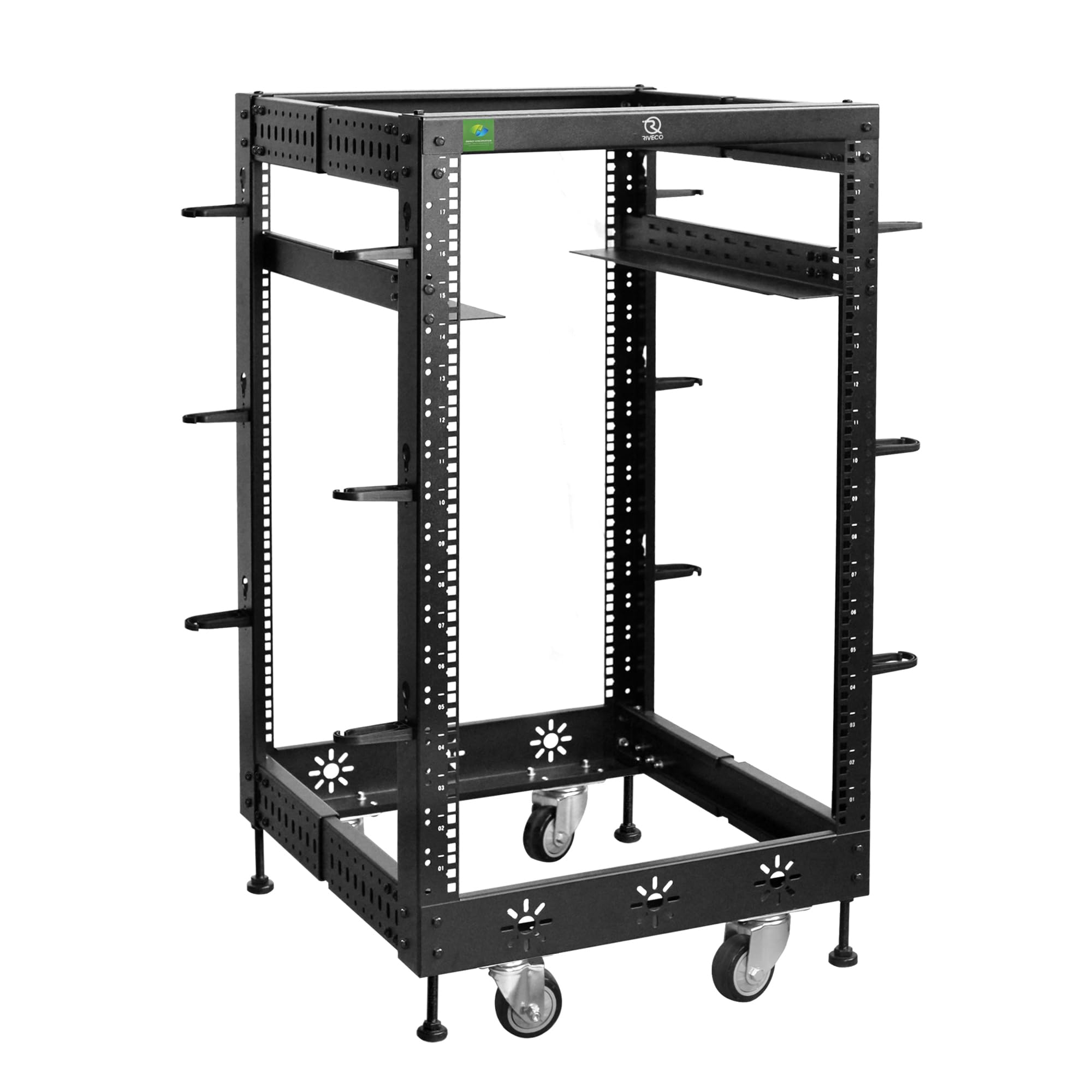
Two-millimeter steel and horizontal L rails, rated to 1700 pounds on its leveling feet.
Weight rating is where this rack separates itself. The 1700 lbs static load on leveling feet is 8.5 times the 200 lbs the VEVOR 20U handles on the floor — a difference that matters the moment you load a heavy UPS low and stack servers above it. The secret is the all-rivet structural connection and 2.0mm thick cold rolled steel, plus horizontal mounting rails that spread the load and stiffen the whole frame whether or not equipment is installed.
Those L rails are the reason this one feels solid rather than shaky. They brace the posts and give the frame a foundation, so the usual open-frame sway is largely absent. The 3-inch load-bearing casters take 1200 lbs static and the leveling feet take 1700, so you can roll it into place and then plant it.
The 18U height is the limiter — that is a modest amount of rack space, and if you are planning to add gear for years you may outgrow it. A few buyers also hit screw holes that would not line up cleanly, so align the frame before you fully tighten the rivet connections.
Why it earns the premium: the 1700 lbs rating and L-rail bracing put it in a different category from typical open frames — this is the one that will not sway.
Where it stops: 18U of capacity caps how much you can build out, and hole alignment rewards a careful, patient assembly.
Ideal for: a home lab or test bench where a modest amount of heavy gear needs a rock-solid base that will not walk or tip.
Not the one if: you need 30-plus rack units of expansion room — 18U fills up faster than you expect.
6. Sysracks 32U 4-Post Open Frame Server Rack

An open frame built for passive airflow, with square holes and a welded steel structure at 32U.
Nothing on this rack blocks a fan. The open frame design has no side or front panels, so rack-mount gear pulls cool room air in from every direction — a real advantage in a closet or spare room where heat builds up. The welded steel frame carries 460 lbs across 32U, and the posts adjust from 24 to 37 inches to accept servers, switches, patch panels, and UPS units of different depths. Square mounting holes are standard for IT gear, and 50 mounting screws and cage nuts ship in the box.
Capacity is the strength buyers notice — one chassis accepts every server size they throw at it, and the frame swallows switches, routers, and patch panels alongside. The 64-inch frame height puts it securely between the 42U giants and the compact 20U racks, and the price lands squarely in the mid-range of this list.
The 460 lb rating is modest for a frame this tall — less than half the RackPath 25U, which is shorter but far heavier-duty. And assembly is a real split: some find it straightforward, others report directions that leave steps unclear. Read through the whole manual before you pick up a screwdriver.
What stands out
- Full open frame for unobstructed passive airflow
- 32U of capacity at 64 inches tall
- 24–37 in adjustable depth handles mixed equipment
- 50 mounting screws and cage nuts included
What to weigh
- 460 lbs capacity is light for a frame of this height
- Directions are inconsistent — read the whole manual first
Made for: a warm room or closet where airflow matters more than raw load rating, and you need tall-but-not-huge.
Best avoided by: anyone loading dense, heavy servers — 460 lbs may not cover a full UPS-and-server stack.
7. NavePoint 25U 4-Post Open Frame Rack

Eighteen inches of depth adjustment in one-inch steps — the frame bends to your deepest chassis.
Depth range is the reason to pick this one over a fixed frame. The posts slide from 22 to 40 inches and lock in 1-inch increments, so you can set the front and rear rails to exactly where your longest server needs them and leave no wasted space behind. Square holes and cage nuts take standard 19-inch equipment, and the floor-mount base is compatible with casters if you want to roll it. Rack quality is what the feedback keeps returning to — the steel has a substantial, well-finished feel that reads as better than the price suggests.
At 49 pounds and 49.45 inches tall, this is a mid-size frame that is easier to move and assemble than the 61-pound RAISING 42U. Buyers consistently note it fits together easily, which is the part of the job nobody wants to fight. The 25U height is a sensible middle ground between compact 20U racks and the towering 42U models.
The assembly instructions are the weak spot — they are thin, so expect to work out some steps by looking at the parts rather than the paper. It is a small frustration rather than a flaw, and a quick online video will usually fill the gap. Confirm your caster choice separately, since the frame is compatible with them but does not necessarily ship with a set.
The case for it: 22–40 inches in 1-inch stops is the finest depth control here, and the frame assembles without drama.
The honest catch: instructions are minimal — plan to figure out some assembly steps from the hardware itself.
Worth it for: mixed-depth gear where you want the rear rails set precisely and a frame that goes together in a single session.
Look elsewhere if: you want casters in the box or a detailed step-by-step manual included.
8. RIVECO 25U Network Rack with Reinforced Top Cover

Round holes on one beam and square on the other, so IT gear and stereo gear share one frame.
This rack solves a specific problem other frames ignore. One mounting beam has round holes tapped for 10-32 screws and audio equipment, while the other has square holes for 19-inch network gear and shelves. If your setup mixes a rack amp with a switch and patch panel, you stop buying two racks. Add a reinforced vented top plate and bottom plate — a half-cabinet, half-rack design — and you get both airflow and a firm structure, with room to set a laptop, projector, or console on top.
The bundle is unusually complete: assembly screws and nuts, leveling feet, casters, and an 8-outlet PDU. Buyers get functionality from the start that costs extra elsewhere, and the included shelves and power strip are what the positive notes center on. It is built from SPCC cold rolled steel with a RAL9005 powder coat that resists scratching and rusting, and it holds 500 lbs on leveling feet or 400 lbs on casters.
Finish quality is the recurring gripe — a few units arrive with dented or scratched metal, which is worth inspecting the moment the box opens and reporting if it is bad. The depth is fixed at 21.7 inches, so long servers will not fit. Neither point sinks an otherwise well-made 25U frame, but both are worth knowing before you order.
Where it shines: round and square holes in one frame, plus shelves, feet, casters, and a PDU in the box — a one-stop rack for mixed gear.
The fit note: 21.7 inches fixed is short for servers, so this suits AV and network devices rather than deep chassis.
A match for: a recording studio, home theater, or office where audio and network equipment live in the same rack.
Step away if: you need depth for long servers or you want a pristine finish guaranteed from the start.
9. NavePoint 42U 4-Post Server Rack

Forty-two units tall with preset depth stops borrowed from data center practice.
Where other racks use a sliding range, this one gives you three fixed depth positions: 600mm, 800mm, or 1000mm. That suits anyone who already knows which server depth they are running and wants the rear rails locked to a proven setting rather than dialed in by eye. The cold rolled steel frame with black powder coat stands 79.06 inches tall and carries 881 lbs across 42U, plenty for a rack full of full-size servers. Square hole cage nut mounting keeps installation and maintenance straightforward.
Sturdiness is the trait that comes up most, and it should — a 42U frame holding 86.4 pounds of steel needs to stand firm. Two of the four casters have brakes that hold the rack in place once it is positioned, so the whole thing wheel where you want it and then stops moving. Setup is quick for a rack this size, and buyers find it good value for what it delivers.
Depth is the one thing that divides opinion — several find it very shallow for a 42U frame, so measure your longest chassis against those three presets before ordering. Mounting hardware also draws some criticism, so pack your own cage nuts if you are particular.
Strong points
- 42U of vertical space at 79.06 inches tall
- 881 lbs capacity for full-size servers
- Preset 600/800/1000mm depth stops
- Two of four casters brake to hold position
Weak points
- Depth reads shallow for a 42U frame
- Bundled mounting hardware is not the best
Built for: an IT room or home data center where gear follows standard 600/800/1000mm server depths and the rack stays put.
Check first if: your servers are deeper than those presets — the fixed positions may not stretch far enough.
10. Tripp Lite 45U 4-Post Open Frame Rack

A 1000-pound, 45U steel frame with numbered holes and a self-squaring build — the long-game rack.
The 45U height is the appeal here — the most rack space on this list. The 45U height is the tallest on this list, and the 1000 lbs capacity runs four times what the VEVOR 20U holds, so there is no realistic load you will outgrow. The self-squaring design keeps the posts true as you tighten the frame, and the square mounting holes are numbered so you can chart exactly where each device sits instead of eyeballing the position. Mounting depth adjusts from 22 to 36 inches.
The hardware package is generous: 50 pieces of M6 cage nuts, screws, and washers, plus 32 cable management hooks and a toolless mount for vertical PDUs and cable managers. Buyers get more than enough cable hooks and plenty of room to grow, and setup is straightforward once you follow the sequence. The heavy-duty steel construction carries the whole thing and a five-year warranty covers it.
The 22-to-36-inch depth range is a bit tighter at the top than several mid-size racks here, so a longer chassis may not fit despite the huge height. And with 24.49 kg of steel, this is a two-person assembly job — plan for help and floor space before the box arrives.
Why it lasts: 45U and 1000 lbs with numbered, self-squaring posts and 32 cable hooks leaves room for years of gear.
Plan around: a 36-inch depth ceiling and a heavy frame that needs two people to stand up.
Choose this if: you want to buy a rack once and never think about capacity again, and you like numbered holes for clean documentation.
Choose something else if: your gear runs deeper than 36 inches or you are assembling solo.
Understanding the Specs
Rack Units (U)
A rack unit, usually shortened to U, is a standard measure of vertical space — one U equals 1.75 inches of mounting height, and every device rated for 19-inch racks occupies a set number of units. A 20U frame gives you 20 stacked slots; a 45U frame gives you 45. The taller the rack, the more room for servers, switches, and PDUs, but the more floor space and steel you are committing to. Match the U-height to how much gear you own today plus what you plan to add, and remember that a tall open frame needs to stay stable when it is only partly filled.
Load Capacity and Casters
Load capacity is the maximum weight the frame is rated to hold, and manufacturers often list two figures — one for the rack standing on leveling feet and one for it rolling on casters. Feet always rate higher because the weight goes straight into the floor; wheels concentrate it on four small contact points. If you plan to roll the rack away from the wall for cabling, look at the caster figure, not the static one. If it will sit in place, the static rating with feet is the one that counts. Under-rate a rack and the frame can bow or tip when you load heavy equipment near the top.
Adjustable Depth
Depth is the distance between the front and rear mounting posts, and it has to exceed the length of your longest chassis. An adjustable frame lets you slide the posts forward and back so short network gear does not leave empty space at the rear, and long servers still fit. Many racks adjust in increments — some in 1-inch steps, others at preset positions like 600mm, 800mm, or 1000mm. Check the published range against your gear before you buy; a rack that is too shallow will not accept a full-depth server no matter how many rack units it has.
Square vs. Round Mounting Holes
Square holes accept cage nuts, which clip into the opening and provide a threaded point for a screw — the standard setup for servers, switches, and patch panels. Round holes are tapped directly into the post and suit specific audio or legacy gear. The nut is what gives you a secure, repeatable mounting point, and it lets you adjust devices between U slots without re-tapping the frame. When a frame offers square holes on one beam and round on the other, you can mount IT and audio equipment in the same rack without adapters.
FAQ
Will a standard 19-inch server fit in any of these 4-post racks?
What is the difference between ground load and wall-mount load on a 4-post rack?
Can I roll a loaded rack around on casters, or should it stay put?
How much weight can a 4-post open frame rack actually hold?
Do I need square holes or round holes for my equipment?
How long does assembly usually take on these racks?
Are the mounting screws and cage nuts included with these racks?
What is the difference between an open frame rack and an enclosed cabinet?
Will a 4-post rack fit under a low ceiling or in a closet?
How do I stop an open frame rack from swaying sideways?
Is a 42U rack overkill for a home lab?
Final Thoughts: The Verdict
For most people building a home lab with real gear and plans to grow, the RAISING ELECTRONICS 42U Open Frame Rack is the one to buy — 42U of room, a 950 lbs rating, adjustable depth from 22 to 34 inches, and an aluminum frame at 61 pounds that is easier to move than several shorter steel racks. If your priority is raw rigidity under heavy equipment, the RIVECO 18U Adjustable Depth Rack wins on load at 1700 lbs on its leveling feet and its L-rail bracing. And if you need to mount a rack on a wall or tuck one into a small space, the VEVOR 20U Open Frame Server Rack gives you both options with 23 to 40 inches of depth. Measure your deepest chassis first, then pick the rack whose depth range covers it.
How We Picked
We do not accept paid placement. Every pick is matched to a real buyer and a real use-case; we do not hands-on test units.
Sources & Methodology
Specifications: manufacturer listings and product documentation. Review insights: verified customer reviews, as of November 2026. Pricing: not shown on this page (it changes often); check the current price via the retailer link.
As an Amazon Associate, Gadgets Feed earns from qualifying purchases. This does not affect which products we feature.