
Our readers keep the lights on and my morning glass full of iced black tea. As an Amazon Associate, I earn from qualifying purchases.
Specs are compiled from manufacturer listings and verified buyer reviews and can change over time — please confirm the key details on the product page before buying.
The right car speaker wire matches your amplifier’s power output and still threads through door boots and sills. Too thin a gauge adds resistance that bleeds power before it reaches the speaker. A stiff jacket turns every door boot and kick-panel bend into a fight. This guide ranks nine popular spools by gauge, conductor material, and jacket flexibility so you can match one to your install.
I’m Min — the founder and writer behind Gadgets Feed. This guide is built by comparing the manufacturers’ published specifications and the patterns across verified customer reviews, so you get each pick’s real strengths and trade-offs instead of marketing spin.
Below you’ll see how gauge, conductor type, and jacket flexibility change what your speakers actually deliver, and which spool suits a door-panel upgrade versus a full subwoofer build. If you want the short answer, the crowd favorite is the GEARit 14 Gauge at 4.5+ stars across 15,000+ ratings — the strongest mix of price, foot markers, and flexibility for most people shopping for car speaker wire.
Our Picks at a Glance


How To Choose The Best Car Speaker Wire
The most common car audio wiring mistake is sizing wire to the speaker instead of the amplifier’s power output. A larger speaker doesn’t demand thicker wire; the amplifier’s wattage does. Three specs decide whether your install sounds clean or thin: gauge, conductor material, and jacket flexibility.
Match the gauge to the amplifier, not the speaker
Gauge is the thickness of the conductor inside the jacket — a lower number means a thicker wire that carries more current with less resistance. A 16-gauge wire handles a modest factory-replacement setup well. Once you push real power through a subwoofer or a component set off an amplifier, a 12-gauge wire like the KnuKonceptz Kord gives the current more room to flow without resistance building up.
Copper-clad aluminum versus oxygen-free copper
Copper-clad aluminum (CCA) wraps a copper skin around an aluminum core — it conducts decently and weighs less, which helps in high-vibration door installs. Oxygen-free copper (OFC) is refined to strip out impurities and oxygen, and it tends to give lower resistance than CCA. For a factory-replacement door speaker, CCA is often plenty. For a subwoofer build, OFC is the safer bet.
Jacket flexibility and printed markers
You will snake this wire through door boots, under sills, and behind trim, so a soft PVC jacket that lays flat without kinking saves real knuckle skin. Foot markers printed on the jacket let you cut exact lengths without dragging a tape measure into the garage. Polarity markings — usually a stripe or two-tone color — stop you from wiring a speaker out of phase.
Quick Comparison
| Model | Best For | Gauge | Conductor | Length | Amazon |
|---|---|---|---|---|---|
| GEARit 14 Gauge Speaker Wire 100FT★ Best Overall | All-round value pick | 14 | Copper Clad Aluminium | 100 ft | Amazon |
| RCA AH1650SR 50 Feet 16-GaugeBudget Starter | Simple short runs | 16 | — | 50 ft | Amazon |
| DS18 SW-16GA-100RB Ultra FlexBest Flexibility | Flexible budget routing | 16 | Copper Clad Aluminum | 100 ft | Amazon |
| DS18 SW-12GA-100RB Ultra Flex | Higher-power builds | 12 | Aluminum, Copper | 100 ft | Amazon |
| InstallGear 14 Gauge 100 ft | Big-roll value | 14 | Aluminum (CCA) | 100 ft | Amazon |
| Sky High Car Audio 10 Gauge OFC | High-power subwoofer runs | 10 | Copper (OFC) | 10–200 ft options | Amazon |
| Amazon Basics 14-Gauge OFC 100-Foot | Clean home audio runs | 14 | Copper (OFC) | 100 ft | Amazon |
| KnuKonceptz Kord 12 Gauge OFC | Audiophile-grade builds | 12 | Copper (OFC) | 50 ft | Amazon |
| Install Link 14 AWG 100 Feet OFC | Premium OFC all-rounder | 14 | Copper (OFC) | 100 ft | Amazon |
In‑Depth Reviews
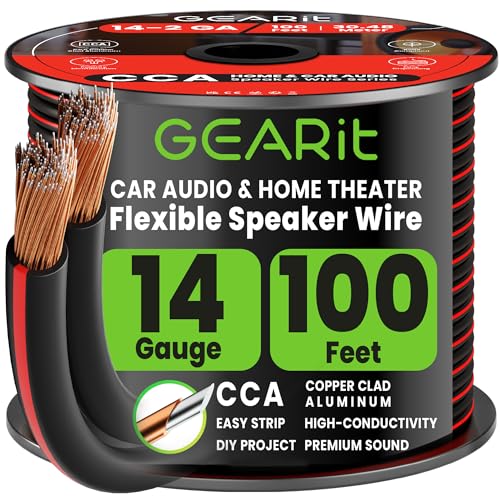
1. GEARit 14 Gauge Speaker Wire 100FT
Our pick — 4.5+★ from 15,000+ verified ratings; the strongest balance of quality and price.
The spool that does everything without asking you to measure twice
If you’re wiring both car doors and a set of bookshelf speakers in the garage, the 14-gauge GEARit gives you 100 feet of wire in one roll. That is double the length of the RCA 50-foot spool on this list, which means you can run longer door and rear-deck routes without buying a second roll. The 14-gauge conductor sits in the middle of the thickness range — thicker than 16-gauge for less resistance, yet easier to snake around furniture or through tight car interiors than a 12-gauge.
The printed sequential foot markers on the jacket are the detail you’ll thank yourself for. You cut exact lengths without dragging a tape measure into the garage, and the clear polarity markings let you spot positive and negative in seconds so a speaker never goes in backwards. The soft PVC jacket is sturdy enough to last but flexible enough to route around corners without kinking. What wins people over most is construction quality — by far the most-discussed attribute in the feedback — followed closely by the value of a 100-foot spool.
Copper-clad aluminum (CCA — a copper skin over an aluminum core) is the conductor here. It offers solid conductivity while staying lighter and more cost-effective than pure copper, which suits high-vibration automotive installs where weight and budget matter. The catch is honest: if you’re pushing serious current to a subwoofer, pure oxygen-free copper is the better choice — CCA is the value play, not the ultimate one. It strips easily and fits banana plugs, spade tips, and standard speaker terminals.
Where it wins your install
- Foot markers printed on the jacket make cutting to exact length fast
- 100 ft roll covers both doors and a rear-deck run in one buy
- Soft PVC jacket routes around tight corners without kinking
- Polarity markings save time and prevent backwards wiring
What to keep in mind
- CCA conductor is the value choice, not the high-power one
- Fits banana plugs and spade tips — standard terminals only
Go this way if: you want one roll that covers doors, rear deck, and a spare set of bookshelf speakers without a second order.
Step up if: your amplifier pushes real power to a subwoofer — then hunt for an OFC conductor instead.
2. RCA AH1650SR 50 Feet 16-Gauge Speaker Wire
A short spool for a simple two-speaker swap, nothing more
If your job is replacing one pair of door speakers off the factory head unit, 50 feet of 16-gauge goes in and you’re done. This is exactly half the length of the GEARit 100-foot roll — enough for a straightforward setup and not much more. The 16-gauge conductor is the thinner of the two common sizes, which is fine for modest factory-replacement power but not for a subwoofer.
Owners come away pleased with the wire’s quality and the value it represents, and the sound holds up for basic installs. Length gets nods too, with buyers finding it suits more than one speaker arrangement and works across both home and car audio. Where opinions split is thickness — some find it thick on the spool, others would call it a bit thin in hand. Worth knowing before you order.
The wire arrives on a plastic spool, connects speakers to an A/V receiver or amplifier, and the insulated jacket keeps the runs tidy. For a first-time door swap with no amplifier in the chain, that’s the whole brief covered.
Straight read: a no-fuss 50-foot 16-gauge spool for factory replacements, with the plastic reel keeping the unspooling simple.
Fair caveat: if your plans include an amplifier or a subwoofer, the thinner gauge and half-length roll will have you buying again.
Reach for this if: you’re a first-timer upgrading a single door pair off the head unit and don’t need amplifier-grade current.
Look elsewhere if: you want spare length for a rear-deck run or a subwoofer that needs heavier wire.
3. DS18 SW-16GA-100RB 16-GA Ultra Flex Speaker Wire Red and Black 100 Ft
Bends through a door boot like it wants to be there
Where the DS18 16-gauge earns its place is the “Ultra Flex” jacket. It bends and curves around tight corners without fighting back, which makes it the friendlier choice when you’re threading wire through a door boot or behind a kick panel. It shares the same 16-gauge conductor as the RCA above, but the flexible jacket is the reason to pick this one over the stiffer reel for cramped cabin routing.
Owners describe the wire as high quality first and foremost, and extremely easy to work with. Sound and functionality get solid mention, with home theater installs coming up as a typical use. Durability is where the story splits — some find it strong, while others note it can rip apart under heavy tension. Pull it gently through corners and you’ll be fine; yank hard and the jacket is the weak point.
The red-and-black two-tone jacket makes polarity obvious at a glance, so positive and negative stay sorted in the door. At 100 feet, it covers a full cabin job like the GEARit roll, just in a thinner 16-gauge conductor.
Why it earns the slot: the soft, pliable jacket is built for tight cabin bends, and the red/black layout kills polarity mix-ups.
Treat it kindly: tension is the reported weak spot — ease it through corners rather than tugging.
Reach for this if: your install runs through cramped door boots and kick panels where a stiff wire would test your patience.
Look elsewhere if: you’re pulling long runs under tension or need amplifier-grade thickness.
4. DS18 SW-12GA-100RB 12-GA Ultra Flex Speaker Wire Red and Black 100FT

The same soft jacket, up two steps in conductor size
This DS18 rolls 100 feet at a genuinely thick 12-gauge — the jump from the 16-gauge version below is a step up in current capacity. It runs 12-gauge against that sibling’s 16, so if you are feeding a component set or a subwoofer off an amplifier, the heavier conductor gives the current more room to flow. You get the full 100-foot slack for rear-deck and trunk routing.
Owners rate it as the best wire they’ve used, and the heavy-duty construction is the first thing noticed. Flexibility earns repeat praise — it bends around tight corners easily, and the soft rubber coating keeps it pliable in the hand. Setup is straightforward too, with buyers reporting an easy hook-up to both a pair of speakers and a receiver. Value rounds out the picture, with many calling it fantastic for the money.
Copper-clad aluminum is the conductor again, which keeps weight and cost down. That’s the honest trade-off: for a high-power subwoofer build, pure OFC will out-conduct it. For most cabin upgrades running moderate power, the 12-gauge CCA handles the job without complaint.
The upsides
- 12-gauge conductor takes more current than the 16-gauge sibling
- Soft rubber jacket stays flexible around tight corners
- 100 feet covers a full rear-deck and trunk route
- Easy hook-up to speakers and receiver
The trade-off
- CCA conductor — OFC is the better call for serious subwoofer power
Go this way if: you want a flexible 12-gauge roll that handles moderate amplifier power without the stiffness of a budget reel.
Step up if: your build centers on a high-power subwoofer — then pure oxygen-free copper earns the extra spend.
5. InstallGear 14 Gauge Speaker Wire 100 ft

A frosted blue-and-black 100-footer built for long runs and soft routing
Run a 5.1 surround job or a long rear-deck wire and length becomes the real limiting factor. This InstallGear roll gives you 100 feet of 14-gauge, with a frosted blue-and-black jacket that handles long runs without a splice. The joke in the review pages is how far it stretches for the money — value is by a wide margin the thing installers talk about, and it holds up even on runs past 30 feet.
The two-color jacket does the polarity job for you, which matters because a polarity mistake can damage your audio equipment. The soft-touch PVC jacket is designed with the installer in mind — it flexes for easy routing and has low memory, so it lays where you put it. It comes on a spool that stays easy to feed out, and owners note clean sound with no distortion on surround setups.
This is a CCA conductor, the economical pick when you’re using the wire as car audio speaker wire or radio wire. The honest limit: on a high-power amplifier it won’t conduct like OFC. For the vast majority of 14-gauge cabin and home jobs, it’s the practical money-saver.
Where the money goes: a full 100 feet of 14-gauge on a spool that feeds easily, with a two-tone jacket that settles polarity in seconds.
What to accept: it’s CCA, so a dedicated subwoofer amp is better served by an OFC roll.
Reach for this if: you’re wiring a 5.1 surround setup or a long cabin run and want the most length for the money.
Look elsewhere if: you’re chasing every watt through a high-power amplifier.
6. Sky High Car Audio 10 Gauge OFC Speaker Wire
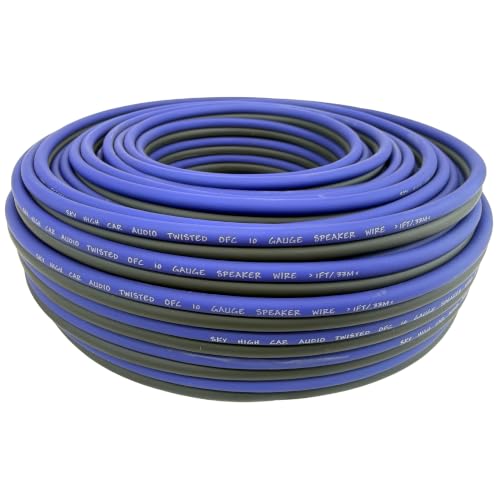
The thick, oxygen-free option for subwoofers that actually draw current
Ten-gauge is the thickest conductor on this list, and it’s aimed at high-power subwoofer and amplifier installs where low resistance is the whole point. Unlike the CCA rolls above, this one is made from 99.9% oxygen-free copper — refined to carry a clean signal with less resistance. If your build centers on a subwoofer enclosure or a component set running off real amplifier power, this is where the extra metal earns its keep.
You pick the length to match the job: 10FT, 25FT, 40FT, 50FT, 75FT, 100FT, and 200FT options are all available, so a door-only run and a full trunk build come from the same wire. The fine-strand conductors and flexible insulation thread through vehicle interiors, speaker enclosures, and amplifier racks without kinking. Owners single out the quality first and call it suitable for high power; value gets its share of nods too.
The one mixed note is precision — a few find the wire less exact than they hoped. Worth keeping in mind if you’re measuring cut lengths to the inch. Everywhere else, this is the high-power pick with length flexibility no other roll here matches.
Why high-power builds like it
- 10-gauge conductor is the thickest here for low-resistance current flow
- 99.9% oxygen-free copper for dependable signal transfer
- Seven length options from 10FT to 200FT
- Fine-strand flexibility for tight enclosure and rack routing
Where it needs care
- Precision of the wire itself splits opinions
- Overkill for a simple factory-speaker swap
Go this way if: you’re feeding a subwoofer or amplifier and want the heaviest OFC conductor with a length that fits your build.
Step back if: a factory door-swap is all you’re doing — the 10-gauge is more than that job needs.
7. Amazon Basics 14-Gauge Audio Speaker Wire, 99.9% Oxygen-Free Copper, 100-Foot, White

Oxygen-free copper in a plain white jacket you can hide against trim
White insulation disappears against door trim and baseboards, and this 100-foot roll of 14-gauge pairs that with 99.9% oxygen-free copper — the conductor refined to remove impurities so signals stay undistorted. Where the CCA rolls save money, this one spends it on copper. Quality is what owners mention first, and durability holds up too, with the jacket taking repeated handling during routing.
Functionality gets strong mention, especially across surround sound systems, and the sound stays clean with no lag or drop noticed. The white color coding gives clear polarity identification during install. It connects speakers to A/V receivers, amplifiers, and home theater systems, with a 9.5-volt rating.
The mixed item to be aware of is thickness — some find it a touch thinner than expected, and flexibility draws split feedback too, so route gently through tight boots. It’s a home-first wire that handles car duty well, just not the stiffest or heaviest in hand.
Why it stands out: true oxygen-free copper at 14-gauge in 100-foot length, with a white jacket that hides against trim.
The honest note: thickness and flex split opinion, so keep your routes gentle through tight spaces.
Reach for this if: you want OFC copper at 14-gauge and prefer a jacket that disappears against white trim.
Look elsewhere if: you need maximum stiffness and heft in hand for a long, taut run.
8. KnuKonceptz Kord Speaker Cable 12 Gauge Oxygen Free Copper Speaker Wire, 50 Feet Blue

High-strand copper that lays flat like it’s been trained to
The spec that sets this one apart is the strand count: 12AWG with 294 strands per conductor, which is what lets it bend so freely. That’s a step above the 12-strand DS18 12-gauge in the way it drapes, and it’s built from at least 99.99% oxygen-free copper. Quality cable uses quality materials, and OFC gives lower resistance than CCA — which means improved frequency response. Owners reach for the pasta comparison because it flexes and lays flat immediately after uncoiling.
The ultra-flex PVC jacket is soft and pliable, doesn’t kink or bind up, and conceals easily under carpet or along baseboards. The gauge is printed directly on each foot of the product so you always know what you’re working with. Sound gets praise for crisp, clear high notes, and installs come out clean and simple.
The one caveat is the 50-foot length — half the 100-foot rolls here, so a full cabin job may need a second spool. And true-AWG construction means you’re paying for accuracy the cheaper rolls don’t always deliver.
What makes it bend
- 294 strands per conductor for exceptional flexibility
- At least 99.99% oxygen-free copper for lower resistance
- Lays flat right after uncoiling, no kinks or memory
- Gauge printed on every foot
Watch for
- 50-foot roll is shorter than the 100-foot options
- Premium copper means a higher spend than CCA rolls
Go this way if: you want true-AWG oxygen-free copper that flexes around every corner and won’t kink under concealment.
Weigh the length if: your route needs more than 50 feet — you’ll want a longer roll.
9. Install Link 14 AWG Gauge Speaker Wire (100 Feet) Car or Home Theater (OFC)

Pure oxygen-free copper in a frosted red-and-black jacket, 100 feet long
This is the straightforward premium route: 14-gauge, 100 feet, pure oxygen-free copper with a frosted red-and-black two-conductor jacket. The copper core is refined to remove impurities and oxygen, which keeps conductivity high and resistance low — the sound comes out clear. It runs a double conductor so polarity identification is easy, and the wire strips cleanly so you’re not fighting the jacket at the terminal.
Buyers report great quality and pure copper construction up front, and the wire handles and strips easily. Flexibility gets solid mention — it doesn’t hold its shape, so it threads through tight spots and bends to follow your route. Functionality and value round out the praise, with the sound coming through clean on both car and home setups.
The SoftFlex jacket shields the wire, looks sharp, and holds up through installation. At 100 feet it matches the longest rolls here, so one spool covers a full car-audio job or a home theater run. It’s the pick when you want pure copper at a standard gauge in a single full-length roll.
Why it fits: pure OFC copper at 14-gauge in a full 100-foot roll, with a soft jacket that strips and routes cleanly.
The trade-off: it’s 14-gauge, so a high-power subwoofer build still wants a heavier 12- or 10-gauge conductor.
Reach for this if: you want pure oxygen-free copper at 14-gauge in a full-length roll for either car or home audio.
Step up if: your amplifier deserves the extra muscle of a 12- or 10-gauge conductor.
Understanding the Specs
Gauge: The Number That Decides Current Flow
Gauge is the thickness of the conductor — a lower number means a thicker wire that carries more current with less resistance. A 16-gauge suits modest factory-replacement power; a 12- or 10-gauge gives a subwoofer amplifier the room it needs. Thicker wire presents less resistance to current flow, which is why the 10-gauge Sky High is the high-power pick.
CCA vs OFC: What the Conductor Is Made Of
Copper-clad aluminum (CCA) wraps a copper skin around an aluminum core — it conducts well and weighs less, which helps high-vibration door installs. Oxygen-free copper (OFC) is refined to strip out impurities and oxygen, and it delivers lower resistance than CCA. For a high-power amplifier, OFC is the safer call; for routine door swaps, CCA often does the job for less.
Jacket Feel and Routing
The outer jacket is what you actually touch during an install. A soft PVC or ultra-flex jacket bends around tight corners and lays flat without kinking, while a stiff one fights every turn. Foot markers and low memory make long runs easier to measure and conceal.
Polarity Markings and Foot Markers
A two-tone or striped jacket lets you spot positive and negative in seconds, and a polarity mistake can damage your audio equipment. Printed sequential foot markers let you cut exact lengths without a tape measure. Both details save time on a cabin full of runs.
FAQ
What gauge speaker wire do I need for car audio?
Is 14-gauge speaker wire thick enough for a car?
Is copper-clad aluminum speaker wire okay for car use?
What is the difference between OFC and CCA speaker wire?
How do I tell positive from negative on a car speaker wire?
Can I use home audio speaker wire in a car?
How long does car speaker wire last?
Do I need 100 feet of speaker wire for a car?
What is the thinnest speaker wire I should use in a car?
Final Thoughts: The Verdict
For most people shopping for the car speaker wire, the GEARit 14 Gauge is the easiest call — foot markers, polarity marks, and a 100-foot CCA roll at a value price, and it’s the highest-rated pick with the deepest review base on this list. If you want pure oxygen-free copper instead, the Install Link 14 AWG gives you a full 100-foot roll of it. And if you’re feeding a subwoofer, the Sky High 10 Gauge OFC delivers the heaviest conductor in the lineup with a length that fits your build.
How We Picked
We do not accept paid placement. Every pick is matched to a real buyer and a real use-case; we do not hands-on test units.
Sources & Methodology
Specifications: manufacturer listings and product documentation. Review insights: verified customer reviews, as of November 2026. Pricing: not shown on this page (it changes often); check the current price via the retailer link.
As an Amazon Associate, Gadgets Feed earns from qualifying purchases. This does not affect which products we feature.