
Our readers keep the lights on and my morning glass full of iced black tea. As an Amazon Associate, I earn from qualifying purchases.
Specs are compiled from manufacturer listings and verified buyer reviews and can change over time — please confirm the key details on the product page before buying.
If your 8-inch knife stalls halfway through a cabbage, a 10-inch chef’s knife gives you the reach and the mass to finish the cut in one motion. The extra length lets you rock through a whole cabbage or break down a chicken without repositioning, and the added weight does the pressing for you. This guide sorts the real contenders by what matters on a board: steel, edge geometry, balance, and how the handle feels over an hour of prep. One honest note up front — this list uses flexible matching for blade length, accepting the standard 10-inch chef’s knife while rejecting 8-inch and smaller or 12-inch and larger, so a couple of picks land on a true 10-inch blade measured in millimeters. Every pick still serves the same purpose.
I’m Min — the founder and writer behind Gadgets Feed. This guide is built by comparing the manufacturers’ published specifications and the patterns across verified customer reviews, so you get each pick’s real strengths and trade-offs instead of marketing spin.
You will see German forged steel next to Japanese-influenced Damascus and stamped commercial workhorses, and each one earns its spot for a different cook. My pick for the widest range of home kitchens is the Victorinox Swiss Classic, at 4.5+ stars across 200+ ratings, and it is the first stop if you want one blade to do everything well.
Our Picks at a Glance


How To Choose The Best 10 Inch Chef Knife
Most buyers assume a longer blade is just for show. In practice, the 10-inch length is what lets you cut without lifting the knife off the board — you rock forward and back and the whole onion falls apart in one motion. The trick is matching that reach to your board size and your wrist, not just grabbing the longest blade you can find.
Match blade length to your cutting board
A 10-inch blade needs room to travel. On a small board you will run out of runway before the tip finishes the cut, so measure your board before committing. If your board is on the shorter side, a stamped knife that weighs less is easier to control in tight space. If you have a full-size board and cook for a family, the extra 2 inches over an 8-inch knife are the reason you stop sawing and start slicing.
Read the steel and hardness first
Rockwell hardness, written as HRC, tells you how hard the steel is and therefore how long it holds an edge. A 56 HRC blade like the MOSFiATA is forgiving and easy to maintain. A 62 HRC core like the XINZUO holds a fine edge longer but is less tolerant of twisting in the cut. German knives in the high 50s HRC sit in the middle and are the safest bet for someone who wants one knife and no fuss.
Understand edge angle in degrees per side
Edge angle is measured in degrees per side, and a smaller number means a thinner, sharper V. Fifteen degrees per side is the common German spec, and 14 to 16 degrees per side is a slightly finer window. A thinner edge bites harder but chips more easily on bones and frozen food. Thirty degrees of total angle is a fine compromise; anything sharper asks you to treat the knife like a precision tool.
Forged versus stamped, and what it means in your hand
Forged means the blade is shaped from a single piece of solid steel, which usually brings more heft and a full bolster between your fingers and the edge. Stamped means the blade is cut from a sheet, which keeps it lighter and often more nimble. Neither is automatically better — forged suits the cook who likes weight doing the work, stamped suits the cook who wants speed and a thinner profile through dense food.
Weigh the handle material against how you clean
Handle materials range from polymer and polyoxymethylene to Santoprene and Micarta and rosewood. Some are rated dishwasher safe, most are not, and hand washing is what keeps a wooden or composite handle from swelling over time. Decide how much maintenance you will genuinely do before you buy, then pick a handle you can live with.
Quick Comparison
| Model | Best For | Blade Length | Blade Material | Construction | Amazon |
|---|---|---|---|---|---|
| ZWILLING Professional S 10-inch Chef’s Knife★ Best Overall | Heirloom forged workhorse | 10 inches | High Carbon Stainless Steel | Forged | Amazon |
| Victorinox Swiss Classic 10-Inch Chef’s KnifeAlso Great | One-knife kitchens | 10 inches | Stainless Steel | Stamped | Amazon |
| Wusthof Classic IKON 10-Inch Chef’s KnifeBest Balance | Balance and heft lovers | 10 inches | High Carbon Stainless Steel | Forged | Amazon |
| Global 10″ Chef’s Knife | All-steel minimalists | 10 inches | Stainless Steel | Stamped | Amazon |
| XINZUO 10 Inch Damascus Chef Knife | Looks and a fine edge | 25.5 cm | 67 Layers Damascus Steel | Forged | Amazon |
| Messermeister Pro Series 10” Wide-Blade Chef’s Knife | High-volume chopping | 10 inches | German X50 Stainless Steel | Stamped | Amazon |
| Mercer Culinary M20610 Genesis 10-Inch Chef’s Knife | Budget forged sharpness | 10 inches | High Carbon Steel | Forged | Amazon |
| MOSFiATA Chef Knife 10 Inch | Gift-ready starter set | 10 inches | EN1.4116 German High Carbon Stainless Steel | Forged | Amazon |
| Arcos Chef Knife 10 Inch Series 2900 | Light dishwasher-safe daily blade | 250 mm | Stainless Steel | Stamped | Amazon |
In‑Depth Reviews
1. ZWILLING Professional S 10-inch Razor-Sharp German Chef’s Knife
Our pick — 4.5+★ from 950+ verified ratings; the strongest balance of quality and price.
A single-piece forged German blade built to be the last chef’s knife you buy.
Start with the number that tells the whole story: 242 people single out its quality above everything else, which is why it reads like the benchmark it is. This knife is forged from a single piece of solid steel in a company-owned German factory, using a special formula high carbon no-stain steel the maker has refined for almost 300 years. The precision-honed, laser-controlled edge is set at 15 degrees per side, and that geometry is exactly what lets it bite into hard vegetables without you forcing it.
The heft is where it differs most from the stamped picks. At 12.16 ounces it is a full 1.92 ounces heavier than the MOSFiATA above, and where the MOSFiATA spans 14-16 degrees per side, this one holds a fixed 15 degrees per side — a tighter, more consistent window. That 57 Rockwell hardness and ice-hardened Friodur blade are the reasons it starts sharp and stays sharp longer, and the ergonomic polymer three-rivet handle is bonded to a full tang so nothing shifts under load. Buyers report the edge still biting after years of daily use, not just on day one.
The honest trade-off is that this is a knife you notice in your hand after an hour, and the forged weight is a real commitment if you are used to something feathery. It is also, by a distance, the most expensive proposition here, which makes it an heirloom buy rather than an impulse one. If you want a blade that will outlast several cheap knives and you do not mind the mass, it is the most proven pick on the page.
Why it holds the top tier: forged single-piece construction, 57 HRC steel, and a laser-controlled 15-degree edge that owners describe as sharp from the start on hard vegetables.
What you accept: 12.16 ounces is the heaviest forged feel in this group, and it demands hand care despite the dishwasher-safe rating.
Built for: the cook who wants one forged knife to pass down and is happy for weight to do the work.
Think twice if: a lighter, quicker blade matters more to you than heirloom durability.
2. Victorinox Swiss Classic 10-Inch Chef’s Knife
The stamped Swiss blade that gets genuine professionals through a full prep without any drama.
This is the highest-rated knife in the group, and the reason is simple: it is a 10-inch stamped blade that weighs just 8.8 ounces. That low weight is the lightest here, and it means you can carve and chop for a long stretch without your forearm tightening up. The extra-wide, super-sharp blade is built for smooth, uniform cuts on meat, fruit, and vegetables — the kind of all-day slicing where a heavier forged knife starts to feel like work.
What wins people over is the balance of the thing. Owners describe a blade with weight where it counts yet stable on the board, which is why it turns up in professional kitchens as often as home ones. The ergonomic handle and balanced design support stability in the cut. Sharpness right from the start is the second thing that keeps coming up, along with edges that hold well over months.
The catch is the maintenance side of owning a great stamped blade. It is not a knife you toss in the dishwasher drawer and forget, and the thin profile asks you to avoid twisting as you break down anything with a bone in it. If you want zero care instructions, this is not that knife; if you want a light, sharp, honest tool you will reach for daily, it is the safest pick on the page.
What earns it top spot
- 8.8 ounces — lightest blade in this lineup, so long prep sessions stay comfortable.
- Extra-wide blade with a balanced, ergonomic handle for stability on the board.
- Sharp from the start and holds its edge well for daily cooking.
- Stamped stainless construction that resists rust with basic care.
Where it asks more of you
- Thin stamped profile demands care around bones and frozen food.
- Not a dishwash-and-forget knife — hand wash keeps the edge honest.
Pick this if: you want one 10-inch blade that handles meat, produce, and daily prep in a light package you can use all evening.
Pass if: you specifically want the heavy, forged feel of a knife where mass does most of the cutting.
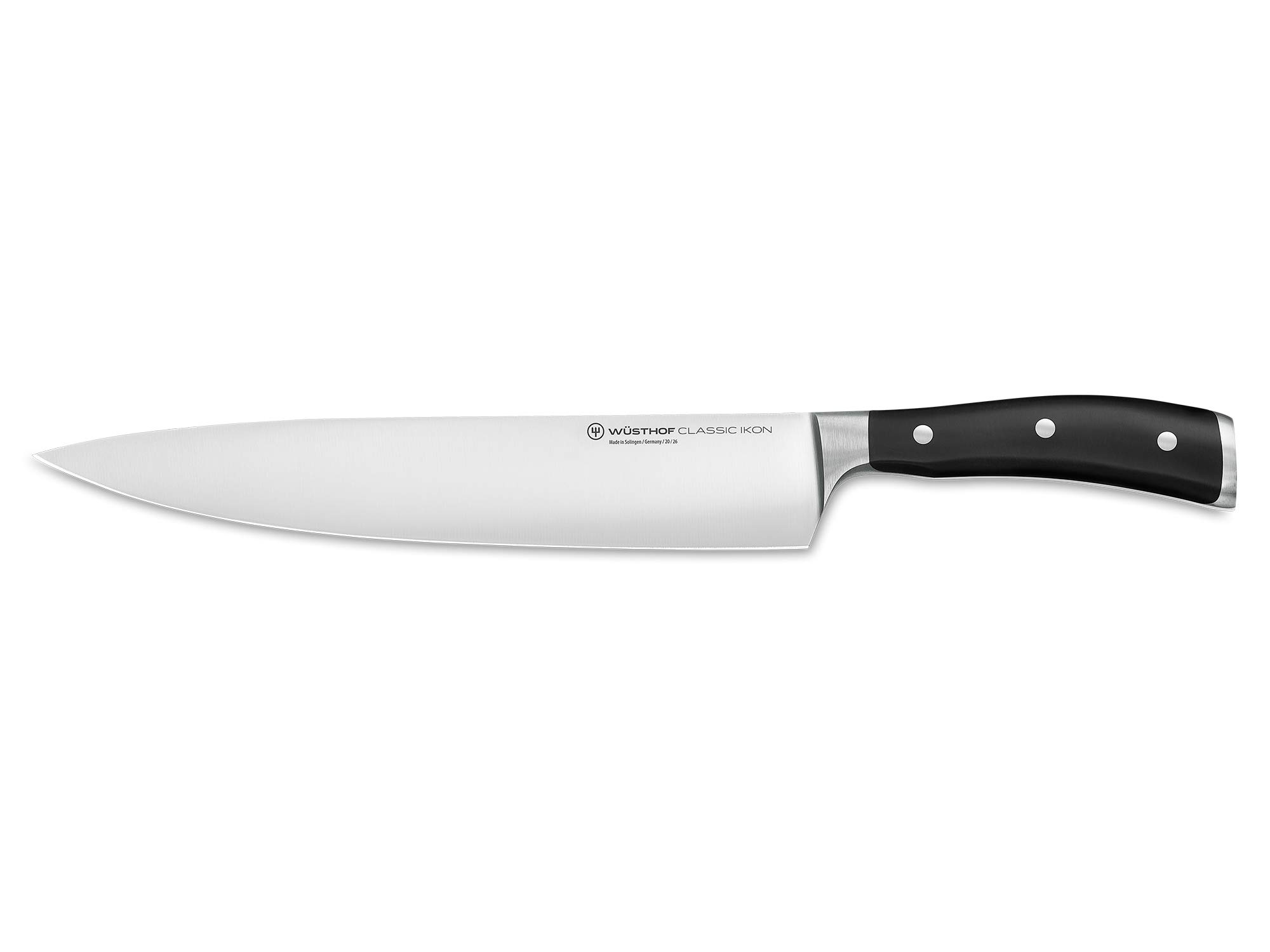
3. Wusthof Classic IKON 10-Inch Chef’s Knife
The double-bolster forged German blade that turns the balance point into a design feature.
If weight distribution is the first thing you notice in a knife, the Classic IKON is the one to feel. It uses a double bolster — the metal collar between blade and handle — to shift the balance point back toward your grip, which gives it the professional-style heft the maker describes. It is forged from a single block of high carbon stainless steel and tempered to 58 HRC (a hardness scale where higher means the edge holds longer), so it keeps a working edge through long prep sessions. The maker’s Precision Edge Technology is claimed to deliver a blade 20% sharper with twice the edge retention of previous models.
What owners consistently praise is edge retention — it keeps cutting the way it did on day one. The synthetic handle is built to resist fading and discoloration, and the 302-gram weight sits close to the ZWILLING’s forged feel while adding that rearward balance. For chopping, mincing, slicing, and dicing, the double bolster gives your hand a natural stopper so you are never guessing where your fingers are.
Here is the trade-off to weigh: at 302 grams it is the heaviest knife in this lineup, so your wrist feels it over a long session. The double bolster can also get in the way when you want to use the full heel of the blade for a hard chop. It is a premium-tier purchase, so you are paying for the balance and the Solingen pedigree rather than raw value. For a cook who likes a substantial, beautifully balanced knife, that is a fair exchange.
Reach for this if: you want a forged German blade with the balance point pulled back toward your hand and a full bolster guarding your grip.
Look elsewhere if: you chop with the heel and need an uninterrupted edge all the way to the end.
4. Global 10″ Chef’s Knife
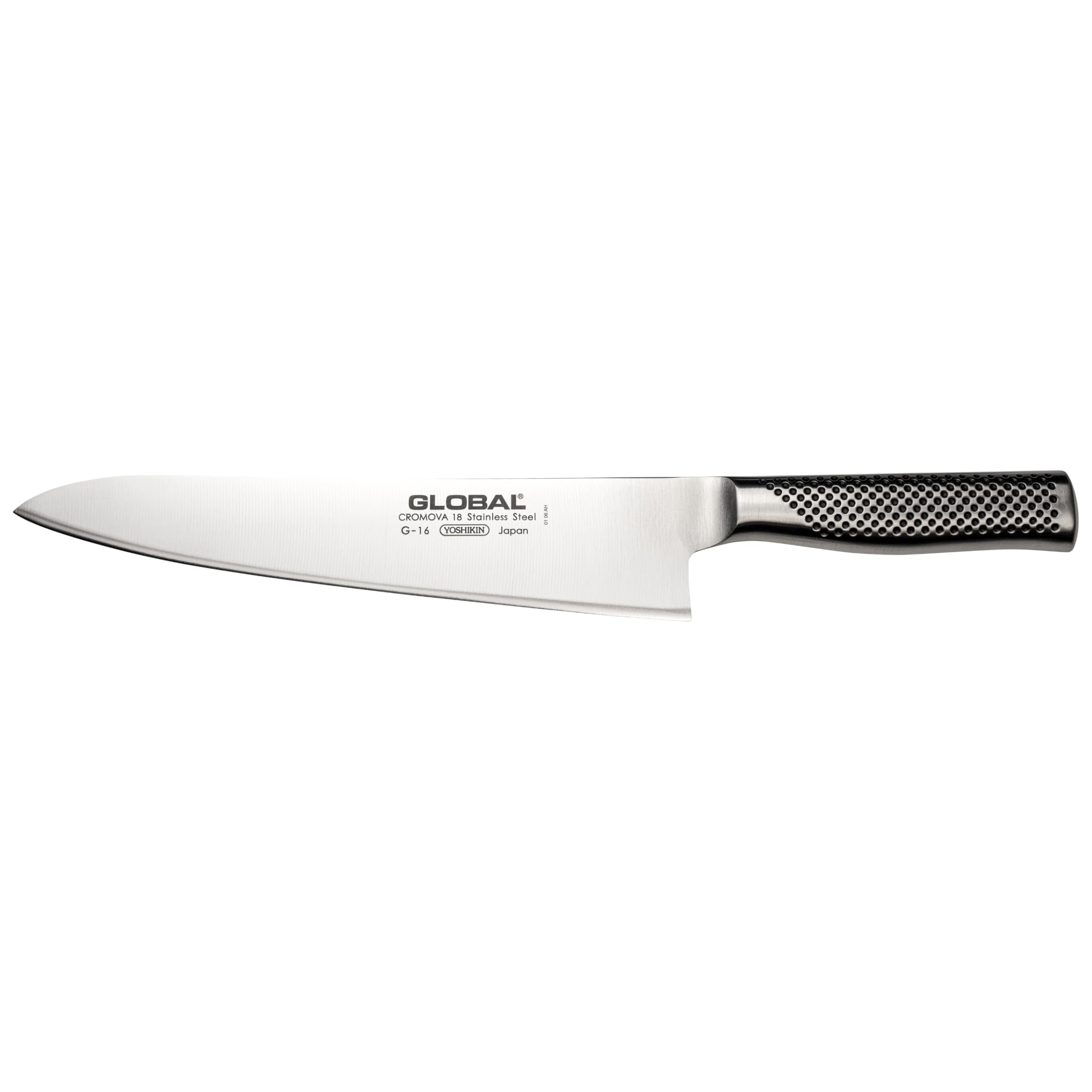
A one-piece all-steel design with a dimpled handle that never asks about left or right.
Global took a different route entirely: the handle is stainless steel, molded for comfort and dimpled for grip, and the whole knife is one continuous piece with no rivets or seams to collect food. The blade is high-tech molybdenum/vanadium stainless steel, and it holds razor sharpness exceptionally well, which is why owners keep returning to it for chopping vegetables, herbs, greens, and meat. At 259 grams it sits between the featherweight stamped picks and the heavy forged German blades.
Owners single out durability — the blade simply never rusts — and a balance they describe as sitting between lightness and heft. The dimpled steel handle is the divider: some cooks love the sure grip even with wet hands, others find the all-steel profile slippery once things get messy. The lifetime warranty against defects and breakage backs the construction, and the precision balance means the blade does not fight you through a long chop.
Value is the honest sticking point. Owners mention it is worth the money overall, but opinions on value split more here than on any other knife in this lineup, which makes sense given the premium tier and the acquired taste of the steel handle. If you like the idea of a smooth all-metal knife you can grip without thinking about orientation, this is a standout; if you want a soft, warm handle, it will not be your favorite.
The case for the all-steel build
- One-piece stainless construction with no seams to trap food.
- Molybdenum/vanadium blade that holds razor sharpness exceptionally well.
- Dimpled steel handle designed for a secure grip.
- Lifetime warranty against defects and breakage.
What divides cooks
- All-steel handle feels slick to some hands when wet.
- Value opinions are mixed at the premium tier.
The fit: cooks who want an all-metal, smooth knife with a dimpled grip and a blade that shrugs off rust.
The mismatch: anyone who wants a warm, textured handle under their palm.
5. XINZUO 10 Inch Damascus Chef Knife

A 67-layer Damascus blade with a rosewood handle for cooks who want their knife to look as sharp as it cuts.
The visual is the entry point here: 67 layers of high carbon Damascus steel wrapped around a 10Cr core, and the pattern in the metal is the first thing people point at. Hardness reaches 62 HRC — the highest in this lineup — and that is what lets the blade hold a razor edge for months of frequent daily use. Owners describe slicing meat and vegetables paper-thin, with one calling it cutting “everything like butter.”
The rosewood handle brings its own texture and color, and the ergonomic shape is built to give a comfortable hold through a long session. It ships in a gift box, so it doubles as a present for a culinary enthusiast or a beginner who wants something that looks the part on the counter. At 268 grams it is a substantial forged-feel knife that still moves quickly through soft produce.
Two things deserve a straight answer before you buy. First, the durability and material claims draw mixed feedback, with some buyers questioning whether the 67-layer pattern is true Damascus steel — worth knowing if authenticity matters to you. Second, a 62 HRC edge at this geometry is precise but less forgiving of twisting or hard-impact chopping. For careful everyday slicing, it is a lovely tool; for breaking down bones, reach for something sturdier.
What draws the eye: 67-layer Damascus cladding over a 10Cr core at 62 HRC, paired with a natural rosewood handle and a gift box.
The honest caveat: some owners question the Damascus provenance, and the hard, fine edge asks for careful use.
Ideal for: cooks who appreciate a patterned blade and a wood handle, and who want a knife that performs as a gift.
Not for: heavy butchery or anyone who needs proven Damascus lineage before buying.
6. Messermeister Pro Series 10” Wide-Blade Chef’s Knife
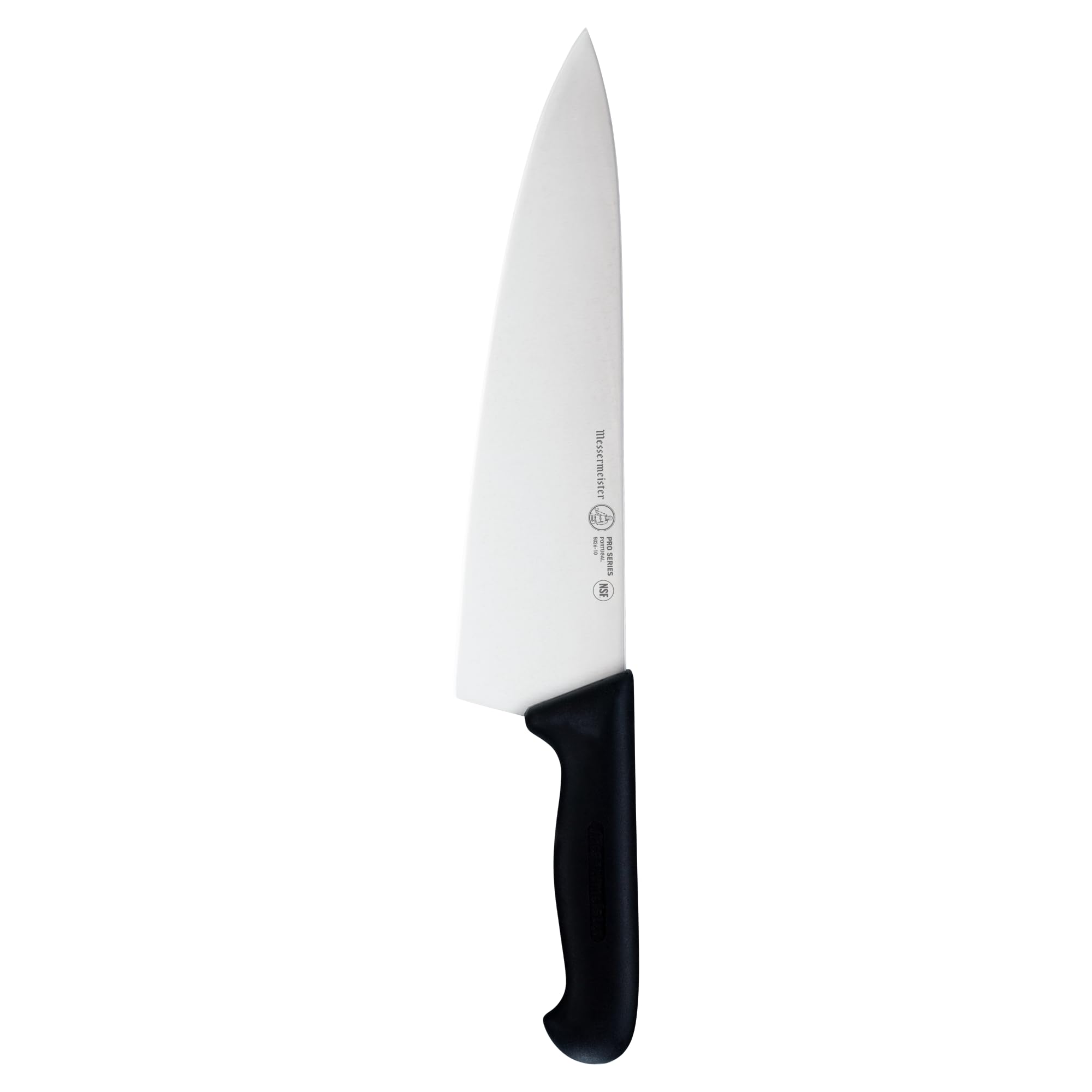
A stamped commercial workhorse with free lifetime sharpening built into the deal.
Built for volume. This is a one-piece stamped knife made from German X50 stainless steel, with an oversized, non-slip PolyFibre handle that is NSF-approved, and it is designed to hold up under the extreme demands of a commercial kitchen. The smooth, fine edge is set at 15 degrees per side, and it cuts, chops, slices, and dices firm and soft produce, meat, and fish alike. Owners rank it among the best commercial knives, with stamped-blade performance that reads like forged.
The warranty is the quiet hero. Messermeister offers a guaranteed lifetime warranty against defects in materials and workmanship, plus free lifetime sharpening and reconditioning — once the edge dulls, you can have it re-ground or send it in for a return shipping fee and they re-sharpen free of charge. That is a level of after-sale support none of the other picks match, and it is the reason this knife makes sense for someone who cooks seriously and hates the idea of replacing a blade.
The one thing to size up is the wide blade itself. A few owners find the blade size takes adjusting to after a narrower knife, and the oversized handle is built for a confident grip rather than a delicate one. If you have small hands or prefer a slim profile, handle it before committing. For high-volume prep where you want a knife that gets resharpened for life, it is a genuinely smart buy.
Made for: high-volume cooks and pros who want a stamped blade backed by free lifetime resharpening.
Think twice if: you have smaller hands or prefer a narrow, delicate blade profile.
7. Mercer Culinary M20610 Genesis 10-Inch Chef’s Knife

A forged German-steel knife at an entry-level tier that punches well above its price.
Sharpness is what this knife is known for, and the fact that it is precision-forged from high-carbon German steel at an entry-level tier is the surprise. The taper-ground edge delivers long-lasting sharpness, and owners compare its edge retention to far more expensive German blades. At 10.88 ounces it is the lightest forged knife in this group, so you get forged construction without the heft of the ZWILLING or the Wusthof above.
The Santoprene handle (a rubbery synthetic grip) stays grippy even with wet hands, so you keep control while dicing onions, mincing shallots, or shredding cabbage. The knife is well-balanced with a nice weight in the hand, and it cuts through food with ease — long vegetables lengthwise are a particular strong suit, since that 10-inch blade gives you the run to do it in one pass. Customers note value for money is the second thing they praise.
The one caveat is a size note that a few owners raise — the blade runs long, so it needs a matching board. Care matters here too: Mercer explicitly asks you to hand wash with warm water and mild soap, rinse, and dry with a soft towel, and to keep it out of the dishwasher entirely. Follow that and this is a remarkably sharp forged knife for the money.
Where the money goes
- Precision-forged high-carbon German steel at an entry-level tier.
- Taper-ground edge built for long-lasting sharpness.
- Santoprene handle keeps a non-slip grip even when wet.
- 10.88 ounces — lightest forged knife in this lineup.
What to plan around
- Hand wash only; keep it out of the dishwasher.
- Long blade needs a full-size board.
Suits: cooks who want forged German-steel sharpness without the premium-tier outlay, and who hand wash their tools anyway.
Skip if: you need a dishwashable knife or have only a compact board.
8. MOSFiATA Chef Knife 10 Inch

A beginner-friendly forged gyuto that arrives with a finger guard, sheath, and sharpener in one box.
For someone setting up a first kitchen or buying a gift, this is the most complete package here. You get the 10-inch gyuto itself, made from EN1.4116 German high carbon stainless steel, plus a stainless steel finger guard, a knife sheath, and a knife sharpener, all in a black gift box. The blade is hand-polished to a 14-16 degree edge at 2.75mm thick, with a Rockwell hardness of 56 ± 2 HRC — forgiving steel that sharpens back up easily.
The Micarta handle is the standout detail. It is built to minimize wrist tension and hold a secure grip regardless of hand size or where you grip along the handle, and the triple-rivet design keeps it firmly attached to the blade. At 10.24 ounces it is the second-lightest forged knife in this group — 1.92 ounces lighter than the ZWILLING — and owners generally find the balance comfortable for chopping, slicing, dicing, and mincing everything from meat to bread.
Weight is the split opinion. Some cooks find the heft reassuring and well-balanced, while others consider it on the heavy side for their taste, so handle it if you have a smaller frame or are used to a stamped blade. It is also explicitly German steel rather than Damascus, and the maker says so plainly. For a gift or a starter blade with all the safety extras included, that combination is hard to argue with.
The right buy for: first-time cooks and gift-givers who want a forged 10-inch blade with a guard, sheath, and sharpener in the box.
Consider skipping if: you have a small hand and prefer something noticeably lighter in feel.
9. Arcos Chef Knife 10 Inch Series 2900

The dishwasher-safe Spanish blade for cooks who want sharp and hygienic without the fuss.
Arcos has been making knives in Albacete, Spain since 1734, and this Series 2900 model is the low-maintenance pick of the bunch. The blade uses the company’s patented Nitrum stainless steel treatment, which the maker says adds durability, hardness, and precision cutting. The 250 mm blade — that is 10 inches — is a wide, smooth-edged multipurpose shape for cleaning, cutting, and chopping vegetables. At 265 grams it stays light enough to move quickly through a pile of produce.
The handle is the reason this one stands out for daily use. It is molded in polyoxymethylene (POM), a plastic chosen for high resistance to detergents and extreme temperatures, and it is rated suitable for the dishwasher. The blade-to-handle union is permanent thanks to the injection process, so there is no gap to harbor anything. Owners call it excellent quality and very sharp, and more than one home cook names it their go-to knife.
The compromise is the same one every dishwasher-friendly knife makes: the handle material is plastic rather than wood or Micarta, so it will never feel like a heirloom in the hand. The stamped construction also means it lacks the heft of the forged German blades up top. If convenience and hygiene are what you actually care about at the end of a long day, that is a trade worth making.
The real draw: Nitrum stainless steel in a 250 mm blade with a POM handle rated for the dishwasher — dry it, rack it, move on.
What you trade: plastic handle and stamped build mean it feels practical rather than precious.
Best for: busy home cooks who want a sharp 10-inch vegetable blade they can put in the dishwasher.
Look past it if: you want the warmth and character of a wood or composite handle.
Understanding the Specs
Blade Length and Reach
Blade length is measured from the heel to the tip, and it sets how much you can cut in a single stroke. A 10-inch blade, which is roughly 250 mm, gives you the runway to rock through a whole head of cabbage or a long carrot without repositioning the food. It also means the knife needs a board long enough to finish the cut, so check your board before you commit. Shorter blades are easier in tight space; longer ones trade that agility for fewer passes and cleaner slices.
Rockwell Hardness (HRC)
Rockwell hardness, written as HRC, is a score for how hard the steel is. Harder steel holds a fine edge longer but is more brittle and less forgiving if you twist the blade. In this lineup the scores run from 56 ± 2 HRC on the MOSFiATA up to 62 HRC on the XINZUO, with the German forged blades sitting at 57 to 58 HRC. A lower score sharpens back up more easily; a higher score keeps its edge longer but asks for careful use.
Edge Angle in Degrees Per Side
Edge angle is the angle of the sharpened V, measured in degrees per side. A smaller number means a thinner, keener edge that bites into tomato skin and hard squash with less pressure. Fifteen degrees per side is the common German standard, and 14-16 degrees per side is a slightly finer window. A thinner edge also chips more readily on bones and frozen food, so the angle you want depends on what you cut most.
Construction and Weight
Forged knives are shaped from a single piece of steel, which usually brings more mass and a full bolster between your fingers and the edge. Stamped knives are cut from a sheet, keeping them lighter and more nimble. Weight in this group runs from 8.8 ounces on the Victorinox to 302 grams on the Wusthof, so handle both styles if you can. The heavier a knife is, the more the cutting is done by gravity rather than your wrist.
FAQ
Is a 10-inch chef’s knife too big for a home kitchen?
What does 15 degrees per side mean on a chef’s knife?
Forged or stamped: which chef’s knife should I buy?
Can I put a 10-inch chef’s knife in the dishwasher?
What Rockwell hardness should a chef’s knife have?
How do I keep a 10-inch chef’s knife sharp at home?
Is Damascus steel better than German stainless for a chef’s knife?
Does a heavier chef’s knife tire out your hand?
What size cutting board do I need for a 10-inch knife?
Which 10-inch chef’s knife is best for a beginner?
Final Thoughts: The Verdict
For most kitchens, the 10 inch chef knife worth buying first is the Victorinox Swiss Classic, because it pairs a light 8.8-ounce stamped build with the sharpest all-around performance in this lineup at 4.5+ stars across 200+ ratings. If you would rather let a forged blade do the cutting for you, the ZWILLING Professional S brings a 57 HRC German edge set at 15 degrees per side and a proven heirloom feel. And for the cook who wants free lifetime resharpening and a commercial-grade workhorse, reach for the Messermeister Pro Series. Whichever you choose, match the blade to your board and pick a handle material you are actually willing to care for — those two decisions matter more than any badge on the box.
How We Picked
We do not accept paid placement. Every pick is matched to a real buyer and a real use-case; we do not hands-on test units.
Sources & Methodology
Specifications: manufacturer listings and product documentation. Review insights: verified customer reviews, as of November 2026. Pricing: not shown on this page (it changes often); check the current price via the retailer link.
As an Amazon Associate, Gadgets Feed earns from qualifying purchases. This does not affect which products we feature.