
Our readers keep the lights on and my morning glass full of iced black tea. As an Amazon Associate, I earn from qualifying purchases.
Specs are compiled from manufacturer listings and verified buyer reviews and can change over time — please confirm the key details on the product page before buying.
If your rural house sits far from the towers and cable never ran out to you, you need an outdoor antenna that points straight at the broadcast towers, boosts the signal, and filters out interference. The Televes DAT BOSS Mix LR 149884 is the strongest all-round answer here. Country reception is a different problem from city reception: your stations sit far away, and trees and hills eat the signal. A cheap flat indoor panel just cannot pull them in. What works is a directional antenna (one that aims at the towers and ignores the clutter) with amplification built in and filtering to keep cell and FM interference out of your picture.
I’m Min — the founder and writer behind Gadgets Feed. This guide is built by comparing the manufacturers’ published specifications and the patterns across verified customer reviews, so you get each pick’s real strengths and trade-offs instead of marketing spin.
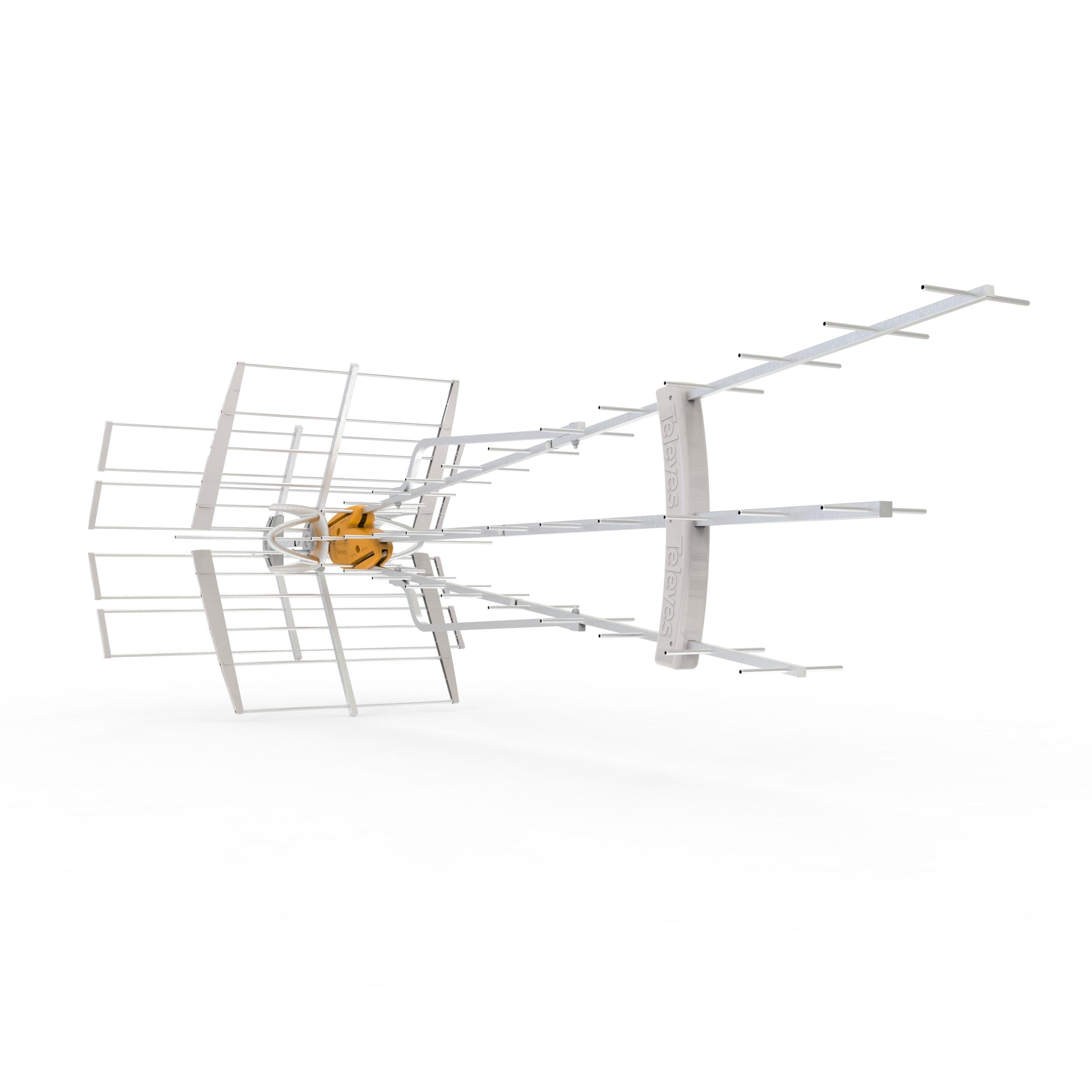
Below you will find long-range outdoor antennas matched to different rural setups, from budget yagi designs to a heavy-duty booster model that holds up in fringe zones. The Televes leads this list of antenna for rural areas picks with 38 dBi High VHF and 46 dBi UHF gain plus a built-in TForce amplifier.
Our Picks at a Glance


How To Choose The Best Antenna For Rural Areas
Out in the country you cannot fix a weak signal with a nicer TV. You have to catch more of the broadcast as it arrives. That means a directional antenna (one that aims at a single cluster of towers) with real gain, mounted high, and pointed by compass. Before anything else, look up how far your nearest towers sit using a free signal-finder tool, then buy range with some headroom.
Gain and directivity beat a big mile number
Gain is measured in dBi (decibels relative to a reference antenna) and it tells you how hard the antenna pulls in a distant station. A directional design focuses that pull toward the towers instead of gathering noise from all directions. The Televes lists 38 dBi High VHF and 46 dBi UHF gain — figures that put it in a class well above simple passive yagis. If a listing only shouts a huge “200 mile” range and never names gain, treat the range as a best-case guess.
Do you need an amplifier, or will it overload?
An amplifier (a small powered booster that lifts a weak signal before it reaches your TV) rescues a faint fringe channel. But in a spot close to strong local transmitters, too much boost can overload the tuner and cause dropouts. A model with intelligent, band-by-band gain control is the safe pick because it turns the boost down when it senses a strong signal. That is exactly what the Televes TForce system does, adjusting independently for High VHF and UHF.
Point it the right way and mount it high
Directional antennas are forgiving only up to a point. Trees, hills and your own roofline all cut signal, so height and a clear aim at the towers matter as much as the box on the mast. Many of these come with a J-mount or mast hardware, and several add a long coax run so you can place the antenna where reception is best rather than where the cable happens to end.
Quick Comparison
All three spec columns below use the same three dimensions — rated range, gain channel count, and build — so you can scan trade-offs at a glance.
| Model | Best For | Rated Range | Channels | Signal Design | Amazon |
|---|---|---|---|---|---|
| Televes DAT BOSS Mix LR 149884★ Best Overall | Fringe rural reception | Up to 100 mi | 29 | Amplified, filtered | Amazon |
| RCA Compact Outdoor YagiTop Performer | Attic or roof, tight budget | Up to 70+ mi | — | Passive yagi | Amazon |
| Five Star Outdoor HDTV AntennaMost Versatile | Multi-TV rural homes | Up to 200 mi | 100 | Passive, multi-directional | Amazon |
| Antennas Direct ClearStream MAX-XR | Spread-out towers | 60 mi | — | Multi-directional double-loop | Amazon |
| Antennas Direct Element | Single-cluster aim | 60 mi | 2 | Uni-directional, high gain | Amazon |
| Winegard HD8200A Platinum | Harsh-weather heavy duty | 65+ mi | 36 | Passive, Low-VHF to UHF | Amazon |
| GE Outdoor HD Digital | Attic or outdoor simplicity | Up to 80 mi | 200 | Passive yagi | Amazon |
| CEKAY Outdoor Yagi | Ready-to-mount kit | 70 mi | 100 | Passive yagi, 40 ft cable | Amazon |
| McDuory Outdoor Yagi | Cheapest fringe try | Up to 70+ mi | — | Passive yagi | Amazon |
In-Depth Reviews
1. Televes DAT BOSS Mix LR 149884 HDTV Antenna
Our pick — 4.5+★ from 500+ verified ratings; the strongest balance of quality and price.
Built for fringe country where the towers sit far and the signal barely makes the trip.
The Televes lists 46 dBi UHF gain and 38 dBi High VHF gain. That is far more pull on a distant broadcast than a passive yagi delivers, so stations that flicker on a simple antenna can come through steadily. It pairs that gain with a built-in TForce preamplifier (a powered booster that lifts the signal before it reaches your TV) designed for fringe reception up to 100 miles from the transmitters.
The clever part is that the boost is not a dumb fixed lift. Its BOSS-Tech system adjusts amplification separately for each band, so a strong local station does not get overloaded while a weak far one still gets help. Built-in FM, LTE, 4G and 5G filtering (a filter that blocks phone and radio interference from leaking into the TV signal) keeps the picture clean where cell towers share your skyline. Its directional stacked triple-boom layout also delivers front-to-back ratios of 12 dB on High VHF and 25 dB on UHF, which helps reject multipath — the smearing you get when a signal bounces off hills and arrives twice.
Owners praise the build quality and the channel haul — even those sitting roughly 70 miles out report clear pictures with no pixelation. Assembly is the one rough edge: plenty find it straightforward, but a few describe the build as a challenge, so allow a patient afternoon rather than a rushed ten minutes. It is also a physically large antenna, so plan roof or eave space before it arrives. Supplied with a UL-listed 12V dual-output power inserter and a weather boot, it keeps passing signal in passive mode if power ever drops.
Where it wins
- 46 dBi UHF and 38 dBi High VHF gain for weak fringe stations
- Intelligent band-by-band amplification avoids overload
- Built-in FM and LTE/5G filtering for a cleaner picture
- Keeps working in passive mode if the power goes out
What to plan around
- Assembly is split — easy for some, a project for others
- Big physical footprint needs roof or eave room
- Premium tier, so it costs the most here
Pick this if: your towers are 60–100 miles out and you want the most stubborn gain in the field.
Think twice if: you have no roof space for a large directional antenna or want a screwdriver-only afternoon.
2. RCA Compact Outdoor or Attic Yagi HD TV Antenna
The two-pound yagi that tucks into an attic and still reaches far-flung towers.
This RCA antenna aims at the towers and ignores the clutter, because it is a yagi (a directional antenna built from a row of cross elements). At 2 pounds, it is one of the easier antennas in this guide to raise on a mast or slip into an attic without a second pair of hands. It covers both UHF and VHF (the two bands TV stations broadcast on) and lists a 70+ mile range from the broadcast towers, so stations in the next county can still come in.
Buyers report that reception and the channel haul are the best things about it, and the crisp, no-pixelation picture comes up again and again. The compact size is a genuine plus for attic installs where headroom is tight. On the flip side, not every buyer in every location pulls a full lineup. A fringe spot deep in a valley can leave you scanning and finding nothing, so aim matters.
It is a passive design, meaning no powered amplifier inside, so it asks more of your location than the amplified Televes above. Set against that, it arrives mostly pre-assembled with snap-lock and fold-out elements, includes the mast, locking clamp and a 75-ohm matching transformer, and pairs with the free RCA Signal Finder app to point you at the towers. Coax cable is sold separately, so budget for that run before install day.
Broad ownership verdict: a light, focused yagi that most rural buyers find punches above its size, with clear pictures and a healthy channel count as the recurring wins.
The honest limit: it is passive, so if your towers are very distant the amplified Televes simply has more pulling power — this one rewards being pointed precisely at the transmitter cluster.
Reach for this if: you want a compact attic-friendly yagi you can raise solo and point by app.
Look elsewhere if: your towers are near that 70-mile ceiling, where a built-in amplifier earns its keep.
3. Five Star Outdoor HDTV Antenna
Splits one rural rooftop signal across up to four TVs without extra boxes to buy.
One mount can feed up to four screens, because the Five Star kit includes not just the antenna and J-pole (the mounting pole) but a TV splitter. That suits a rural house with a TV in the den, one in the bedroom and another out in a cabin. The maker advertises reception up to 200 miles from the transmitters and lists a 100 channel capacity — the longest headline range in this lineup. The catch: at 46″ x 28″ x 25″, the extended elements that earn that range take real roof space.
Owners tend to agree on the assembly story: it goes together and mounts without drama, and the money saved against a cable bill is the refrain. Quality and channel count are what buyers praise most, with clear pictures and roughly 30 stations showing up in many homes. The ranged and reception picture is more mixed — a 200-mile claim is a best-case ceiling, and in hilly country with tree cover your real distance will be shorter.
It handles both VHF and UHF, runs passive with a 75-ohm impedance, and is ATSC 3.0 ready for the next-gen broadcast standard where it is available. Best practice with any antenna this size is to run a channel scan after mounting, then repeat it monthly or whenever a station vanishes, so your lineup stays current. Think of the 200-mile figure as ambition and the build as a solid, straightforward rooftop unit.
What it is really for: a multi-TV rural home that wants one antenna and a splitter to cover the whole house, assembled without fuss.
The caveat worth knowing: treat the 200-mile range as a best case — real distances shrink with trees and hills, and the reception feedback reflects that.
Go with this if: you are wiring several rooms from one rural mast and want the splitter in the box.
skip it if: you need maximum verified gain on one stubborn fringe channel rather than broad multi-TV coverage.
4. Antennas Direct ClearStream MAX-XR Outdoor TV Antenna
For country homes where the towers are scattered across the horizon, not bunched in one spot.
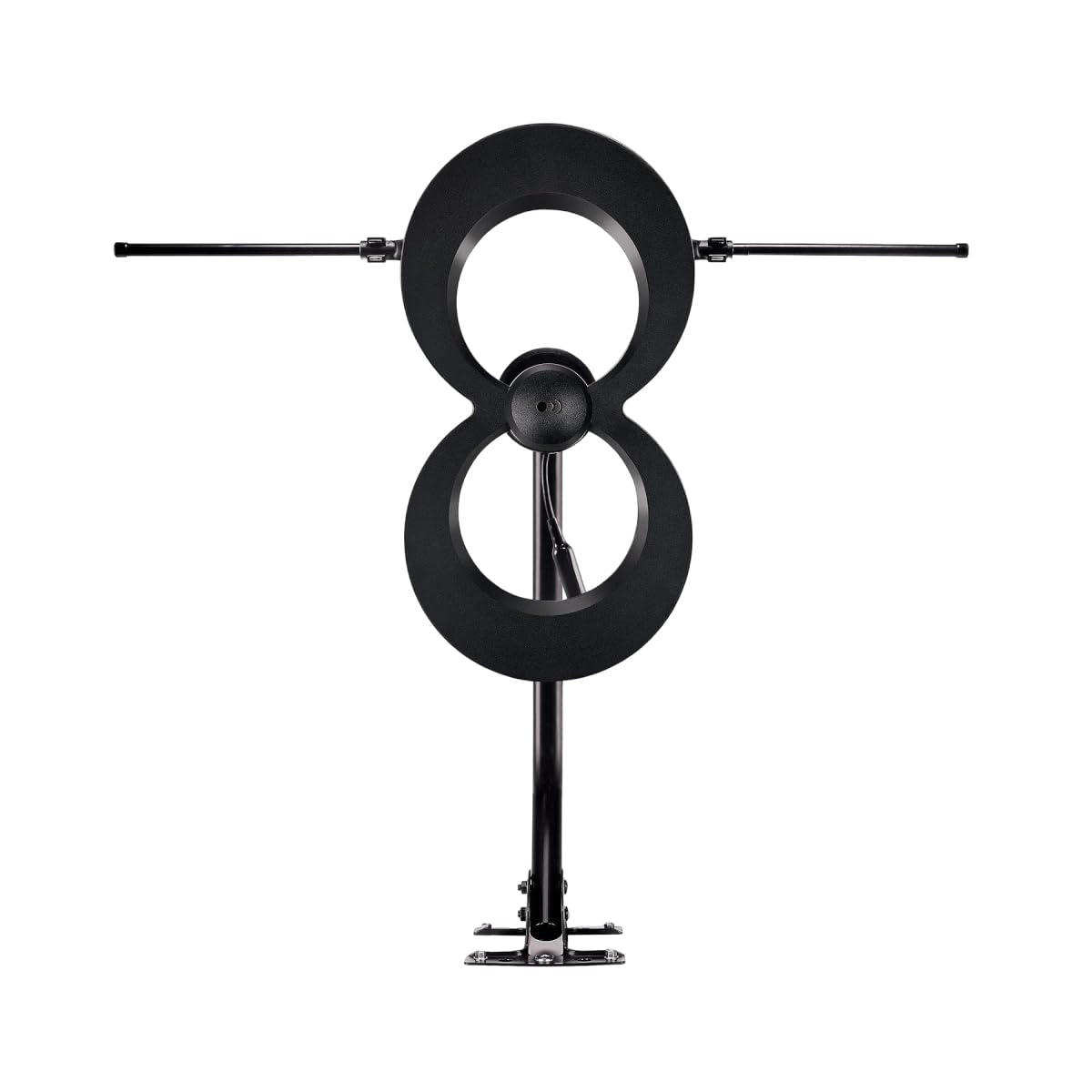
Most rural antennas are directional, which is a problem when your stations come from different compass points. The ClearStream MAX-XR solves that with a multi-directional double-loop design and a wide 65-degree beam angle, so it picks up channels from both the front and the back instead of demanding one precise aim. It reaches a 60-mile range and pulls UHF and Hi-VHF broadcasts, weighing just 1.4 pounds.
Performance is the headline in the feedback — it works well and mounts fast, with setup landing around ten minutes for many buyers, and the channel coverage is the kind of result rural setups crave. The clear signal quality rounds out the story. It arrives with a 20″ mast and a pivoting base that mounts on horizontal or vertical surfaces, so you can angle it toward the spread of towers without fabricating brackets.
Two things to keep straight. It is a shorter-range pick at 60 miles than the Televes or Five Star, so it suits towers within that circle rather than true fringe territory. And it is fully passive with no amplifier, so its strength is the wide aim, not raw pull on a very faint signal. For a rural spot with stations spread across the horizon, that trade is exactly right.
Why it fits scattered towers
- 65-degree beam catches signals front and back
- Multi-directional, so no single precise aim needed
- Light 1.4 lb body with a pivoting 20″ mast
- Quick setup, often around ten minutes
Where it stops short
- 60-mile range, so not a true fringe antenna
- Passive design with no amplifier for weak signals
The right call when: your towers fan out in several directions and you cannot aim at just one.
Wrong call when: your stations sit beyond 60 miles and need amplified gain to arrive.
5. Antennas Direct Element Uni-Directional UHF VHF Outdoor TV Antenna

Aiming at one tower cluster? This one trades wide coverage for a tighter, harder pull.
When all your transmitters sit in one direction, a uni-directional antenna rewards that aim. The Element is a step beyond a conventional yagi, with a peak gain of 9.2 dBi on UHF and 6.7 dBi on Hi-VHF across its 174 to 216 MHz and 470 to 608 MHz bands. In plain terms it concentrates reception on that cluster rather than chasing signals from every angle. It covers UHF and VHF and lists a 60-mile range.
Channel reception is what buyers talk about most here — it delivers, and it lifts VHF signal strength for many owners. The build is solid and installs cleanly, and its simplicity is a selling point for anyone tired of fiddly designs. Picture quality is the more split part of the story, so set expectations that the cleanest possible aim gives this one its best chance.
Physically it measures 44.5″ long and 35.5″ wide by 2.5″ high, folds out for assembly, and weighs 2.6 pounds, so it mounts to an existing mast or tucks into an attic for rural and suburban use. It is fully passive — no amplifier — and it is good value for the gain it delivers. If your towers cluster in one spot and sit inside 60 miles, its 9.2 dBi UHF gain is aimed exactly where you need it.
Straight read: precise, focused reception from a single direction with real gain numbers behind it, built simple and priced fairly against the field.
Fair warning: point it wrong or pick it for scattered towers and you lose the advantage — this is a single-aim antenna, and picture quality depends on that aim.
Best matched to: a rural home with one clear tower cluster inside 60 miles that wants focused gain over wide coverage.
Not for you if: your stations are spread across the horizon — grab the multi-directional ClearStream instead.
6. Winegard HD8200A Platinum Heavy-Duty Outdoor Yagi TV Antenna
Zinc-plated steel for country weather that eats lesser antennas alive.
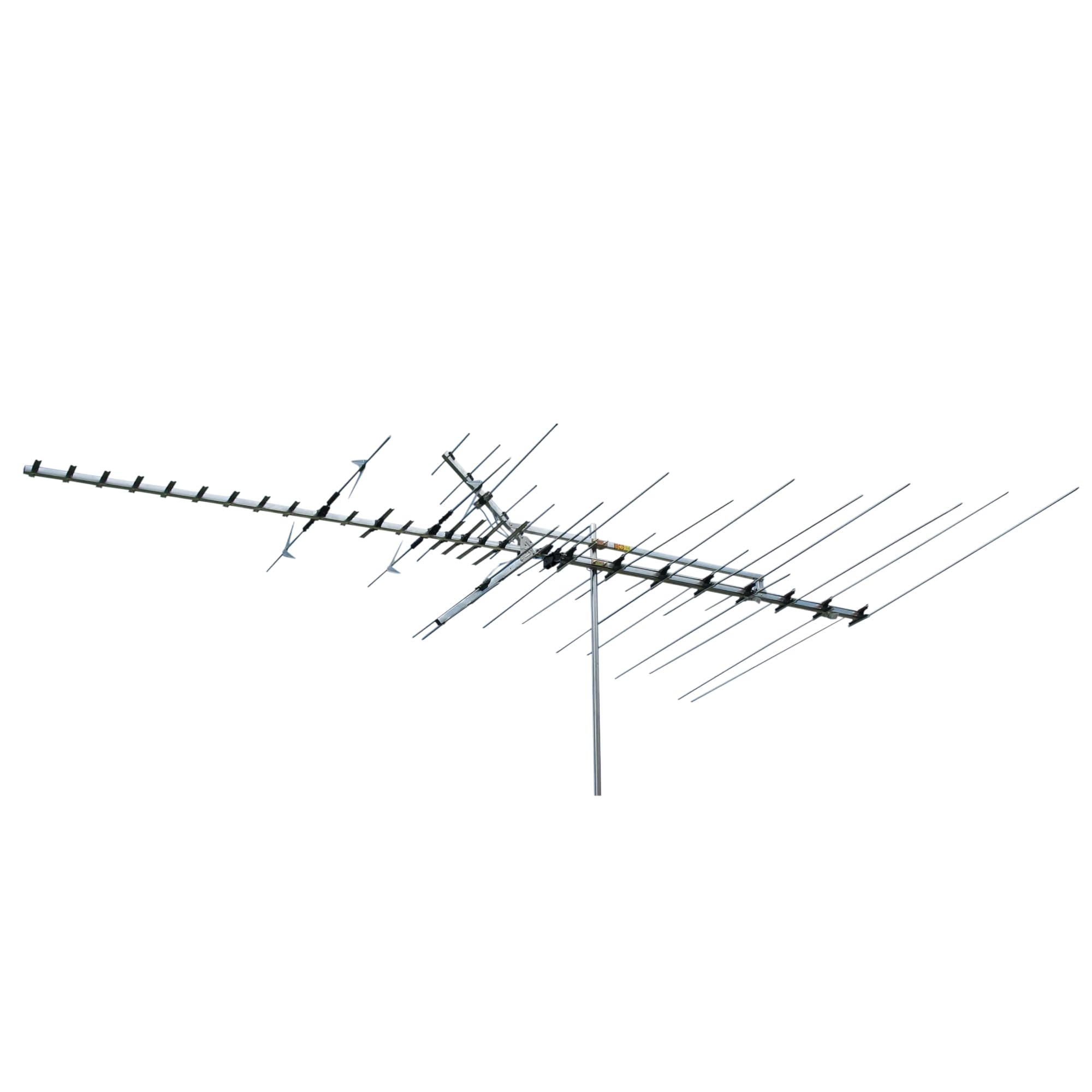
Out where wind, rain and freeze-thaw hammer a rooftop year after year, construction is the spec that matters. The Winegard HD8200A is built from zinc-plated steel for oxidation resistance, weighs 8 pounds, and is rated for 65+ mile reception — a heavy-duty frame designed to weather harsh conditions rather than a lightweight element array. It is a directional yagi covering High-VHF, Low-VHF and UHF, which lets it catch the low-band VHF stations some compact antennas skip.
The performance and frequency reception are what buyers praise most — it works at distance (around 60 miles in practice) and picks up a broad channel spread, with easy assembly and install as recurring notes. It is also a strong value against a cable bill. The size draws mixed reactions: this is a large antenna, so plan generous mounting space. Build-quality opinions are split too, so inspect the hardware on arrival.
It is a non-amplified design, so it relies on its raw directional gain and your aim rather than a powered booster — a different tactic from the amplified Televes. It is NextGen TV compatible and works with modern tuners and streaming devices. If you prize a rugged, US-designed steel frame and low-VHF coverage, this is the durable option; if you want maximum gain on the faintest signal, an amplified model will out-pull it.
Durability story: zinc-plated steel and an 8-pound frame built for hard weather, with Low-VHF coverage that compact yagis leave out.
Trade-off to weigh: it is passive with no amplifier and a large physical size, so it rewards a big mounting space and a precise aim rather than boosting a faint fringe signal.
Choose it if: weather resilience and Low-VHF reception top your list and you have room for a big steel antenna.
Pass it over if: your signal is so faint you need built-in amplification to rescue it.
7. GE Outdoor HD Digital TV Antenna

A simple yagi that covers VHF and UHF up to 80 miles and mounts outdoor or in the attic.
This GE lists a 200 channel capacity, the highest channel count in this guide. That is a headroom figure rather than a promise of what you will receive, but it signals the antenna is built to scan a wide band. It reaches up to 80 miles from the broadcast source, so stations a county over can still land. It handles both VHF and UHF (the two TV bands) and can go outside or hide in the attic at 37″ x 26.5″ x 19″.
Channel reception is what buyers praise most — clear pictures with no pixelation and a healthy lineup show up across the feedback, and installation is the second most-liked thing. The size earns mixed views: some like how compact it is, others wish it were smaller. Instructions are the weak spot, with the setup paperwork the one area buyers find wanting, so lean on the included mounting bracket, mast clamp and J-mount to guide you.
It is a passive yagi, so it is best within its stated distance rather than deep fringe, and it covers 4K-ready reception while being ATSC 3.0 compatible. The 200-channel capacity is the standout on paper, but expect the real number to follow your local broadcast inventory. For a straightforward outdoor or attic install within 80 miles, it is an easy, well-known pick.
Why it earns its place
- 200 channel capacity, the highest count here
- Up to 80-mile range for VHF and UHF
- Mounts outdoor or in the attic
- Includes weather-resistant bracket, clamp and J-mount
Where it stumbles
- Instructions leave buyers wanting
- Size draws mixed reactions
- Passive, so not a deep-fringe booster
Good fit if: your towers are inside 80 miles and you want a recognizable brand you can mount outside or in the attic.
Look past it if: you are deep in a fringe zone that needs amplification rather than a passive yagi.
8. CEKAY Outdoor Yagi TV Antenna

Comes with the cable and the pole, so the run from roof to living room is covered.
Half the headache of a rural install is the stuff that is not the antenna — the coax run, the mounting pole. The CEKAY bundles a 40 ft RG6 coax cable and a J-pole in the box, so you are not buying them separately. It is an all-metal yagi with a high-gain, directional design covering UHF and VHF, rated to 70 miles, and it lists a 100 channel capacity.
What buyers like most is that the set actually performs — it works well at distance, and pulling in well over 90 channels with clear local reception is a common result, even in hilly terrain. Assembly is another plus, with clear instructions and minor tool-free setup. It is built for extreme weather, all-metal, so heat, rain, wind and snow are part of the design brief.
It is ATSC 3.0 compatible for next-gen broadcasts, runs passive at 75-ohm impedance, and carries a 1-year warranty. The durability picture is split — some owners find it sturdy, others wonder about longevity — so mount it where wind exposure is reasonable. Compared with the GE above, it adds the cable and pole but trades the GE’s higher 80-mile range for a shorter 70-mile spec.
What you get assembled: a complete outdoor kit — antenna, 40 ft RG6 cable and J-pole — that many rural buyers find pulls in over 90 channels with clear local reception.
The honest catch: durability views are divided, so pick a sheltered mounting spot and treat the 1-year warranty as your safety net.
Buy it when: you want the cable and pole in the box and a tool-free setup for a modest rooftop job.
pass on it if: you need the largest advertised range or worry about long-term durability in a wind-blasted spot.
9. McDuory TV Outdoor Yagi Antenna

The low-cost way to test whether a rural rooftop can pull free channels at all.
If you are not sure a rural antenna will work at your address, starting small and cheap makes sense. The McDuory is a passive yagi that covers UHF and VHF and lists a total 150-mile range with an effective 70+ miles from the towers. It arrives mostly pre-assembled with no tools needed, so it is a low-friction first try before committing to a bigger mount.
Functionality is the thing owners like most — it simply works, and some find it performs better than pricier models, pulling 30+ channels with clear reception even in bad weather. The durability picture is mixed, with some finding it solid and others calling it flimsy, so it rewards a sheltered mount rather than an exposed ridge.
Practically, its real-world range in reviews runs shorter than the headline — comfortable for local channels, less certain deep in fringe country. It is a passive design with no amplifier, so on the faintest signals it relies on aim and height. As a first experiment, or for a rural spot within striking distance of the towers, it is an honest, inexpensive way to cut the cord.
Price-to-value read: a no-tools yagi that many buyers find out-punches its cost, pulling 30+ channels clearly where towers are within reach.
Set expectations: the effective range often lands near local coverage, and durability is a mixed bag — mount it out of the worst weather.
Try this if: you want a low-cost first attempt to see what your rural address can receive.
Hold off if: you already know your towers are deep fringe and need amplified gain to reach them.
Understanding the Specs
Gain (dBi) and What It Does
Gain, measured in dBi, is how hard an antenna pulls a distant station relative to a plain reference. Higher gain equals more pull on a weak signal, but it usually comes with a narrower aim, so gain and directional focus travel together. The Televes leads here with 46 dBi UHF and 38 dBi High VHF, well beyond the smaller yagis.
Amplified vs Passive
An amplified antenna uses a powered booster to lift a faint signal before your TV sees it, which helps deep in fringe country. A passive antenna relies on its own design and aim, with nothing to power. Amplified wins on the weakest signals; passive wins on simplicity and never needs an outlet or power inserter.
Front-to-Back Ratio and Multipath
Front-to-back ratio measures how well an antenna ignores signals coming from behind it. A higher ratio rejects multipath — the ghosting you get when a signal bounces off hills and arrives twice. The Televes lists 25 dB UHF and 12 dB High VHF, helping a clean picture where terrain causes reflections.
Range Ratings and Reality
A range figure like 60, 80 or 200 miles is a best case. Trees, hills, building materials and weather all shorten it. Use the number as a starting filter, then aim for towers comfortably inside it. A shorter-range antenna pointed well often beats a longer-rated one aimed blindly.
FAQ
How far can a rural outdoor antenna really reach?
Do I need an amplified antenna in the country?
Can I mount a rural antenna in the attic instead of the roof?
What is the difference between a directional and multi-directional antenna?
Will an outdoor antenna pick up VHF and UHF stations both?
How do I aim a rural antenna at the towers?
Is ATSC 3.0 or NextGen TV support worth having?
How many TVs can one rural antenna feed?
Why does my antenna lose channels in bad weather?
Do I have to run a channel scan after installing?
Final Thoughts: The Verdict
For most rural homes the winner is the Televes DAT BOSS Mix LR 149884. Its 46 dBi UHF and 38 dBi High VHF gain plus intelligent band-by-band amplification is the most reliable way to lock onto distant towers. If your towers fan out in several directions inside 60 miles, the Antennas Direct ClearStream MAX-XR and its wide 65-degree beam handles scattered stations better than a strict directional. And for a rugged steel build with Low-VHF coverage in hard weather, the Winegard HD8200A Platinum is the durable one to reach for. Whatever you choose, mount it high, aim by signal-finder, and rescan — that is where the free channels come from.
How We Picked
We do not accept paid placement. Every pick is matched to a real buyer and a real use-case; we do not hands-on test units.
Sources & Methodology
Specifications: manufacturer listings and product documentation. Review insights: verified customer reviews, as of November 2026. Pricing: not shown on this page (it changes often); check the current price via the retailer link.
As an Amazon Associate, Gadgets Feed earns from qualifying purchases. This does not affect which products we feature.