
Our readers keep the lights on and my morning glass full of iced black tea. As an Amazon Associate, I earn from qualifying purchases.
Specs are compiled from manufacturer listings and verified buyer reviews and can change over time — please confirm the key details on the product page before buying.
Three players is the awkward number at a game table. Two-player duels are tight and four-player nights are social, but a three-player group often gets stuck with a game that only really works at two or four. The picks below are all built so that a third seat is a genuinely good seat — not a filler chair where someone waits their turn and watches.
I’m Min — the founder and writer behind Gadgets Feed. This guide is built by comparing the manufacturers’ published specifications and the patterns across verified customer reviews, so you get each pick’s real strengths and trade-offs instead of marketing spin.
Some of these games finish in half an hour; others stretch into a long evening with friends. The one that fits best is the one your group will actually get to the table twice — and this list of 3 player board games spells out which pick suits which crowd.
Our Picks at a Glance


How To Choose The Best 3 Player Board Games
Your first job is to ignore the cover art and read the player count on the box. Every game here lists a range that includes three, but the range is only the start. What matters is whether the rules give a third player real choices or just an extra turn in the rotation.
Check the player range first, then the playtime
A game listed as “2-5 players” covers your three-player night, and a game listed as “1-4 players” does too. Both work, but they feel different. A wider range tends to mean the rules bend to fit each group size, so check that the box actually states three players as a supported count before you commit.
Playtime is the other number that changes your night. A 30-minute game fits after dinner on a school night. A 60-minute or longer game is an evening plan, and the group needs to agree to it up front.
Match the complexity to your table
Some of these games teach in a few minutes and let you play right away. Others ask you to learn a system of cards and resources before the first scoring round makes sense. Neither is better, but casual players and hobby gamers want different boxes.
Look at the reading load, too. A game whose turns are driven by cards with short text is easier to run with a mixed-age group than one where every player must track several interlocking rules.
Weigh replayability and space
A game you play once and shelve is a poor buy, so favour randomised setups and varied card pools. Look for randomised setups, varied card pools, or shifting boards, because those keep a three-player group coming back. Also check the table footprint — a large central board and player mats eat space fast on a small kitchen table.
Quick Comparison
| Model | Best For | Players | Playtime | Style | Amazon |
|---|---|---|---|---|---|
| Asmodee Harmonies★ Best Overall | Best overall for a calm, beautiful three-player game | 1-4 | 30 minutes | Pattern building, strategy | Amazon |
| Raccoon TycoonBest Value | Fast economic strategy with lots of routes to win | 2-5 | 75 minutes | Auction, set collection | Amazon |
| Buffalo Games PlantedBest Quick Play | A quick houseplant-themed game for small groups | 2-5 | 30 minutes | Resource management | Amazon |
| Azul | Beautiful tiles and deep choices for a game night | 2-4 | 30-45 minutes | Draft and tile placement | Amazon |
| Carcassonne | A classic tile game that fits any group size | 2-5 | 35 minutes | Tile placement | Amazon |
| Ticket to Ride | A family train game everyone learns in one sitting | 2-5 | 30-60 minutes | Route building, set collection | Amazon |
| The Night Cage | A tense cooperative escape for three players | 1-5 | 40 minutes | Cooperative tile laying | Amazon |
| Wingspan | Card-driven engine building with gorgeous birds | 1-5 | 60-90 minutes | Engine building, set collection | Amazon |
| Everdell | A cozy woodland city builder for a long session | 1-4 | 60 minutes | Worker placement, tableau building | Amazon |
In‑Depth Reviews
1. Asmodee Harmonies Board Game
Our pick — 4.5+★ from 900+ verified ratings; the strongest balance of quality and price.
Thirty minutes of building your own dreamlike landscape, with a third chair that feels just as full as the other two.
Harmonies is the rare game that fits three players without stretching. It supports 1-4 players and runs a 30-minute playtime, so a three-person night gets one full game and often a second right after. You build a landscape from animal and nature cards using 120 wooden tokens, matching habitats to score points. The rules are short enough to teach at the table, but the layering of tiles and animals gives you real decisions to weigh each turn.
What wins players over is the core gameplay loop. Combining a landscape and the animals that live there is simple to grasp but keeps opening new choices as your board fills up. It is a calm table — two or three players can sit quietly thinking through their next placement, and nobody is punished for it. The 42 illustrated cards do a lot of the charm work, and the art carries a dreamlike feel that matches the name. Most reviews point to how easy it is to pick up while still rewarding sharp play, so it suits mixed groups where one person has played before and others have not.
The honest trade-off is that the peaceful pace will not fire up a group that wants conflict. There is no attacking and no stealing from another player’s board, so a table that wants a competitive scramble may find it too gentle. The board is also a lot of small tokens to sort and pack up, which adds a few minutes to the end of the night. For the group that wants a smart, pretty, quick game, this is the pick that earns its place first. It holds a 4.5+ star rating across 900+ reviews, and that consistency is why it takes Best Overall here.
Where it shines
- Thirty-minute playtime keeps a three-player night moving
- Easy rules with deep choices for a shared table
- 120 wooden tokens and 42 illustrated cards give it a premium build
- Includes a solo version for quiet practice
Where it asks more
- No direct competition between players
- Many small tokens to sort at setup and clean-up
Reach for this if: your group wants a calm, fast, thinking game that three people can finish before bedtime.
Pass if: your table lives for aggressive, take-that competition.
2. Raccoon Tycoon
Railroad cards, town cards, and a price that keeps it on the family shelf week after week.
Raccoon Tycoon is built around a simple idea: buy cards, collect sets, and outscore your rivals as the most successful tycoon in Astoria. The components set the tone — 27 building tiles, 24 railroad cards, 16 town cards, 30 commodity tokens, and a start player token. The manufacturer says the basic rules take about 10 minutes to learn, and the shifting cards and tiles make each game play differently.
The 75-minute playtime is the key contrast you should know about. Against Harmonies at 30 minutes, that is a 2.5x gap — an evening game, not a quick filler. The upside is depth: auction rounds, set collection, and modular boards give a three-player table several routes to win. Players who like a game with a real economic engine to build will find the pacing worth it.
The honest note is the learning curve. Reviews are broadly positive about the fun and the strategy, but ease of learning is the most mixed topic in the feedback. A group of three newcomers should expect to read the card text carefully for the first game and then enjoy it more from the second run. It is also a table-hungry game because the board and tiles need room, so a small coffee table will feel tight. Once the rules land, it has the variety to become a regular pick for a three-player group that likes a longer session.
Play the long game: three players get the most out of this one when the group settles in for a full 75 minutes and treats set collection as the puzzle it is.
Clear the space: the board, tiles, and cards need a proper table, so measure before you commit.
Pick it for: a three-player group that wants a longer strategy evening with several ways to win.
Leave it for later if: your group wants a game you can learn and finish in one short sitting.
3. Buffalo Games Planted
A houseplant-growing game that fills a half-hour gap with three players and leaves room for a second round.
Planted is a game about growing houseplants, and it takes its theme seriously across 42 plants. You use resource cards to give each plant the right food, and you compare how well your home ends up decorated. Its 30-minute playtime matches Harmonies, so three players can fit in a short session. The 10.5-inch square box and board also keep the footprint manageable on a small table.
The pacing is the whole pitch. This is the pick for three players who want a quick round that still feels like a real strategy game rather than a party filler. Resource management gives you decisions each turn, and the plant variety means the board looks different as you go. The scoring is point-based, so a third player has a genuine race to win rather than a waiting role.
What to watch: the game is lighter than the heavier picks on this list, so a group that loves deep engines may want more. Planted is best treated as the fast, pretty option for a mixed table — good for a family night where one player is still learning. It does not have the long tail of a 60-minute strategy game, but it is easy to teach and easy to replay.
Why it earns a slot
- Thirty-minute playtime suits a three-player weeknight
- Plant variety keeps the board looking fresh
- Resource cards give each turn a simple decision
What to know first
- Lighter strategy than the deeper picks
- Not built for a group that wants conflict
Best fit: a three-player group that wants a fast, quietly competitive plant-growing round.
Think twice if: you want a heavier engine-building challenge.
4. Azul

A Portuguese mosaic in tiles, drafted and denied across three players in under an hour.
Azul won the 2018 Spiel des Jahres, and it is easy to see why three players love it. The setup is 100 resin tiles spread across 9 factory displays, and each turn you draft tiles to fill your pattern rows. You then place them on your player board to build a mosaic wall. Every pick is a draft and deny decision, because the tile you leave behind is a tile your opponent can take.
The 2-4 player range means three is a real supported size here, not an afterthought. Playtime runs 30-45 minutes, which is long enough to feel like a full game and short enough to add a rematch. The 10.25-inch square board and four player boards fit round a normal dining table. This is the pick for a group of three adults who want a sharp, competitive round with simple rules.
Know this before you buy: Azul is not gentle. The drafting (taking tiles from a shared pool each turn) can sting when you are forced to take a full tile row you did not want, and that is by design. If your three players include a younger child, the theme and tiles are friendly, but the choices stay competitive. It is among the most-played games in this group for good reason — a single round is a real contest.
The hook: the draft-and-deny turn is what keeps a three-player table engaged, because every tile you skip is a gift to the player next to you.
The catch: the puzzle can turn harsh when someone is forced to overfill a row, so it fits a group that enjoys a little pressure.
Choose Azul: for a three-player group that wants a short, sharp tile draft with real stakes each turn.
Skip Azul: if your table needs a relaxed, no-pressure game.
5. Carcassonne
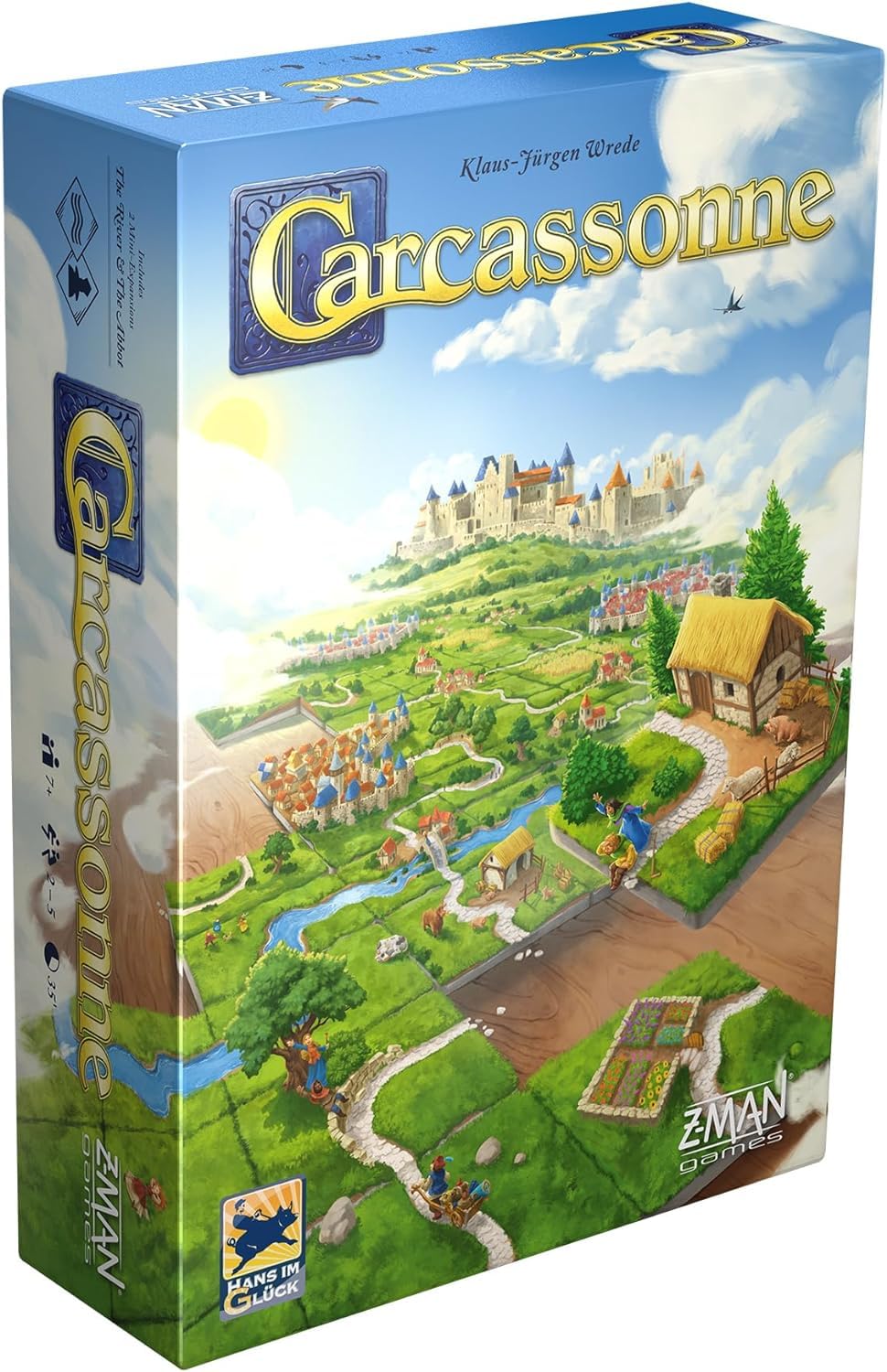
Draw a tile, place a tile, and watch a medieval landscape build itself across the table.
Carcassonne is the tile-placement classic that three players can learn in a few minutes. Each turn you draw a landscape tile and add it to the growing map of cities, roads, fields, and monasteries. You then place a meeple as a knight, farmer, or monk to claim a feature and score. The 2-5 player range is one of the widest on this list, and it supports three players without any rule changes.
The 35-minute playtime makes it a natural weeknight game. It also shows the gap against the heavier picks: 35 minutes here versus 75 for Raccoon Tycoon, which matters on a work night. The box also includes The Abbot and The River mini-expansions, which give a three-player table extra variety from the first session.
The one recurring note is that the base game can feel repetitive after many rounds if you never add expansions. The randomised tile draw ensures a new map every time, but the core loop stays familiar. For a group that wants a reliable game night staple, that reliability is the point. For a group that craves novelty every single session, layer in the included expansions early.
Why a three-player table likes it
- 35-minute rounds fit a weeknight
- 2-5 player range covers three without rule changes
- Abbot and River mini-expansions included in the box
- Simple rules that any new player learns fast
The small print
- The base loop can feel familiar after many sessions
Worth it for: a group that wants a dependable, easy-to-teach classic they can finish in a lunch break.
Not for: players who want a brand-new puzzle every single session.
6. Ticket to Ride
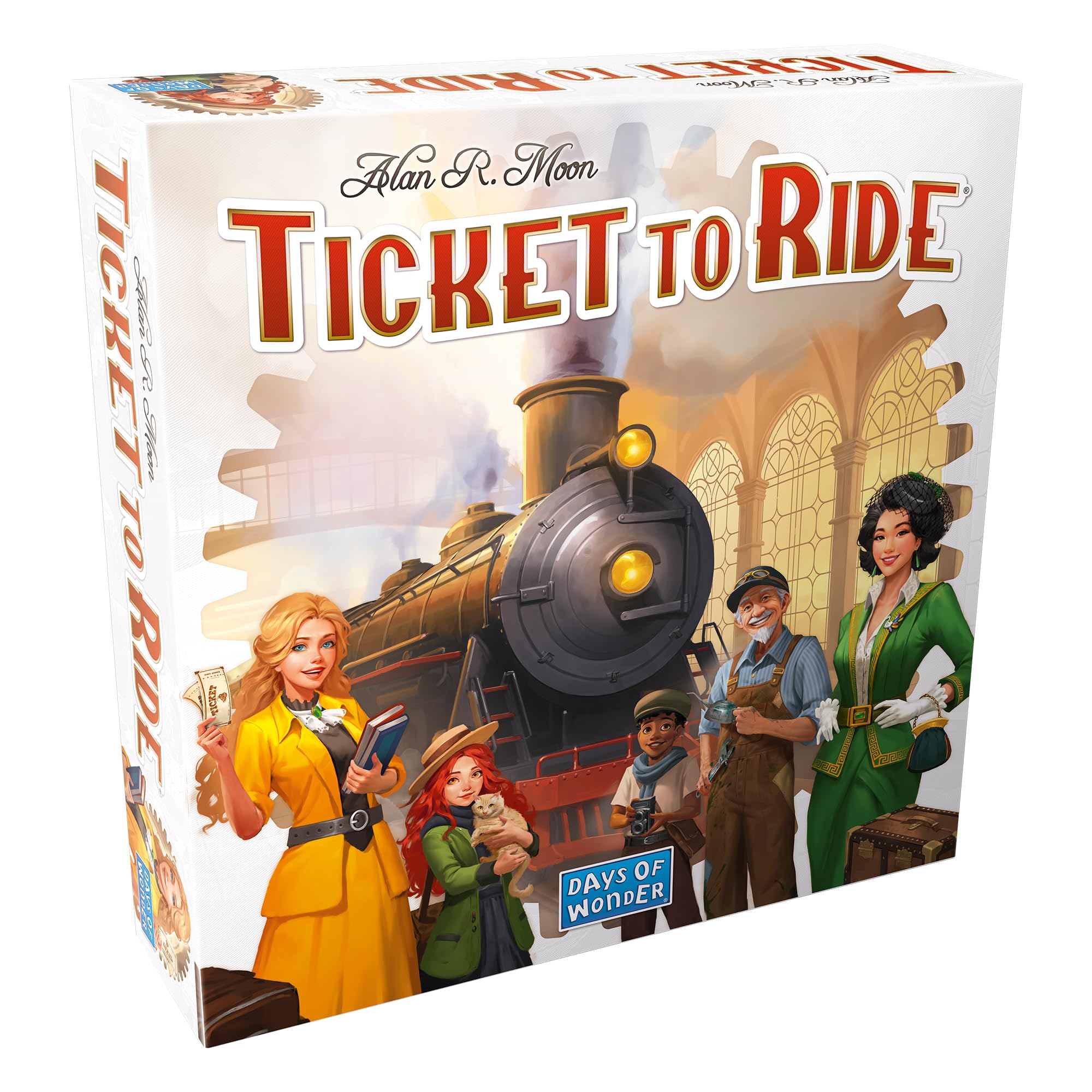
Build a rail network across North America and watch three players fight over the same routes.
Ticket to Ride puts a giant map of the North American train network on the table, along with 225 plastic trains in 5 colors, 110 train cards, and 33 tickets. You collect colored train cards to claim routes and connect cities. The goal is to complete your tickets and build the longest route. With three players, the map stays open enough to plan boldly but tight enough that routes become contested.
The rules are among the easiest to teach in this group. The box has 1 game board, the train pieces, the card decks, and 5 wooden scoring markers, and the playtime runs 30-60 minutes depending on how long players study their tickets. For a mixed-age table, the theme and the miniature trains do a lot of work keeping younger players engaged.
The main trade is that the game can feel long if three players each take their time on tickets. The 30-60 minute range means you should agree up front how fast you want to play. It is also a gentle game rather than a cutthroat one — most of the conflict is indirect, through contested routes, not attacks. That makes it a strong family choice and a weaker pick for a group hunting for heavy confrontation.
Board presence: the giant map and 225 plastic trains make it feel like a big event on the table, which is why a family night gravitates to it.
The trade: 33 tickets and route-blocking mean a three-player game can get tense if all of you chase the same cities.
Reach for it when: three players want a family-friendly route race with clear, learnable rules.
Look elsewhere when: you want direct confrontation or a faster, tighter round.
7. Smirk and Dagger The Night Cage

Three players, one candle, and a maze that keeps rewriting itself while you try to escape.
The Night Cage is the cooperative pick on this list. Everyone works as a team to explore a shifting labyrinth lit only by a candle, collecting keys and finding the gate before the maze collapses. The 1-5 player range means three players can play as a full team, and the 40-minute playtime keeps the pressure on without dragging. The board is 10.75 inches square, so it fits a standard table with room for the tiles.
What makes it distinct is the genre. Most of the picks here are competitive point races, while this one is a shared survival puzzle. The Wax Eaters stalk the shadows and the limited vision keeps every turn tense. An Advanced Game mode with new monsters and obstacles adds replay value after the first few games. The adjustable difficulty settings let a three-player team set the challenge to their skill level.
The honest caveat is difficulty. The rules are not hard to read, but the game itself is challenging to grasp in the first session, and some groups will lose their first game badly. If your three players want a relaxed, competitive scoring game, this is not the one for them. If your group enjoys planning together and losing to a tough puzzle once before beating it, this is a strong addition to the shelf. It is also the most atmospheric box in this lineup, and the candlelit theme carries through every turn.
Why it stands out
- Cooperative play suits a team that likes solving a puzzle together
- Shifting maze tiles keep every game different
- Adjustable difficulty and an Advanced Game mode extend replay
Before you buy
- The difficulty can be steep for a first game
- No head-to-head competition for a competitive group
It suits: a three-player team that wants a shared escape puzzle with a horror atmosphere.
It does not suit: a group that wants to compete for points against each other.
8. Wingspan

A birdfeeder full of dice, 170 unique bird cards, and a three-player engine that rewards careful planning.
Wingspan is a card-driven engine builder built around birds. You and the other players are bird enthusiasts trying to attract the best network of birds to your wildlife preserve. The game ships with 170 unique bird cards, 26 bonus cards, 8 goal tiles, 103 food tokens, and 75 egg miniatures. The custom birdfeeder dice tower is the physical centrepiece — you drop dice to gain food, then use cards and eggs to build up your preserve. It won the 2019 Kennerspiel des Jahres.
The game is designed for 1-5 players with a listed 60-90 minute playtime, so three players should plan for an evening rather than a quick round. Each player builds a habitat where the bird cards chain together, so a smart three-player table spends its time planning combos rather than waiting for turns. The Automa solo opponent and the swift-start guide also mean a new player can practice before the group game.
The recurring honest note is complexity. The bird powers and resource chains take a few rounds to click, and the review feedback reflects that some players need extra time to feel fluent. The artwork and the bird theme carry the table through that learning phase, and the 170-card pool keeps sessions distinct. This is the pick for a three-player group that wants a long, thoughtful game with real depth.
The draw: the combination of a physical dice tower and 170 bird cards makes each session feel like a nature walk with a puzzle attached.
The cost: a 60-90 minute playtime and a real learning curve mean it fits a planned evening, not a quick gap.
Made for: three players who want a long, layered engine builder with a strong theme.
A poor match for: a casual group that wants to learn and finish in under thirty minutes.
9. Everdell

Squirrels, mice, and hedgehogs building a woodland city under the Ever Tree.
Everdell is the coziest game on this list. You build a city of critters beneath the Ever Tree, using worker placement and tableau building to add characters and resources to your own little settlement. It supports 1-4 players, so three is a supported size, and the listed playtime is 60 minutes. The components are a real draw — tactile pieces that are satisfying to handle between turns.
The theme is what sells it to a family table. The woodland characters and charming artwork make the game feel friendly before the first turn, which helps get a three-player group to the table without a rules argument. The strategy is approachable but not shallow, and the replay value comes from building a different city each time.
The catch is that Everdell sits at the more complex end of this list. Reviews find it easy to learn for some players but slightly more complex than expected for others, so a three-player group should expect to spend the first game learning the worker placement flow. The upside is a game that feels different on the second and third run. It is the largest box here, so check your shelf space before you commit.
Why families reach for it: the woodland critter theme and tactile pieces make the first game feel inviting rather than intimidating.
The catch: the worker placement rules take a session to settle in, so plan the first game as a learning round.
Pick it if: you want a charming woodland city builder for a three-player evening with a family table.
Not the first choice if: your group needs a game that plays in under thirty minutes.
Understanding the Specs
Player count and range
The player count tells you how many people can sit at the table. A range like 2-5 or 1-4 means the game is designed to adjust for different group sizes. For a three-player night, check that three is included in the range, then think about whether the game plays well at that number. Some games shine at two players and only stretch to three; others are built so that three is a natural fit. The picks above all support three players, and several reach to five, which gives you room to add friends later.
Playtime in minutes
The playtime number tells you whether a game fits a weeknight or needs a planned evening. A 30-minute game suits a weeknight or a school night. A 60-90 minute game needs a planned evening and a group that agrees to commit. Watch for the word “estimated” in the specs — it is an average, not a promise. A group of three players who think slowly will run longer than the printed time, and a group that knows the rules will finish faster.
Game mechanics
The mechanics line names how the game actually works. Set collection means you gather matching cards or tokens for points. Tile placement means you add pieces to a growing board. Worker placement means you send pieces to claim actions. Engine building means each card or tile you place makes your later turns stronger. A game that names several mechanics usually gives you more routes to win, which keeps a three-player table interesting across repeat sessions.
Components and table space
The components list tells you how much is in the box and how much space you need. Wooden tokens, resin tiles, miniatures, and player boards all add table footprint. A game with a large central board and personal player mats needs a full dining table. A game with a small board and a card deck can fit on a coffee table. Also check whether the components come in a custom insert, because that affects setup and pack-up time at the end of the night.
FAQ
Which of these games is best for exactly three players?
Do any of these games play well with only two players as well as three?
How long does a three-player game usually take to learn?
Is a cooperative game better than a competitive one for three players?
What is the difference between tile placement and worker placement?
Can a family with a young child play these three-player games?
Do I need expansion packs to enjoy these games?
How much table space do these games need for three players?
Which of these games is best for a three-player group that plays often?
Are these three-player board games suitable for adults as well as kids?
Final Thoughts: The Verdict
For most three-player nights, the 3 player board games winner is the Asmodee Harmonies because it uses a 30-minute playtime and a 1-4 player range to give every seat real decisions. If you want a longer strategy evening with an economic engine, grab Raccoon Tycoon. And for a three-player team that wants to solve a shared puzzle together, The Night Cage is the one to reach for.
How We Picked
We do not accept paid placement. Every pick is matched to a real buyer and a real use-case; we do not hands-on test units.
Sources & Methodology
Specifications: manufacturer listings and product documentation. Review insights: verified customer reviews, as of November 2026. Pricing: not shown on this page (it changes often); check the current price via the retailer link.
As an Amazon Associate, Gadgets Feed earns from qualifying purchases. This does not affect which products we feature.