
Our readers keep the lights on and my morning glass full of iced black tea. As an Amazon Associate, I earn from qualifying purchases.
Specs are compiled from manufacturer listings and verified buyer reviews and can change over time — please confirm the key details on the product page before buying.
You want one camera that covers birthdays, holidays, school plays and the odd sunset without turning photography into a second job. The honest answer up front: a full-frame mirrorless body gives you the most room to grow, while a pocket zoom keeps things simple. Your pick depends on two things: how much weight you will carry and how much camera control you want to learn.
I’m Min — the founder and writer behind Gadgets Feed. This guide is built by comparing the manufacturers’ published specifications and the patterns across verified customer reviews, so you get each pick’s real strengths and trade-offs instead of marketing spin.
Below you’ll find plain-English notes on sensor size, zoom range, autofocus points and low-light behaviour, plus the trade-offs that matter after the novelty wears off. Every pick here is a real, currently sold camera, chosen so you can find the best camera for personal use without paying for features you will never touch.
Our Picks at a Glance


How To Choose The Best Camera For Personal Use
The first fork in the road is sensor size — not megapixels. A full-frame sensor (the same physical size as a frame of 35mm film) gathers more light, so evening shots and indoor shots come out cleaner. An APS-C sensor is smaller and cheaper, and a compact point-and-shoot sensor is smaller still, which is why those cameras lean on zoom to earn their place.
Decide what you will actually carry
A camera that stays in a drawer shoots nothing. If your shooting happens on walks and holidays, weight and pocket fit matter more than any spec sheet line. A body that slips into a coat pocket gets used weekly; a full-frame kit with a zoom lens gets used on planned days out. Decide up front whether you are a pocket-carry shooter or a planned-day-out shooter.
Match the lens to the distance you shoot from
Wide-angle reach (a lower millimetre number like 24mm) frames a whole room or landscape. Telephoto reach (a higher number like 200mm or beyond) pulls in a stage performer or a bird across a field. A long optical zoom range covers both ends in one body, which is why travel cameras lean on it. Interchangeable-lens cameras trade that convenience for better glass over time.
Look past autofocus point counts to autofocus type
More autofocus points give the camera more places to lock focus, but the technology matters more than the count. Phase detection (which measures distance directly) tracks moving children and pets better than contrast detection (which hunts for sharpness). Face and eye detection is the feature you will notice most in everyday family shooting.
Plan for power and cards
Check battery life and card format before you buy — they are the two specs buyers most often overlook. Dual card slots let you keep shooting if one card fills or fails. USB-C charging means you can top up from a power bank on a trip. Check both before you commit, especially if you shoot video.
Quick Comparison
| Model | Best For | Resolution | Autofocus Points | Sensor Type | Amazon |
|---|---|---|---|---|---|
| Nikon Z 6II★ Best Overall | All-round stills and video | 24.5 MP | 273 | Full-frame BSI | Amazon |
| Canon EOS R8Full-Frame Star | Step-up full-frame | 24.2 MP | 1,053 | Full-frame | Amazon |
| Sony Alpha a7 IIIVideo All-Rounder | Stills and 4K video value | 24.2 MP | 693 | Full-frame BSI | Amazon |
| Sony Alpha 7 IV | Highest-resolution full-frame | 33 MP | 693 | Full-frame BSI | Amazon |
| Panasonic LUMIX ZS99 (DC-TZ99) | Travel zoom with tilt screen | — | 19 | Compact | Amazon |
| LUMIX ZS99 (Silver) | Pocket zoom, stabilization | — | 121 | Compact | Amazon |
| Nikon Z 30 | Vlogging and streaming | — | 209 | APS-C | Amazon |
| Canon EOS R100 | First interchangeable lens | 24.1 MP | 143 | APS-C | Amazon |
| FUJIFILM X Half | Fun retro styling | 18 MP | — | Compact | Amazon |
| KODAK PIXPRO AZ528 | Long-range zoom | 16 MP | 25 | BSI CMOS | Amazon |
| KODAK PIXPRO FZ55 Bundle | Budget starter kit | 16 MP | 179 | Compact | Amazon |
In‑Depth Reviews
1. Nikon Z 6II | Versatile Full-Frame mirrorless Stills/Video Hybrid Camera
Our pick — 4.5+★ from 400+ verified ratings; the strongest balance of quality and price.
The full-frame hybrid that handles a wedding and a weekend walk without changing bodies.
A 24.5MP BSI sensor (back-illuminated, which means it collects more light per pixel) is the heart of this camera. That extra light is why dim living rooms and evening streets come out clean rather than grainy. It also fires at 14 FPS (frames per second), so a sprinting toddler or a diving goalkeeper lands in sharp focus.
The autofocus system packs 273 points, which is far more coverage than the 25 points on the KODAK PIXPRO AZ528 lower down this list — 273 versus 25. In practice that gap shows up as more keepers when your subject drifts toward the edge of the frame. Bit depth is 14 Bit here against 8 Bit on the AZ528, which gives you far more room to lift shadows and recover highlights when you edit.
What wins people over is plain build quality and image output — quality is the most-discussed positive across the review pages. Owners describe it as a camera that suits both a beginner learning the dials and a working photographer on assignment. Dual card slots (CFexpress/XQD plus UHS-II SD) mean a full card never ends the shoot. USB-C constant power keeps a livestream or timelapse running without a battery swap.
Where it earns its keep
- 24.5MP BSI sensor that holds up in low light — evening shots stay clean
- 14 FPS burst catches fast action without missing the moment
- Dual card slots give you a backup during weddings and events
- USB-C constant power for livestreams and timelapses
- Accepts roughly 360 F-mount NIKKOR lenses with an FTZ adapter
What to weigh first
- Full-frame glass is the expensive part of the system long-term
- The FTZ mount adapter for older F-mount lenses is sold separately
- Heavier and larger than any pocket zoom on this list
Built for: anyone who wants one body for family photos, events and 4K video, and is ready to learn a little.
Think twice: if you want something that disappears into a jacket pocket — the compact picks below do that job better.
2. Canon EOS R8 Mirrorless Camera (Body Only)
Canon’s lightest full-frame body, with tracking that finds the dog before you do.
Subject detection is the headline. Dual Pixel CMOS AF II covers up to 100% x 100% of the frame across 1,053 autofocus zones, and the camera recognises people, animals, vehicles, aircraft, trains and horses on its own. That means you point the camera and it keeps focus — useful when a child will not stand still and you are shooting one-handed.
A 24.2MP CMOS sensor and DIGIC X processor do the behind-the-scenes work, and the electronic viewfinder (the small screen you look through) refreshes up to 120 fps, so panning feels smooth rather than smeary. The 3.0-inch vari-angle touchscreen flips out for odd angles.
For video, it records uncropped 4K at up to 60 fps oversampled from 6K, plus Full HD at up to 180 fps for slow motion. It also works as a webcam over UVC/UAC, so one camera covers both photography and Zoom calls. The honest caveat: battery life draws the most gripes on this model, and the lens is not included in the body-only kit, so budget for glass separately.
Real-world read: this is the pick for someone stepping up to full-frame who shoots fast-moving subjects and wants the camera to do the tracking.
The catch: body-only means the RF lens is a separate purchase, and the battery is the most-complained-about part of ownership.
Reach for this if: action, pets and kids are your main subjects and you already own or plan to buy RF glass.
Look elsewhere if: you want a complete kit in one purchase — the Canon R100 below includes its lens.
3. Sony Alpha a7 III Mirrorless Camera with 28-70mm Lens
A full-frame workhorse with a lens in the box and 4K footage that holds up.
You get 693 phase-detection autofocus points paired with 425 contrast points across 93% of the image, which keeps moving subjects locked in. The 24.2MP back-illuminated full-frame sensor reads out at 1.8X speed, which is why 10 fps silent or mechanical shooting with autofocus tracking works reliably on a running child.
The spec that sells this camera to video shooters is 15-stop dynamic range (the range between the darkest and brightest detail it can hold), plus 14-bit uncompressed RAW. In plain terms, a bright sky and a shadowed face can both survive in one image. Picture quality is what reviewers praise hardest after camera quality itself, and 4K video gets called out specifically.
The trade-off: this is an older-generation body, and a slice of buyers report reliability issues where the unit stops operating properly. Autofocus is quick rather than class-leading by current standards. Still, with the 28-70mm lens included, it is a complete full-frame starting point rather than a body-only purchase.
Why it still earns a slot
- Lens included — shoot on day one
- 15-stop dynamic range holds sky and shadow together
- 693 phase-detect points track motion reliably
- 4K video quality is a consistent praise point
Honest caveats
- A minority of units arrive faulty and stop working
- Older generation compared with the a7 IV below
- Battery life is a recurring grumble, so carry a spare
Best match for: the buyer who wants full-frame quality plus a usable zoom lens without buying the two separately.
Not for you if: you want the newest autofocus and menu system — the a7 IV is the modernised sibling.
4. Sony Alpha 7 IV Full-frame Mirrorless Interchangeable Lens Camera

The most detail on this list, in a body built for both stills and serious video.
A 33MP full-frame Exmor R back-illuminated sensor sits at the top of the resolution ladder here. More pixels means you can crop into a frame and still print large or share sharp. It pairs with the BIONZ XR processor, which Sony describes as 8x more powerful than the previous generation.
Video is where the spec sheet gets serious: 4K 60p at 10-bit 4:2:2 with full pixel readout, and 7K oversampling for 4K 30p that avoids pixel binning. S-Cinetone colour, the profile borrowed from Sony’s cinema line, gives skin tones a pleasing look straight out of the camera. The menu system draws direct praise as improved over older Sony bodies.
Both this and the a7 III carry 693 autofocus points, yet the a7 IV pairs them with a newer sensor and processing pipeline. Owners consistently call the image quality and autofocus accuracy excellent. The realistic caution is that performance and battery life split opinion, so set expectations on longer shoots.
Standout spec: 33MP plus 7K-oversampled 4K video — you can crop and still keep detail.
Fair warning: this is a body-only listing, and full-frame lenses are the real long-term spend.
Pick this if: you shoot both photos and video and want the most pixels of any body here.
Look at the a7 III instead if: you want the lens bundled rather than bought separately.
5. Panasonic LUMIX TZ/ZS99 Point and Shoot Camera (DC-TZ99)

A pocket body with a 30x zoom that reaches the back of a concert hall.
The 24-720mm LEICA lens with 30x optical zoom is the reason to buy this camera. A 24mm wide end frames a whole street while 720mm pulls a performer close from the cheap seats — in a body that slips into a pocket. That range is the whole argument for a compact over a phone.
Video runs 4K at 30p and 4K PHOTO bursts at 30fps, with HD high-speed recording at 120fps for slow motion. The 1,840k-dot tiltable touchscreen lets you shoot from odd angles, and USB Type-C charging means one cable for your phone and your camera. Bluetooth v5.0 and a dedicated Send Image button push shots to the Panasonic Image App on your phone.
Size is what owners praise most — it is the top positive by a clear margin, and functionality follows closely. The honest note is that image quality draws a split response: some produce lovely travel shots, others are disappointed. The menu also frustrates a share of buyers. Pair it with daylight shooting and it does its best work.
The pocket argument: 30x optical zoom in a body that fits a pocket is why this one travels.
Keep in mind: mixed image quality reports mean indoor evening shots need a steady hand.
For you if: you travel light and want zoom reach phones simply cannot match.
skip it if: you mostly shoot indoors in low light and want full-frame cleanliness.
6. Nikon Z 30 with Wide-Angle Zoom Lens

Built for talking to camera, with a selfie screen and a stereo mic already on board.
This is the creator camera of the group. The flip-out touchscreen monitor lets you frame yourself, and the built-in stereo microphone with adjustable sensitivity means you do not need an add-on mic to start recording. A red REC light on the front confirms you are actually rolling.
Autofocus offers 209 points with eye tracking for people and pets, so your face stays sharp while you move. Video is 4K, and for live streaming it does full HD at 60p over USB-C or 4K at 30p over HDMI while drawing constant power over USB-C. The 16-50mm zoom lens has a wide enough end for arm’s-length framing.
Fast autofocus and full manual controls are what buyers talk about most positively. The 14-bit depth matches the Nikon Z 6II above. A fair caveat: image quality draws split feedback, some owners reporting only small improvements, and battery charging is the most-discussed weak point — several report it will not charge while plugged in. Plan on spares.
What makes it a creator tool
- Selfie screen plus stereo mic — ready to record, no extras
- Eye tracking for people and pets across 209 points
- Constant USB-C power for long livestreams
- Accepts Nikon’s full NIKKOR Z lens line as you grow
Watch out for
- Battery charging is the biggest reported frustration
- Image quality improvement splits opinion
- APS-C sensor gathers less light than full-frame rivals
Made for: vloggers, streamers and anyone who records themselves talking and wants it simple.
Pass if: your priority is stills quality rather than video convenience.
7. LUMIX ZS99 Point & Shoot Digital Camera (Silver)

Same 30x travel reach, now with five-axis stabilization fighting hand shake.
The engineering difference from the TZ/ZS99 above is stabilization: this version adds 5-Axis HYBRID O.I.S.+, which corrects shake on five axes. At full 720mm zoom that matters, because tiny hand movements get magnified. The lens is the same 24-720mm LEICA unit with 30x zoom, and autofocus runs 121 points here against 19 on the TZ/ZS99.
Video specs repeat the formula — 4K at 30p, 4K PHOTO bursts at 30fps, and HD at 120fps for slow motion. The 1,840k-dot tiltable touchscreen and USB Type-C charging carry over. Bluetooth v5.0 and the Send Image button keep sharing to your phone quick.
Zoom reach is what gets singled out for praise, with portability close behind. The camera lives happily as a daily pocket carry. Still, image quality and user-friendliness split buyers down the middle, and low-light performance is the weakest point noted. Shoot it in daylight and the results are far more consistent.
Why the extra stabilization counts: five-axis correction makes handheld 720mm shots far more usable.
The honest limit: low light is its weakest area, so treat it as a daylight travel tool.
Choose it for: travel and concerts where you want long reach and steadier handheld shots.
Think hard if: you expect clean shots after sunset — the compact sensor will struggle.
8. Canon EOS R100 Mirrorless Camera RF-S18-45mm Lens Kit

Canon’s smallest EOS R body, sold with a lens so you can shoot immediately.
A 24.1MP APS-C CMOS sensor (smaller than full-frame, larger than a compact’s) delivers natural background blur and crisp detail. The kit includes the RF-S18-45mm lens with optical stabilization rated at up to 4 stops of shake correction, which steadies handheld shots in dim rooms.
Canon calls this the smallest and lightest body in the EOS R series, and that matters if the camera lives in a bag. Dual Pixel CMOS AF covers up to 143 zones with human face and eye detection, plus animal and vehicle detection. Continuous shooting reaches 6.5 shots per second in One-Shot AF.
Video goes up to 4K at 24 fps, Full HD at 60 fps, and HD at 120 fps for slow motion. Quality and image quality are the review-page pillars — buyers call it compact, crisp and good value for a first interchangeable-lens camera. The fair caveat: battery life is the weakest area noted, and a few report the camera stopping. Budget a spare battery.
What you get: a stabilized 18-45mm lens in the box plus 24.1MP stills — a complete starter kit.
Honest note: battery life is the frequent gripe, so a second cell is worth adding.
Right for: a first mirrorless buyer who wants a lens included and a body that travels light.
Not ideal if: you need long battery endurance or a full-frame sensor.
9. FUJIFILM X Half Premium Compact Camera

A dial-driven retro compact that turns snapshots into prints you can stick on a fridge.
The X Half is about the experience as much as the output. It uses film-camera-style dial controls, weighs 240g (8.4oz), slips into a coat pocket, and offers 26 analog-inspired film and filter options to set your own look. A 2-in-1 mode combines stills and video for a creative twist.
It prints straight to a compatible instax printer or shares through a dedicated app. The 18MP effective resolution and ISO range of 100-3200 cover daylight and reasonable indoor light. It records JPEG only, which keeps things simple for anyone who does not want to edit.
Fun is the most-praised aspect by a wide margin, so the joy factor is real. The stinging caveat is value: a significant slice of buyers call it poor value, and camera quality overall draws a mixed response. There is an optical viewfinder and a 3:4 upright LCD if you prefer composing the old way. Buy it for the dials and film looks, not the spec sheet.
The charm offensive
- 240g body slips into a coat pocket
- 26 analog-inspired film looks
- Prints to an instax printer or shares via app
- Dial-based control feels like a film camera
Where it stumbles
- Value for money is the loudest criticism
- JPEG only — no RAW editing headroom
- Camera quality itself earns mixed reviews
Buy it for: the tactile dials, the film looks and instant prints — not for spec bragging rights.
Leave it if: you want RAW files and maximum image quality per dollar.
10. KODAK PIXPRO AZ528 16MP Digital Camera

The zoom range that leaves every other camera here in the dust.
A 52x optical zoom is the defining number. That compares with the 5X optical zoom of the KODAK PIXPRO FZ55 below — 52x versus 5X — and it turns distant birds, wildlife and athletes into frame-filling subjects. Genuine optical zoom, not a digital crop, so the detail holds up.
A 16MP BSI CMOS sensor (back-illuminated for better low-light capture) pairs with built-in optical image stabilization, which counters hand movement even at full 52x reach. That keeps handheld telephoto shots crisp without a tripod. Burst mode fires at 6fps so you can catch a fast sequence and keep the sharpest frame.
Built-in Wi-Fi lets you send photos straight from the field or use your phone as a live remote viewfinder. The rechargeable Li-Ion battery powers a full day, and it accepts Class 10 SD, SDHC or SDXC cards up to 1.5TB. Quality is the top-praised aspect, with value close behind. The honest catch: picture quality and zoom both split opinion, and autofocus is the most-criticised part — expect hunting on fast subjects.
The headline number: 52x optical zoom makes distant subjects fill the frame.
Set expectations: autofocus is the weakest link, so slow-moving subjects give the best results.
Suits you if: reach is everything — birds, sports from the stands, or a child on a far pitch.
Think again if: you need reliable autofocus on fast action.
11. KODAK PIXPRO FZ55 Compact Zoom Digital Camera Bundle
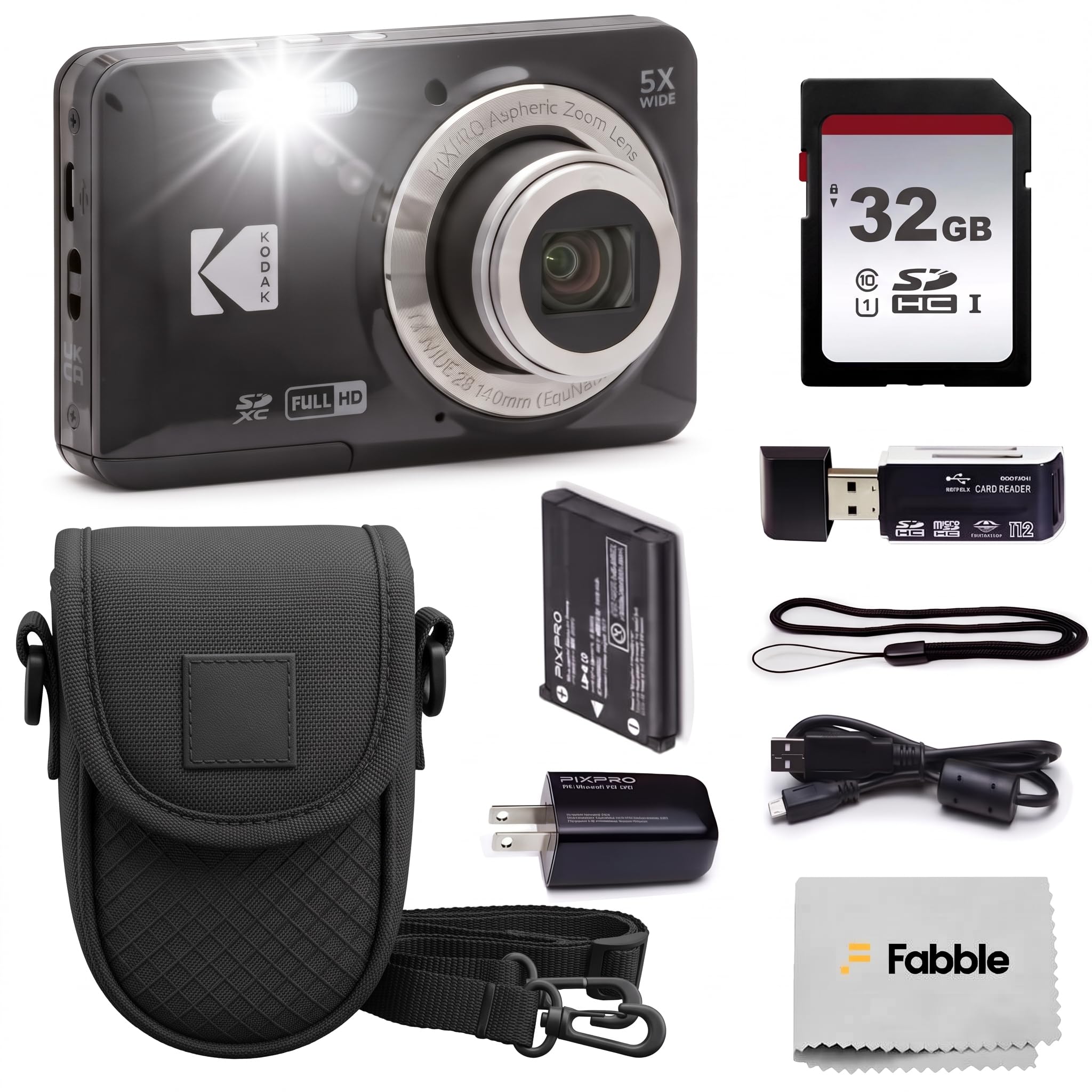
The simple point-and-shoot that hands a first camera to someone without a learning curve.
Sixteen megapixels is the resolution here — noticeably below the 24.5MP of the Nikon Z 6II at the top, but plenty for holiday snaps and everyday family shots. A 28mm wide-angle lens with 5X optical zoom covers a room or a nearby subject without you moving your feet. Both optical and digital stabilization help steady handheld shots.
Video records at 1080p Full HD, and the 2.7-inch LCD makes composing and reviewing easy. The contrast-detection autofocus offers 179 points — more points than the AZ528’s 25, even though the zoom range is shorter. A built-in flash covers dim indoor moments.
What buyers value most is the price-to-performance balance, with picture quality right behind it. Compact size and ease of use round out the praise — this is a camera you can hand to a teenager or a grandparent without a tutorial. The honest caveat: general functionality draws mixed feedback, and it will not match a mirrorless body for low light or speed.
Why it earns the last slot: a complete, simple kit with 16MP stills and 5X zoom for someone starting out.
Keep in mind: mixed functionality reports and a small sensor mean it is a daylight, everyday camera.
Best for: a first camera, a gift, or a backup you can toss in a bag.
Skip if: you want interchangeable lenses or serious low-light performance.
Understanding the Specs
Sensor Size and Type
Sensor size decides how much light the camera collects. A full-frame sensor is the largest here, so evening and indoor shots come out cleaner. An APS-C sensor is smaller and cheaper but still interchangeable-lens capable. A compact sensor relies on zoom and processing instead of raw light-gathering. Back-illuminated (BSI) designs collect more light per pixel, which helps in dim conditions.
Autofocus Points and Technology
Autofocus points are the spots where the camera can lock focus. More points means more coverage across the frame. But type matters more than count: phase detection measures distance directly and tracks movement well, while contrast detection hunts for sharpness. Face and eye detection is the feature you will notice most in family shooting. A long-zoom compact with few points may still focus fine on still subjects.
Optical Zoom and Focal Length
Focal length in millimetres tells you the angle of view. A low number like 24mm is wide and captures a whole scene; a high number like 720mm magnifies distant subjects. Optical zoom uses the lens to magnify, while digital zoom simply crops. Always favour optical zoom, because cropping loses detail. The 52x and 30x ranges here are optical, which is why they hold up better than a phone crop.
Video Resolution and Frame Rate
Resolution like 4K or 1080p sets how much detail each frame holds. Frame rate, measured in fps (frames per second), sets how smooth motion looks and lets you slow footage down. A higher frame rate means smoother slow motion. Bit depth (like 10-bit or 14-bit) sets how much colour and shadow detail you can recover when editing. All three matter if you plan to record, not just photograph.
FAQ
Is a full-frame camera worth it for personal use?
How many megapixels do I actually need?
Can these cameras connect to my phone to share photos?
What is the difference between optical and digital zoom?
Do I need a camera with image stabilization?
How long does the battery last on these cameras?
Can I use these cameras for video as well as photos?
Will a compact camera take better photos than my phone?
What memory card do these cameras take?
Can I change lenses on every camera here?
Final Thoughts: The Verdict
For most people shopping for a camera for personal use, the Nikon Z 6II is the strongest all-rounder because its 24.5MP BSI full-frame sensor handles both low light and fast action, and its dual card slots protect the photos that matter. If you want the most autofocus coverage and uncropped 4K video, step to the Canon EOS R8. And for a first camera that includes a lens and travels light, the Canon EOS R100 is the sensible starting point.
One tasteful nudge if you are still deciding: the Nikon Z 6II carries one of the highest scores on this list, and its quality and image quality are the two things buyers praise hardest — a sign that the money goes into the parts you actually notice. Whichever you pick, budget a spare battery and a card that matches the slot format — those two extras keep you shooting past sunset.
How We Picked
We do not accept paid placement. Every pick is matched to a real buyer and a real use-case; we do not hands-on test units.
Sources & Methodology
Specifications: manufacturer listings and product documentation. Review insights: verified customer reviews, as of July 2026. Pricing: not shown on this page (it changes often); check the current price via the retailer link.
As an Amazon Associate, Gadgets Feed earns from qualifying purchases. This does not affect which products we feature.