
Our readers keep the lights on and my morning glass full of iced black tea. As an Amazon Associate, I earn from qualifying purchases.
Specs are compiled from manufacturer listings and verified buyer reviews and can change over time — please confirm the key details on the product page before buying.
The pan does one job you actually notice: it lets air reach the dough while it bakes. Buy a perforated tray with real coating and enough slots for your oven, and you get a thin, brittle crust instead of a pale, soft roll. Perforation quality is what separates a tray that sells by the thousands from one that sits ignored.
I’m Min — the founder and writer behind Gadgets Feed. This guide is built by comparing the manufacturers’ published specifications and the patterns across verified customer reviews, so you get each pick’s real strengths and trade-offs instead of marketing spin.
Below you get nine trays, their real dimensions, and the honest gripes that keep showing up. Picks are ordered by how strong the evidence is, not by what they cost. Start with how many loaves your oven rack can fit, since that decides more than any other spec.
Most home bakers should start by checking slot count and outside width against their own oven before reading any further, which is exactly what this guide to the baguette baking pan is built to help you do.
Our Picks at a Glance

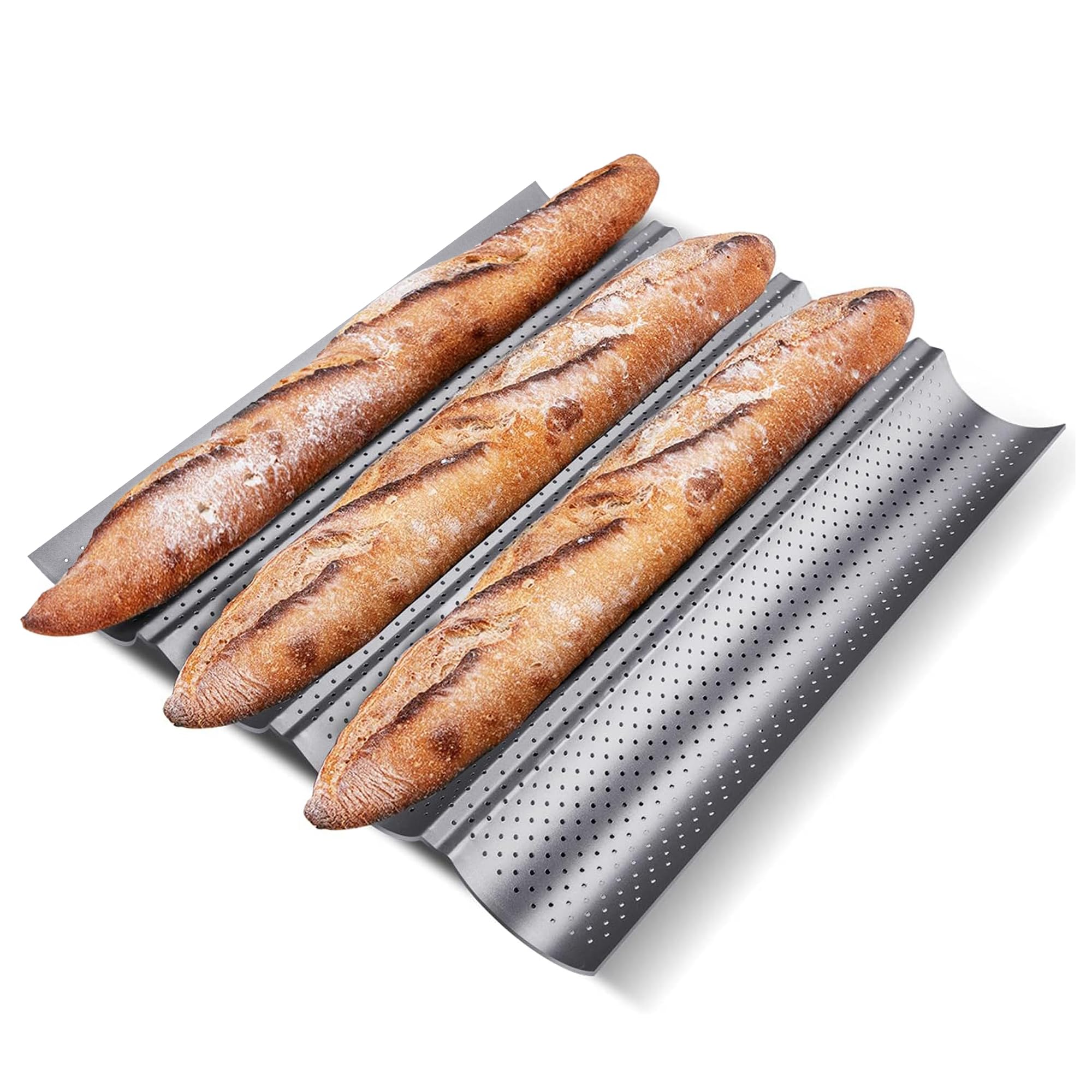

How To Choose The Best Baguette Baking Pan
You are shopping for a shaped tray, not a flat sheet. The curve of the channel holds the dough so it rises into a long thin loaf instead of spreading into a pancake. Everything that makes one tray better than another comes back to that curve and the holes punched through it.
Count the slots against your oven first
Each slot bakes one baguette, so a two-slot tray gives you two long loaves at once. Width is the surprise: a 13-inch wide body (33 cm across) eats a big chunk of your oven rack, so measure your rack first. Then decide if you want three loaves, four, or just two at a time.
Ovens differ in interior height as well. Baguettes rise upward, so a tray that fits the rack sideways may still leave you short on clearance above. Check both before you order.
Check the perforations, because this is the crust
Holes across the bottom let moisture leave the dough as steam, and that drying action is what turns a soft roll into a cracked, crisp shell. Fewer or poorly spaced holes give you a paler, chewier loaf. Every tray here leans on this idea, but the thickness of the metal around each hole varies.
Thickness decides evenness
A thicker pan heats more slowly and holds that heat steady, so the ends of a baguette brown closer to the middle. Thin metal responds fast but can scorch where a burner runs hot. Some trays here list their exact thickness, and where a maker does, that figure tells you a lot.
Quick Comparison
| Model | Best For | Loaf Slots | Body Size (W x L) | Material | Amazon |
|---|---|---|---|---|---|
| Chicago Metallic Commercial II Non-Stick Perforated French Bread Pan★ Best Overall | Best all-round pick | 2 | 8″ x 16.38″ | Steel | Amazon |
| KITESSENSU Nonstick Baguette Pans, Perforated 4 LoavesBest for Batches | Best for batch baking | 4 | 13″ x 15″ | Carbon Steel | Amazon |
| Hesanzol Baguette Bread Pans 15″ x 11″High-Heat Pick | Best for high-heat ovens | 3 | 11″ x 15″ | Carbon Steel | Amazon |
| Eparé French Baguette Bread Pan | Best for easy release | 3 | 11″ x 15″ | Carbon Steel | Amazon |
| CHEFMADE Perforated Baguette Pan 15-Inch | Best for slim loaves | 3 | 9.61″ x 15.2″ | Carbon Steel | Amazon |
| Tiawudi 2 Pack Nonstick Perforated Baguette Pan | Best for two-tray families | 2 per tray (2 trays) | 15″ x 6.3″ per tray | Carbon Steel | Amazon |
| USA Pan Bakeware Aluminum Perforated 3-Loaf | Best for crust and heat spread | 3 | 16″ x 9.5″ | Aluminum | Amazon |
| de Buyer Baguette Pan | Best for traditional bakers | 2 | — | Coated Steel | Amazon |
| HKZTUY 4 Loaf Baguette Bread Pan | Best starter kit | 4 | 13″ x 15″ | Carbon Steel | Amazon |
In‑Depth Reviews
1. Chicago Metallic Commercial II Non-Stick Perforated French Bread Pan
Our pick — 4.5+★ from 4,000+ verified ratings; the strongest balance of quality and price.
Deep channels, a lifetime warranty, and the crust that keeps bakers coming back.
What makes this tray the top pick is depth. The channels stand 2.5 inches tall, which is the deepest measurement in this group and more than double the 1-inch channel of the KITESSENSU tray below. A deeper well holds a fully risen loaf in shape instead of letting it slump sideways, so your baguette stays tall and rounded rather than spreading flat.
It bakes two full loaves at once across its 16.38-inch by 8-inch body. The perforations run through the channels so steam escapes and the crust sets crisp and evenly browned. The dual-layer nonstick then lets the baked loaf lift out whole — no torn underside, no soaking and scraping afterwards.
Durability is the other standout. It carries a lifetime warranty, and the reviews describe tray after tray still working after years of regular baking. Baking performance is the thing people rave about most, with crust and nonstick running close behind. That is the whole recipe here: air gets in, heat spreads evenly, bread comes out clean. If you bake a couple of baguettes a week, this is the tray that reputation is built on.
What earns it first place
- 2.5-inch channel depth keeps loaves from slumping — the most generous in this lineup
- Perforated bottom delivers an evenly browned, crisp crust
- Dual-layer nonstick releases whole loaves and speeds cleanup
- Backed by a lifetime warranty
Where it asks something of you
- Dishwasher safe, but handwashing is recommended to protect the coating long term
- Only two slots — a batch for a crowd means baking twice
- Wider than some oven racks at 16.38 inches
Reach for this if: you bake a couple of baguettes a week and want one tray that will outlast the hobby.
Think twice if: your oven rack is snug and a 16.38-inch wide tray leaves no room for air to move.
2. KITESSENSU Nonstick Baguette Pans for French Bread Baking, Perforated 4 Loaves
Four loaves in one pass — a whole week of bread from a single bake.
If you bake bread for a household rather than for one dinner, four slots changes your routine more than any other spec here. This tray is 13 inches by 15 inches and carries four curved channels. You shape four loaves, set them, and you are done — no second round of shaping and waiting.
The grooves are cut into an arc so the dough rounds at the bottom as it bakes. Pores are spaced across the whole pan so the crust comes out golden and crisp rather than pale. Coating quality is what wins people over here; the maker backs the tray with a 10-year warranty, which is a long promise for bakeware.
The one trade-off is the shallow channel. At 1 inch tall it is the opposite of the Chicago Metallic’s 2.5-inch well, so a very wet, high-rising dough may spill over the edge. At 13 inches wide, it takes about 62% more rack width than the 8-inch Chicago tray. The catch is simple: this is a tray for people who want volume, not for a tight single-loaf bake.
What it gets right: four channels, even pore spacing, and a 10-year warranty — the mid-range value play for anyone feeding a family.
The honest limit: that 1-inch channel depth rewards a firm dough and punishes a slack one.
Pick this one when: your Saturday bake needs to produce four loaves in a single trip through the oven.
Look past it if: you like a wet high-hydration dough that needs a tall wall to rise against.
3. Hesanzol Baguette Bread Pans for Baking 15″ x 11″
Thick steel that shrugs off heat and keeps its shape bake after bake.
The number that matters on this tray is 0.8mm. That is the thickness of its carbon steel, and it is why the pan holds a steady temperature instead of spiking and cooling around a hot burner. It also resists warping, the slow bend that ruins a thin tray over months of oven cycling.
It is rated to 446°F, which leaves headroom above normal baguette temperatures, and the crimped edges are folded smooth rather than left sharp. Three channels sit across a 15-inch by 11-inch body. Butter the pan lightly on the first use and loaves lift out without tearing; the perforations carry air through so the crust crisps and browns evenly.
The catch is coating life. The nonstick and the durability both land in mixed territory in the reviews — some bakers find the dough releases cleanly for seasons, others report the coating wearing thin and washing producing rust. Hand drying it thoroughly after every wash goes a long way. The 2-year warranty is the confidence cushion here.
The real draw: 0.8mm carbon steel at a 446°F rating gives you even heat and a warp-resistant body for a home oven that runs hot.
The one to watch: treat the coating kindly — wash and dry it by hand to keep the release surface alive.
Suits you if: your oven runs hot and you have already lost a thin tray to warping.
skip it if: you expect to rinse it in the dishwasher and ignore it — the coating will not forgive that.
4. Eparé French Baguette Bread Pan – 15×5 Non-Stick Perforated

The tray for anyone who has ever torn a loaf trying to get it out.
Nonstick that actually releases is the whole pitch, and it lands here. Loaves lift out whole with no scraping and no torn underside. The surface is perforated too, so you still get heat and airflow through the channel and a golden shell rather than a limp crust.
Three slots sit across a 15-inch by 11-inch body, each channel shaped to hold a proper baguette. The carbon steel plate is 0.5mm thick, which is thinner than the 0.8mm Hesanzol above — it heats fast and responds quickly, though it has less mass to hold heat steady. For a home oven doing a mid-length baguette bake that difference is small in practice.
Where it falls short is the rim. The edges are the one point of contention in an otherwise pleased review page, with some bakers finding them sharp enough to handle carefully. It does wash in the dishwasher, which is rarer than you would think in this group. If your goal is simply to get bread out of the pan intact every single time, this nonstick surface is the safest bet.
Made for: the baker whose loaf keeps sticking and tearing on the way out.
Avoid if: you grip pans bare-handed at speed — those rims are not rounded.
5. CHEFMADE Perforated Baguette Pan, 15-Inch 3 Wave Loaves

Three long channels for the classic skinny baguette silhouette.
The channels here run 2 inches deep and hold three loaves across a 15.2-inch by 9.61-inch body.
Thickened 0.8mm carbon steel spreads heat evenly and the reinforced edge holds the shape straight so it will not warp. The coating is food-grade silicone rated free of PTFE and PFOA, so you need less oil to get a clean release. Cleaning is quick — that is the second most praised quality of this tray, right behind the overall build.
The honest caveat is the width of the channels. The size earns mixed reactions — some bakers find the loaf dimension exactly right, others find the grooves too narrow for a fatter, fuller baguette. If you roll a tight, slender loaf this is a strength, not a limit. The trade-off is in your shaping, not the pan.
Choose this if: your ideal baguette is a thin, crackling baton with a deep crisp shell.
Hold off if: you prefer a thick, hearty loaf — the narrow channels pinch a wide dough.
6. Tiawudi 2 Pack Nonstick Perforated Baguette Pan 15″ x 6.3″

Two skinny trays, four loaves, and one trip through the oven.
You get two trays here, each 15 inches by 6.3 inches with two channels. Run them side by side and you are baking four loaves at once, which is the trick a single four-slot tray cannot match: you can slide one out early and leave the other to finish. For baguettes that brown at different rates, that flexibility is real.
Each channel is 7.1 cm wide and the perforated surface lets air reach the dough for a light interior and a browned shell. The carbon steel frame is sturdy and the maker stands behind it with a lifetime warranty. Home bakers are the ones this tray suits best, and build quality is the trait most praised.
Because each tray is narrow, the pair slides into smaller ovens one at a time when you are not running a full batch. That is a genuine advantage over one wide tray. The flip side is counting: two trays to store, two to wash, and two to find space for in a crowded cabinet. The catch is storage, not performance.
Why two beats one: four loaves with staggered timing, plus a lifetime warranty on a budget-friendly pair.
What you accept: double the washing-up and double the cupboard footprint.
Best match for: bakers who want four loaves and the freedom to pull them at different moments.
Not for you if: counter and cabinet space is already at a premium.
7. USA Pan Bakeware Aluminum Perforated Nonstick 3-Loaf

Aluminum does the one thing steel cannot — it heats in a hurry.
Aluminum is the reason to look at this tray. It moves heat faster than the carbon steel pans here, so three loaves brown more evenly from end to end. The body measures 16 inches by 9.5 inches, with three wells each 3 inches across and a full 16 inches long — a thin, uniform shape rather than a squat roll.
The perforated bottom lets moisture out and air in, which is exactly what a crisp crust and a warm chewy crumb demand. It is rated oven safe to 450°F, and the coating is made without PFAS, PTFE, PFOA, and BPA. Build quality is the trait that draws the most praise, and the list of what is left out of the coating is a genuine trust point for anyone wary of what touches their bread.
Two things run mixed in the reviews. The nonstick has some bakers thrilled and others finding their loaves sticking together, and warping resistance gets similar split feedback. Give the wells a proper grease-and-flour pass or a brush of butter before the first bake and most of that frustration goes away. A lifetime warranty still backs the pan.
Strong points
- Aluminum construction heats quickly for even browning across all three loaves
- 16-inch wells produce a traditional thin baguette shape
- Coating made without PFAS, PTFE, PFOA, and BPA
- Oven safe to 450°F with a lifetime warranty
Points to plan around
- Nonstick feedback is split — prep the wells before the first bake
- Warping resistance is also mixed in reviews
- A 16-inch by 9.5-inch body needs a roomy rack
Go here if: even browning across three long loaves is your priority and you want a coating free of PFAS and PTFE.
Elsewhere if: you want a nonstick finish that never needs prepping — this pan rewards the extra step.
8. de Buyer Baguette Pan

French-made steel for two loaves, built slow and seasoned by tradition.
Two wells, coated steel, and a naturally nonstick finish — the de Buyer pan keeps the design simple on purpose. The steel distributes heat evenly so the crust sets right, and the perforations let air move through and moisture escape for a crisp golden shell.
The edges extend beyond the channels, which gives you a safe strip to grab when pulling a hot pan from the rack. The maker has been building cookware in France since 1830, and at 7.84 ounces the tray is light and easy to angle into the oven. If you want a pan that feels like it belongs in a French kitchen rather than a gadget drawer, this coated steel tray is it.
It is the premium option of the group, and the trade-off is that it offers two loaves for that spend — the KITESSENSU gives you four channels and the USA Pan gives you three. The 4.5+ rating and the maker’s lifetime-level reputation are there; the loaf count is not. For a baker who makes two perfect baguettes twice a week, that is fine. For a big family, it is a compromise.
It rewards: the purist who wants two impeccable baguettes and a pan rooted in French tradition.
Look elsewhere when: you need to feed a tableful and want more than two slots.
9. HKZTUY 4 Loaf Baguette Bread Pan, Perforated Nonstick

Four channels plus the scoring tools, all in one first purchase.
The pan is the point, but the extras are what make this a sensible first buy. You get the four-channel tray, a dough cutter, a proofing cloth, a leather case containing five replacement blades, and the blade handle itself. That is the whole bread workflow — dough, proof, score, bake — from one box.
Four shaped channels run across a 15-inch by 13-inch body, each one supporting the dough into a long loaf instead of letting it spread. The perforated carbon steel lets air through as it bakes, and the nonstick surface is designed to let finished bread release from the grooves.
It is a newer pan with a small review base, so you cannot lean on years of owner experience the way you can with the Chicago tray. What those buyers do say is that it works well and cleans up easily. The pan is also hand-wash only and needs thorough drying before it goes away, which is worth knowing before the first bake rather than after.
The bundle logic: four slots plus scoring and proofing tools, so a beginner is not assembling three separate orders.
Worth noting: a young review history and a hand-wash, dry-fully care routine.
Ideal first tray: you are new to baguettes and want the pan and the tools to arrive together.
Delay if: you would rather buy a pan with a long, deep track record behind it.
Understanding the Specs
Channel Depth
This is the height of the curve that cradles the loaf, and it decides how tall your baguette stands. A 2.5-inch well, like the Chicago Metallic’s, holds a fully risen dough in shape. A 1-inch channel, like the KITESSENSU’s, keeps the loaf closer to the pan and rewards a firmer dough. Deeper is not automatically better — a deeper pan takes longer to heat through, and a very tall loaf needs more oven clearance above.
Perforations
These are the small holes punched through the bottom and body. As dough bakes it releases steam, and those holes let that steam move out and hot air move in. That exchange dries the outer surface and sets a crisp, browned crust while the inside stays chewy. Fewer or unevenly placed holes leave more moisture trapped, so the crust stays paler and softer.
Carbon Steel vs Aluminum
Carbon steel is heavier and holds heat longer, so it browns steadily once it warms up. Aluminum moves heat faster and answers changes in oven temperature more quickly. Neither is better for every baker; it depends on whether your oven runs steady or uneven. Both materials are prone to warping if they are thin, which is why published thickness, like 0.8mm, is a useful thing to look for.
Coating and Care
Nonstick coatings only work as well as you treat them. Steel blades, harsh scrubbers, and dishwasher heat all shorten a coating’s life, and once it flakes the release is gone. Hand washing and drying fully after every wash is the safest routine. Some pans list being free of PTFE, PFOA, and PFAS, which matters if that concern is central to your buying decision.
FAQ
Do I need a baguette pan, or can I bake baguettes on a flat sheet?
Will a 4-loaf baguette pan fit in a standard home oven?
How do I stop baguettes sticking to the pan?
Can I put a nonstick baguette pan in the dishwasher?
What temperature can these pans take?
Do baguette pans rust if I wash them?
How many loaves should I bake at once?
Can I use a baguette pan for other breads?
Is thicker carbon steel worth it over a thin pan?
Do I need to season a new baguette pan?
Final Thoughts: The Verdict
For most bakers, the baguette baking pan worth starting with is the Chicago Metallic Commercial II. It backs the deepest channels in the group at 2.5 inches with perforations for a real crust and a lifetime warranty, so you buy once and stop thinking about it. If your Saturday bake needs volume, the KITESSENSU four-loaf tray gets four loaves through the oven in one pass. And if even browning across three long, thin loaves is what you chase, the USA Pan aluminum tray is the one to reach for.
One honest note to close: the trays with the strongest owner track record are also the ones with the most reviews behind them. So a pick with a smaller, newer review base is not a weaker pan — it is a quieter one. Match the slot count and channel depth (how deep each groove sits) to the bread you bake, and the choice gets simple.
How We Picked
We do not accept paid placement. Every pick is matched to a real buyer and a real use-case; we do not hands-on test units.
Sources & Methodology
Specifications: manufacturer listings and product documentation. Review insights: verified customer reviews, as of November 2026. Pricing: not shown on this page (it changes often); check the current price via the retailer link.
As an Amazon Associate, Gadgets Feed earns from qualifying purchases. This does not affect which products we feature.