
Our readers keep the lights on and my morning glass full of iced black tea. As an Amazon Associate, I earn from qualifying purchases.
Specs are compiled from manufacturer listings and verified buyer reviews and can change over time — please confirm the key details on the product page before buying.
The right automotive adhesive glue matches the joint: urethane for glass, epoxy for steel panels, trim gel for badges. Windshield urethane, panel-bond epoxy, trim gel and seam sealer do completely different jobs, and using the wrong one is how badges fall off and panels start to rattle. Below are six adhesives that genuinely hold, sorted by what they are actually built to stick.
I’m Min — the founder and writer behind Gadgets Feed. This guide is built by comparing the manufacturers’ published specifications and the patterns across verified customer reviews, so you get each pick’s real strengths and trade-offs instead of marketing spin.
You will see which tube suits glass, which suits steel, and which suits a five-minute emblem job. Each pick below is matched to a specific surface, flex requirement and cure time, so you can choose by the repair in front of you.
Our Picks at a Glance


How To Choose The Best Automotive Adhesive Glue
Start with the surfaces you are joining, because that single answer eliminates most of the shelf. A urethane windshield adhesive bonds glass to a metal frame and stays flexible. A two-part epoxy bonds steel to steel for structural panel work. A trim gel handles small plastic and metal pieces. Match chemistry to material first, then worry about cure speed.
Flex versus rigidity
A moving joint needs an adhesive that can stretch. Windshields and body seams vibrate constantly, so a rigid glue that cures glass-hard can crack or let go. Polyurethane and silicone stay flexible, which is why they dominate glass and weather-stripping work. Epoxy cures firm and is the choice for panels that must not shift.
Cure time and when you can drive
Fast set is not the same as full cure. A trim adhesive can set in about 15 minutes yet still need 24 hours to reach full strength, and a two-part epoxy can reach full cure in 45 minutes. Plan the repair around the full-cure number, not the set number, so you are not loading a joint before it is ready.
Cartridge, tube or twin-tube
Delivery format decides how easy the job is. Standard cartridges load into a caulking gun and suit larger beads like windshield urethane and seam sealer. Small squeeze tubes give precise control for emblems. Two-part epoxies arrive as a twin cartridge that needs a static mixing nozzle so the resin and hardener blend as you dispense.
Quick Comparison
| Model | Best For | Material | Capacity | Full Cure | Amazon |
|---|---|---|---|---|---|
| [2 Pack] Polyurethane Windshield Adhesive★ Best Overall | Glass and windshield work | Polyurethane | 310 ml per cartridge (2 pack) | — | Amazon |
| Amazing Goop Trim Repair GelBest for Trim | Trim and vibration-prone parts | Synthetic rubber | — | — | Amazon |
| Tylove Seam Sealer Automotive | Body seams and rust prevention | Resin | 10.5 oz | 30 minutes to paint | Amazon |
| 3M Plastic Emblem & Trim Adhesive 03601 | Emblems and small trim | Acrylic | 1 fl oz per tube (3 pack) | 24 hours | Amazon |
| Permatex 81173 Black Silicone Sealant | General sealing and wiring | Silicone | 12.9 oz | 24 hours | Amazon |
| Buck Panel Bonding Adhesive | Structural panel bonding | Two-part epoxy | 400 ml / 13.5 fl oz | 45 minutes | Amazon |
In-Depth Reviews
1. [2 Pack] Polyurethane Windshield Adhesive
Our pick — 4.5+★ from 100+ verified ratings; the strongest balance of quality and price.
The glass specialist that takes the shudder out of a repaired windshield without going brittle.
If your job involves glass bonded to a metal frame, this is the pick that behaves like the real thing. It is a polyurethane adhesive, meaning a flexible plastic-based glue that stretches with the joint instead of cracking. That flexibility is why it absorbs impacts and vibrations and keeps the seal tight between a glass edge and the vehicle frame.
What wins people over is straightforward function: it simply does the windshield job. The kit arrives complete for a two-person repair — two 310 ml cartridges of sealant, two application nozzles and two pairs of gloves. It loads into a standard caulking gun, and no primer is needed before you lay the bead. A moisture-curing formula handles high heat and humidity, UV exposure and car washes.
The catch is the format. Two 310 ml cartridges are a lot of adhesive, so this suits a full windshield or sunroof job rather than one small badge. It also needs a caulking gun, which not every garage has on hand. For multi-panel or overhead work where gravity fights you, the thick polyurethane stays put far better than a runny trim gel would.
Where it earns its place
- Flexible polyurethane absorbs vibration instead of transferring it to the glass
- Complete kit: two 310 ml cartridges, two nozzles, two pairs of gloves
- No primer step — load the gun and lay the bead
- Copes with heat, humidity, UV and car washes
Where it asks more of you
- Requires a standard caulking gun you supply
- 310 ml cartridges are sized for full glass jobs, not tiny touch-ups
Made for: anyone reseating a windshield, rear glass, sunroof or headlight housing who wants a flexible, weather-tight bond.
Think twice if: you only need to restick one small emblem — the two large cartridges and gun requirement are more than that job needs.
2. Amazing Goop Trim Repair Permanent Strength Gel
A clear rubber gel for trim that shakes — flexible enough to hang on through vibration.
Trim work is where most adhesives fail, because the part keeps moving. This one is built around that: a synthetic rubber-based gel that stays flexible even in extreme temperatures and resists abrasion, which is the surface wear that vibration causes over time. It dries clear, so a repair on a visible badge does not leave a milky smear.
It bonds metal, plastic and rubber, which covers most trim and molding jobs. It is paintable once cured, resistant to chemicals, and waterproof so the bond stays put when exposed to water. That makes it a sensible choice for wheel-arch trim and anything that sees road spray. It is the smallest-volume pick here, so treat it as a targeted trim tool rather than a panel adhesive.
The honest limit is that this is a flexible trim gel, not a structural bond. Do not expect it to hold a door skin or a load-bearing panel — that is epoxy territory. For a badge, a molding strip or a loose interior piece, its flexibility is exactly the point.
Why trim loves it: the rubber gel flexes with a vibrating part instead of shearing off, and the clear dry keeps the repair invisible on painted surfaces.
The fair warning: it is a trim and small-parts adhesive, so anything structural needs one of the epoxy or urethane picks instead.
Pick this for: reattaching molding, wheel-arch trim or interior pieces that flex and vibrate.
Pass on it for: structural panel work, where a two-part epoxy is the correct tool.
3. Tylove Seam Sealer Automotive
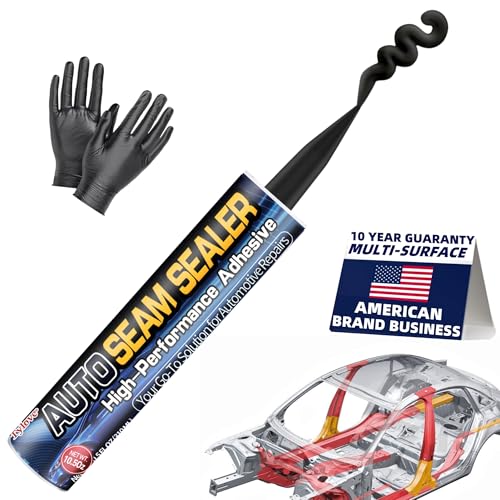
Fills and seals body seams so rust and leaks never get a foothold.
Seam sealer is the adhesive-adjacent product people forget until a leak shows up. This one is a resin paste that bonds to primed, painted or bare metal and is ready for paint in just 30 minutes with no sanding. That quick paint window matters when you are working through a rust repair and want to close it out the same day.
Effectiveness is what carries this pick. It handles body panels and seams across cars, trucks, boats and RVs, and it is engineered not to shrink or crack through extreme weather. It is low-VOC and solvent-free, and it loads into any standard urethane caulk gun. At 10.5 oz it is a usable single-tube size for a defined repair area.
The recurring gripe is the handling, not the result. It can be stubborn to remove from hands, and some jobs take hours to dry rather than the quick paint window would suggest. Wear the included gloves and work in thin, even passes. Compared with the Permatex silicone above, this one is the better fit for filling a gap in metal; the silicone is the better fit for a flexible weather seal.
The repair it is built for: priming, painting and sealing a body seam in a single afternoon, with no sanding step in between.
What to plan around: the paste is messy on skin and can dry slower than the 30-minute paint window implies, so gloves and patience are part of the job.
Reach for this if: you are sealing body seams, patching rust or waterproofing an RV roof and want to paint the same day.
Look elsewhere if: you need a clean, flexible weather seal on moving trim — a silicone or rubber gel handles that better.
4. 3M Plastic Emblem & Trim Adhesive 03601
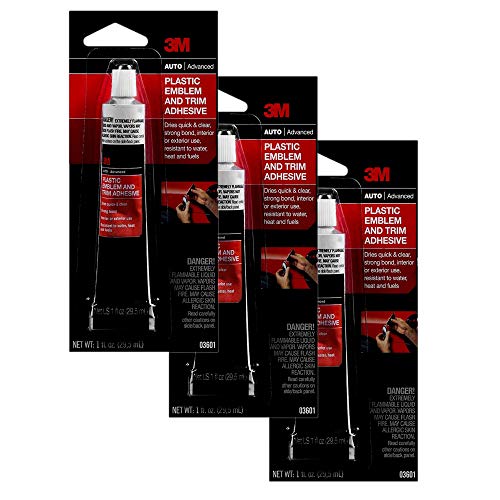
The small-tube acrylic that puts a fallen badge back on in one clean pass.
Emblems and small trim are the most common automotive glue job there is, and this is the tube built around them. The acrylic formula sets in about 15 minutes and fully cures in 24 hours. It dries clear, so a repair on a visible badge does not leave a visible line, and it bonds plastic and metal as well as automotive paints.
The 3-pack here is the practical part: three 1 fl oz tubes give you spare adhesive and a smaller tube for a controlled, precise bead. That is dramatically more working material than the single Amazing Goop tube — three tubes versus one, which matters if you have several badges or trim pieces to sort through on one car. It resists water, heat, vibration and automotive fluids, so road weather does not undo the job.
Durability is the split, though. The bond holds strong on a clean, well-prepped surface, but it can let go if the surface is not cleaned properly first. Clean and dry the area, apply a controlled bead, press firmly, then leave it alone for the full cure. Unlike the Buck epoxy below, this is for cosmetic and light pieces, not structural panels.
The small-job strengths
- Sets in about 15 minutes, full cure in 24 hours
- Dries clear for visible emblems and lenses
- Three 1 fl oz tubes give spare capacity for several repairs
- Resists water, heat, vibration and automotive fluids
The conditions it needs
- Surface prep is non-negotiable — a greasy panel can loosen the bond
- Cosmetic-grade hold, not a substitute for panel epoxy
The right tube for: badges, logos, side trim, interior panels and cracked light lenses on a clean panel.
Not the right tube for: door skins or any load-bearing panel, which call for the two-part epoxy.
5. Permatex 81173 Black Silicone Adhesive Sealant

One black silicone tube that seals, mends and weatherproofs dozens of small car jobs.
When you want one tube that stays handy for odd jobs, this is it. It is a black RTV silicone — RTV meaning room-temperature-vulcanizing, a sealant that cures into flexible rubber without heat. It seals, bonds, repairs, mends and secures glass, metal, plastics, fabric, vinyl and weather stripping.
That range is why it earns a spot: it also protects and repairs electrical wiring, and it is sensor-safe for indoor and outdoor use. It resists water, weather and vibration and stays flexible once cured. At 12.9 oz it carries 23% more capacity than the Tylove seam sealer’s 10.5 oz tube, so it lasts through more than one small repair. Full cure takes 24 hours, so plan around that when sealing.
It is a general-purpose sealant, not a dedicated bonding adhesive. A rigid structural panel is better served by the Buck epoxy, and a windshield is better served by the polyurethane above. For wiring, weather stripping, and a flexible weatherproof seal, this black silicone is the sensible everyday pick.
One tube, many jobs: the sensor-safe, waterproof silicone covers glass, metal, plastic, vinyl, wiring and weather stripping, all with a flexible hold.
Know its lane: it is a sealing and mending silicone, not a heavy panel-bond adhesive, so structural work belongs to a different tube.
Best for: owners who want one flexible sealant on the shelf for wiring, weather stripping and general waterproofing.
Skip if: you need to bond a rigid load-bearing panel — that is a job for a structural epoxy.
6. Buck Panel Bonding Adhesive

The two-part epoxy that lets you bond steel panels without a single weld.
This is the structural heavy lifter of the group. It is a two-part epoxy, meaning resin and hardener that only bond when mixed — here routed through the three included static mixing nozzles. It bonds steel, aluminum, plastic, fiberglass and composite panels, and full cure comes in 45 minutes at room temperature with no added heat.
Its capacity is the standout number: 400 ml, or 13.5 fl oz, in one cartridge. That is 29% more adhesive than the 310 ml cartridges of the windshield urethane above, so a larger panel repair is covered in one tube. It is built as a replacement for 3M Panel Bonding Adhesive 08115 and holds up against impact and vibration. Door skins, roof skins, quarter panels, box sides and bumper covers are all within its range, and it resists chemicals, water and corrosion.
The trade-offs are real but fair. It is the priciest pick here, and it needs a dispensing tool plus the mixing nozzles to apply properly. The epoxy goes to a firm cure, so it is not the tube for a part that needs to flex. A badge job does not need this; a panel job does.
The structural advantage: OEM-style panel bonding for steel, aluminum, fiberglass and composites, with a 45-minute full cure and no welding torch in sight.
The real cost: it is the most expensive tube here and needs a dispensing tool, so it is worth it only for genuine panel work rather than trim.
Choose it when: you are bonding door skins, roof skins, quarter panels or bumper covers and need a weld-free structural joint.
Leave it on the shelf if: your job is a small emblem or flexible trim — the firm epoxy cure is the wrong tool for those.
Understanding the Specs
Material Type (the chemistry)
This is the single most important line on any tube. Polyurethane is a flexible plastic-based adhesive for glass and frames. Epoxy is a two-part resin and hardener mix for firm structural bonds. Silicone cures to flexible rubber for sealing and weatherproofing. Acrylic and synthetic rubber handle small trim and badge work. Match the chemistry to the material you are joining and the flex the joint needs.
Capacity and container
Capacity tells you how much work a tube covers. A 400 ml cartridge handles a full panel job; a 1 fl oz tube is for a badge or two. Container type decides delivery: standard cartridges load into a caulking gun for larger beads, twin cartridges need static mixing nozzles, and squeeze tubes give precise control on small parts.
Full cure time
Full cure time is when the adhesive reaches its rated strength — not when it first grabs. A quick set of 15 minutes is handy, but the joint may still need 24 hours to reach full strength. Plan when you drive or load the part around the full-cure figure, so the repair holds instead of shifting early.
Weather and vibration resistance
Car adhesive faces heat, rain, car washes and constant road vibration. Flexible adhesives like polyurethane and silicone absorb that vibration instead of passing it into a brittle joint. Weather resistance — the ability to shed water and handle UV and temperature swings — decides whether a repair survives its first winter.
FAQ
What is the difference between a windshield urethane and a panel bonding epoxy?
Can I use trim adhesive to reattach a car emblem?
How long before I can drive after a windshield repair?
Do I need a special caulking gun for these adhesives?
Is silicone adhesive strong enough for body panels?
What does full cure time mean and why does it matter?
Can I paint over these automotive adhesives?
Which adhesive should I use for a seam that keeps leaking water?
Will these adhesives work on plastic and rubber trim?
How much adhesive do I need for a full panel repair?
Final Thoughts: The Verdict
The honest answer to the best automotive adhesive glue is that no single tube does everything — but for the broadest range of real repairs, the Polyurethane Windshield Adhesive earns the top spot. It keeps its flexibility on glass and frames, comes with two cartridges, nozzles and gloves, and needs no primer. If your job is steadier hands-on trim and badges, the 3M 03601 sets fast and dries clear. For structural panel bonding, the Buck two-part epoxy is the one to grab, with a 45-minute full cure and OEM-style strength. Whatever you pick, match the chemistry to the joint and wait out the full-cure time before loading it.
How We Picked
We do not accept paid placement. Every pick is matched to a real buyer and a real use-case; we do not hands-on test units.
Sources & Methodology
Specifications: manufacturer listings and product documentation. Review insights: verified customer reviews, as of November 2026. Pricing: not shown on this page (it changes often); check the current price via the retailer link.
As an Amazon Associate, Gadgets Feed earns from qualifying purchases. This does not affect which products we feature.