
Our readers keep the lights on and my morning glass full of iced black tea. As an Amazon Associate, I earn from qualifying purchases.
Specs are compiled from manufacturer listings and verified buyer reviews and can change over time — please confirm the key details on the product page before buying.
The hardest part of cellular trail camera shopping is that a low sticker price means nothing if the camera cannot hold a signal in the trees behind your property. You want photos landing on your phone without driving out to swap cards or feed batteries every week. So the short answer: the Tactacam REVEAL X Gen 3.0 is the safest all-around buy for most people. It brings multi-carrier flexibility, a built-in GPS, and an SD card in the box. Below are nine cameras that actually transmit over a cellular network, sorted into what each one does best, so you can match one to your ground instead of guessing.
I’m Min — the founder and writer behind Gadgets Feed. This guide is built by comparing the manufacturers’ published specifications and the patterns across verified customer reviews, so you get each pick’s real strengths and trade-offs instead of marketing spin.
What separates a camera that earns its place from one that sits dead in a hedge is boring: carrier coverage where you hunt, how long a set of batteries lasts, and whether the trigger fires in time. Read down for the budget cellular trail camera picks that get those three right.
Our Picks at a Glance


How To Choose The Best Budget Cellular Trail Camera
A cellular trail camera shoots on motion, then sends the photo over a 4G LTE network to an app on your phone. The cellular radio is where cheap cameras cut corners, and a weak one means photos that never leave the tree. Carrier coverage, battery life, trigger speed, and data-plan cost are the four specs that decide whether a budget camera earns its price.
Carrier coverage beats every other spec
Before you look at megapixels, check who has bars where the camera will hang. Some cameras lock you to one network. Dual-SIM and multi-carrier models, like the SPYPOINT Flex-Plus and the Moultrie Edge 3, use two or four networks and pick the strongest automatically. You buy one camera and let it pick the strongest tower on your parcel instead of matching a locked model to a carrier.
Battery capacity and solar, in plain terms
A trail camera that sends photos burns power on every transmission, not just every picture. Battery capacity — often listed in mAh on rechargeable packs — plus a solar panel is what keeps a camera alive all season without a visit. One 7800mAh battery pack paired with a 5200mAh solar panel appears on the GardePro X66 Pro, and it is the reason a bundle can beat a cheaper camera on long-term effort.
Trigger speed and detection range
Trigger speed is how long the camera takes to fire after something moves — 0.5 seconds catches a walking deer, and 0.1 seconds catches one crossing fast. Detection range is how far out the motion sensor wakes up, quoted in feet. A 100-foot detection range with a matching flash is the common target on these cameras, so the sensor and the light reach the same distance.
The data plan is part of the cost of owning
Every cellular camera needs a data plan to send anything. Plans run from free monthly photo allowances to paid monthly tiers, and some cameras let several units share one plan. A camera with a free plan and a camera with a required subscription can cost very different amounts over two seasons of scouting.
Quick Comparison
| Model | Best For | Photo Resolution | Battery / Power | Detection Range | Amazon |
|---|---|---|---|---|---|
| Tactacam REVEAL X Gen 3.0★ Best Overall | All-around best for most properties | — | AA; solar-panel compatible | — | Amazon |
| Muddy MitigatorBudget Anchor | Tightest budget with two carriers | 24 mp | — | — | Amazon |
| SPYPOINT Flex-PlusFree Plan Pick | Free monthly photo transmission | 36 mp | Double-capacity battery | 100 ft | Amazon |
| Moultrie Edge 2 Pro | Highest still resolution here | 40 mp | 8GB built-in memory | 100 ft | Amazon |
| Stealth Cam Revolver Pro 2.0 | 360-degree field of view | 40 mp | 16-piece battery tray; 12V DC jack | 100 ft | Amazon |
| SPYPOINT Flex-M Solar Bundle | Solar-powered low-maintenance setup | 28 mp | SPLB-10 solar panel included | — | Amazon |
| Moultrie Edge 3 (2-Pack) | Covering two spots at once | 40 mp | AA or Moultrie Power Mag | 100 ft | Amazon |
| GardePro X66 Pro with SP350 | Fastest trigger and live view | — (1296p video) | 7800mAh pack + 5200mAh solar | — | Amazon |
| Tactacam REVEAL Pro 3.0 | Long standby with 4G LTE | — (1080p video) | Up to 6+ months standby | — | Amazon |
In‑Depth Reviews
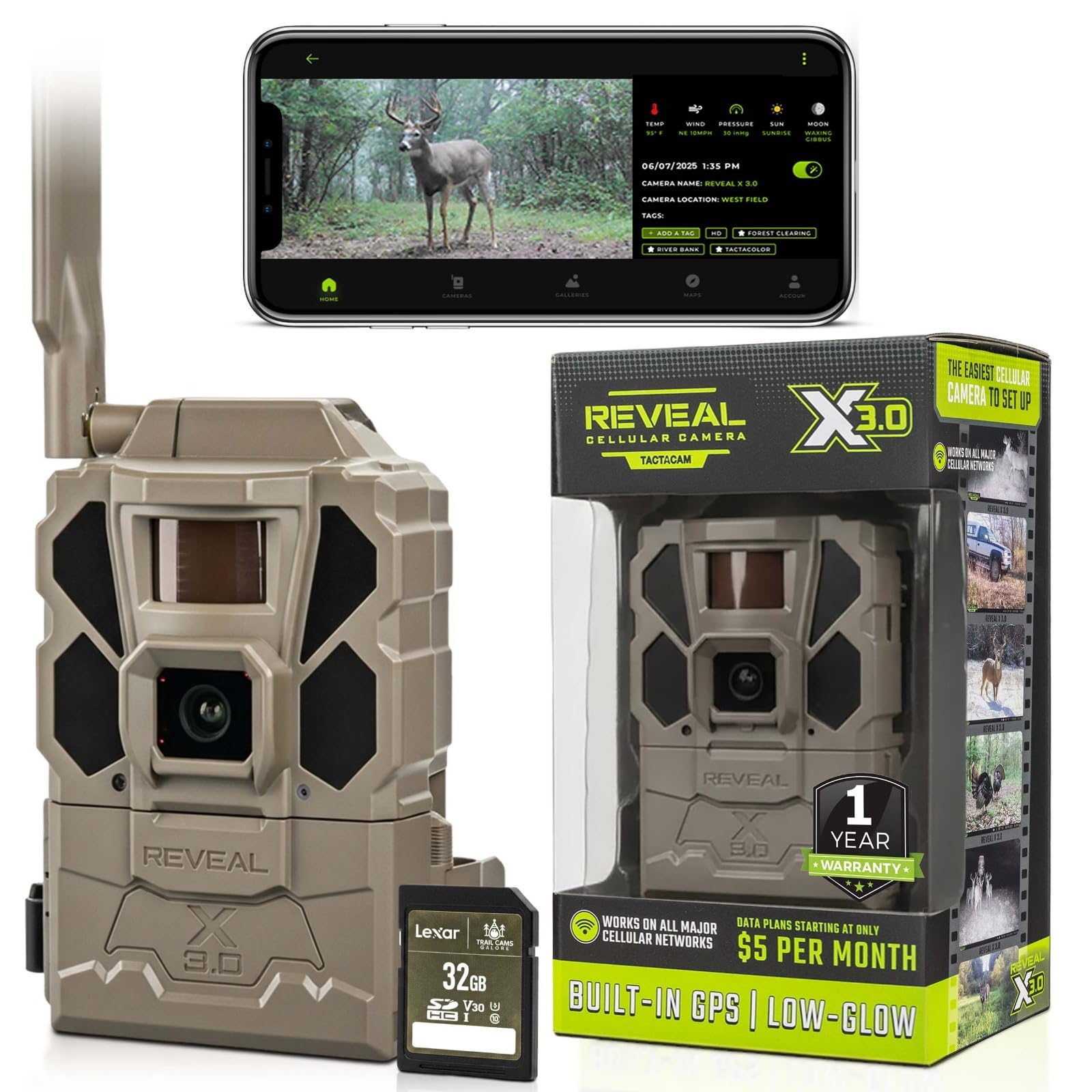
1. Tactacam REVEAL X Gen 3.0 Cellular Trail Camera
Our pick — 4.5+★ from 100+ verified ratings; the strongest balance of quality and price.
The camera that stops you guessing which network your hunting ground actually runs on.
This is the one to start with if you want a cellular camera that just works across providers. It pairs with multiple cellular networks, so you are not locked to whichever carrier has a weak tower near your stand. A pre-installed antenna sits in a new location on the housing, which Tactacam says makes the camera more durable. That matters for a box that lives strapped to a tree through rain and frost.
The REVEAL app is the other half of the deal. A preactivated SIM card connects the camera to your phone, so photos travel from your hunt location straight to your device. There is a 3-shot burst mode that groups three frames, which helps put a moving animal in the center of at least one shot. It ships with a Lexar 32GB SD card, and it also carries built-in storage — so no SD card is strictly required to run. GPS and low-glow IR flash (an infrared light the eye barely registers) cover location and night work. For reference, the SPYPOINT Flex-Plus measures 4.34 x 3.94 x 5.5 inches, while this body measures 9 x 5 x 3 inches.
What owners value most is image quality — it is the trait the review pages return to again and again, alongside how simple setup is for a first-timer. Reliability and battery life are the mixed notes: some sets run fine for weeks, others report trouble within the first month, and battery lifespan varies with how often it transmits. The honest read is that this is a strong camera with a normal spread of owner experience. If you need a camera that plays nice with whatever network is out there, this is the balanced answer.
Where it earns the top spot
- Works across multiple cellular carriers instead of one locked network
- Preactivated SIM plus the REVEAL app gets photos to your phone after quick activation
- 32GB SD card included and a built-in storage option that needs no card
- 3-shot burst mode plus low-glow IR flash for night frames
- One-year comprehensive warranty with in-house customer service
What to weigh first
- Battery life depends on transmission frequency and cold weather
- Camera body is larger than some compact rivals
- Solar panels are optional accessories, not included
Reach for this if: your ground sits across more than one carrier’s patch and you want a camera that adapts without you reconfiguring anything.
Look elsewhere if: you insist on a compact body or a solar panel in the box.
2. Muddy Mitigator Cellular 24MP Imaging
Entry-level money, two major carriers, and no SIM-card shopping required.
The Mitigator is the value play, and its clever part is the dual-network design. Pre-installed AT&T and Verizon SIM cards travel with the camera, and automatic network coverage picks whichever carrier has the better signal. That removes the usual beginner mistake of buying a camera for a network that turns out to be thin where you hunt. You get 24 mp stills (megapixels — the raw size of each photo), which is a big step up from older 8 or 12 mp cameras.
On-demand photos let you ping the camera for a fresh shot rather than waiting for something to walk past. It also works with the Stealth Cam Command Pro app, and you can share the camera with other app users — handy when a buddy or family member wants to watch the same property. There is an auto-focus lens and a boxy form that straps easily to a trunk.
Picture quality is the high point for buyers, with sharp daylight detail and clear night shots of small game. The part to plan around is power and reliability: batteries can run down fast if the camera transmits heavily, and a share of buyers report units quitting. Treat it as a solid entry-level camera for a first property, and budget for a spare set of batteries and a check-in now and then. It is also the smaller-resolution option next to the Moultrie Edge 2 Pro — 24 mp versus that camera’s 40 mp.
The value math: two carriers, on-demand capture, and 24 mp stills for a beginner-friendly layout. It is the right first camera if you want to test whether cellular scouting fits how you hunt before spending more.
The fair caveat: battery drain and reliability get mixed word-of-mouth, so keep fresh cells on hand and check the camera after rough weather.
Smart buy for: a first-time cellular user who wants AT&T and Verizon coverage without picking a side.
Think twice if: you want the highest resolution class or a hands-off, battery-thrifty setup.
3. SPYPOINT Flex-Plus Cellular Trail Camera
A free monthly photo plan is the quiet reason this one gets recommended to tight budgets.
SPYPOINT’s free plan transmits up to 100 photos a month with no fees and no long-term commitment, and the maker calls it the only free photo transmission plan for cellular cameras. For one camera on a single stand, 100 free photos a month can cover a whole scouting season at zero ongoing cost. Need more volume? Paid plans and the Insiders Club sit above it. The camera itself shoots 36 mp photos (stills) and 1080p video with sound, both landing in the SPYPOINT app.
Two preactivated SIM cards are included, and the dual-SIM design switches carriers for the best signal instead of making you pick a carrier model upfront. Battery capacity is described as double, and Instant Mode lets you request a fresh photo or video on demand. Capture modes cover Photo, Video, Time-Lapse, and Time-Lapse+, and a simultaneous send-and-capture feature keeps it hunting while it uploads. It weighs 16 ounces — light enough to strap high without wrestling it.
Owners are happiest with the camera overall — its build and the images it produces are what get praised most — and the battery capacity is the close second. Reliability and value get mixed notes, which is normal at the value end, and some find the instant-image pull slower than they would like. The free plan is the thing to check first: 100 photos a month is a real allowance for one camera, but two busy cameras will eat it quickly.
Why it stands out: a no-fee monthly photo allowance plus dual-SIM coverage and 1080p video with sound. For a single set on a budget, the ongoing cost story beats most of this list.
Know before you buy: there is no free lunch past 100 photos a month — heavy sending pushes you onto paid tiers.
Best match: one or two cameras on a property, where a free monthly photo allowance covers your whole scouting season.
Not the one for: heavy multi-camera use that blows past the free tier every month.
4. Moultrie Edge 2 Pro Cellular Trail Camera

Forty megapixels on demand, and a sensor tuned for the dim light before dawn.
If the photo itself is what you care about most, this is the camera to beat on paper. On-demand 40 mp stills sit well above the Muddy Mitigator’s 24 mp, which shows up as finer detail on antlers and faces. Video steps up to 1440p with audio, and the advanced sensor is tuned to hold detail in low light. A 100-foot detection range pairs with a no-glow flash, so night frames come out without a visible burst that spooks game.
Storage is stored away cleanly: 8GB built-in plus cloud backup, so a full card never costs you a trip. Live Aim previews the camera’s view in the app before you walk away, which takes a lot of the guesswork out of aiming. Moultrie’s A.I. identifies bucks, does, turkey, and humans and filters false triggers, which also saves battery on empty branches. Auto-connect scans nationwide 4G LTE for a signal across carriers, and it works with Moultrie’s Power Mag and solar accessories sold separately. A two-year warranty runs from activation in the app.
Quality and picture quality are what buyers rate highest, with setup close behind — it is an easy camera to get running. The note that keeps coming back is the monthly subscription: the A.I. and cloud features lean on a paid plan, and a share of owners find the total cost of ownership steep. Plan for the plan, and this camera rewards you with the sharpest files in this group.
The case for 40MP
- On-demand 40 mp photos and 1440p video with audio
- 100-foot detection range with no-glow flash for discreet night shots
- 8GB built-in memory plus cloud backup, no SD card needed
- Live Aim preview and A.I. species filtering cut false triggers
- Two-year warranty from activation
The ownership caveat
- The app’s smart features lean on a monthly subscription
- Solar and battery accessories are sold separately
- Only 50-degree field of view, so aim carefully at a trail
Buy it when: you want the sharpest stills in this group and can live with a data plan carrying the smart features.
Pass when: a subscription-free camera is a hard requirement.
5. Stealth Cam Revolver Pro 2.0 360-Degree Cellular Camera
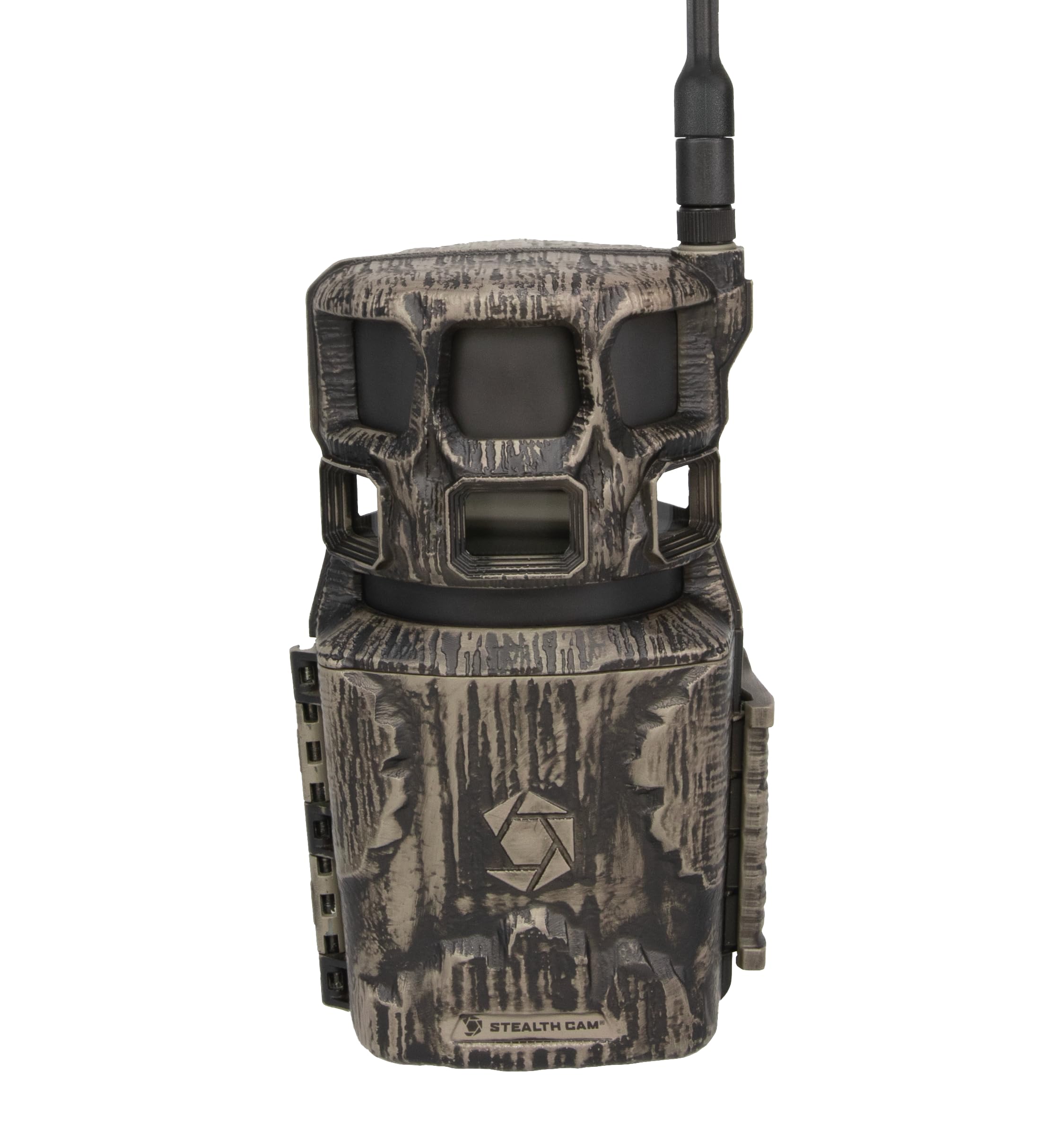
One camera covering a full circle is a different job than a camera aimed down a trail.
The Revolver Pro 2.0 takes its name from the 360-degree field of view, which means it sees all the way around its mount instead of down one lane. Hang it on a field edge or a crossing and it does not matter which way the deer arrives. The trigger fires in 0.35 seconds, quick enough for a fast-moving animal, and you can set a burst of 1-3 photos with time-out delays from 2-59 seconds or 1-59 minutes.
Resolution is selectable at 4MP, 8MP, 16MP, or 40MP, so you can send small thumbnails fast and pull a full 40 mp frame when you want detail. Video is 1440 QHD with audio. A 100-foot detection and flash range is lit by 4 power LEDs, and 32GB of internal memory means you are not hunting for a card slot. Built-in GPS maps where it hangs, AIO carrier determination handles the network, and the Command Pro app picks up remote management. There is a 16-piece battery tray and a 12V DC auxiliary jack if you want to run external power, plus a 1/4-20 threaded insert and a python cable provision for security.
The trade-off here is consistency. Image quality draws praise for good frames and complaints about blurry morning shots, and a share of units have quit early. Fogging shows up as a recurring gripe — a sealed box that swings between cold nights and warm days will fog, so a silica pack and careful sealing help. This is the pick for covering a wide opening from one mount, not for someone who wants zero fuss.
The wide-angle appeal: 360 degrees from a single mount with a 0.35-second trigger and selectable 4/8/16/40 mp output. Nothing else here covers that much ground from one tree.
The honest limit: fogging and early failures are the recurring notes, so check the seal and test the unit before you trust it as your only camera.
Worth it if: you are covering an open field or a crossing from one mounting point and need a full circle of view.
Skip the idea if: you want a set-and-forget camera with a spotless reliability record.
6. SPYPOINT Flex-M Solar Bundle

A camera and its sun-charger in one box, for people who hate battery runs.
The FLEX-M bundle pairs a cellular camera with an SPLB-10 compact solar panel, a mounting arm, and a strap, so power comes from daylight instead of a fresh set of cells every few weeks. The camera shoots 28 mp stills (megapixels) with night vision and records 720p video with sound. It is rated IP65 — that is weather-resistant against dust and water jets, which covers normal rain and spray but not a dunking. No WiFi is needed; everything rides the cellular network to the SPYPOINT app.
Capture modes include Photo, Video, Time-Lapse, and Time-Lapse+, with Constant Capture sending and shooting at the same time. The app brings personalized maps, real-time weather, and BUCK TRACKER AI for species filtering, plus remote settings and firmware updates. Storage takes a 32GB microSD card that is required to run, and there is an optional LIT-22 rechargeable battery pack for longer stints. The free plan tops out at 100 photos a month, with paid tiers above it. This is the heaviest unit here at 3.8 pounds, which is the price of a solar panel in the box.
Owners talk most about the build and how easy the setup is, and connectivity earns its own praise. The mixed notes land on image quality — clear day and night shots for many, but some units fail to capture at all — and on the ongoing plan cost. For a camera that lives in the field month after month, the solar panel is what makes it worth the bulk.
The hands-off angle: an included solar panel plus IP65 sealing means fewer mid-season visits to swap batteries. The included SPLB-10 panel is what separates this bundle from a bare FLEX-M and its weekly battery swaps.
The catch: it is a 3.8-pound package and still depends on a paid plan past the free monthly photo tier.
Pick this for: a remote set you cannot easily reach, where solar charging saves you the battery run.
Look past it if: the camera must be small and light, or you want everything included with no plan.
7. Moultrie Edge 3 Cellular Trail Camera 2-Pack
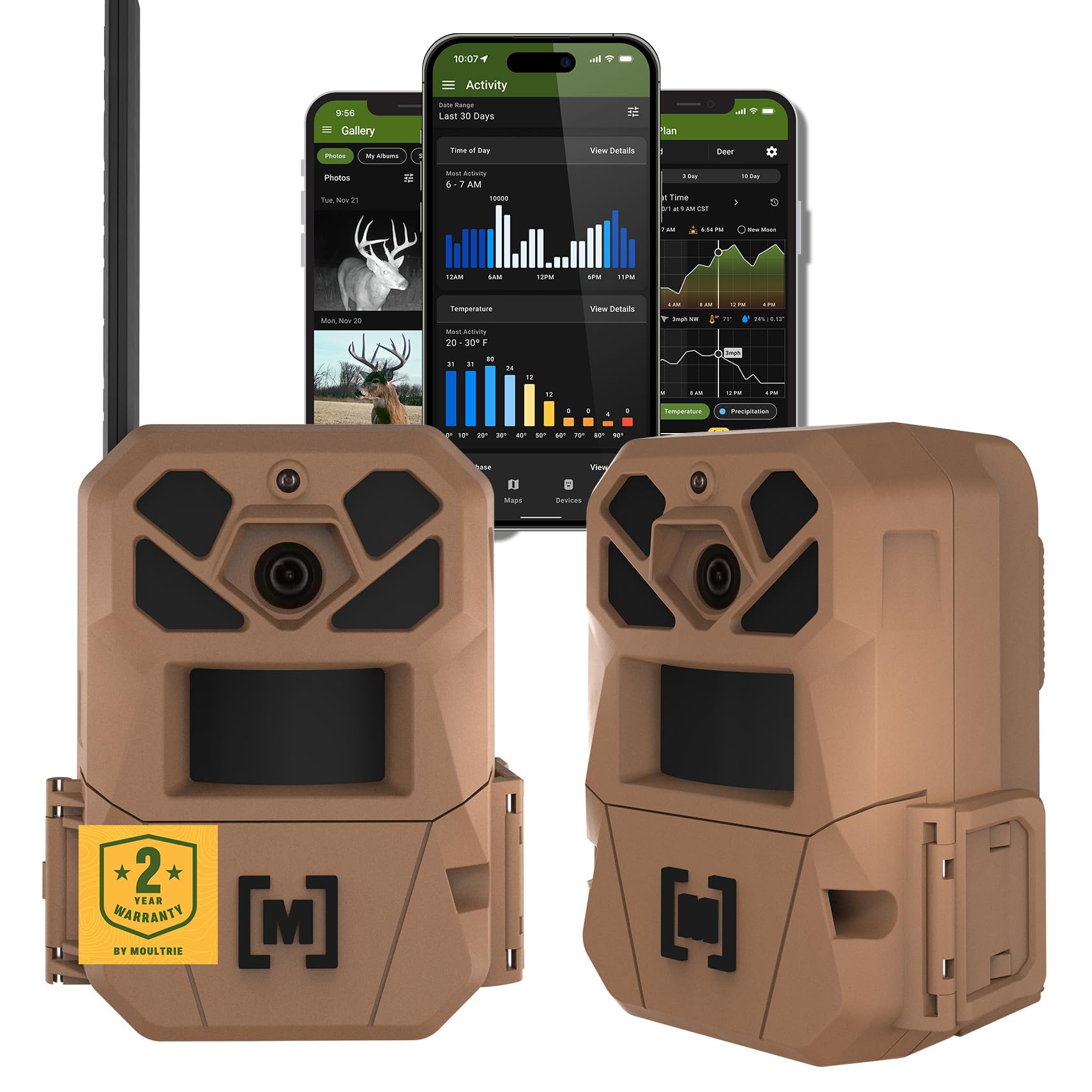
Two cameras on two properties, sharing one app and one species-filtering brain.
This pack doubles everything: two cameras, two straps, and a 40 mp still resolution on each. The trigger fires in 0.5 seconds, and a 100-foot detection range with low-glow infrared flash keeps night frames sharp without a visible burst. Nationwide 4-carrier auto-connect means it finds the strongest of four major U.S. networks on its own — no SIM cards, no manual setup. Four-carrier auto-connect is what makes the two-pack work, since each camera can sit on different ground and still find a signal.
Moultrie A.I. identifies bucks and pushes high-resolution photos or HD video, cutting false alerts. Live Aim plus built-in GPS means you can preview the view and map every camera, so you always know where each one is. There is also feeder remote control — adjust settings, check battery life, and control compatible feeders from the app. Memory is integrated, so no SD card is needed. A two-year warranty is backed from activation, and the camera runs on AA batteries or a Moultrie Power Mag pack. A Moultrie data plan is required and sold separately.
The clear win for buyers is camera quality — it comes up most often as the thing people love — then picture quality, especially clear night-time images. Setup is easy, and the fast trigger gets its own praise. Reliability and connectivity are the mixed notes, with an occasional unit stopping and signal dropping in rough terrain. If you want two cameras that share one scouting system, this is the natural fit.
Why two beat one here
- Two 40 mp cameras with integrated memory in one pack
- Nationwide 4-carrier auto-connect with no SIM cards to manage
- 0.5-second trigger and 100-foot detection range on each unit
- Live Aim, built-in GPS, and feeder remote control from the app
- Two-year warranty from activation
Where it asks more
- A Moultrie data plan is required and sold separately
- Signal holds the line in remote country, mixed by owner reports
- Batteries are AA or a Power Mag pack, not included with solar
Right call for: covering two stands or two properties under one app with the same sharp 40 mp output.
Reconsider if: one camera is all your ground needs, or you want no required data plan.
8. GardePro X66 Pro Cellular Trail Camera with SP350 Solar Panel
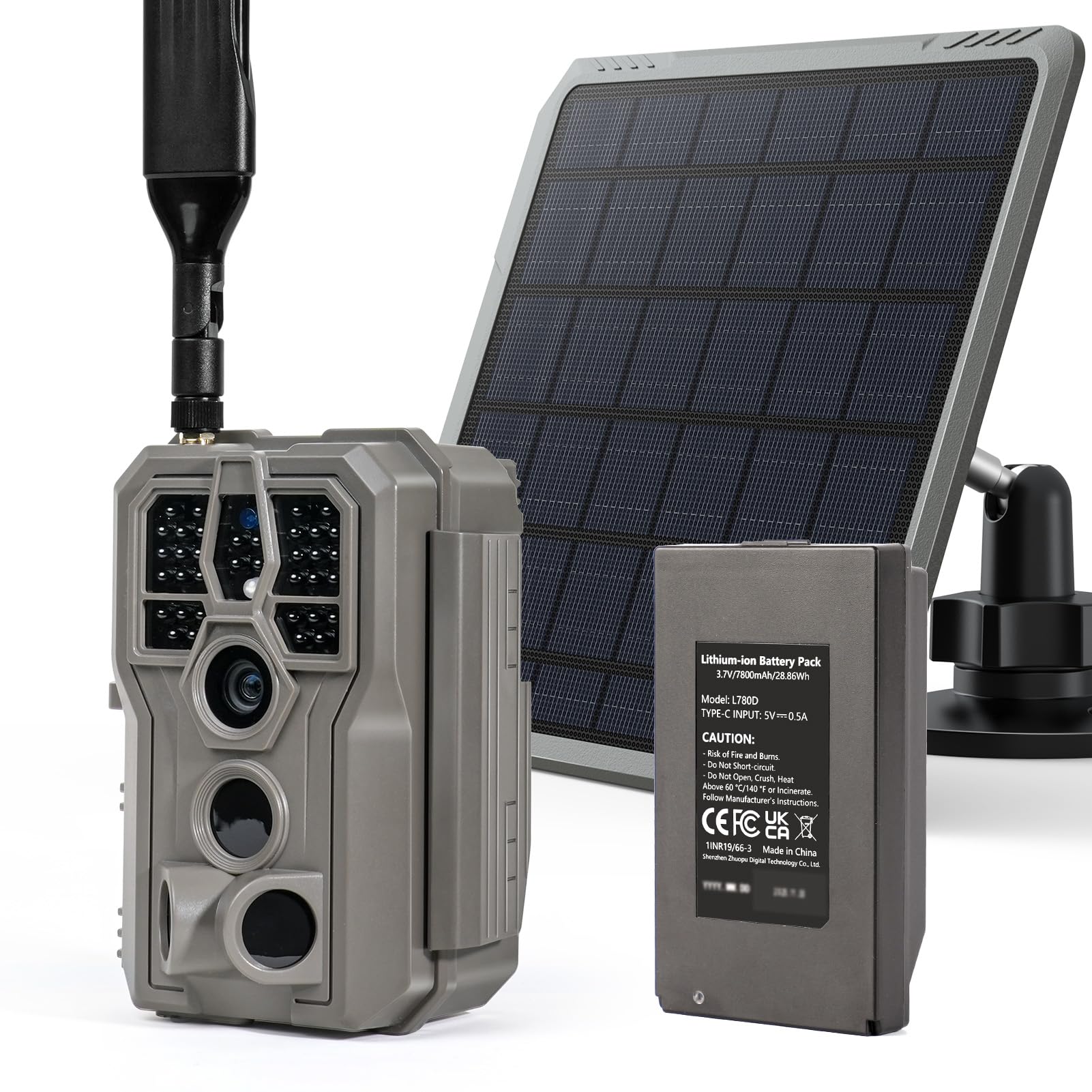
A tenth-of-a-second trigger is the difference between a buck in frame and an empty lane.
The X66 Pro’s headline is a 0.1-second trigger driven by a 3-PIR sensor system (three motion sensors working together to detect movement faster and more accurately). That is the swiftest fire time in this group, and it is aimed squarely at fast-moving wildlife. Video records at 1296p HD with sound, and the 940nm no-glow infrared flash (an invisible infrared light) lights night frames without alerting animals. It is rated IP66 — dust-tight and protected against strong water jets, a step above ordinary weather-resistant.
The power setup is the other big draw. The bundle includes a 7800mAh camera battery plus an SP350 solar panel with its own 5200mAh rechargeable cell, so power is topped up by daylight through the season. Live View and On-Demand HD requests work from the app, and built-in GPS syncs its location and lets you pull the latest position on demand. Multiple cameras can share one data plan, pooling HD photos, videos, and Live View usage under one account. Capture modes cover Burst, Motion Detection, Time-Lapse, and Hybrid Mode.
Quality, picture quality, and value are what owners praise most here — sharp daytime photos and good video, with live view a favorite feature. The problem to know about is battery drain: it is the most-discussed negative on this camera, and heavy sending can flatten cells faster than you expect. The solar panel in the box is the fix, which is why this bundle exists. Super fast trigger plus solar power makes a strong pairing for a busy trail.
The standout: 0.1-second trigger and 3-PIR detection with 940nm no-glow flash, backed by a 7800mAh battery and 5200mAh solar panel. For a fast trail, that combination is hard to match.
The real-world caution: even with the solar panel, heavy live-view use drains power fast — expect to manage your request frequency.
Made for: a fast trail or a busy field edge where a slow trigger loses the shot, and you want solar keeping it alive.
Skip if: you rarely check the app and just want the cheapest way in — the power setup is more than you need.
9. Tactacam REVEAL Pro 3.0 Cellular Trail Camera
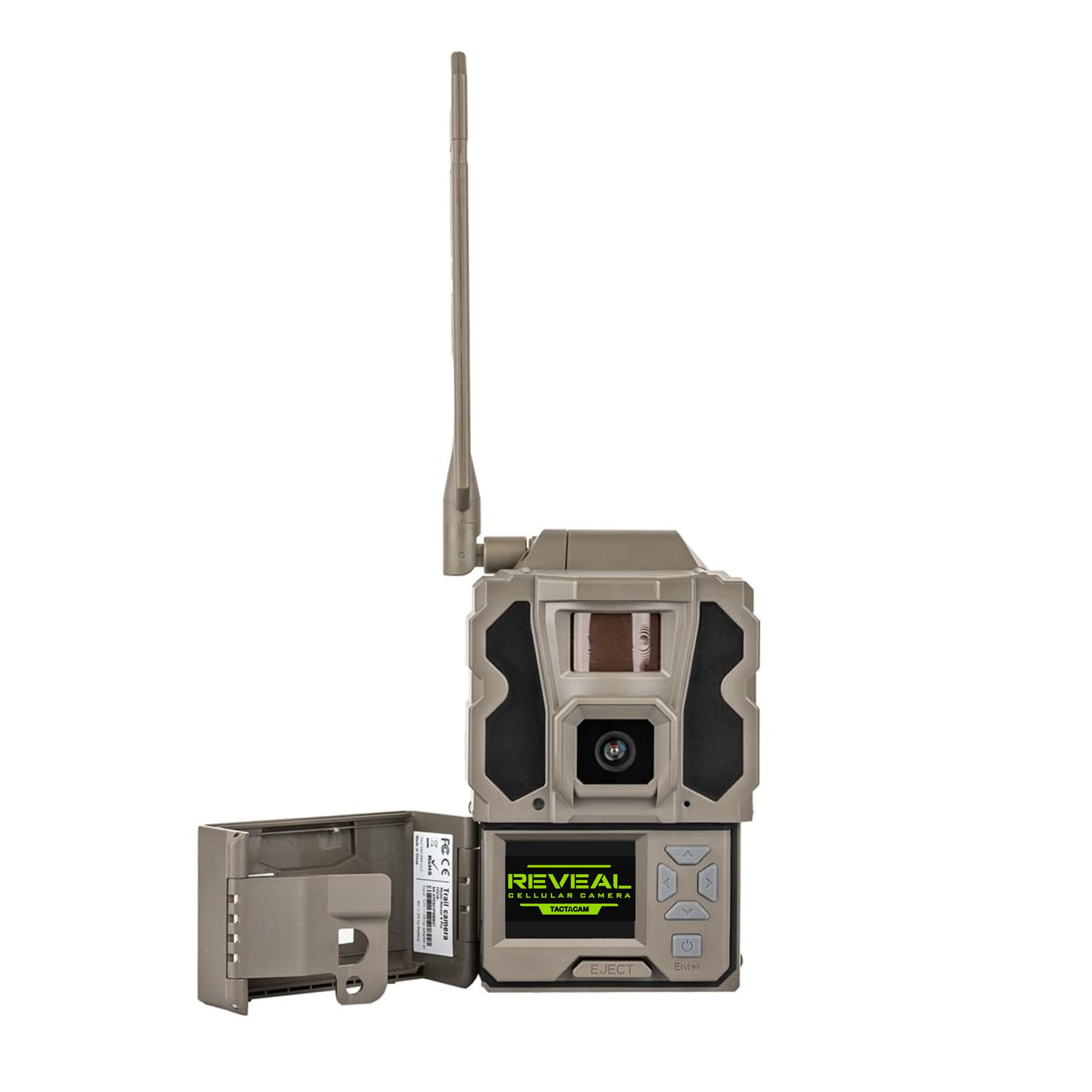
Rated for six-plus months of standby on one set of batteries where the signal is strong.
For a camera that sits deep in the field and rarely gets visited, standby life is the spec that matters most. Tactacam rates the Reveal Pro 3.0 at up to 6+ months of standby on a single set of batteries, though that varies with usage and temperature. A pre-installed antenna and a pre-activated SIM get it sending photos within minutes — no technical experience required. 4G LTE connectivity carries on-demand photos and video clips to your phone, and it works off Verizon and AT&T networks.
Local backup runs on microSD cards up to 512GB, and it takes Class 10 or higher — that is a speed rating for the card, and a slow card can cost you video frames. Video resolution is 1080p, with a 50-degree field of view, so aim it down the trail rather than across open ground.
Buyers describe clear photos and videos and an easy setup that sends shots straight to the phone — the functionality is well liked. Battery life and value get mixed word-of-mouth, which is honest for a cellular camera that transmits often. Compared with the REVEAL X Gen 3.0 above, this model leans on standby endurance and a simple SIM-ready setup rather than multi-carrier flexibility. If you value long battery life over the widest carrier choice, this is the smarter pick.
Built for longevity: 6+ months of standby on one set, 4G LTE delivery, and support for microSD cards up to 512GB. For a set you visit once a month, that standby rating is the spec that keeps you out of the woods.
The honest limit: standby time drops with heavy transmission and cold, and you may need a paid plan for regular photo flow.
Best for: a remote camera you want to leave alone for weeks and check only through the app.
Consider another pick if: multi-carrier flexibility is more important to you than standby life.
Understanding the Specs
Photo resolution in megapixels (mp)
Megapixels are the raw pixel count in each photo. A 40 mp camera captures finer detail than a 24 mp one, which shows up on antlers, faces, and numbers. Resolution often gets reduced for transmission, so a high-mp sensor still sends small thumbnails until you request the full frame. Match it to the job: high mp for trophy scouting, lower for general movement.
Trigger speed in seconds
Trigger speed is how long the camera takes to fire after motion is detected. A 0.1-second trigger catches an animal crossing fast, while a 0.5-second trigger is fine for a deer walking a trail. Faster is not always better if the sensor is overeager — false triggers fill your card and drain power. Aim speed at your terrain.
Detection range in feet
Detection range is how far out the motion sensor picks up movement before the camera fires. A 100-foot range with a matching flash means the sensor and the light reach the same distance, so you get a usable frame. If detection outruns the flash, late-night shots come back dark at the edge of range.
Battery capacity and solar input
Battery capacity in mAh (milliamp-hours) is how much charge a cell holds — a 7800mAh pack holds far more than a standard AA tray. Solar panels add daily top-ups, and a 5200mAh panel keeps a camera alive all season. If a camera has no solar option, plan on swapping cells or adding a pack.
Cellular network and SIM setup
Cellular cameras use 4G LTE or similar networks to send photos to an app. Dual-SIM and multi-carrier designs switch to the strongest signal automatically. A pre-activated SIM means faster setup, while a locked network camera needs a plan on that specific carrier. Check coverage where the camera hangs first.
Weather rating and sealing
An IP rating (like IP65 or IP66) describes how well the housing keeps out dust and water. Higher numbers mean more protection against rain and spray. Cold nights and warm days still create fog inside a sealed box, so a silica pack helps and careful sealing matters more than the number alone.
FAQ
Do cellular trail cameras need a data plan to work?
Will a cellular trail camera work without a signal?
How long do batteries last in a cellular trail camera?
What is the difference between a cellular trail camera and a WiFi trail camera?
Can I use an SD card with these cellular cameras?
How do I aim a cellular trail camera without walking to it?
Why do my trail camera photos come out blurry at night?
Can I run more than one cellular trail camera on a single plan?
Does a solar panel really replace battery changes on a cellular camera?
Final Thoughts: The Verdict
How We Picked
We do not accept paid placement. Every pick is matched to a real buyer and a real use-case; we do not hands-on test units.
Sources & Methodology
Specifications: manufacturer listings and product documentation. Review insights: verified customer reviews, as of July 2026. Pricing: not shown on this page (it changes often); check the current price via the retailer link.
As an Amazon Associate, Gadgets Feed earns from qualifying purchases. This does not affect which products we feature.