
Our readers keep the lights on and my morning glass full of iced black tea. As an Amazon Associate, I earn from qualifying purchases.
Specs are compiled from manufacturer listings and verified buyer reviews and can change over time — please confirm the key details on the product page before buying.
Buy the pump that matches where you actually fix flats. If you ride road or gravel and top up tires at home, a floor pump is the right tool — faster, easier on your arms, and easier on your back. If you only ever pump air into a tire with your thumbs after a puncture on the roadside, a pocket-size hand pump belongs in your jersey or seat bag, and a full-size floor pump is dead weight on the bike. Decide if you need a home floor pump or a roadside hand pump before you start comparing valve heads and gauge sizes.
I’m Min — the founder and writer behind Gadgets Feed. This guide is built by comparing the manufacturers’ published specifications and the patterns across verified customer reviews, so you get each pick’s real strengths and trade-offs instead of marketing spin.
Bike pumps look interchangeable, but the pressure rating, valve head, and gauge decide whether you actually enjoy inflating a tire or just tolerate it. The big number to watch is maximum pressure in PSI (pounds per square inch — how hard the pump can push air), because road tires want high pressure and mountain tires want volume, and the wrong pump fights you on one or the other. That one spec is the fastest way to separate the nine bike pump options below into the ones worth your money and the ones you will only ever reach for in an emergency.
Our Picks at a Glance


How To Choose The Best Bike Pump
The first question is not which pump is best — it is whether you are inflating at home or on the roadside. A floor pump by the door that gets used before every ride beats a frame pump that never leaves its bracket. Work out where you inflate, then match the pump to that spot.
Floor pump or hand pump: pick by where you fix flats
A floor pump stands on the ground with a broad base and a long hose, so you push down with your body weight instead of your arms. That makes it the tool for topping up tires at home before a ride. A hand pump is small enough to mount on the frame or drop in a jersey pocket, and it exists for the moment a tire goes soft miles from home. Most riders end up wanting both eventually, but start with the one that matches your worst flat-fixing scenario.
Match maximum PSI to your tire type
Road tires run hard, so you want a pump that reaches the pressure printed on your sidewall without a fight. The pumps here list maximum pressure as high as 220 psi and as low as 100 psi — plenty for road, gravel, and mountain use as long as you check the number against your own tire’s target. A pump pushing close to its ceiling on every stroke wears you out; one with headroom makes topping up a two-minute job.
Valve heads: Presta, Schrader, and Dunlop
Presta valves are the thin ones with a small nut on top, common on road and gravel bikes. Schrader valves are the wider car-style valves found on many mountain and kids’ bikes. Dunlop is the third type, still seen on some city and touring bikes. A pump that handles all three without an adapter saves you from digging through a drawer mid-ride, and several options below do exactly that.
Quick Comparison
| Model | Best For | Max Pressure | Type | Weight | Amazon |
|---|---|---|---|---|---|
| SILCA Mini Bike Pump★ Best Overall | Riders who want a mini pump that feels like a real tool | 100 psi | Mini hand pump | 165 g | Amazon |
| BV Bicycle Pump Floor PumpBudget Champion | Everyday home inflation on a tight budget | 160 psi | Floor pump | 16 ounces | Amazon |
| Park Tool PMP-3.2BTrail Backup | Trail riders who want a tiny backup pump | 100 psi | Micro hand pump | 0.1 kg | Amazon |
| LEZYNE Pocket Drive HP | Road riders carrying the lightest possible pump | 160 psi | Mini hand pump | 75 g | Amazon |
| Topeak Mini Morph | Gravel and MTB riders who want floor-pump feel on the trail | 140 psi | Mini floor-style pump | 5.44 ounces | Amazon |
| Park Tool PFP-10 | Home mechanics who want one sturdy pump for the garage | 160 psi | Floor pump | — | Amazon |
| Topeak JoeBlow Max HP | High-volume home inflation across road and mountain bikes | 160 psi | Floor pump | 1.39 kg | Amazon |
| PRO BIKE TOOL Floor Pump | Riders who want a long hose and big-volume strokes | 140 psi | Floor pump | 1520 g | Amazon |
| LEZYNE Classic Floor Drive 3.5 | Track and high-pressure road setups | 220 psi | Floor pump | 3.1 pounds | Amazon |
In‑Depth Reviews
1. SILCA Mini Bike Pump – Frame Mount Bicycle Pump with Expandable Hose and Lever Lock
Our pick — 4.5+★ from 250+ verified ratings; the strongest balance of quality and price.
A frame pump that hides its hose and punches like a floor pump.
You are buying a mini pump because you do not want to be stranded — and this aluminum SILCA is built so the roadside job feels like a tool, not a toy. It inflates to 100 psi effective maximum, so you spend less time hunched over the valve. Both ends work together: the expandable hose pulls out to 21.5 inches when fully extended so you can pump at any angle, and the reversible lever-locking chuck clamps onto Presta or Schrader without fumbling.
The weight is where buyer opinion splits. At 165 g and 9.5 inches closed, the LEZYNE Pocket Drive HP sits at 75 g, so this is not the lightest option in the pack, and some riders do grumble that it feels heavier than they expected. The counterargument is construction: the adaptable cup seal expands with the tube to keep pumping smooth when things get hot, a built-in heat sink pulls heat away, and a twin-tube insulated grip keeps your hands cool. That adds up to a pump that hangs off a bottle-cage bracket year-round without complaint.
What wins people over here is build quality above all — it is the top praise across the review pages, and owners describe it as lasting for years, with the lever lock and growling high-pressure performance called out again and again. Durability and construction get steady mention too. What you get is a pump for road, gravel, or mountain frames where the priority is a reliable seal and pressure control on the trail rather than shaving grams.
What earns a frame spot
- Expandable hose to 21.5 inches lets you pump from any angle without wrenching the valve
- Aluminum body with adaptable cup seal keeps the stroke smooth when the pump gets hot
- Reversible lever-locking chuck handles Presta and Schrader with no adapters
- Built-in heat sink and twin-tube insulated grip protect your hands at high pressure
- Bottle-cage bracket included for secure on-bike storage
The honest trade-offs
- At 165 g it is noticeably heavier than the LEZYNE Pocket Drive HP at 75 g
- 100 psi ceiling is lower than the 160 psi hand pumps here, so it suits road tires better than track pressures
- Weight is the one mixed point across reviews — fine on a frame, less ideal in a jersey pocket
Pick this if: you want a frame-mounted pump that feels like a real inflator and handles road, gravel, or MTB pressure without drama.
Reconsider if: every gram counts and you plan to carry it in a pocket rather than on a bracket.
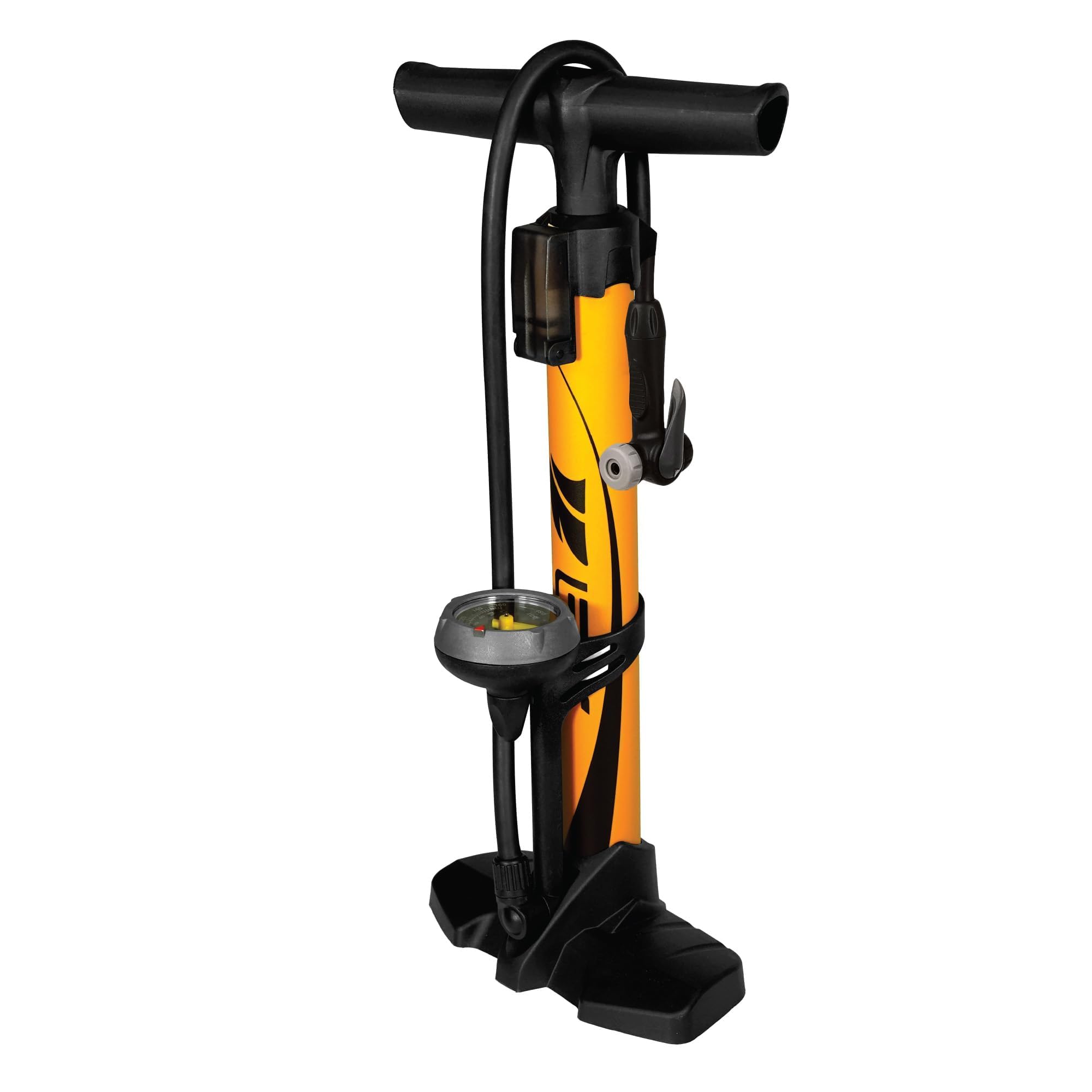
2. BV Bicycle Pump Durable Bike Floor Pump 17/24 inch Smart Valve Head, 160 psi
The pump that turned a chore into the default thing you grab before every ride.
Start with the number that matters: 160 psi. That is plenty of pressure for any road, gravel, or mountain tire you will realistically inflate, and it is the same ceiling as the Park Tool PFP-10 and Topeak JoeBlow Max HP. The twin valve design reverses the components in the head so Presta and Schrader both work without adapters, and the ergonomic handle is shaped to push down with your body weight. Alloy steel construction means the barrel takes repeated stomps without flexing.
At 16.25 inches tall and 16 ounces, it is longer than the SILCA Mini at 9.5 inches, which is exactly what you want in a floor pump — the height gives you a full stroke that moves real air. The 16-ounce weight is a fraction of the Topeak JoeBlow Max HP at 1.39 kg and the PRO BIKE TOOL at 1520 g, so this is a pump you can carry down a flight of stairs or stash in a small corner without effort.
The quality and functionality of this pump are what owners consistently praise most, and that is why it sits at the front of this budget pack. The honest catch is the pressure gauge: some riders find it clear and useful, others cannot get a reliable read out of it, so treat the gauge as a rough guide and judge by feel plus your tire’s target. A few also mention the ball needle giving out over time and airflow that varies between units — real, but infrequent against a large review base.
Where the value lands: a 160 psi floor pump with automatic Presta/Schrader switching and a comfortable handle for very little money — the obvious starter pick if you are pumping tires at home and do not want to overthink it.
The compromise: the gauge is the weak link, so plan to cross-check pressure with a separate gauge if precision matters for your road setup.
An easy yes for: first-time buyers and anyone who wants a dependable home floor pump without stretching the budget.
Look past it if: you need an accurate built-in gauge for dialing in exact road pressures.
3. Park Tool Pmp-3.2b
A pocket-sized Park Tool that is happiest as your trail safety net.
This micro pump is about one thing: being there when you need it, without weighing down your frame. It tops out at 100 psi (7 bar), which covers mountain and gravel tires comfortably and gets a road tire back to rideable after a puncture. Presta and Schrader are both compatible, and the aluminum-alloy body is compact enough to disappear into a pack or frame mount. Park Tool’s compact and lightweight design is the reason riders who want a trail backup reach for it.
Compact size and light weight are what owners call out most about this pump, and compared with the BV floor pump at 16.25 inches, this one slips into a hydration pack without a second thought. Owners also consistently praise the aluminum-alloy body and its solid feel. If you are setting up a small emergency kit for mountain or gravel rides, this is the shape of pump that fits the job.
The catch is reliability, and it is the one thing to go in eyes-open about. Owner experiences range from “works exactly as expected” to “does not inflate at all,” and a handful report the pump failing within minutes of first use. That is a real risk on a small, light pump where every component is doing heavy work at high pressure. If you want a dependable everyday pump, a floor pump is the safer tool; if you want a compact trail backup and accept the occasional dud, this is the form factor to look at.
What it is built for: a genuinely tiny, genuinely light pump that fits a jersey or pack and can rescue a ride at 100 psi.
The honesty note: reliability is the most-mixed feedback for this pump, so inspect it on arrival and keep it as a backup rather than your only inflator.
Worth a look if: you want an ultra-compact, 100 psi pump for a trail or gravel bag.
Hold off if: you need a pump that will be your only inflation tool and has to work every single time.
4. LEZYNE Pocket Drive HP Bike Hand Pump
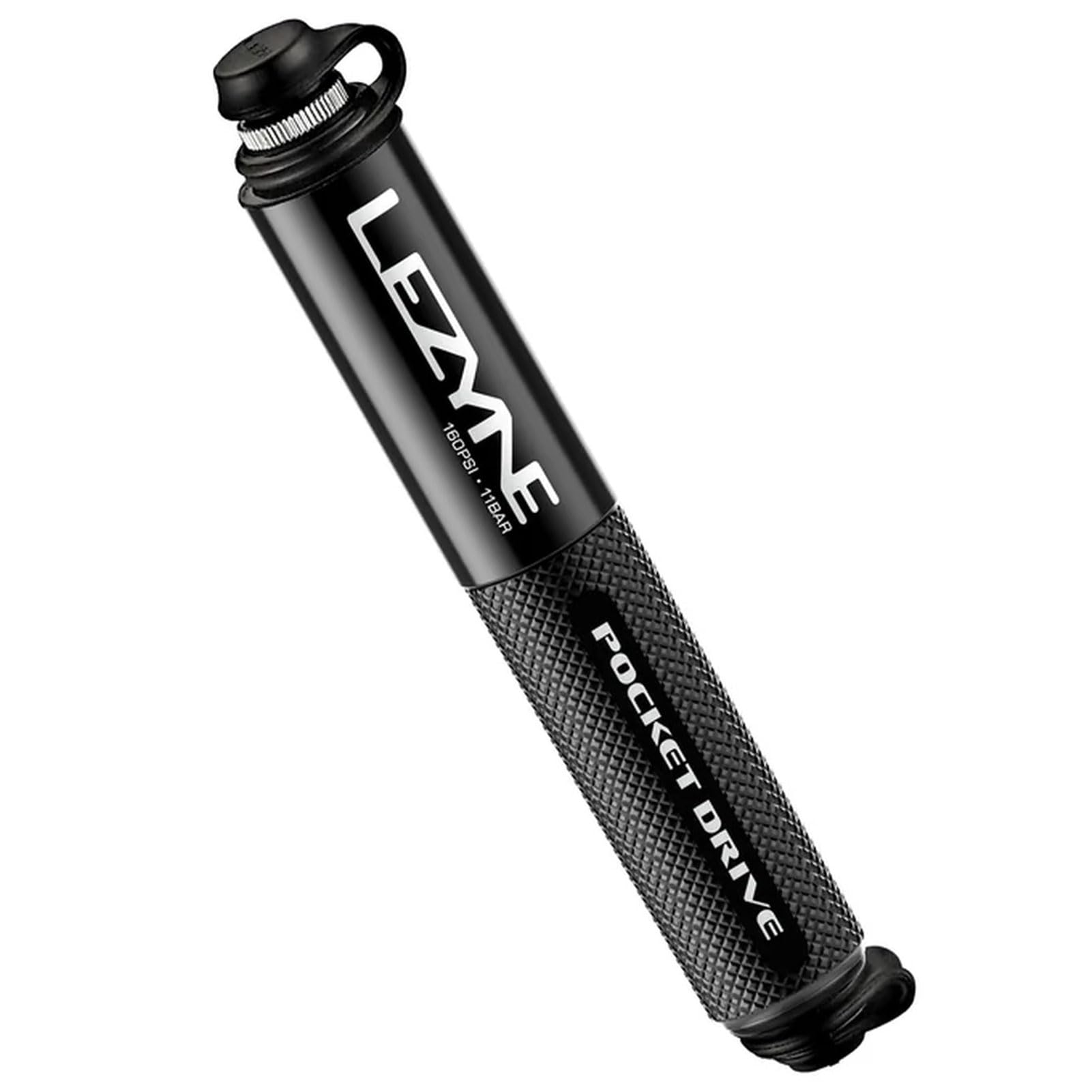
Seventy-five grams of machined aluminum that still reaches 160 psi.
Here is the standout spec: 160 psi from a pump that weighs 75 g. That is 75 g against the SILCA Mini at 165 g, and 160 psi against the SILCA’s 100 psi ceiling — so you get more pressure headroom in a pump that vanishes into a jersey pocket. The CNC-machined aluminum body has a knurled, slip-resistant handle for grip while you are pushing hard, and the ABS Flex Hose works with both Presta and Schrader while flexing to reduce stress on the valve.
Size is the other headline: at 150x23x28.8mm it drops into a seat bag or jersey pocket, and the Composite Matrix mount lets you bolt it to the frame instead. The rebuildable design is the quiet long-game — a serviceable pump outlasts a sealed throwaway one, because you can keep it working through years of flats and long rides. That combination of tiny, light, and serviceable is unusual at this size.
The honest part: durability is the recurring gripe. Some riders report the pump or hose giving out after very little use, and the valve stem area draws particular criticism. If you want something to sit in a bag and mostly never be used, that trade is easy to make.
Build quality is the top praise, and buyers consistently call it better than carrying CO2, with an easy fit in seat bags and plenty of pressure for road and gravel tires when it works. Think of it as a pump you carry because it is nearly invisible, not because you want to use it every day.
The case for the Pocket Drive
- 75 g weight disappears into a jersey or seat bag
- 160 psi ceiling matches the top hand pumps here while being the lightest option in the pack
- ABS Flex Hose handles Presta and Schrader and reduces stress on the valve
- Rebuildable design means it can be serviced rather than replaced
What to watch
- Durability is the recurring complaint — hose and valve stem failures show up in reviews
- You are paying for the engineering that makes it this light, so it costs more than budget hand pumps
- At this size, expect more strokes to reach high pressure than a floor pump
A smart choice for: road, gravel, and commuter riders who prioritize a pump they will barely notice.
Think twice if: you want a pump that shrugs off hard use and abuse year after year.
5. Topeak Mini Morph Bike Pump with Fold-Out Foot Pad

Floor-pump posture, trail-friendly size, and a 140 psi gauge built in.
This is the clever one: a mini pump that unfolds a foot pad and stands on the ground, so you get the stability of a floor pump without carrying a full-size one. The in-line gauge reads up to 140 psi (9.6 bar), which is plenty for road, gravel, and mountain tires, and the padded T-handle gives you something comfortable to push against. Presta, Schrader, and Dunlop valves all work without adapters.
At 5.44 ounces and 13 inches long, it is lighter than the BV floor pump at 16 ounces, so it still travels. The butted aluminum body with a dual-density polymer handle is built to take real pressure, and the included TRP-3C centerline bracket mounts with straps or on bottle bosses, so the pump stays fixed and ready on the frame.
Performance and functionality are the two things owners praise most, and the pressure control earns its own approval too — buyers report pumping up 65 psi gravel tires quickly, and the mounting options work on most frames. The built-in gauge is the one mixed point: several riders find it small and hard to read mid-pump. If you do not need a precise pressure readout and just want to get a tire back up fast, that gripe is small against the rest.
The standout: a fold-out foot pad plus a flexible hose and a padded T-handle — in practice, a mini floor pump you can brace against the ground on a trail.
The trade: the gauge is small, so treat it as a close guide rather than a precise readout.
Reach for this if: you want the leverage of a floor pump in a packable size for gravel or MTB rides.
Look elsewhere if: reading the gauge mid-pump matters a lot to you.
6. Park Tool PFP-10 Home Mechanic Bicycle Floor Pump
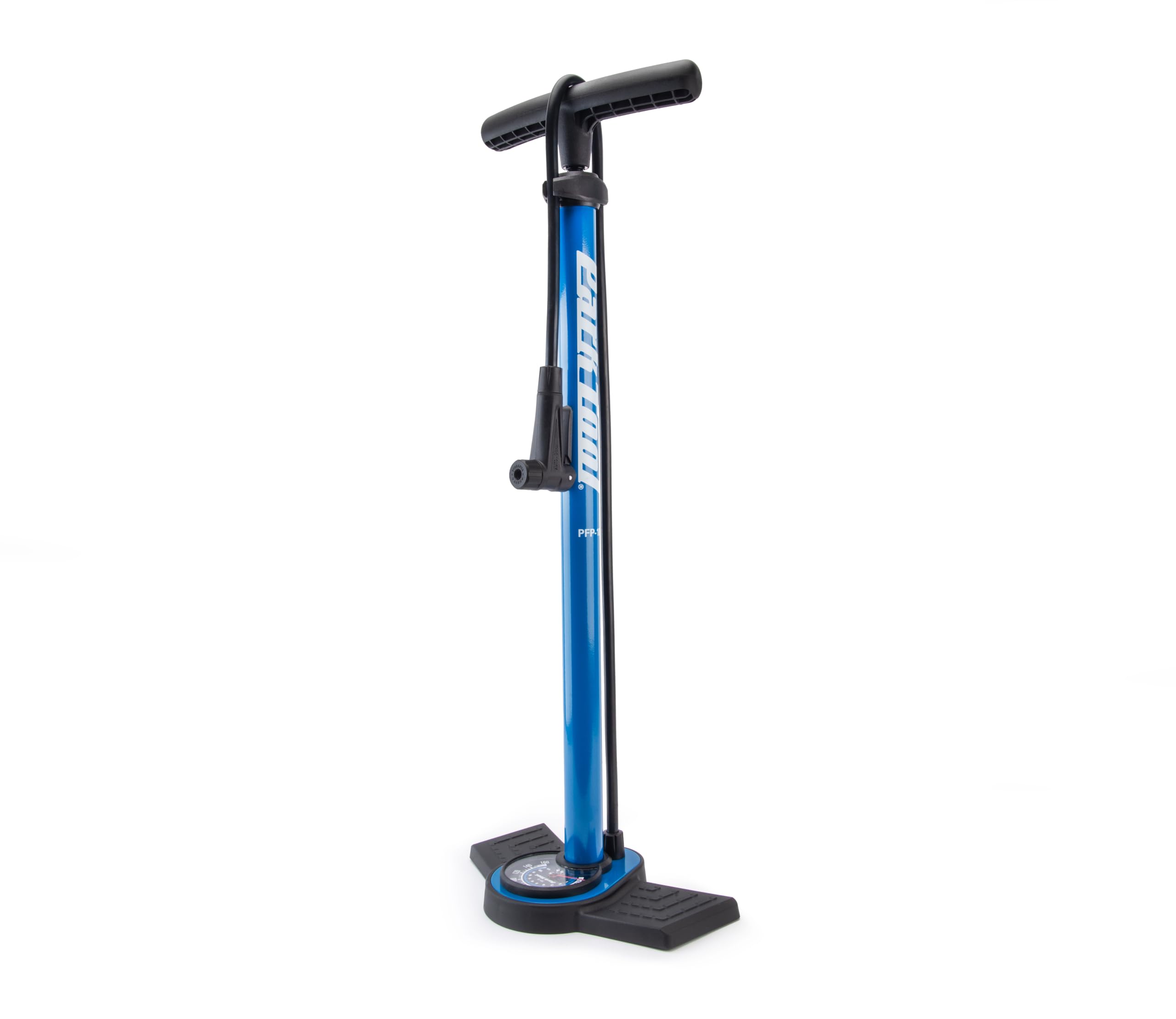
A garage pump with a gauge you can actually read from a distance.
Of everything here, this is the pump built most clearly for the person who keeps bikes in a garage or workshop. The giant easy-to-read gauge is the callout — no squinting to find your target pressure. The 160 psi (11 bar) maximum matches the Topeak JoeBlow Max HP, and extra-large foot pads plus a long hose give you a stable, full stroke. The locking universal head adjusts automatically for Presta and Schrader, so no reversing parts between bikes.
Park Tool’s pump quality is what buyers praise most, followed closely by functionality — the same picture of a trusted workshop tool that shows up across their lineup. The automatic valve switch is the detail that makes it easy to hand off to a kid, a partner, or a friend who has never touched a pump before.
The honest catch is size and commitment: at 37 inches long with a 9-inch base, this is a tool that lives where you keep the bikes rather than something you carry. That is a feature, not a flaw — it is a floor pump, and its job is to be planted and stable while you push. If you are short on floor space, a compact floor pump will fit your life better.
If your main bike time is spent topping up tires and doing maintenance at home, this is a sensible everyday workhorse. If you are looking for something that lives on the frame, the Topeak Mini Morph is the better travel answer.
What earns its place: a giant gauge, huge foot pads, a long hose, and an auto-adjusting universal head — the tools that make a home pump pleasant instead of fiddly.
What it asks of you: 37 inches of stored length and a fixed spot in the garage.
Made for: home mechanics and families with multiple bikes who want one stable pump to share.
Not for: riders who need an inflator they can bring along on the ride.
7. Topeak JoeBlow Max HP Bike Floor Pump, 160 PSI Gauge

The high-volume workhorse that inflates a whole family’s tires without fatigue.
The spec that gets real riders to stop looking: 322 cubic centimeters per second of air flow. Compare that with the Topeak Mini Morph at 50 cubic centimeters per second — this pump moves a lot of air per stroke, so you spend fewer strokes and less effort getting a mountain tire up to pressure. The TwinHead design fits Presta, Schrader, and Dunlop with no adapters or tools, and the large analog gauge reads to 160 psi for accurate road and gravel inflation. A heavy-duty painted steel barrel and composite base give it stability and staying power for a home or shop.
The details fill in around that: an oversized padded handle and extra-long hose make pumping comfortable from any angle, and the kit includes ball and bladder needles plus a hose dock for keeping them tidy. At 1.39 kg it is far heavier than the Topeak Mini Morph at 5.44 ounces, which is what you expect from a steel floor pump designed to sit in one place.
Functionality is praised most, and that matches how this pump is used — owners mention it handling road bikes up to 120 psi without trouble, and the gauge being clear and easy to read. Pump quality, airflow, and value-for-money all draw positive mention as well. The large size is the honest limit: this is not the pump you take on the bike, so pair it with a mini pump if you also want road coverage.
Where the JoeBlow pays off
- 322 cc per second airflow fills high-volume mountain tires fast
- TwinHead works with Presta, Schrader, and Dunlop without adapters
- Steel barrel and composite base keep it stable under repeated home or shop use
- Ball and bladder needles and a hose dock included so attachments stay together
- Large, easy-to-read analog gauge to 160 psi
What you are giving up
- 1.39 kg and a full-size frame mean it stays at home
- For high-pressure road-only use, a smaller-barrel pump like the LEZYNE Classic Floor Drive is easier to push
- It takes up floor space — no way around that for a pump this size
A strong choice if: you pump mountain and hybrid tires at home and want the airflow to do the work.
skip it if: you ride only high-pressure road tires and want a small-barrel pump that pushes easier.
8. PRO BIKE TOOL Bike Floor Pump with Pressure Gauge

A 43 inch hose and a big piston, with a wooden handle to push against.
Two specs define this pump. The extra-long 1100mm (43 inch) hose means you can stand upright and pump without dragging the bike close, and the oversized piston delivers the kind of pumping power that fills high-volume tires to pressures reaching 140 psi and over. An ergonomic wooden T-handle gives a genuinely grippy push, and the high-tensile steel base paired with an aluminum barrel keeps it solid underfoot while you lean on it.
The clamp-on valve connection is designed for a tight air seal with no leaks, and the pump covers Presta and Schrader plus extras — ball needle, balloon valve, and Dunlop valve adapter — so it handles more than bike tires. At 1520 g it is on the heavy side compared with the 1.39 kg Topeak JoeBlow Max HP, so expect to plant it in one spot rather than move it around.
What owner reviews consistently praise is build quality: buyers describe the pump as solidly built and effective, working very well and worth the money. The CNC-machined aluminum alloy parts fit together precisely, the kind of detail that separates a durable pump from a disposable one. The honest trade-off is that this is a workshop tool — 27.1 inches tall and heavy — so it is for the garage, not the trail.
The big draw: a long 43 inch hose and an oversized piston make this one fast, comfortable pump for high-volume tires and general home inflation.
The catch: 1520 g and a large footprint mean it is a permanent fixture in one spot.
Best if: you want a long hose, a comfortable wooden handle, and multi-purpose inflation for tires and balls.
Not ideal if: you need a pump to carry with you or maneuver into tight storage.
9. LEZYNE Classic Floor Drive 3.5 High Pressure Bicycle Pump

The highest pressure ceiling on the list, built for track and road setups.
Two hundred twenty psi — that is the headline. No other pump here comes close: the LEZYNE Pocket Drive HP tops out at 160 psi, the Topeak JoeBlow at 160 psi, and this one reaches 220 psi. The oversized 3.5 inch analog gauge is the partner to that ceiling, giving you precise readings so you can dial in exact tire pressure rather than guess. A smaller-diameter steel and aluminum barrel lets you reach those high pressures with less pumping effort.
The varnished wood handle gives this floor pump the feel of a proper workshop tool. The threaded ABS-1 Pro chuck fits Presta and Schrader valves, and the metallic black finish with a premium paint finish keeps the look. At 3.1 pounds it is a stay-at-home floor pump — heavier than the JoeBlow Max HP at 1.39 kg, and designed for a spot in the garage or workshop rather than the trail.
Quality is the strongest point in the reviews, followed by reliability and the easy-to-read gauge, with the design itself earning its own share of appreciation. The honest catch lives in the valve connection: the screw-on chuck divides riders. Many find it easier to attach, but a sizable group finds screwing it onto the valve awkward mid-inflation. That is a real trade for a threaded seal, and it is the main reason to think twice if you pump often. The pressure reading and valve operation also draw some mixed feedback against the pump’s otherwise strong record.
Why the Classic Floor Drive earns a look
- 220 psi ceiling — the highest in this group — makes it a fit for track and high-pressure road setups
- Oversized 3.5 inch analog gauge keeps readings precise at high pressure
- Small-diameter barrel reduces pumping effort when you are working against high pressure
- Threaded ABS-1 Pro chuck fits Presta and Schrader with a secure seal
The honest slowdowns
- Screw-on chuck is the recurring complaint — some riders find it awkward to thread onto the valve
- 3.1 pounds makes it a garage pump, not a travel companion
- Pressure reading and valve operation draw mixed feedback against an otherwise solid record
The right pump for: road and track riders who run high pressures and want a big, precise gauge.
Not the one for: riders who want a quick-release chuck they can slam on and off.
Understanding the Specs
Maximum pressure (PSI)
PSI stands for pounds per square inch — a measure of how hard the pump can push air into your tire. A higher number means the pump can reach harder, higher-pressure setups, while a lower one caps how much you can inflate. A road tire typically wants more pressure than a mountain tire, so check your tire’s printed range against the pump’s ceiling. Pumps here range from 100 psi to 220 psi, and matching that to your tire type is more useful than chasing the biggest number.
Valve compatibility (Presta, Schrader, Dunlop)
The valve is the little metal spout on your inner tube. Presta is the slim one with a nut, Schrader is the wider car-style one, and Dunlop is a third type seen on some city bikes. A pump that works with all three without an adapter saves you from carrying extra parts. Some pump heads reverse a component to switch valves; others are automatic and adjust themselves. Either way, know your bike’s valve type before you buy.
Gauge type and readability
The gauge is the built-in pressure dial that tells you when you have pumped enough. A larger dial is easier to read at a glance, and an analog needle gives you a continuous read as you pump. Not every pump here includes one — several hand pumps do, and some floor pumps have giant faces. If precise pressure matters to you, a clear gauge is worth prioritizing over a bigger air chamber.
Floor pump vs hand pump
A floor pump has a broad base and long hose so you push with your body weight, which is why they are the tool for topping up at home. A hand pump is small enough to mount on your frame or tuck in a pack, and it exists for roadside rescues. Several pumps here blend the two — a fold-out foot pad and a flexible hose turn a mini pump into a mini floor pump for the trail.
FAQ
Will a Presta pump work on Schrader valves?
What PSI do I need for a road bike versus a mountain bike?
Can I use a floor pump to inflate balls and inflatables?
How much does a good bike pump weigh?
Do I need a pump with a gauge?
How long should a bike pump last?
Can I mount a mini pump on my bike frame?
Is a floor pump or a hand pump better for home use?
What is the difference between a screw-on and lever-lock valve chuck?
Does a higher PSI rating always mean abetter pump?
Final Thoughts: The Verdict
The bike pump that does the most for the widest range of riders is the SILCA Mini Bike Pump. Its 100 psi ceiling hides a full 21.5 inch expandable hose, a reversible lever-locking chuck that handles Presta and Schrader, and an aluminum body that owners describe as lasting for years — and it mounts straight to a bottle cage so it is always with the bike.
If your inflating happens at home instead of on the trail, the BV Bicycle Pump is the one to start with: 160 psi, automatic Presta and Schrader switching, and a comfortable handle for a fraction of what most floor pumps ask. Step up to the Topeak JoeBlow Max HP when you want that same 160 psi with 322 cubic centimeters per second of airflow behind it, or go to the LEZYNE Classic Floor Drive 3.5 if you run a high-pressure road or track setup and want the 220 psi ceiling.
Riders who want one tiny pump in a jersey pocket should look at the LEZYNE Pocket Drive HP at 75 g, and anyone who wants floor-pump stability on a gravel or mountain ride should look at the Topeak Mini Morph with its fold-out foot pad. Whichever you pick, buy for the moment you will actually use it: a floor pump for pre-ride top-ups at home, a hand pump for roadside flats.
How We Picked
We do not accept paid placement. Every pick is matched to a real buyer and a real use-case; we do not hands-on test units.
Sources & Methodology
Specifications: manufacturer listings and product documentation. Review insights: verified customer reviews, as of November 2026. Pricing: not shown on this page (it changes often); check the current price via the retailer link.
As an Amazon Associate, Gadgets Feed earns from qualifying purchases. This does not affect which products we feature.