
Our readers keep the lights on and my morning glass full of iced black tea. As an Amazon Associate, I earn from qualifying purchases.
Specs are compiled from manufacturer listings and verified buyer reviews and can change over time — please confirm the key details on the product page before buying.
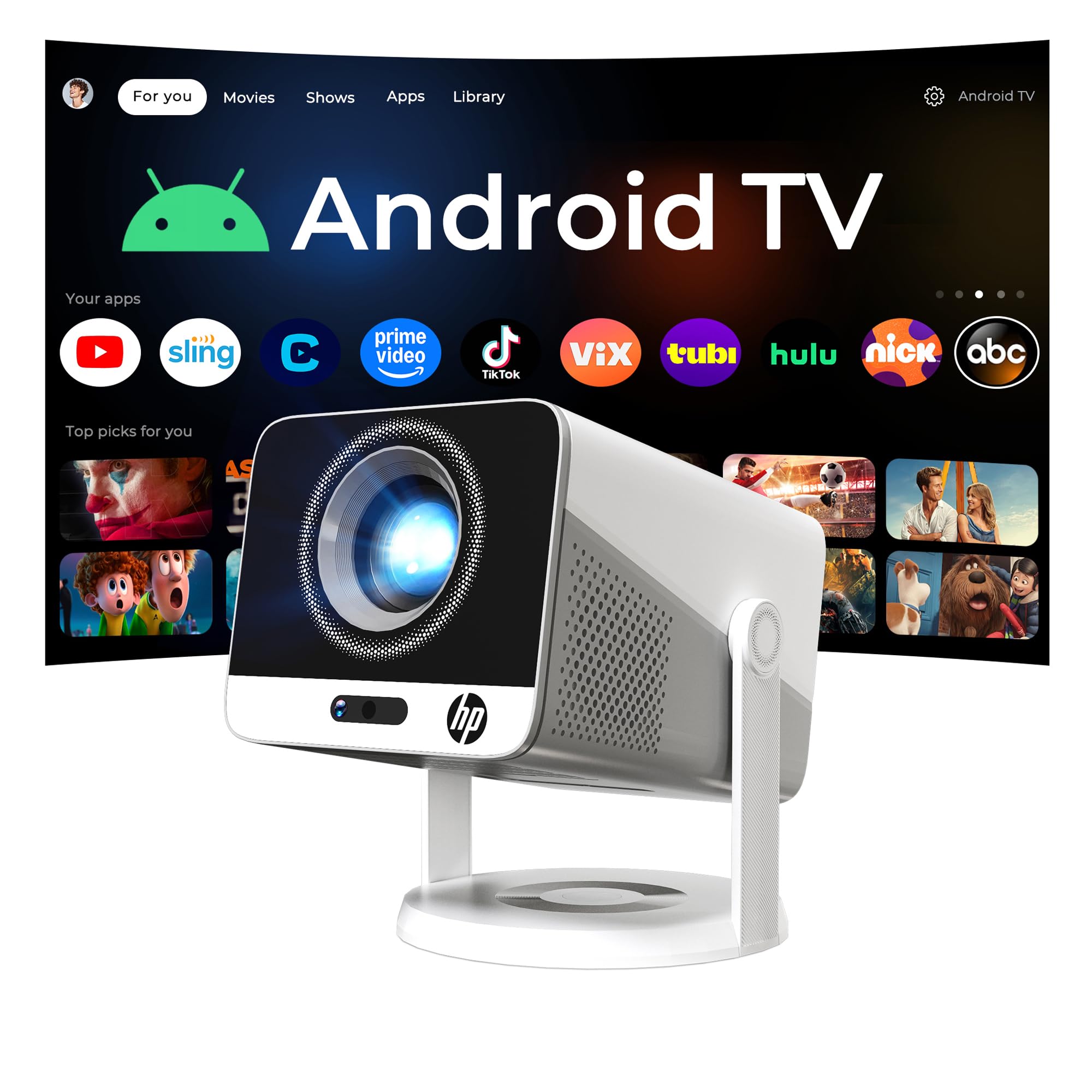
You want a big-screen picture without paying big-screen money, and one model here does that with the least fuss: the HP Projector with Apps MC425. It runs Android 14 built in, so you skip buying or plugging in a streaming stick. Its 1500:1 contrast (the gap between the darkest and brightest parts of the image) and 200 lm output (lumens, a measure of brightness) keep dark scenes readable. Want the brightest picture in this group instead? That is the 800 ANSI lumen X6 Pro. The picks below are ordered so you can find your own fit in about two minutes.
I’m Min — the founder and writer behind Gadgets Feed. This guide is built by comparing the manufacturers’ published specifications and the patterns across verified customer reviews, so you get each pick’s real strengths and trade-offs instead of marketing spin.
Budget projectors live or die on three things: real brightness, honest resolution, and whether the apps are actually built in. That last one saves you the cost of a streaming stick. Whether you are setting up a dorm wall or a backyard, this shortlist covers the best cheap projector picks, ranked by brightness, native resolution and built-in apps.
Our Picks at a Glance
How To Choose The Best Cheap Projector
Every buying decision here comes back to light. A projector makes a picture by throwing light at a wall, so the brightness figure is the single biggest factor in whether you get a usable image. Cheap projectors usually list brightness two different ways, and the labels are not interchangeable.
Read the brightness label, not the big number
ANSI lumens and ISO lumens are two ways of measuring the same thing — how much light actually lands on the screen. A brand that quotes a huge “lumens” figure without ANSI or ISO in front of it is usually quoting a lamp output number, not screen brightness. On this list, the listings that name ANSI or ISO give you something to compare. The HP MC425 uses 200 ISO lumens; the X6 Pro quotes 800 ANSI lumens; the TCL C1 quotes 230 ISO lumens. Those are the figures to weigh against your room.
Native resolution versus “supported” resolution
Native resolution is the actual pixel grid inside the projector. “Supported” or “decoding” resolution only means the projector can accept a higher-quality video file and then scale it down. A native 1080P projector puts 1920 x 1080 real pixels on the wall. A 720P projector that “supports 1080P” is still showing you a smaller grid. Look for the word native and a 1920 x 1080 figure.
Built-in apps versus plugging in a stick
A projector with Roku TV, Google TV or Android TV inside needs only Wi-Fi and an account. You skip buying a streaming stick and skip hunting for an HDMI port in the dark. The trade-off is that the app library is fixed by that system, so check the platform carries the services you actually watch before you commit.
Where you will put it matters as much as the spec sheet
Throw ratio describes how far the projector sits from the wall for a given screen size — a lower number means a bigger picture from closer in. A rotating stand or gimbal lets you aim at a ceiling from a bedside table without a tripod. If your room is small, these two features decide whether the projector is usable at all.
Quick Comparison
| Model | Best For | Brightness | Native Resolution | Smart System | Amazon |
|---|---|---|---|---|---|
| HP MC425 with Apps★ Best Overall | All-round pick | 200 ISO lumens | 1080P | Android 14 | Amazon |
| LYNCAST 600 ANSI Smart ProjectorBrightest Value | Brightest for the money | 600 ANSI lumens | 1920 x 1080P | Android TV | Amazon |
| Aurzen Roku TV E1RFeatherweight Pick | Smallest and lightest | 160 lumens | 1280 x 720 | Roku TV | Amazon |
| Boldever Roku TV 1080P Mini | Fastest autofocus | 200 ANSI lumens | 1920 x 1080 | Roku TV | Amazon |
| Aurzen Roku TV D1R air | Backyard and travel | 300 ANSI lumens | 1920 x 1080 | Roku TV | Amazon |
| LYNCAST X6 Pro | Largest picture | 800 ANSI lumens | 1080P | Licensed apps | Amazon |
| HAPPRUN Google TV Projector | Simplest interface | 400 lumens | 1920 x 1080 | Google TV | Amazon |
| TCL C1 Google TV | Brand-name polish | 230 ISO lumens | 1920 x 1080 | Google TV | Amazon |
| HAPPRUN 2000 ANSI 4K Decoding | Brightest room use | 2000 ANSI lumens | 1920 x 1080 | — | Amazon |
In‑Depth Reviews
1. HP Projector with Apps MC425
Our pick — 4.5+★ from 650+ verified ratings; the strongest balance of quality and price.
Runs its own apps, powers from a USB-C brick, and pivots 90 degrees onto a ceiling.
Android 14 is what makes this the group’s most complete package. Android 14 lives inside the projector, so Netflix, Prime Video, YouTube, Disney+ and Tubi are there the moment you log in — no streaming stick, no second remote, no HDMI cable to lose. You get a native 1080P picture at 200 ISO lumens, and a 1500:1 contrast ratio that is the figure behind the depth you see in dark scenes. If you are looking for one cheap projector to be the only projector in a spare room, this is the one to start with.
What also stands out is how you power and place it. The USB-C PD 3.0 input accepts 20V at 3.25A, so a 65W-or-higher power bank can run it — which turns a bedroom appliance into something you can carry outside. Its short-throw 0.8:1 ratio means the projector sits close to the wall and still fills it. The 90-degree rotating design throws the image onto a slanted ceiling with no stand, so ceiling viewing from your bed is a genuine option. Add WiFi 6 on both 2.4G and 5G bands and Bluetooth 5.4 for headphones, and the wireless side is genuinely sorted.
One honest catch: that 200 lm output is fine in a dark room and weak in a bright one. There is no way around that physics. Also, the power bank has to be 65W or higher — a smaller one simply will not run it, so check the brick before you plan an outdoor night. For the money, though, the built-in Android 14, the auto focus and auto keystone that square the image in seconds, and the short-throw flexibility give you a lot of usable projector.
Why This One Leads
- Android 14 with the big streaming apps already loaded — nothing extra to buy
- Native 1080P and a 1500:1 contrast ratio that holds its own in a dark room
- USB-C PD input at 20V / 3.25A, so a 65W power bank can take it outdoors
- Short-throw 0.8:1 ratio and a 90-degree rotating body — no stand needed for ceiling viewing
- WiFi 6 dual-band plus Bluetooth 5.4 for headphones and soundbars
What To Know Before Buying
- 200 ISO lumens needs a dim room; afternoon sunlight will wash it out
- The power bank must be rated 65W or higher — smaller ones cannot run it
- The remote needs 2 AAA batteries, which are not in the box
The right buy for: anyone who wants one projector that does the whole job — apps, picture and placement — without extra purchases.
Look elsewhere if: you plan to watch a lot in daylight, where you need far more light output than this provides.
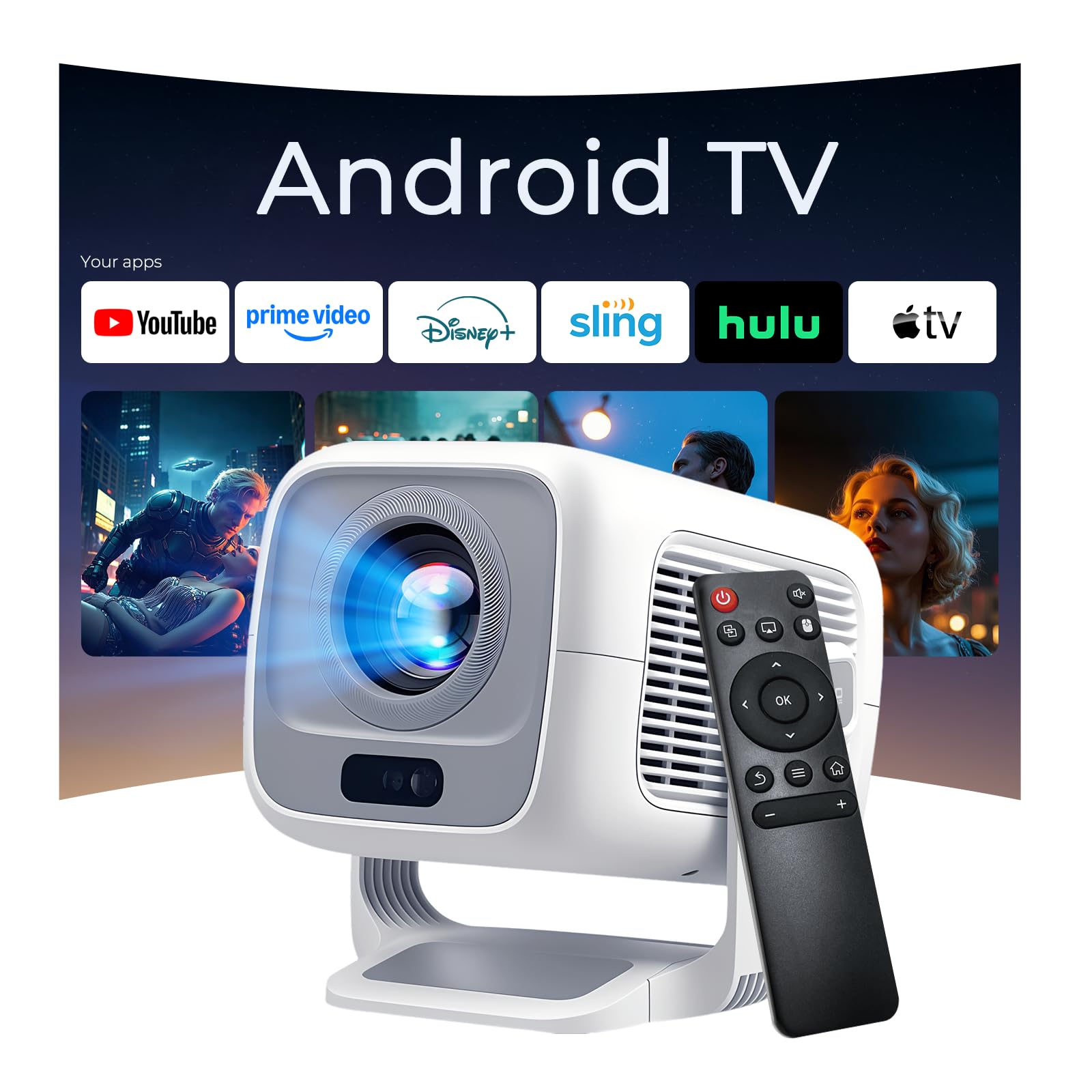
2. LYNCAST 600 ANSI Smart Projector
Three times the light output of the HP, at a lower cost — that is the whole pitch.
On the brightness number alone, this one is in a different league. It throws 600 ANSI lumens against the HP MC425’s 200 lm — a 3.0x gap — and backs that with a 10000:1 contrast ratio versus the HP’s 1500:1, a 6.7x gap in the black-level spec. In plain terms, bright scenes have more punch and dark scenes keep more shadow detail. If your viewing room has any ambient light at all, that extra output is the difference between a watchable picture and a washed-out one.
The rest of the package is built for the same job. Android TV is inside, so apps load straight from the home screen with no stick. A 270-degree rotating body lets you aim at a wall or a ceiling without a tripod. Auto focus and auto keystone handle setup, and the digital zoom lets you resize the image from where the projector sits. WiFi 6 and Bluetooth 5.4 cover the wireless end, and HDMI, USB and a 3.5mm jack handle anything you want to plug in.
Buyers consistently praise the picture, the quick setup and the everyday reliability. The honest gap is in the app world: some services, Disney and Netflix among them, can be awkward to get running, and the built-in sound is described as workable rather than good. Plan on a soundbar or headphones if audio matters. For the light output, though, it is the value play of this list.
The light-to-cost math: 600 ANSI lumens and a 10000:1 contrast ratio make this the most usable picture you can get in the budget tier — it beats the HP MC425 on both figures outright.
Where it gives ground: app compatibility is uneven and the onboard speakers are serviceable at best, so budget for a soundbar alongside it.
Buy this if: your room is never fully dark and you want the brightest picture your money can reach.
Think twice if: you stream exclusively on Netflix or Disney+ and want those apps to just work on day one.
3. Aurzen Roku TV E1R
A Roku TV in your hand at under a pound, with a strap where a handle should be.
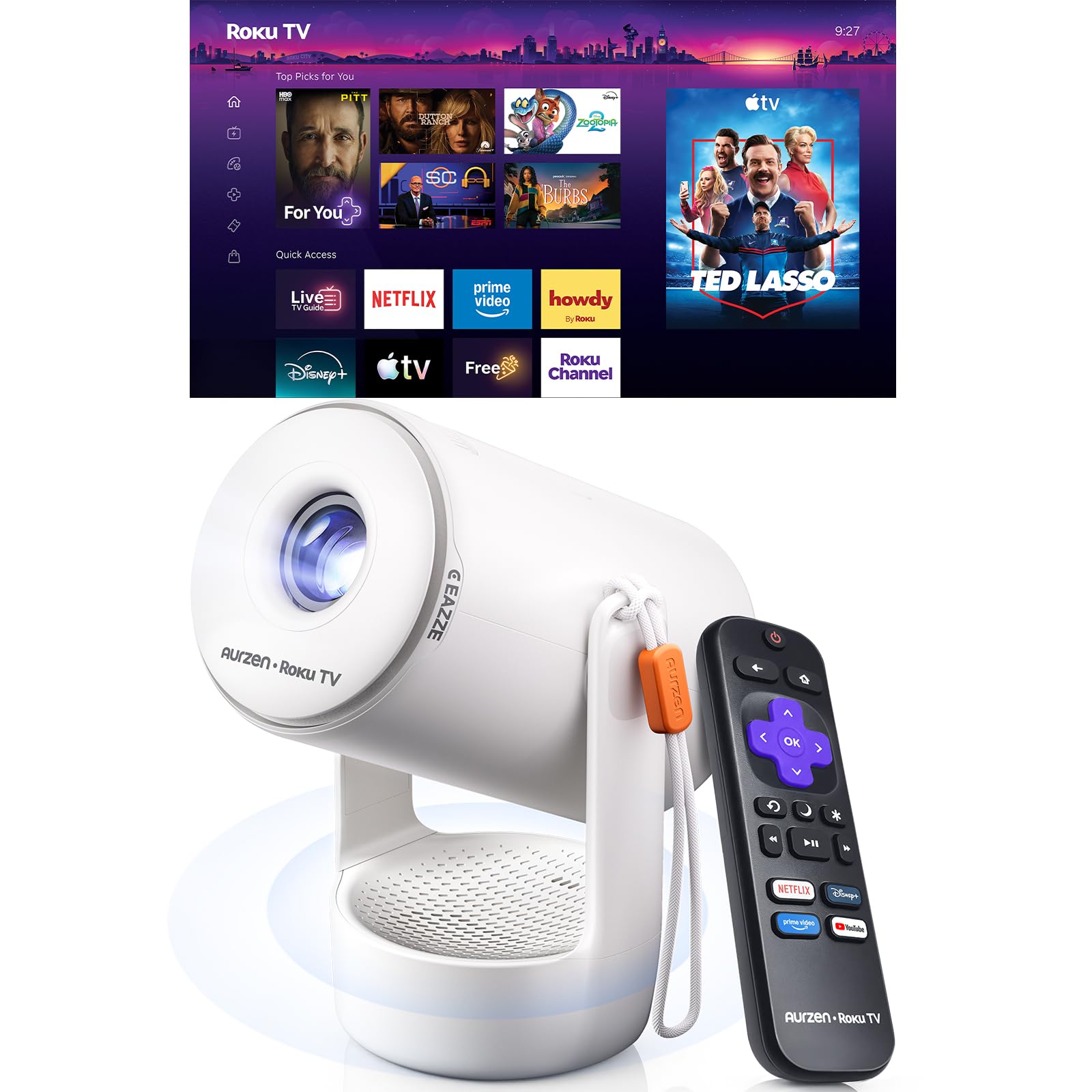
If the projector has to move — bedroom tonight, a friend’s place tomorrow — this is the shape you want. It weighs under 1 lb and has a built-in strap, so it travels like a small speaker rather than a piece of AV equipment. Roku TV is baked in, which means Netflix, Prime Video, Hulu, YouTube, The Roku Channel and Apple TV sit on one home screen with no dongle in sight, plus live sports and free movies and shows.
The 1.12:1 throw ratio is the practical detail that makes small rooms work: it can fill a 40 to 120-inch screen from a shorter distance, which is what you need in a dorm or a bedroom. A 180-degree rotating stand covers table and bedside placement, and auto vertical keystone squares the image while a top focus wheel fine-tunes sharpness. The sound chamber built into the base is 3× larger than the usual size and uses Dolby Audio, so dialogue comes through clearly. Two-way Bluetooth 5.2 means you can send audio to headphones or play music through the projector from your phone.
Set your expectations on resolution and light, because both are honest here. The display resolution is 1280 x 720 and the brightness is 160 lm — this is a dark-room, close-wall projector, not a living room centerpiece. It also needs a wall outlet, since there is no internal battery and the USB-C power input is not supported. The upside is that buyers praise the picture quality and easy setup, a combination that is hard to match under 1 lb.
What It Does Well
- Under 1 lb with a built-in carry strap — genuinely portable
- Roku TV built in, with Apple AirPlay for one-tap casting from an iPhone
- 1.12:1 throw ratio fills 40 to 120 inches from a short distance
- Base-mounted sound chamber with Dolby Audio and two-way Bluetooth 5.2
The Fine Print
- 1280 x 720 native resolution and 160 lm brightness — dark room only
- No battery, and USB-C power input is not supported, so bring the wall cable
- Lens needs a check every three months per the maker’s guidance
Made for: dorm rooms, bedrooms and anyone hauling a projector between places weekly.
Not the one for: a bright living room or a big-screen daylight setup, where 160 lm and 720P will fall short.
4. Boldever Roku TV 1080P Mini Smart Projector
Focus lands in under two seconds, and every pixel on the wall is real.
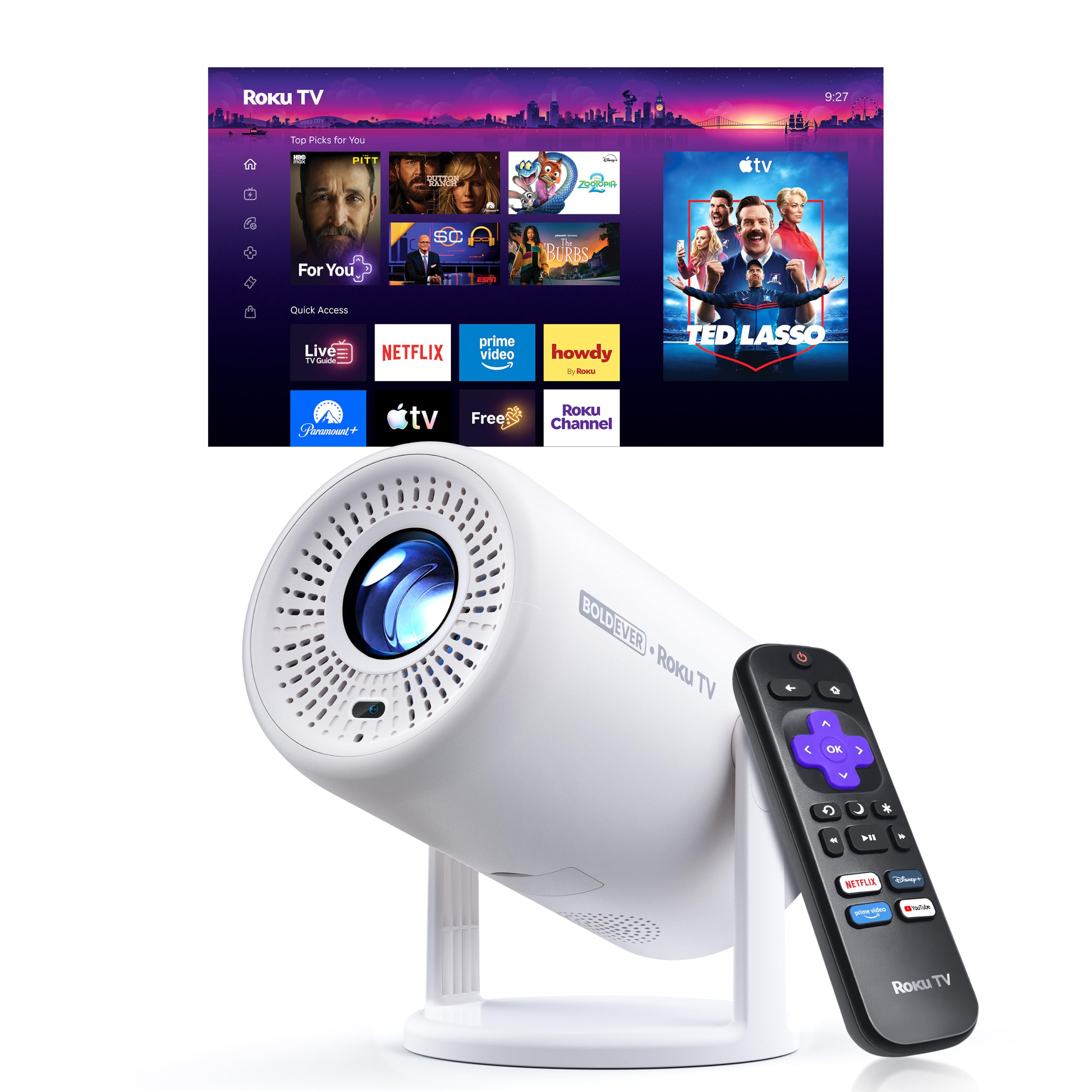
The autofocus is the headline. It uses ToF — time-of-flight — technology, which measures the distance to your wall with a sensor rather than hunting for contrast. The maker states that focus completes in under 2 seconds, against up to 10 seconds for traditional ceiling projectors, and it happens without the black screen or flashing grid you see on cheaper autofocus systems. Auto keystone then squares the picture. Point it, turn it on, and the image is ready.
The resolution claim deserves credit for honesty. This is true native 1080P at 1920 x 1080 pixels, not a 720P panel that accepts a 1080P signal. At 200 ANSI lumens you will want a dark room, but the detail that resolution buys you shows up in text, sports graphics and faces even on a large screen. Six picture modes — Roku Smart Picture, Vivid, Standard, Eco, Movie and Sports — let you shift the image toward the content.
Sound and connection are handled without extra boxes. Dolby Audio covers dialogue, two-way Bluetooth 5.2 lets you stream music from your phone into the projector or push audio out to a speaker, and HDMI ARC makes a soundbar a one-cable job. Dual-band Wi-Fi on 2.4GHz and 5GHz keeps streaming steady, and official Apple AirPlay means an iPhone or Mac casts with no third-party app. The one limit is brightness: it works best in a dark room, which the listing itself points out. At 1.6 lbs it also travels easily.
Trading on speed: under-2-second ToF autofocus plus auto keystone means no fiddling — this is the quickest setup on the list, and the native 1080P panel is the genuine article.
The honest limit: 200 ANSI lumens is a dark-room figure, so plan your viewing space around low light rather than fighting daylight.
Worth choosing when: you move the projector around and want it perfectly focused before you sit down.
Ruled out when: your wall gets direct sun, because no amount of fast focus fixes a 200-lumen picture in daylight.
5. Aurzen Roku TV D1R air
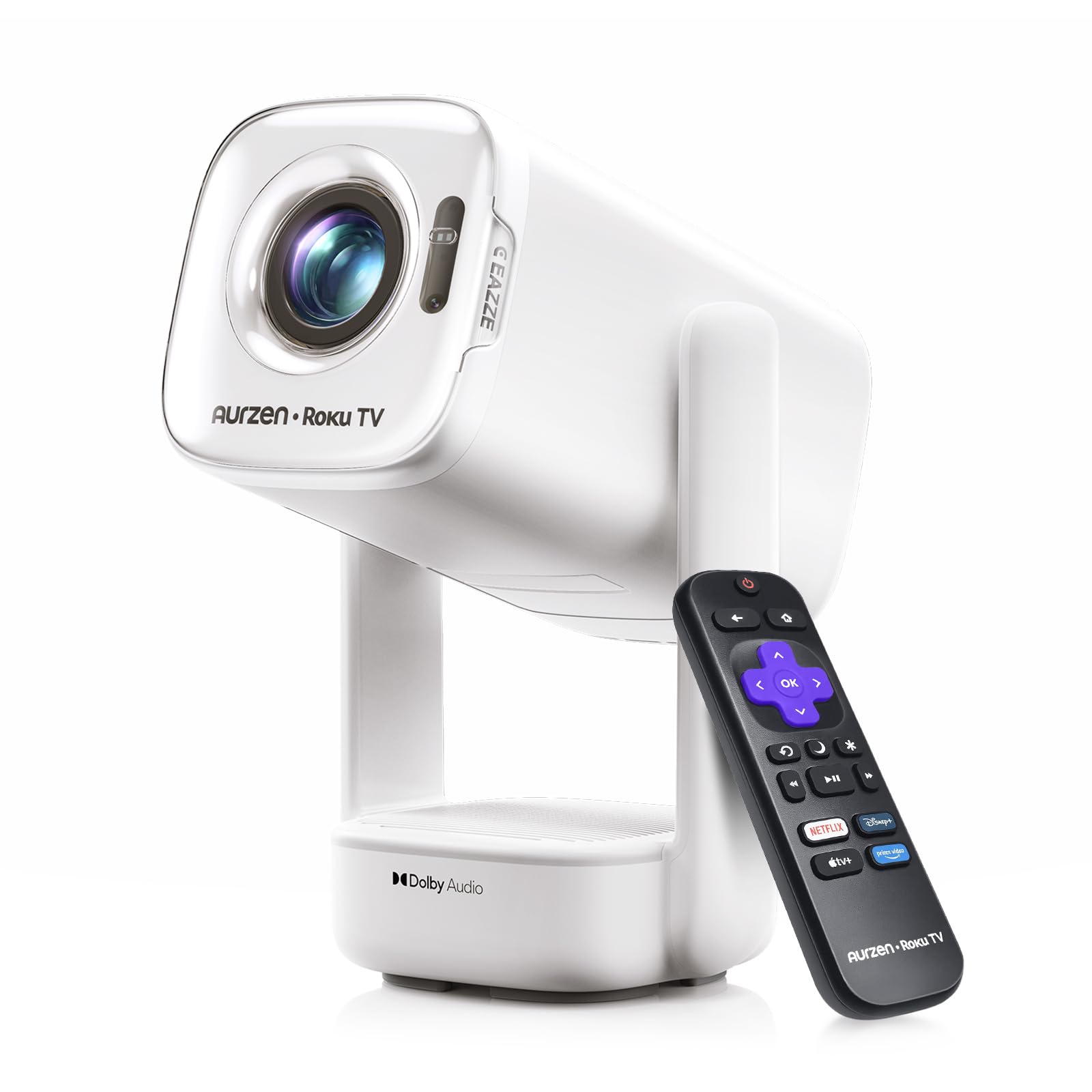
Built to escape the wall socket and still put a straight picture on a backyard screen.
This is the list’s outdoor specialist, and it earns the label three ways. First, the power: it takes a 65W-or-higher USB-C PD source at 20V/3.25A, so a compatible power bank, laptop charger or the maker’s own PowerBase stand can run it away from an outlet. Second, the body: it weighs 1.18 kg (2.60 lb) and uses a smooth-damping gimbal stand that holds its position without sinking. Third, the cable routing — the power input sits at the bottom rather than the side, so cables stay out of the rotation path instead of snagging as you aim it.
Picture and sound are sized for the job. Native 1080P resolution and 300 ANSI lumens give you a clear picture in a dim room or outdoors after dark, and six picture modes cover the different looks. Audio comes from dual 5W speakers mounted in the independent base rather than the projector body, which creates a larger sound chamber — clearer dialogue and less vibration. Dolby Audio, dual-band Wi-Fi, Bluetooth 5.2 and ports for HDMI, USB, audio out and USB-C fill out the connections.
Roku TV is built in, with the standard apps plus 500+ live channels, and you get TOF autofocus and auto keystone so the image stays straight when you move rooms. Fan noise runs 29-35 dB at a metre depending on mode, which is a soft background hum you will notice in quiet scenes. The practical catch is the wall charger: you need a 65W+ USB-C PD source and a 5A E-Marker cable, and neither is necessarily in the box. Plan for that and the outdoor side works exactly as intended.
The Case For It
- Runs from a 65W+ USB-C PD power bank — genuinely free of the wall outlet
- Native 1080P at 300 ANSI lumens, with six picture modes
- Dual 5W speakers in the base for fuller dialogue and less vibration
- Bottom-mounted power input keeps cables clear of the rotating gimbal
Plan Around This
- Needs a 65W+ USB-C PD charger and a 5A E-Marker cable, sold separately
- Fan noise runs 29-35 dB at one metre
- No HDMI cable included in the box
Reach for this if: backyard movie nights, camping and game-day watch parties are your main use.
skip it if: you only ever watch in one fixed room where a wall-powered unit would do the same job.
6. LYNCAST X6 Pro
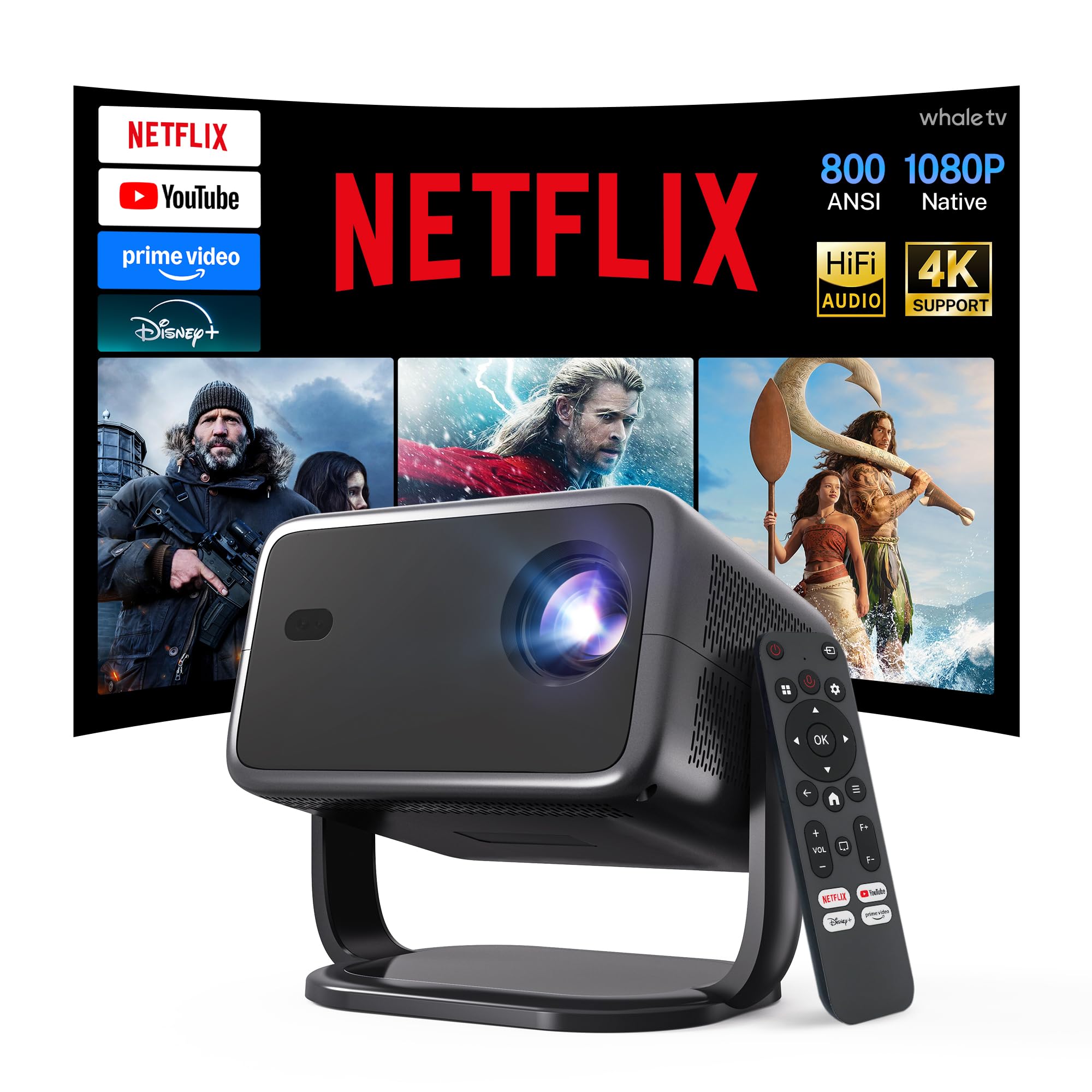
The brightest panel here, and the only one built to fill a 200-inch screen.
Start with the numbers that drive the picture. It puts out 800 ANSI lumens with a 10000:1 contrast ratio — a huge jump over the 200 lm and 1500:1 of the HP MC425. That combination produces deeper blacks and brighter whites, and makes a 200-inch image viable rather than washed out. Whether you are projecting across a den wall or into a backyard at night, the light is there.
Setup takes seconds rather than minutes. The 3-second AI visual calibration handles auto focus and auto keystone, and it also does obstacle avoidance, so it adjusts if something is in the frame. A 50 to 100 percent zoom lets you size the image without moving the projector. Around the back you get HDMI with CEC and ARC, USB and a 3.5mm audio jack, so laptops, TV sticks, phones and DVD players all connect. The 360-degree rotating design lets it sit on a table or mount to a ceiling and project straight up.
You get Netflix, Prime Video, YouTube, Disney+ and Hulu without adding a streaming stick, because the licensed app suite covers 1000+ apps. The licensed remote has a voice assistant, so you can search or change the volume just by speaking. Cooling runs under 28 dB (decibels, a measure of sound), so quiet movie scenes stay quiet. Be honest with yourself here: the gap between this and the 600 ANSI model two spots up is mostly that 28 dB figure and the voice remote. If neither matters to you, the cheaper unit gives similar light. Pick the X6 Pro when you want the biggest, brightest picture in this lineup.
Where it wins: 800 ANSI lumens and a 10000:1 ratio are the strongest light figures on this list, and 3-second auto calibration takes the guesswork out of placement.
Worth weighing: the leap over the 600 ANSI model is smaller than the price tag suggests — that gap buys you the voice remote and the under-28 dB cooling, not more picture.
Pick this for: a big-screen movie room where you want the brightest image and a voice remote in one box.
Look past it if: you are happy with 600 ANSI lumens and would rather keep the difference in your pocket.
7. HAPPRUN Google TV Projector

If you already use Google TV, this projector runs the same interface from the start.
Netflix, Prime Video, YouTube and Hulu sit right on the home screen with no extra device, because licensed Google TV is built in. That is the reason to look here. The Google Voice Assistant lets you open an app, search for a movie, adjust the volume or check the weather by holding the button and talking. It is the same interface as a Google TV set, so there is almost nothing new to learn.
Around that, the hardware is sensible. It outputs 400 lm with a 2000:1 contrast ratio at 1920 x 1080 native resolution, and the 300-inch maximum screen means it can go big if your wall allows. Three installation options — ceiling, desktop or tripod — cover the usual room layouts. Wi-Fi 6 keeps streaming stable, Bluetooth 5.2 connects a premium sound system or wireless headphones, and a built-in 5W speaker with Dolby support covers casual viewing. HDMI, USB and a 3.5mm jack handle wired sources.
The honest part: sound quality and brightness both come up mixed in owner feedback — the audio is fine for dialogue and the picture is fine for a dim room, but neither is the reason to buy this. What buyers actually praise is the picture quality for the price and Google TV’s no-fiddling interface. Buy it for the Google TV interface and the value, not the 400 lm brightness.
Strong Points
- Licensed Google TV with the major apps preloaded, no stick needed
- Voice search, volume and weather through the Google Assistant remote
- Wi-Fi 6 and Bluetooth 5.2 with three mounting options
- Up to a 300-inch image from a short-throw design
Keep In Mind
- 400 lm and a 2000:1 ratio suit a dim room, not a bright one
- The 5W speaker is workable for dialogue but not a cinema experience
- Brightness is the most-debated point in owner feedback
Fits you when: you want the Google TV remote you already know, plus a sub–class native 1080P picture.
Not for you when: your room is bright or your ears expect more than a single 5W speaker can give.
8. TCL C1 Smart Google TV Projector

The one from the TV maker, with a sealed light engine and a 30,000-hour lamp.
TCL builds televisions, and that shows in the software. Google TV is on board with Netflix, Prime Video, YouTube, Hulu and HBO ready to go, plus access to more than 10,000 apps through the Play Store and Google Assistant voice control. You also get HDR10 and 4K video compatibility alongside native 1080P resolution, with four visual modes tuned for different content.
The physical build is the part most cheap projectors ignore. A fully sealed optical engine keeps dust and humidity away from the internals, which is what protects picture quality over years rather than months. The lamp is rated at 30,000 hours, and maintenance is a lens wipe. The 285-degree rotatable handle stand aims anywhere from 40 to 120 degrees, and the unit weighs 1.77 kg. Intelligent screen adjustment handles autofocus, auto keystone, obstacle avoidance and screen sizing automatically. An 8W speaker with Dolby Audio runs below 30 dB of fan noise, so quiet scenes stay quiet.
Be careful reading the brightness label. It quotes 230 ISO lumens, and the listing argues that ISO lumens cannot be falsified the way ANSI figures can. That is a fair point, but 230 ISO lumens still means a dark room — the picture is bright and clear in a pitch-dark space and only good in a partially lit one. Ports run to HDMI 2.1, USB 2.0 and 3.5mm audio, with a standard quarter-inch mount for tripods and walls.
The long-haul angle: a sealed optical engine plus a 30,000-hour lamp rating is the durability argument nothing else on this list makes.
The light reality: 230 ISO lumens is an honest figure, and honest means dark-room viewing — partial light is where it starts to struggle.
Best matched to: buyers who want a recognized TV brand, a dust-proof engine and a long lamp life over raw brightness.
Wrong turn if: you want to watch with the lights on, where 230 ISO lumens cannot do the work.
9. HAPPRUN 2000 ANSI 4K Decoding Projector

The only one on the list that claims enough light to fight a lit room.
The brightness figure is the entire reason this projector is here. It claims 2000 ANSI lumens with a 20000:1 contrast ratio and a 95% color gamut. Put next to the 200 ANSI lumens and 10000:1 of the Boldever, the light output is in a completely different bracket. If your room has lamps on or windows nearby, that is the spec that decides whether the picture survives. It also supports 4K decoding, so high-resolution files play back at their source quality with the panel handling the display.
Setup is handled by AI. Auto focus plus 6D auto keystone squares the picture within 5 seconds of startup, and it adds auto obstacle avoidance and auto screen alignment. You can set it on a table, a bedside surface, a wall mount or the ceiling, and it adapts. A 300-inch maximum display with 50% zoom gives you room to size the image. The audio side is a built-in 8W HiFi speaker with bidirectional Bluetooth 5.2 — pair external speakers, or use the projector itself as a Bluetooth speaker for music from your phone. Wi-Fi 6 covers both 2.4GHz and 5GHz networks for screen mirroring from iOS and Android.
Two things to know before you buy. First, an autofocus limit: place it level and perpendicular to the wall, because the focus function fails if the angle goes past 15 degrees. Second, Disney+, Prime Video and Hulu are not built in — those require a Chromecast, dongle or TV stick due to app licensing. The ports are generous (two HDMI, two USB, AV and a 3.5mm jack), so a stick is easy to add, but budget for one if those services matter.
Where It Delivers
- 2000 ANSI lumens and a 20000:1 contrast ratio — the brightest on this list
- 95% color gamut and 4K decoding support
- 8W HiFi speaker plus bidirectional Bluetooth 5.2 for speaker mode
- Wi-Fi 6 with both 2.4GHz and 5GHz bands
Before You Commit
- Needs a level, perpendicular setup — autofocus fails past 15 degrees of angle
- Disney+, Prime Video and Hulu require a streaming stick or dongle
- No smart TV system built in, unlike the Roku and Google TV units here
The call for: bright rooms, backyard parties and anyone who values light output over built-in apps.
Skip past it if: you want one box with the apps inside and no streaming stick to manage.
Understanding the Specs
ANSI Lumens vs ISO Lumens
Both measure how much light reaches the screen, but the two standards use different test procedures. ANSI lumens is the older, more common label; ISO lumens is a newer standard that brands like TCL lean on. The two numbers are not directly interchangeable, which is why a 200 ISO lumen projector and a 600 ANSI lumen projector are further apart than the raw digits suggest. What matters for you is the number on the box, not the marketing word: below about 300 lumens is a dark-room projector, and higher figures buy you tolerance for ambient light.
Contrast Ratio
Contrast ratio describes the gap between the brightest white and the darkest black the projector can produce. A 10000:1 ratio gives you more separation in shadowed scenes, while a 1500:1 ratio tends to look flatter in dark content. It is not a brightness measure, so do not confuse a high contrast figure with a bright picture — a projector can have a strong ratio and a dim lamp. Read it alongside the lumen figure.
Throw Ratio
Throw ratio is the distance to the wall divided by the image width. A lower number means a bigger picture from a shorter distance, which is what small bedrooms and dorms need. The Aurzen E1R’s 1.12:1 ratio is designed to fill 40 to 120 inches from close range, while the HP MC425’s 0.8:1 short-throw ratio lets it sit even nearer the wall. If your room is tight, this is the spec to check before anything else.
Auto Focus and Keystone Correction
Autofocus adjusts the lens until the image is sharp. Keystone correction squares up a picture that has been aimed at an angle by digitally reshaping the image. They usually work as a pair, and the difference between models is speed. The Boldever uses ToF sensing to focus in under 2 seconds; the X6 Pro does it in 3 seconds; the HAPPRUN 2000 ANSI model does it within 5 seconds of startup. Faster means less time staring at a blurry wall.
FAQ
Will a cheap projector work with my iPhone?
Do I need a streaming stick with these projectors?
How dark does my room need to be for 200 ANSI lumens?
What is the difference between native 1080P and 1080P supported?
Can these projectors run from a power bank?
How loud is the fan on these budget projectors?
Can I project onto the ceiling from my bed?
How long will the lamp last before it needs replacing?
Do these projectors have HDMI for a games console or laptop?
Is a 720P projector good enough for movies?
Final Thoughts: The Verdict
For most people, the cheap projector that makes the most sense is the HP MC425. Android 14 is already inside, so there is no stick to add. Its 0.8:1 short throw (the throw ratio, meaning it sits close to the wall for a big picture) fits small rooms. The 90-degree body lets you aim at the ceiling for lying-down viewing without a stand. If light output is your priority and your room is never fully dark, the LYNCAST 600 ANSI gives you far more brightness for less money. And if you need to carry it outside and run it off a power bank, the Aurzen D1R air is the one built for that job.
One spec worth trusting: the HP MC425 and the Boldever both hold a 4.5+ rating, and the HP does it with the larger owner base of the two, making it the crowd favorite of this group. Whatever you pick, buy for your room’s light level first and its size second. Match those two to your room and a budget projector stops feeling like a compromise.
How We Picked
We do not accept paid placement. Every pick is matched to a real buyer and a real use-case; we do not hands-on test units.
Sources & Methodology
Specifications: manufacturer listings and product documentation. Review insights: verified customer reviews, as of November 2026. Pricing: not shown on this page (it changes often); check the current price via the retailer link.
As an Amazon Associate, Gadgets Feed earns from qualifying purchases. This does not affect which products we feature.