
Our readers keep the lights on and my morning glass full of iced black tea. As an Amazon Associate, I earn from qualifying purchases.
Specs are compiled from manufacturer listings and verified buyer reviews and can change over time — please confirm the key details on the product page before buying.
If you only buy one thing for measuring out 10 mL, buy a glass serological pipette with a stated Class A tolerance — that single number tells you how far off the delivered volume can be, and most cheap import pipettes simply never publish one. The rest of this list splits into two very different tools: fixed-volume glass and plastic pipettes you fill by mouth or by bulb, and adjustable mechanical pipettors with a plunger button you dial to the volume you want. Decide which of those two you need before reading a single spec — they are not interchangeable.
I’m Min — the founder and writer behind Gadgets Feed. This guide is built by comparing the manufacturers’ published specifications and the patterns across verified customer reviews, so you get each pick’s real strengths and trade-offs instead of marketing spin.
Glass or plastic, fixed or adjustable — that fork in the road decides everything else, including how much you will spend and how often you replace the thing. Below you will find the nine picks that hold their stated tolerance, ranked and explained for the way you actually pipette, in this 10 ml pipette breakdown written for working benches and classroom labs alike.
Our Picks at a Glance


How To Choose The Best 10 ML Pipette
Before anything else, ask what you are actually moving. A 10 mL pipette in a teaching lab that runs two protocols a week is a different purchase from one in a research bench that runs forty a day. That answer alone decides if you want glass you wash and reuse, sterile plastic you unwrap and throw away, or a mechanical plunger tool with a dial on top.
Fixed Volume Or Adjustable Volume
A serological pipette does one volume — 10 mL — and does it with a printed scale you read by eye. You control the liquid by squeezing a bulb or a pump. An adjustable pipettor does a whole range instead: the ONiLAB spans 2-10 ml, so it covers 10 mL and everything under it. The trade-off is cost and cleaning. Serological pipettes are cheap and near-indestructible, while a mechanical pipettor has moving parts and a tip cone that needs care.
The Tolerance Number Is The Real Spec
Tolerance tells you the worst-case error on a delivered volume. The EISCO Class A glass pipette states ±0.050 ml, while the ONiLAB glass set states ±0.1 ml — the Class A figure is the tighter of the two. Buyers in this category who care about reproducibility read that line first and the capacity line second. If a listing never prints a tolerance, treat that silence as a signal about the maker’s confidence.
Glass, Polystyrene, Or Something With A Plunger
Borosilicate glass survives an autoclave and a flame and a hot wash, which is why it lives on a shelf for years. Polystyrene is optically clear and comes sterile, but it is a one-and-done consumable. A mechanical pipettor sits in its own lane entirely: it needs matching tips, and at least one pick here is explicitly not suitable for oils and high-viscosity liquids. Match the material to the liquid: glass for thick or hot samples, polystyrene for sterile single-use draws.
Sterility And Wrapping Decide Your Prep Time
A sterile, individually wrapped pipette removes a step: you tear the sleeve and you are ready. Non-sterile glass adds a wash-and-rinse cycle. For a plasma or cell-culture protocol the sterile pack is worth the money. For a brew gravity reading or a fish tank test it is wasted spend, and plain reusable glass will do the same job without the wrapper.
Quick Comparison
| Model | Best For | Type | Stated Tolerance | Pack / Weight | Amazon |
|---|---|---|---|---|---|
| ONiLAB Lab Micropipette 2-10ml★ Best Overall | Adjustable everyday plunger work | Mechanical, adjustable | — | 1 unit / 6.3 ounces | Amazon |
| EISCO Serological Pipette 10ml Class ATightest Tolerance | Tight glass accuracy on a budget | Borosilicate glass, fixed | ±0.050 ml | 1 unit / 1.6 ounces | Amazon |
| LACHOI Lab Single Channel Pipettor 1-10mlWidest Range | Widest adjustable range on a budget | Mechanical, adjustable | — | 1 unit / 6.4 ounces | Amazon |
| ONiLAB 10mL Glass Graduated Pipettes | Reusable glass in a ten-pack | Sodium calcium glass, fixed | ±0.1 ml | 10 pcs / 9.9 ounces | Amazon |
| 4E’s USA 1-10mL Pipette | Long repetitive sessions, low hand strain | Mechanical, adjustable | — | 1 unit / 8.8 ounces | Amazon |
| Polystyrene Serological Pipettes 10ml, 50 Pack | Larger sterile runs on plastic | Polystyrene, sterile, fixed | — | 50 pcs / 1.56 pounds | Amazon |
| Serological Pipette 10ml/Orange, Case of 100 | High-volume sterile glass-free work | Polystyrene, sterile, fixed | within ±2% | 100 pcs / 2.59 pounds | Amazon |
| Celltreat 229210B Serological Pipet 10mL | Big sterile runs with a filter plug | Polystyrene, sterile, fixed | — | 200 pcs / 6 pounds | Amazon |
| MicroPette Single-Channel Pipettor 2-10 ml | Precision plunger work with support | Mechanical, adjustable | — | 1 unit / 8 ounces | Amazon |
In‑Depth Reviews
1. ONiLAB Lab Micropipette, Single Channel Adjustable Pipettor, 2-10ml
Our pick — 4.0+★ from 200+ verified ratings; the strongest balance of quality and price.
One dial covers 2 ml to 10 ml, so a single tool replaces a drawer of fixed pipettes.
The range is what earns this the top slot. You get an adjustable span from 2 to 10 ml on one instrument, which is twice the reach of the LACHOI that starts at 1 ml and stops at 10 ml on a narrower band. Every unit ships with its own individual calibration certificate, so you have a paper trail for the delivered volume before you ever draw liquid. The lower half can be autoclaved, which means the part that touches contaminated sample cleans up without you buying a second instrument.
The everyday usability is where it pays off. A large display window shows the set volume so you are not squinting at a dial mid-protocol, and the ergonomic body is built to be held through a long session rather than a single draw. Calibration and maintenance are designed to be done by the owner. At 6.3 ounces it sits light in the hand, and owners doing chemistry work report the plunger action and bench accuracy hold up as expected.
The honest catch is build quality. Owners split hard on this one: some call the quality excellent and are happy with what they paid, while others describe it as poor quality and not worth the outlay. Pumping performance is the single area where the gripes cluster, so treat the plunger with normal mechanical respect rather than slamming it home. Buy it for the 2-10 ml adjustable range and the calibration certificate, not for premium instrument feel.
What earns it the top slot
- Adjustable 2-10 ml span covers 10 mL and everything beneath it on one instrument
- Ships with an individual calibration certificate for each unit
- Lower half is autoclave-safe, so the sample-contact end cleans up properly
- Large volume display window removes mid-protocol guesswork
Where it asks for care
- Build quality divides opinion — some find it excellent, others poor for the outlay
- Pumping performance is the recurring weak point, so ease the plunger rather than forcing it
- Needs matching tips, which is one more thing to keep stocked
Worth it for: anyone who wants one adjustable instrument spanning 2 to 10 ml with a calibration certificate in the box.
Think twice if: you expect premium instrument feel — the quality split among owners is the real story here, not the spec sheet.
2. EISCO Serological Pipette, 10ml – Class A, Tolerance ±0.050ml – Blue Graduations – Borosilicate Glass
A half-tenth of a millilitre of allowed error, in a tube that weighs almost nothing.
Start with the number that matters. This pipette carries a Class A tolerance of ±0.050 ml, verified against the DIN IS 835 standard — half the ±0.1 ml the ONiLAB glass set allows. When your protocol lives or dies on a reproducible delivered volume, that gap is the whole reason to pick this one over a cheaper bundle. It is calibrated for delivery to jet, which means you blow out the last drop rather than shaking it down, and the 0.1 ml graduation lines marked every 1 ml keep the reading clean.
The physical build is a different argument entirely. Borosilicate 3.3 glass gives it chemical durability and a low temperature gradient, so it takes high temperatures and thermal shocks without flinching, and it is autoclavable. At 1.6 ounces it is the lightest instrument on this list by a wide margin — the ONiLAB glass ten-pack weighs 9.9 ounces, so a single EISCO tube is a fraction of one bundle’s heft in the hand. Blue graduations with an orange colour code mean you can confirm the 10 ml size at a glance in a drawer of mixed glass.
Here is the trade you are making. One tube, hand-read scale, no plunger — you supply the bulb or the pump and you supply the patience. Nothing here tells you an error figure in a display; you read it off the wall of the glass. For a classroom demo or a professional bench doing fixed 10 ml transfers, that is exactly enough. For someone who wants to dial 3.7 ml and forget about it, the adjustable picks above and below are the right call.
Editor’s read: this is the accuracy play, full stop. Class A at ±0.050 ml against the ONiLAB glass set’s ±0.1 ml is not a rounding difference when you are chasing reproducibility.
The cost of that accuracy: it is a single fixed-volume tube with no plunger, so speed and convenience are what you give up for the tighter tolerance.
Reach for this if: your work demands the tightest stated tolerance and you are comfortable reading a glass scale by eye.
Leave it for the plunger tools if: you need variable volumes — this one delivers 10 ml and only 10 ml.
3. LACHOI Lab Single Channel Pipettor Adjustable Variable Volume, 1-10ml
A full millilitre of extra reach at the bottom of the dial, for the money.
Where the ONiLAB adjustable starts at 2 ml, this one starts at 1 ml and climbs to 10 ml in 0.1 ml increments. You rotate the piston button to set the volume and read it off the digit display — no separate tool, no guesswork. That extra lower millilitre is the entire pitch: if your bench runs 1 ml draws and 10 ml draws in the same afternoon, one instrument covers both ends where the narrower-range tools do not.
The mechanical details are sensible for the price bracket. A steel wire spring set runs the plunger, described by the maker as high strength with fast rebound and no deformation, which is what gives the button its feel. The lightweight ergonomic handle is shaped to reduce the risk of repetitive strain over long sessions. The tip cone disassembles and autoclaves at 121°C for 20 minutes, so the contaminated end cleans up without touching the rest of the body. Beyond the lab, it is sold for pool water testing, brew work and fish tank checks.
One constraint deserves to be stated plainly, because it decides suitability before anything else: the maker says this pipettor is not suitable for oils and high-viscosity liquids. If your sample is thick, look at the glass picks instead. It is also the lowest-rated instrument on this list at 3.5+ out of 5, which tells you the adjustable-import bracket is a mixed bag on consistency. Look at it as the range-per-unit it is, not as a precision instrument.
The case for the extra reach
- Covers 1-10 ml, a full millilitre wider than the 2-10 ml ONiLAB at the low end
- 0.1 ml increments set by rotating the piston button, read off a digit display
- Tip cone removes and autoclaves at 121°C for 20 minutes
- Steel wire spring set is built for rebound and no deformation
Read before you buy
- Not suitable for oils or high-viscosity liquids, per the maker
- Lowest rating on this list, so consistency is the open question
- Like any plunger tool, it needs matching tips and a gentle touch
Pick this if: you bounce between 1 ml and 10 ml in the same session and want one tool instead of two.
skip it if: your sample is oily or thick — the maker rules that out outright.
4. ONiLAB 10mL Glass Graduated Pipettes, 10 Pcs, ±0.1mL Tolerance

Ten reusable glass tubes, so a broken one is not the end of your week.
Glass breaks. That is the argument for a bundle, and ten pieces at a stated ±0.1 ml tolerance softens the sting when one goes off the bench. The scale is clear and standard against the wall of the tube, so measuring by eye is straightforward. Suction is good enough to move the right amount of liquid without dripping or spilling — the maker pitches it for collecting and dispensing, and it behaves like a proper transfer tool rather than a dropper.
The material is sodium calcium glass, described as thick and durable and chosen to survive high-temperature, high-pressure lab environments. That is a different glass from the borosilicate 3.3 in the EISCO above, and the two differ on tolerance as well — this set allows ±0.1 ml where the EISCO Class A holds ±0.050 ml. Ten tubes at 9.9 ounces total work out to roughly a single ounce each in the hand, which is why a full rack feels lighter than you expect. The maker also replaces anything that arrives shipping-damaged.
One handling rule comes straight from the manufacturer and it is worth following: hold the dropper near vertical while drawing liquid, and keep the tip away from other objects after you pull it out so you do not contaminate the sample. Practical, not fussy. If you want the tightest published tolerance, the EISCO wins that fight. If you want a working stock you can afford to break, this is the sensible buy.
Handling note: draw with the tube near vertical and keep the tip clear of other surfaces after lifting it — the maker’s own guidance for keeping the sample clean.
Where it lands: a good-value working stock at ±0.1 ml, a step behind the Class A EISCO on stated accuracy but far ahead of it on quantity.
Buy it when: you want reusable glass for daily work and can live with ±0.1 ml rather than Class A.
Look at the EISCO instead when: tolerance is the deciding spec and one tube is enough.
5. 4E’s USA Lab 1-10mL Pipette: Single-Channel Adjustable Micropipette with Color-Coded Top (Grey)
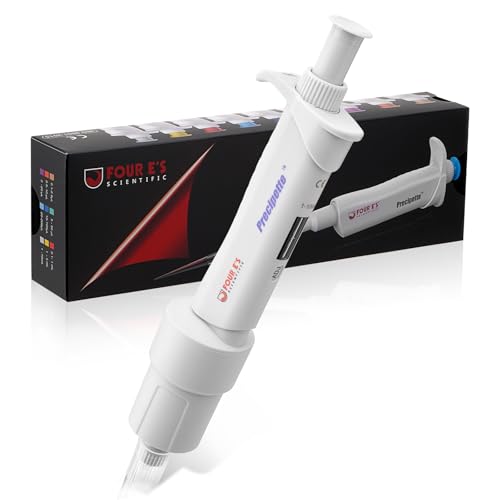
Built for the fortieth draw of the day, when your thumb is the thing that gives out.
The design brief here is repetitive strain, and it shows. A low-force plunger and a comfortable grip are shaped around long sessions, so the motion that wears on your hand is deliberately lightened. A four-digit micrometer with overlapping volume ranges lets you read and set the volume precisely, and the soft touch tip ejector pops the tip off without a fight. The body uses high-tech synthetic materials chosen for resistance to high temperature and corrosion, which matters when the instrument lives near a hotplate.
It is calibrated to ISO 8655, and a specific calibration tool ships in the package so you can check and adjust it yourself later rather than sending it away. The lower portion is autoclavable, so the sample-contact end gets properly cleaned. A grey colour-coded top identifies it at a glance in a shared rack — useful when more than one person works the same bench. The maker calls it lighter than a cup of coffee, but the published figure is 8.8 ounces — the heaviest plunger tool here — so judge the feel in your own hand.
The deciding question is whether ISO 8655 calibration and a self-service adjustment tool are worth more to you than the raw volume range. It spans 1-10 ml, matching the LACHOI, and it costs more for the calibration paperwork and the low-force action. If you pipette for hours, that trade makes sense. If you draw ten samples a week, the budget plunger tools above will do the same job.
Where the design earns its keep
- Low-force plunger and contoured grip aimed squarely at repetitive strain
- Calibrated to ISO 8655 with a calibration tool included in the box
- 4-digit micrometer display with overlapping volume ranges
- Lower portion autoclavable; corrosion-resistant synthetic body
What you accept
- Costs more than the LACHOI for the same 1-10 ml span
- At 8.8 ounces it is the heaviest plunger tool here despite the light-weight marketing
- Like any adjustable tool it depends on matching tips being on hand
Made for: the person running repeated pipetting for hours who feels it in their thumb by lunchtime.
Not the pick for: occasional users — the premium over a basic adjustable goes into strain relief and calibration paperwork you may never need.
6. Polystyrene Serological Pipettes Individually Wrapped Sterile Plastic Graduated Pipette 10ml, Pack of 50

Fifty wrapped sterile tubes — unwrap, draw, discard, repeat, and no washing up.
This is the entry point into sterile consumables. Each pipette comes individually wrapped and sterilized by irradiation to SAL10-6 under ISO 11137, a standard sterility assurance level. Optically clear polystyrene gives you high transparency so the meniscus and the scale both read cleanly. A filter plug sits in the tube to help handle the liquid sample and keep it where it belongs. Both the pipette and its wrapper carry colour-coded stripes so you can confirm the 10 ml size without unwrapping it.
The scale is the practical detail people miss on plastics. It is bidirectional, with positive and negative graduations printed in bold, so you can dispense and aspirate in the same motion and read either direction. At 1.56 pounds for fifty, the box is light enough to store on a shelf and pull from as needed — noticeably lighter than the 100-count orange case at 2.59 pounds. If you run a steady stream of protocols that need a clean, unused tube every time, this pack quietly removes the wash-and-autoclave cycle from your day.
The catch is that polystyrene is a consumable, not an investment. Fifty tubes run out, and then you buy fifty more. Compare that with the reusable glass ten-pack, which costs roughly the same once and keeps going until something breaks.
Sterility standard: irradiation-sterilized to SAL10-6 under ISO 11137, and individually wrapped so each tube is clean until the moment you open it.
Consumable reality: fifty tubes is a finite supply — good value for a defined campaign, less so if you want one purchase to last.
The right call for: anyone who needs a guaranteed-sterile 10 ml tube and would rather unwrap than wash.
Wrong call for: routine non-sterile work, where the reusable glass ten-pack stretches further.
7. Serological Pipette – 10ml/Orange, Individually Wrapped (Case of 100)

A hundred wrapped sterile tubes that publish their error margin — ±2% of the volume.
Most plastic serological pipettes tell you nothing about accuracy. This case is different: it states the volume calibration rate within ±2%. That gives you a number to work with instead of a hope. Polystyrene construction is described as thick, sturdy, high-transparency material, and the orange colour circle marks the 10 ml size so nobody grabs the wrong tube from a crowded cabinet. Every tube is gamma irradiated and individually wrapped, ready to use straight out of the sleeve.
The two-way scale is the feature that earns its keep day to day. Clear graduations cover adding and subtracting samples at the same time, and a negative scale with extra capacity gives you headroom above the 10 ml line for absorption and reading. The maker also designed the nozzle to fit most pipettes on the market, so it slots onto the controller you already own rather than forcing a new one. The tube contains a sand core filter, the same idea as a filter plug — it keeps liquid out of the controller end. At 2.59 pounds for a hundred tubes, the case is compact enough to stack.
Do the arithmetic on quantity before you commit. This case holds twice the tubes of the fifty-pack at 2.59 pounds against 1.56 pounds, so you are buying fewer restocks and more storage. If you pipette in bursts and want a sterile tube ready at any moment, this is the sensible volume. If you run a small bench with occasional needs, half the count is the better fit.
Why a hundred makes sense
- Publishes its calibration at within ±2% of the volume, which most plastics do not
- Two-way scale with a negative side and extra capacity above the 10 ml mark
- Nozzle designed to fit most pipettes on the market
- Gamma irradiated and individually wrapped, so each tube is sterile until opened
Weigh before ordering
- A hundred tubes is a lot of shelf space if you pipette rarely
- Single-use polystyrene, so the supply eventually runs dry
- ±2% is looser than the Class A glass tolerance if your work is sensitive
Go with this: if you run sterile 10 ml transfers often enough that a hundred tubes makes sense and you want a stated error figure.
Think smaller if: your bench pipettes in bursts — the fifty-pack leaves less stock sitting on the shelf.
8. Celltreat 229210B Serological Pipet 10mL, Sterile Individually Wrapped 200
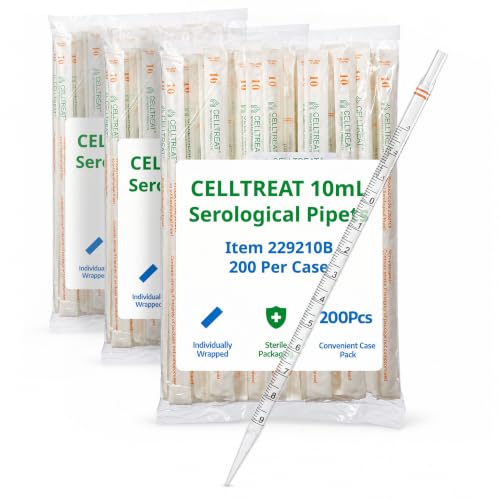
Two hundred sterile tubes built to a published ASTM standard — the big-bench default.
At four times the count of the fifty-pack, this is the case you buy when the pipettes are part of the furniture. Each tube is manufactured to meet ASTM Standard Specification E 934, an actual published standard for serological pipettes rather than a marketing adjective. Volume, draw and colour are all 10 ml, and every pipet is gamma irradiated and individually wrapped so it is sterile the moment it is opened. Polystyrene construction keeps the wall thin and the optics clear.
The reading experience is the quiet win. Bold bidirectional graduations in black ink cut eye strain on a busy bench — you read the meniscus faster and you read it the same way every time. Colour-coded stripes and matching packaging mean you can confirm the volume at a glance and stop mixing tubes up in a shared lab. A premium material filter plug sits inside every pipet to keep liquid handling controlled and protect the sample. Six pounds for two hundred tubes is a case you lift with both hands, not one you tuck in a drawer.
Emptying a two-hundred case takes a while, so this is not the pack for occasional work. It is also polystyrene, which means single-use and no autoclave cycle to fall back on. The ratio versus the fifty-pack is four to one on count, and the storage demand scales the same way. Buy it when sterile volume is a standing requirement.
Standard, not slogan: ASTM E 934 is written into the spec line, which tells you the maker built to a published standard and not just a capacity number.
The space question: six pounds of tubes takes up real shelf space, so measure the cabinet before you order the case.
Suited to: busy labs that burn through sterile 10 ml pipettes as routine consumables.
Not suited to: a small or occasional bench — the shelf demand and the single-use nature make a smaller pack the wiser buy.
9. MicroPette Single-Channel Pipettor – 2-10 ml Adjustable Volume – High Precision Ergonomic Micropipette
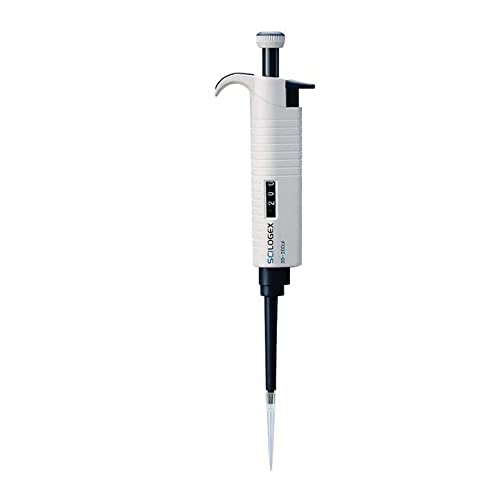
The adjustable tool you buy when the work is repeatable results, not one quick draw.
Read the range in microlitres, because that is how the maker states it: 2000 to 10000 µl, which is the same 2-10 ml span as the ONiLAB. The difference is what surrounds it. This instrument is calibrated for consistent accuracy and repeatable results, which is the language of diagnostics and sensitive research rather than classroom demos. A clear volume display and an integral tip ejector handle the set-and-eject motions, and it takes universal tips so you are not locked into a proprietary supply.
Handling is where a premium manual pipettor justifies itself. The body is deliberately light and comfortable for repetitive pipetting, so hand fatigue builds slower across a long session of the same 10 ml draw. The maker is SCILOGEX, headquartered in Rocky Hill, Connecticut, and the post-sales support is part of what you are paying for. That matters if the instrument misbehaves mid-study and you need an answer rather than a return label. At 8 ounces it sits in the lighter half of the mechanical tools on this list.
This is the highest-rated instrument on the page, and it is also the most expensive by a clear margin over every other pick. That premium does not buy you more range than the cheaper adjustable tools — it buys calibration consistency and a manufacturer standing behind the unit. If your lab runs protocols where a drifting pipettor costs you a whole plate, the extra is easy to justify. If you are doing homebrew gravity readings, it is a lot of instrument for the job.
What the premium buys
- Calibrated for repeatable accuracy, aimed at research and diagnostics work
- Integral tip ejector plus universal tip compatibility
- Light, comfortable body built for long repetitive sessions
- Manufacturer support out of Rocky Hill, CT
What it does not add
- Same 2-10 ml range as the cheaper ONiLAB, so no extra span for the premium
- The highest price on this list by a clear margin
- Still depends on matching tips and proper plunger technique
Choose it for: research or diagnostic work where a drifting pipettor would cost you a whole run.
Pass for: hobby or classroom work — the cheaper adjustable tools cover the same 2-10 ml range.
Understanding the Specs
Tolerance
Tolerance is the allowed error on a delivered volume — the guarantee, in millilitres, of how far off your measurement can be. A ±0.050 ml Class A figure means the delivered volume stays inside a five-hundredths window; a ±0.1 ml figure doubles that window. Read it before capacity, because a 10 ml pipette that cannot hold its 10 ml with any consistency is a 10 ml pipette in name only.
Gradations
Gradations are the printed lines on the scale. A serological pipette with 0.1 ml lines marked every 1 ml gives you a reading point every tenth of a millilitre, which is what lets you deliver a measured amount rather than an approximate one. Bidirectional graduations appear on both sides — positive for dispensing, negative for aspirating — so you can read the tube whichever way you are working. Bold black ink reduces eye strain on a long bench session.
Autoclavable
Autoclavable means the part can be steam-sterilized under pressure, and on these instruments it usually applies to the lower half or the tip cone only, not the whole body. The LACHOI tip cone autoclaves at 121°C for 20 minutes; the ONiLAB and the 4E’s both specify an autoclavable lower portion. Confirm which end before you cook the whole instrument, because the display and the spring assembly are not built for that cycle.
Calibrated For Delivery To Jet
This phrase describes how the pipette is calibrated to empty. Calibrated for delivery to jet means the stated volume assumes you blow the final drop out of the tip, rather than letting it hang. That is why the EISCO notes the last drop is expelled by blowing. If you drain a delivery-to-jet pipette by gravity alone, the actual delivered volume sits short of the printed line — a common and avoidable error.
FAQ
What is the difference between a serological pipette and a micropipettor?
Does a 10 mL pipette also measure smaller volumes?
How accurate is a Class A 10 mL pipette?
Can these pipettes be autoclaved?
Are sterile individually wrapped pipettes worth it over reusable glass?
Can I use a 10 mL pipette with oils or thick liquids?
Do I need a separate pipette controller or bulb?
What is the negative scale on a serological pipette for?
How long does a pack of sterile pipettes last?
Should I buy borosilicate or sodium calcium glass?
Final Thoughts: The Verdict
For most people working with a 10 ml pipette, the ONiLAB Lab Micropipette 2-10ml is the pick that covers the most ground — one adjustable instrument spanning 2 to 10 ml, an individual calibration certificate in the box, and an autoclave-safe lower half. If your work lives or dies on a tight delivery figure, the EISCO Class A glass pipette is the accuracy play at ±0.050 ml, half the error window of the ONiLAB glass set. And when you want a supply of guaranteed-sterile tubes rather than an instrument, the Celltreat 229210B case does the job with a published ASTM standard behind it.
The one nudge worth giving: the highest-rated instrument on this page is the MicroPette, and if a drifting pipettor would cost you a whole plate of results, that reliability is the smartest money here. Everyone else can start with the adjustable ONiLAB or a glass stock and spend the difference on tips and tubes.
How We Picked
We do not accept paid placement. Every pick is matched to a real buyer and a real use-case; we do not hands-on test units.
Sources & Methodology
Specifications: manufacturer listings and product documentation. Review insights: verified customer reviews, as of November 2026. Pricing: not shown on this page (it changes often); check the current price via the retailer link.
As an Amazon Associate, Gadgets Feed earns from qualifying purchases. This does not affect which products we feature.