
Our readers keep the lights on and my morning glass full of iced black tea. As an Amazon Associate, I earn from qualifying purchases.
Specs are compiled from manufacturer listings and verified buyer reviews and can change over time — please confirm the key details on the product page before buying.
You want a bowl of matcha at home that tastes like the one from the café — sweet, grassy, no bitter chalk at the bottom. The short answer: buy a first-harvest ceremonial grade powder from a named region (Uji and Yame are the two named in the picks below) and store it in a tin or glass jar, not a folded bag. Everything else — latte versus usucha, tin size, whether it clumps in cold milk — follows from those two choices.
I’m Min — the founder and writer behind Gadgets Feed. This guide is built by comparing the manufacturers’ published specifications and the patterns across verified customer reviews, so you get each pick’s real strengths and trade-offs instead of marketing spin.
Below, each pick is paired with the drinker it actually suits: the beginner who wants forgiveness, the latte maker who needs a powder that dissolves in milk, and the traditionalist whisking a proper bowl of usucha. Every claim traces back to the tin, the grade, or the harvest — never to a slogan. Expect a straight answer on which of these nine is worth buying, and a clear read on where the best at home matcha options stop justifying their price.
Our Picks at a Glance

How To Choose The Best At Home Matcha
Choosing matcha is mostly a matter of matching three things: how you drink it, how fast you will use up the tin, and how much bitterness you can forgive on a bad whisk. The picks below cover all three, so start with your cup rather than the label.
Match the grade to your cup, not the marketing
If you drink matcha over ice with milk, you want a powder that dissolves cleanly and tastes sweet enough to survive the milk. If you whisk it into hot water with nothing added, bitterness and astringency — the drying, grippy feel on your tongue — are suddenly the whole point of the decision. Some picks below are built for lattes and cold brew, and one is pitched explicitly at beginners learning the basic tasting notes of umami and astringency.
Check the harvest and the source region
First harvest (also called first flush, or hatsumukashi in the Kiyo tin) means the leaves were picked in the spring, when the plant has stored the most sweetness. Uji in Kyoto and Yame in Fukuoka are the two growing regions named across these picks. A powder that names both the region and the harvest gives you something concrete to judge; one that just says “Japanese” tells you nothing about when or where.
Buy a size you can finish
Matcha is ground tea leaf, not dried leaf — it loses its brightness the moment air gets at it. The tins here run from a 30g pouch to a 100g pack. A 30g tin at roughly a gram or two per bowl is a fast-finishing supply, which is exactly what you want while you learn your own taste. A 100g pack makes sense only once you know you like the blend enough to drink it several times a week.
Look at what the tin is made of
A resealable pouch, an airtight pull-top can, and a tinted glass jar all fight air and light differently. Light fades green powder faster than most people expect, which is why one pick below ships in Miron violet glass rather than a plain jar. Whichever you buy, keep it cool and dry — the cupboard next to the stove is the worst place in the kitchen for it.
Quick Comparison
| Model | Best For | Grade / Harvest | Package Size | Origin | Amazon |
|---|---|---|---|---|---|
| DoMatcha Organic Summer Harvest★ Best Overall | Everyday lattes for a crowd | Latte grade | 2.82 oz | Japan | Amazon |
| The Republic of Tea Organic CeremonialBest for Straight Bowls | Straight hot bowls | Ceremonial, stone ground | 1.5 oz | Japan | Amazon |
| Umami Leaf Organic JapaneseMost Versatile | Milk-based drinks and desserts | Ceremonial, first harvest | 1.4 oz tin | Uji, Kyoto | Amazon |
| Terrasoul Superfoods Organic | Smoothies and blender drinks | Ceremonial, first flush | 2.12 oz | Japan | Amazon |
| Wako Matcha Single-Origin Uji | Newcomers who hate bitterness | Ceremonial, first harvest | 1.4 oz pouch | Uji | Amazon |
| Kiyo Matcha Classic Grade | Learning what umami tastes like | Ceremonial, first harvest | 1.41 oz | Uji | Amazon |
| FKRO Organic Okumidori | Single-cultivar sipping | Ceremonial, first harvest | 30 g pouch | Kagoshima | Amazon |
| Naoki Matcha Fragrant Yame Blend | Drinkers past the beginner stage | Ceremonial blend | 100 g / 3.5 oz | Yame, Fukuoka | Amazon |
| DoMatcha Organic Ceremonial | A true ceremony-grade bowl | Ceremonial | 2.82 oz | Japan | Amazon |
In‑Depth Reviews
1. DoMatcha Organic Summer Harvest Matcha Powder
Our pick — 4.5+★ from 850+ verified ratings; the strongest balance of quality and price.
The tin that makes a proper latte on your first try, without a barista’s wrist.
Most buyers start with lattes, and this is the pick built for exactly that. It is a latte grade powder sourced from Japan — meaning it was chosen to hold up against milk rather than to be drunk bare in a ceremonial bowl — and the 2.82 oz tin gives you a generous run of morning drinks. It is also the heaviest tin on this list: 2.82 ounces versus the 1.4 ounces of the Umami Leaf tin, so you simply get more powder per container.
What wins people over is the mouthfeel. Owners consistently describe a wonderfully creamy consistency and a vibrant green colour that survives the whisk, and the quality of the powder ranks as the single most-discussed trait in its review pages. The flavour holds up in water and in milk both, which is why it doubles as the everyday tin in a house where one person drinks it hot and another takes it iced with oat milk.
The one honest question is cost. A vocal slice of buyers call it overpriced for what is, after all, ground tea leaf — this is a premium-grade tin and it is priced like one. The way to think about it: if you are making two lattes a day, the tin amortises quickly; if you whisk one bowl a week, a smaller ceremonial tin is the smarter entry. Keep it somewhere cool and dry, because a 2.82 oz supply is enough to notice the colour fade if you leave it open on a sunny counter.
Where the tin earns its keep
- Latte-grade powder whisked for milk drinks as well as hot water
- 2.82 oz — the largest supply among the DoMatcha ceremonial-adjacent picks here
- Creamy, smooth body with a green colour that holds up in the bowl
- Doubles as a hot-tea and iced-latte powder for a two-drinker household
The part to weigh up
- Priced in premium territory, and the sticker is the most-discussed sticking point
- Latte grade rather than a dedicated ceremonial bowl powder
- The tin is large for a once-a-week drinker
Pick this if: you want one tin that handles a daily latte and the occasional bare bowl without you worrying about grade.
Think again if: you whisk one ceremonial bowl a week — the tin will outlast its own freshness.
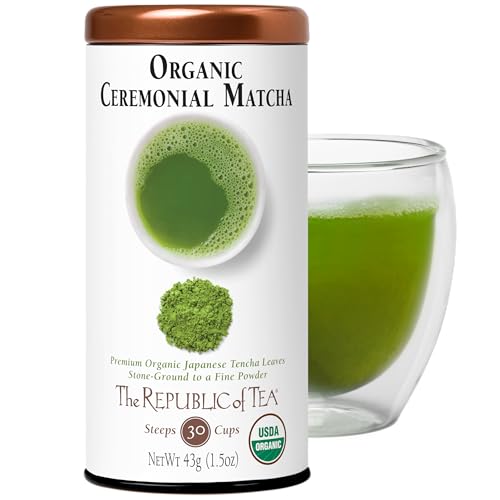
2. The Republic of Tea Organic Ceremonial Matcha Powder
Stone-ground tencha for drinkers who want the bowl, not the blender.
This powder is stone ground from the tencha leaf — the shaded leaf matcha is made from — and it is pitched at water just before boiling, whisked into a smooth cup with no astringency and a vegetal sweetness. The whole leaf is consumed rather than steeped, so matcha delivers more of what green tea offers than a brewed cup does. It also carries less than half the caffeine per cup of a coffee, which matters for an afternoon bowl.
Flavour is where it lands hardest, and the powder’s strength is the next thing buyers bring up. What divides opinion is the look and the smell: the green draws a mixture of raves about its brightness and grumbles that it is less vivid than expected, and the aroma splits the same way. Neither is a defect — it is the difference between a tea-drinker’s palate and a latte-drinker’s, and this tin is aimed squarely at the former.
At 1.5 ounces it is the smaller sort of tin, sized for a person who whisks a bowl most mornings rather than a household brewing for guests. If you have been drinking matcha only in milk drinks, this is a good stepping stone back to water — the vegetal sweetness is gentle enough to drink without sweetener while still tasting like matcha rather than like a weak green tea.
The honest read: a proper stone-ground ceremonial tin for hot-water drinkers, with a colour and aroma that will not suit everyone who arrives from the latte aisle.
Worth grabbing if: your daily ritual is a whisked bowl of hot matcha and you want it smooth and vegetal rather than bright and showy.
Pass on it if: you take matcha in milk — the latte-grade tin above is the better fit.
3. Umami Leaf Organic Japanese Matcha Powder
A 1.4 oz tin that shines brightest the moment milk enters the glass.
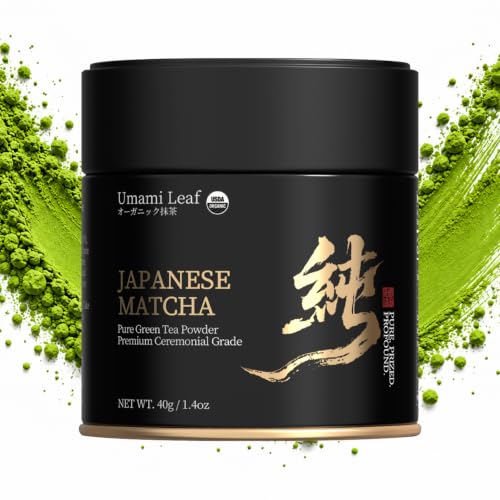
The headline is the sourcing: first-harvest, spring-picked leaves from Uji in Kyoto, shade-grown and hand-picked during the prime harvest and then stone ground into a fine powder. It is USDA organic certified, and it comes sealed in a metal tin rather than a bag — the tin is the small detail that keeps the powder bright between scoops. At 1.4 ounces it is a compact supply, the lightest tin discussed here.
On the palate, the striking thing is the sweetness. Drinkers describe a lovely lingering sweetness without bitterness and a silky smooth texture, and it makes its best showing not neat but in milk-based drinks and desserts. That is not a knock — it means the same tin handles your iced oat latte in the morning and a matcha cheesecake in the evening, which is more ground covered than the average ceremonial powder.
If you are chasing the traditional bare-water bowl, a different pick further up will suit you better. The 1.4 ounce tin is also gone in a matter of weeks if you are drinking daily. But for the kitchen where matcha is a component as often as a drink, this is the most flexible tin on the page.
Why it earns a spot: single-origin Uji pedigree and a natural sweetness that punches through milk, dairy or plant-based — plus a resealable tin that keeps it there.
The small print: the same sweetness that rescues a latte can read as too soft to a bare-bowl traditionalist.
Reach for this if: lattes, smoothies and matcha bakes are your thing and you like a tin you can reseal after every scoop.
Look elsewhere if: you judge matcha neat, in water only, and want the grip of umami rather than sweetness.
4. Terrasoul Superfoods Organic Matcha Green Tea
The one that arrives in violet glass and dissolves into a smoothie without a fight.
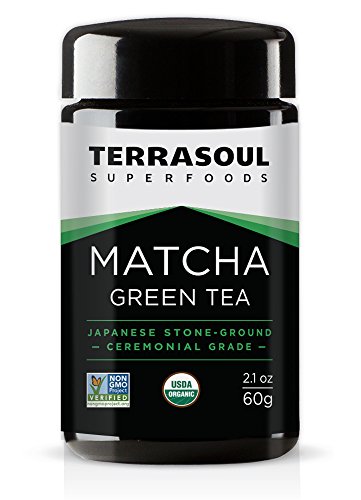
Start with the container, because it is the tell. This powder ships in a Miron Violet Glass jar — a tinted jar made to block the wavelengths of light that fade green powders — which is a step beyond the pouches most brands use. It is a first-flush, ceramic-stone-milled ceremonial powder, USDA certified organic and Non-GMO Verified, and the jar holds 2.12 ounces. For anyone who buys matcha in a bag and then wonders why the last third looks dull, the jar answers that directly.
Owners go out of their way to praise the quality and the clean, non-bitter finish, and the blendability earns its own mentions — it dissolves beautifully, and it comes into its own in smoothies where a stubborn powder would otherwise leave specks in the glass. There is a recurring caveat worth knowing: it can clump, leaving little lumps at the bottom of the cup. Sifting it before whisking and giving it a proper 30 seconds of whisking handles it, and that is standard practice for stone-ground matcha anyway.
The colour and aroma are as described — a rich vibrant green with sweet, smooth earthy notes. It is a versatile, everyday tin rather than a ceremony tin, which is exactly the right brief for the person who drinks matcha in a blender more often than in a bowl.
The case for the jar
- Miron violet glass jar keeps light off a 2.12 oz first-flush ceremonial powder
- Dissolves cleanly — strong feedback for smoothies and blended drinks
- Organic, Non-GMO Verified, gluten-free and vegan
- Good value for a ceremonial-grade jar of this size
What to expect going in
- Can clump at the bottom of the cup — sift before whisking
- Earthy, green-leaning flavour rather than a sweet dessert profile
- The jar is bulkier on the shelf than a flat pouch
Suits you if: your matcha goes into a blender and you want the jar to do the preservation work for you.
Skip if: you want a powder that needs no sifting — this one rewards a sieve.
5. Wako Matcha Single-Origin Uji Matcha
The gentlest entry into matcha: no bitterness, no astringency, no blend.
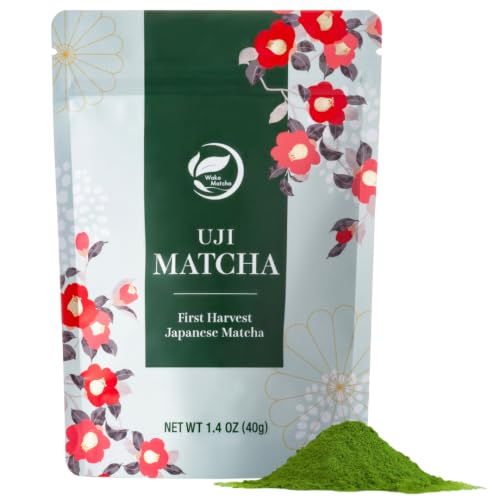
Wako’s brief is the newcomer who tried matcha once, found it harsh, and never went back. This is a first-harvest ceremonial grade powder from Uji — single-origin, no blends — and the flavour is built to be smooth rather than challenging, with none of the bitter grip that turns people off. The pouch is resealable and yields 40 servings of usucha (hot tea) or 10 of a latte, and the 40g weighs 1.4 ounces.
The flavour is what carries it. Drinkers praise a natural sweetness that is not bitter, a creamy texture, and a vivid green in the bowl, with minimal astringency that does not linger — the exact fault beginners complain about. It is also unusually forgiving of additions: it blends into a latte with any flavour you put to it, and it mixes well with milk without going grainy.
The trade-off is durability of the pouch rather than the powder. A resealable bag is convenient but does less to keep light out than the tins and jars higher up this list, so store it in a dark cupboard and squeeze the air out each time. And if you find yourself craving a bolder, more vegetal bowl after a few weeks, that is a sign your palate has moved on — go for a single-cultivar pick like the FKRO next.
The draw: single-origin Uji matcha tuned for no bitterness and no lingering astringency — the least intimidating tin on the page for a first-time buyer.
Ideal for: anyone who has been put off matcha by a harsh first cup and wants to start over gently.
Not for: the drinker who already loves a strong, grassy, astringent bowl — you will find this too soft.
6. Kiyo Matcha Classic Grade Hatsumukashi Ceremonial Uji Matcha
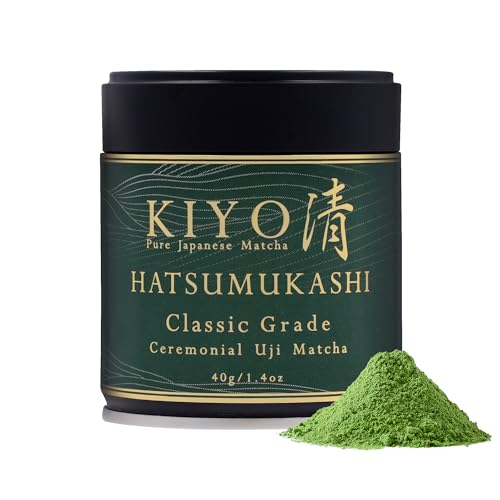
A beginner’s teaching tin — the one built to show you what umami actually tastes like.
Kiyo calls its Classic Grade an entry-level ceremonial made for beginners to appreciate the basic tasting notes of matcha: umami, bitterness and astringency. That is a refreshingly honest brief. It is first-harvest Uji leaf, hand-picked and steamed within a day, then de-stemmed and stone ground for Japan’s domestic market. It comes sealed in an airtight bag inside a pull-top screw can, which is a better seal than a folded pouch.
Taste is the thing it is known for. Drinkers describe an excellent flavour that is not bitter and chalky, a creamy texture once it meets warm water, and a beautiful vibrant green. The blendability earns its own praise — it takes willingly to additions like maple syrup — and the aroma is distinctive enough that regulars notice it.
The 1.41 ounce can is small, so if you drink two bowls a day you will be reordering in weeks. That is the point of a beginner tin, though: it is sized so you can finish it fresh, learn what you like, and then spend more on the tin that suits your taste. The pull-top screw can is also easy to reseal one-handed, which is a small thing until you are doing it every morning.
The value play: a small-batch Uji ceremonial with a proper airtight can, priced to let a beginner find their palate without committing to a large tin.
Know before you buy: the tasting notes are the point — expect to taste astringency, not to be shielded from it.
This is your tin if: you are learning and want to taste umami, bitterness and astringency side by side in one small, resealable can.
Choose differently if: you already know you love matcha — a larger supply will serve you better.
7. FKRO Organic Okumidori Ceremonial Grade Matcha

One cultivar, one farm, one flavour — the wine-lover’s matcha.
Most matcha is a blend. This one is a single-cultivar Okumidori from a family tea farm in the mountain highlands of Kagoshima, cultivated organically since 1954 and stone-ground in small batches. The leaves are shaded for roughly 3 weeks before harvest, then hand-picked and slowly stone-milled into a vivid jade-green powder with a fresh, grassy aroma. It is USDA and JAS certified organic — that is, certified to organic standards in both the US and Japan — with no fillers, sugar or additives.
The cultivar is why it tastes the way it does. Okumidori is a late-maturing leaf known for a velvety body, savoury umami and soft natural sweetness, so it stays mellow whether you whisk it traditionally, cold-brew it, or blend it into a latte. Drinkers single out the flavour above all, then the quality, and the smoothness earns steady praise — it blends into hot and cold liquids alike. Expect around 15 servings from the 30g resealable tin.
The catch is volume. A 30g tin at 15 servings is the smallest supply on this list, and single-cultivar matcha is not the cheap route. It is the tin for someone who has decided they want to taste a specific cultivar and accepts that a small, fresh supply is the right way to do it. Store it resealed in a cool, dry place and it will hold up long enough to finish.
What the single origin buys you
- Okumidori cultivar from one family farm — a specific flavour, not a blend
- USDA and JAS certified organic, with no fillers, sugar or additives
- Velvety umami and soft sweetness with low bitterness
- Works whisked, cold-brewed or mixed into a latte
Worth knowing upfront
- About 15 servings per 30g tin — a small supply
- Single-cultivar pricing sits at the premium end
- The mellow profile may read as too gentle for drinkers who want grip
Chase this one if: you want to taste a named cultivar and reward a farm’s specific work over a house blend.
Leave it if: you want a household tin that lasts months — this is a 15-cup supply.
8. Naoki Matcha Fragrant Yame Blend Matcha

Fifty servings of a competition-medal blend, grown in Yame’s hot days and cold nights.
This is the biggest tin on the page — 100g, or about 50 servings — and it is a blend from Yame in Fukuoka prefecture, a region that has been producing tea for centuries. Yame’s hot days and cold nights push the leaf towards an extremely sweet flavour, which the blend is built to maximise. It won Silver at a national tea competition in Japan and is pitched at intermediate drinkers for traditional usucha (thin tea) or koicha (thick tea).
Sweetness is the whole story. The cup opens with fresh natural sweetness, then buttery, floral notes and an incredibly smooth finish — and drinkers back that up, describing it as delicious and naturally sweet with a creamy texture that whisks well. It holds its own in a flavoured drink too, with a strawberry matcha latte named as a favourite pairing. The earthy fragrance is the reason for the name.
The one question is commitment. Fifty servings is a long relationship, and if you do not drink matcha regularly the last of the pack will lose some brightness before you reach it. The answer is to keep the pack tightly closed, dry, and out of the light, and to treat it as a daily-drinker’s supply rather than a sampler. For someone already drinking a bowl most mornings, this is the most efficient tin on the list.
Why the size matters: a 100g competition-medal Yame blend gives you 50 servings of a sweet, smooth, buttery cup — fewest reorders of any pick here.
The catch: that same volume demands regular drinking to finish while the flavour is at its best.
Buy it when: matcha is a daily habit and you want 50 servings of a sweet, smooth Yame blend from one pack.
Hold off when: you are still deciding whether you like matcha — a sampler tin will not go stale on you.
9. DoMatcha Organic Ceremonial Green Tea Matcha Powder
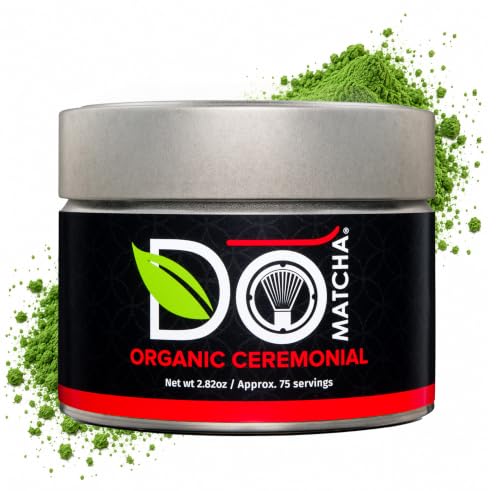
The tin for the drinker who wants a ceremony-grade bowl, every single morning.
DoMatcha’s ceremonial blend is the fuller, more traditional sibling of the latte-grade tin at the top of this list — same maker, same 2.82 ounce format, but pitched at ceremonial use and offering 75 servings. It is organic and kosher, sourced from Japanese tea estates, and built for the whisked bowl as well as smoothies and iced drinks. If you want to drink matcha the way it is meant to be drunk, this is the tin that asks to be treated as a ritual rather than an ingredient.
The cup is smooth and slightly less bitter than the category norm, with a vibrant green and a rich, creamy texture that mixes well in hot water. Expect the calm-alertness effect matcha drinkers describe — focus without coffee’s jitter — which owners of this tin cite as why they switched from coffee. The colour and texture are the two things that come up next most, and both hold up well in the bowl.
It is the most expensive tin here, and the honest caveat is that a share of buyers find it slightly overpriced for what it is. That is the nature of a ceremonial-grade premium tin: you are paying for the leaf, the grade and the 75 servings, which works out to a sensible per-bowl cost if you drink it daily. If you drink matcha weekly, the smaller ceremonial tins above will serve you better without the waste.
What you get for the top spot
- Ceremonial grade from the same Japanese estates as the latte-grade tin
- 75 servings per 2.82 oz tin — the longest supply of any ceremonial pick here
- Smooth, slightly less bitter cup with a vibrant green and creamy body
- Organic and kosher, versatile across hot, iced and blended drinks
The honest trade-off
- The priciest tin on the list, and some buyers find the premium hard to justify
- Ceremonial grade is wasted on a drinker who only ever adds milk
- The large tin needs a cool, dark cupboard to stay at its best
It’s the right fit for: the daily ceremonial drinker who wants one premium tin that lasts through 75 bowls.
Better saved for later if: you are experimenting — start small and graduate to this.
Understanding the Specs
Grade and harvest
Ceremonial grade means the powder was judged fine enough to whisk into water and drink neat, while latte grade is chosen to survive milk. First harvest (also called first flush) means spring-picked leaves, which tend to carry the most natural sweetness. A tin that names both a grade and a harvest gives you two concrete things to compare; one that only says “Japanese green tea” gives you a marketing line and little else.
Package size and servings
Matcha is ground leaf, so freshness fades with air and light rather than with time alone. The tins here run from a 30g pouch with about 15 servings to a 100g pack with 50, and one ceremonial tin promises 75. Match the size to how often you actually drink: a 30g tin is smart while you find your taste, and a 100g pack makes sense only once matcha is a daily habit. Buying bigger than your habit just means watching the colour go dull.
Storage and light
Green powder fades in daylight, which is why one pick here arrives in Miron violet glass and others come in airtight tins or resealable pouches. Keep the container sealed, cool, dry and out of the sun. The cupboard above the kettle is convenient and the worst place in the kitchen for it — the heat and steam will shorten the powder’s bright green life faster than anything else.
Clumping and sifting
Stone-ground matcha is a very fine powder, so it can clump when it hits liquid, especially the cold milk in a latte. Sifting a gram or two through a small sieve before you whisk is the standard fix, and it takes seconds. Powders that draw complaints about lumps at the bottom of the cup are not defective — they are simply fine enough to need the sieve that the smoother ones happen to forgive.
FAQ
What is the difference between ceremonial grade and latte grade matcha?
Does first harvest matcha actually taste different from later pickings?
How long does an opened tin of matcha stay fresh?
Why does my matcha clump at the bottom of the cup?
Can I use ceremonial grade matcha in a latte?
How much matcha do I use per bowl or per latte?
Is Uji matcha better than Yame matcha?
How should I store matcha to keep the green colour?
Does matcha have less caffeine than coffee?
What is the difference between usucha and koicha?
Final Thoughts: The Verdict
For most people setting up matcha at home, the at home matcha winner is the DoMatcha Organic Summer Harvest, because it is a latte grade tin of 2.82 ounces that handles both the daily milk drink and the occasional bare bowl without you having to think about grade. If your ritual is a whisked bowl of hot water and nothing else, reach for the The Republic of Tea Organic Ceremonial and its stone-ground tencha. And if you are still learning what you like, the Kiyo Matcha Classic Grade can is the smartest starting point — a small-batch Uji ceremonial with a teaching brief.
The strongest value case on the page belongs to the Umami Leaf tin: single-origin Uji pedigree, first-harvest leaves, and a natural sweetness built for milk. If matcha is already a daily habit and you want one pack to carry you through fifty bowls, the Naoki Fragrant Yame Blend is the efficient choice. And if you want to taste one named cultivar from one farm rather than a house blend, the FKRO Okumidori is worth the small tin — around 15 servings, all of them distinctive.
One nudge before you close the tab: buy the size that matches your habit, not the size that looks like the best deal per gram. A 30g pouch finished fresh beats a 100g pack that goes dull at the bottom, and the FKRO and Kiyo tins are proof that a small supply can still carry real quality.
How We Picked
We do not accept paid placement. Every pick is matched to a real buyer and a real use-case; we do not hands-on test units.
Sources & Methodology
Specifications: manufacturer listings and product documentation. Review insights: verified customer reviews, as of November 2026. Pricing: not shown on this page (it changes often); check the current price via the retailer link.
As an Amazon Associate, Gadgets Feed earns from qualifying purchases. This does not affect which products we feature.