
Our readers keep the lights on and my morning glass full of iced black tea. As an Amazon Associate, I earn from qualifying purchases.
Specs are compiled from manufacturer listings and verified buyer reviews and can change over time — please confirm the key details on the product page before buying.
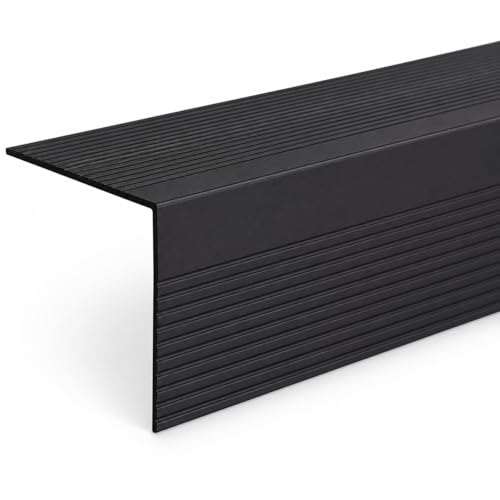
Every shoe lands on the edge of a step first, so that strip wears out faster than any other trim in your home. Aluminum stair nosing is the fix: a metal cap that covers the worn lip of a step, gives wet shoes a textured surface to grip, and survives weather that makes vinyl and adhesive grit tape peel. For most buyers, the TMH 48-inch dark bronze piece is the one to buy — it protects both indoor and outdoor steps, has a fluted (grooved) walking surface, and comes undrilled so you can glue it down or drill your own screw holes.
I’m Min — the founder and writer behind Gadgets Feed. This guide is built by comparing the manufacturers’ published specifications and the patterns across verified customer reviews, so you get each pick’s real strengths and trade-offs instead of marketing spin.
Below are the specs that matter — top-face width, drop height, length, fastening method and finish — explained in terms of what they mean on your stairs. Several picks can be cut with ordinary snips, and a few include screws. Choosing the right aluminum stair nosing mostly depends on matching length, drop and fastening to your steps.
Our Picks at a Glance


How To Choose The Best Aluminum Stair Nosing
Buying stair nosing is a measuring job before it is a shopping job. Get the length right first — a strip that runs short leaves exposed edge at one side. Then match the shape to how much of the step you want covered, and decide whether you are screwing, gluing or peeling off a backing.
Length and corner coverage
Nosing comes in 30-inch, 36-inch and 48-inch runs here, and one piece in a 4-pack bundle. A 36-inch strip covers a standard single step width in most homes. A 48-inch piece is the better bet if your staircase is wider than usual or if you want to cover a landing lip in one continuous run. Anything longer can usually be trimmed with a hacksaw or tin snips — several of these picks state they are cuttable, which makes a single length work across several steps.
Top-face width and drop — the fit that sinks or saves the job
The top face is the flat part that sits on the tread; the drop is the return that folds over the riser edge. A 2-inch top face with a 1.5-inch drop is a common profile and covers a decent slice of tread plus the vertical lip. A narrower 1-1/8-inch top face is meant for a slimmer, more decorative edge on interior steps. Measure both your tread depth and how far the existing edge overhangs before ordering, because a drop that is too deep will stand proud of the riser and catch a shoe.
Screw, glue or peel-and-stick
Drilled mounting is the most secure method for outdoor stairs and high-traffic steps, and several pieces here arrive undrilled so you can set holes where your stair structure needs them. Some include color-matched stainless or color-matched screw nails in pre-drilled holes. Self-adhesive versions skip tools entirely — clean, peel and press — which is quick but depends on a flat, sound surface. Grit tape is the weakest option outdoors, since it will not bond in cold or wet conditions.
Grip surfaces and finish
Three grip styles show up here: fluted grooves pressed into the metal, raised perforations punched through it, and textured powder-coat or anti-skid coating. All three raise friction, and the open patterns let water drain rather than pool. For finish, anodizing and powder coating are the two ways aluminum is protected, and both are described in this data as resisting rust and corrosion. Polished aluminum is brighter but shows scuffs more readily.
Quick Comparison
| Model | Best For | Length | Profile (W x H) | Fastening | Amazon |
|---|---|---|---|---|---|
| TMH Stair Nosing 48″ Dark Bronze★ Best Overall | Wide indoor/outdoor steps | 48 in | 2.25 x 1.5 in | Glue or drill your own | Amazon |
| MD Building Stair EdgingBest Value | Slim interior carpeted edges | 36 in | 1.13 x 1.13 in | Pre-drilled, 6 screws included | Amazon |
| Clearway Anti-Slip Outdoor NosingBest for Wet Weather | Wet outdoor stairs | 36 in | 2-1/8 in wide | Pre-drilled, stainless screws included | Amazon |
| Orechic Black 36″ 2-Pack | Tool-free apartment fixes | 36 in (2 pcs) | 1.6 x 0.8 in | Self-adhesive | Amazon |
| Jiekayi 36″ Self-Adhesive 2-Pack | Fast renovation on tile or wood | 36 in (2 pcs) | 2 x 1.2 in | Self-adhesive | Amazon |
| TMH Stair Nosing 48″ Aluminum Mill | Matching silver trim and long runs | 48 in | 2 x 1.5 in | Glue or drill your own | Amazon |
| Awvob 3ft 4-Pack Nosing | Whole-staircase safety job | 35.4 in (4 pcs) | 1.57 x 0.79 in | Glue | Amazon |
| Gisafai 4-Piece Non-Slip Tread | Wooden deck and ramp steps | 30 in (4 pcs) | 3.75 in wide | Pre-drilled, 12 holes per tread | Amazon |
In‑Depth Reviews
1. TMH Stair Nosing, Stair Edge Protector – 48″ Long, Dark Bronze Anodized
Our pick — 4.5+★ from 200+ verified ratings; the strongest balance of quality and price.
One full 48-inch run that handles the whole width of a wide step, indoors or out.
The reason this one tops the list is coverage. At 48 inches long it is the longest single piece in this set, and it measures 2 inches across the top face with a 1.5-inch drop down the riser. On a wide painted step, that means one continuous cap instead of a patchwork of short strips with gaps at the seams. The fluted non-slip surface — shallow grooves rolled into the metal — gives a wet boot somewhere to bite, which matters on an exterior landing.
What wins people over is the build. The anodized black finish is applied as a hard oxide layer that resists scratches, and the commercial grade rating reflects that this is meant for steps taking real daily traffic. Owners describe it as sturdy and easy to install, and one notes it bridges the transition between a staircase and a wooden floor cleanly. Most of the discussion centers on the quality of the metal itself, which buyers single out as the standout.
Here is the honest catch: it ships with no holes. That is deliberate — you can glue it down on a clean surface, or drill your own holes to match your stair stringers. The trade-off is that a screw-based install takes planning and the right bit. Some buyers also felt the price sat high for a single strip, which is fair given it is one piece rather than a pack. The upside is that you are paying for the extra length and the anodized finish, not for a bundle of short sections.
Where it earns its place
- 48 inches covers a wide step in one piece with no mid-run seam
- Fluted surface adds grip underfoot when the step is wet
- Anodized finish guards against scratches and corrosion
- Cuttable with snips or a trim saw to fit shorter steps
What to plan around
- Ships undrilled — you supply the drill work if you screw it down
- One strip per order, so a full staircase needs several
- The finish choice drives the look; the dark bronze reads darker than plain black
Reach for this if: your steps are wide, exposed to weather, or you want one uninterrupted cap over a wooden-floor transition.
Look elsewhere if: you would rather not touch a drill — a self-adhesive two-pack gets you there faster.
2. MD Building Stair Edging, Polished Aluminum, 1-1/8in x 1-1/8in x 36in
The slim, ready-to-screw edge for interior carpeted steps that need a neat lip.
This one takes a different job than the wide outdoor strips. It is 36 inches long with a 1-1/8-inch top face and a 1-1/8-inch depth, which makes it roughly half the footprint of the wider profiles here. That slimmer shape suits an interior staircase where you want the edge protected without a broad metal band across the tread. It is the narrowest profile in this set, and it sits at the budget-friendly end of the range.
Installation is the selling point. Six 1-1/4-inch, 13-gauge screw nails come in the box, already color-matched to the polished finish, and they seat into pre-drilled holes. The maker states the nails fit firmly in those holes, so you are not hunting for a bit or guessing at spacing. A hacksaw takes it down to a shorter length if your step is narrower than the standard 36 inches. It weighs 6.4 ounces, which is light enough to hold in place with one hand while you drive the first nail.
The limitation is placement. The maker recommends it for interior stair steps and says it is not for outdoor use, though it does state it can go on carpeted stairs. The polished finish, meanwhile, is the brightest look here — anodized so the maker states it will not corrode or fade. If your steps are outside, or you need rust-proofing against rain, a marine-grade or powder-coated pick is the safer call than this polished interior piece.
What it does well: the included color-matched fasteners turn a fiddly job into a five-minute one, and pre-drilled holes mean no layout guesswork on the tread.
Where the limit sits: it is an interior-rated piece, so an exposed porch or a landing that takes rain is not its ground.
The fit: interior carpeted or hard-surface steps where a slim, polished lip and a screw-in install are what you want.
The mismatch: exterior stairs, where you need a profile rated for wet and sun.
3. Anti-Slip Stair Nosing for Outdoor Stairs – Durable Aluminum, Made in Canada
Perforated grip that lets rain through and boots bite — built for a cold-weather install.
Most outdoor slip strips depend on a stuck-on grit surface. This one is different: it is punched with raised perforations, small holes with the metal lifted around them, so the shoe rests on standing ridges and water drains through instead of sitting on top. The maker calls it marine-grade aluminum with a black anti-skid coating, and states it will not rust. At 36 inches by 2-1/8 inches, it covers a standard step width in one piece.
The install schedule is where it beats adhesive tape. The maker states it can be installed year-round, even in cold and wet conditions, because stainless screws do the holding rather than a glue that needs warmth to cure. Color-matched stainless screws come in the box, and it is pre-drilled for wood, composite wood and concrete — though concrete fasteners are not included, so a masonry step needs those bought separately. It carries an ANSI rating (an industry safety standard) and is made in Canada.
These perforated holes do mean the surface has gaps, so on a step where you want a smooth sweep underfoot this is a different feel from a fluted groove. It is a safety-first profile. Pair it with the Smooth Transition TMH: the TMH covers a wooden-floor join with a clean top face, while this one prioritizes grip on the exposed outdoor riser lip.
The case for the perforated top
- Raised perforations grip in both wet and dry conditions
- Marine-grade aluminum stated not to rust
- Stainless screws included and color-matched
- Can be fitted year-round, even in cold and wet
Before you order
- Concrete fasteners are not in the box — buy those for a masonry step
- The open pattern is a texture change from a smooth capping strip
Pick this for: an outdoor staircase that gets rain, frost or morning dew and needs a screw-down grip surface that installs in bad weather.
Think twice if: you want a solid, smooth cap over a wooden-to-carpet transition — a continuous profile is cleaner there.
4. Orechic Black 36″ Metal Stair Nosing, Self-Adhesive, L-Molding, 2-Pack
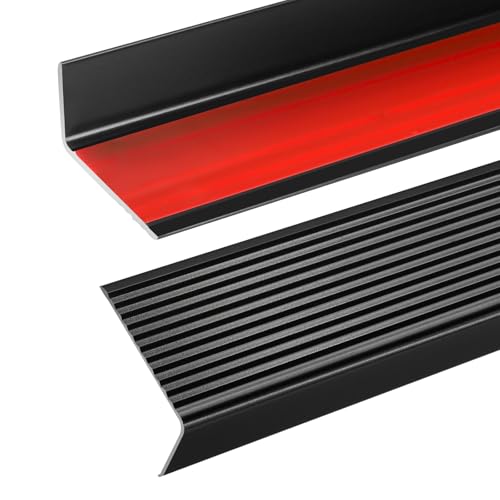
Two anodized aluminum caps that press into place — no drill, no screws, minutes not hours.
The premise here is speed. Each 36-inch strip comes pre-coated with industrial-strength adhesive on the back, so the job is clean the surface, peel the backing and press firmly. No drilling and no tools. For a renter who cannot put holes in a landlord’s stairs, or a quick fix on a deck, that trade-off is the whole point. The profile is 1.6 inches across and 0.8 inches deep, a low L-shape that hugs the edge. The contrast with the heavier TMH is straightforward: that piece is 48 inches and undrilled, while this is two 36-inch adhesive strips.
The metal itself does not cut corners. It is rust-resistant anodized aluminum that the maker states stands up to heavy foot traffic, sunshine and harsh weather without warping or corrosion, and the textured surface adds friction on a wet step. Two pieces per pack means you can cover two steps or trim one to a shorter half-length. A commercial grade rating sits behind it too. The practical read: this is a surface protection and grip upgrade, not a load-bearing structural edge.
The one thing to weigh is surface prep. Adhesive is only as good as the surface under it, so a dusty, oily or damp step will not hold. The maker lists tile, wood, concrete, vinyl and stairs among the compatible substrates, and cleaning first is the difference between a firm bond and a corner peeling up. On a rough or uneven concrete edge, a drilled piece will outlast a peel-and-stick one.
Where it shines: two strips in the box, textured traction on wet steps, and an install you can do without owning a drill.
The prep rule: adhesive strength lives or dies on a clean, flat, dry surface — skip the wipe-down and you waste the strip.
Best used on: flat, sound indoor steps or a sheltered deck where you want grip and edge protection without putting a hole in anything.
Wrong tool for: a rough or crumbly concrete edge that needs a screw-down anchor to stay put.
5. Jiekayi 36″ Metal Stair Nosing, 2-Pack Self-Adhesive, Black

A wider 2-inch face and a reinforced core, applied with a peel-and-press in minutes.
Where the Orechic strip is 1.6 inches across the top, this one broadens that to 2 inches and deepens to 1.2 inches, so more of the tread is covered per strip. Both are 36 inches long with two per pack, but this is the beefier of the two adhesive options. The reinforced metal core is stated to prevent bending under heavy foot traffic, and the textured surface adds grip when the step is wet.
What buyers notice first is the finish. Owners describe it as high-end quality, and several say the finish looks like professionally installed work. Durability holds up too: buyers report it still holding after six months of use. Installation draws consistent praise as a straightforward peel-and-stick job.
Adhesive is where this one splits opinion. The backing is strong, but it runs along one side of the strip, so a buyer wanting full-width adhesion will find that arrangement less than ideal. Clean, flat surfaces — tile, wood, marble, metal, glass and concrete are all listed — take it well. A warped or greasy step does not. The maker rates it commercial grade and for both indoor and outdoor use, with a weather-resistant design against rain, snow and sun.
Why it works
- 2-inch face covers more of the tread than a slimmer strip
- Reinforced core resists bending under traffic
- Texture holds grip on a wet step
- Two per pack, tool-free install
The catch to size
- The adhesive runs along one side — full-width contact is not what you get
- A rough or uneven surface will lift at a corner without extra care
Good pick for: a fast cosmetic-plus-safety refresh on tile or hardwood where the metallic look matters as much as the grip.
Not ideal for: a step with a rough or uneven lip, where the one-sided adhesive will struggle to stay flat.
6. Stair Nosing Stair Edge Protector – 48″ Long, Aluminum Mill (Silver)
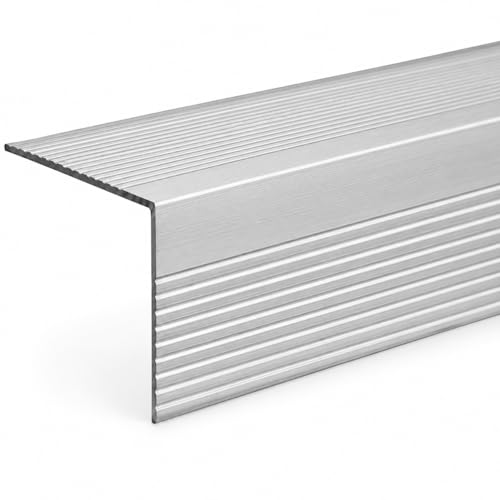
The bright aluminum twin of the top pick — 48 inches of matching silver trim.
Same 48-inch length and same 2-inch top face with 1.5-inch drop as the dark bronze winner, but in an untreated mill finish. For a staircase with silver hardware or a brushed-metal railing, this keeps the palette consistent where a dark strip would look bolted on. It matches the Winner’s 48 inches exactly, so a wide step is covered in one go with no seam. The steel thickness is listed at 0.06 inches — a thin, low-profile cap that sits flush rather than standing proud.
Owners tend to land on two things: how it looks and how it ages. Owners mention it still looks and works great after several years of use. The maker lists it for carpet, hardwood, tile and concrete stairs, indoors and outdoors, so one piece can run from a hallway step onto an exterior landing. It ships undrilled like its dark counterpart, ready for glue or your own screw layout.
The mill finish is the honest trade-off. It is bare, uncoated aluminum rather than anodized, so it will not have the scratch-resistance layer the dark bronze piece carries. On a high-traffic outdoor step that sees grit and road salt, an anodized or powder-coated surface will take more abuse. For an interior hall stair or a sheltered entrance, the plain silver is a cleaner look and wears fine with an occasional wipe.
What it nails: a full 48-inch run in a silver that matches brushed-metal hardware, on indoor or outdoor steps, cuttable to length.
The honest limit: uncoated mill aluminum shows scuffs more than an anodized layer would — reserve the roughest exterior steps for a coated profile.
Suits you if: your trim or railing is silver and you want a long, single-piece run that blends into the metalwork.
Pass if: the step faces heavy grit and weather, where a scratch-resistant anodized finish earns its keep better.
7. Awvob Stair Edge Protector, 3ft 4-Pack Aluminum Stair Nosing

Four strips to a pack — enough to see a whole flight of stairs done in one order.
Most picks here sell one strip at a time, which means a full staircase is a repeat order. This one arrives as four pieces of 35.4 inches each, roughly three feet. That is a meaningful difference in scope for a safety project: you can do four steps, or a few platforms, from the one box. It edges out the single-packs on quantity, and the per-step cost reflects that. The strip itself is L-angle aluminum in a black finish, 1.57 inches wide by 0.79 inches deep.
The grip design is worth a look. The surface carries thickened serrated grooves — a row of tooth-like ridges — that the maker states raise friction even in a wet environment. The claim is aimed squarely at households with elderly parents, young children, or pets, where a slip on a stair is the worry. The aluminum 7075 alloy is described as waterproof, oxidation-resistant and rust-, fade- and wear-resistant, with a surface a damp cloth will clean.
Install is glue-based, not drilled: the maker states you attach it with super glue, no holes, and no floor damage. That is quick and renter-friendly. It does mean the bond depends on both surfaces being clean and compatible — tile, wood, marble, steel, metal and glass are all listed as fits. For a step in constant wet weather, a screwed strip is the more permanent anchor.
The case for the four-pack
- Four 35.4-inch strips per order — several steps done at once
- Serrated grooves specified for grip in wet conditions
- Aluminum 7075 alloy stated waterproof and oxidation-resistant
- Glue-on, no holes, no floor damage
What to square away
- Glue-only fastening needs thorough cleaning to hold long-term
- The black finish is the single stock color option
Made for: a full staircase safety pass in one purchase, especially in a home with older family members or small kids.
Weigh against: a drilled profile if the steps take constant wet weather and you want the most permanent hold.
8. Gisafai 4-Piece Aluminum Non-Slip Stair Tread, 30 x 3.75 Inch

A full-width 3.75-inch tread that bolts down on wooden steps and ramps.
This is less a thin edge cap and more a tread plate. At 30 inches by 3.75 inches, it spreads across the tread rather than just folding over the lip, so more of the step gets grip surface. Four pieces come in the box with mounting screws, all in rust-resistant aluminum with a powder-coated finish for both looks and corrosion resistance. It weighs 3.2 pounds for the set, so it has real metal to it. This one is the widest footprint of the group — a contrast with the narrow 1.13-inch MD Building strip.
Installation is a pre-drilled job: 12 pre-drilled holes in each tread, with carbon steel screws included, which the maker frames as an easy DIY project. The attention is squarely on the grip. With raised eyelets punched into the surface, it is specified to help prevent slips, and the reviews lean that way. Buyers use these on shed ramps, wood walkways and wheelchair ramps, and report they stay attached.
The catch is where they are designed to mount. The maker lists wood and composite wood surfaces, including porches, ramps, piers and garage steps. That is a wooden-stair product, not a substitute for a concrete or tile edge cap. Carbon steel screws are also a different metal from the aluminum tread, so in a wet, salty coastal setting you will want to keep an eye on them. For a wooden deck staircase, these are a sturdy option.
Its strength: four full-width treads plus screws in one box, on wooden stairs and ramps, with a powder-coated rust-resistant finish.
Where it stops: wooden and composite mounts only — a concrete or tile edge needs a different profile entirely.
Right for: a wooden or composite stair and ramp setup where you want a wide, bolted-down grip plate and screws included.
Look for another pick if: your steps are concrete or tile, where these wood-focused treads are not the mapped fit.
Understanding the Specs
Top Face and Drop (the L or bullnose profile)
The top face is the horizontal strip that sits on the tread; the drop is the vertical return that folds over the riser edge. A wider face like 2 inches or the 3.75-inch tread plate spreads grip across more of the step, while a slim 1-1/8-inch face keeps a low decorative profile on interior stairs. Measure your tread depth and how far your existing edge overhangs before ordering — a drop that is too deep stands proud and catches a shoe.
Fastening: drilled, glued or adhesive
Drilled mounting with screws is the firmest hold for outdoor steps and heavy traffic; several pieces here ship undrilled so you set holes to your own stair structure, and others come pre-drilled with screws included. Glued and self-adhesive versions skip tools and damage, and are quick on a clean, flat surface — but they need that surface flat, dry and grease-free to hold. For exposed outdoor stairs, screws are the more permanent anchor.
Grip surface: fluted, perforated or serrated
Fluted means shallow grooves rolled into the metal; perforated means punched holes with the metal raised around them; serrated means a row of tooth-like ridges. All three raise friction, and the open patterns let water drain rather than pool on the step. The more open the pattern, the more it feels like a grip plate than a smooth cap underfoot.
Finish: anodized, powder-coated or mill
Anodizing builds a hard oxide layer into the aluminum for scratch and corrosion resistance; powder coating adds a baked color layer that resists rust. Mill finish is bare aluminum — bright and clean but without a protective layer. For high-traffic or wet exterior steps, a coated finish is the safer long-term bet.
FAQ
How do I measure my stairs for aluminum stair nosing?
Will adhesive stair nosing stay on outdoor concrete steps?
Can I cut aluminum stair nosing to a shorter length?
Which grip surface is best for a wet outdoor staircase?
Is an L-angle nosing the same as a bullnose?
Will aluminum stair nosing rust outdoors?
What is the difference between polished and anodized aluminum finishes?
Can I install stair nosing on carpeted stairs?
How many strips do I need for a full staircase?
Final Thoughts: The Verdict
For most buyers, the aluminum stair nosing winner is the TMH 48-inch Dark Bronze, because it gives you the longest single-piece coverage in this set, a fluted non-slip surface, and an anodized finish that handles indoor and outdoor steps. If you want a slim, ready-to-screw edge for an interior carpeted stair, the MD Building edging brings color-matched screws and pre-drilled holes. And for a wet outdoor staircase that needs a screw-down grip surface that installs in cold weather, reach for the Clearway perforated nosing.
How We Picked
We do not accept paid placement. Every pick is matched to a real buyer and a real use-case; we do not hands-on test units.
Sources & Methodology
Specifications: manufacturer listings and product documentation. Review insights: verified customer reviews, as of November 2026. Pricing: not shown on this page (it changes often); check the current price via the retailer link.
As an Amazon Associate, Gadgets Feed earns from qualifying purchases. This does not affect which products we feature.