
Our readers keep the lights on and my morning glass full of iced black tea. As an Amazon Associate, I earn from qualifying purchases.
Specs are compiled from manufacturer listings and verified buyer reviews and can change over time — please confirm the key details on the product page before buying.
You fill a bag, hang it from a branch, and walk away — that is the whole appeal of a gravity filter. The trouble is that plenty of them dribble instead of flow, or clog halfway through a trip. The picks below sort the reliable ones from the slow ones, so you can choose by group size and trip length instead of by marketing copy.
I’m Min — the founder and writer behind Gadgets Feed. This guide is built by comparing the manufacturers’ published specifications and the patterns across verified customer reviews, so you get each pick’s real strengths and trade-offs instead of marketing spin.
You will see how capacity, filter pore size, and flow rate change what a filter feels like at camp, and which models suit a solo trek versus a basecamp crowd. Every pick here hangs and filters on its own, so the only work left is filling the bag. This breakdown of the backpacking gravity water filter market focuses on flow rate, capacity, and how each system packs down.
Our Picks at a Glance

How To Choose The Best Backpacking Gravity Water Filter
A gravity filter earns its place in your pack by turning a chore into a waiting game. You hang the bag, and water moves through the filter while you set up the tent. Choose badly and you spend twenty minutes watching a trickle. Choose well and the bag is empty before your stove is lit. Here is what actually separates the two.
Match the bag size to how many people you are watering
A 3-liter bag is a solo hiker’s tool — enough for drinking and a dehydrated meal, light enough to forget it is there. A 6-liter bag covers two or three people comfortably. Anything from 10 liters up is basecamp territory, where one hang fills everyone’s bottles and the cooking pot too. Oversize a solo kit and you carry water weight you never drink; undersize a group kit and you are hanging the bag three times before dinner.
Understand what the micron rating really means
The micron number describes the size of the holes in the filter membrane — a smaller number means a tighter weave that catches smaller particles. A 0.1-micron hollow-fiber membrane is the common standard in this category and stops bacteria and protozoa. A 0.01-micron membrane goes finer still. Tighter pores generally mean slower flow and faster clogging, which is why the fastest systems are not always the finest.
Check the flow rate before you commit
Flow rate tells you how long you stand around waiting. A 1-liter-per-minute system fills a bottle in about a minute, which is fine for one person. A 1.75-liter-per-minute system moves a full group’s worth of water far quicker. Read that number alongside capacity, because a big bag with a slow filter still means a long wait — you just wait less often.
Quick Comparison
| Model | Best For | Capacity | Max Flow Rate | Weight | Amazon |
|---|---|---|---|---|---|
| Platypus GravityWorks Group★ Best Overall | Groups and family camping | 4 liters | 1.75 L/min | 11.5 oz | Amazon |
| MSR AutoFlow XL 10LTop Performer | Large groups and basecamps | 10 liters | 1.75 L/min | 12 oz | Amazon |
| Katadyn BeFree Gravity 10L | Base camp and shared cooking | 10 liters | 2 L/min | 10.7 oz | Amazon |
| HydraPak Seeker+ 3L | Ultralight solo trips | 3 liters | 1 L/min | 127 g | Amazon |
| Gravity Water Filter Kit with LED Display | Camp and emergency kits | 2 gallons | 500 mL/min | 9.6 oz | Amazon |
| 6L Gravity Fed Filtration System | Family and group outings | 6 liters | — | 0.45 kg | Amazon |
| Gravity Water Filter Pro 3L | Versatile survival packing | 3 liters | 600 mL/min | — | Amazon |
In‑Depth Reviews
1. Platypus GravityWorks Group Camping Water Filter System
Our pick — 4.5+★ from 70+ verified ratings; the strongest balance of quality and price.
Two four-liter bags and a hollow-fiber filter that fills your pot in 2.5 minutes without a single pump stroke.
This is the pick for the person who ends up filtering for everyone. The kit pairs a 4-liter dirty reservoir with a 4-liter clean reservoir, so you hang one bag above the other and let the water move itself. Platypus says a full four liters of filtered water lands in about 2.5 minutes, delivered at a 1.75 liters-per-minute flow rate. That is fast enough that you start the stove while the bag is still draining. The whole kit weighs 11.5 ounces and stows in its own sack.
What wins people over is reliability: the same 1.75 L/min flow trip after trip, with a replaceable 1,500-gallon cartridge behind it. The filter cartridge is replaceable and rated for up to 1,500 gallons, which is a very long runway before you think about a new membrane. It meets the EPA and NSF guidelines the maker lists for removing bacteria and protozoa, including giardia and cryptosporidium. When you are drawing from a Maine lake or a questionable stream, that specification is the one that lets you relax.
The honest catch is capacity, not filtration: four liters means a group of six hangs it twice. Four liters is a group-friendly figure but not a basecamp one — for a crowd of six or more you will hang it twice. Compare it to the MSR AutoFlow XL above: same 1.75 L/min flow, but 4 liters per fill against that kit’s 10 liters. The trade you get back is 11.5 ounces versus 12 ounces and a kit that packs smaller.
Where It Earns Its Keep
- Two 4-liter reservoirs let you filter and store without a separate container
- 1.75 L/min flow fills a full four liters in about 2.5 minutes
- Replaceable cartridge rated up to 1,500 gallons
- 11.5-ounce kit with a PFAS-free DWR storage sack
What To Weigh First
- Four liters per fill means repeat hangs for big groups
- Premium-tier spend for a mid-size reservoir
Reach for this if: you filter for two to four people and want a proven two-bag setup that hangs, drains, and stores in one motion.
Look elsewhere if: your camp runs six or more and you want one hang to serve everyone.
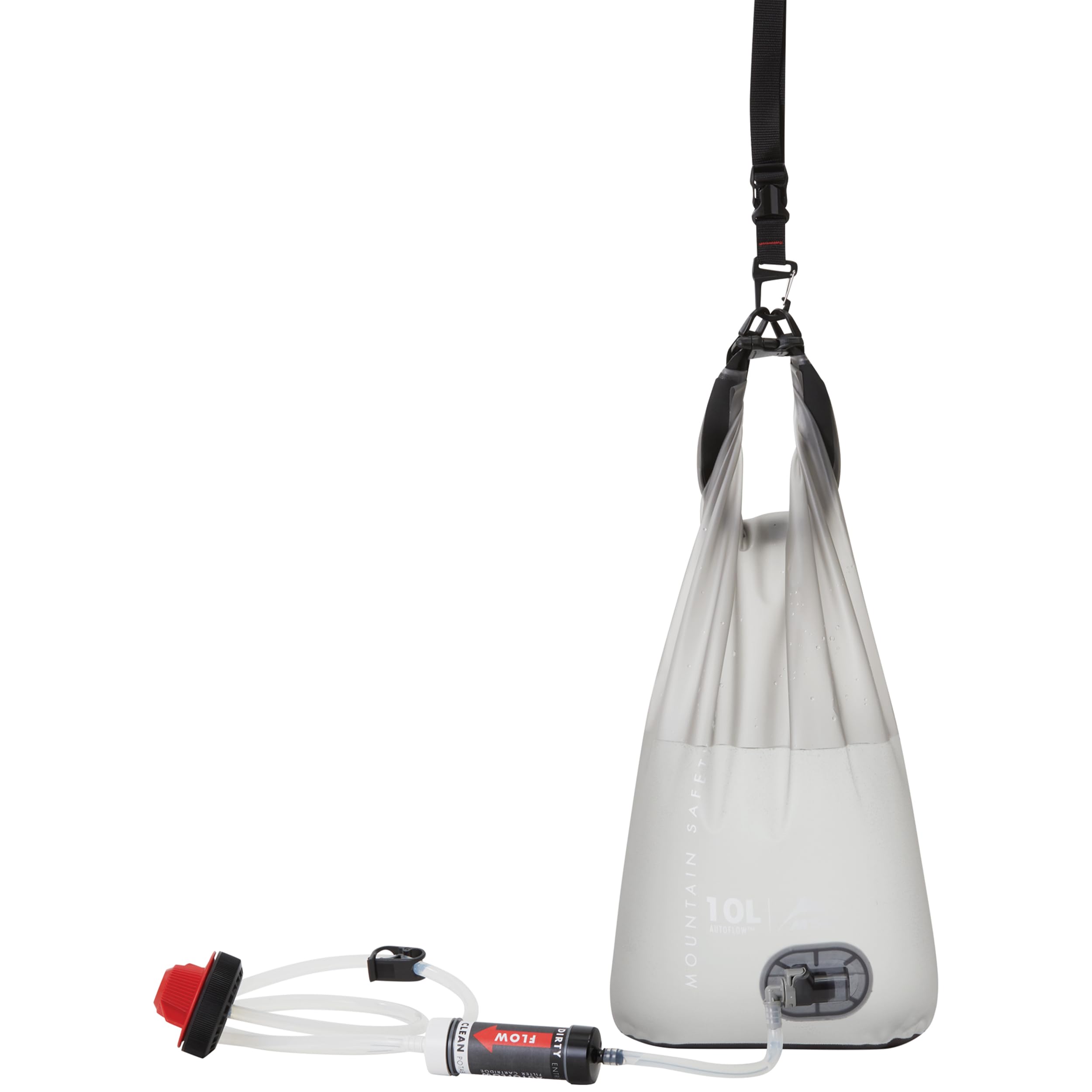
2. MSR AutoFlow XL 10-Liter Backcountry Gravity Water Filter
Ten liters that drain at the same speed as a four-liter kit — the basecamp crowd’s obvious answer.
Here is the number that matters: 1.75 liters per minute out of a 10-liter bag. The Platypus above moves water at that same rate, but this one holds 10 liters before you refill, against 4 liters there. For a group of six or a basecamp with a cooking pot in play, that means one hang covers the evening. MSR lists removal of 99.9999% of bacteria and 99.9% of protozoa, plus dirt and debris, and the flat-bottomed reservoir includes a sediment trap to keep grit out of the filter.
The camp details are thought through: a separate hang strap and bag clip let you level the bag without fighting a single loop. There is a separate hang strap and a bag clip, so you are not fighting a single loop to get it level. The 3-dimensional film reservoir sits flat and takes wear better than a plain bladder. The storage bag uses a PFAS-free DWR coating, which keeps your gear dry without the older chemistry. It weighs 12 ounces, packs to 8 x 4 inches, and carries a manufacturer’s 3-year limited warranty.
The trade-off is a group tool that a solo hiker will resent. Twelve ounces of empty bag plus ten liters of water is a lot to carry up a pass for one person’s drinking supply. If you hike alone, the HydraPak Seeker+ at 127 grams is the far saner companion — this MSR stays in the pack of whoever is feeding the whole camp.
Volume without a speed penalty: 10 liters at 1.75 L/min, so a full camp fill is a single hang, and the flow does not soften as the bag drains.
Built for rough ground: a flat base, a sediment trap, and a hang strap plus clip — details that matter when the only tree at camp is at an awkward angle.
The verdict: buy it the moment your group outgrows a four-liter bag — it is the volume leader that keeps the fast flow.
One caveat: at 12 ounces empty it is weight a solo backpacker should not carry.
3. Katadyn BeFree Gravity Water Filter 10L for Base Camp & Large Groups
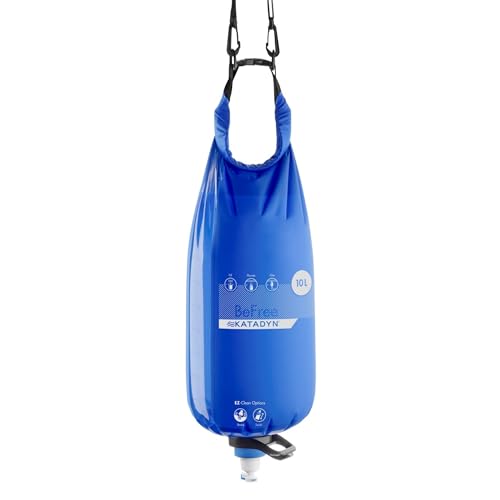
The quickest pour in this lineup at 2 liters per minute, from a bag that flattens to nothing when empty.
A 10-liter bag that moves water at up to 2 liters per minute is the fastest combination here. Compare it to the MSR AutoFlow XL’s 1.75 liters per minute and the Katadyn leads on speed while matching it on capacity. On a real pour, that speed is the difference between waiting for the pot to fill and getting on with dinner. The 0.1-micron EZ-Clean hollow fiber filter is rated for up to 1,000 liters before replacement.
Cleaning is the part that keeps a filter working, and this one asks for almost nothing. You shake or swish the filter in water — no tools, no disassembly. The 10-liter bag is built for shared drinking and cooking at basecamp, and it packs flat when empty. Katadyn has built water filters since 1928, and that history shows in fittings that hold up season after season.
The recurring gripe is flow that fades. Camp users report it moves three quarts in three to four minutes fresh, then slows toward a trickle after a handful of uses unless you stay on top of the swishing. Treat the 2 L/min figure as what a clean filter does, not what a neglected one does. Stay ahead of the cleaning and the speed holds.
The Case For It
- Up to 2 L/min — the fastest flow rate in this comparison
- 10-liter bag for basecamp drinking and cooking
- Clean by shaking in water, no tools needed
- Packs flat when empty, weighs 10.7 ounces
Stay Ahead Of This
- Flow drops when the filter is not cleaned regularly
- Rated to 1,000 liters, shorter life than some cartridges here
Pick it for: a basecamp that wants the fastest possible fill from one hang and will keep the filter swished clean.
Not for: anyone who wants a filter they can neglect for a whole season and still get full speed.
4. HydraPak Seeker+ Collapsible Water Filtration & Storage (3L)

Filter and bottle in one 127-gram package — the one you carry on a solo push instead of hanging at camp.
At 127 grams, this is the lightest system here by a wide margin, and it is really a different animal from the bag-and-hose kits. The 42mm filter screws straight into the reservoir, so you drink through the filter rather than waiting for a bag to drain. Two load-bearing lash points let you hang it for a gravity feed or strap it to a pack. When you are counting grams on a long solo approach, that flexibility earns its place.
The filtration specifications are strong on paper. HydraPak lists removal of 99.9999% of common waterborne bacteria, 99.999% of parasitic cysts per EPA Guide Standards, and 99.999% of microplastics per NSF 42 at 3.0 microns and up. It filters roughly 1,500 liters at more than 1 liter per minute. The high-flow drink nozzle opens and locks one-handed, and a dust cover keeps the valve clean between sips.
Here is the honest limit: this system is rated at just over 1 liter per minute, while the Platypus above moves water at 1.75 liters per minute. That does not matter when you drink directly, but it does when you want to fill a pot for a group. Flow can also stall on a clogged filter — a few users report no water moving at all, so backflush with the included adapter and keep it clean.
Weight you forget: 127 grams packed into a stuff sack, with the filter built into the cap instead of a separate cartridge and hose.
Know the pace: over 1 L/min suits drinking and bottle fills; it is not the tool for filling a cooking pot for four.
Best match: the solo backpacker or fast-and-light hiker who drinks on the move and counts every gram.
Skip if: your camp needs bulk water fast — the slower 1 L/min flow will test your patience.
5. Gravity Water Filter Kit with LED Display, 2-Gallon Bag
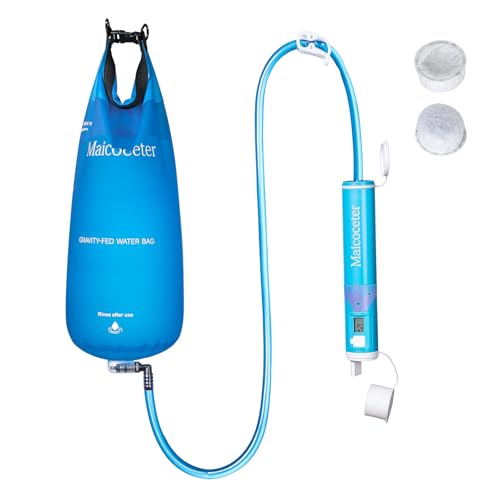
A 2-gallon bag with a countdown screen on the filter — camping gear that thinks like a kitchen appliance.
The LED countdown display is the unusual part. It shows each filtration cycle ticking down in real time, so you know how long is left without guessing from the drip. Whether that earns a spot in your pack is a personal call — some campers love the readout, others would rather save the battery. What surrounds it is solid: a 2-gallon bag, a 0.1-micron hollow-fiber membrane, activated carbon, and multiple PP filtration layers, aimed at reducing sediment, visible particles, unpleasant taste, and odor.
Maintenance is genuinely practical: the hollow-fiber membrane and activated-carbon stages are replaceable separately, so you swap only the worn part. The hollow-fiber membrane and the activated-carbon components are replaceable separately, so you swap the part that wears out instead of the whole filter. The whole kit weighs 9.6 ounces, and the Platypus above weighs 11.5 ounces for comparison. The bag folds flat when empty, and the included hose gives you flexible reach to your water source.
On speed, the numbers temper the enthusiasm. It filters at 500 milliliters per minute, the slowest rate in this lineup, and the Burtrail Pro below runs at 600 mL/min. A 2-gallon bag at that pace means a real wait for a full fill. Fine for a campsite where you hang it and go do something else; less fine when everyone is thirsty at once.
The readable filter: an LED countdown takes the guesswork out of each cycle, which is genuinely useful for a camp or emergency kit you rarely use.
Slow but steady: 500 mL/min means patience, though the 2-gallon bag saves you hanging it often.
Fits: the car camper, the preparedness kit, or anyone who wants a clear readout of how long the filter still needs.
Think twice if: you backpack far and hate waiting — 500 mL/min is the slowest fill here.
6. 6L Gravity Fed Water Filtration System with Adjustable Tree Strap

Six liters, a tree strap that grips the trunk, and a two-filter stack that sweetens the taste.
The capacity story here is the 6-liter bag, against the 3 liters the Burtrail Pro below holds. That is the sensible middle ground between a solo bladder and a basecamp barrel. It covers a family’s drinking water or a small group’s cooking needs in one hang. The adjustable tree strap is a small detail that pays off at a site where the branches are the wrong height.
The filtration is a two-part stack. A hollow-fiber membrane with a 0.1-micron pore size does the main filtering, and a carbon fiber layer improves taste, removes odor, and protects the membrane so it lasts longer. The membrane is rated for 6,000 liters (1,500 gallons) and the carbon for 300 liters (80 gallons); both are replaceable. The bag is food-grade, BPA-free material, and the filter straw can run on its own, with the bag, or stretched with an extension tube.
One thing to sort before you buy: this is a specifications-led listing, so the published numbers are what you are buying on. The two-filter stack is sound — 0.1-micron hollow fiber plus a carbon layer — but no flow rate is published, so speed is the one spec you cannot compare. If speed is your deciding factor, a model with a stated rate is the safer bet.
Why It Works For Families
- 6-liter bag serves a family or small group in one hang
- Carbon fiber layer improves taste and protects the membrane
- Membrane rated for 6,000 liters, carbon for 300 liters
- Filter straw works standalone, with the bag, or on an extension tube
Weigh Before You Buy
- No flow rate published, so speed is hard to compare
Good fit: a family or small group that wants six liters and a taste-smoothing carbon stage without the basecamp-sized bag.
Look elsewhere if: a published flow rate is a must-have for your decision.
7. Gravity Water Filter Pro, Versatile Water Purifier Camping with 0.01-Micron Filter Straw, 3L Gravity Bag
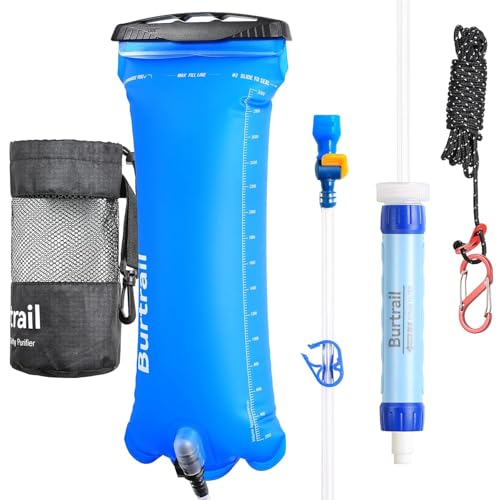
Three ways to drink from one kit — gravity bag, straw straight from the stream, or bottle adapter.
Most filters here do one job well. This one tries three. You can hang the 3-liter gravity bag for hands-free filtering, use the filter straw directly in a stream, or screw it onto a bottle for an extruded-style setup. The straw itself stacks a 0.01-micron hollow-fiber membrane with activated carbon fiber and double PP cotton, filtering at about 600 milliliters per minute. A finer membrane than the 0.1-micron standard, which is a real point in its favor.
The flexibility is the draw — gravity bag, stream straw, or bottle adapter — and 600 mL/min is respectable for a 3-liter kit. It filters at 600 mL/min, a little faster than the LED-display kit above at 500 mL/min. Maintenance is designed to be painless: the wide-open bag fills and flushes fast, and the filter backwashes by pushing a plastic bottle over the outlet — no extra syringe to lose. Food-grade materials throughout, and the bag sits flat in the pack.
The catch is bulk. It is a lightweight kit, but the 3-liter bag plus the straw and fittings adds up in a pack, and that is the part some campers find awkward to stow. If you are a committed ultralight packer, the HydraPak Seeker+ at 127 grams packs tighter. If you want one kit that covers gravity, straw, and bottle duty on a budget, this does the most jobs for the least outlay.
One kit, three roles: gravity bag, direct-drink straw, and bottle adapter — more ways into water than anything else here.
Fine membrane, fair speed: 0.01-micron hollow fiber at 600 mL/min, so it filters fine without a slow trickle.
Choose this if: you want a versatile survival kit that handles gravity, straw, and bottle duty without spending much.
Look past it if: you pack ultralight — the 3-liter bag and fittings take up more room than a bare 127-gram reservoir.
Understanding the Specs
Micron Rating (Pore Size)
The micron number (a micron is a thousandth of a millimeter) describes the size of the openings in the filter membrane. A 0.1-micron hollow-fiber filter is the common standard in this category and stops bacteria and protozoa. A 0.01-micron membrane is ten times finer in the listing numbers, so it catches smaller particles — usually at the cost of slower flow as the pores clog faster. For most backcountry water, 0.1 micron is the working standard.
Flow Rate and Capacity
Flow rate — liters or milliliters per minute — tells you how long you wait for a bag to drain. Capacity tells you how much one hang produces. Read them together: a big bag with a slow filter still means a long wait, just less often. A 1.75 L/min rate on a 10-liter bag fills a group’s water in one unhurried go; a 500 mL/min rate on a 2-gallon bag asks for patience even though you hang it rarely. Neither number alone tells the whole story.
Replaceable Cartridges
Filters are consumables, so the lifetime rating matters. Cartridge life here ranges from 300 liters on a carbon stage to as much as 6,000 liters on a hollow-fiber membrane, with most hollow-fiber filters landing in the 1,000-to-1,500-liter range. A replaceable cartridge means you swap the worn part instead of the whole kit. Some systems let you replace the membrane and carbon separately, which stretches the life of the bulkier components.
Weight and Packed Size
Empty weight decides whether a filter rides in your pack or stays home. A 127-gram reservoir with an integrated filter disappears into a daypack. A 12-ounce, 10-liter bag is a group tool you divide among several packs. Consider packed size as well — a collapsible bag folds flat, while hoses and clamps add bulk. Match the weight to how far you carry it, not just how much water you need.
FAQ
How does a gravity filter differ from a pump filter?
What micron rating do I need for backcountry water?
How long does a hollow-fiber filter cartridge last?
Can I hang a gravity filter from a tree without damaging it?
How often should I backflush my gravity filter?
Is a bigger bag always better for backpacking?
Do gravity filters remove viruses as well as bacteria?
What is the difference between the Platypus and MSR 1.75 L/min filters?
Can I use a gravity filter for emergency water at home?
Why does my gravity filter slow down after a few uses?
Final Thoughts: The Verdict
For most backpackers and campers, the backpacking gravity water filter to beat is the Platypus GravityWorks Group — two 4-liter bags, a 1.75 L/min flow that fills four liters in about 2.5 minutes, and a replaceable cartridge rated up to 1,500 gallons. It is the sensible all-rounder for two to four people. If you feed a larger basecamp, grab the MSR AutoFlow XL 10L for the same flow rate at ten liters per hang. And if you hike solo and count grams, the HydraPak Seeker+ at 127 grams is the one to reach for.
The Katadyn BeFree is the crowd favorite at 4.0+ stars across 700+ owners, but the Platypus wins on balance: 1.75 L/min, two 4-liter bags, and a 1,500-gallon cartridge. Whichever you pick, backflush it regularly; a clean filter is the difference between the published flow rate and a slow trickle.
How We Picked
We do not accept paid placement. Every pick is matched to a real buyer and a real use-case; we do not hands-on test units.
Sources & Methodology
Specifications: manufacturer listings and product documentation. Review insights: verified customer reviews, as of November 2026. Pricing: not shown on this page (it changes often); check the current price via the retailer link.
As an Amazon Associate, Gadgets Feed earns from qualifying purchases. This does not affect which products we feature.