
Our readers keep the lights on and my morning glass full of iced black tea. As an Amazon Associate, I earn from qualifying purchases.
Specs are compiled from manufacturer listings and verified buyer reviews and can change over time — please confirm the key details on the product page before buying.
You want one pocket-sized drive that holds your whole footage archive, moves a 4K project in minutes instead of hours, and does not quietly die at the worst moment. The short answer: buy the SanDisk Extreme 4TB first if you want the crowd favorite, then move up to the Samsung T9 if you regularly push 4K60 footage and want the fastest sustained writes. Everything below explains exactly how those two differ, and which of the other nine fits your machine, your cables, and your workload.
I’m Min — the founder and writer behind Gadgets Feed. This guide is built by comparing the manufacturers’ published specifications and the patterns across verified customer reviews, so you get each pick’s real strengths and trade-offs instead of marketing spin.
Capacity is the easy part here, because every drive on this list is a genuine 4TB unit — the real differences live in read speed, drop rating, and which port your laptop actually has. That is exactly what this 4tb portable ssd breakdown compares, drive by drive.
Our Picks at a Glance


How To Choose The Best 4TB Portable SSD
Your computer’s port, the drive’s toughness, and how much of that 4TB survives formatting decide whether a drive suits you. Match all three and the drive you pick will do its job without surprises. Speed only counts if your computer can feed it, so check your port first.
Your port decides your real speed, not the box
A drive sold at 2000MB/s needs a USB 3.2 Gen2x2 port to reach that figure, and Gen2x2 is a dual-lane variant of USB that many laptops do not have. Plug the same drive into a standard 10Gbps USB-C port and you get closer to 1000MB/s. That is still fast, but it is half the speed you paid for. Check your laptop’s spec sheet before you chase the biggest number on the shelf.
Rugged ratings are about surviving your bag, not a lab
An IP code (a two-digit water-and-dust rating) tells you how well a drive survives the outdoors. The first digit covers dust, the second covers water. IP65 means sealed against dust and able to shrug off water spray from a nozzle, so a rainy shoot won’t kill it. IP67 goes further, covering brief immersion, so a dropped-in-a-puddle moment is survivable. Drop protection figures like 1.2 meters, 3 meters, or 6 feet describe the fall height the housing is rated to survive. Match that to whether the drive rides in a hard case or loose in a camera bag.
Remember that 4TB is not 4,000GB in your file manager
Windows calculates a gigabyte as 1,024 megabytes while drive makers count 1,000, so a factory-fresh 4TB drive can show as roughly 3725GB on a Windows machine and still read as 4TB on a Mac. The drive is not shortchanged; only the unit label differs. Expect a small visible gap, and plan your archive around it rather than being surprised on day one.
Quick Comparison
| Model | Best For | Rated Read Speed | Port / Interface | Rugged Rating | Amazon |
|---|---|---|---|---|---|
| SanDisk Extreme 4TB★ Best Overall | All-round archive and travel | Up to 1050MB/s | USB-C (USB 3.2) | 3 m drop, IP65 | Amazon |
| SSK 4TB USB-CBest Value | Cross-device video work | Up to 1050MB/s | USB 3.2 Gen2 | — | Amazon |
| SSK 4TB Gen2x2 20GTop Performer | Fast transfers on modern laptops | Up to 2000MB/s | USB 3.2 Gen2x2 | — | Amazon |
| DATO ARES Amber Shield | Console storage and outdoor use | Up to 1600MB/s | USB 3.2 Gen2x2 | 1.2 m drop, IP67 | Amazon |
| MOVE SPEED SP10 | Phone-first creators | Up to 1050MB/s | USB-C + USB-A dual ports | — | Amazon |
| KingSpec Z5 4TB | Desk-side speed with some flair | Up to 2100MB/s | USB 3.2 Gen2x2 | — | Amazon |
| Transcend ESD410C | Handheld gaming and iPhone capture | Up to 2000MB/s | USB 3.2 Gen2x2 | 3 m drop, IPX5 | Amazon |
| SanDisk Creator PRO | Adobe workflow users | Up to 2000MB/s | USB-C (USB 3.2) | 3 m drop, IP65 | Amazon |
| Sabrent Rocket Nano XTRM | Thunderbolt editing rigs | Up to 2700MB/s | Thunderbolt 3 | — | Amazon |
| Samsung T7 4TB | Everyday backup and study use | Up to 1,050MB/s | USB 3.2 Gen 2 | 6 ft drop | Amazon |
| Samsung T9 4TB | Heavy 4K project work | Up to 2,000MB/s | USB 3.2 Gen 2×2 | 9.8 ft drop | Amazon |
In‑Depth Reviews
1. SanDisk Extreme 4TB Portable SSD (Old Model)
Our pick — 4.5+★ from 92,500+ verified ratings; the strongest balance of quality and price.
A credit-card-sized 4TB drive with a 3-meter drop rating and IP65 sealing, and the safest first buy for a laptop with ordinary USB-C.
If you want one drive for offsite backup, travel, and a laptop with only ordinary USB-C, start here. The SanDisk Extreme reads at up to 1050MB/s and writes at up to 1000MB/s over NVMe solid state memory. A solid state drive uses flash chips instead of spinning discs, so there is no waiting for platters to spin up when you open a folder of camera files. A full day of shooting copies across in a coffee break rather than an evening.
Where it genuinely leads is toughness. The housing carries a 3-meter drop rating and IP65 water-and-dust resistance, which is a full meter and a half more fall protection than the DATO drive below manages at 1.2 meters. IP65 means dust cannot get in and splashes bounce off, so a drive that lives loose in a jacket pocket or gets caught in rain on a shoot is not a gamble. There is also a carabiner loop, which sounds trivial until you have watched a drive slide off a table.
Security is handled properly too — 256-bit AES hardware encryption built into the drive itself, protected by a password, so the files stay locked even if the drive is pulled out and plugged into another machine. The SanDisk Memory Zone app handles file management and clearing space. During longer sustained writes the drive warms up noticeably, which is normal for a metal-cased NVMe unit and worth knowing if you plan to run it for hours. The crowd verdict backs the design: 4.5+ stars across 92,000+ ratings, with owners most often cheering the speed and the fact it slips into a shirt pocket.
What earns the top slot
- 3-meter drop protection and IP65 sealing, the toughest combo in the top half of this list
- Up to 1050MB/s read and 1000MB/s write, plenty for 4K editing off the drive
- 256-bit AES hardware encryption keeps client work locked behind a password
- Carabiner loop and credit-card footprint make it genuinely pocketable
What to keep in mind
- It tops out around 1000MB/s, so the Gen2x2 drives here will beat it on raw throughput
- Reliability feedback across the reviews is split rather than unanimous — treat it as a drive to back up, not your only copy of anything
Pick it for: anyone who wants one durable, encrypted 4TB drive for travel and offsite backup without chasing a special port.
Look elsewhere when: your laptop has USB 3.2 Gen2x2 and your day is built around moving enormous files, where a 2000MB/s drive earns its keep.
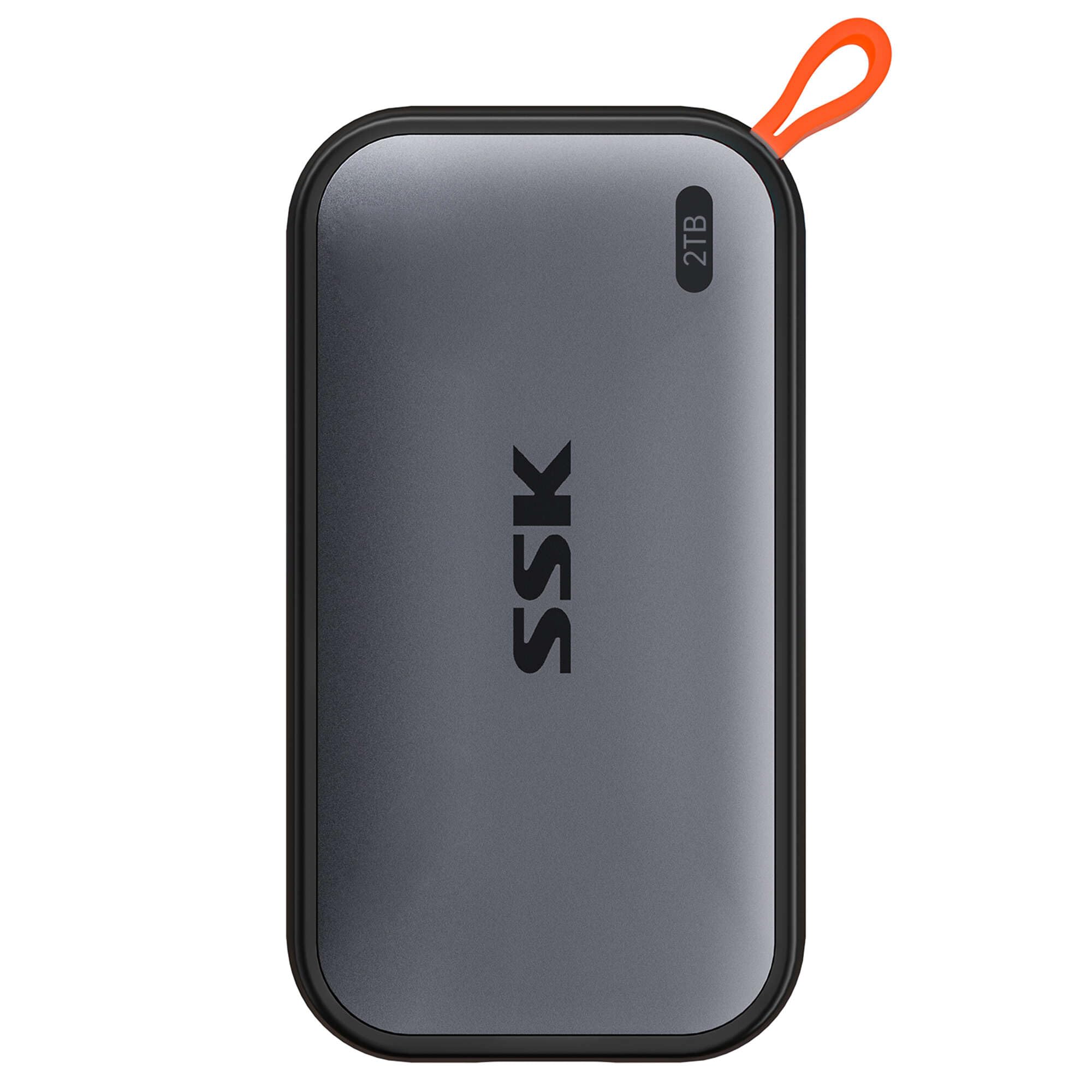
2. SSK Portable SSD 4TB External Solid State Hard Drive USB C
Two cables in the box, a metal body, and enough patience with file systems to keep Windows and Mac users both calm.
Some drives punish you for owning the wrong laptop. This SSK does the opposite: it ships with both a USB-C and a USB-A cable, so an older machine with rectangular USB-A ports gets the same plug-and-play experience as a modern one. Reads run up to 1050MB/s and writes up to 1000MB/s over USB 3.2 Gen2, which is the difference between copying a card’s worth of RAW photos in a few minutes and wondering if the transfer froze.
It also handles iPhone footage directly — the drive supports 4K60 ProRes HDR capture with low power draw, which matters if you shoot high-resolution video on a phone and do not want to stop recording to clear space. S.M.A.R.T. monitoring and TRIM support are both on board; in plain terms, the drive checks its own health and keeps its write speeds from sagging as it fills. Owners find it reliable and dead simple to use, and the compact metal shell travels easily. A handful do hit compatibility snags with iPhones specifically, so if that is your only device, test it early rather than on the day of a shoot.
On value it is the strong play of the whole group: 4.5+ stars across 3,900+ ratings, mid-tier money, and cross-platform cables you would otherwise buy separately. Just budget a little patience for the first setup — Windows may show the drive as roughly 3725GB while a Mac shows 4TB, both of which are correct readings of the same physical space.
Why it earns its place: the dual-cable kit and phone-ready capture are features the premium drives here charge extra for, and neither is a gimmick for anyone who edits on more than one machine.
The realistic caveat: it is a 1050MB/s class drive, so it will not keep pace with the 2000MB/s units further down this list when you are pushing multi-gigabyte project folders around.
Reach for this if: you juggle a laptop, a camera, and a phone and want one drive with the right cable already inside.
Think twice if: your entire workflow lives on iPhone — compatibility is the one recurring snag in the feedback.
3. SSK 4TB Portable SSD External Solid State Hard Drive USB3.2 Gen2x2 20Gbps
A near-doubling of speed over the 1050MB/s class, if your laptop has the port to feed it.
Here is the honest math on this drive: it reads at up to 2000MB/s, which is nearly twice the 1050MB/s ceiling of the SanDisk Extreme above. That figure is measured on CrystalDiskMark 7.0, so treat it as a best-case lab number rather than a promise on every machine. The catch is the port. Full speed requires USB 3.2 Gen2x2 — a dual-lane USB variant most laptops lack — and Thunderbolt or ordinary USB ports will cap it at 10Gbps. Buy this only after you have confirmed your machine has Gen2x2.
Included cables are thoughtfully split: a 20Gbps USB-C cable for full-speed machines and a 10Gbps USB-A cable for backward compatibility, so you are not forced to buy adapters. S.M.A.R.T. diagnostics and adaptive TRIM keep write speeds from degrading as the drive fills up and help it last. A blue LED shows transfer activity in real time, which is a genuinely useful guard against unplugging mid-copy — a habit that destroys data on any drive. The enclosure mixes plastic with zinc alloy, and it stays compact enough for a jacket pocket.
Feedback is thin but flattering: 4.5+ stars across a modest pool of ratings, with reliability and speed leading what people talk about. Heat and capacity expectations are the two things that pull in different directions — the casing gets warm under sustained load, which is normal, and a small number of owners expected more usable space than they found. Neither is unusual for the class.
The case for it
- Up to 2000MB/s read — close to double the 1050MB/s drives here when paired with a Gen2x2 port
- Ships with both a 20Gbps USB-C cable and a 10Gbps USB-A cable
- Activity LED and TRIM support help you avoid mid-transfer data loss
Where it falls short
- Drops to a 10Gbps ceiling on Thunderbolt and standard USB ports
- Warms noticeably during long writes; give it airflow in a busy session
Best matched to: an editor whose laptop genuinely carries USB 3.2 Gen2x2 and who moves footage daily.
Not the one for: anyone on Thunderbolt-only hardware, who will pay for speed they cannot reach — the Sabrent further down handles that better.
4. DATO External SSD 4TB — ARES Amber Shield

An amber-shielded drive built for console gaming and messy locations, with a five-year warranty behind it.
If the drive is going to live near a console, a workshop, or the bottom of a camera bag, this is the one to look at. It is explicitly listed as compatible with the PlayStation 5 and works with OTG-enabled USB-C devices.
The rugged side is where it pulls ahead for outdoor work. The housing survives a 1.2-meter drop and carries IP67 protection, meaning it is dustproof and rated to handle 1 meter of water for 30 minutes. That is a meaningful step up from splash resistance for anyone shooting near water, mud, or weather. Graphene thermal material sits inside to move heat away from the flash chips, which is the difference between consistent writes and a drive that throttles halfway through a backup.
The bundle is generous — a 2-in-1 cable with a detachable USB-A end that reveals a USB-C connector, covering 20Gb/s USB-C to USB-C and 10Gb/s USB-C to USB-A, plus a limited 5-year warranty. One practical note the maker stresses: use the included high-speed cables, because third-party cables can drag the transfer rate down. Feedback is split on Windows 11 compatibility and on value, so verify your machine first if that is your platform.
Standout strength: the combination of IP67 sealing, a 1.2-meter drop rating, and 1500MB/s writes makes it the most travel-proofed drive here that still moves data fast.
Worth checking first: a few owners run into trouble on Windows 11 and some find the cost hard to justify — confirm compatibility before a big project depends on it.
Go here if: your drive sees consoles, vehicles, or wet locations and you want IP67 sealing plus a five-year warranty.
Pass if: you are on Windows 11 and cannot easily test return policies — compatibility is the recurring question mark.
5. MOVE SPEED 4TB SP10 External Drive

Both plug types live on the same end, so there is no cap to lose and no adapter to forget.
Creators who move between an iPhone, an iPad, and a laptop know the small indignities: hunting for the right cable, losing a port cap, adding a dongle. This drive puts a USB-C port and a USB-A port on the same end of the body, so you simply flip the drive rather than the cable. Reads run at up to 1050MB/s and writes at 1000MB/s, enough to handle large 4K video files and project folders without the transfer bar stalling.
The housing is zinc alloy, described by the maker as offering drop and crush resistance, and the chipset is tuned to stay cool through intense 4K transfers — a peak temperature of 122°F is cited. That is lukewarm to the touch, not scorching, so long sessions are comfortable to handle. It also works with the PlayStation 5 if you want a shared drive between desktop work and console storage.
Owners consistently highlight speed and value, with files moving in seconds and the compact shape sliding into a pocket without a bulge. The mixed notes are worth knowing: a few report heat under load and a handful question long-term reliability, so treat it as a working drive backed up elsewhere rather than a sole archive. It lands at 4.0+ stars across 170+ ratings — respectable, if slightly behind the leaders.
Reasons it stands out
- USB-C and USB-A ports on the same end — flip the drive, not the cable
- Zinc alloy shell with a cited peak temperature of 122°F, so it stays handleable
- Up to 1050MB/s read for large 4K files, plus PS5 compatibility
Honest downsides
- Heat shows up in some feedback during long transfers
- Reliability is a mixed signal — keep a second copy of anything critical
Worth choosing when: your daily setup is a phone, a tablet, and a laptop and you are tired of swapping cables.
Skip the risk if: you need a single-drive archive for irreplaceable footage — mirror it to a second SSD.
6. KingSpec Z5 4TB Portable External SSD with RGB Light

The highest read rating on this list, wrapped in a zinc case that glows in 128 colors.
On paper this is the quickest drive of the group: up to 2100MB/s over USB 3.2 Gen2x2, which edges past even the 2000MB/s drives. That speed is earned only on a Gen2x2 port — the maker is explicit that MacBook and iMac users get capped at 10Gbps and that it does not work with iPhone at all. Buy it for a Windows desktop or laptop with the right port, not for a Mac-first workflow.
The zinc alloy casing does double duty: it resists impacts and helps spread heat, which keeps sustained performance steadier during long transfers. Then there is the look — 128 colors of breathing ambient light, which is either the reason you want it or a detail you ignore. It is compatible with phones, laptops, TVs, PCs, and PlayStation consoles, so it can sit under a TV one day and beside a laptop the next.
Owners are broadly satisfied, with performance and storage capacity leading the conversation and setup coming across as simple. The honest wrinkle is speed consistency — some find real-world read and write figures come in under the advertised claim, which is common once thermal limits and file sizes enter the picture. Backed by a 3-year limited warranty and lifetime technical support.
What it does best: the highest read rating here, plus a metal shell that handles heat and the occasional knock in a workspace.
The reality check: Mac users are capped at 10Gbps and iPhone is not supported, and some find real throughput under the headline number.
Made for: a Windows setup with USB 3.2 Gen2x2 where you want the fastest listed read speed and a desk-friendly look.
Wrong fit for: Apple-only workflows — the driver support simply is not there.
7. Transcend 4TB ESD410C Portable SSD

Drop-tested to 3 meters with military-grade durability, and it plugs straight into a Steam Deck.
If you carry a handheld console, this is the list’s best fit. Transcend names Steam Deck, ROG Ally, and MSI Claw specifically, plus Windows, macOS, iPhone, iPad, Android, PS5, and Xbox — with one caveat: it is not compatible with the older Lightning-port iPhones. It reads at up to 2000MB/s over USB 3.2 Gen2x2 and comes formatted exFAT, so it is plug-and-play the moment you take it from the start.
Durability is the other half of the pitch. The drive is IPX5-rated for water resistance — that means it survives water jets, though not full submersion — and carries MIL-STD-810G military-grade durability with drops tested up to 3 meters (9.8 ft). That 3-meter figure matches the SanDisk Extreme but pairs it with a lower water rating. If you capture Apple ProRes on an iPhone, it records 4K 60fps straight to the drive and transfers instantly, which is a genuinely fast mobile workflow.
Owners speak highly of the performance, and the reliability feedback is split rather than glowing — some report smooth operation, some occasional hiccups. With a mid-sized pool of ratings at 4.0+ stars, it is a capable pick for gaming and phone capture rather than a sole archive. Data recovery service and password protection are both listed as included features.
Why gamers reach for it
- Explicit Steam Deck, ROG Ally, and MSI Claw compatibility
- Drop-tested to 3 meters (9.8 ft) with MIL-STD-810G durability
- Records 4K 60fps Apple ProRes from an iPhone
- Comes formatted exFAT — plug and play on first use
Where it stops short
- IPX5 means water jets, not immersion — do not dunk it
- Not compatible with Lightning-port iPhones
- Reliability feedback is mixed rather than consistent praise
A smart pick if: you game on a handheld or record ProRes from an iPhone and want built-in durability for life on the move.
Look past it if: you need submersion-proof sealing — the DATO’s IP67 goes further on water.
8. SanDisk Creator PRO Portable SSD 4TB

The creator-focused step up from the Extreme, doubling read speed while keeping the same armor.
SanDisk markets this as the drive for people who make things, and the numbers back the pitch: up to 2000MB/s read speeds, nearly double the Extreme’s 1050MB/s. Backing up and scrubbing through large projects stops being the slow part of your day. It keeps the 3-meter drop protection and IP65 water-and-dust resistance of its stablemate, so the durability you already trust is intact. A SanDisk Creator PRO, a USB Type-C cable, and a USB Type-C to USB Type-A cable all come in the box.
There is also a genuinely practical perk for editors — a month of Adobe Creative Cloud is included, which is aimed squarely at the audience this drive targets. It is built and packaged for impact protection, and it pairs with the Nintendo Switch as a compatible console. The aesthetics lean premium: a blue body, NAND flash storage, and a 2.5-inch form factor.
One caution: there is no user feedback curve yet to tell you how it holds up over time. You are choosing on the spec sheet and brand track record rather than owner experience. At the premium end it is the safe upgrade if your workflow lives inside SanDisk’s ecosystem and Adobe apps.
The appeal in one line: doubles the Extreme’s read speed while keeping the 3-meter drop and IP65 sealing that make a travel drive trustworthy.
What you give up: it costs more than the plain Extreme, and the Adobe perk plus premium branding are what most of the difference depends on. If you don’t use Adobe apps, the plain Extreme covers the same backup and travel jobs for less.
Consider it when: you live in Adobe apps, want speed near 2000MB/s, and value the same sealed armor as the classic Extreme.
Hold off if: you want a large body of real owner experience behind the choice — this one is too new for that.
9. SABRENT Rocket Nano XTRM 4TB External SSD

The only Thunderbolt drive here, and the fastest: 2700MB/s in a 1.69-ounce aluminum body.
If you edit 4K or 6K video on a Thunderbolt-equipped machine, this is the drive that removes the bottleneck. Over a Thunderbolt 3 interface running 40Gbps, it delivers up to 2700MB/s — higher than every other drive on this list, including the 2100MB/s KingSpec and the 2000MB/s SSK. Plug it into a regular USB port and it falls back to USB 3.2 Gen 2 at up to 900MB/s while staying backward compatible, so it degrades gracefully rather than refusing to work.
The physical build is its other story: 4TB of NVMe storage inside a 2.95″ × 1.34″ × 0.71″ aluminum body that weighs 1.69 oz. It is bus-powered, so no power adapter is needed, and it ships with both a Thunderbolt/USB-C cable and a USB-C to USB-A cable. A silicone sleeve adds drop and scratch protection. The aluminum also spreads heat during long sustained transfers, and that is note because heat is the one recurring note in feedback — during heavy loads it warms up noticeably.
Coverage is unusually good: a 3-year standard warranty that extends free to 5 years if you register on the maker’s site within 90 days, plus US-based support. Owners who run it on Thunderbolt hold its speed and reliability in high regard, and value is the mixed note — worth it if you can use the Thunderbolt bandwidth, less so if you cannot.
Why it tops the speed chart
- Up to 2700MB/s over Thunderbolt 3 — the fastest figure on this list
- 1.69 oz in a 2.95″ × 1.34″ × 0.71″ body, bus-powered with both cables included
- Free 5-year warranty if you register within 90 days
- Backward compatible to USB 3.2 Gen 2 at up to 900MB/s
What to watch for
- Gets noticeably hot during sustained transfers
- Costs more than the 2000MB/s USB drives and needs Thunderbolt to justify it
Choose it for: Thunderbolt-based editing where 2700MB/s turns long transfers into short ones.
Leave it if: you are on plain USB — you will not hit the headline speed and pay a premium anyway.
10. Samsung T7 Portable SSD 4TB

An aluminum 4TB drive rated for 6-foot drops, with 1,050MB/s reads and 4K60 ProRes capture for students, gamers, and photographers.
This is the drive people buy when they want something proven and uncomplicated. It reads and writes at up to 1,050/1,000 MB/s via PCIe NVMe technology and USB 3.2 Gen 2, so it comfortably handles large working files, 4K video, and game data. It also records 4K 60fps Ultra High Resolution video directly from a camera or mobile device, including iPhone 15 Pro Res at 60fps. The solid aluminum unibody handles shock and fall protection up to 6 feet.
What owners appreciate most is the compact footprint paired with the full 4TB — it slides into a bag without a bulge and holds an enormous library. Samsung builds its own DRAM and NAND in-house, which is the basis for its claim to the world’s number one flash memory brand since 2003. Magician software handles encryption, firmware updates, and drive-health monitoring. Reliability and write-speed feedback is genuinely mixed here, though, with some complaints of slow writes once files get large — so keep it backed up.
It is a generalist, not a specialist: everyday backup, coursework, and photo libraries suit it better than heavy sequential writes. For everyday backup, coursework, photo libraries, and light editing, the T7 does the job with a big track record behind it. It reads slower than the Gen2x2 drives here at 1,050MB/s, so aggressive 4K editing can feel a step behind.
Its strong suit: a 6-foot drop rating, 4K60 ProRes capture, and aluminum build in a package that fits a laptop bag with no fuss.
Fair warning: sustained write speed is the spot where some owners see it fall behind, so plan around it for heavy edits.
The right call for: students, gamers, and photographers who want a proven 4TB drive for everyday backup.
Not ideal for: editors pushing huge sequential writes, who should look at the Gen2x2 options above.
11. Samsung T9 Portable SSD 4TB

Sustained 2,000MB/s with a thermal guard, and the toughest drop rating in the entire lineup.
This is the drive to pick when you are pushing giant 4K projects for hours and cannot afford a mid-transfer slowdown. It runs sustained read and write speeds up to 2,000MB/s over USB 3.2 Gen 2×2 — nearly double the T7’s 1,050MB/s, and it holds that pace during longer processes rather than spiking and sagging. Dynamic Thermal Guard is the mechanism behind that, controlling heat to keep the SSD within its ideal range under heavy load.
Durability is the surprising headline: it endures drops of up to 9.8 ft, which beats the 6 ft of the T7 and matches the 3-meter rating of the rugged drives here. It is compatible with desktops, cameras, and consoles including PS5 and both Xbox Series models, and it supports iPhone 15 Pro Res 4K at 60fps. Magician Software handles firmware updates, extra encryption, and health monitoring. AES 256-bit hardware encryption keeps sensitive project files locked.
Owner sentiment is strong and broad-based: 4.5+ stars across 5,000+ ratings, with performance and speed leading the praise and owners noting it is about the size of a thick credit card. A minority do hit recognition problems on some devices and mixed durability notes, which is common once you push a drive this hard.
The strongest case
- Sustained 2,000MB/s over USB 3.2 Gen 2×2, roughly double the T7’s 1,050MB/s
- 9.8 ft drop rating beats the T7’s 6 ft and matches the rugged drives here
- Dynamic Thermal Guard holds speed through long editing sessions
- AES 256-bit hardware encryption and Magician Software health monitoring
Where it gives ground
- Needs a Gen2x2 port to reach 2,000MB/s
- A few owners find it unrecognized on specific devices, so test it early
- Premium-tier positioning puts it near the top of this group on price
The best pick for: anyone running long 4K edits who wants sustained speed rather than a headline spike, backed by the toughest drop rating here.
Think again if: your laptop lacks USB 3.2 Gen 2×2 — the T7 will save you the premium for similar real-world results.
Understanding the Specs
Read vs. write speed
Read speed is how fast the drive hands files to your computer; write speed is how fast it takes files in. Backup and export work lives and dies on write speed, while editing off the drive relies on read. Most drives here publish both figures — for example up to 1050MB/s read and 1000MB/s write on the SanDisk Extreme — and the two rarely match, so check both if your day is heavy on copying footage in.
USB 3.2 Gen2x2 and why the port matters
USB 3.2 Gen2x2 is a dual-lane version of USB that carries data over two channels at once, which is how drives reach 2000MB/s and beyond. Thunderbolt and standard USB ports lack that dual-lane path, so a 2000MB/s drive plugged into them tops out near 10Gbps. Match the drive’s interface to your machine’s actual port before paying for the faster label.
IP ratings decoded
An IP rating uses two digits — the first for dust, the second for water. IP65 keeps dust out and shrugs off water spray, while IP67 goes further and handles brief immersion. IPX5 means water jets only, not submersion. If the drive rides in a bag near weather, pick IP65 or IP67; if it lives on a dry desk, splash protection is enough.
Drop protection in meters and feet
A drop rating states the fall height the housing is built to survive. This list ranges from 1.2 meters on the DATO up to 3 meters on the SanDisk Extreme and Transcend, with the Samsung T9 rated to 9.8 ft. If the drive travels loose in a bag, a higher rating buys confidence. A lower one is fine inside a padded case.
FAQ
Why does my new 4TB drive show less space in Windows?
Will a 2000MB/s drive run at full speed on my laptop?
Can I plug these drives straight into an iPhone or iPad?
Which drive is best for a PS5 or Xbox?
Do I need a Thunderbolt drive for video editing?
Why do these drives get warm during long transfers?
Is a 4TB portable SSD reliable enough to be my only copy?
Can I edit video directly off the drive instead of copying first?
Do these drives include the cables I need?
What does hardware encryption actually protect?
Final Thoughts: The Verdict
For most people, the 4tb portable ssd winner is the SanDisk Extreme 4TB because it pairs a 3-meter drop rating and IP65 sealing with 1050MB/s reads and hardware encryption at a fair mid-range price. If you want the fastest sustained speed for heavy 4K editing, grab the Samsung T9. And for handheld gaming or iPhone ProRes capture, the Transcend ESD410C is the one to reach for.
Let your port decide before anything else. A Gen2x2 machine turns the SSK 20G, KingSpec, or T9 into real time savers, while a plain USB laptop is better served by the SSK USB-C value pick or the T7. Buy only the speed your port can feed: a Gen2x2 machine makes the 2000MB/s drives worth it, while a plain USB laptop gets the same real-world result from a 1050MB/s model.
How We Picked
We do not accept paid placement. Every pick is matched to a real buyer and a real use-case; we do not hands-on test units.
Sources & Methodology
Specifications: manufacturer listings and product documentation. Review insights: verified customer reviews, as of November 2026. Pricing: not shown on this page (it changes often); check the current price via the retailer link.
As an Amazon Associate, Gadgets Feed earns from qualifying purchases. This does not affect which products we feature.