
Our readers keep the lights on and my morning glass full of iced black tea. As an Amazon Associate, I earn from qualifying purchases.
Specs are compiled from manufacturer listings and verified buyer reviews and can change over time — please confirm the key details on the product page before buying.
If you are shopping for a compact monitor, the honest answer is that the best value usually sits in the portable class, not the old desktop slab. A 17-inch portable panel gives you a 1080p or 4K picture you can slide into a backpack and set up beside your laptop in under a minute. The desk-and-wall units still make sense for a cash register, a security desk, or a legacy machine that only speaks VGA. One quick note before the picks: this list uses flexible, human-like matching for the size, so not every pick is the exact number you typed. The nearest same-type size serves the same purpose, and the nearest 17.3-inch panel is still a 17-inch monitor in practice.
I’m Min — the founder and writer behind Gadgets Feed. This guide is built by comparing the manufacturers’ published specifications and the patterns across verified customer reviews, so you get each pick’s real strengths and trade-offs instead of marketing spin.
Below you will find a mix of travel panels, budget desktop units, touch units, and industrial-grade frames, ordered by what each one actually does best. If you want the one most buyers end up keeping, the cocopar at the top holds 4.5+ stars across 6,000+ ratings, and it earns that spot with a 3840×2160 panel. The rest of this guide covers the best 17 Inch Monitor for every setup, from a laptop bag to a CCTV wall.
Our Picks at a Glance


How To Choose The Best 17 Inch Monitor
A 17-inch monitor is small enough to crowd your desk and close enough to strain your eyes, so the panel you pick matters. The panel you pick changes how much you squint, how fast you can pack up, and whether your old software looks right. These four things decide most of that.
Resolution decides how much fits on the screen
More pixels means more spreadsheet columns and readable text at arm’s length. A 3840×2160 panel versus a 1280×1024 screen keeps documents from looking chunky. If you only type and check email, a 1280×1024 panel is still perfectly usable, just not crisp.
Aspect ratio decides legacy fit
A 4:3 panel is the safe choice for a point-of-sale terminal, a CCTV recorder, or a piece of software written before widescreen. A 16:9 or 16:10 panel gives you a wider workspace for a browser and a document side by side. Match the ratio to the software you actually run, not to what looks trendy.
Brightness and contrast decide comfort
Brightness is measured in candelas, written cd, and a 250 cd panel can wash out near a sunlit window. A 600 cd panel holds its picture in a bright room. Contrast is the gap between the darkest black and the brightest white, so a 1200:1 panel reads better than a 1000:1 one in a dim corner.
Portability and mounting decide where it lives
Travel panels weigh 1.7 lbs to a couple of pounds and slip into a bag. Desktop units sit on a stand or hang on a VESA mount, which is a four-hole pattern on the back that fits a wall bracket. Decide whether the monitor travels or stays put before you compare specs.
Quick Comparison
| Model | Best For | Resolution | Refresh Rate | Panel Type | Amazon |
|---|---|---|---|---|---|
| cocopar 17.3 Inch 4K Portable★ Best Overall | Sharpest laptop companion | 3840×2160 | 60Hz | LCD | Amazon |
| Thinlerain 17-inch 4:3 LEDBudget Champion | Retro and budget desks | 1280×1024 | 60Hz | LED | Amazon |
| SKitphrati 17-inch 1440×900Best for Legacy Software | Legacy business apps | 1440×900 | 75Hz | TN | Amazon |
| ZOSHING 17inch Security Monitor | CCTV and wall mounting | — | — | LCD | Amazon |
| Thinlerain 17″ 10-Point Touch | POS and touch input | 1280×1024 | — | LCD | Amazon |
| ZSCMALLS 17.3 Inch 144Hz | Fast-action gaming | 1920×1080 | 144Hz | IPS | Amazon |
| ARZOPA 17.3″ 1080P | Everyday travel use | 1920×1080 | — | IPS | Amazon |
| Acer V173 Djb | Simple office work | 1280×1024 | — | LCD | Amazon |
| GreenTouch Open Frame | Industrial touch builds | 1280×1024 | — | LED | Amazon |
In‑Depth Reviews
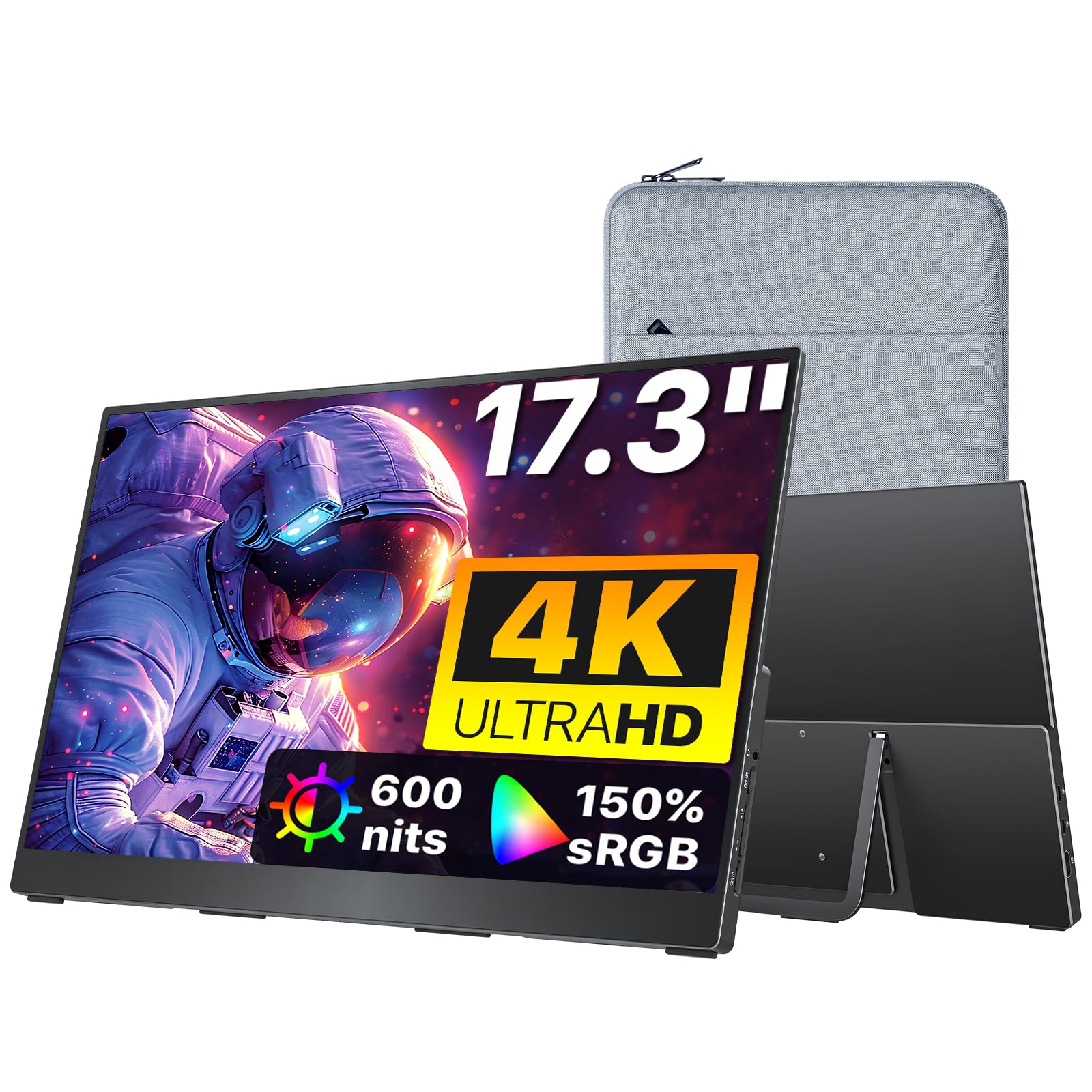
1. cocopar Portable Monitor 17.3 Inch 4K UHD
Our pick — 4.5+★ from 6,000+ verified ratings; the strongest balance of quality and price.
A 4K panel you can fold into a backpack and open on any hotel desk.
The defining number here is 3840×2160 on a 17.3-inch screen. That is 3840×2160 versus a 1280×1024 panel, so spreadsheets, photo edits, and three stacked browser windows stay readable without zooming. The 150% sRGB color rating means the panel shows a wider range of color than most budget screens, which matters if you touch up photos or build design files on a laptop. The 1200:1 contrast ratio gives you darker blacks than a 1000:1 desk monitor, so movie night in a hotel room looks less gray.
Portability is the other half of the pitch. The whole thing weighs 1.7 lbs, and a cloth bag comes in the box for scratch protection on the road. Two USB-C ports and one HDMI port handle laptops, a Surface, or a game console with no driver install, as long as your device supports Thunderbolt 3/4/5 or USB 3.1 Type-C DisplayPort alt mode. When you are not traveling, four VESA holes on the back let you mount it for a permanent desk setup. A built-in kickstand props it at several angles, and dual stereo speakers cover a video call without a headphone hunt.
The catch is power. To hold peak brightness at 600 cd and keep audio stable during loud use, cocopar says you need the included power adapter — running on a single USB-C cable drops it to a stated 500 cd. That is still bright for a café table, but a dimmer picture on a sunny patio is the trade-off for one-cable simplicity. If you plan to edit color-critical work away from a wall outlet, budget for the adapter in the bag.
Where the money goes
- 3840×2160 detail makes text and photos look sharp at arm’s length.
- 1.7 lbs with a cloth travel bag, so it rides in a normal backpack.
- HDMI plus dual USB-C covers laptops, consoles, and phones with the right port.
- VESA holes handle a permanent wall or arm setup.
Where it asks for more
- Full 600 cd brightness needs the wall adapter plugged in.
- Your device must support Thunderbolt or USB-C alt mode for a single-cable hookup.
Go for it if: you work from a laptop and want one sharp screen to mirror or extend anywhere.
Think twice if: you need a no-fuss desk monitor that never moves — a fixed panel is simpler.
2. Thinlerain 17-inch 4:3 LED Backlit Monitor
The square-shaped screen for old consoles or a machine that only speaks VGA.
Picture a PlayStation 3, an Xbox 360, or a piece of office software that was written before widescreen existed. This panel is built for exactly that: a 1280×1024 resolution in a 4:3 aspect ratio, the same shape as the old CRT monitors these devices were designed around. The 60Hz refresh rate and 5ms response time are modest by gaming standards but fine for a slower-paced game or a spreadsheet. It also comes with built-in speakers, so you do not need a separate set for basic audio.
Thinlerain labels this a low-resolution monitor, and it is honest about that. The 250 cd brightness and 1000:1 contrast put it in the same range as the Acer and a step below the brighter travel panels. What it does offer is flexibility on a budget: it sits on the included stand, or the 100mm×100mm VESA holes let you hang it on a wall or a bracket. HDMI and VGA inputs cover old and new machines. A one-year warranty and the company’s customer service line back it up.
The mixed side is worth hearing. Build quality and functionality land as mixed in the review pages, and color accuracy is the recurring complaint — several people found the tint hard to adjust. That makes it a poor choice for photo work and a reasonable choice for a game, a menu screen, or a basic second display. Buy it as a cheap legacy-friendly screen, not a color-accurate one.
What to expect: a plain 4:3 panel that wakes up an old console or POS machine without a fuss.
Right call for: retro gaming or a legacy device that needs a VGA port.
Skip if: color accuracy is the reason you are buying.
3. SKitphrati 17 inch Monitor 1440×900, 75Hz
A widescreen step up for the office app that still needs a small footprint.
This panel sits in the middle of the resolution race. It runs 1440×900 in a 16:10 shape, which gives you a wider canvas than a 1280×1024 square screen for a browser and a document side by side. The 75Hz refresh rate is a touch smoother than the 60Hz on the Thinlerain 4:3, so scrolling feels less jerky. The 5ms response and 95° horizontal viewing angle are basic TN-panel behavior: sharp from straight on, dimmer as you move to the side.
The 16:10 ratio is the specific draw for business and government software, where a slightly wider frame fits the app layout better than a square one. HDMI 1.4 and VGA cover laptops, desktops, and point-of-sale systems. The stand tilts up to 15° forward and 15° back so you can find a comfortable angle. The 75mm VESA pattern lets you put it on a wall or an arm. Color gamut is 72, which is modest — fine for text and charts, not for color grading.
What buyers talk about most with this one is desk fit — the size suits a small desk or a tight counter. Setup is straightforward and the function is reliable for daily basics. The mixed signals sit around overall quality and long-term reliability, plus picture and color quality, so it is a value screen rather than a premium one. The honest caveat is the TN viewing angle; if two people need to watch the same screen from different seats, this is not the pick.
Why it works at a tight desk
- 1440×900 in 16:10 fits a small desk and old business software.
- 75Hz refresh is a touch smoother than a 60Hz panel.
- Tilt of 15° each way plus 75mm VESA mounting.
Be aware
- TN viewing angle is 95° horizontal, so it dims off-axis.
- Color gamut of 72 suits text, not color work.
The fit: an office or POS desk that needs a small widescreen with VGA and HDMI.
The limit: anyone who needs a shared viewing angle or accurate color.
4. ZOSHING 17inch Security Monitor with USB Playback

A CCTV panel that plays a USB drive and takes a remote, built for a back room wall.
If your job is watching a DVR feed or mounting a screen in a stockroom, this is the shape of monitor you want. The 170° viewing angle lets you glance at the feed from the side of the door, and the 4:3 ratio matches most security recorders. The ports are the real story: HDMI, AV, VGA, and 3.5mm audio in and out. That lets it connect to a DVR or NVR, a DVD player, a PC, or an MP5 box that outputs old composite video. Two built-in speakers and a headphone output cover sound.
It is also a media player on its own. A USB port plays movies or video files straight from a USB disk, which is useful for a shop window or a waiting room slideshow. The monitor weighs little enough and is thin at 0.6 inches deep, so it hangs close to the wall. A remote control and a one-year replacement window come in the box, with a 30-day refund for dead-on-arrival units.
Two honest notes on fit. First, several owners found 17 inches too small for an eight-camera grid — a smaller screen means each feed is tiny, so a larger panel is often the better choice for multi-camera walls. Second, the 200 cd brightness is dimmer than most travel panels, which is fine in a controlled room but weak near a bright window. Reliability reads as mixed, with some units working for years and others quitting within months.
The real draw: a jack-of-all-trades security screen with AV, VGA, HDMI, and a USB player, all in one thin frame.
Worth it for: a single DVR feed, a shop loop, or a wall-mounted back-office display.
Not for: an eight-camera grid or a sunlit room that needs a bright picture.
5. Thinlerain 17″ 10-Point Touch Monitor

Ten fingers on glass for a POS counter, with no driver install.
If you run a point-of-sale app or a Windows kiosk, this screen is the budget route into touch. The 10-point capacitive touch layer tracks multiple fingers at once, so pinch, scroll, and two-finger gestures work the way they do on a laptop trackpad. It runs driver-less under Windows 10 and 11, which means you plug in and touch. The 1280×1024 panel in a 4:3 shape matches most POS software, and the 2000:1 contrast ratio is the highest of the touch and desk screens here, so text stays legible.
The 250 cd brightness is standard for an indoor counter, and the 70 color gamut is utilitarian rather than vivid. The HDMI port carries the video and the USB port carries the touch signal, so you get one cable for each. A second screen or a VESA arm keeps it off the counter, and built-in speakers handle the barcode beep and alert tones. A two-year warranty comes with it, plus the maker’s support line.
Think about the fit before you buy. Touch is the point here — if you only need a display, the cheaper SKitphrati 1440×900 gives you more workspace for the same basic text. And this is a 17-inch class, so it is ideal for a compact register, not for a big conference touch wall. If you want the panel for a creative desk instead, a travel screen with 150% sRGB color is a better match.
Why a counter needs this
- 10-point touch with one USB cable for the touch signal.
- Driver-less on Windows 10 and 11, so a new register boots in minutes.
- 2000:1 contrast is the strongest of the touch and desk screens here.
Trade-offs
- 70 color gamut is plain, not vivid.
- 17-inch class is best for a compact register, not a large kiosk wall.
Go touch: a POS counter, a Windows kiosk, or a touch-driven order pad.
Stay with a plain panel: if nobody will ever touch the screen.
6. ZSCMALLS 17.3 Inch 144Hz Portable Gaming Monitor
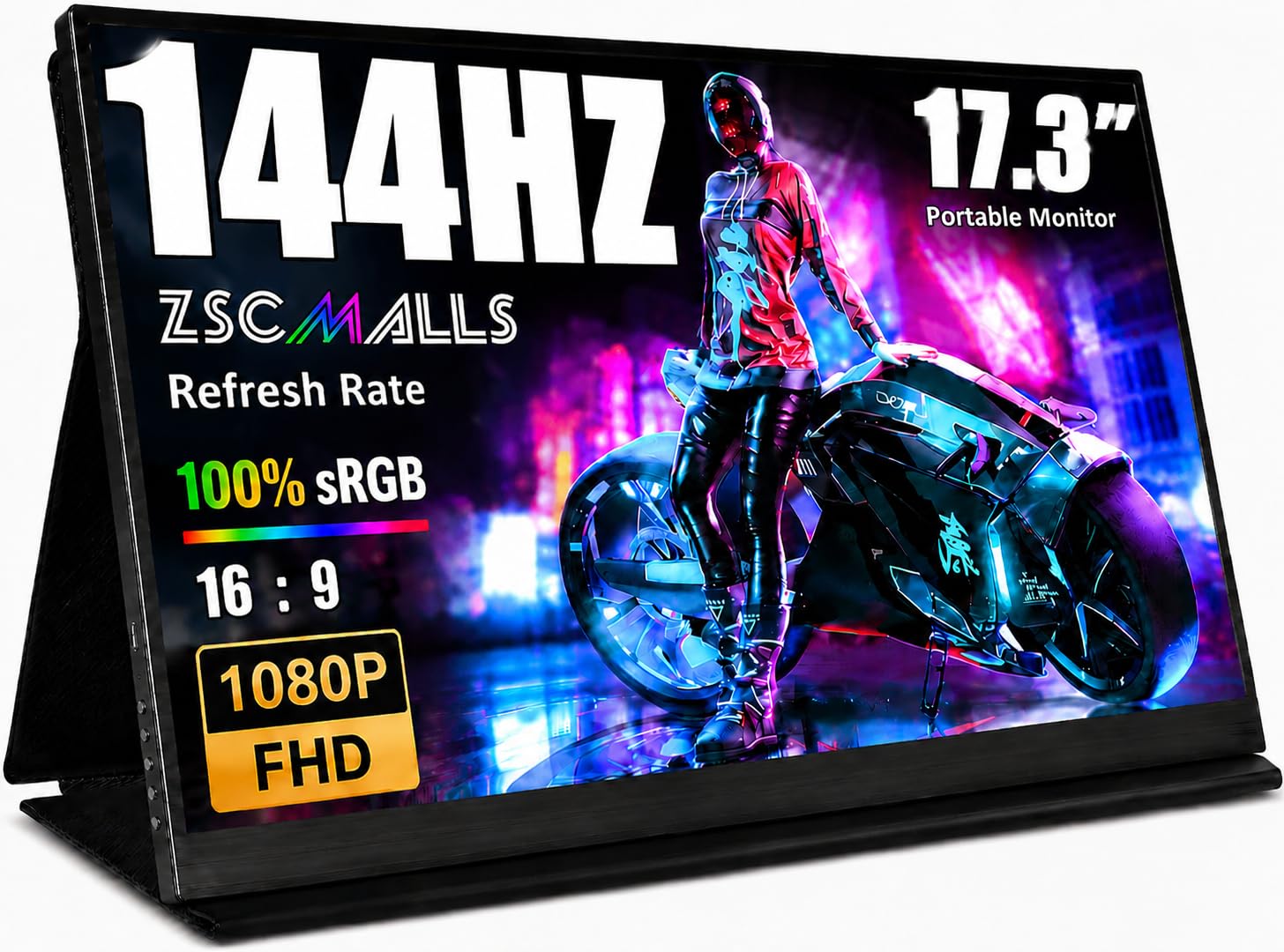
A 144Hz travel panel built to keep fast motion smooth in a hotel room.
Most portable screens stop at 60Hz, which makes a fast shooter feel like a slideshow. This one runs 144Hz on a 1920×1080 IPS panel, so panning in a game looks fluid rather than smeared. The FreeSync support smooths out screen tearing when the frame rate dips. IPS means the color stays consistent when you tilt the screen, unlike the TN panel on the SKitphrati above. The 1000:1 contrast is standard, and the 250 cd brightness is fine for a shaded room but not for a sunny window seat.
Its ergonomics are built for movement. It works in landscape or portrait, with four holes on the back for mounting on a stand. As the listing puts it, the unit is light enough to carry in a backpack for travel or work. The port lineup — USB-C, HDMI, and USB — connects to a laptop, PC, phone, PS3/PS4/PS5, Xbox, or Switch, and you can hang a mouse and keyboard off the USB ports.
The reliability question is the one to weigh. Screen quality is the thing that wins people over — crisp graphics and a smooth refresh — and the compact size suits a small desk or a bag. But some units have stopped working after only a few uses or failed after several months. A three-year warranty and lifetime support soften that risk. If you want a budget travel gaming screen and can lean on the warranty, this is a strong bet; if you want zero maintenance, a fixed gaming monitor is sturdier.
The spec that sells it: 144Hz on an IPS panel you can fold and carry.
The honest risk: mixed long-term reliability, softened by a three-year warranty.
Made for: a laptop gamer who wants a fast, portable second screen.
Not the one: a set-and-forget desktop station that rarely moves.
7. ARZOPA 17.3″ Portable 1080P FHD IPS Monitor
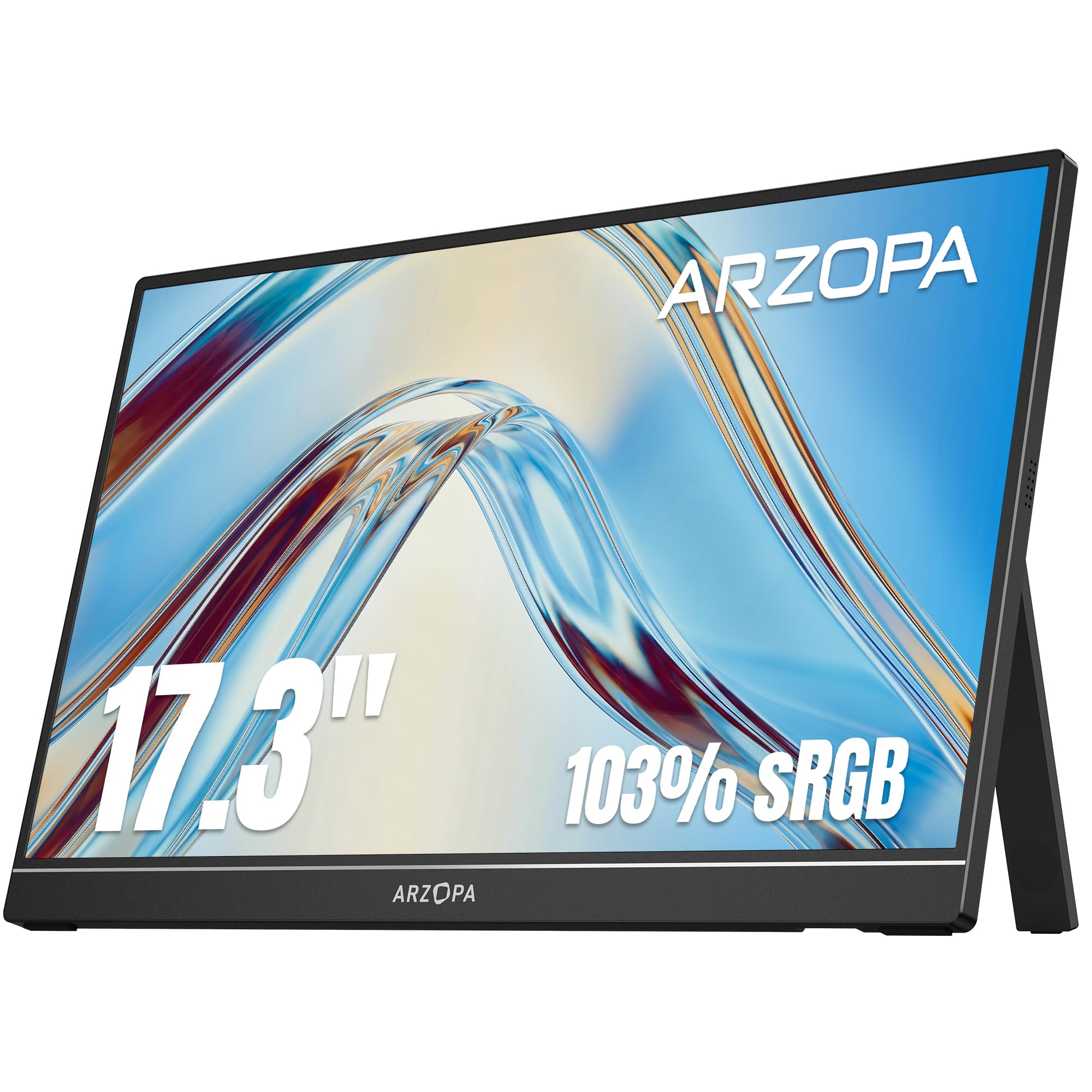
The everyday traveler’s screen that plugs in with a single cable.
This is the panel to start with if you want a portable second screen and do not know where to begin. The 17.3-inch IPS screen runs 1920×1080 at 300 cd brightness, and the 103% sRGB rating means colors look richer than a plain office panel. G-Sync compatibility helps keep games tear-free on a supported graphics card. A built-in stand flips between landscape and portrait and holds an adjustable angle, so a presentation or a movie finds the right height without a separate kickstand.
Setup is the part buyers like most. One USB-C cable carries both the video signal and the power on a compatible laptop, phone, or tablet, with no driver or app to install. Type-C and mini HDMI ports reach laptops, desktops, phones, a PS5, or an Xbox. There are three display modes — duplicate, extend, and a second screen — so you can mirror your laptop or spread your workspace across both. The dimensions are 16.5 by 10.6 inches with a 2-inch profile, easy to slide into a laptop bag.
Weigh the trade-offs honestly. It is a 1080p panel, so it is not as sharp as the 4K cocopar at the top for photo work. Reliability is the recurring note — most owners are happy, but a few report units that quit early. Consider this the safe all-rounder: bright enough for a café, sharp enough for work, and light enough to travel.
Why it is the easy pick
- One USB-C cable carries video and power, no driver needed.
- 103% sRGB IPS screen at 1920×1080 and 300 cd.
- Built-in stand switches landscape and portrait with an adjustable angle.
What you give up
- 1080p detail falls behind a 4K portable for color work.
- Long-term reliability is the one recurring question.
Pick this for: a first portable monitor that has to do a bit of everything.
Look up instead: if sharpness on a close-up photo edit is the priority.
8. Acer V173 Djb 17-Inch LCD Monitor

A no-nonsense office screen that turns on and just works.
Some buyers want a monitor that does not ask questions. The Acer V173 Djb runs a 1280×1024 panel at 250 cd brightness, with a 5ms response time that keeps web videos from smearing and a 16.7 million color count that looks fine for documents and spreadsheets. Acer’s ComfyView backlight setting is tuned to reduce glare and eye strain over long work sessions. The single VGA input means it connects to older desktops and towers that still use that cable.
The contrast story has two numbers worth knowing. Acer lists an ACM (adaptive contrast) figure of 10000:1, with a native 2000:1 and an earlier 1000:1 reading, so treat the dynamic number as a marketing ceiling rather than a constant. In practical terms, whites are bright and blacks are deep enough for a browsing monitor. Pixel pitch is 0.264mm, which keeps text looking smooth at arm’s length. The stand adjusts, and the appearance is clean and businesslike.
What comes through in the reviews is simplicity: it delivers crisp graphics and works the moment you plug it in, and the 17-inch size is plenty for web surfing. The limitation is the VGA-only input, so if you need HDMI for a modern laptop, this is not the one — the SKitphrati or Thinlerain covers that. Buy it for an older tower, a back-office PC, or a parent who does not want a learning curve.
Who this suits: an older desktop or a buyer who wants the monitor part to be invisible.
The right desk: a VGA-era tower doing email, web, and Word.
Look elsewhere: if your laptop only offers HDMI or USB-C.
9. GreenTouch 17 Inch Open Frame Industrial Touch Monitor
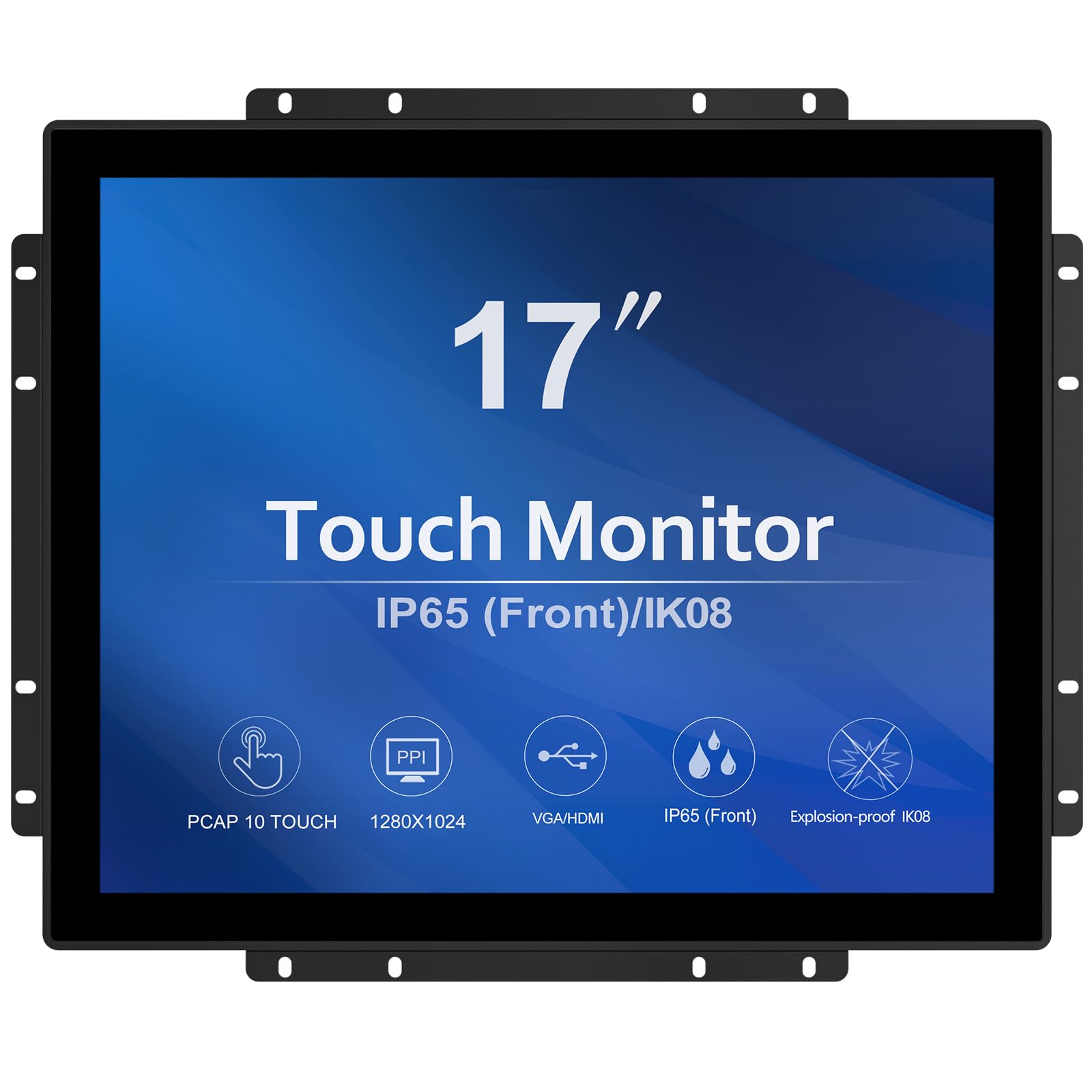
A sealed, metal-bodied touch screen that shrugs off dust, splashes, and hard presses.
This is the panel for a factory floor, a kiosk build, or a machine control cabinet, not a living room. The projected capacitive touch layer offers 10-point touch and is sealed to keep out dirt, dust, and liquid, meeting a front IP65 water-resistant rating. The cover glass is 3mm tempered and rated IK08 vandal-proof, so a hard press or a knuckle tap does not crack it. A 1280×1024 panel with a 2000:1 contrast ratio keeps text readable from straight on, and the metal housing is the reason the unit weighs 4 kg.
The port list is built for professional installs: HDMI, VGA, DVI, and audio in and out. That covers a range of controllers, PLCs, and media boxes that still speak DVI or VGA. GreenTouch rates the unit at 50,000 hours MTBF, a mean-time-between-failures estimate for industrial duty cycles. The open-frame design means the bezel is thin so it can be inset into a panel or a cabinet door.
Two things to weigh. It is heavy and needs a cut-out or a bracket, so it is not a sit-on-the-desk screen. And it is a 1280×1024 panel, so it is not a high-resolution display for photo work. If you are building an enclosure for a touch terminal and need durability over pixels, this is the one; for a home or office desk, a lighter travel or budget panel is a better fit.
Engineered to survive
- Front IP65 rating seals the touch surface against dust and liquid.
- 3mm tempered glass carries an IK08 vandal-proof rating.
- HDMI, VGA, DVI, and audio cover legacy controllers and media boxes.
Plan around this
- 4 kg metal housing needs a cut-out or bracket mount.
- 1280×1024 resolution is not built for sharp color work.
Choose it for: a kiosk, a machine panel, or any install that needs a sealed touch surface.
Not for a home desk: the weight and open-frame mount make it awkward there.
Understanding the Specs
Resolution and pixels
Resolution is the grid of dots the screen draws, written as width by height. A 3840×2160 panel versus a 1280×1024 screen draws sharper text and photos at the same distance. For a 17-inch screen, a 1920×1080 or 1440×900 panel is comfortable for work; a 1280×1024 panel is fine for basic tasks and legacy software.
Refresh rate in Hz
Refresh rate is how many times per second the picture redraws, measured in hertz. A 60Hz panel redraws 60 times a second, a 75Hz panel 75 times, and a 144Hz panel 144 times. The higher the number, the smoother fast motion looks — a 144Hz gaming panel keeps a quick turn from smearing, while 60Hz is fine for documents and slow games.
Brightness in cd and contrast
Brightness is measured in candelas per square meter, written cd, and it decides whether the picture survives a bright room. A 250 cd panel looks washed out by a sunny window; a 600 cd panel holds up. Contrast is the ratio between the darkest black and the brightest white, so a 1200:1 panel reads better in a dim corner than a 1000:1 one.
Panel type and viewing angle
TN panels are fast and cheap but dim when you view from the side. IPS panels keep color and brightness steady at wider angles. A listed 170° viewing angle means you can stand off to the side and still see the picture; a 95° horizontal angle means the picture fades quickly as you move. Pick IPS for shared viewing, TN for a straight-on desk.
FAQ
Will a 17.3-inch portable monitor work with my MacBook?
Do I need a separate power cable for a portable 17-inch monitor?
Is a 4:3 monitor still useful for a modern PC?
What does VESA mountable mean for a 17-inch monitor?
Can I use a 17-inch gaming monitor with a PS5 or Xbox?
Is a touchscreen 17-inch monitor worth it for a point-of-sale counter?
How do I connect a 17-inch monitor to an older desktop with only VGA?
What does IP65 or IK08 mean on an industrial touch monitor?
Can a portable monitor be used as a second screen for a phone?
Why is a 17-inch monitor heavier than a larger one sometimes?
Final Thoughts: The Verdict
For most people, the 17 inch monitor winner is the cocopar 17.3 Inch 4K because its 3840×2160 panel makes text and photos sharp on a screen you can still carry. If you want a smoother, faster travel display for games, grab the ZSCMALLS 144Hz. And for a legacy desk, a POS counter, or a security wall, the Thinlerain touch panel or the ZOSHING security monitor is the one to reach for. Before you buy, check the return window on whichever you pick — a 17-inch panel only earns its keep when it matches your desk.
How We Picked
We do not accept paid placement. Every pick is matched to a real buyer and a real use-case; we do not hands-on test units.
Sources & Methodology
Specifications: manufacturer listings and product documentation. Review insights: verified customer reviews, as of November 2026. Pricing: not shown on this page (it changes often); check the current price via the retailer link.
As an Amazon Associate, Gadgets Feed earns from qualifying purchases. This does not affect which products we feature.