
Our readers keep the lights on and my morning glass full of iced black tea. As an Amazon Associate, I earn from qualifying purchases.
Specs are compiled from manufacturer listings and verified buyer reviews and can change over time — please confirm the key details on the product page before buying.
You want a camera your ten-year-old will actually use, not one that ends up in a drawer after a week. The short answer: look for a model with a protective silicone or textured shell, simple buttons, and a screen big enough to frame a shot — that combination is what keeps a kid coming back to it. Instant-print models add a second reason to keep shooting, because a paper photo appears in seconds and can be stuck on a wall.
I’m Min — the founder and writer behind Gadgets Feed. This guide is built by comparing the manufacturers’ published specifications and the patterns across verified customer reviews, so you get each pick’s real strengths and trade-offs instead of marketing spin.
Below you’ll find the honest split between kid-safe build quality and print quality, laid out so you can pick with confidence. This is the practical shortlist of the camera for 10 year old that holds up to real handling.
Our Picks at a Glance

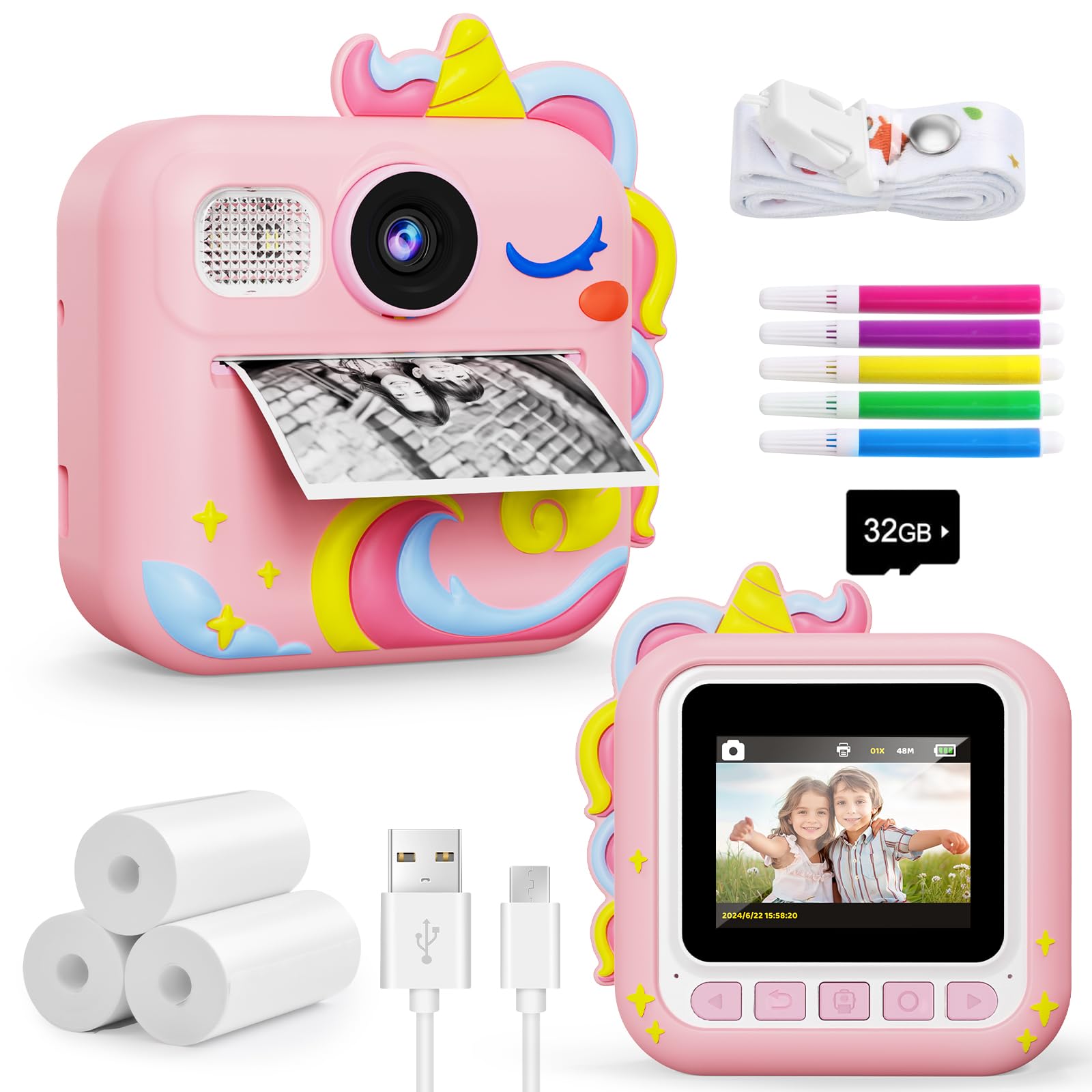

How To Choose The Best Camera For 10 Year Old
A ten-year-old is right at the hinge point of this category. They are old enough to want real control over framing and filters, but they still drop things, lose lanyards, and forget to charge. That shapes every decision below.
Drop protection beats megapixel count
A silicone or textured case is the single most useful feature on a kid camera, because it absorbs the knocks that a hard plastic shell would pass straight through. Several models here ship with one fitted already. An unprotected body is fine on a desk and disappointing on a campsite.
Megapixels are the number printed largest on the box, and they matter least. A 12-megapixel sensor is already more than enough for a photo that will be viewed on a phone or printed on a thermal roll. Chasing a 48-megapixel figure buys you a bigger number, not a better photo.
Do you want instant prints or not
Instant-print cameras use a thermal head — a small heated strip that darkens the paper directly, so there is no ink cartridge to buy or spill. It is the same principle as a shop receipt printer. The catch is that the prints come out black and white on most models, and the paper rolls are a recurring purchase.
A plain digital camera skips all of that. It stores photos on a memory card you can plug into a computer, which suits a kid who wants to edit, share, or keep shooting without worrying about paper.
Battery and screen size in practice
Battery capacity is quoted in mAh — milliamp-hours, a measure of how much charge the cell holds. Bigger numbers mean more shots per charge, though the screen and the printer both eat into it. A camera that lasts a full afternoon is the realistic target.
Screen size decides how easy the camera is to actually use. A 2.0-inch screen is small but pocketable. A 2.4-inch or 3.0-inch screen makes framing and reviewing much friendlier for a ten-year-old’s eyes, at the cost of a slightly chunkier body.
Quick Comparison
| Model | Best For | Photo Resolution | Screen Size | Battery | Amazon |
|---|---|---|---|---|---|
| Unicorn Toys Camera for Kids Girls Age 3-8, Purple★ Best Overall | Younger siblings and first-timers | 12 MP | — | 4-6 hrs use | Amazon |
| KOKODI Kids Camera Instant Print (Pink)Best Value | Printing photos on the spot | 1080P video | 2.4″ | 1500 mAh | Amazon |
| Kids Camera Instant Print, Dual LensTop Performer | Selfies plus instant prints | 48 MP | 2.0″ | 2-4 hrs use | Amazon |
| HiMont Kids Instant Print Camera (Black) | Big bundles of paper and card | 1080P video | 2.4″ | — | Amazon |
| Instant Print Camera for Kids, 3.0″ HD 32MP | The biggest screen here | 32 MP | 3.0″ | 1000 mAh | Amazon |
| Kids Camera Instant Print, 1080P Digital Toy | Hands-off printing for beginners | 8.0 MP | 2.4″ | 1000 mAh | Amazon |
| Yehtta Kids Camera Instant Print (Black) | Selfie-first shooters | 30 MP | 2.4″ | 2000 mAh | Amazon |
| VAHOIALD FHD 1080P Digital Camera | Carrying in a pocket all day | 44 MP | — | — | Amazon |
| W & O 4K Digital Camera with Flip Screen | Selfies and video creation | 4K | 180° flip | — | Amazon |
In‑Depth Reviews
1. Unicorn Toys Camera for Kids Girls Age 3-8, Purple
Our pick — 4.5+★ from 900+ verified ratings; the strongest balance of quality and price.
The crowd favorite: 4.5+ stars across 900+ ratings, and a silicone shell that shrugs off drops.
The number worth starting with is 12 — as in 12 megapixels of main-camera resolution, plus 1080P video. On a kid camera that is plenty to produce a photo you can actually look at on a laptop screen. There is also a 720P selfie camera on the front, so a ten-year-old can flip it around and shoot themselves without asking for help.
What wins people over is how much entertainment is packed in at this level. The camera carries 28 fun frames, 10 special effects and 6 filters, plus five built-in educational games including puzzles and mazes. A 32GB card comes with it, sized for over 35,000 photos, so storage never becomes the limit on a trip. An MP3 player lets you load their own music on too, so the camera doubles as something to carry on a long car ride.
The practical part is the case. A silicone shell covers the body to cut the damage from drops, and the compact shape is built to sit in smaller hands. Charging takes 1.5 hours and returns 4-6 hours of use, which covers a school trip or a full day of a family outing. A lanyard is included so it can hang around the neck instead of riding loose in a bag.
purple grip for small hands
- The silicone case is the reason this survives a ten-year-old’s backpack.
- The silicone case is the reason this survives a ten-year-old’s backpack.
- Games and music give a kid reasons to pick it up beyond taking photos.
- 4-6 hours of runtime from a 1.5-hour charge.
toy-grade photo quality
- You get no instant printer, so photos live on the card until someone transfers them.
- The listing frames this for ages 3-8, so a ten-year-old may outgrow the styling faster than the hardware.
- Picture sharpness splits opinion — good enough for a phone screen, not for enlarging.
gift for ages three: you want the safest all-round first camera — a protective case, a selfie lens, and games that stretch the fun past the first week.
serious photo needs: printed photos are the whole point for your kid, because this one keeps them on a memory card.
2. KOKODI Kids Camera Instant Print, Pink
Press one button, a black-and-white photo slides out. That is the whole sell.
Printing is where this one lives or dies, and the mechanism is the clever part. Thermal printing needs no ink cartridge and no toner — a heated print head darkens the paper itself, so there is nothing to refill and nothing to leak onto a car seat. Three rolls come in the box, enough for more than 150 black-and-white prints before you buy more paper.
Behind the printer sits a 2.4-inch HD screen and a 1080P video mode, with 4 puzzle games and MP3 music for the downtime. The optics give you 16x digital zoom, a burst shot mode and time-lapse, all of which a curious ten-year-old will find within an afternoon. A 1500mAh battery is the biggest cell in this lineup, and it runs for 4-5 hours of continuous shooting with the printer idle. Type-C charging means one cable handles the camera and most phones.
Two things to set expectations on. Prints come out black and white, so a kid hoping for colour photos will be let down. And print sharpness divides people — some photos come out crisp while others look blurry, which is the nature of a thermal head at this size. What keeps this in the shortlist is the gift factor: it lands well, and the shock-resistant non-toxic silicone casing means it survives being a favourite.
instant prints on the spot: a 2.4-inch screen is just big enough to frame a shot properly, and the 32GB card stores thousands of photos and videos so nothing gets deleted to make room.
instant fun for kids: the instant paper photo is what will keep your kid interested and you want the largest battery in this group.
screen-first buyers: colour prints are non-negotiable, since this model prints in black and white only.
3. Kids Camera Instant Print, Dual Lens Digital Camera
The resolution leader of the print cameras — 48 megapixels is quadruple a 12 MP rival.
For a ten-year-old, 48 megapixels means they can crop into a shot and still have something usable. That is four times the 12 MP of the Unicorn camera above, a real gap if your kid likes zooming in on a bird or a sibling’s face after the fact. Video steps down to 1080P, which is the sensible ceiling for a camera this size.
Prints pop out in three seconds, so the thrill of pressing the button lands while the moment is still fresh. It uses inkless thermal printing (heat, not ink, makes the image), so no cartridges ever run dry. Colour prints need coloured thermal paper, which you buy separately — that is the only way to get colour here. The 2.0-inch LCD screen (the little display you frame shots on) is the smallest in this lineup, so framing takes a little more squinting.
The build earns its place for a clumsy kid. The body is soft BPA-free plastic with polished edges and no sharp burrs, and the ABS shell is there to soak up drops and impacts. Type-C charging reaches 80% in about the time it takes to drink a coffee, and a full charge gives 2-4 hours of shooting or video. A lanyard ships in the box.
dual lens front and back: a 2.0-inch panel is 20% smaller than the 2.4-inch screens on several rivals, which is the one place this camera asks you to compromise.
small screen preview: 5 games, 5 filters, 18 frames, 6 effects and an MP3 player — a lot of distractions for the money.
selfies and prints: you want the highest still resolution available among the print cameras and your kid will cope with a smaller screen.
large display fans: your ten-year-old needs a big, forgiving display to frame shots comfortably.
4. HiMont Kids Instant Print Camera, Black

Two print modes, colour pens in the box, and paper for a long stretch of drawing.
Most instant cameras here give you one print style. This one gives you two built-in printing modes — dot matrix and grayscale — which changes how a finished photo looks, and that variety matters to a kid who is experimenting rather than documenting. Three rolls of paper come included along with colour pens, so the printed photo becomes something to colour in rather than just something to stick on the fridge.
The screen is a 2.4-inch panel (the same size as the KOKODI above) paired with a high-definition lens for 1080P video. Filters, cartoon frames and mirror effects round out the creative side, alongside five puzzle games, a music player, continuous shooting and time-lapse. The listed range covers ages 3 to 12, so the styling should still appeal to a ten-year-old rather than feeling babyish.
The most-discussed topic in the feedback is simply whether it suits kids — for a large group the answer is yes, and the hours-of-entertainment result is the second. The honest caveat sits in print quality: grainy prints come up, and reliability splits between units that run fine and a few that stop. There is no flash on this model, so indoor evening photos are the weak spot.
sleek black instant body
- Two print modes (dot matrix and grayscale) rather than one.
- Three rolls of paper plus colour pens in the box.
- 5 games, a music player, time-lapse and continuous shooting.
- Wide 3-14 age range so it does not read as a toddler toy.
limited color choice
- No flash — evening indoor shots will not get help from the camera.
- Print sharpness is inconsistent from photo to photo.
- The bundle’s value depends on your kid actually using the paper and pens.
older kids wanting style: your kid is a maker who wants to colour and customise the photos they print, and you want the spares thrown in upfront.
bright color seekers: a lot of shooting happens indoors after dark, where the missing flash shows.
5. Instant Print Camera for Kids, 3.0″ HD 32MP
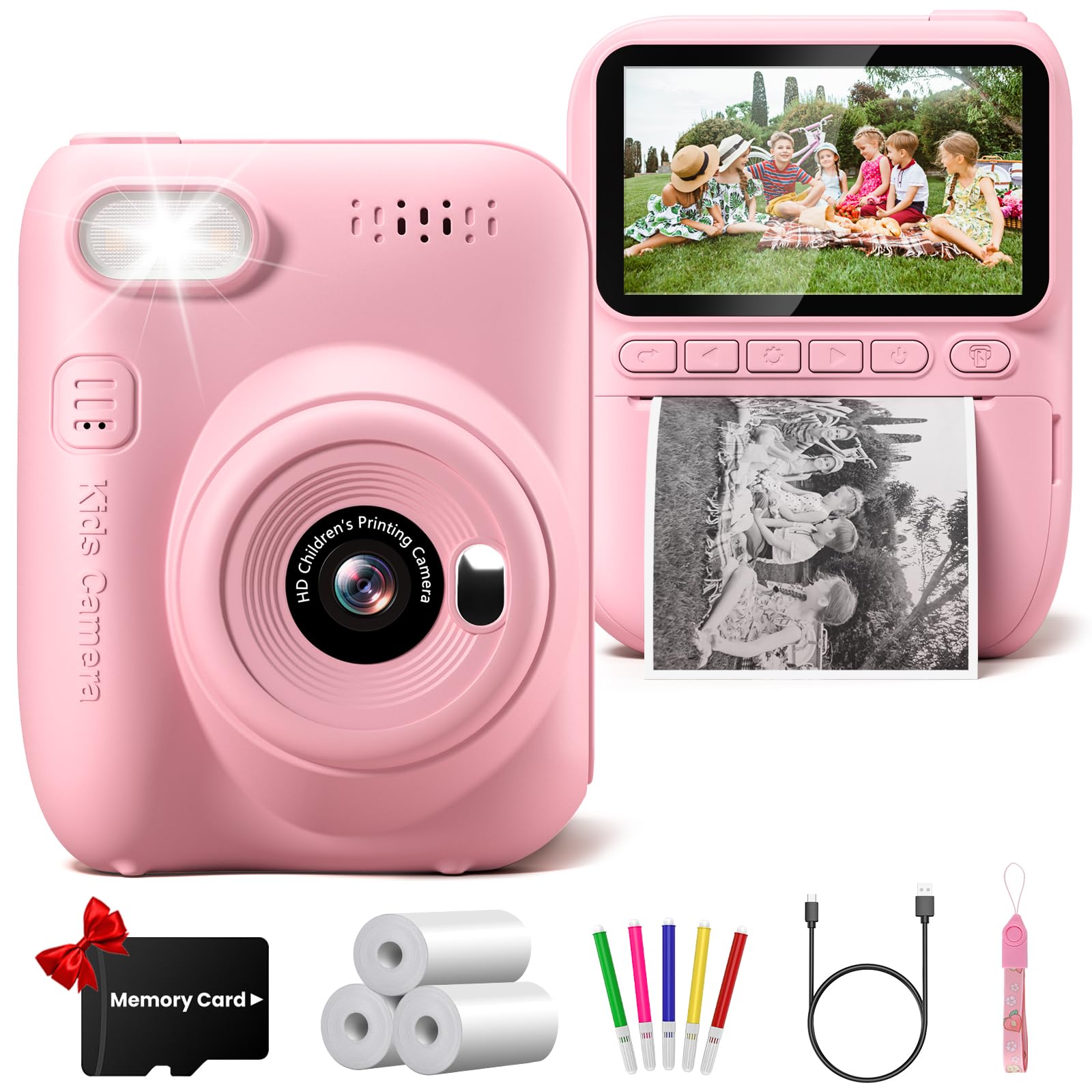
A 3.0-inch display — the biggest here — makes framing a shot painless for smaller eyes.
Screen size is the spec that quietly decides whether a kid enjoys a camera, and this is the roomiest of the lot. The 3.0-inch IPS panel (IPS is the panel type that keeps colours stable when you tilt the screen) is the largest in this lineup. It restores truer colour and smooths out the viewing experience, which in plain terms means your kid can see what they are actually shooting.
Behind the screen sits a 32MP still sensor and 1080P video recording, with flash, time-lapse, burst shooting, filters and frames bundled in. A 1000mAh rechargeable battery gives up to 3 hours of continuous photography on a full charge, and Type-C charging keeps topping it up simple. A 32GB SD card and a lanyard are both in the box.
Printing works on a one-click basis — the photo paper comes straight out of the camera body in black and white, and five colour pencils are included so the print can be finished by hand. The paper is soft BPA-free plastic with no odour and no carbon dust, which is a detail worth knowing if your kid chews pencils. Camera quality is the most-praised trait in the feedback and fun comes second, though print sharpness is a genuine split — some come out clear, others grainy.
big 3 inch display: a 3.0-inch panel is noticeably more forgiving than a 2.0-inch one when a ten-year-old is trying to fit a whole group of friends into the frame.
easy framing view: the screen is your priority and you want your kid to compose shots without squinting or guessing.
pocket-size priority: you are chasing the crispiest prints, since sharpness varies shot to shot here.
6. Kids Camera Instant Print, 1080P Digital Toy
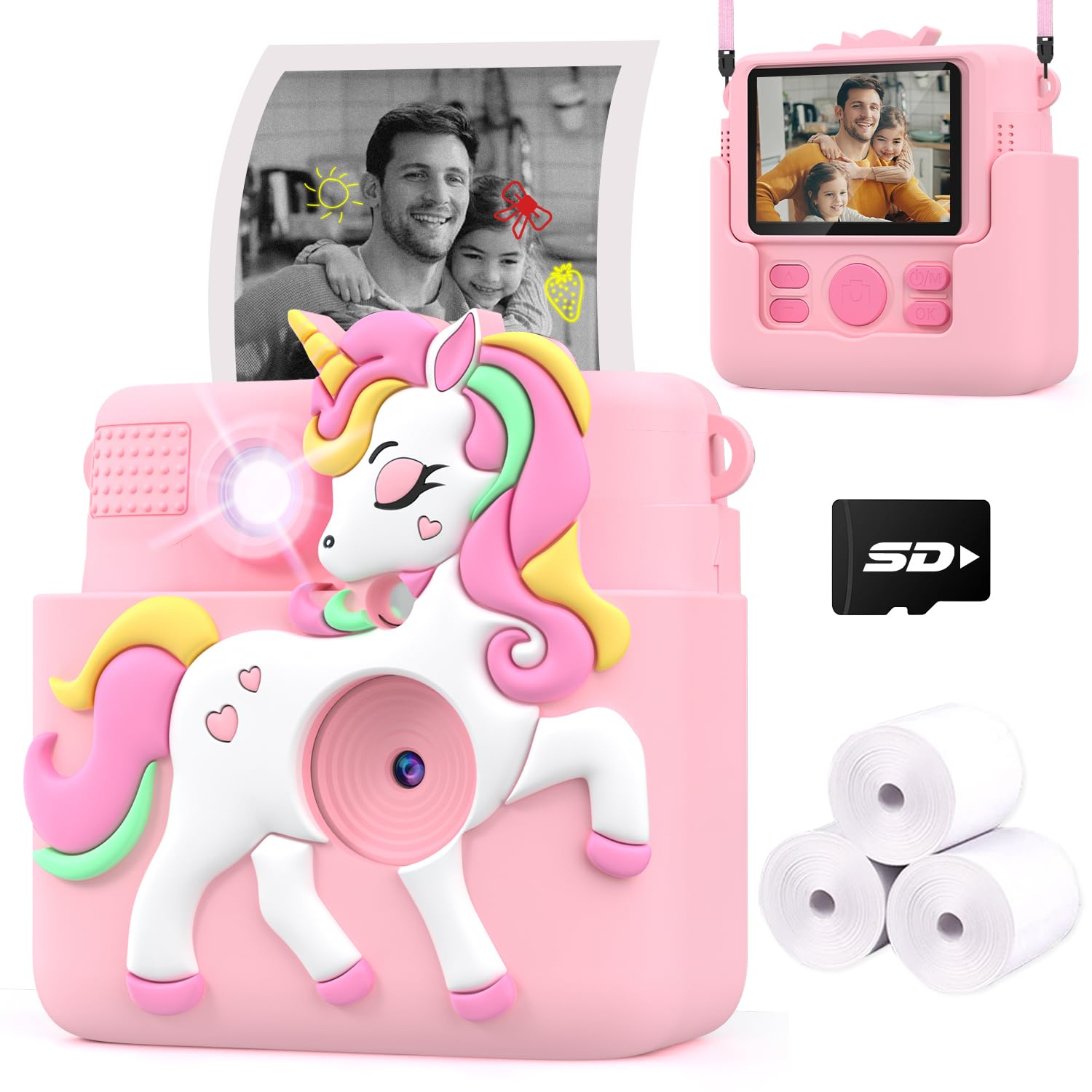
Simplified buttons, a horse-shaped silicone shell, and paper for hundreds of prints.
The paper maths is the standout here. Three rolls come included and the listing puts that at roughly 372 prints, so the paper outlasts the first week of excitement. Each print measures 4 by 2.2 inches — a proper little keepsake size — and swapping in a refill when it runs out is a straightforward job.
The camera side is honest about its limits. Photos are 8.0 megapixels, the lowest in this lineup, and video records in 1080P. That combination suits a child who is learning to point and press rather than one chasing sharp detail. A 2.4-inch IPS screen makes the framing clear, and 16x digital zoom, flash, time-lapse and burst shooting are all present. A 1000mAh battery runs 2.5 hours of continuous video.
What really makes this a first camera is the wrapper around it. A horse-themed silicone case is shockproof and designed to be endurable in a child’s hands, and the buttons are simplified deliberately so a five- or six-year-old can learn on it. Five filters, 13 frames, 13 cartoon effects and five print-density settings give plenty to fiddle with, plus four games and an MP3 player.
The reliability picture is mixed — most run well, a small number stop working early. And the print quality splits between good and blurry. Neither is unusual at this level, but it is worth buying from a seller with a clear return route.
video plus prints: you are buying for a younger or less careful kid and want the biggest paper bundle plus the simplest controls.
pro image quality: photo detail is what your ten-year-old cares about, because 8.0 megapixels sits at the bottom of this group.
7. Yehtta Kids Camera Instant Print, Black
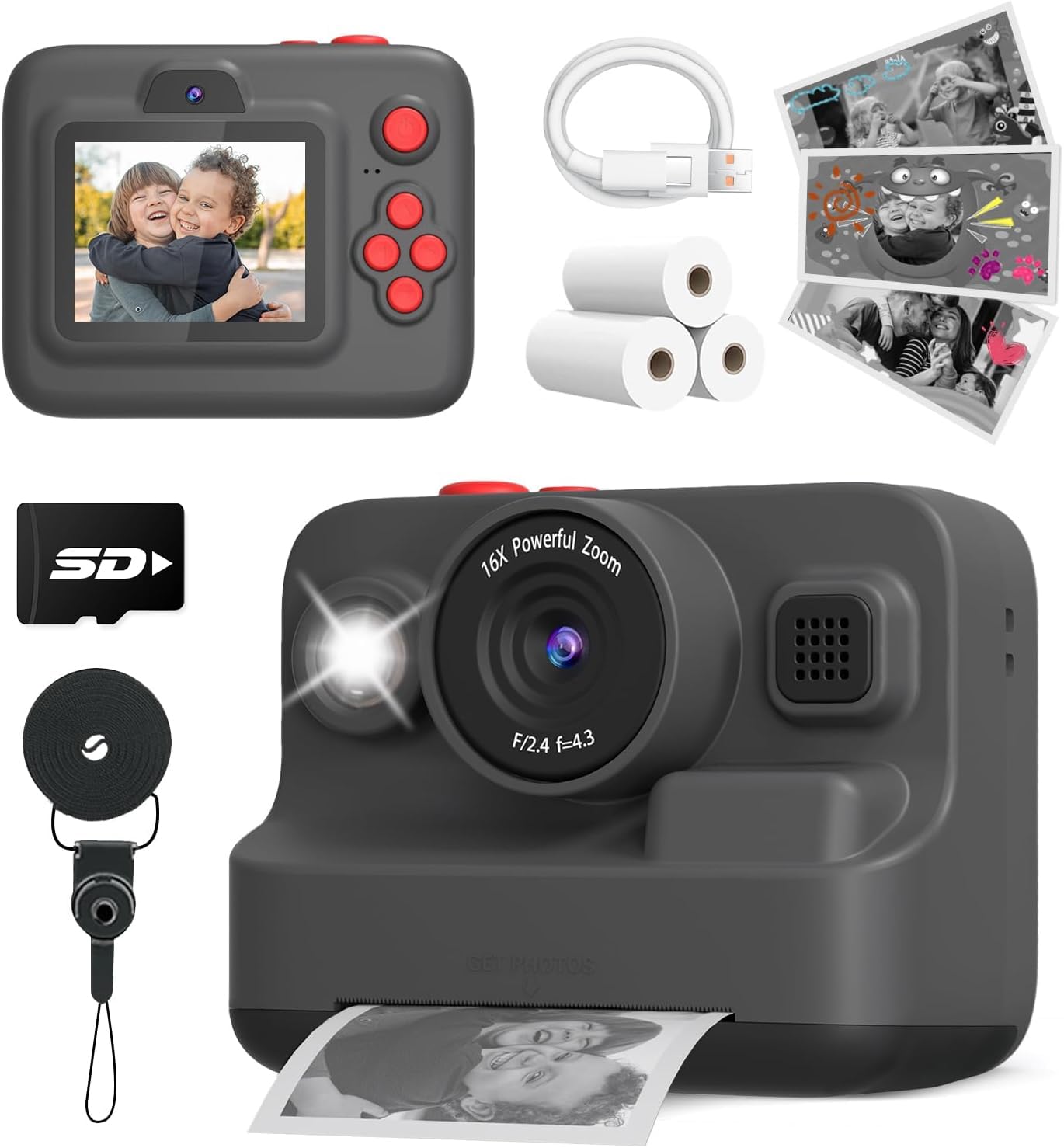
The 2000mAh cell is the largest in this lineup, and the black body reads grown-up.
A ten-year-old cares about how a camera looks, and this one passes that test — the textured black body has the shape and feel of a real Polaroid rather than a plastic toy. The dual lenses are the useful part: one faces forward for normal shots, one faces the kid for selfies, and switching between them is a single button press with a 30MP still sensor behind each.
Battery is where it separates from the pack. A 2000mAh rechargeable cell is bigger than the 1500mAh and 1000mAh units elsewhere in this group, and it buys up to 3 hours of continuous shooting per charge. A memory card comes included and stores thousands of photos and videos, so storage will not be the thing that ends a day out.
The instant side runs ink-free over thermal paper, with three rolls included and capacity for up to 300 prints before you buy more. The prints are black and white. That is where expectations need setting: black-and-white photos look strong, while some feel the prints come out faded. Durability is the other mixed note, so treat the textured shell as protection rather than armour.
reliable black instant cam: what earns the most praise here is overall quality — the camera feels like more than a toy — with the gifting appeal close behind as the second theme.
everyday kid shooting: your kid takes selfies constantly and you want the longest runtime between charges with a body that does not look childish.
high-res demands: you need prints that pop in colour, or you expect the shell to shrug off serious drops.
8. VAHOIALD FHD 1080P Digital Camera
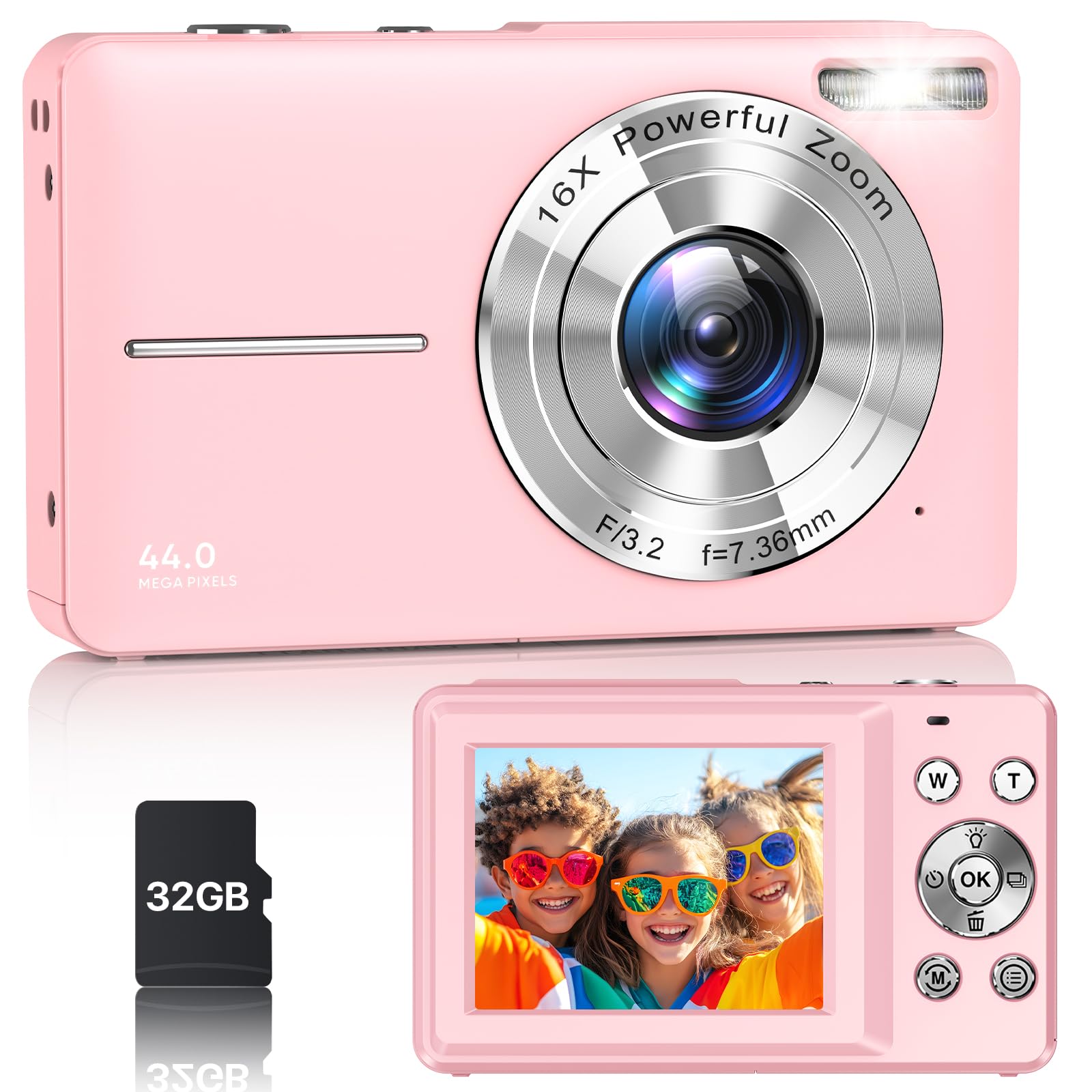
No printer, no paper cost — just a slim card camera you can drop in a pocket.
This is the option for the ten-year-old who wants photos to share rather than photos to hold. It shoots 44 MP stills and FHD 1080P video off a CMOS sensor (the chip that turns light into an image), and it carries a built-in fill light so dim rooms do not kill the shot. Anti-shake stabilisation is the other helper — it reduces the small hand wobbles that blur a photo when a kid is holding the camera at arm’s length.
Buyers praise the compact size most in the feedback, and it is easy to see why: the body is slim enough to fit in a pocket, which is the difference between a camera that travels and one that stays home. The W/T button gives you 16x digital zoom (it crops in on the picture rather than moving a lens), so a distant subject fills more of the frame. You also get 20 filters, a self-timer, continuous shooting, time-lapse and a date stamp. An internal microphone and speaker record sound with video, and the whole thing can switch into webcam mode for video calls.
What’s in the box is unusually complete — the micro SD card, a wrist strap, a camera pouch and a cleaning cloth for the lens and screen all ship together. The caveat is that this is a plainly built point-and-shoot, and reliability is the mixed note: most work fine, some run into faults. There is no printer here, so nothing to refill and nothing to jam.
Versus the instant model above, you are trading the paper print for a card full of photos you can transfer to a computer or phone. For a kid who wants to post, that is the right trade.
video-first kids: your kid wants digital photos to keep and share, and you would rather not buy paper refills forever.
print lovers: the physical print is the reason your ten-year-old wants a camera at all.
9. W & O 4K Digital Camera with 180° Flip Screen
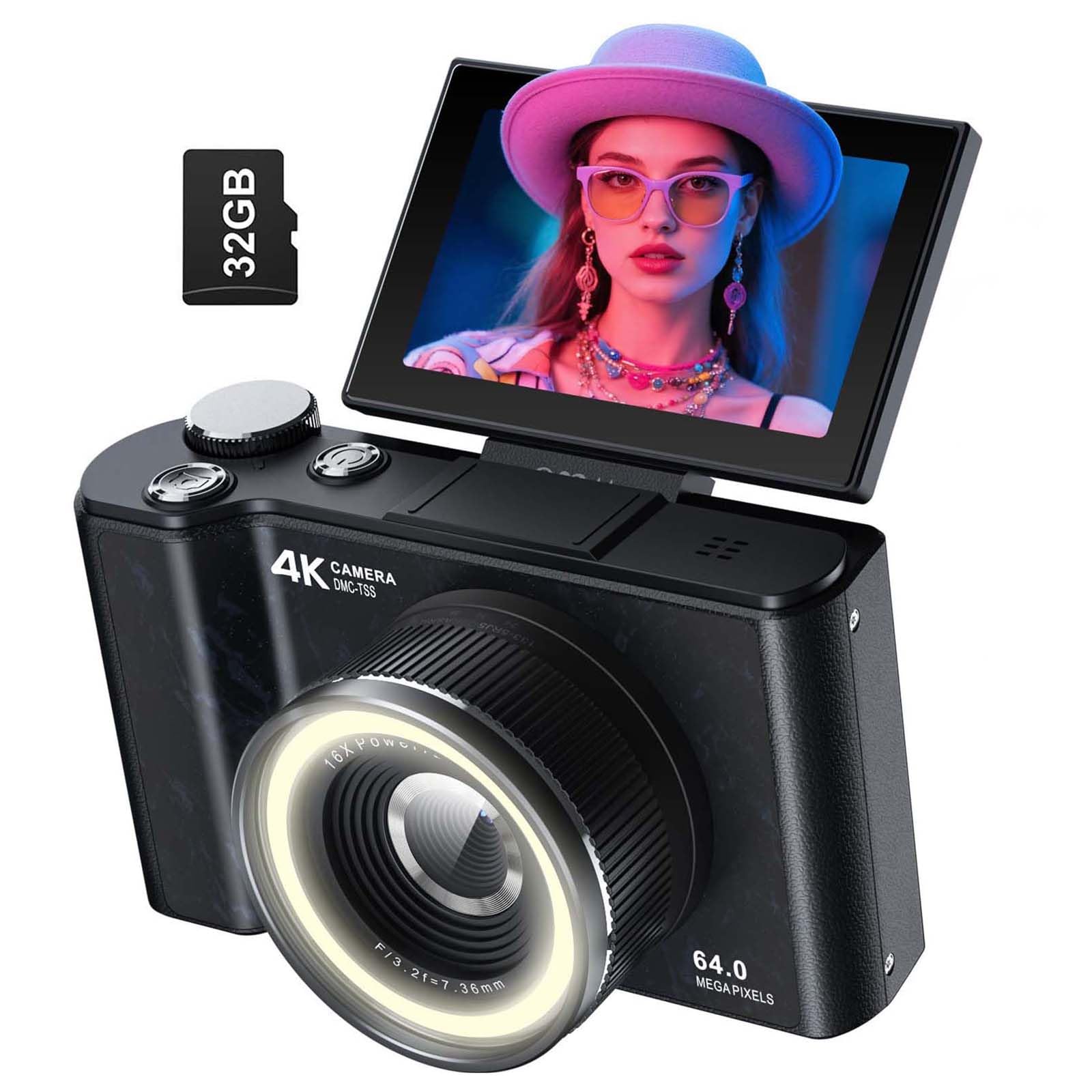
A screen that flips all the way around, so framing a selfie is just looking at yourself.
For a ten-year-old who has watched a sibling or a parent film themselves, the 180° flip screen is the feature that clicks immediately. It turns to face forward, so you see yourself while framing the shot. A front ring light and a built-in beauty mode join it to brighten portraits, which is where this camera earns its place as the most selfie-focused pick in the group.
Resolution runs to 4K video off a CCD sensor. CCD is the older sensor type, and it is the reason the colour here gets described as rich with a nostalgic look rather than the clean, flat rendering of a modern phone. Autofocus locks on quickly, so fast-moving kids, pets and party moments still land sharp. A 32GB SD card is included so nothing extra needs buying, and a USB-C phone card reader lets you move photos to a phone without an app.
Setup is genuinely from the start — the card, reader, cable, adapter and strap all ship together. The caveat is a practical one: photos must be imported off the card before they show in your phone’s gallery, which is a step some kids will need help with the first time. Screen-freezing problems after removing the SD card come up in a minority of cases.
4k with flip screen: picture quality and overall quality are the two things buyers talk about, with the flip screen itself drawing steady praise for selfies and vlogging.
higher price tag: the SD card should be left in place while shooting — pulling it mid-session is the scenario linked to the frozen screen.
vlogging and selfies: your ten-year-old is drawn to filming themselves and you want 4K video plus a card and reader in the box.
budget shoppers: you want a simple point-and-shoot with no transfer steps for a kid who will not read instructions.
Understanding the Specs
Megapixels (MP) and video resolution
Megapixels count how many dots make up a single photo. A 12 MP camera captures fewer dots than a 48 MP one, which mainly shows up when you crop in or enlarge a shot. For a ten-year-old viewing photos on a screen, 12 MP is already enough; the higher numbers give more room to zoom into a shot afterwards. Video resolution like 1080P or 4K works the same way — 4K packs in more detail and fills storage faster.
Battery capacity in mAh
mAh stands for milliamp-hours, a measure of how much charge a battery holds. A 2000mAh cell holds more than a 1000mAh one, so it generally runs longer between charges. Runtime also depends on what the camera is doing — printing and video eat through charge faster than taking the odd photo. A camera lasting a full afternoon out is the realistic target for this age group.
Thermal printing and paper rolls
Thermal printing uses heat instead of ink. A print head warms the paper and the coating darkens where it touches, so there is no cartridge to run dry. That is why most kid instant cameras print in black and white. Paper rolls are the ongoing cost — one roll typically covers a set number of prints, and refills are cheap but not free.
Screen size and panel type
Screen size decides how easy the camera is to frame with. A 2.0-inch screen is pocketable but cramped; 2.4 inches is the comfortable middle; 3.0 inches is the friendliest for smaller eyes. IPS is the panel type that keeps colours steady when you tilt the screen, which matters for a kid reviewing photos at an angle.
FAQ
Is an instant print camera good for a 10 year old?
Do these cameras need ink or toner?
How many photos fit on the included memory card?
Can a 10 year old use these cameras without help?
Do instant print cameras only print in black and white?
How long does the battery last on a kids camera?
Is a big screen worth it on a camera for a 10 year old?
What is the difference between a kids instant camera and a point and shoot camera?
Will a silicone case really protect a kids camera from drops?
Final Thoughts: The Verdict
For most ten-year-olds, the camera for 10 year old winner is the Unicorn Toys Camera because it pairs a drop-absorbing silicone case with a selfie lens, games and music — the mix that keeps a kid using it past the first week. If you want the paper print in their hand, reach for the KOKODI Kids Camera Instant Print, whose 1500mAh battery (a measure of charge capacity) is the biggest cell among the print models. And for a kid who would rather film themselves than print, the W & O 4K Digital Camera with its 180° flip screen is the one to grab.
How We Picked
We do not accept paid placement. Every pick is matched to a real buyer and a real use-case; we do not hands-on test units.
Sources & Methodology
Specifications: manufacturer listings and product documentation. Review insights: verified customer reviews, as of November 2026. Pricing: not shown on this page (it changes often); check the current price via the retailer link.
As an Amazon Associate, Gadgets Feed earns from qualifying purchases. This does not affect which products we feature.