
Our readers keep the lights on and my morning glass full of iced black tea. As an Amazon Associate, I earn from qualifying purchases.
Specs are compiled from manufacturer listings and verified buyer reviews and can change over time — please confirm the key details on the product page before buying.
You want a tripod that disappears into your backpack and still holds your camera dead still for a long exposure at dusk. The real divide in this category is not brand — it is how much support you get per pound you carry, and how small the thing folds when the legs come in. Below you get the picks that balance those two things best, plus the honest limits of each one.
I’m Min — the founder and writer behind Gadgets Feed. This guide is built by comparing the manufacturers’ published specifications and the patterns across verified customer reviews, so you get each pick’s real strengths and trade-offs instead of marketing spin.
A carbon fiber tripod saves your shoulders on a long hike, but a flimsy one shudders in the first gust. This breakdown pairs real folded lengths and load ratings with what owners actually live with, so your next carbon fiber travel tripod is one you keep for years.
Our Picks at a Glance

How To Choose The Best Carbon Fiber Travel Tripod
A travel tripod is a compromise machine. You are trading a little stability for a lot of portability, and the trick is knowing which trade you can live with. Here are the four things that actually decide whether a tripod earns its place in your bag.
Start with folded length, not maximum height
A tripod that does not fit in or on your bag stays home. Folded length is the number to check first — the shorter the packed tube, the more likely it rides along on every trip. A folded size around 13 to 17 inches slips into most carry-on bags, while anything past 20 inches starts to dictate how you pack. Maximum height only matters after the tripod is already coming with you.
Match load capacity to your heaviest lens
Your camera body is rarely the problem — a long telephoto lens is. A tripod’s load rating tells you how much gear the legs and head are built to support together. Mirrorless setups with compact lenses sit comfortably on lighter-rated models, while a full-frame DSLR with a telephoto zoom needs the higher-capacity options. Leave yourself some headroom rather than loading right up to the limit.
Understand the ball head before you commit
The ball head is the part that actually holds your frame steady. A single adjustment ring or two-knob design changes how fast you can level and lock a shot. Look for a panning scale if you shoot panoramas, and check that the quick-release plate matches the Arca-Swiss style if you already own plates or gimbal gear. A head with stiff or cramped knobs turns a five-second setup into a fiddly minute.
Weigh the leg lock style against your shooting rhythm
Twist locks need a turn to loosen and tighten, while flip locks pop open with a thumb. Both work, but twist locks tend to pack tighter and flip locks tend to be faster in the field. Carbon fiber legs cut the carrying weight, but the joints and shoulder are where stability really lives — a well-built shoulder on a light tripod beats a heavy tube with sloppy locks.
Quick Comparison
| Model | Best For | Max Load | Folded Size | Weight | Amazon |
|---|---|---|---|---|---|
| Peak Design Travel Tripod★ Best Overall | Best Overall | 20 lb | 15.4 in | 1.29 kg | Amazon |
| K&F CONCEPT 64″ Carbon Fiber TripodBest Value | Best Value | 17.6 lb | 16.3 in | 1.14 kg | Amazon |
| Fotopro 60″ Carbon Fiber Travel TripodMost Compact | Most Compact | 17.6 lb | 14.17 in | 0.98 kg | Amazon |
| Sirui Compact Traveler 5C | Best for Hiking | 8.8 lb | 13 in | 0.85 kg | Amazon |
| SmallRig AP-10 | Most Versatile | 11 lb (head) | 21.3 in | 1.175 kg | Amazon |
| Benro Slim TSL08CN00 | Best Warranty | 8.8 lb | 20.07 in | 3 lb | Amazon |
| SIRUI Traveler 7C | Top Performer | 17.6 lb | 18.89 in | 1.57 kg | Amazon |
| NEEWER LITETRIP LT38 | Best Load Capacity | 22 lb | 19.7 in | 1.43 kg | Amazon |
| Freewell Carbon Fiber Travel Tripod | Most Portable Premium | 5 kg (head) | 42.8 cm | 900 g | Amazon |
| 3 Legged Thing Albert Kit 2.0 | Best Reach | 66 lb | 17 in | 1.87 kg | Amazon |
In‑Depth Reviews
1. Peak Design Travel Tripod, Carbon Fiber
Our pick — 4.5+★ from 650+ verified ratings; the strongest balance of quality and price.
The travel tripod that packs as narrow as a water bottle but still holds a full-frame kit.
The folding trick is the headline here. Peak Design squeezes the legs into a 15.4-inch folded package, and the tube narrows to the diameter of a water bottle so it slots into a backpack side pocket rather than strapping to the outside. That is the difference between a tripod that rides in your side pocket and one that stays in the hotel room.
The support underneath is genuinely serious. It carries 20 lb, which is enough for a full-frame DSLR wearing a telephoto lens, and the legs deploy with a quick-release lever instead of a twist. Mounting is handled by a single adjustment ring on the omnidirectional ball head, so leveling a shot is one motion rather than three. There is even a mobile mount that pops out of the center column for phone shoots. If you are comparing carry weight, the Peak Design sits at 1.29 kg against the Sirui Compact Traveler 5C at 0.85 kg — you are paying for more support in that extra mass.
The crowd favorite here holds a 4.5+ star average across 660+ ratings, and what wins people over is the build quality, with stability right behind it. Portability and compactness come up constantly because the design earns it. The one honest note: value for money is the mixed aspect — plenty of owners think it is worth it, and others feel the premium is steep. That is a budget judgment, not a performance flaw.
Where it shines
- Folds to 15.4 inches and packs to water-bottle diameter for real carry-on travel
- 20 lb capacity handles a full-frame DSLR with telephoto glass
- Single-ring ball head and quick-release leg levers speed up every setup
- Built-in mobile mount pops out of the center column for phone work
What to weigh
- At 1.29 kg it is heavier than the lightest picks here
- The premium build puts it at the top of the price range for many buyers
Built for: photographers who want pro-level stability without strapping a tripod to the outside of a pack.
Look elsewhere if: your priority is the absolute lightest carry weight or the tightest budget.
2. K&F CONCEPT 64″ Carbon Fiber Camera Tripod
Reaches eye-level for tall shooters at a weight your shoulders will forgive.
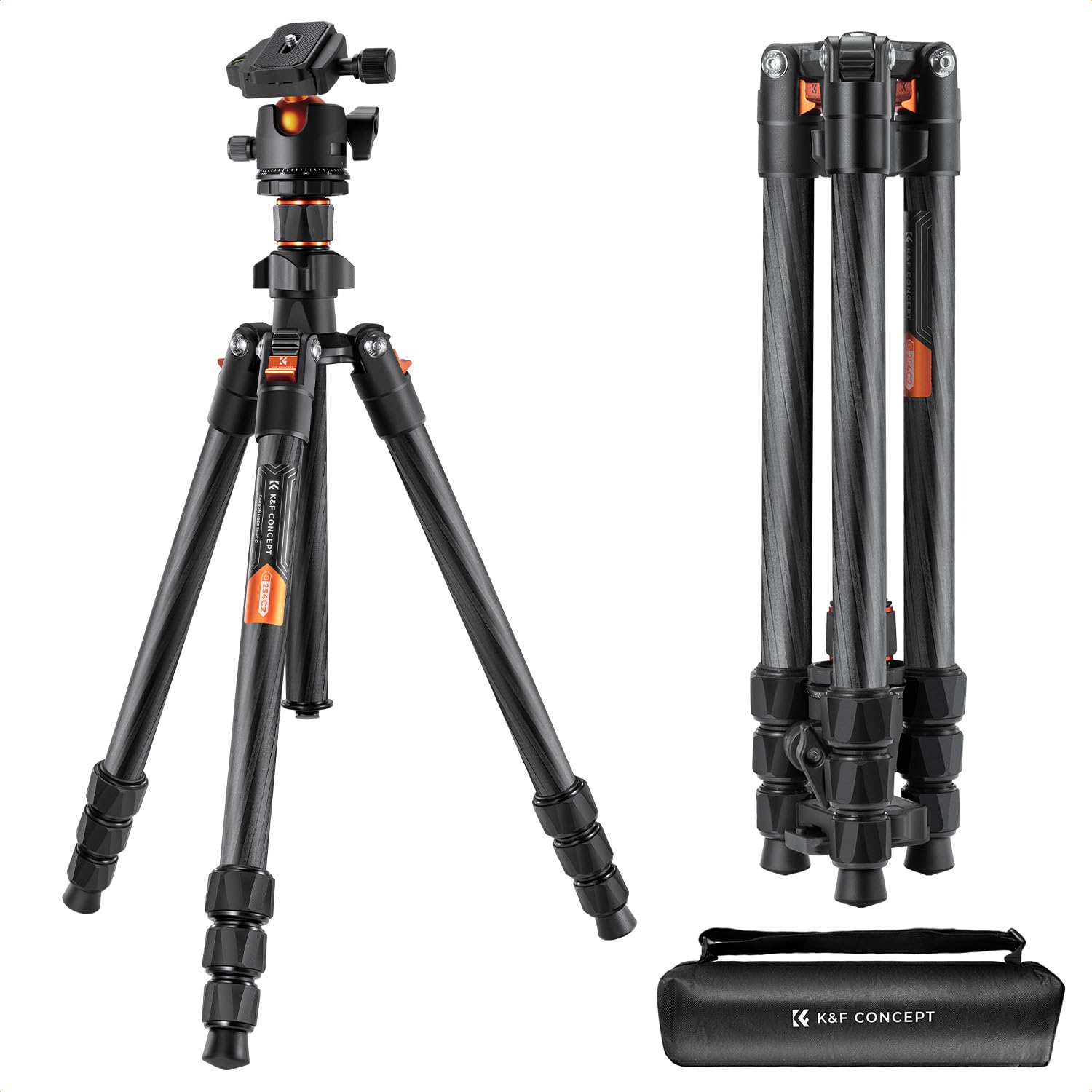
Most travel tripods make you hunch. This K&F extends from 21.2 inches up to 64 inches across four leg sections, so a taller photographer can frame at eye level instead of crouching. It folds back to 16.3 inches for the bag, and the whole thing — ball head included — comes in at 2.5 lb.
The head is a 36mm ball with a 360-degree panning dial, which lets you lock a landscape frame and then sweep the horizon smoothly for a panorama. The center column inverts, and a short column is included for ground-level and macro work. A standard 1/4-inch thread means most Arca-Swiss plates and most DSLR bodies drop straight on.
Owners lean on the lightness first and the portability second — the whole point of the carbon build is that it goes in the bag and stays light. Performance and value get solid marks too. The honest caveat sits in the build: material and construction quality draw a split verdict, with some loving the carbon tubes and others less convinced. Treat it as a light-duty travel tripod rather than a studio tank.
The height advantage: 64 inches of reach is a rare thing at this carry weight, and it means tall shooters get proper framing without adding a riser.
Set expectations: the mixed notes on build quality suggest it suits gentle travel use over hard field abuse.
Reach for this if: you are tall, you pack light, and you want real height without a heavy tube.
Think twice if: you plan to lean on it in rough weather or heavy field use every week.
3. Fotopro 60″ Carbon Fiber Travel Tripod
Folds to 14.17 inches and turns into a monopod in under ten seconds.
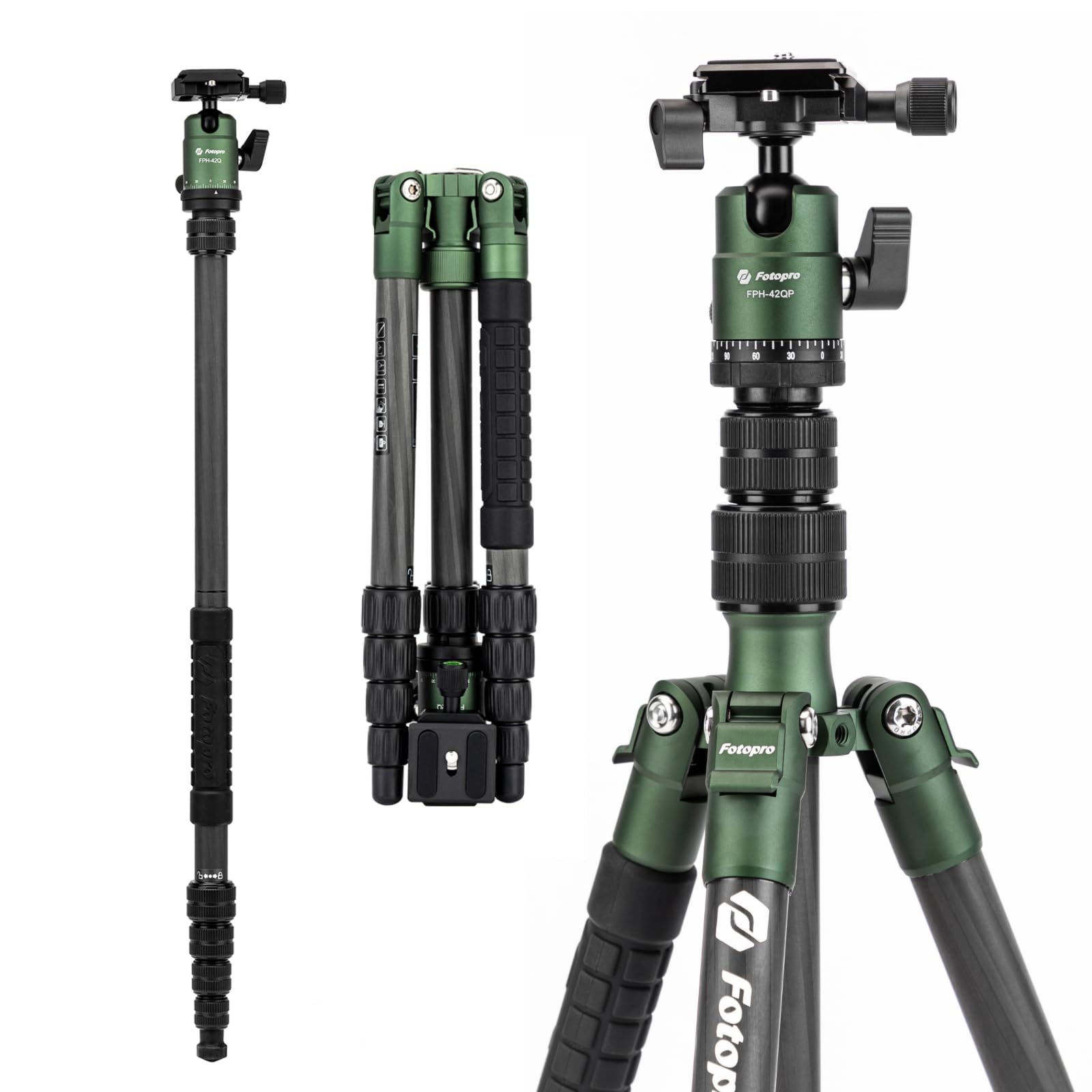
If bag space is your tightest constraint, this is the pick to beat. At 14.17 inches folded it drops into a carry-on or overhead bin without a fight, and at 2 lb it barely registers on your back. The load rating is a claimed 17.6 lb of gear, which is well beyond what a mirrorless kit needs.
The clever part is the second job. Detach one leg and it converts to a monopod with no tools — the tripod reaches 62 inches and the monopod reaches 42.7 inches. That covers the crowded-plaza situation where a full tripod footprint is impossible. The 360-degree ball head handles panoramas, three leg angles (25, 50 and 80 degrees) handle slopes, and a center hook lets you hang a bag for wind stability. A true Arca-Swiss plate ships in the box.
Functionality is what owners talk about most, with value close behind and build quality getting its own nods. The one thing to go in clear-eyed about is stability — it draws a split verdict and is the most-discussed aspect overall. On flat ground with a light kit it does the job; on a gusty ridge with a heavy lens, this is not the tripod to trust.
The smart fit: a compact-kit traveler who wants tripod and monopod in one light package.
Not for you if: you routinely shoot heavy glass in wind and need rock-solid footing.
4. Sirui Compact Traveler 5C Tripod

The ultralight hiker’s choice — 0.85 kg that folds to 13 inches.
This is the smallest and lightest tripod here. It folds to 13 inches and weighs 0.85 kg (about 1.9 lb), so it disappears into a daypack. Compare it to the Fotopro at 2 lb: the Sirui is the one you forget you are carrying. But it gives up load capacity to get there, holding 8.8 lb against the Fotopro’s 17.6 lb.
The spec sheet suits backpackers and hikers. The working height runs from 6.3 inches up to 54.3 inches, with three leg-angle positions for uneven ground, and the center column inverts for macro work. The aluminum ball head has two independent knobs so you can pan and tilt separately, and a 1/4-inch quick-release plate connects most bodies fast. Legs invert and fold back 180 degrees to hit that 13-inch length.
Lightness and quality tie as what owners praise most, with compactness and portability close behind — the travel-and-hiking use case comes through loud and clear. Stability is where the honest note lives: it draws a mixed verdict and is the most-discussed aspect overall. That is the nature of a sub-1 kg tripod: keep the load under 8.8 lb and it behaves.
The ultralight trade: 0.85 kg and a 13-inch fold are class-leading, and the 8.8 lb rating tells you exactly what it is built to carry.
Keep it light: buyers report mixed stability notes, so a compact mirrorless kit is its balance, not a full-frame telephoto rig.
Who it suits: the hiker and backpacker counting every gram.
Who should pass: anyone shooting heavy glass who needs maximum footing.
5. SmallRig AP-10 52.4″ Carbon Fiber Tripod

A modular rig that mounts a monitor, a phone, and a camera all at once.
SmallRig builds for videographers, and this tripod shows it. Three 1/4-inch threaded holes sit on the bracket for attaching a magic arm, a phone, or a monitor, so your rig grows without a separate cage. It also converts to a monopod or a walking stick, which is a genuinely useful second job on a hike. The folded size is 21.3 inches at 2.24 inches in diameter, though the NEEWER LT38 packs tighter at 19.7 inches and carries a higher 22 lb load — this one is built for accessories over raw capacity.
The legs hold up to 10 kg and the ball head supports 5 kg, with three leg angles for low shots and flip locks that adjust height from 19.7 to 52.4 inches. The 360-degree detachable head swivels fully and tilts through a damping knob, and the quick-release system works with most Arca-Swiss plates. At 1.175 kg it stays light on the trail.
Lightness is the most-praised trait, with quality right behind and reliability getting its own nods. The honest edge is stability — it draws a mixed verdict, and the leg functionality gets mixed notes too, including reports of legs that resist removal. For a compact rig used as designed, those are manageable; for heavy mounted loads, keep expectations modest.
Choose it for: the video shooter who wants to bolt on a monitor or phone without extra rigging.
skip it if: you want the tightest fold and the biggest load number in one tripod.
6. Benro Slim Tripod Kit with Ball Head, Carbon Fiber
A magnesium-shouldered travel kit with a warranty that outlasts most packs.
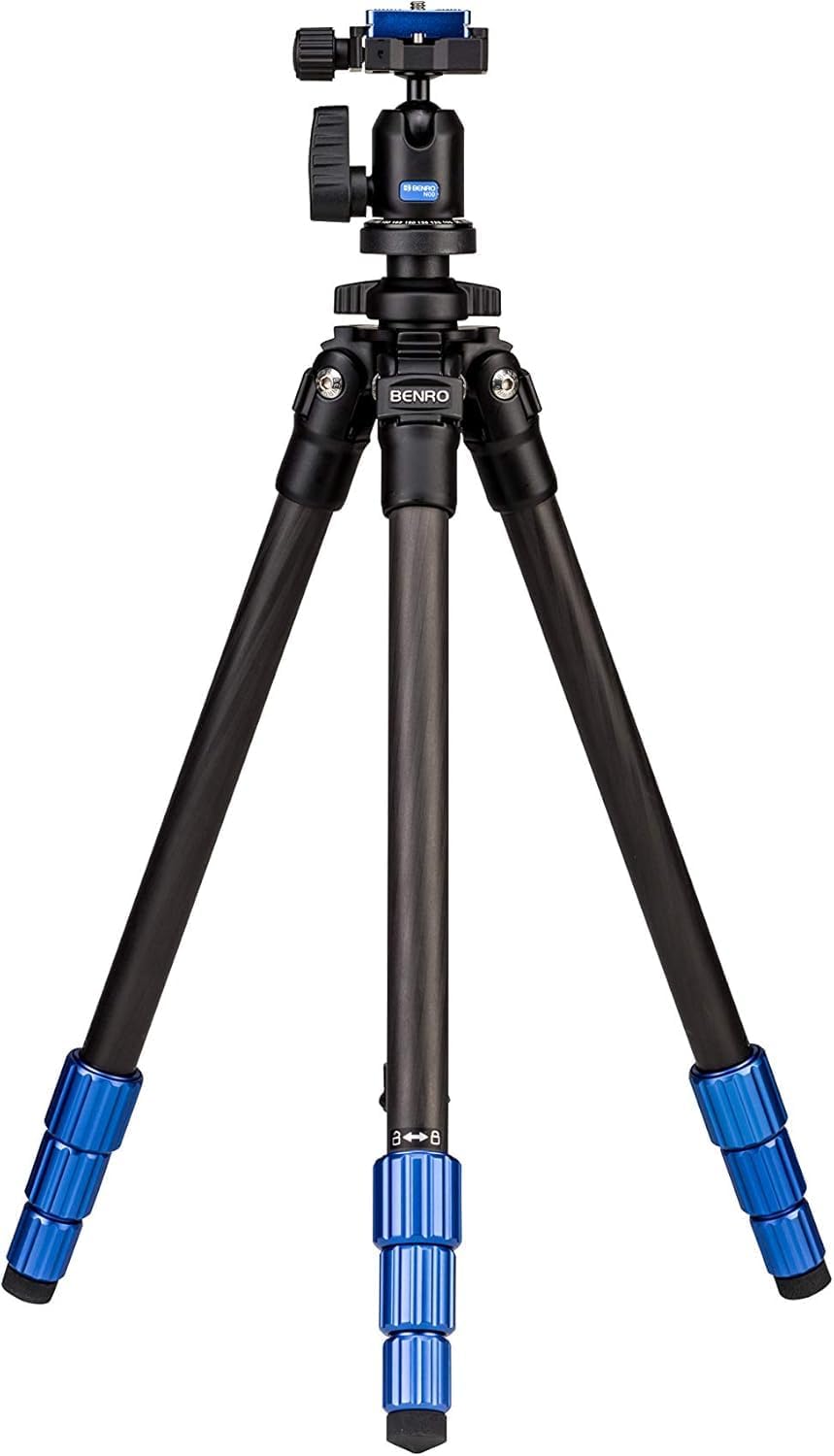
The headline for a long-term buyer is the coverage: a standard 3-year limited warranty, extended by 2 more years if you register the product online. That kind of backing matters on a piece of gear that takes knocks in the field. The tripod itself folds down to 20.07 inches and packs to 3.2 inches wide, sized for a carry-on backpack.
The build is carbon-fiber legs on a magnesium alloy shoulder with three leg-angle positions, twist-lock sections, and a reversible center column. Height runs from 15.7 inches at the low end up to 57.6 inches with the column up. The included removable N00 ball head and Arca-Swiss style plate make large-sensor camera setups fast to mount. Load capacity is 8.8 lb, which fits mirrorless bodies and compact DSLRs with accessories.
Owners talk about quality above all, then weight, and the travel use case runs through everything. The mixed notes cluster around the locking mechanism, head quality, and stability — a few owners note a lean to one side. Those are the trade-offs of a slim, light format; if you push right up to the load limit, you will notice them more.
What earns it a place
- 3-year warranty that becomes 5 years when you register online
- Magnesium alloy shoulder and carbon legs in a 20.07-inch fold
- Removable N00 ball head with Arca-Swiss style plate included
Where it asks patience
- 8.8 lb load suits light kits, not heavy telephoto rigs
- Locking mechanism and head draw mixed notes from some users
Ideal for: the buyer who values a long warranty and a slim, pack-friendly build.
Reconsider if: you shoot heavy lenses and need more than 8.8 lb of support.
7. SIRUI Traveler 7C Camera Tripod

Big-tripod reach and load in a carbon package that still travels.
This is the step up from the Compact Traveler 5C, and the numbers show it. Where the 5C holds 8.8 lb, the 7C holds 17.6 lb, and it reaches 65.55 inches instead of 54.3. The cost is 3.46 lb of carry weight and an 18.9-inch fold — a fair trade for a photographer who needs to support a serious camera body in the field.
Four carbon leg sections with twist locks set the height fast, and three leg-angle positions handle slopes. It converts to a full-size monopod by screwing the center column to a removable leg, and it can double as a walking stick on the trail. The center column inverts for macro, and the E-10 ball head rotates a full 360 degrees on two independent knobs. The 1/4-inch plate fits most DSLR mounts across the major brands.
Sturdiness is what owners praise most, and lightness comes right behind — the combination is why this one punches above its weight. Ease of use and value both get strong marks. Mounting is the one mixed area, with notes about screw placement for some setups. Check your plate and lens collar before a big shoot and it is not a problem.
The value play: a 17.6 lb load capacity while keeping carbon lightness is the point of the 7C.
Mind the mount: if your plate or collar is unusual, confirm it seats cleanly before you rely on it.
Pick it when: you need to support heavier glass and want real height on location.
Pass when: the 18.9-inch fold is too long for your carry-on bag.
8. NEEWER LITETRIP LT38 61″ Travel Tripod

A 22 lb load ceiling on a carbon frame that still folds to 19.7 inches.
For the photographer who carries heavy glass, this is the capacity king. The LT38 holds up to 22 lb across the legs and head, and it does it at 1.43 kg with metal height buckles and non-slip rubber feet. It folds to 19.7 inches at a 2.7-inch diameter, and a storage bag ships with it. Compare that 22 lb load to the SmallRig AP-10’s 11 lb head rating and the LITETRIP carries the higher load for a full-frame kit.
The low-profile 40mm metal ball head sits low for balance, pans 360 degrees, and has a U-shaped groove for 90-degree vertical framing with a spirit level built in. The center column inverts for macro shots down to 5.9 inches, and there is a hook for hanging weights. The quick-release plate is Arca-compatible and also fits PD backpack strap clip mounts — a nice bridge between systems. Five leg sections run the height from 18 to 61 inches across three fixed angles.
Quality is the trait that carries this one, with sturdiness right behind it and portability and value close behind those. The honest catch is the head and adjustability: the ball head only tilts so far before it hits its limit, and the lock can release a little too easily. Metal buckles and rubber feet help the stability story, but a careful hand on the lock is wise.
Why it stands out
- 22 lb capacity for full-frame bodies with telephoto lenses
- Low-profile 40mm ball head with spirit level and 90-degree groove
- Dual Arca and PD clip compatibility for fast transitions
Worth knowing
- Ball head tilt range is limited
- Lock can release more easily than some shooters prefer
Best match for: the heavy-kit shooter who needs a high load ceiling and a stable low head.
Less ideal for: anyone who wants a super-tight fold or a wide-tilting head.
9. Freewell Carbon Fiber Travel Tripod 59.1″

A sub-kilo traveler with a compartment for a tracker and room for extra gear.
Freewell targets the ounce-counting traveler. At 900 g it sits among the lightest carbon options here, and it folds to 42.8 cm — short enough to slip into a daypack side pocket. The head supports up to 5 kg, and the aluminum ball head pans a full 360 degrees for horizontal and vertical framing. Bubble levels help you square the shot without a separate level.
The interesting extras are the three 1/4-20 threaded holes for mounting lights or microphones, and an AirTag compartment for a tracker so you can keep tabs on your gear. A phone clip and quick-release plate are included. Screw off one leg and it becomes a monopod for the crowded-plaza situation where a tripod footprint is a problem. Maximum height reaches 150 cm, which is a comfortable standing eye level for most shooters.
On the trade-off side, 5 kg of head support is modest compared to the 22 lb ceiling on the NEEWER — so this is a light-kit tripod, not a heavy-glass workhorse. It is a compact, premium-priced option with a smaller review base than the crowd favorites here. The feature set is what you are paying for: low weight, tracker slot, and monopod conversion in one compact tube.
The carry story: 900 g and a 42.8 cm fold make this one of the easiest to keep on you all day.
Know the limit: 5 kg of head support means compact cameras and phones, not a long telephoto.
Suits you if: you want a light, tracker-ready premium tripod for phones and compact bodies.
Look elsewhere if: you need heavy-lens support and a taller working range.
10. 3 Legged Thing Albert Kit 2.0 Carbon Fiber Tripod

Tripod, monopod, or table-top rig — with a load ceiling that laughs at most kits.
This is the most flexible frame in the group. Three detachable legs let it become a monopod or a table-top tripod without extra parts, and the working range is huge — from as low as 5 inches up to 72 inches. It folds to 17 inches for a carry-on bag, and it carries up to 66 lb of gear, which is far beyond anything a travel photographer will hang on it.
The details show the engineering. A parallel locking system reduces the chance of accidental disassembly, the weight-balanced locks lower the center of gravity, and 3M rubber pads improve grip when extending and folding. Detachable rubber Bootz can be swapped for other foot accessories sold separately. The AirHed Pro ball head comes in the kit, and the whole thing weighs 1.87 kg.
This is a premium pick with a smaller review base than the crowd favorites, so the consensus is thinner — but the specs and the 5-year warranty do the talking. If you want reach, load, and modularity in one travel-ready frame, the feature set is hard to match. Just note the higher carry weight against the sub-kilo crowd.
The one for: a photographer who wants one tripod to cover low macros and tall standing shots.
Not the one for: anyone counting grams — at 1.87 kg it is not the lightest traveler.
Understanding the Specs
Folded length and carry weight
Folded length is how long the tripod sits when the legs come in — the number that decides whether it fits your bag. Carry weight is what your back feels on the trail. These two numbers work together: a shorter fold and a lower weight make a tripod more likely to travel with you, while a higher weight and longer fold give you more stability and load capacity. Match the pair to your bag and your back before anything else.
Load capacity
Load capacity is how much gear the tripod and head are built to hold together. A mirrorless body with a compact lens needs far less than a full-frame camera with a telephoto zoom. Leave headroom — stay well under the load rating rather than loading to the ceiling. The load ratings here span from about 8 lb up to a 66 lb ceiling, so the range covers light travelers to heavy kits.
Ball head types and controls
The ball head holds your frame in place and lets you adjust the angle. A single adjustment ring is fast and simple; two independent knobs let you pan and tilt separately, which helps with panoramas. A panning dial with a degree scale aids precise sweeping shots. Check that the quick-release plate matches the Arca-Swiss style if you already own plates or gimbal gear, so you are not buying adapters.
Leg locks and sections
Twist locks need a turn to loosen and tighten; flip locks pop open with a thumb for fast height changes. More leg sections mean a shorter folded length but more joints to manage. Fewer sections mean fewer joints and often more rigidity. The length and weight of a tripod come largely from how many sections and what material the tubes are — carbon fiber cuts the weight while keeping the tubes stiff.
FAQ
Will a carbon fiber tripod support a full-frame DSLR with a telephoto lens?
How small does a travel tripod fold for carry-on luggage?
Is carbon fiber worth the premium over aluminum?
What is the difference between a ball head and a pan-tilt head?
Can a travel tripod convert into a monopod?
Where do I attach a heavy bag for wind stability?
Do these tripods work with Arca-Swiss quick-release plates?
How low can these tripods get for macro shots?
How much does a travel tripod weigh, and does it slow me down?
Should I get a carbon fiber tripod or a lighter aluminum one?
Final Thoughts: The Verdict
For most photographers who want one tripod that travels easily and holds a serious camera, the Peak Design Travel Tripod is the safest bet. It holds 20 lb and folds to 15.4 inches. It has a 4.5+ star average across 660+ ratings, and owners mention quality is what wins them over. If you want a farther-reach frame that converts to a monopod, the SIRUI Traveler 7C raises the load capacity to 17.6 lb from its smaller sibling’s 8.8 lb and gives you 65.55 inches of height. And for the ounce-counting hiker, the Sirui Compact Traveler 5C at 0.85 kg and a 13-inch fold is the one that disappears into the pack.
How We Picked
We do not accept paid placement. Every pick is matched to a real buyer and a real use-case; we do not hands-on test units.
Sources & Methodology
Specifications: manufacturer listings and product documentation. Review insights: verified customer reviews, as of November 2026. Pricing: not shown on this page (it changes often); check the current price via the retailer link.
As an Amazon Associate, Gadgets Feed earns from qualifying purchases. This does not affect which products we feature.