
A family game night should bring everyone together, but the wrong choice can lead to eye-rolling teenagers, bored adults, and toddlers scattering cards. The best options balance simple rules, engaging mechanics, and quick playtimes so that a six-year-old and a grandparent can genuinely have fun without frustration or lagging turns.
I’m Min — the co-founder and writer behind Gadgets Feed. I spend hours digging into player counts, age ratings, component quality, and real-world feedback to pinpoint the titles that deliver consistent, inclusive entertainment across every generation.
Whether you need a fast word-association sprint, a trivia battle across the decades, or a strategy game that rewards cunning over luck, this guide to the board games for families of all ages will help you find a new favorite for your shelf.
How To Choose The Best Board Games For Families Of All Ages
The best family game survives the living-room test: a table full of mixed ages and attention spans that all stay engaged until the final round. Focus on three factors — playtime, complexity floor, and player count flexibility — to avoid duds that collect dust between holidays.
Playtime and Pacing
A game that runs over 60 minutes can lose younger players and adults with limited evening time. Look for titles with a 20-to-45-minute playtime where rounds feel snappy. Bonus points if the game has a variable end condition so you can call it early if energy dips without ruining the experience.
Rule Simplicity and the “Teach Test”
If you can explain the rules in under two minutes and start the first round without consulting the manual, the game passes the barrier test. Games with a single core action — giving a one-word clue, guessing a category answer, drafting tiles — are far more likely to succeed with a wide age gap than games with layered scoring exceptions.
Component Quality and Replayability
Thin cardboard and tiny pieces that get lost under the sofa kill enthusiasm fast. Durable tokens, large-print cards, and modular setups that create a different board or question pool each time keep a game feeling fresh after a dozen plays. Read reviews about pieces breaking or wearing out before you commit.
Quick Comparison
On smaller screens, swipe sideways to see the full table.
| Model | Category | Best For | Key Spec | Amazon |
|---|---|---|---|---|
| CATAN 6th Edition | Strategy | Deep strategy & trading | Modular hex board | Amazon |
| Azul | Strategy | Tile placement & draft | 100 resin tiles | Amazon |
| Splendor | Strategy | Engine-building & gems | 40 gem tokens | Amazon |
| Codenames 2nd Edition | Word / Party | Word-association teams | 400 codenames | Amazon |
| GENSMAK Trivia | Trivia / Party | Multi-generational trivia | 750 trivia questions | Amazon |
| Spin Master Family Feud | Party / Trivia | TV-style team play | 200 survey cards | Amazon |
| Big Potato Tilt ‘n’ Shout | Party / Speed | Marble-timed shout-outs | 150 category cards | Amazon |
In‑Depth Reviews
1. CATAN 6th Edition

CATAN remains the gold standard for introducing strategy and negotiation to a mixed-age table. The 6th Edition cleans up rule clarity with a beginner-friendly manual and includes card trays and chunkier wooden pieces that survive aggressive trading. Players collect brick, wood, wheat, ore, and sheep to build roads and settlements, racing to 10 victory points while the modular hex board ensures no two games play identically.
The 60-to-90-minute runtime is longer than most party games, but the trading and negotiation loop keeps everyone engaged between turns. At ages 10 and up, younger kids may need help with resource math, but the social element — bartering, blocking, and rolling for resources — creates memorable moments across generations. The robber mechanic adds a pinch of tension without punishing beginners too harshly.
Component quality is noticeably improved in this edition with sturdier player aids and a larger box that accommodates expansions smoothly. Just be ready for the occasional friendly argument over sheep trades — that is half the fun.
Why it’s great
- Modular board offers near-infinite replayability
- Trading and negotiation engage all personality types
- 6th Edition has superior component quality and rulebook
Good to know
- 60-90 minute playtime may be long for restless younger kids
- Requires exactly 3-4 players for best experience
- Dice randomness can frustrate strategic planners
2. Azul Board Game

Azul is a visual and tactile delight — the Spiel des Jahres 2018 winner — where players draft colorful resin tiles from factory displays to complete patterned rows on their individual mosaic boards. The rules are simple enough to teach in under two minutes, yet the draft-and-deny mechanics offer serious depth for adults. Every round forces you to weigh immediate gains against future penalties, keeping decision-making tight at any player count.
The 30-to-45-minute playtime is a sweet spot for family nights where you want a meaningful game without committing to an epic. The tiles are chunky and satisfying to touch, and the linen bag adds a premium feel that younger players love. Scoring penalties for incomplete rows introduce gentle risk management without making the game punishing for beginners.
Azul shines at 2 players for a sharp duel or at 3-4 where the shared tile pool creates genuine tension. The lack of direct attack mechanics means the game stays friendly, though eagle-eyed players will find plenty of opportunities to sabotage an opponent’s plan by leaving them unwanted tiles.
Why it’s great
- Beautiful, weighty resin tiles that feel premium
- Teaches in minutes, yet offers deep strategic layers
- Perfect playtime (30-45 min) for family sessions
Good to know
- Some tiles lack patterned backs for color-blind accessibility
- Not a loud or chaotic game; it rewards quiet planning
- Box is larger than necessary for the components
3. Splendor Board Game

Splendor is the purest distillation of engine-building in a family-friendly package. Players collect colored gem tokens — beautifully weighted poker-chip-style pieces — to purchase development cards that grant permanent discounts and victory points. The goal is to attract noble patrons, which adds a layer of timing and resource planning that rewards thoughtful play over lucky draws.
The 30-minute playtime makes it easy to squeeze in multiple rounds, and the rules can be explained in about 90 seconds. What sets Splendor apart for family play is the complete absence of direct conflict — no attacking, no stealing, no negative interactions — so the focus stays entirely on building your own engine. Younger players can compete by focusing on cheap cards, while experienced players chase high-value combinations.
Component quality is outstanding, with heavy resin tokens that feel satisfying to stack and trade. The game scales beautifully from 2 to 4 players, though the 2-player variant does lose a little tension compared to the full table. The only downsides are a slightly dry theme that may not excite fantasy lovers and cards that benefit from sleeves after heavy use.
Why it’s great
- Premium poker-chip gem tokens are incredibly satisfying
- No direct conflict keeps the mood friendly and focused
- Explains in 90 seconds, plays in 30 minutes
Good to know
- Theme is abstract and may not engage younger imaginations
- Card sleeves recommended if you play frequently
- 2-player mode has less tension than 3-4 player games
4. Codenames 2nd Edition
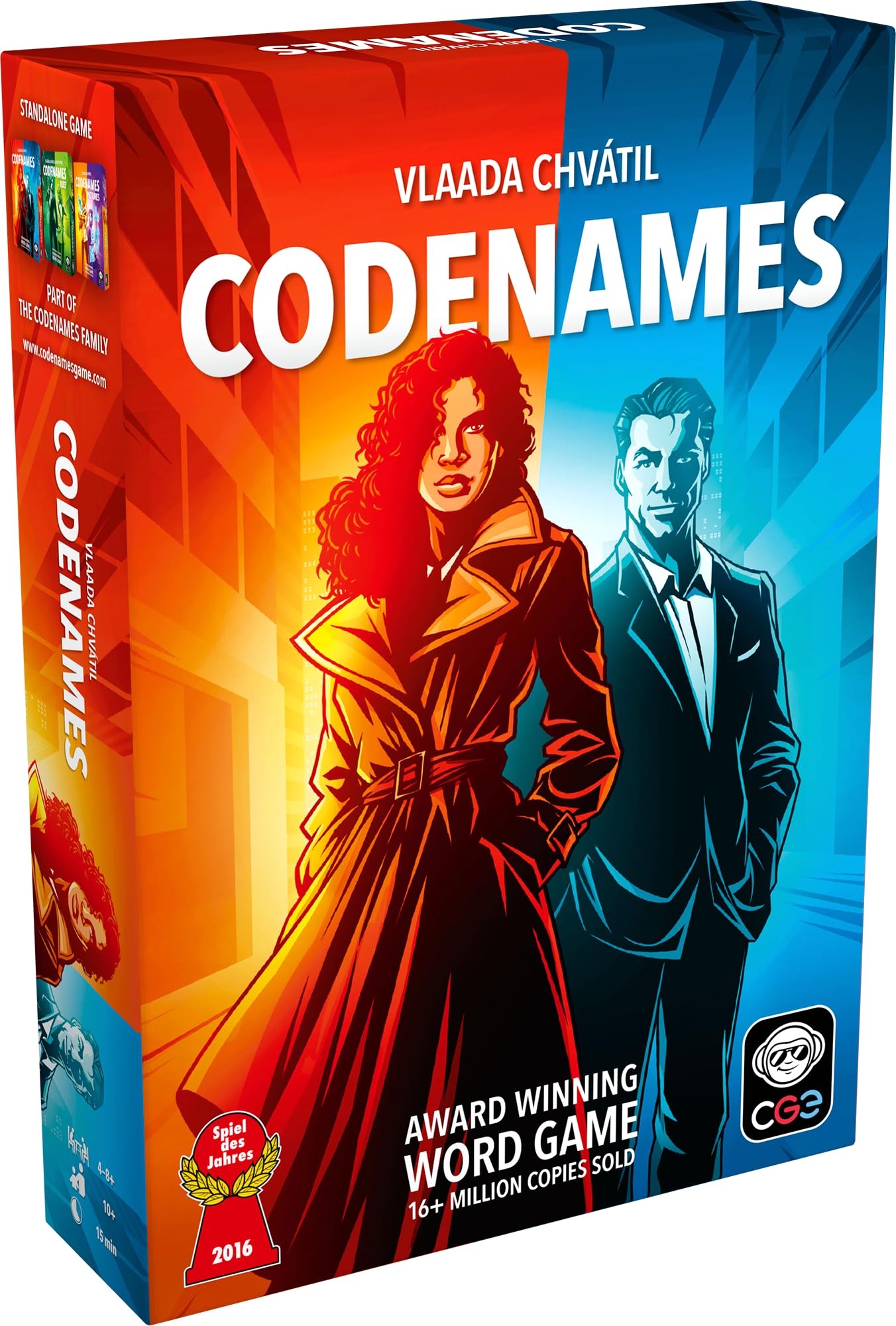
Codenames transforms family night into a spy agency word-association challenge where two teams race to identify their secret agents from a 5×5 grid. The spymaster gives a single word clue plus a number — “Fruit, 3” — hoping their teammates correctly pick the right tiles while avoiding the assassin tile that instantly loses the game. The 2nd Edition revises the word list, refreshes the art, adds a better card tray, and streamlines the rulebook.
The beauty of Codenames for mixed-age groups is that the spymaster role allows older players to flex their vocabulary and lateral thinking, while guessers of any age can participate as long as they can read the grid. The game supports from 4 to 8+ players easily, and rounds are fast — usually 10–15 minutes — so you can cycle roles and keep everyone engaged. The assassin mechanic creates genuine tension without being scary.
Component quality in the 2nd Edition is improved with a sturdier card stand and updated tile art, though the box is still compact enough to toss in a bag for travel. The only catch is that very young readers (under age 8) may struggle with the word list, and the spymaster’s downtime between clues can briefly slow the pace for hyperactive players.
Why it’s great
- Team-based fun with creative word association
- Scales from 4 to 8+ players easily
- Fast 10-15 minute rounds allow multiple games
Good to know
- Reading required; best for ages 8 and up
- Spymaster role can be stressful for some players
- Replay value depends on group creativity
5. GENSMAK! Trivia Party Game
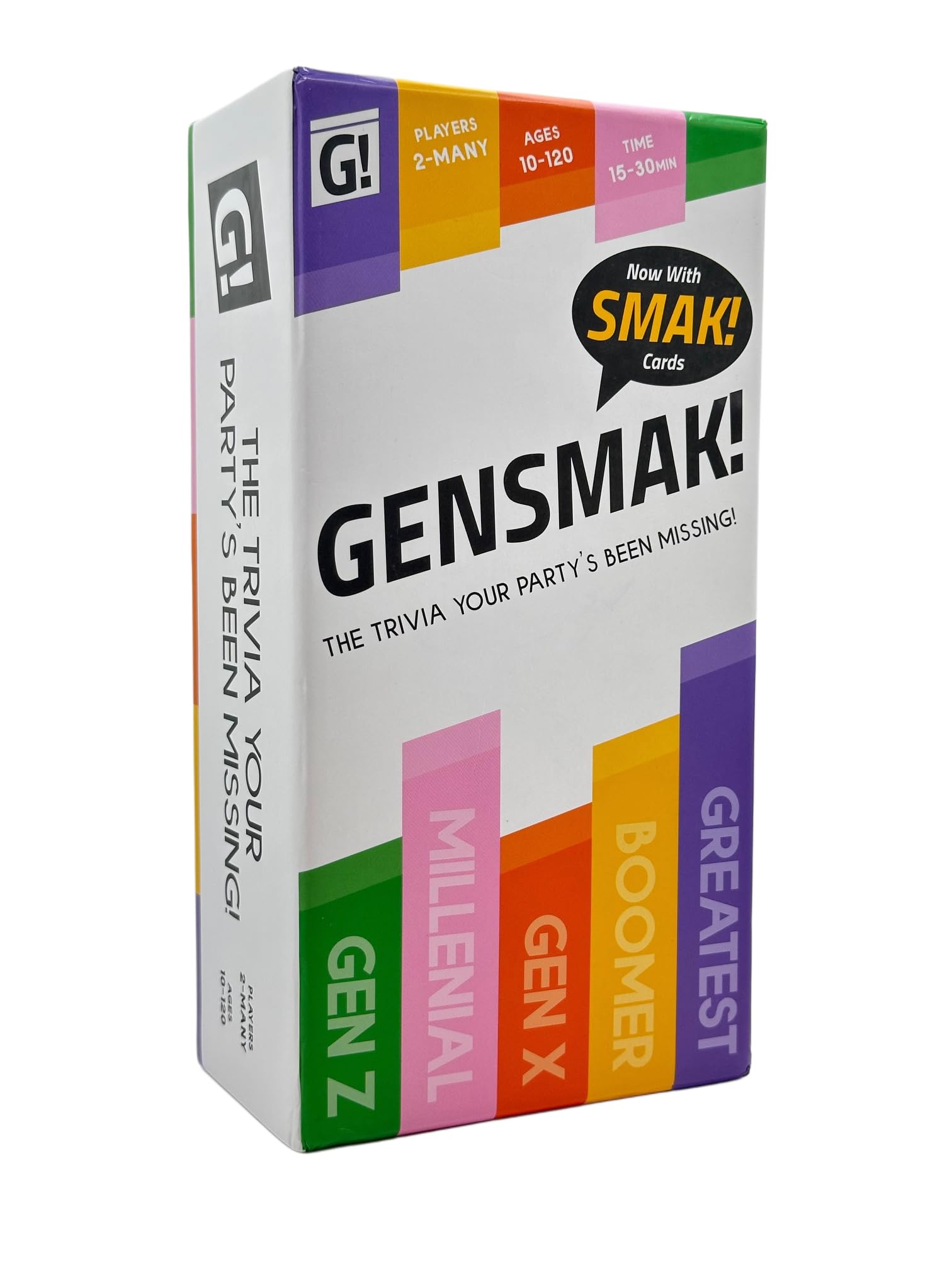
GENSMAK is the rare trivia game built specifically to bridge generational gaps. Questions span from the Greatest Generation through Gen Z, covering pop culture, music, TV, and historical events. Each question includes a comedic hint that keeps players guessing even when they have no idea — “Name the actress who played X — hint: she was in that movie where…” — which levels the playing field for younger family members against trivia-savvy elders.
The special SMAK gameplay cards add a strategic layer: you can double down on a question, challenge another player, or run the Decade Dash to score bonus points. The 750-question count provides substantial replay value, though after a dozen sessions you may see repeats if your group plays frequently. The box is compact and easy to bring to gatherings, and the rulebook gets you playing in under 2 minutes.
Players consistently praise GENSMAK for becoming the centerpiece of family gatherings, camping trips, and road trips. The hint system reduces the sting of not knowing an answer, keeping the mood light and encouraging laughter. The main trade-off is that the physical card stock could be thicker, and the box insert could better organize the various card types.
Why it’s great
- Trivia spans multiple generations fairly
- Comedic hints keep everyone competitive regardless of age
- Compact box is perfect for travel and gatherings
Good to know
- Card stock feels slightly thin; sleeve cards for longevity
- Questions may repeat after many play sessions
- Best with at least 4 players for team dynamics
6. Spin Master Games Family Feud Ultimate Edition
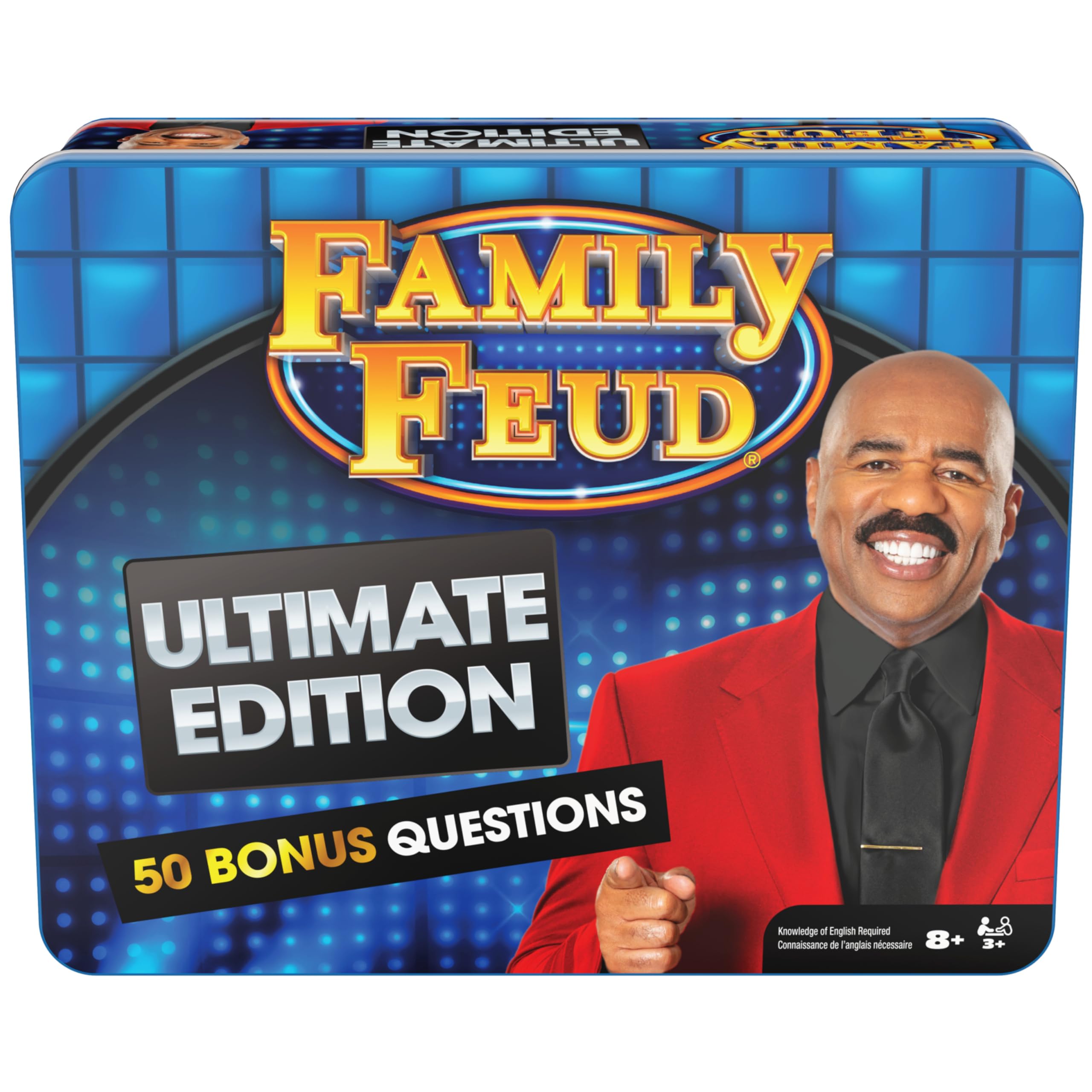
If your family watches Family Feud together, this Ultimate Edition delivers the TV show experience straight to your table. It includes 150 Face Off question cards, 50 Fast Money cards, a Steve Harvey card, a dry-erase scoreboard, and a collectible tin for storage. Two teams compete to guess the most popular survey answers, and the Fast Money bonus round adds a high-stakes finale.
The game shines because the survey format is inherently democratic — winning depends on guessing what “100 people surveyed” said, not on trivia knowledge. This means an eight-year-old can nail a question just by thinking like the crowd, while a grandparent’s lived experience gives them insight into older survey data. The 20-minute estimated playtime is on the shorter side, making it an easy filler game between heavier titles.
The tin storage box is a nice touch for keeping everything organized, though some players wish it came with buzzers to heighten the game-show feel. The dry-erase scoreboard works well, but the marker needs to be stored carefully to avoid drying out. The question cards are robust enough for regular use, though you may want to add your own house rules for the “steal” mechanic to keep it exciting.
Why it’s great
- Survey format levels the playing field across generations
- Fast Money bonus round adds exciting climax
- Compact tin storage protects components
Good to know
- No built-in buzzers; consider buying separate ones
- May benefit from house rules to prevent rule arguments
- Dry-erase marker may dry up over time
7. Big Potato Tilt ‘n’ Shout

Tilt ‘n’ Shout delivers high-energy family fun with a simple hook: two teams shout out answers to a category while a marble runs down a seesaw timer. You want the marble to drop into your team’s zone, so you better think fast and shout louder than the other team. The 150 category cards are refreshingly diverse — from “Things that are sticky” to “Movie titles with a color” — ensuring no two rounds feel the same.
The interactive seesaw is the star attraction; its speed changes throughout the game, giving trailing teams a comeback chance right until the last round. The game takes minutes to learn, and rounds are short enough to keep even short attention spans engaged. The compact plastic build makes it a good travel companion for holiday gatherings or camping trips.
However, the physical mechanism has some reliability concerns. A few buyers report the seesaw can get stuck or requires a rubber band to work consistently, and the small metal ball is easy to lose if it rolls off the table. Despite these caveats, the sheer volume of laughter and shouting this game generates makes it a solid entry-level pick for families who prioritize energy and chaos over precision components.
Why it’s great
- Unique marble-seesaw timer creates genuine excitement
- 150 diverse categories ensure fresh rounds
- Extremely easy to learn and quick to play
Good to know
- Seesaw mechanism sometimes needs adjustment
- Small metal ball is easy to lose
- Plastic build feels less durable than premium games
FAQ
What is the best board game for a family with kids ages 6 to 16?
How many players do I need for a good family game night?
Can younger kids play strategy games like CATAN or Splendor?
Which game is best for a large extended family gathering?
Final Thoughts: The Verdict
For most users, the board games for families of all ages winner is the CATAN 6th Edition because its blend of negotiation, strategy, and modular replay creates lasting memories across generations. If you want a faster, tactile experience with stunning components, grab the Azul. And for a pure party atmosphere that gets everyone shouting and laughing, nothing beats the Codenames 2nd Edition.