
Choosing your first pair of powered speakers often feels like navigating a minefield of specs—woofer size, amplifier class, DAC quality, and connectivity options all compete for your attention. The wrong pick can leave you with either anemic, lifeless sound or a boom-heavy mess that fatigues your ears within an hour. The right pair, however, transforms your desk or living room into a personal concert hall where every cymbal crash and vocal breath lands with pinpoint accuracy.
I’m Min — the co-founder and writer behind Gadgets Feed. I’ve spent countless hours dissecting frequency response graphs, amplifier topologies, and real-world user feedback to separate the genuine performers from the marketing fluff in this crowded category.
Active speakers eliminate the need for a separate amplifier or receiver, making them a streamlined upgrade for any listener. Whether you are building a desktop workstation, a vinyl listening corner, or a compact home theater, this guide to the best active bookshelf speakers will help you find the pair that matches your room, your source gear, and your sonic priorities.
How To Choose The Best Active Bookshelf Speakers
The perfect pair hinges on three variables: how you plan to use them, what you are connecting, and the physical space they will occupy. A speaker that excels on a desk in near-field listening may sound hollow in a large living room, and a model built for raw volume may lack the nuance needed for critical mixing work. Focus on these factors to narrow the field.
Driver Configuration and Amplifier Power
The woofer size—typically 4 to 6.5 inches—dictates how low and how loudly the speaker can play before distortion sets in. A 4-inch driver paired with 30 watts per channel works fine for a small desk setup, but filling a 20-foot room calls for a 5.25-inch or larger driver and at least 50 watts of clean amplification. Pay attention to the amplifier class: Class D designs offer high efficiency and low heat, while Class AB tends to deliver a warmer, more natural tonal balance at the cost of higher power consumption.
Connectivity Options and Input Flexibility
The range of inputs determines which gear you can pair without extra adapters. Optical (TOSLINK) and coaxial inputs let you connect TVs and CD players directly for a pure digital signal path. RCA and 1/4-inch TRS inputs accommodate turntables with a built-in phono stage and professional audio interfaces. A built-in phono preamp is a rare but valuable feature for vinyl enthusiasts, and HDMI ARC simplifies integration with modern televisions by allowing volume control via a single remote.
Cabinet Construction and Placement
MDF (medium-density fiberboard) cabinets with internal bracing reduce unwanted resonance that colors the sound. A front-firing bass port is more forgiving when you place speakers near a wall, while a rear port requires a few inches of breathing room for clean bass. If your setup forces tight placement against a bookshelf, prioritize models with front ports or sealed enclosures to avoid a muddy low end.
Quick Comparison
On smaller screens, swipe sideways to see the full table.
| Model | Category | Best For | Key Spec | Amazon |
|---|---|---|---|---|
| Edifier S1000MKII | Premium Powered | Audiophile desktop listening | 120W total, 5.5″ aluminum woofer, 1″ titanium tweeter | Amazon |
| KEF LSX II | Wireless Hi-Fi | Multi-source streaming with hi-res audio | 200W total, 4.5″ Uni-Q driver, HDMI ARC | Amazon |
| PreSonus Eris 5BT | Studio Monitor | Accurate near-field mixing and production | 100W total, 5.25″ woven-composite woofer, Bluetooth 5.0 | Amazon |
| Fluance Ai41 | Versatile Powered | Balanced sound for TV and turntable setups | 90W total, 5″ woven glass fiber driver, subwoofer out | Amazon |
| Klipsch R-40PM | Horn-Loaded Powered | Dynamic, detailed sound with high efficiency | 4″ copper-spun woofer, 1″ LTS tweeter, phono input | Amazon |
| Polk Audio ES20 | Passive Bookshelf | Home theater and high-output music playback | 6.5″ woofer, 1″ terylene tweeter, Power Port design | Amazon |
| HiVi-Swans OS-10 | Budget Powered | Affordable near-field listening with touch controls | 62W total, 4″ dynamic woofer, optical/coaxial inputs | Amazon |
| KEF LS50 Meta | Reference Passive | High-end critical listening with MAT technology | 5.25″ Uni-Q driver, MAT dampens rear-wave 99% | Amazon |
| Klipsch RP-600M II | Reference Passive | High-sensitivity, dynamic home theater surrounds | 6.5″ cerametallic woofer, 1″ titanium LTS tweeter | Amazon |
In‑Depth Reviews
1. Edifier S1000MKII

The Edifier S1000MKII strikes a rare balance between audiophile-grade components and accessible pricing. Its 5.5-inch aluminum alloy woofers and 1-inch titanium dome tweeters are driven by a high-efficiency Class D amplifier that delivers 60 watts per channel, producing a frequency response that dips to 45 Hz—enough low-end authority for most music genres without an external subwoofer. The titanium tweeter offers exceptional detail retrieval in the upper registers, making cymbals and string harmonics sparkle without tipping into harshness.
Connectivity is unusually generous for this price tier: optical, coaxial, dual RCA line inputs, and Bluetooth 5.0 with Qualcomm aptX HD for near-lossless wireless streaming. The included remote control handles volume, input switching, bass, and treble adjustments, though it requires a direct line of sight to the front panel IR sensor. The cabinet is constructed from MDF with a wood-grain vinyl wrap that looks convincing from normal viewing distance, and each speaker weighs roughly 16 pounds—a testament to the internal bracing that keeps resonance in check.
Where the S1000MKII truly excels is in near-field listening on a desktop or a console under a television. The front-firing port allows placement closer to a wall without the bass becoming muddy, and the amplifier has enough headroom to fill a medium-sized room with clean, undistorted sound. Some users report that the sound signature takes about five hours of playback to fully open up, but after that break-in period, the combination of bass punch, midrange clarity, and airy treble makes this the most complete all-rounder in the active speaker market today.
Why it’s great
- Wide, detailed soundstage with surprisingly deep bass from a 5.5-inch woofer
- Multiple digital inputs (optical, coaxial) plus aptX HD Bluetooth for high-quality wireless streaming
- Built-in Class D amplification eliminates the need for a separate receiver
Good to know
- Remote control requires near-perfect line of sight to the IR receiver
- Some listeners may find the titanium tweeter slightly bright before break-in
2. KEF LSX II

The KEF LSX II is a compact all-in-one wireless system that does not compromise on hi-res audio performance. Its 4.5-inch Uni-Q driver places the tweeter at the acoustic center of the woofer, creating a single point source that delivers a wide, coherent soundstage regardless of where you sit in the room. The built-in 200-watt amplifier drives each driver separately, and the system supports streaming up to 24-bit/384kHz resolution via Wi-Fi, Apple AirPlay 2, Chromecast, and Roon for audiophile-grade wireless playback.
Input options are exceptionally forward-looking: HDMI ARC for direct TV connection with your television remote, USB-C for a laptop, optical for consoles, and a 3.5mm auxiliary input. The KEF Connect app handles streaming from Spotify, Tidal, Amazon Music, and Qobuz, though some users find the app navigation slightly unintuitive compared to dedicated streaming platforms. The carbon black and mineral white finishes use a textured wrap that resists fingerprints, and the speakers can be placed on optional floor stands or wall-mounted with dedicated brackets sold separately.
In practice, the LSX II sounds remarkably mature for its size. The bass is tight and defined down to about 54 Hz, and the Uni-Q driver’s off-axis performance means you do not have to lock yourself into a single chair to hear the full image. This system truly shines in a small to medium living room or a large bedroom where space is at a premium but sound quality cannot be compromised. The LSX II LT version offers the same acoustic drivers for a lower entry point, sacrificing only the analog input and some color options.
Why it’s great
- Uni-Q driver creates a wide, immersive soundstage from a compact cabinet
- HDMI ARC and USB-C inputs simplify TV and laptop connectivity
- Supports high-resolution streaming up to 24-bit/384kHz over Wi-Fi
Good to know
- Ethernet connection is recommended for stable playback over Wi-Fi
- The KEF Connect app has a moderate learning curve for first-time users
3. PreSonus Eris 5BT

The PreSonus Eris 5BT are studio monitors first and lifestyle speakers second, meaning their primary goal is accuracy rather than flattery. Each monitor houses a 5.25-inch woven-composite woofer and a 1-inch ultra low-mass silk dome tweeter, driven by a 50-watt Class AB amplifier per channel. The woven-composite cone material delivers tight, controlled bass without the overhang that plagues less expensive paper or polypropylene cones, and the silk dome tweeter provides a smooth, non-fatiguing high end that is critical for long mixing sessions.
Connectivity covers both professional and consumer use cases: balanced 1/4-inch TRS inputs for audio interfaces and mixers, unbalanced RCA for consumer gear, and a front-panel 1/8-inch aux input for quick phone connections. Bluetooth 5.0 is included for wireless streaming, though the reviews note a noticeable drop in clarity compared to the wired inputs due to Bluetooth’s data compression limits. The front-panel headphone output with a dedicated amplifier allows you to switch between monitors and headphones without reaching around the back of the unit.
One of the most useful features for desktop users is the pair of high- and low-frequency tuning controls on the rear panel. These allow you to compensate for room acoustics or speaker placement, cutting or boosting by up to 6 dB in 2 dB steps. The auto-standby mode engages after 40 minutes of silence to save power, and the monitors wake on signal detection. For anyone who needs a truthful reference for mixing, mastering, or simply hearing recordings as the engineer intended, the Eris 5BT deliver that honesty at an accessible price point.
Why it’s great
- Flat, honest frequency response ideal for music production and critical listening
- Acoustic tuning controls (HF/LF) let you adjust for room placement and personal preference
- Balanced TRS inputs ensure noise-free connection to professional audio gear
Good to know
- Wired connections yield noticeably better clarity than Bluetooth streaming
- Auto-standby cannot be fully disabled from the front panel
4. Fluance Ai41

The Fluance Ai41 is a thoughtfully designed powered speaker that bridges the gap between turntable setups, TV audio, and desktop listening. Its 5-inch woven glass fiber drivers and 1-inch neodymium tweeters are powered by a 90-watt integrated amplifier, producing a balanced sound signature that leans slightly warm without sacrificing detail. The MDF cabinets are internally braced to minimize resonance, and the rear bass port extends low-frequency output, though you will want at least three inches of clearance behind each speaker for clean bass reproduction.
Input selection is straightforward and practical: RCA for turntables with a built-in phono preamp, optical for TVs and game consoles, and Bluetooth 5.0 for wireless streaming. The subwoofer output on the rear panel allows you to add an external powered sub for deeper bass extension in a 2.1 configuration. The included remote controls volume, input switching, bass, and treble, and the speakers offer a volume range from 0 to 30—most users find that 15 to 20 is more than enough for a medium-sized room.
Where the Ai41 really earns its keep is in its flexibility. The compact dimensions—roughly 10 inches tall and 6 inches wide—make it easy to fit into an entertainment center or on a desktop shelf alongside a monitor. The natural walnut finish adds a touch of warmth that blends well with mid-century modern decor. While the amplifier’s DSP limits the ultimate volume ceiling compared to larger passive setups, the trade-off is a consistently clean, non-distorting output that works for casual music listening, movie dialogue, and gaming alike.
Why it’s great
- Versatile inputs (RCA, optical, Bluetooth) work with nearly any source device
- Subwoofer output enables easy expansion to a 2.1 system
- Compact MDF cabinets with real wood veneer look and sound premium
Good to know
- Amplifier DSP limits maximum volume compared to larger passive+receiver setups
- Rear-firing bass port requires at least 3 inches of wall clearance
5. Klipsch Reference R-40PM
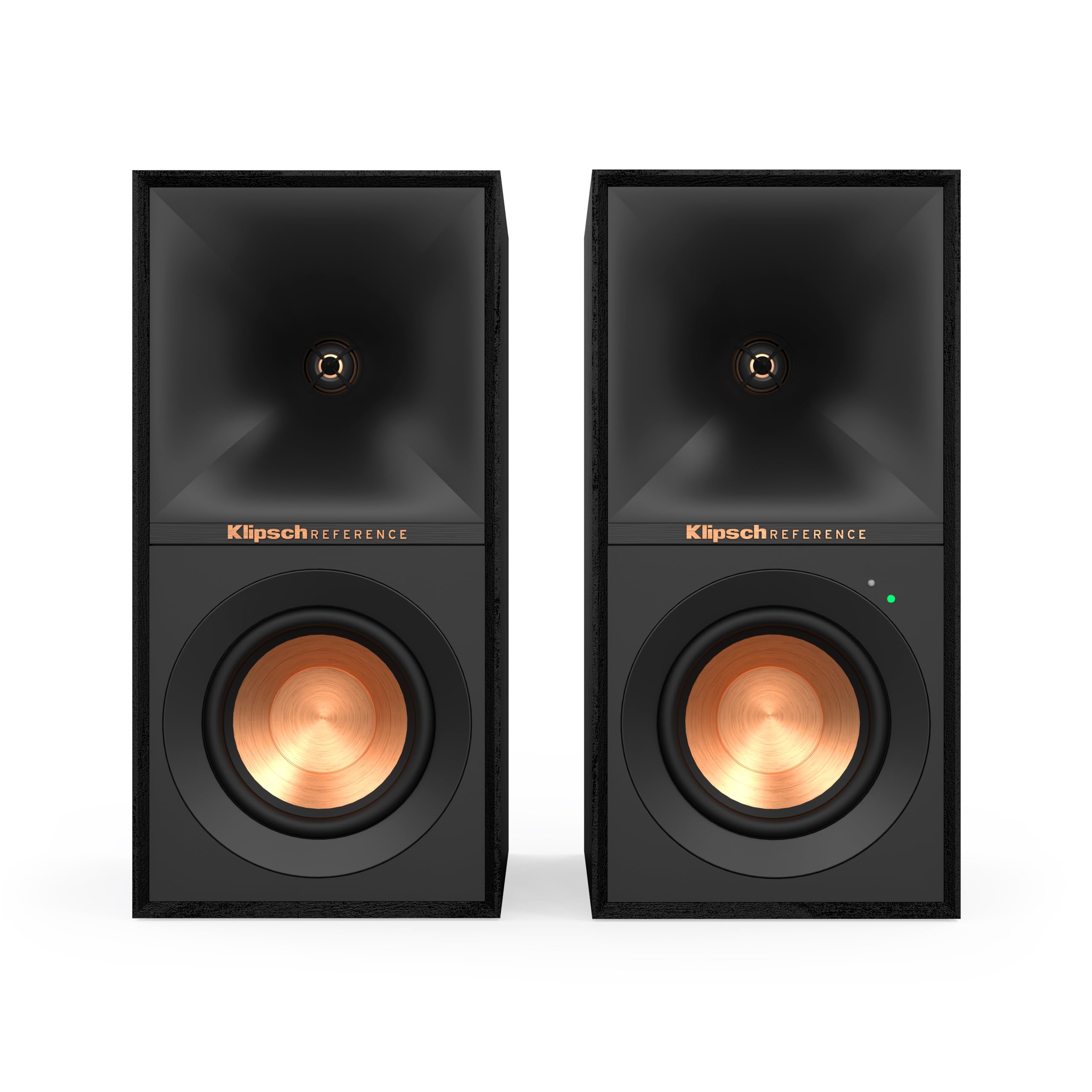
The Klipsch R-40PM packs the brand’s signature horn-loaded dynamics into a compact powered package. The 1-inch aluminum LTS tweeter coupled with a 90×90 Tractrix horn delivers the high efficiency and controlled directivity Klipsch is known for, while the 4-inch copper-spun Thermoformed Crystalline Polymer woofer handles midrange and bass. The result is a lively, engaging sound that cuts through a room without needing to crank the volume, making dialogue and vocal performances particularly clear and present.
This is one of the few powered speakers in its price tier that includes a built-in phono preamp with a ground screw terminal, allowing direct connection of a turntable without an external preamp. Beyond that, you get Bluetooth wireless streaming, a digital optical input, and analog RCA inputs. The low-profile magnetic grilles attach cleanly to the front baffle, and the compact footprint—roughly 9 inches tall and 5.5 inches wide—allows placement on crowded shelves or desks without dominating the space.
Bass output from the 4-inch woofer is surprisingly punchy for its size, though true sub-bass below 60 Hz will require adding the optional Klipsch subwoofer via the dedicated output. Some users report that the auto-on/off switching can be overly sensitive, causing the speakers to power back on when no audio is playing. Despite that quirk, the R-40PM remains a top choice for listeners who value dynamic impact and vocal clarity, especially in smaller rooms where a larger driver would overwhelm the space.
Why it’s great
- Built-in phono preamp with ground screw allows direct turntable connection
- Tractrix horn delivers high efficiency and focused, clear sound
- Compact footprint fits easily on cluttered desks or narrow shelves
Good to know
- 4-inch woofer has limited sub-bass extension; a subwoofer is recommended for deep bass
- Auto on/off feature can be overly sensitive and may require manual power cycling
6. Polk Audio Signature Elite ES20

The Polk Audio Signature Elite ES20 is a passive bookshelf speaker, meaning it requires an external amplifier or AV receiver to operate. This distinction is critical for buyers who already own a receiver or plan to build a full home theater system. The ES20 features a 6.5-inch mica-reinforced polypropylene woofer and a 1-inch Terylene dome tweeter, paired with Polk’s patented Power Port design that flares the port opening to reduce turbulence and deliver bass that is 3 dB louder than a conventional port of the same size.
The cabinet is deeper than many competitors—over 13 inches deep—so it will protrude from standard bookshelves. The walnut vinyl finish looks attractive from a distance but reveals its synthetic nature up close. The speakers are compatible with 4-ohm and 8-ohm systems, making them easy to drive with most mainstream receivers. Imaging is wide and precise, and the sound signature is slightly bright out of the box but smooths out after a 20-30 hour break-in period. The ES20 works exceptionally well as part of a timbre-matched Signature Elite surround system with the ES60 towers and ES35 center channel.
For listeners who value high output and dynamic range for movies and rock music, the ES20 delivers a visceral experience that few active speakers at this size can match. The Power Port genuinely improves low-frequency extension and reduces port noise at high volumes. However, the speaker’s size, need for an external amplifier, and the requirement for careful placement (at least six inches from the rear wall) make it a less convenient choice for minimalist desktop setups compared to self-powered alternatives.
Why it’s great
- Power Port technology delivers louder, cleaner bass than conventional ported designs
- Wide, immersive soundstage with precise imaging for movies and music
- High sensitivity makes them easy to drive with modest amplification
Good to know
- Passive design requires an external amplifier or AV receiver
- Deep cabinet may protrude from standard bookshelves
7. HiVi-Swans OS-10

The HiVi-Swans OS-10 proves that exceptional sound quality does not require a premium budget. These powered speakers use a 20mm silk dome tweeter paired with a 4-inch dynamic woofer, driven by 62 watts of total RMS amplification. The silk dome tweeter delivers smooth, non-fatiguing highs that avoid the harshness common in entry-level speakers, while the woofer produces punchy bass down to around 80-100 Hz before rolling off. In near-field desktop use, the OS-10 produces a wide soundstage with detailed mids and clean separation between instruments.
Connectivity is surprisingly robust for the price: optical and coaxial digital inputs for lossless audio from a TV or CD player, plus analog RCA and Bluetooth 5.0 with AAC and aptX support. The touch-sensitive control panel on the front allows input selection and volume adjustment, though some users find the touch controls finicky and prefer the included remote. The grey woven mesh wrapping that covers the sides and back gives the speakers a unique, textile-like appearance that stands out from the usual vinyl or painted finishes.
Build quality is a mix of impressive value and minor compromises. The plastic enclosure feels less substantial than MDF cabinets, but the woven mesh helps dampen resonance. Some units have experienced quality control issues, though the manufacturer’s support is generally responsive. For the budget-conscious listener who prioritizes sound quality over cabinet heft, the OS-10 delivers about 97% of the performance of speakers costing three times as much, making it arguably the best value proposition in this entire guide.
Why it’s great
- Silk dome tweeter produces smooth, detailed highs without listener fatigue
- Optical and coaxial digital inputs allow lossless connection to TVs and CD players
- Exceptional value—delivers near hi-fi sound at an entry-level investment
Good to know
- Touch controls can be inconsistent and require a firm, precise press
- Cabinet is plastic rather than MDF; some units have reported QC issues
8. KEF LS50 Meta

The KEF LS50 Meta represents a genuine breakthrough in driver engineering. The 12th-generation Uni-Q driver places a 1-inch aluminum dome tweeter at the acoustic center of a 5.25-inch magnesium/aluminum alloy cone woofer, creating a single point source that eliminates phase interference. The real innovation is Metamaterial Absorption Technology (MAT) — a highly absorptive circular disc placed behind the tweeter that traps 99% of unwanted rear-wave energy, dramatically reducing distortion and revealing micro-details that other speakers smear over.
These are passive speakers, meaning they require an external amplifier with substantial current delivery. The LS50 Meta’s impedance dips to around 3 ohms in the upper bass, which means a budget receiver will struggle to control the driver properly. Pair them with a high-quality amplifier delivering at least 50 watts per channel into 8 ohms—ideally a Class A/B or high-current Class D design—and you will be rewarded with imaging precision that rivals speakers costing several times more. The 0.07% total harmonic distortion figure is among the best in its class.
The LS50 Meta excels in near-field to midfield listening at moderate volumes. The soundstage is holographic, with instruments occupying specific positions in three-dimensional space. Bass extension reaches about 47 Hz, which is impressive for the cabinet size but not chest-thumping; most users will want to add a quality subwoofer for full-range playback. The fit and finish are superb, with a choice of glossy finishes and a curved baffle that reduces edge diffraction. For the dedicated listener building a reference system, the LS50 Meta is a cornerstone component.
Why it’s great
- MAT technology effectively eliminates 99% of tweeter rear-wave distortion
- Uni-Q driver creates a coherent, holographic soundstage with pinpoint imaging
- Exceptionally low THD (0.07%) for accurate, uncolored sound reproduction
Good to know
- Requires high-current amplification due to 3-ohm impedance dips
- Best at moderate volumes in small to medium rooms; not for large spaces or party use
9. Klipsch Reference Premiere RP-600M II

The Klipsch Reference Premiere RP-600M II is a second-generation passive bookshelf speaker that refines an already excellent design. The 1-inch titanium diaphragm LTS tweeter is mated to a new, larger 90×90 Tractrix horn made from a silicone composite hybrid material that reduces waveguide resonance and delivers crisper, clearer highs. Below it, the 6.5-inch cerametallic woofer—a spun copper-colored cone made from a ceramic and aluminum composite—provides stiffness and damping that eliminate cone breakup at high output levels.
These speakers are designed for high sensitivity (94 dB), meaning they produce significant volume with very little amplifier power. A modest 50-watt receiver will drive them to room-shaking levels with ease. The port design uses Tractrix geometry on both the front and rear openings to accelerate air transfer, reducing port noise and producing cleaner bass. Dual binding posts allow bi-wiring or bi-amping configurations, and the magnetically attached grille snaps off cleanly to reveal the driver array. The furniture-grade walnut veneer looks genuinely expensive.
The RP-600M II shines as part of a surround system or as primary left/right channels in a dedicated two-channel setup. The sound is forward, dynamic, and highly resolving—voices are clear, percussion attacks with authority, and the bass is punchy without being bloated. They pair exceptionally well with the RP-1000SW subwoofer for theater use. Placement is critical: they need at least six inches from the rear wall to avoid bass bloom from the rear-firing Tractrix port. For listeners who crave dynamics and efficiency, the RP-600M II is a top-tier choice.
Why it’s great
- High sensitivity (94 dB) means huge volume from modest amplifier power
- Cerametallic woofer and titanium horn deliver clean, dynamic sound with low distortion
- Bi-wire/bi-amp terminals provide upgrade flexibility for serious systems
Good to know
- Requires at least 6 inches of rear wall clearance for clean bass
- Passive design necessitates an external amplifier or receiver
FAQ
Do I need a separate amplifier for active bookshelf speakers?
What is the difference between a studio monitor and a consumer active speaker?
Can I use active bookshelf speakers with a turntable?
How much power do I need for a medium-sized room?
Final Thoughts: The Verdict
For most users, the best active bookshelf speakers winner is the Edifier S1000MKII because it combines audiophile-grade driver components, generous connectivity, and enough amplifier headroom to fill a medium room with clean, detailed sound—all without requiring any additional gear. If you want wireless streaming with hi-res capability and a compact footprint, grab the KEF LSX II. And for studio-accurate monitoring at a fair price, nothing beats the PreSonus Eris 5BT.