
Running a workshop, farm, or large home with well pumps, HVAC systems, and heavy machinery means single-phase generators often struggle to deliver stable, balanced power under load. A 3 phase electric generator solves that by distributing voltage across three legs, giving you smoother operation for demanding equipment and better efficiency under sustained use. Choosing the right unit comes down to fuel flexibility, power output, and whether you need portable convenience or automatic standby protection.
I’m Min — the co-founder and writer behind Gadgets Feed. I’ve spent hundreds of hours dissecting technical specifications, comparing engine displacements, inverter topologies, and fuel consumption curves across the most popular generator models to help you make an informed decision.
Whether you need a portable tri-fuel workhorse for job sites or an automatic standby unit for whole-home protection, finding the right 3 phase electric generator means balancing starting wattage, fuel type, and total harmonic distortion for your specific equipment.
How To Choose The Best 3 Phase Electric Generator
Selecting a three-phase generator requires understanding your specific loads, fuel infrastructure, and whether you need portability or automatic standby operation. These factors determine which unit delivers reliable power when you need it most.
Fuel Type Flexibility
Tri-fuel generators running on gasoline, propane, and natural gas offer unmatched flexibility during emergencies when one fuel source becomes scarce. Propane stores indefinitely without degradation, natural gas provides unlimited runtime via a utility line, and gasoline offers the highest peak wattage. Dual-fuel models are a solid middle ground, while single-fuel units lock you into one supply chain.
Starting vs. Running Wattage
Motor-driven equipment like well pumps, compressors, and air conditioners require three to seven times their running wattage during startup. Always compare the generator’s peak (starting) watts against your equipment’s surge requirements. The running (rated) watts determine how much continuous load the unit can handle once equipment is operational.
Transfer Switch Compatibility
A transfer switch isolates your home or facility from the utility grid during an outage, preventing dangerous backfeed. Portable generators typically require a manual interlock kit or external transfer switch, while standby generators include an integrated automatic transfer switch that detects grid failure and starts the unit without human intervention.
Quick Comparison
On smaller screens, swipe sideways to see the full table.
| Model | Category | Best For | Key Spec | Amazon |
|---|---|---|---|---|
| Westinghouse WGen14500TFc | Tri-Fuel Portable | Large home backup | 713cc V-Twin engine, 18,000 peak watts | Amazon |
| DuroMax XP15000HXT | Tri-Fuel Portable | Medium home & jobsite | 670cc OHV engine, 50A outlet | Amazon |
| Generac Guardian 10kW | Standby Automatic | Whole-house automatic backup | 100A 16-circuit transfer switch | Amazon |
| EF ECOFLOW Delta Pro 3 + GE305 | Hybrid Solar/Gas | Whole-home with solar | 4096Wh LFP, dual fuel generator | Amazon |
| Jackery Solar Generator 5000 Plus | Solar Power Station | Extended solar backup | 5040Wh, 7200W surge | Amazon |
| EF ECOFLOW Delta Pro 3 8kWh | Battery Power Station | Clean, silent indoor power | 4096Wh + extra battery, 30 dB | Amazon |
| OSCAL PowerMax 6000 | Solar Power Station | Solar with 240V split phase | 3600Wh, 6000W output | Amazon |
In‑Depth Reviews
1. Westinghouse WGen14500TFc
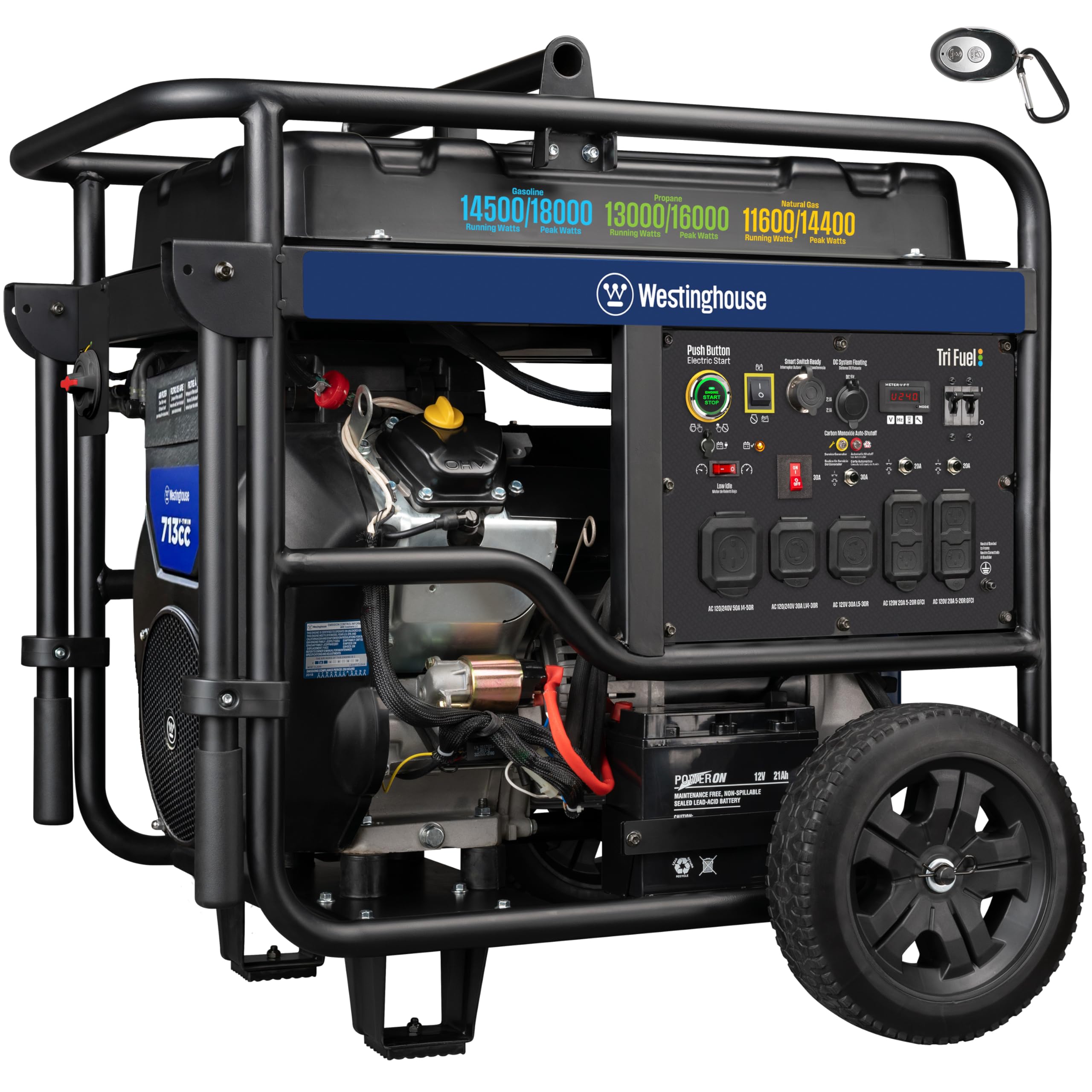
The Westinghouse WGen14500TFc delivers 18,000 peak watts on gasoline and 14,400 on natural gas, making it one of the most versatile tri-fuel portables on the market. Its 713cc Westinghouse V-Twin OHV engine provides the displacement needed to handle heavy startup loads from central AC units and well pumps without bogging down. The <5% total harmonic distortion means you can safely power sensitive electronics like computers and televisions directly from the generator.
Runtime reaches up to 16 hours at 25% load on its 10.5-gallon gas tank, and the dual fuel selector lets you switch between gasoline, propane, or natural gas in seconds. The remote electric start, CO sensor with automatic shutdown, and VFT data center displaying voltage, frequency, and lifetime hours add a layer of convenience and safety that few competitors match at this output level.
At 348 pounds, this is a heavy unit that requires the included wheel kit for mobility, and some users report needing to manually free a stuck fuel shutoff solenoid on the carburetor bowl for gasoline operation. The exhaust note is loud at 74 dBA, so ear protection and placement away from living areas are recommended. Overall, the combination of tri-fuel flexibility, clean power, and robust engine performance earns it the top spot.
Why it’s great
- Tri-fuel with remote start and CO sensor
- Sub-5% THD safe for electronics
- 16-hour runtime at 25% load
Good to know
- Heavy at 348 pounds; wheel kit required
- Loud operation at 74 dBA
- Minor fuel solenoid issue reported by some users
2. DuroMax XP15000HXT
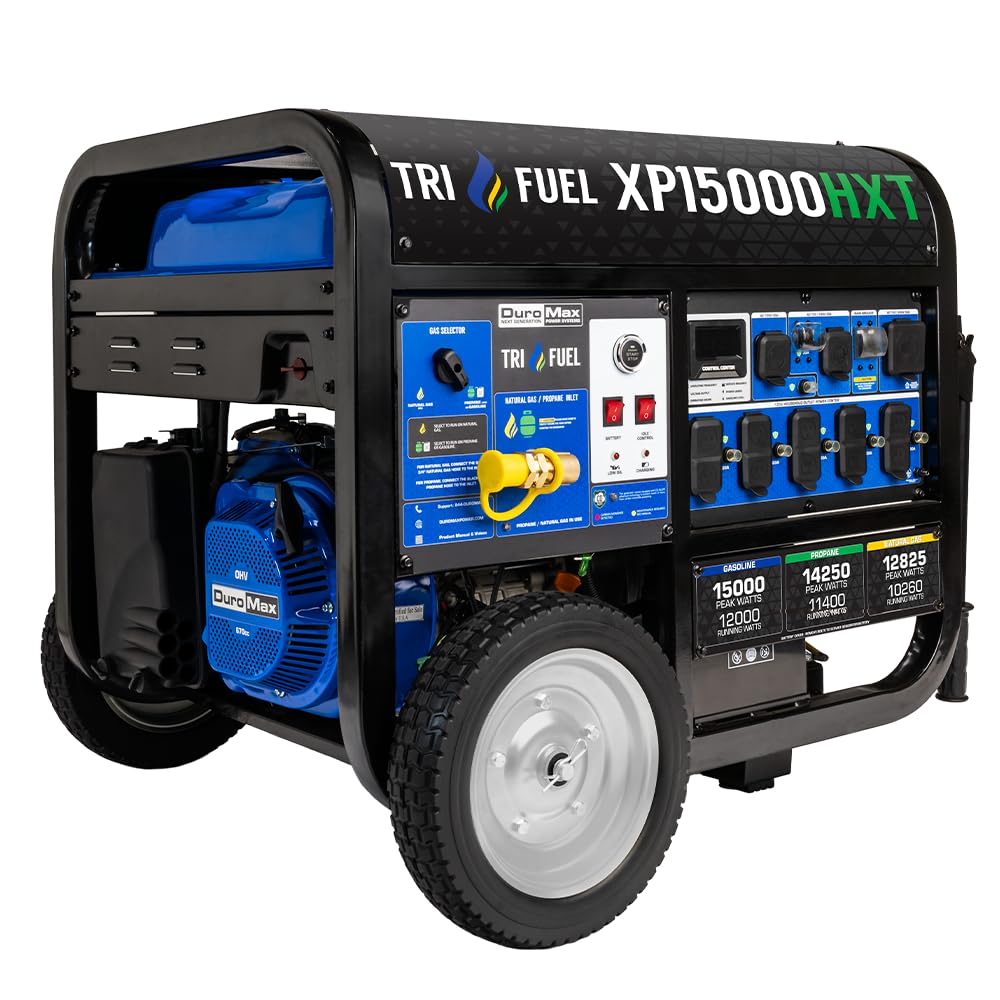
The DuroMax XP15000HXT produces 15,000 watts of peak power from its 670cc OHV engine, with tri-fuel capability running on gasoline, propane, or natural gas. The 100% copper windings offer superior heat dissipation compared to aluminum, contributing to longer generator life under sustained loads. The push button start and included remote key fob make startup convenient, and the front-facing interface lets you switch fuel types quickly without crouching behind the unit.
The power panel is fully loaded with a 50-amp heavy-duty outlet ready for transfer switch connection, plus 120/240V 30-amp twist lock and four GFCI 120V 20-amp outlets. The advanced computer interface with large LED display shows gas gauge, load gauge, voltage, frequency, and runtime at a glance. The CO Alert system automatically shuts down the generator when harmful carbon monoxide is detected, providing critical safety during operation.
Some users report that the unit struggles to deliver its full 15,000-watt claimed output without tripping breakers, though this varies by load type and starting surge requirements. The dimensions changed from previous XP15000 models, which may affect mounting in pre-existing setups. The included wheel kit and handle make it mobile, but at 400+ pounds, level ground is essential for safe movement.
Why it’s great
- Tri-fuel with remote start and CO Alert
- 100% copper windings for heat dissipation
- 50A outlet ready for transfer switch
Good to know
- Breaker tripping under full load reported
- Dimensions changed from prior models
- Very heavy; needs stable ground for movement
3. Generac Guardian 10kW

The Generac Guardian 10kW is a completely different category — an automatic standby generator that detects grid failure, starts itself, and transfers power to your home without any manual steps. It includes a 100-amp, 16-circuit transfer switch with a durable aluminum enclosure, and the system runs on natural gas or liquid propane, eliminating refueling hassles during extended outages. True Power Technology delivers clean electricity with under 5% harmonic distortion, protecting sensitive electronics.
The G-Force 400 series engine displaces 460cc and is purpose-built for standby generator duty, designed to start reliably after weeks or months of sitting idle. Mobile Link WiFi connectivity allows remote monitoring of generator status, maintenance alerts, and runtime history from anywhere via smartphone. The 5-year limited warranty and USA engineering and assembly reflect Generac’s commitment to quality in the home standby segment.
Installation is not DIY — a certified electrician must handle the transfer switch wiring and gas line connection, and the location must comply with clearance requirements for exhaust and noise. The 10kW output handles whole-house backup for most homes under 3,000 square feet, but larger homes with central AC or electric heat may need a higher-output model. Noise is comparable to a power mower outside, but interior sound levels remain comfortable.
Why it’s great
- Fully automatic standby with included transfer switch
- WiFi remote monitoring via Mobile Link
- 5-year warranty and USA engineering
Good to know
- Professional installation required by certified electrician
- 10kW may not cover large central AC or electric heat
- Location must meet clearance and noise requirements
4. EF ECOFLOW Delta Pro 3 + GE305
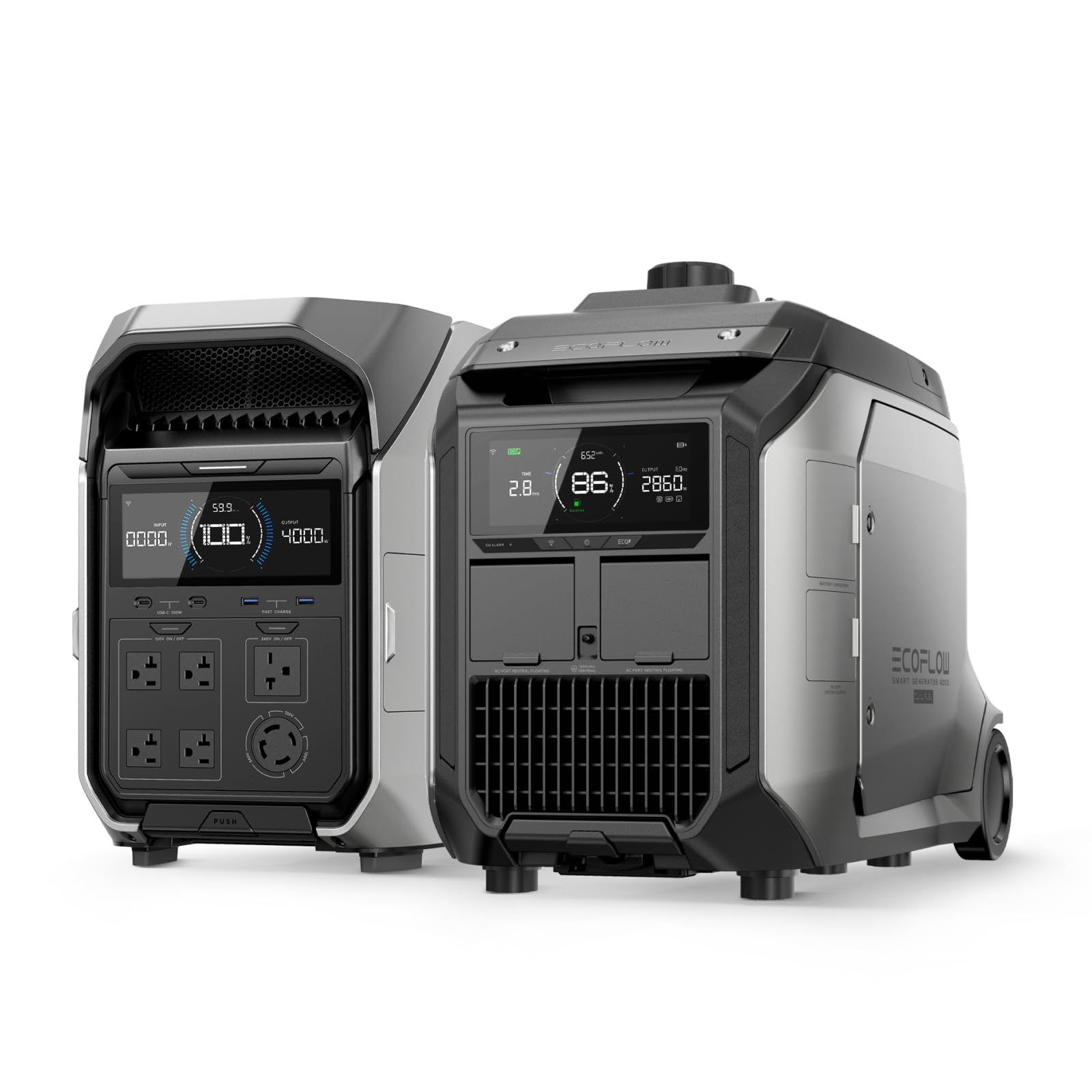
The EcoFlow Delta Pro 3 bundled with the GE305 Dual Fuel Generator creates a hybrid system that combines battery storage with backup generation for maximum flexibility. The Delta Pro 3 holds a 4096Wh LFP battery expandable to 48kWh, while the GE305 can run on gasoline or propane to recharge the battery automatically, providing virtually unlimited runtime during extended outages. This eliminates the noise and emissions of running a generator continuously — the GE305 only runs when the battery needs charging.
The system supports 7 unique and 18 combo charging methods including AC wall outlets, solar panels, EV charging piles, and gas generators. The EcoFlow app provides real-time alerts for CO concentration, temperature, and overload conditions, with automatic shutdown for safety. The smart generator produces 8kWh from a single gasoline tank, providing about 8 hours of runtime at 25% load before needing a refill.
This bundle is not CARB-approved and cannot be shipped to California. The generator portion weighs 83 pounds and is heavy to move despite wheels. Some users report initial WiFi/Bluetooth connection issues with the app, and the system represents a significant investment compared to standalone generators. When paired with solar panels, however, this setup offers the lowest long-term fuel cost of any option on this list.
Why it’s great
- Hybrid battery/generator system for silent nights
- Expandable to 48kWh capacity
- 18 combo charging methods including solar
Good to know
- Not CARB-approved; no California shipping
- Heavy components; generator is 83 lbs
- App connection issues reported
5. Jackery Solar Generator 5000 Plus

The Jackery Solar Generator 5000 Plus pairs a 5040Wh LFP battery power station with 500W of solar panels, offering 7200W of rated power (14,400W surge) supporting both 120V and 240V output. This is sufficient to run a 5-ton central AC or a water heater, making it one of the most capable all-in-one solar backup systems available. The LiFePO₄ cells with ChargeShield 2.0 technology are rated for up to 11 years of daily use, far exceeding the lifespan of typical portable generators.
Expandability is a key strength — the unit can scale up to 60kWh with additional batteries, providing up to 13 days of backup for essential circuits. Recharging via solar takes about 2 hours with up to 4000W input, and the Jackery 60A Smart Transfer Switch can power up to 12 circuits at 120V or 6 circuits at 240V. The unit is completely silent during battery operation, with zero emissions, making it safe for indoor use.
The 190.5-pound weight makes this far from portable despite wheels, and some users report F6 pass-through failure on the 30A circuit that requires firmware updates to resolve. The unit cannot function as a true UPS with a manual transfer switch, limiting its automatic failover capabilities. For users seeking pure solar backup with massive capacity and expandability, however, this system is hard to beat.
Why it’s great
- 5040Wh capacity expandable to 60kWh
- 7200W surge; runs 5-ton AC
- Silent, zero-emission operation
Good to know
- 190.5 lbs; heavy despite wheels
- Pass-through failure issue on 30A circuit
- Cannot serve as true UPS with manual switch
6. EF ECOFLOW Delta Pro 3 8kWh

The EcoFlow Delta Pro 3 with extra battery delivers 8kWh of total capacity with 4000W AC output (6000W with X-Boost, scalable to 12000W) supporting both 120V and 240V loads. This is enough to run a 3-ton central AC or a 1 HP water pump, and the 30 dB X-Quiet technology makes it virtually silent during operation — quiet enough to place beside a bed without disturbance. The 10 ms switch-over time provides instant backup for NAS systems, servers, and entertainment devices, functioning as a true UPS.
The automotive-grade LFP cells with IP65-rated CTC battery pack technology extend the battery lifespan significantly, backed by a 5-year warranty. The system supports 7 unique and 18 combo charging methods including AC wall outlets, solar panels, gas generators, and EV charging piles. The plug-and-play design requires no installation or maintenance, and the portable handle makes it easy to move between rooms or take on trips.
The main unit and extra battery ship in separate packages, which can cause confusion if one arrives before the other. The 188-pound total weight is substantial for moving up stairs, though wheels and a telescoping handle ease transport on flat surfaces. The app requires WiFi connectivity for remote control, which may be inconvenient during an outage when the home network is down.
Why it’s great
- 8kWh capacity with 30 dB silent operation
- 10 ms UPS-grade switch-over
- LFP cells with 5-year warranty
Good to know
- 188 lbs; heavy for stairs
- Battery ships in separate packages
- App requires WiFi for remote control
7. OSCAL PowerMax 6000
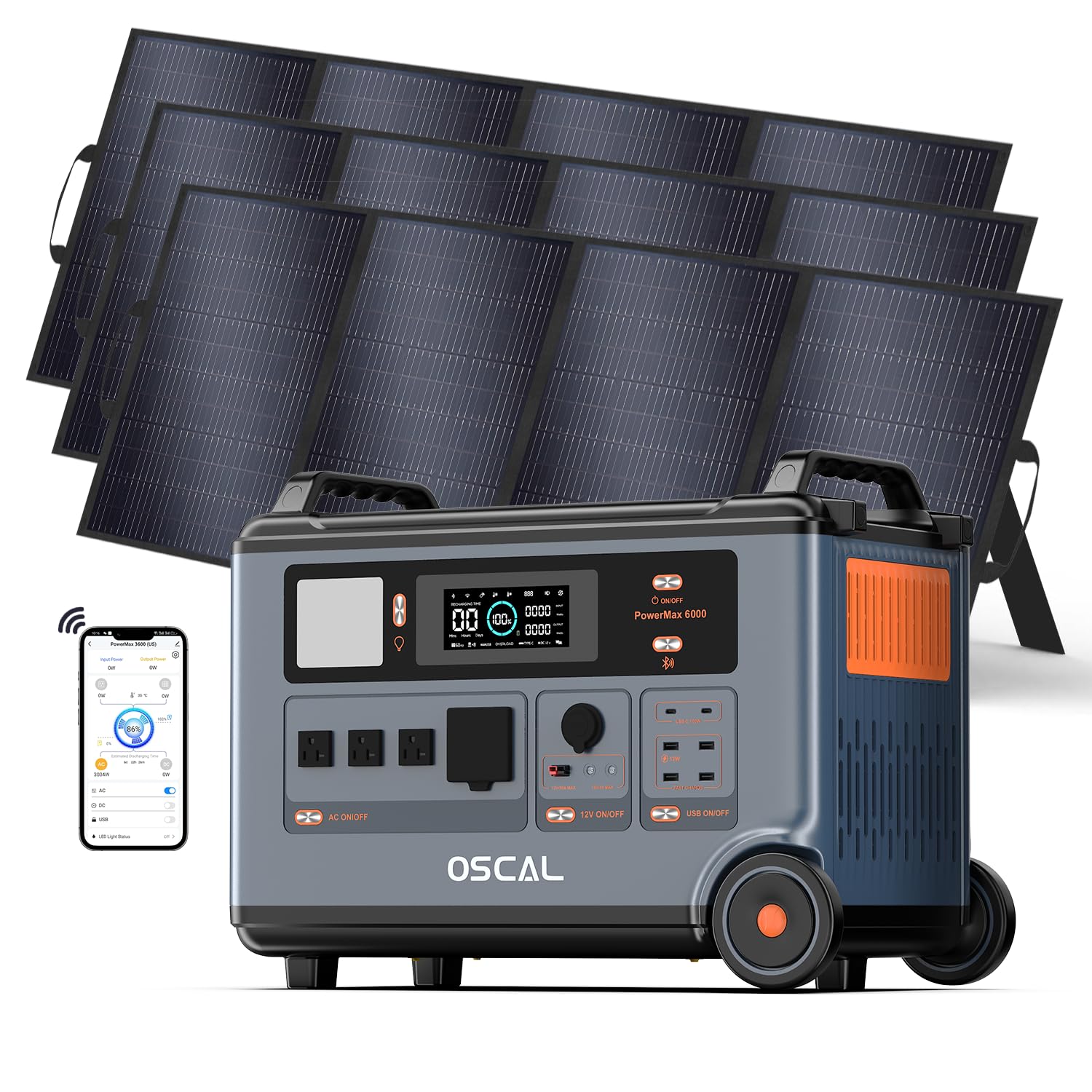
The OSCAL PowerMax 6000 provides 3600Wh of LFP battery capacity with 6000W AC output (9000W surge) supporting true 120V/240V split-phase voltage, making it compatible with standard US home electrical panels. The system includes three 400W solar panels, providing 1200W of total solar input for recharging. The 2200W bi-directional inverter enables fast AC charging from 0-100% in about 1.44 hours, while solar charging at 2400W replenishes the battery in roughly 1.5 hours of peak sun.
The EPS uninterruptible power supply automatically switches to battery within 5-8 ms during a power outage, keeping connected equipment running without interruption. The LFP battery is rated for up to 3500 charge/discharge cycles with an eight-layer BMS protecting against overcharge, over-discharge, and temperature fluctuations. The OSCAL app provides remote monitoring and control of power usage and system status.
Some users report that battery drain is faster than expected, with one reviewer observing a drop from 100% to 85% in two hours with a single LED bulb, which may indicate a calibration or standby draw issue. The unit cannot actually deliver its full 6000W output simultaneously, and the solar panel connection requires additional MC4 branch connectors for optimal parallel wiring. For users seeking a complete solar generator package with 240V output, however, this is a compelling value proposition.
Why it’s great
- 120/240V split-phase output
- Includes 3x400W solar panels
- 5-8 ms EPS switch-over
Good to know
- Faster battery drain than expected by some users
- Full 6000W output not achievable simultaneously
- Requires MC4 branch connectors for solar
FAQ
Can I run a 3 phase generator on single phase loads?
What size generator do I need for a whole house with central air conditioning?
How often should I change oil in a 3 phase portable generator?
Final Thoughts: The Verdict
For most users, the 3 phase electric generator winner is the Westinghouse WGen14500TFc because it combines tri-fuel flexibility, sub-5% THD for electronics, and 18,000 peak watts in a package with remote start and CO safety shutdown. If you want automatic whole-house protection with no manual intervention, grab the Generac Guardian 10kW. And for silent, zero-emission backup with solar recharging, nothing beats the Jackery Solar Generator 5000 Plus.