
An 85-inch Mini LED TV sits at a unique intersection of home cinema ambition and real-world practicality: it delivers the deep black levels and punchy highlights that once required an OLED, but at a size and brightness that keeps a living room functional during daytime sports viewing. The technology uses thousands of tiny backlighting LEDs behind the LCD panel, each one dimmable independently, to produce the high contrast that makes HDR content truly pop. The result is a screen that handles both a sunlit afternoon game and a dark, moody sci-fi movie without compromise.
I’m Min — the co-founder and writer behind Gadgets Feed. I’ve spent hundreds of hours analyzing the technical specifications, local dimming zone counts, peak brightness measurements, and native refresh rates across the current generation of Mini LED panels so you don’t have to separate marketing claims from meaningful engineering.
No matter your room’s lighting conditions or your preferred content library, the right 85 inch mini led tv will deliver contrast ratios that rival emissive displays while maintaining the brightness and longevity that plasma and OLED buyers have long envied from afar.
How To Choose The Best 85 Inch Mini LED TV
Navigating Mini LED tiers requires more than comparing resolution stickers. The real differentiators live in dimming zone density, processor capability, refresh rate ceiling, and panel coating. Below are the three specifications that define whether a set feels premium or merely adequate in daily use.
Local Dimming Zone Density
Zone count determines how precisely the TV can light an object while keeping its background black. Entry-level Mini LED panels may carry fewer than 300 zones, which produces noticeable blooming around subtitles and bright scene elements. Premium models with 1500 to 3000 zones deliver the per-pixel-like control that makes Mini LED competitive with OLED. Two models with identical peak brightness can look completely different in a dark room if one has three times the zone count.
Native Refresh Rate and Gaming Features
Standard 120Hz panels handle console gaming and sports smoothly. The latest generation pushes to 144Hz or 165Hz native, which reduces motion blur further and unlocks compatibility with high-frame-rate PC gaming. Variable refresh rate (VRR), Auto Low Latency Mode (ALLM), and FreeSync Premium Pro certification are equally important for tear-free, responsive gameplay. If you connect a current-gen console or a gaming PC, prioritize a set with at least 144Hz capability and certified VRR support.
Anti-Glare and Viewing Angle
Mini LED panels can achieve very high brightness, but that advantage disappears if a glossy screen turns your window into a permanent reflection. Look for sets with dedicated anti-reflective layers or matte finishes if the TV faces windows or bright overhead lights. Viewing angle is another hidden spec — many VA-based Mini LED panels shift contrast and color when you sit off-center. Premium models incorporate wide-angle films to preserve image fidelity for side-seating in larger rooms.
Quick Comparison
On smaller screens, swipe sideways to see the full table.
| Model | Category | Best For | Key Spec | Amazon |
|---|---|---|---|---|
| Sony BRAVIA 7 K-85XR70 | Mini LED QLED | Upscaling & PS5 | XR Backlight Master Drive | Amazon |
| Hisense 85U7SG | Mini LED ULED | Gaming Bright Room | Native 165Hz / 3000 zones | Amazon |
| TCL 85QM8K | QD-Mini LED | Halo-Free Dark Room | Game Accelerator 288 VRR | Amazon |
| Samsung QN90D | Neo QLED | Object Tracking Sound | NQ4 AI Gen2 / 144Hz | Amazon |
| Amazon Ember 85 | Mini LED QLED | Alexa Integration | 512 zones / 144Hz | Amazon |
| LG QNED85A 100″ | QNED evo Mini LED | Massive Screen Cinema | Alpha 8 AI / 144Hz VRR | Amazon |
| Sony BRAVIA 3 II K-85XR30M2 | LED Smart TV | Sony Ecosystem Value | XR Processor / 120Hz | Amazon |
| Hisense 100U6SF Pro | Mini LED ULED | 100-Inch Budget | 144Hz / Built-in Subwoofer | Amazon |
| Sony BRAVIA 5 K-98XR50 | Mini LED 4K | Reference Image Quality | XR Backlight Master Drive | Amazon |
| Samsung QN90F 98″ | Neo QLED Mini LED | Ultimate Glare Free | 128 Neural Networks / 165Hz | Amazon |
In‑Depth Reviews
1. Sony BRAVIA 7 85 Inch Mini LED QLED (K-85XR70)

The Sony BRAVIA 7 is the gold standard for this class because its XR Backlight Master Drive manages thousands of individual Mini LEDs with the same precision that Sony applies to its professional monitors. The result is blooming so minimal that even in a pitch-black room, white subtitles on a black background stay crisp without the hazy halo that plagues lower-zone-count competitors. The XR Triluminos Pro color reproduction hits over a billion shades with a naturalism that makes skin tones look alive rather than oversaturated, and the upscaling engine turns 1080p cable broadcasts and streaming content into something approaching native 4K detail.
PlayStation 5 owners get exclusive Auto HDR Tone Mapping and Auto Genre Picture Mode that synchronize console output directly with the TV’s processing pipeline, eliminating the manual calibration dance. The Acoustic Multi-Audio system uses actuators behind the screen to place dialogue sound precisely at the on-screen speaker’s mouth position. Motion handling is superb for sports — the 120Hz native panel clears fast-moving objects like a soccer ball without judder, and the XR Motion Clarity algorithm avoids the soap-opera effect that cheaper interpolation introduces. The Google TV interface with Gemini voice support feels snappy and organizes content across subscriptions intelligently.
Some users note that the viewing angle narrows compared to IPS-based alternatives, and the lack of an aggressive anti-reflective coating means direct window light can wash out darker scenes if you sit square-on. The built-in speakers are adequate for casual watching but lack the deep bass that justifies skipping a soundbar. The BRAVIA 7 occupies the premium tier for a reason — the engineering investment in backlight control and processing is visible frame-by-frame.
Why it’s great
- XR Backlight Master Drive delivers near-OLED black levels with minimal blooming
- Best-in-class upscaling transforms 1080p and streaming content into sharp 4K
- PS5 integration with Auto HDR Tone Mapping removes setup guesswork
Good to know
- Viewing angle narrows noticeably beyond 30 degrees off-center
- Glossy screen finish reflects bright windows without dedicated anti-glare coating
2. Hisense 85U7SG Mini-LED ULED 4K (2026)
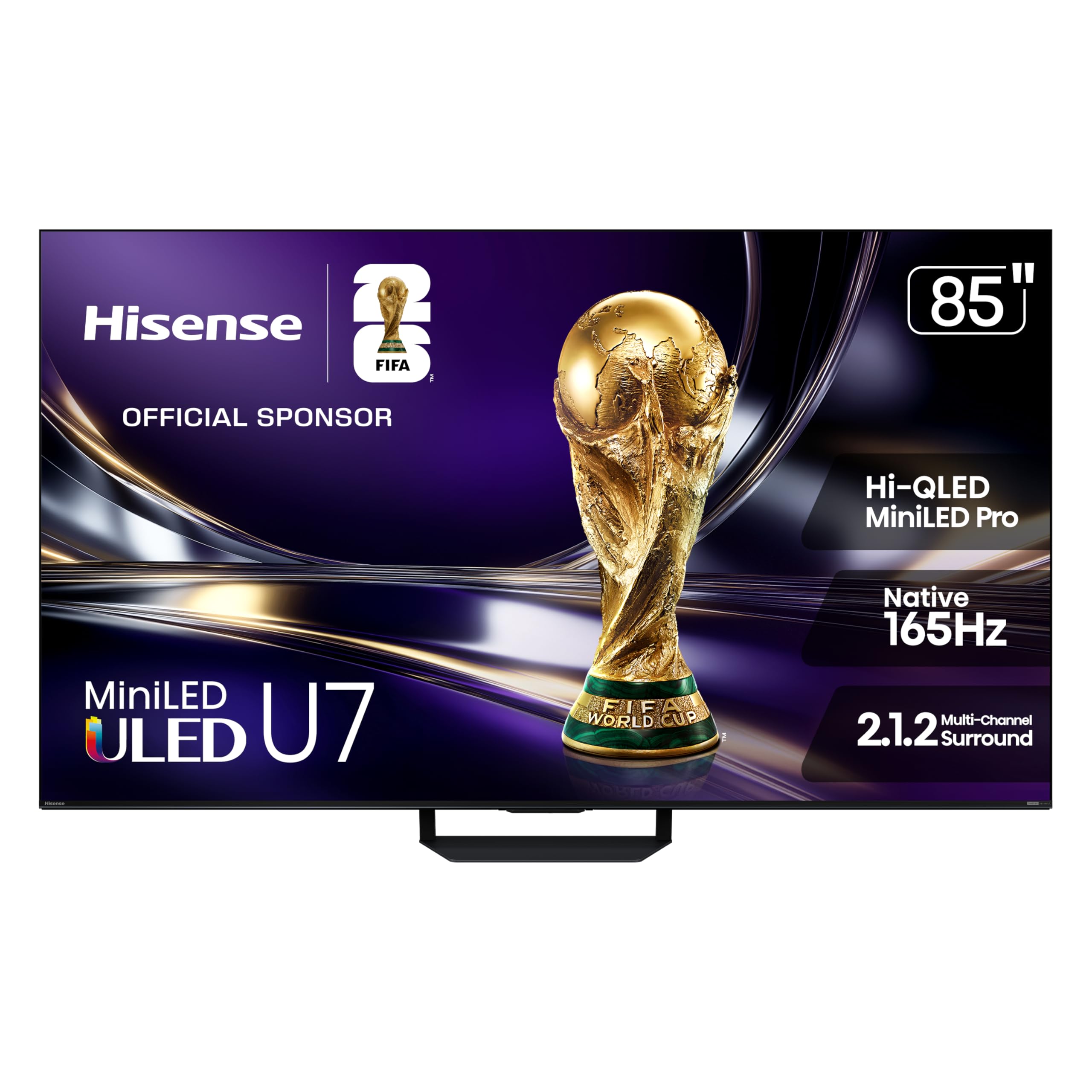
Hisense packed the 85U7SG with specifications that read like a wish list for the bargain-hunting cinephile. The native 165Hz refresh rate is the highest in this roundup, and combined with a VRR ceiling of 330Hz, it delivers fluid motion for competitive PC gaming at frame rates that most 120Hz panels cannot touch. The claimed 3000 local dimming zones — among the highest zone counts at this price tier — create contrast that handles specular highlights like explosions and polished metal reflections without washing out adjacent shadow areas. Peak brightness reaches approximately 3000 nits, which is enough to make Dolby Vision content look punchy even in a sun-drenched living room.
Hi-QLED Pro color with Pantone validation means the panel reproduces industry-standard color accuracy out of the box. Sports fans will appreciate the anti-reflection and glare-free layer, which maintains image integrity under overhead lighting or bright windows. The 2.1.2 channel audio system produces more spatial presence than most built-in TV speakers, and Wi-Fi 6E support keeps 4K streaming stable without buffering. Google TV with Gemini runs responsively, and the Filmmaker Mode disables all post-processing for purists who want the director’s intended frame rate and color timing.
Hisense’s quality control can be inconsistent across units — some owners report minor uniformity issues like DSE (dirty screen effect) on solid-color panning shots. The onboard processor, while capable, does not match Sony’s XR chip for low-bitrate content cleanup, so highly compressed streams may show macroblocking. The stand is wide and requires a substantial media console. For the price, however, the zone count and refresh rate combination is unmatched in this class.
Why it’s great
- Native 165Hz refresh rate with 330Hz VRR for competitive PC gaming
- High zone count delivers deep contrast with minimal blooming
- Anti-glare coating maintains picture clarity in bright rooms
Good to know
- Processor struggles with heavy compression artifacts from low-bitrate sources
- Panel uniformity can vary between individual units
3. TCL 85 Inch QM8K Series Mini LED QLED (85QM8K)
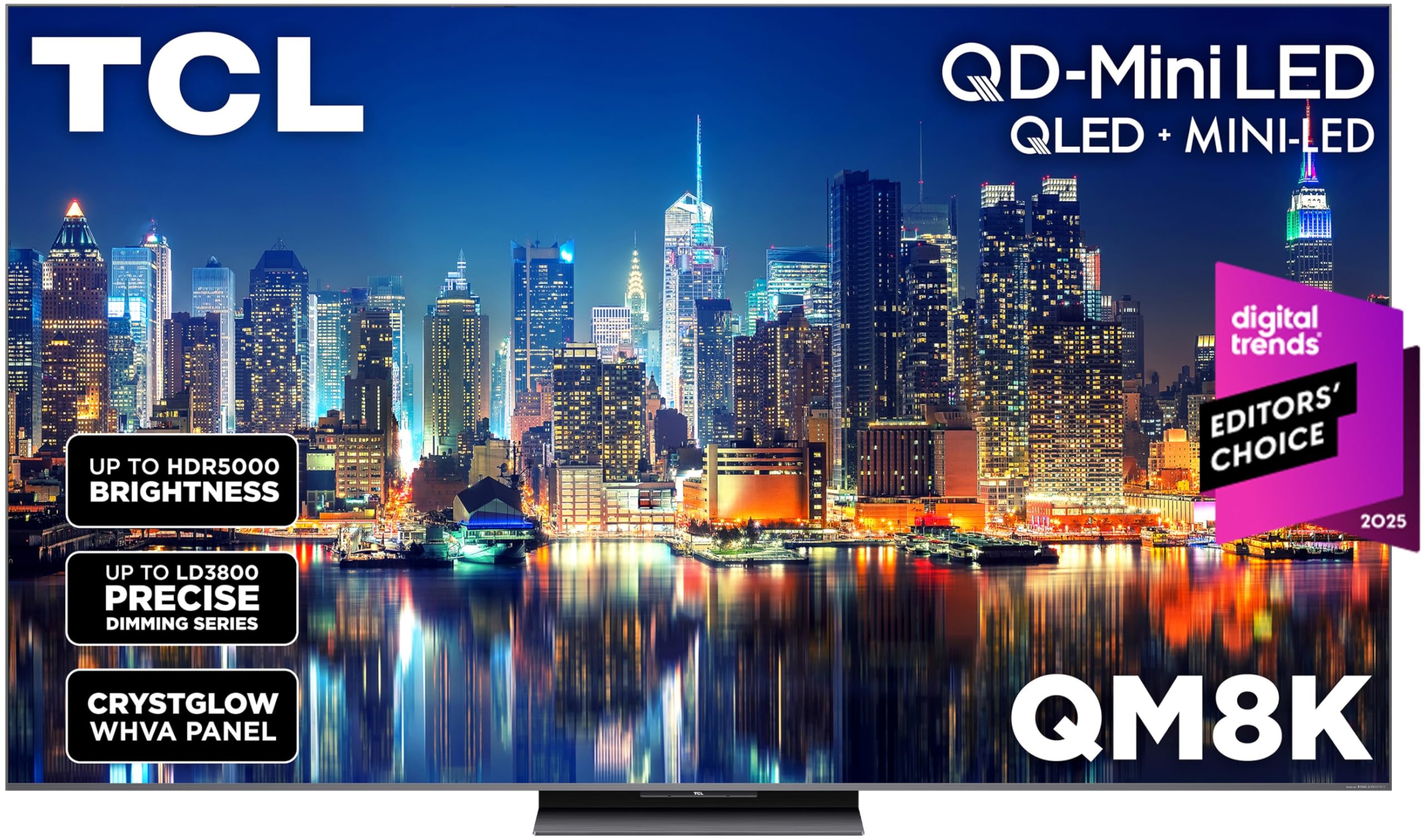
TCL’s QM8K series leverages the Halo Control System, a suite that combines a high-energy LED microchip with condensed micro lenses and bi-directional 23-bit backlight control. The practical effect is that the 85QM8K produces exceptionally clean images with virtually no halo artifacts around bright objects — a feat that places it above many competitors that cost several hundred dollars more. The CrystGlow WHVA panel includes an anti-reflective layer that cuts glare effectively, and the edge-to-edge ZeroBorder bezel makes the screen feel larger than its physical dimensions suggest. Peak brightness reaches around 5000 nits in small highlights, which gives HDR content explosive specular energy.
Gamers will appreciate the Game Accelerator 288, which supports VRR up to 288Hz, making this one of the few sets that can keep up with high-end PC frame rates. The native 144Hz panel handles console gaming at 120Hz without issue, and ALLM kicks in automatically when a game signal is detected. Bang & Olufsen audio tuning provides clear dialogue and respectable bass for built-in speakers. Google TV with hands-free voice control and the backlit premium remote make navigation fast. The Filmmaker Mode is accurate enough for critical viewing without needing immediate calibration.
Some users have reported that the Hulu app has slow menu navigation and occasional audio sync issues, though other streaming apps function normally. The viewing angle is decent but not class-leading — colors shift slightly when you move past 30 degrees off-center. The included stand feet are wide and may not fit all media console depths. The QM8K is a serious contender for buyers who want near-flagship zone control without flagship pricing.
Why it’s great
- Halo Control System eliminates blooming around bright objects
- 288Hz VRR support for ultra-smooth PC gaming
- 5000-nit peak brightness makes HDR highlights pop
Good to know
- Hulu app has reported navigation lag and audio sync issues
- Wide stand feet require a large media console
4. Samsung 85-Inch Neo QLED QN90D (2024)

Samsung’s QN90D uses Quantum Matrix technology with Mini LEDs to deliver the brand’s signature vibrant color saturation and high brightness levels that work well in showroom-like living spaces. The NQ4 AI Gen2 processor handles upscaling with 20 dedicated neural networks, analyzing content frame by frame to add texture and sharpness. Neo Quantum HDR+ pushes highlights into the 1500-nit range while maintaining shadow detail. The Motion Xcelerator 144Hz ensures smooth panning in fast-moving sports, and the Real Depth Enhancer Pro adds a sense of dimensionality to foreground objects by adjusting contrast around the focal point of each scene.
The standout feature is Object Tracking Sound+ with Dolby Atmos. The built-in speakers create a soundstage that follows on-screen action — when a car crosses the screen, the audio pans from left to right convincingly. This eliminates the immediate need for a soundbar for many viewers. The Tizen OS is fast and logically organized, with Alexa built-in for voice control. The Ultra Viewing Angle layer keeps color and contrast stable even for viewers seated at the edges of a wide sectional. The 4K 120Hz gaming pipeline supports VRR and ALLM for console gaming.
Reflections are handled well but not completely eliminated — the glossy finish still shows window outlines in bright sunlight. The AI upscaling can introduce artifacts on very old 4:3 content, making it look artificially processed. Samsung’s ecosystem pushes account sign-up during initial setup, which some users find annoying. The pedestal stand is stable but leaves the TV feeling slightly high off the media console.
Why it’s great
- Object Tracking Sound+ creates an immersive audio experience solo
- Ultra Viewing Angle maintains contrast and color from side seats
- AI upscaling adds detail to HD and streaming content
Good to know
- Glossy screen still catches reflections in very bright rooms
- Samsung account requirement during setup can be intrusive
5. Amazon Ember 85 Mini-LED Series with Fire TV (2026)
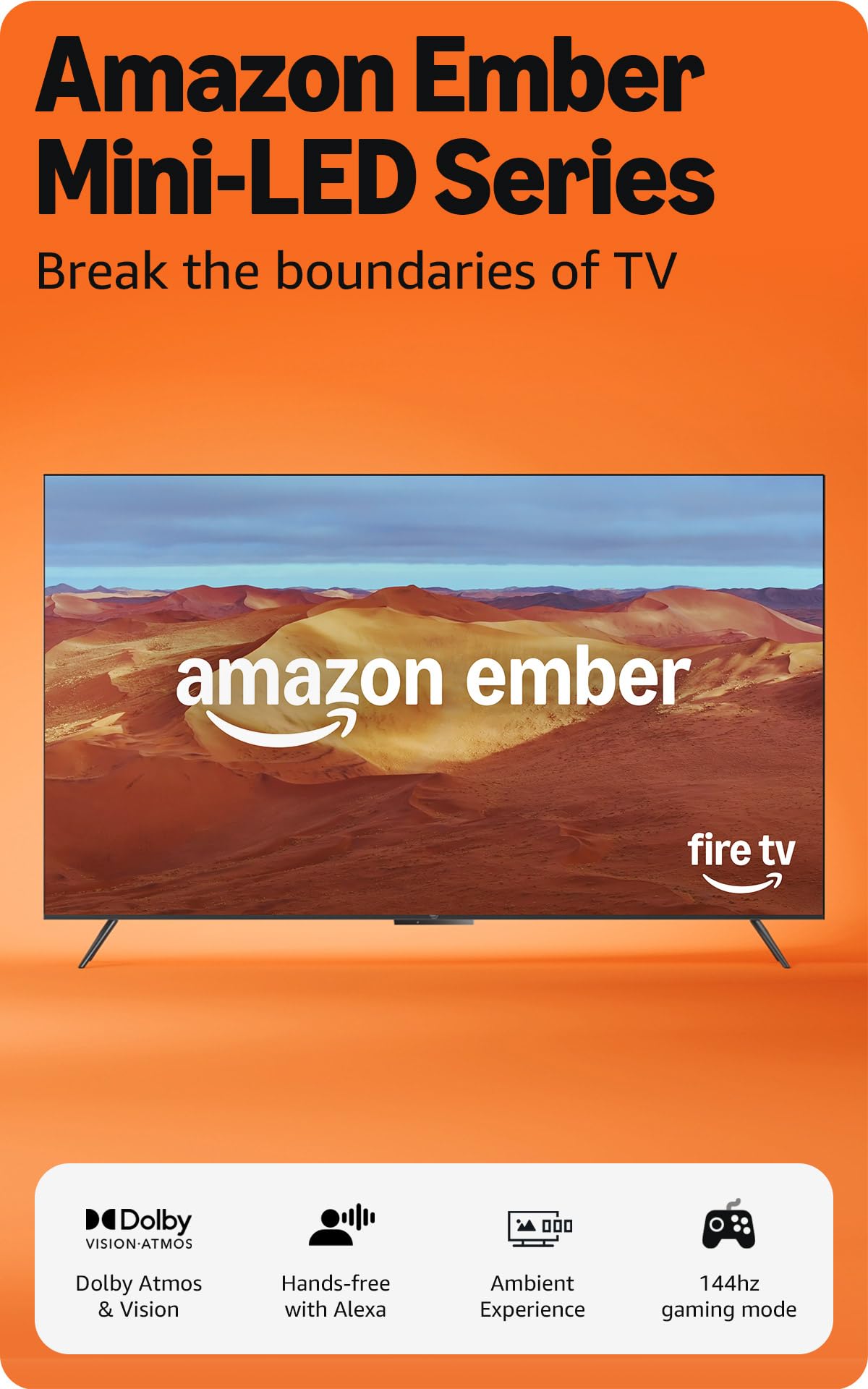
Amazon’s Ember 85 integrates deeply with the Alexa ecosystem in ways no other TV matches. The new Fire TV experience (2026 release) with Alexa+ allows natural language search across subscriptions, smart home device control, and hands-free operation — even with the screen off. The QLED Mini LED panel with 512 dimming zones delivers contrast that approaches OLED in dark scenes, and the peak brightness of 1400 nits handles HDR10+ Adaptive content effectively. The 144Hz native refresh rate with AMD FreeSync Premium Pro certification ensures tear-free gaming at high frame rates, making this Amazon’s best gaming TV to date.
The built-in 2.1 Dolby Atmos audio system includes a subwoofer that produces surprising low-end presence for a flat panel. The Omnisense technology wakes the display when you enter the room, turning the black screen into ambient artwork or a live information dashboard. Fire TV Intelligent Picture adjusts brightness and color temperature to room lighting conditions automatically. The promise of no remote needed — with wake-word activation and sensor-based display wake — changes the daily interaction pattern significantly for households committed to the Amazon ecosystem.
Some users report that the processor feels underpowered after major software updates, causing the Fire TV interface to lag significantly — a problem some solve by adding an external Fire Stick 4K Max. The home screen is dense with Amazon advertising and recommendations, which can feel invasive to users accustomed to clean Android TV or webOS interfaces. Random reboots have been reported during streaming sessions. The Ember 85 offers tremendous value when on sale, but the software experience is more uneven than competing platforms.
Why it’s great
- Deep Alexa+ integration with hands-free voice control and room sensors
- 144Hz FreeSync Premium Pro gaming for tear-free high-frame-rate play
- Built-in subwoofer delivers impressive bass for a flat panel design
Good to know
- Fire TV interface can lag after major software updates
- Home screen includes heavy Amazon advertising and recommended content
6. LG 100-Inch QNED evo AI QNED85A (2025)
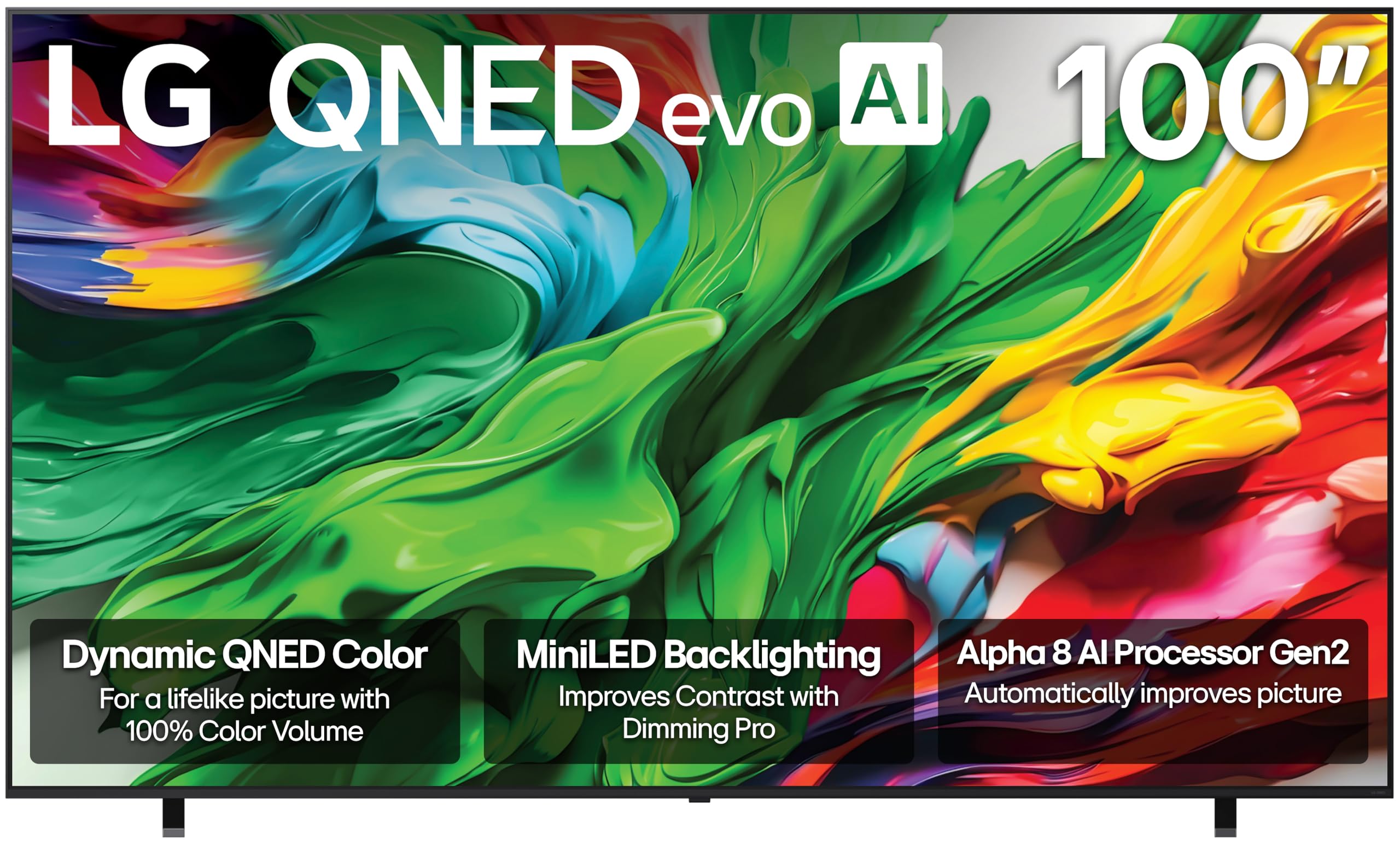
LG’s 100-inch QNED85A pushes into a size category that was once reserved for projectors. The Alpha 8 AI Processor Gen2 analyzes content in real time to optimize brightness, contrast, and color temperature, and the Precision Dimming system controls the Mini LED array to maintain black depth across the massive canvas. Dynamic QNED Color delivers 100% color volume — meaning the panel maintains its color saturation even at high brightness levels, which is crucial for a screen this large in a room with ambient light. HDR10 Pro enhances color gradation for a more three-dimensional image.
The 120Hz native refresh rate with VRR up to 144Hz covers current-gen console gaming comfortably, and the Game Optimizer puts all gaming settings in one unified panel. Filmmaker Mode preserves the original frame rate and color timing, which is important for movie purists on a screen this size. The webOS interface remains one of the cleanest smart TV platforms, and the adjustable stand width accommodates different media console sizes. The LG also supports Wow Orchestra, syncing the TV speakers with a compatible LG soundbar for a unified soundstage.
Some users find the included remote frustrating — it lacks a dedicated mute button and a number pad, and the pointer-style cursor can be less precise than a traditional directional pad. The TV occasionally defaults back to internal speakers after a power cycle, requiring manual re-selection of external audio output. The 100-inch panel is extremely heavy and requires professional installation in most homes. The QNED85A is an excellent choice for buyers who want a true cinema-scale experience without the installation complexity of a projector and separate screen.
Why it’s great
- 100-inch screen delivers a true cinema-scale experience without a projector
- 100% color volume maintains saturation at high brightness levels
- webOS interface is clean, fast, and well-organized
Good to know
- Remote control lacks a mute button and number pad
- Extremely heavy panel requires professional installation and a sturdy wall mount
7. Sony BRAVIA 3 II 85 Inch (K-85XR30M2, 2026)
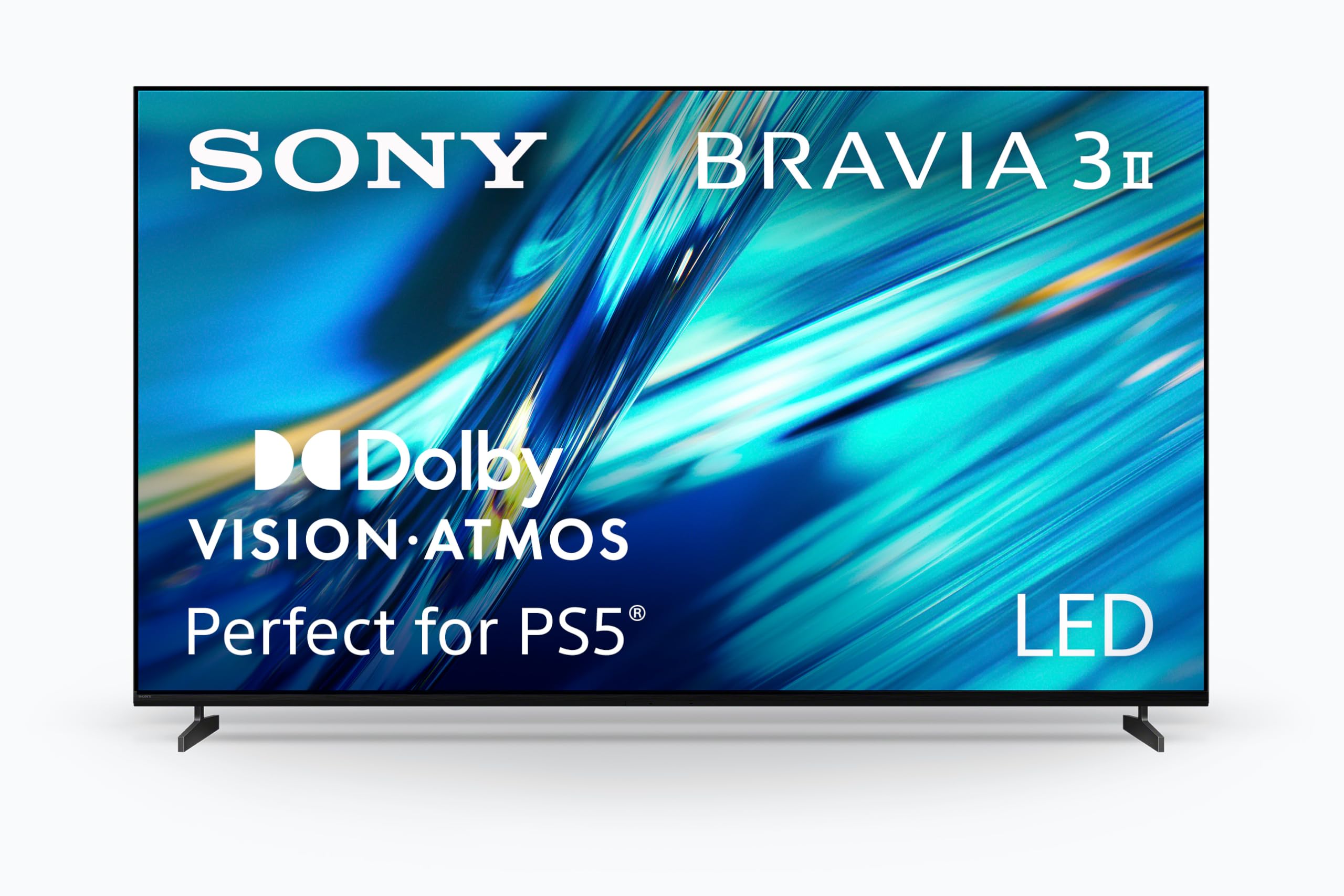
The Sony BRAVIA 3 II represents the portal into the Sony ecosystem at a lower cost. The XR Processor with AI scene recognition optimizes color, contrast, and clarity in real time, and XR Clear Image uses AI to restore lost detail and reduce noise from compressed content. While this model uses a standard LED backlight rather than a full Mini LED array, the XR Triluminos Pro color engine still produces vibrant, natural-looking skin tones. The 120Hz panel with Motionflow XR keeps fast sports and action clear, and Dolby Vision and Atmos support ensures compatibility with the latest streaming HDR formats.
PS5 integration includes Auto HDR Tone Mapping and Auto Genre Picture Mode, making this the most affordable Sony TV that fully connects with the PlayStation 5 ecosystem. Google TV with Gemini provides responsive voice search and content discovery across 700,000 movies and TV episodes. The X-Balanced speakers deliver deeper bass than typical slim TV speakers. The set includes 5 movie credits for Sony Pictures Core and 12 months of streaming access to classics. Setup is straightforward — users report 40 minutes from unboxing to watching.
Without Mini LED backlighting, the BRAVIA 3 II cannot match the black levels or zone-controlled contrast of the other sets in this comparison. Blooming around bright objects in dark scenes will be noticeable to viewers coming from an OLED or a high-zone Mini LED panel. Some users have reported persistent software issues with casting and DRM that required return or replacement. The low entry price makes this a good option for buyers who prioritize Sony processing and PS5 features over absolute contrast performance.
Why it’s great
- XR Processor provides excellent upscaling and motion handling
- Full PS5 integration with Auto HDR Tone Mapping
- Sony Pictures Core credits and streaming subscription included
Good to know
- Standard LED backlight cannot match Mini LED zone control or black levels
- Some units have experienced persistent software and casting issues
8. Hisense 100U6SF Pro Mini-LED ULED (2026)
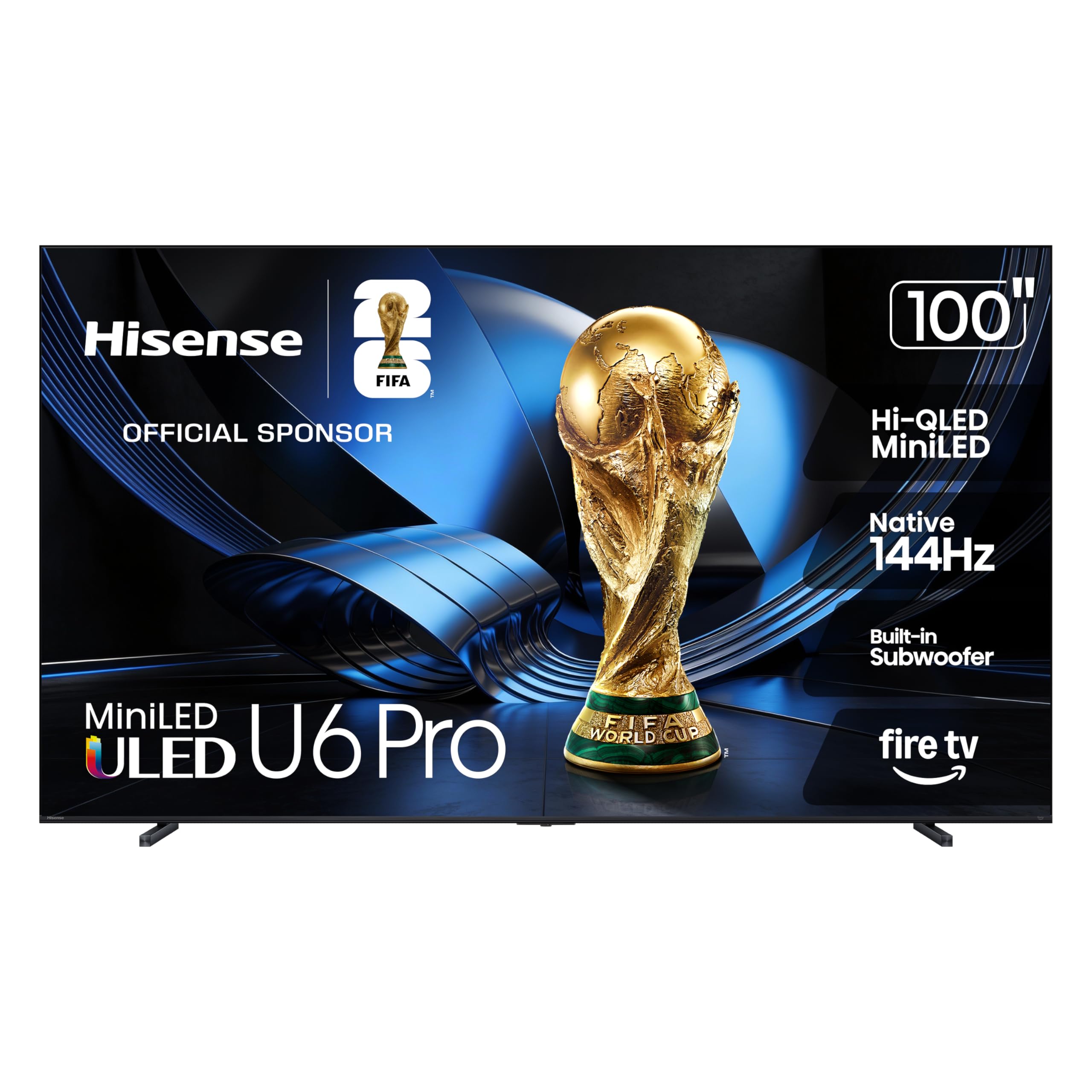
The Hisense 100U6SF Pro brings a 100-inch Mini LED panel to a budget tier price point. The native 144Hz refresh rate handles fast-paced gaming, and the built-in subwoofer provides substantial low-end audio presence that eliminates the immediate need for external speakers for many viewers. The Hi-QLED Mini LED backlighting with Hi-View AI Engine adjusts picture parameters dynamically based on content type — optimizing contrast for movies, brightness for sports, and response time for gaming. The anti-glare coating is effective enough to use in brightly lit rooms without frustrating reflections.
The Fire TV operating system integrates Alexa+ for voice search and smart home control. The Total HDR solution supports Dolby Vision IQ, HDR10+ Adaptive, HDR10, and HLG, ensuring compatibility across all major HDR formats. The Filmmaker Mode is available for purists, bypassing motion smoothing and dynamic contrast. The unibody slim design and edge-to-edge display create a clean, modern look. Owners consistently report the set delivers crisp, bright images with excellent contrast that punches above its price point, and the 100-inch size provides an immersive experience that 85 inches can’t match.
The Fire TV interface, while functional in Amazon households, is less polished than Google TV or webOS. The processor’s upscaling for low-bitrate content is mediocre — highly compressed streams can appear blocky and soft. The remote control feels cheap and lacks backlighting. Some users have noted that out-of-the-box color settings require manual calibration to avoid overly cool or cyan-tinted skin tones. The 100-inch size presents logistical challenges: it will not fit in many elevators or stairways, so delivery requires careful pre-measurement.
Why it’s great
- 100-inch Mini LED panel at a price that undercuts most 85-inch competitors
- Built-in subwoofer provides usable bass without external speakers
- 144Hz native refresh rate supports smooth gaming frame rates
Good to know
- Upscaling quality for low-bitrate content is noticeably weaker than Sony or Samsung
- 100-inch size may not fit in standard elevators or stairwells
9. Sony BRAVIA 5 98 Inch Mini LED (K-98XR50)

The Sony BRAVIA 5 is the reference for what Mini LED technology can achieve when price is a secondary constraint. The XR Backlight Master Drive controls thousands of Mini LEDs with the same precision as Sony’s professional mastering monitors, producing blacks that are functionally indistinguishable from OLED in most content. The XR Processor with AI technology enhances every scene in real time, boosting color, contrast, and clarity. Dolby Vision and Atmos support, combined with IMAX Enhanced and DTS:X, make this a complete home cinema solution. The XR Triluminos Pro delivers billions of accurate real-world colors.
Google TV runs buttery smooth, and the inclusion of 5 Sony Pictures Core credits with access to the largest IMAX Enhanced collection adds ongoing value. Studio calibrated picture modes for Netflix, Prime Video, and Sony Pictures Core ensure that streaming content looks as close to the mastering suite as possible. The 120Hz panel with XR Motion Clarity eliminates blur in fast sports and action without introducing the soap-opera effect. PS5 integration with Auto HDR Tone Mapping is as seamless as the BRAVIA 7, but at a larger scale. The 98-inch screen transforms a home theater room into a true cinema space.
The viewing angle is narrower than OLED or IPS alternatives, and the glossy screen finish reflects direct light sources. Only two of the four HDMI ports support HDMI 2.1 bandwidth, which could be limiting for setups with multiple next-gen consoles and a soundbar. The set requires professional installation — 98 inches of TV is extremely heavy and will not fit through standard residential doorways in many homes. For buyers seeking the closest thing to a reference monitor in a living-room-friendly format, the BRAVIA 5 is the definitive choice.
Why it’s great
- XR Backlight Master Drive delivers OLED-like black levels at a 98-inch scale
- Studio calibrated picture modes match the director’s mastering intent
- IMAX Enhanced and Sony Pictures Core provide ongoing cinema-quality content access
Good to know
- Only two HDMI 2.1 ports limit multi-console setups
- Glossy screen reflects bright light sources directly
10. Samsung 98-Inch Neo QLED QN90F (2025)

The Samsung QN90F sits at the absolute top of the Mini LED hierarchy with 128 neural networks powering its NQ4 AI Gen2 processor. This processing horsepower translates to scene-by-scene optimization that adjusts brightness, color mapping, and motion interpolation with a level of granularity no other TV in this class matches. The Neo Quantum HDR+ technology produces spectacular brightness and deeper contrast, and the Glare Free screen is the most effective anti-reflective coating in this roundup — it diffuses direct sunlight and overhead lamps so effectively that the image remains visible and colorful even in extreme lighting. The 4K 165Hz VRR gaming pipeline with FreeSync Premium Pro is the fastest available on any TV at this size.
Vision AI integration uses the processor to detect content types and automatically apply the optimal picture mode. Object Tracking Sound+ with Dolby Atmos creates a 3D audio bubble that follows on-screen movement convincingly enough that many buyers may skip a dedicated sound system. The AI upscaling transforms HD and even SD content into sharp 4K with minimal artifacts. The Samsung Gaming Hub consolidates cloud gaming services and local console input into a single interface. The build quality is exceptional — the Titan Black chassis feels rigid and premium, and the minimalist remote with built-in Alexa is a joy to use once you adapt to its layout.
The price is extremely high, positioning the QN90F as a luxury purchase for buyers who want the absolute best available. The built-in audio, while impressive for a TV, still cannot match a proper multi-channel soundbar system for cinematic bass and channel separation. The pedestal base is wobbly on the 98-inch version, and some users have reported occasional audio dropouts that require a power cycle to resolve. For buyers who prioritize anti-glare performance, raw processing power, and the largest available screen sizes, the QN90F represents the current ceiling of consumer Mini LED technology.
Why it’s great
- 128 AI neural networks deliver the most sophisticated real-time image processing available
- Glare Free coating eliminates reflections better than any competitor
- 165Hz VRR gaming pipeline with FreeSync Premium Pro is the fastest at this size
Good to know
- Premium price puts it in luxury goods territory
- Pedestal base feels wobbly on the 98-inch model
FAQ
How many local dimming zones do I need for an 85-inch Mini LED TV?
Does Mini LED suffer from burn-in like OLED?
What is the real-world difference between 120Hz and 144Hz for gaming?
Can I wall-mount an 85-inch Mini LED TV by myself?
Final Thoughts: The Verdict
For most users, the 85 inch mini led tv winner is the Sony BRAVIA 7 K-85XR70 because its XR Backlight Master Drive, reference-quality upscaling, and seamless PS5 integration deliver a complete premium experience at a reasonable price. If you want the highest native refresh rate and zone count for bright-room gaming, grab the Hisense 85U7SG. And for uncompromising cinema-scale performance with OLED-competitive black levels on a 98-inch canvas, nothing beats the Sony BRAVIA 5 K-98XR50.