
A dead internet connection costs your business more than just a slow morning. For companies relying on cloud apps, real-time payments, or remote field teams, the difference between a stable 5G failover and a failed cellular handoff is measured in lost revenue and frustrated customers. Choosing the right router means evaluating dual-SIM failover speed, VPN throughput, and bandwidth management for simultaneous users.
I’m Min — the co-founder and writer behind Gadgets Feed. I’ve spent hundreds of hours analyzing cellular router specifications, comparing carrier certification lists, and studying real-world signal performance metrics to separate marketing claims from actual business-grade reliability.
This guide breaks down the top performers by wired capacity, cellular modem quality, and enterprise security features so you can find the best 5g router for business that matches your deployment scenario.
How To Choose The Best 5G Router For Business
Business 5G routers differ from home models in carrier certification, wired backbone capacity, and the ability to maintain uptime through cellular failover. The three criteria below separate a temporary hotspot solution from a permanent corporate internet gateway.
Dual-SIM Failover vs. Load Balancing
Not all dual-SIM implementations are identical. Many routers support automatic failover: if the primary SIM loses signal, the device switches to a secondary carrier. More advanced units offer load balancing, distributing traffic across two active cellular connections simultaneously. For mission-critical retail or payment systems, load balancing reduces latency spikes, while failover suffices for a backup office line.
Wired Backplane and LAN Speeds
A 5G modem capable of 3.4 Gbps downstream is wasted if the router’s Ethernet ports cap at 1 Gbps. Look for models with at least one 2.5 GbE port per user segment, or 10 GbE and SFP+ cages for network aggregation. The wired backplane determines whether your office can actually use the cellular bandwidth during peak hours.
Carrier Certification and Band Support
Routers certified by AT&T, T-Mobile, and Verizon guarantee that the modem firmware passes carrier validation for VoLTE, carrier aggregation, and network profiles. Unlocked modems may lack proper band support (n77, n71, n41) or fail to register during network migrations. Always cross-reference the product’s supported 5G NR bands against your carrier’s deployed spectrum.
Quick Comparison
On smaller screens, swipe sideways to see the full table.
| Model | Category | Best For | Key Spec | Amazon |
|---|---|---|---|---|
| GL.iNet GL-XE3000 (Puli AX) | Mid-Range | Power-outage resilience | 6400mAh internal battery | Amazon |
| ASUS RT-BE88U | Mid-Range | Wired port density | 34G total wired capacity | Amazon |
| GL.iNet GL-X3000 (Spitz AX) | Mid-Range | OpenWrt customization | 300 Mbps WireGuard VPN | Amazon |
| Cudy P5 | Mid-Range | Band-locking controls | SDX62 5G modem chip | Amazon |
| MOFINETWORK MOFI6500 | Premium | Rugged outdoor deployment | Amplified Wi-Fi 6 signal | Amazon |
| Netgear Nighthawk RS700S | Premium | WiFi 7 tri-band speed | 19 Gbps aggregate wireless | Amazon |
| Netgate 4200 MAX | Premium | Enterprise firewall appliance | pfSense+ software included | Amazon |
| MikroTik CCR2116-12G-4S+ | Premium | High-traffic ISP routing | 16GB RAM, 4x SFP+ cages | Amazon |
| Teltonika RUTX50 | Premium | Industrial 5G gateway | 3.3 Gbps cellular throughput | Amazon |
In‑Depth Reviews
1. GL.iNet GL-XE3000 (Puli AX)
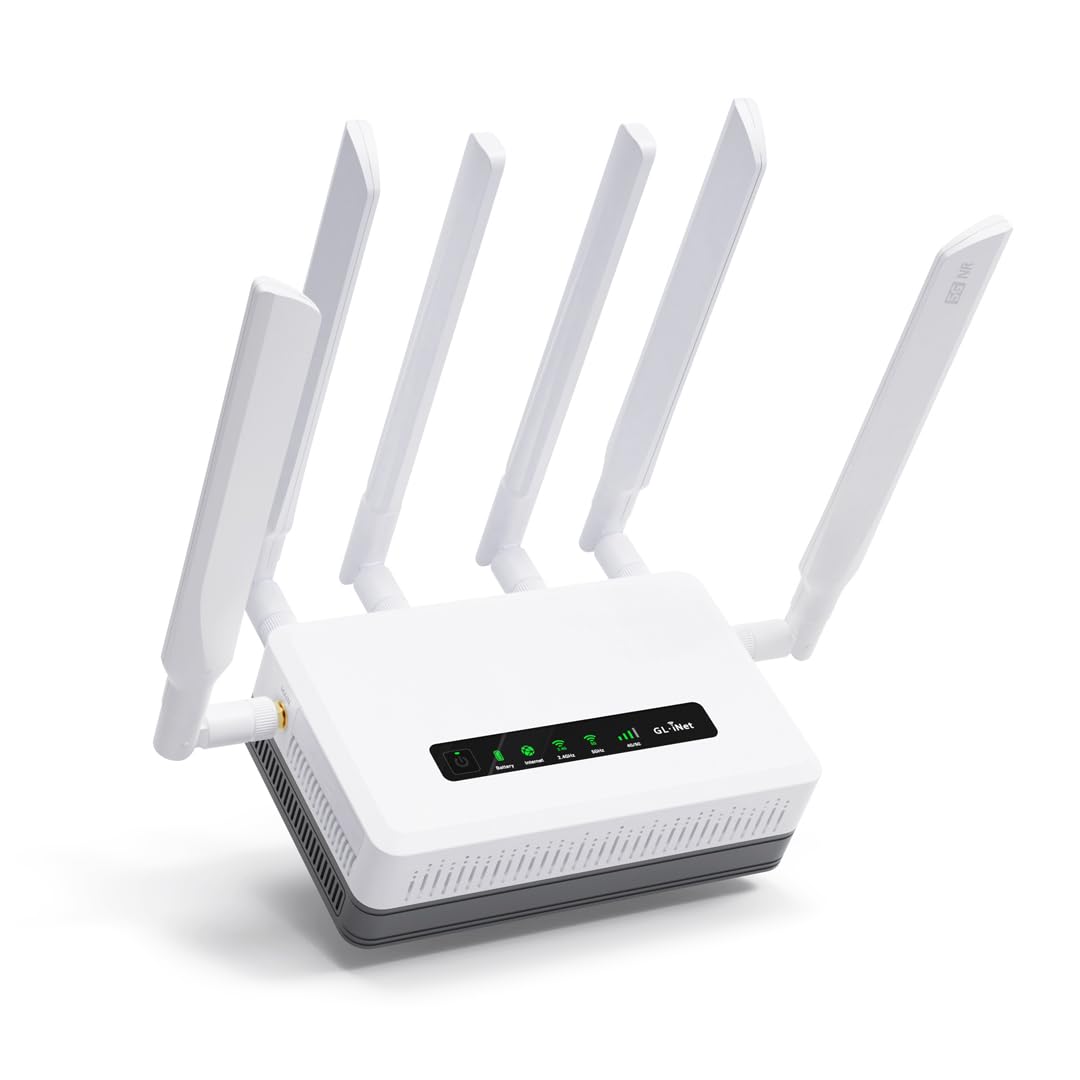
The Puli AX distinguishes itself from other cellular routers with a built-in 6400mAh battery that delivers up to eight hours of uninterrupted connectivity during a power outage. For field operations, construction sites, or retail locations where grid stability is unreliable, this battery backup transforms the router from a simple modem into a true business continuity device. Its dual-SIM capability with automatic failover means the switch between carriers happens without manual intervention, keeping payment terminals and cloud apps live.
Wi-Fi 6 throughput reaches 574Mbps on 2.4GHz and 2402Mbps on 5GHz, while the Qualcomm chipset handles MU-MIMO for up to 20 simultaneous devices without buffering. The OpenWrt-based firmware exposes WireGuard and OpenVPN tunnels reaching 300 Mbps and 150 Mbps respectively, sufficient for a small office VPN headend. AT&T and T-Mobile certification ensures the modem locks onto carrier-aggregated 5G NR bands correctly.
Detachable antennas give you the option to mount a directional external antenna if the cellular signal is marginal, though the included retractable antennas work well for most indoor deployments. The router also supports WAN failover via Ethernet, repeating, and USB tethering, providing three backup paths if cellular fails.
Why it’s great
- 6400mAh battery runs up to 8 hours with no external power
- Dual-SIM auto-failover with AT&T and T-Mobile certification
- OpenWrt firmware with WireGuard VPN hitting 300 Mbps
Good to know
- Dual-SIM is single-standby, not simultaneous active
- Maximum VPN speeds depend on local network conditions
2. ASUS RT-BE88U

For businesses that need to connect wired workstations, IP cameras, and a LAN backbone, the RT-BE88U’s port selection is unmatched: one 10G SFP+ cage, one standard 10G RJ45 port, four 2.5G ports, and four 1G ports, totaling 34G of wired capacity. This router can aggregate multiple high-bandwidth connections without a separate switch, making it ideal for a small-to-medium office with mixed-speed devices.
Wi-Fi 7 with 4096-QAM and Multi-Link Operation pushes wireless throughput toward 7200 Mbps, though you need WiFi 7 client devices to see the full benefit. The 2.6GHz quad-core CPU handles AiProtection Pro, a Trend Micro-powered security suite that blocks malicious sites and inspects traffic without a subscription fee — a rare perk compared to Netgear’s annual Armor subscription.
The USB port supports 4G LTE and 5G mobile tethering as a backup WAN, useful when the primary wired ISP goes down. Setup via the ASUS Router app is straightforward, and AiMesh compatibility lets you expand coverage with another ASUS unit if the 3000 sq. ft coverage falls short in a multi-story office.
Why it’s great
- 34G total wired capacity with 10G SFP+ and 2.5G ports
- Commercial-grade AiProtection Pro with no subscription
- WiFi 7 with 4096-QAM for future-proof wireless speed
Good to know
- Uses dual-band 2.4/5GHz, missing the 6GHz band
- Firmware updates at midnight can cause temporary disconnects
3. GL.iNet GL-X3000 (Spitz AX)

The Spitz AX runs a native OpenWrt v21.02 firmware stack that exposes over 5,000 plug-ins for custom routing, DNS filtering, and traffic shaping. For a tech team that needs to integrate a cellular gateway into an existing VPN infrastructure or deploy custom firewall rules, this router provides the control that locked-down consumer routers lack. The built-in support for WireGuard and OpenVPN achieves 300 Mbps and 150 Mbps respectively, enough for a dozen concurrent remote office tunnels.
Dual-SIM slots with single-standby failover let you choose between T-Mobile and AT&T (both certified), and the six detachable antennas give you the flexibility to swap in high-gain directional panels for rural or warehouse environments. Multi-WAN supports Ethernet, repeater, cellular, and USB tethering simultaneously, with configurable failover priority.
The 574Mbps (2.4GHz) + 2402Mbps (5GHz) Wi-Fi 6 radio covers up to 3,000 sq. ft. with MU-MIMO, though the router lacks WiFi 7. Some users report that latency creeps up after several days of uptime, requiring a scheduled weekly reboot — easily scripted via OpenWrt’s cron.
Why it’s great
- OpenWrt v21.02 with 5,000+ plug-ins for deep customization
- Dual-SIM failover and multi-WAN with four connection types
- WireGuard throughput of 300 Mbps supports multiple VPN tunnels
Good to know
- Latency climbs after days of continuous uptime without a reboot
- Limited to 2-band carrier aggregation on the cellular modem
4. Cudy P5

The Cudy P5 uses Qualcomm’s Snapdragon SDX62 platform, the same modem found in many enterprise-grade mobile hotspots, delivering NSA downlink speeds up to 3.4 Gbps and SA downlink up to 2.4 Gbps. The 1GHz dual-core ARM Cortex-A53 SoC manages Wi-Fi 6 at AX3000 speeds, with 4x5dBi cellular antennas and 2x5dBi Wi-Fi antennas for improved sensitivity in fringe coverage zones.
What makes this router stand out for IT administrators is its transparent band-locking interface and TTL modification tools. Band locking forces the modem onto a specific 5G NR band (e.g., n71 or n41) to avoid congestion, while TTL adjustment lets you bypass certain carrier tethering restrictions. The web UI also includes WireGuard, OpenVPN, IPsec, and Zerotier clients for remote site connectivity.
Dual-SIM failover works reliably with AT&T and T-Mobile, though some users report incompatibility with Verizon’s CDMA-less network. The device runs warm under load, and the plastic chassis lacks passive heat dissipation structures found in metal-enclosed alternatives. Setup is more technical than consumer routers, requiring manual APN configuration in many cases.
Why it’s great
- SDX62 modem delivers up to 3.4 Gbps NSA 5G downlink
- Band locking and TTL control for carrier optimization
- Support for WireGuard, OpenVPN, IPsec, and Zerotier
Good to know
- Not fully compatible with Verizon CDMA-less networks
- Runs warm under sustained load without a metal chassis
5. MOFINETWORK MOFI6500-5GXeLTE-RM520-HP
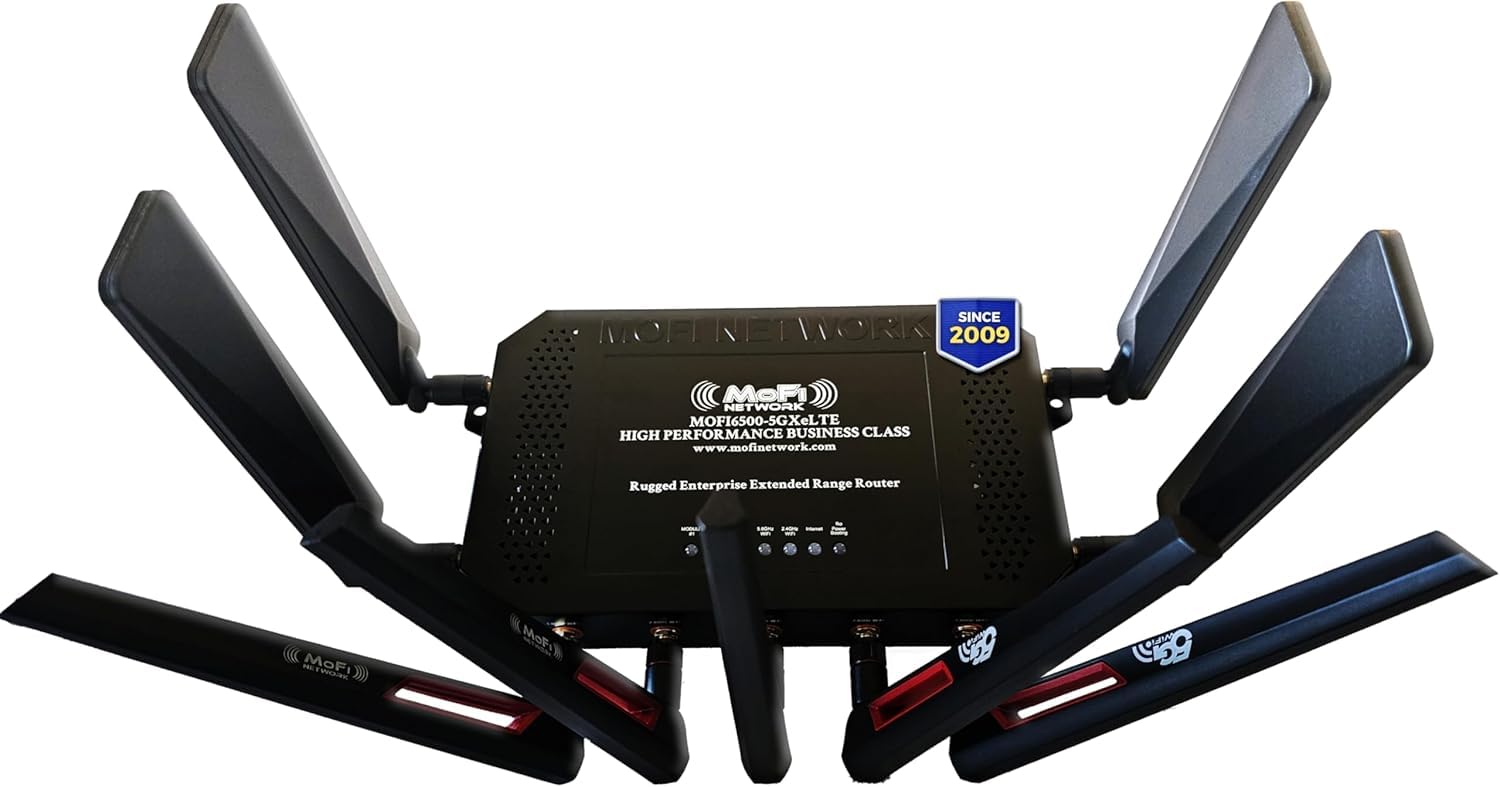
Built into a full metal chassis with a locking power connector, the MOFI6500 is designed for environments where plastic routers would fail: construction site trailers, warehouse mezzanines, and RV offices on rough terrain. The internal amplification boosts Wi-Fi 6 range beyond typical consumer routers, and the bundled 10-foot CAT6E cable makes ground-wire runs easier.
The Qualcomm modem supports dual-SIM failover (not simultaneous), with IP pass-through mode for assigning the public cellular IP directly to a firewall appliance. Band-lock tools and VPN compatibility (OpenVPN, WireGuard) give IT admins the same advanced controls as the Cudy P5, but with a more industrial physical footprint. The unit ships with four 5G cellular high-gain antennas and five Wi-Fi antennas covering 2.4GHz and 5GHz bands.
During real-world testing in rural Fort Worth with AT&T, the MOFI6500 delivered stable 5G connectivity after a two-minute setup. Users pairing it with an external Yagi antenna saw signal strength jump from one bar to four bars, covering two buildings. The only quirk: “dual SIM” here means failover only, not load balancing, which disappointed some buyers expecting active-active redundancy.
Why it’s great
- Full metal enclosure with locking power for harsh environments
- Amplified Wi-Fi 6 signal with up to 9 antennas included
- IP pass-through and band-lock for enterprise firewall integration
Good to know
- Dual SIM supports failover only, not simultaneous active links
- Initial setup can be tricky without reading the manual closely
6. Netgear Nighthawk RS700S

The RS700S is the flagship Nighthawk router, delivering aggregate wireless speeds up to 19 Gbps across tri-band WiFi 7 (2.4GHz, 5GHz, 6GHz). For a business that relies on large file transfers, 4K video conferencing, or AR/VR training sessions, the 6GHz band provides a dedicated high-speed channel with minimal interference from legacy devices. The 10 Gig internet port matches the fastest business fiber or cable plans.
Coverage reaches 3,500 sq. ft. with 360-degree antennas, and the passive cooling design eliminates the fan noise that plagues some competing WiFi 7 routers. The 1GHz quad-core CPU handles 33 simultaneous client devices without breaking a sweat, and the streamlined body is significantly smaller than the old Nighthawk X10.
This router does not include a built-in cable modem — you need a separate modem for wired ISP service. A firmware bug in version 1.0.7.86 caused 6GHz dropouts at 15-foot range through one wall, though a firmware rollback resolved the issue for most users. Netgear also requires a subscription for Armor cybersecurity features after the one-year trial.
Why it’s great
- Tri-band WiFi 7 with 19 Gbps aggregate wireless throughput
- 10 Gig WAN/LAN port for multi-gig fiber connections
- Passive cooling with no fan noise for quiet office environments
Good to know
- Requires separate cable modem for wired ISP service
- Armor security requires subscription after first year
- Firmware bug caused 6GHz dropouts in early units
7. Netgate 4200 MAX

The Netgate 4200 MAX is a dedicated security gateway that runs pfSense+ software with lifetime updates and TAC Lite support. It delivers 9.28 Gbps routing for IMIX traffic and 8.61 Gbps firewall throughput thanks to a 4-core 2.1GHz Intel Atom C1110 CPU with AVX2 instructions for accelerated encryption. The four discrete 2.5 GbE Intel i226 ports can be independently configured as WAN, LAN, or DMZ interfaces.
For businesses that already have a separate 5G modem or need to add cellular connectivity downstream, the 4200 MAX functions as the firewall and VPN headend while the modem stays in bridge mode. It supports IPsec, OpenVPN, and WireGuard with hardware-accelerated cryptography, making it ideal for multi-site VPN deployments. The passive cooling system operates silently, and the compact form factor fits in a 19-inch rack with an optional bracket.
This is not a plug-and-play device for non-technical users. PfSense configuration requires understanding VLANs, firewall rules, and routing tables. The return policy includes restocking fees if tech support determines the unit functions correctly but the user cannot complete setup. The unit also lacks built-in Wi-Fi, so a separate access point is required for wireless coverage.
Why it’s great
- pfSense+ with lifetime updates and 24/7 TAC support included
- 9.28 Gbps routing with hardware-accelerated encryption
- Silent passive cooling, quiet enough for open office areas
Good to know
- No built-in Wi-Fi; requires separate access points
- Setup requires networking knowledge beyond consumer routers
- Return policy includes restocking fees for non-defective units
8. MikroTik CCR2116-12G-4S+

The CCR2116-12G-4S+ is a Cloud Core Router built for high-volume traffic environments like ISPs, data centers, or large enterprise campuses. It packs 16GB of RAM, thirteen Gigabit Ethernet ports, and four 10G SFP+ cages into a 1U rackmount chassis, providing the wired capacity to aggregate multiple 5G modems or fiber uplinks simultaneously. The RouterOS operating system supports OSPF, BGP, MPLS, and advanced QoS queuing.
While this router lacks a built-in 5G modem, it excels as the wired aggregation backbone for businesses that already have cellular gateways. You can pair it with an external 5G modem in bridge mode and use RouterOS to manage load balancing, failover, and traffic shaping across multiple WAN links. The Winbox GUI simplifies configuration for administrators familiar with MikroTik syntax, but the learning curve is steep for those new to the platform.
The 5 Gbps data transfer rate listed in the specs feels conservative — the SFP+ cages support 10 Gbps each, and the internal switching fabric handles full line-rate routing across all ports. The unit runs passively cooled but generates moderate heat in a closed rack; ensure adequate ventilation. At roughly one-third the cost of a comparable Cisco ISR, the CCR2116 delivers exceptional value for routing performance.
Why it’s great
- 16GB RAM and 4x 10G SFP+ for high-throughput routing
- RouterOS with BGP, OSPF, and advanced QoS capabilities
- Cost-effective alternative to Cisco ISR for ISP/enterprise use
Good to know
- No built-in 5G modem; requires external cellular gateway
- Steep learning curve for users new to MikroTik RouterOS
- Generates moderate heat; needs proper rack ventilation
9. Teltonika RUTX50

The Teltonika RUTX50 is an industrial-grade 5G router designed for installations in manufacturing facilities, remote oil rigs, and smart-city infrastructure. It achieves cellular throughput up to 3.3 Gbps with single-digit latency, supporting both NSA and SA 5G architectures for mission-critical SCADA and telemetry applications. The dual-SIM auto-failover ensures uninterrupted communication even when one carrier’s tower goes down.
The router handles up to 150 simultaneous client connections across its dual-band Wi-Fi 5 (802.11ac) radio while maintaining backward compatibility with 4G LTE CAT 20 and 3G networks. The included GNSS antenna enables location-tracking use cases for fleet management or mobile asset monitoring. The industrial enclosure and wide input voltage range (9-50V DC) make it suitable for vehicles and harsh electrical environments.
Critical caveat: the RUTX50 is region-locked for Europe, Middle East, Africa, Oceania, and Brazil. It is not authorized for use in the United States due to FCC compliance and band support limitations. Units purchased from European sellers may not work on Australian or North American networks due to frequency differences. The router also lacks WiFi 6, which is a noticeable omission at this price point for offices with dense client populations.
Why it’s great
- Industrial 5G with 3.3 Gbps throughput and sub-10ms latency
- Supports 150 simultaneous connections for dense deployments
- Wide input voltage range and GNSS for fleet/field use
Good to know
- Region-locked for EMEA, Oceania, Brazil; not for US use
- Wi-Fi 5 only, no WiFi 6 support for high-density offices
- Regional model variants may not work on local carrier bands
FAQ
Is dual-SIM failover or load balancing more important for a small business?
Can I use any 5G router with my Verizon or AT&T business plan?
How many simultaneous users can a business 5G router handle?
Final Thoughts: The Verdict
For most users, the best 5g router for business winner is the GL.iNet GL-XE3000 (Puli AX) because its built-in 6400mAh battery provides power-outage resilience that no other mid-range router offers, while the dual-SIM failover and OpenWrt flexibility cover the essential business continuity and customization needs. If you want maximum wired port density for a growing office, grab the ASUS RT-BE88U. And for enterprise security with pfSense+, nothing beats the Netgate 4200 MAX.