
A smartphone struggles when you need consistent focus, clean audio, and a real zoom. For videography, a dedicated body with a larger sensor and interchangeable lenses separates hobby footage from something you want to share in full screen. The right entry mirrorless body solves rolling shutter, poor low-light detail, and battery anxiety that a phone simply cannot fix. This guide breaks down the actual specs that matter for moving images.
I’m Min — the co-founder and writer behind Gadgets Feed. I have spent countless hours cross-referencing sensor readout speeds, bit rates, codec support, and autofocus algorithms across the current market to separate beginner-friendly video tools from feature-limited traps. Every recommendation here is rooted in raw technical analysis, not brand loyalty.
Whether you need reliable face-tracking, external mic input, or a flat picture profile for color grading, this guide will help you find the exact beginner camera for videography that matches your skill curve and budget.
How To Choose The Best Beginner Camera For Videography
Video success depends on three pillars: reliable autofocus, a flat color profile for grading, and a clean HDMI or USB output. If any one of those is missing, your editing workflow becomes much harder. A beginner videography camera should also offer a mic input without forcing you into a hot-shoe adapter with extra cables.
Autofocus Consistency for Moving Subjects
Contrast detection hunts. Phase detection locks. Eye-tracking systems like Sony’s Real-Time Eye AF or Canon’s Dual Pixel CMOS AF hold focus on a talking face even when you pan. For interviews, vlogs, or walk-and-talk scenes, a camera with on-sensor phase detection or a hybrid AF system is non-negotiable.
Codec Quality and Bit Rate
4K at 24fps with 8-bit 4:2:0 is the bare minimum. A camera that offers 10-bit internal recording, a flat Log profile, or high bit rate options (100 Mbps or more) gives you room to recover highlights and shadows. 8-bit footage banding in gradients like skies or skin is a common regret among new videographers who bought the cheapest body.
Stabilization Type
In-body image stabilization (IBIS) lets you shoot handheld without a gimbal. Lens-based optical stabilization (OIS) helps in specific focal lengths but does not correct sensor roll. A camera with 5-axis IBIS and a lens with OIS together deliver smooth walking footage, while a body with no IBIS forces you into post-production warp stabilization or extra hardware.
Quick Comparison
On smaller screens, swipe sideways to see the full table.
| Model | Category | Best For | Key Spec | Amazon |
|---|---|---|---|---|
| Canon EOS R100 (Kit) | Mirrorless APS-C | Entry-level RF system | 4K 24fps, DIGIC 8 | Amazon |
| Canon EOS R100 + Bag Bundle | Mirrorless APS-C | Complete starter kit | 4K 24fps, bundled 64GB | Amazon |
| Canon EOS M50 (Renewed) | Mirrorless APS-C | Budget vlogging | 4K 24p, 120p HD | Amazon |
| Panasonic LUMIX G85 | Mirrorless MFT | Stabilized handheld 4K | 5-axis IBIS, 4K 30p | Amazon |
| Sony Alpha a3000 | Mirrorless APS-C | Ultra-budget stills | 20.1 MP, Full HD | Amazon |
| OM System E-M10 Mark IV | Mirrorless MFT | Compact travel vlog | 4.5 stops IBIS, 4K | Amazon |
| Sony ZV-E10 (Body Only) | Mirrorless APS-C | Vlogging & content | 4K oversampled, 425 AF | Amazon |
| Sony ZV-E10 (Renewed Bundle) | Mirrorless APS-C | All-in-one creator kit | 4K, 16-50mm + extras | Amazon |
| Sony ZV-E10 (Video Bundle) | Mirrorless APS-C | Pro video starter | 4K, LED light, mic | Amazon |
| Sony Alpha a6400 | Mirrorless APS-C | Fast AF hybrid | 0.02s AF, 4K oversampled | Amazon |
| Canon EOS RP + RF 24-105mm | Mirrorless Full-Frame | Full-frame entry | 4K UHD, 5-stop IS | Amazon |
In‑Depth Reviews
1. Sony ZV-E10 Mirrorless Vlog Camera
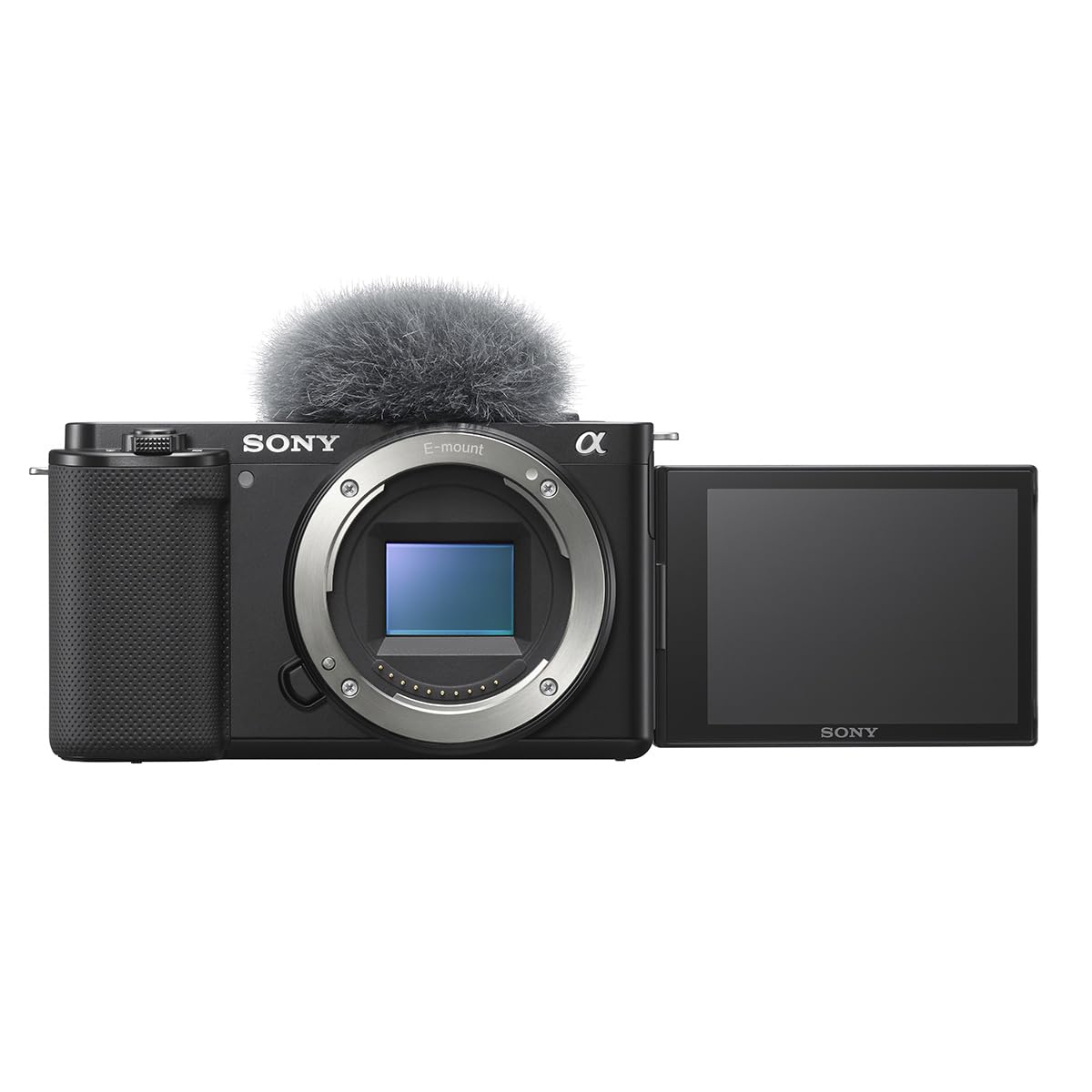
The ZV-E10 uses a 24.2MP APS-C sensor with BIONZ X processing that oversamples 4K from a 6K readout, producing noticeably sharper footage than cameras that pixel-bin. Its 425-point phase-detection AF with Real-time Eye Tracking sticks to a moving subject reliably, and the Product Showcase mode transitions focus seamlessly from a face to an object held up to the lens — a feature built for review content creators.
The body is lightweight enough for one-handed gimbal use, and the side flip-out screen faces forward without obstruction from cables. Background Defocus is a single-button toggle that instantly opens the aperture, saving time when switching between talking-head and b-roll shots. The built-in directional three-capsule microphone with windscreen is usable for scratch audio, though an external mic via the 3.5mm port is still recommended for final delivery.
There is no in-body stabilization, so handheld walking footage will need a gimbal or post stabilization. The battery is rated for roughly 25 minutes of continuous 4K recording, so a spare set is mandatory for longer shoots. These limitations are predictable at this tier, and the clean 4K output and best-in-class AF justify the trade-offs for a beginner videographer.
Why it’s great
- Oversampled 4K from 6K readout for sharp detail
- Reliable real-time eye AF for faces and objects
- Light body and side flip-out screen designed for content creation
Good to know
- No in-body stabilization — gimbal recommended
- Battery life is short for extended video shoots
2. Sony Alpha a6400

The a6400 pairs a 24.2MP APS-C sensor with a front-end LSI that accelerates readout speeds, delivering 0.02-second autofocus lock and 425 phase-detection points covering nearly the entire frame. Real-time Eye AF works for both humans and animals in video, and the object tracking is sticky enough to follow a runner through mixed lighting without hunting. The 4K output uses full pixel readout without pixel binning, resulting in clean oversampled footage with natural detail.
The body is compact and the 180-degree tiltable touchscreen folds up for overhead or low-angle shots without blocking the hot shoe. The built-in flash works for stills and the E PZ 16-50mm OSS II lens adds optical stabilization that reduces handheld shake in static shots. Picture Profiles including S-Log give beginners room to grade without immediately switching to a flat external recorder.
The a6400 lacks in-body stabilization, so moving gimbal-free shots will still require a steady hand or a tripod. Battery life is adequate for photo bursts but video drains the standard NP-FW50 quickly — carrying two spares solves the issue. The menu system is dense, but the touchscreen and customizable buttons make it manageable after a short learning curve.
Why it’s great
- Industry-leading 0.02s autofocus with Real-time Eye Tracking
- 4K oversampled with full pixel readout, no binning
- 180-degree tiltable screen and compact build
Good to know
- No IBIS — rely on lens OSS or a gimbal
- Menu system is deep and takes time to learn
3. Canon EOS RP + RF 24-105mm

The EOS RP steps into full-frame territory with a 26.2MP sensor that delivers shallower depth of field and better high-ISO performance than any APS-C body in this guide. Dual Pixel CMOS AF provides smooth, reliable face-tracking in both 1080p and 4K modes, though the 4K mode carries a 1.6x crop factor that narrows the field of view significantly. The RF 24-105mm F4-7.1 IS STM lens includes up to 5 stops of optical image stabilization, making handheld wide-angle shots much steadier than an unstabilized APS-C body.
The body is compact for a full-frame mirrorless, and the vari-angle touchscreen works cleanly for vlogging or low angles. The menu system inherits Canon’s familiar layout with a guided UI that beginners navigate without frustration. The RP can also function as a high-quality webcam via clean HDMI output, useful for streaming or video calls that demand better quality than a laptop camera.
The 4K crop is the main trade-off — at 24mm you effectively get a 38mm field of view, which is tight for indoor vlogging. The kit lens aperture drops to f/7.1 at the telephoto end, limiting low-light performance. Battery life is modest, so an extra LP-E17 pack is recommended. For a beginner who wants full-frame flexibility for future lens upgrades, the RP offers a credible gateway without full-frame pricing pain.
Why it’s great
- Full-frame sensor for superior low light and depth of field
- 5-stop optical IS in the kit lens for smooth handheld shots
- Intuitive Canon menu and UI for beginners
Good to know
- 4K video has a 1.6x crop factor
- Kit lens aperture narrows significantly at telephoto
4. Sony ZV-E10 (Renewed + Accessory Bundle)

This bundle pairs the Sony ZV-E10 body with an E PZ 16-50mm f/3.5-5.6 OSS lens and a massive collection of accessories: two 64GB memory cards, an LED video light, a tripod, a steady-grip pod, filter sets, macro attachments, a wide-angle adapter, a telephoto adapter, spare batteries, a charger, and a camera bag. For a beginner, this covers nearly every accessory need out of the box — all you add is a microphone.
The ZV-E10’s core video capability remains the same as the standalone unit: 4K oversampled from 6K, 425-point phase-detection AF, and product showcase mode. The spare batteries solve the short runtime issue, and the LED light provides continuous illumination for indoor vlogs. The tripod and grip pod handle static shots and selfie-style handheld recording without additional purchases.
The attachment lenses (wide-angle and telephoto screw-ons) are acceptable for experimentation but noticeably softer than dedicated glass. The bag and cleaning kit are basic but functional for starting storage. The renewed body condition varies, though most reviews report cosmetic wear that does not affect function. This is a turnkey solution for a beginner who wants everything in one shipment.
Why it’s great
- Complete accessory set including spare batteries, LED light, and tripod
- Same oversampled 4K and 425-point AF as the standalone ZV-E10
- Turnkey kit eliminates separate accessory shopping
Good to know
- Attachment lenses are lower quality than dedicated glass
- Renewed body condition may show minor cosmetic wear
5. Sony ZV-E10 Pro Video Bundle

This 38-piece bundle focuses on video creation, pairing the ZV-E10 with a 128GB Extreme Speed memory card, an LED video light, a directional microphone, a U-grip, a tripod, filter kits, and editing software. The inclusion of an external microphone is a significant upgrade over the bare-bones kit, as it solves the primary audio weakness of the ZV-E10’s built-in mic. The variable-angle LCD and Real-time Eye AF make this kit immediately ready for talking-head and interview scenarios.
The neutral density filter pack allows the beginner to control exposure in bright scenes without raising shutter speed, a core video technique. The 4K output with full pixel readout and no binning maintains the ZV-E10’s sharpness, and the BIONZ X processor handles the encoding without overheating issues reported in some older models. The software bundle provides basic editing tools to start cutting footage without a separate subscription.
The bundled accessories are functional but not pro-grade — the microphone is a step above the internal mic but not competitive with a dedicated Rode or Deity. The grip pod is comfortable for a few hours but not built for all-day handheld work. The value proposition is clear: you start shooting with a full kit and replace individual pieces as your skills improve.
Why it’s great
- Includes a dedicated microphone for cleaner on-camera audio
- 128GB high-speed card and ND filter pack included
- Real-time Eye AF and 4K oversampled video
Good to know
- Battery life still requires spares for all-day shoots
- Bundled mic is entry-level — upgrade path exists
6. Panasonic LUMIX G85

The G85 is built around a 16MP Micro Four Thirds sensor without a low-pass filter, giving it a near 10 percent boost in fine detail resolution compared to other 16MP MFT sensors. The standout feature is its 5-axis in-body dual image stabilization — the IBIS alone handles handheld panning, and when combined with the 12-60mm Power O.I.S. lens, the result is smooth walking footage that rivals footage from much more expensive bodies. A magnesium alloy build with weather sealing makes it durable for outdoor shoots.
The 4K QFHD video (3840×2160) supports 30fps, and the Lumix 4K Photo mode allows frame extraction at 30fps for stills after the fact. The 3-inch tiltable touch LCD and OLED live viewfinder provide clear framing even in bright sunlight. Zebra patterns, focus peaking, and a microphone input are all present, which are essential for beginner video shooters learning manual exposure.
The 16MP sensor is lower resolution than the 24MP APS-C competition, which limits still image cropping. Autofocus in 4K video can hunt in low-light scenes due to the contrast-detect system. The G85 is a heavier body than its G7 predecessor, approaching the heft of the GH4. For a beginner who prioritizes stabilization and build quality over megapixels, the G85 delivers a reliable shooting experience in tough conditions.
Why it’s great
- 5-axis IBIS delivers smooth handheld footage
- Weather-sealed magnesium alloy body for outdoor use
- Microphone input, zebras, and focus peaking
Good to know
- 16MP sensor limits still image cropping
- Contrast-detect AF can hunt in low light 4K
7. OM System Olympus E-M10 Mark IV

The E-M10 Mark IV uses a 20MP Live MOS Micro Four Thirds sensor with 5-axis in-body stabilization rated at 4.5 stops of compensation. That level of IBIS means you can shoot 4K handheld at wide focal lengths and achieve usable footage without a gimbal. The flip-down monitor and dedicated selfie mode automatically engage when you tilt the screen downward, making solo vlogging much faster to set up than a body that requires menu diving to flip the image.
The camera is notably compact — paired with the M.Zuiko 14-42mm EZ pancake lens, it fits into a jacket pocket. The 121 contrast-detect AF points are fast enough for well-lit shooting and the 16 Art Filters including Instant Film add creative variety without post-processing. The built-in flash handles fill light for close shots and the Bluetooth connection allows remote control via the OI Share app.
The app is noticeably slow for wireless file transfer. The camera does not include a USB-C port, and no external charger is in the box. For a beginner who values portability and IBIS above all else, the E-M10 Mark IV is the lightest serious video body in this lineup.
Why it’s great
- 4.5 stops of IBIS for smooth handheld video
- Compact and pocketable with the pancake kit lens
- Flip-down selfie monitor with automatic mode
Good to know
- Contrast-detect AF lags in dim tracking scenarios
- Slow app and no USB-C port
8. Canon EOS R100 (Kit)

The R100 is Canon’s most affordable entry into the RF mirrorless system, built around a 24.1MP APS-C sensor and a DIGIC 8 image processor. Dual Pixel CMOS AF covers 143 zones with human face and eye detect, which locks onto subjects reliably during filmed interviews. The camera shoots 4K at 24fps, HD up to 120fps for slow motion, and Full HD at 60fps. The RF-S 18-45mm kit lens includes optical stabilization that cancels out handheld micro-jitters at wide angles.
The body is the smallest and lightest in the EOS R series, making it genuinely travel-friendly. The guided user interface helps a beginner understand aperture, shutter speed, and ISO without consulting a manual. Wireless photo transfer to a smartphone via Wi-Fi and Bluetooth is seamless, which is useful for quick social media uploads between shooting sessions.
The 4K frame rate tops out at 24fps — no 30fps or 60fps 4K option. The slower frame rate can cause flickering under artificial lights in regions with 50Hz mains frequency. The DIGIC 8 processor is a generation behind the DIGIC X, limiting the bit depth to 8-bit. The R100 is best suited for a beginner photographer who also wants occasional 4K video, not a dedicated videographer who needs flexible frame rates.
Why it’s great
- Smallest and lightest EOS R body for portability
- Dual Pixel CMOS AF with reliable face detection
- Seamless Wi-Fi/Bluetooth photo transfer
Good to know
- 4K limited to 24fps only
- 8-bit internal recording limits grading flexibility
9. Canon EOS R100 (Bag & 64GB Bundle)
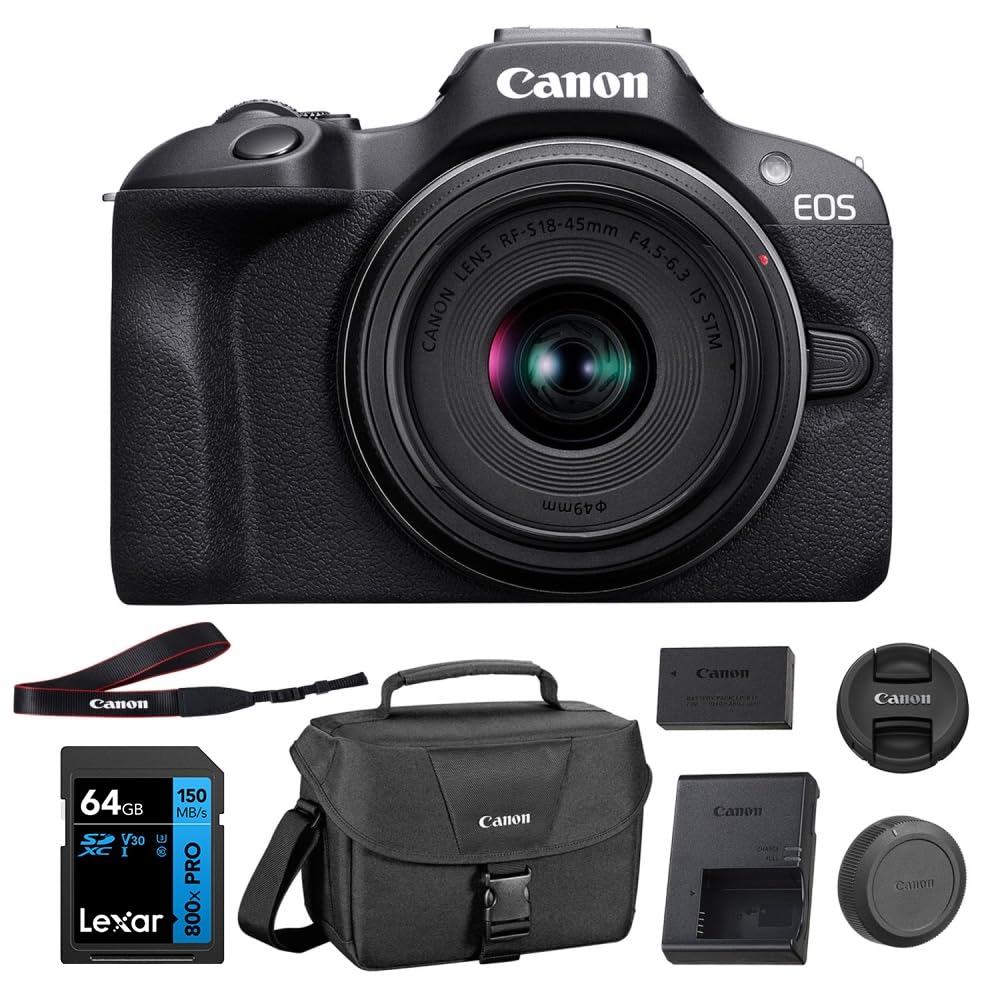
This bundle adds a Canon 200ES shoulder bag and a Lexar 64GB UHS-I SD card to the same R100 body and RF-S 18-45mm kit lens. The bag provides padded storage for the camera and a small lens collection, while the 64GB card offers roughly 80 minutes of 4K footage at 24fps before needing a swap. Everything else — Dual Pixel CMOS AF, 24.1MP sensor, DIGIC 8 processing — is identical to the standalone R100 kit.
The value here is purely about convenience. For a beginner who does not already own a camera bag or memory card, this bundle avoids separate trips to the accessory aisle. The bag is compact enough to fit under an airline seat, and the card speed (UHS-I) is adequate for 4K 24fps but not ideal for burst photo sequences. The package is simple: the camera works as expected, the bag protects it, and the card stores the footage.
The 4K frame rate limit to 24fps remains the same constraint as the base model. The bundle does not include an external microphone or tripod, so those remain separate purchases. The shoulder bag padding is thin — sufficient for gentle daily carry but not heavy outdoor protection. For the beginner who wants a clean start with a familiar brand, this bundle removes friction from the first unboxing.
Why it’s great
- Everything needed to start shooting out of the box
- Lightweight body and lens for travel
- Canon’s Dual Pixel AF simplifies focus for beginners
Good to know
- 4K limited to 24fps — no 60fps option
- Bag padding is basic for heavy protection needs
10. Canon EOS M50 (Renewed)

The M50 is the predecessor to the R100 in Canon’s mirrorless lineup, using the EF-M mount rather than the RF system. It shares the 24.1MP APS-C sensor and DIGIC 8 processor, so image quality is comparable to the R100. The key advantage is HD 120p for slow motion — the R100 also has this — and a built-in OLED electronic viewfinder. The eye detection AF works well for both stills and video, though it is the older implementation without animal detection.
As a renewed camera, the M50 is a budget-friendly entry point. Users report units in like-new condition with full functionality. The articulating touchscreen is useful for vlogging, and the external mic compatibility via the hot shoe mount makes audio upgrade possible without specialized hardware. The camera is lightweight enough for a small gimbal or a selfie stick.
The 4K video on the M50 has a known crop factor and limited tracking during capture — reviews confirm that the phase-detect coverage narrows in 4K mode, causing focus issues that are less pronounced in the newer R100. The EF-M lens ecosystem is effectively abandoned by Canon, so future lens upgrades are limited. The M50 is a temporary solution for a beginner who wants to test the mirrorless waters at a low entry cost and is comfortable with a dead mount system.
Why it’s great
- Very low cost for an APS-C mirrorless with 4K
- Built-in OLED viewfinder and articulating touchscreen
- External mic compatible via the hot shoe
Good to know
- 4K mode has a significant crop and reduced AF coverage
- EF-M mount is discontinued — no future lens development
11. Sony Alpha a3000

The a3000 is a budget mirrorless camera with a 20.1MP APS-C Exmor sensor and a 19-55mm OSS lens. Its most notable feature is the separate body design with a built-in electronic viewfinder, which mimics a DSLR form factor for users who prefer an eye-level shooting posture. The Full HD video recording is basic — no 4K, no slow motion — but the lens stabilization helps keep clips steady during casual shooting.
The image quality is genuinely good for its tier, with low distortion and fringing in the kit lens. The contrast-detect autofocus system with 25 points is functional for slow-paced scenes but will hunt noticeably in video. The camera supports manual controls including shutter priority, aperture priority, and full manual mode, giving the beginner room to learn exposure basics on a system that does not penalize them for a high price.
The camera is a decade-old design, and it shows in every interaction. The 24-bit depth is better than some contemporaries, but the low-resolution EVF and LCD make composition less precise. Battery life is poor — 20 to 30 percent drain per hour of active shooting — and the camera lacks an external charger in the box (USB charging only). The a3000 is strictly for the absolute lowest entry cost into the Sony E-mount ecosystem, with video as a secondary function.
Why it’s great
- Extremely low entry price into APS-C mirrorless
- Good image quality with low distortion in the kit lens
- Separate EVF and DSLR-like grip for comfortable handling
Good to know
- Full HD only — no 4K video capability
- Very poor battery life for video recording
FAQ
Do I need in-body stabilization for my first videography camera?
Why does 4K 24fps flicker under indoor lights?
Is a full-frame camera worth it for a beginner videographer?
Final Thoughts: The Verdict
For most users, the beginner camera for videography winner is the Sony ZV-E10 because it combines oversampled 4K, best-in-class autofocus, and a content-creator form factor at a mid-range price. If you want in-body stabilization without a gimbal, grab the Panasonic LUMIX G85. And for the highest image quality with full-frame depth of field, nothing beats the Canon EOS RP.