
Our readers keep the lights on and my morning glass full of iced black tea. As an Amazon Associate, I earn from qualifying purchases.
Specs are compiled from manufacturer listings and verified buyer reviews and can change over time — please confirm the key details on the product page before buying.
The best anatomy and physiology flash cards turn a two-hour lecture into a twenty-minute review you can actually finish, and they fit in the pocket of your scrubs while you wait for clinicals to start. This guide covers three sets that do that job, and it tells you plainly which one suits which kind of student.
I’m Min — the founder and writer behind Gadgets Feed. This guide is built by comparing the manufacturers’ published specifications and the patterns across verified customer reviews, so you get each pick’s real strengths and trade-offs instead of marketing spin.
Card size and deck organization matter as much as card count when you are flipping through terms on a bus. Below is a straight read on the anatomy and physiology flash cards worth carrying. anatomy and physiology flash cards come in very different shapes, and the difference decides how you study.
Our Picks at a Glance
How To Choose The Best Anatomy And Physiology Flash Cards
Most students buy the biggest deck they can find and then never open it, because a thousand loose cards are impossible to sort on a dorm bed. The set that actually gets used matches your study habits in size, organization, and card count, not the biggest number on the box.
Match the card count to your exam timeline
A 500-card deck is a semester-long project, while a 53-card summary deck is a two-week cram tool. Be honest about how many weeks you have before the exam, then buy for that window rather than for the whole degree.
Card size decides where you can study
Bigger cards mean bigger diagrams and less squinting at labels — the kind of anatomy and physiology flash cards you can read on a crowded train without holding them an inch from your face. Smaller cards fit a scrub pocket, but dense labels get harder to read the smaller the print goes.
Structure versus terminology
A pure anatomy and physiology deck tests body systems, structures, and functions. A medical terminology deck tests word roots, prefixes, and drug and condition vocabulary, which helps in the same courses but serves a different purpose. Know which one your syllabus actually rewards before you pick.
How the deck stays organized
A hole-punched stack on a ring lets you carry one body system at a time instead of the whole box. A boxed set with dividers keeps cards sorted at your desk. Loose cards with no ring or divider system tend to end up as a pile at the bottom of a backpack.
Quick Comparison
| Model | Best For | Card Count | Card Size | Organization | Amazon |
|---|---|---|---|---|---|
| TribeRN Anatomy and Physiology Flash Cards★ Best Overall | Nursing students who want a full-semester deck | 320 cards | 5.27 x 4.58 x 4 inches | Hole-punch and ring | Amazon |
| Anatomy and Physiology Flashcards | Fast review before clinicals | 53 double-sided summaries | 4.92 x 3.5 x 0.1 inches | Grouped by body system | Amazon |
| Medical Terminology Flashcards for Health Professionals | Terminology and pharmacology drilling | 500 double-sided cards | 7.5″L x 5.5″W | Sorting ring plus divider box | Amazon |
In‑Depth Reviews
1. TribeRN Anatomy and Physiology Flash Cards
Our pick — 4.5+★ from 250+ verified ratings; the strongest balance of quality and price.
A 320-card deck that clips onto a ring so one body system comes with you.
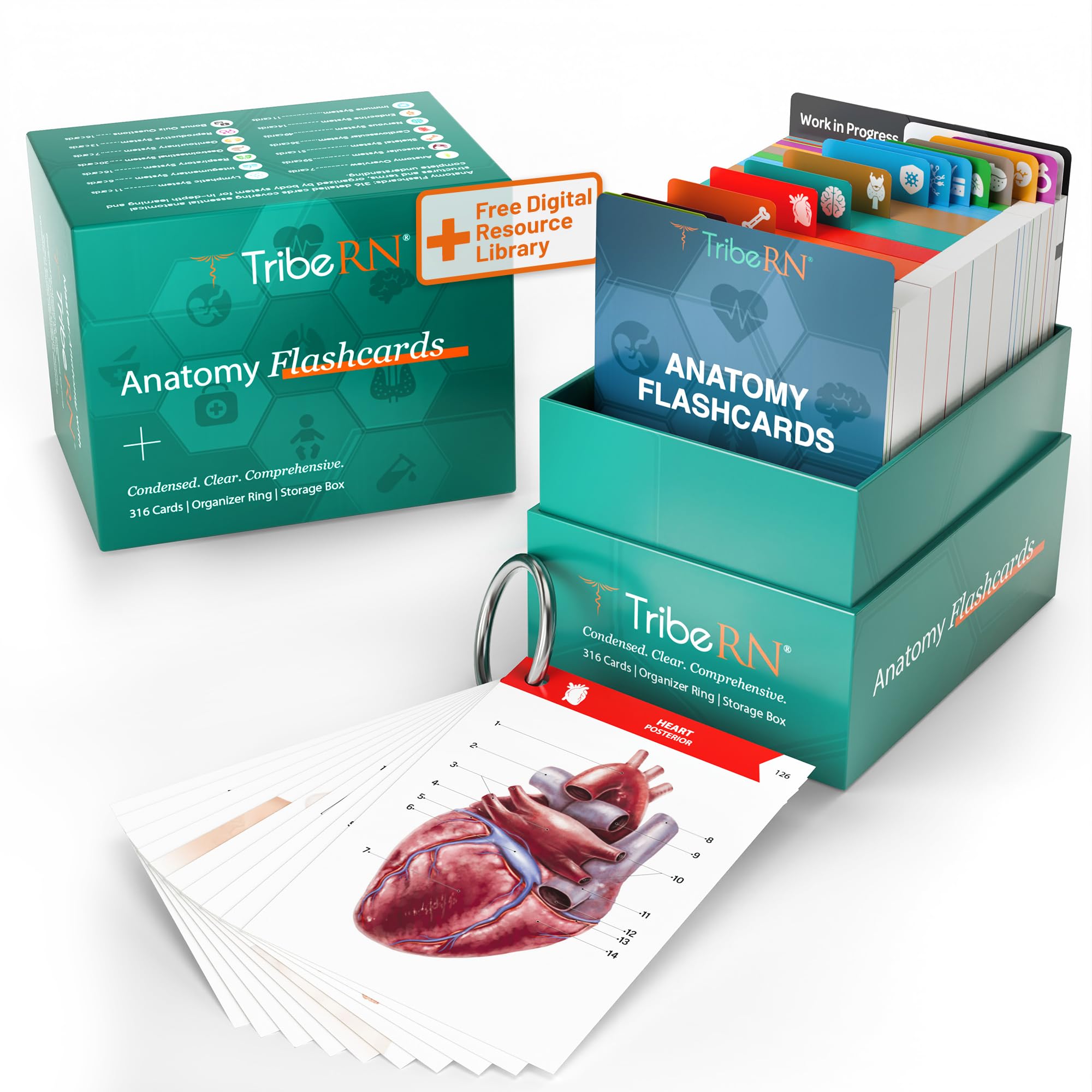
The TribeRN set gives you 320 cards spanning every major body system, which is the widest coverage of the three picks here. Each card carries color-coded anatomy illustrations plus labels and definitions, so visual learners get a picture to hang the memory on rather than a wall of text. Across those cards the set covers more than 1,800 A&P terms — that figure is on the listing, and it is the reason the deck lasts a whole semester instead of running dry in week three.
You get bigger cards than the compact deck below, so labels stay legible when you read fast. This set measures 5.27 x 4.58 x 4 inches, versus 4.92 x 3.5 x 0.1 inches on the Anatomy and Physiology Flashcards from Bear Grocery Store, so each card gives labels noticeably more room. A hole punch runs through the corner of each card, and a ring threads them together, so you can carry the nervous system to clinicals and leave the rest on the desk.
Buyers report the set works as a solid study aid for nursing school, and the card stock earns steady praise for holding up to repeated flipping. A fair number of reviews do flag that some individual facts on the cards do not check out against their course material, so treat the deck as a recall prompt and verify details against your lecture notes. At 4.5+ stars across 290+ ratings, the crowd leans strongly positive. This crowd favorite is not the cheapest deck in this guide, but it is the one you are least likely to outgrow before finals.
What earns the top spot
- 320 cards covering all major body systems in one ring-bound set.
- More than 1,800 A&P terms across the deck.
- Color-coded illustrations with labels and definitions for visual recall.
- Tear-resistant paper stock that survives being carried daily.
Where it asks patience
- More than a few cards contain information that conflicts with some courses’ material.
- A 320-card deck is a bigger commitment to sort through than a short summary set.
Reach for this if: you are in a full nursing or pre-med course load and want one deck that covers every system through the term.
Cross-check your notes: the accuracy flags mean it works best as a review prompt rather than as your only source.
2. Anatomy and Physiology Flashcards
Fifty-three cards for the student who has twenty minutes, not a whole evening.
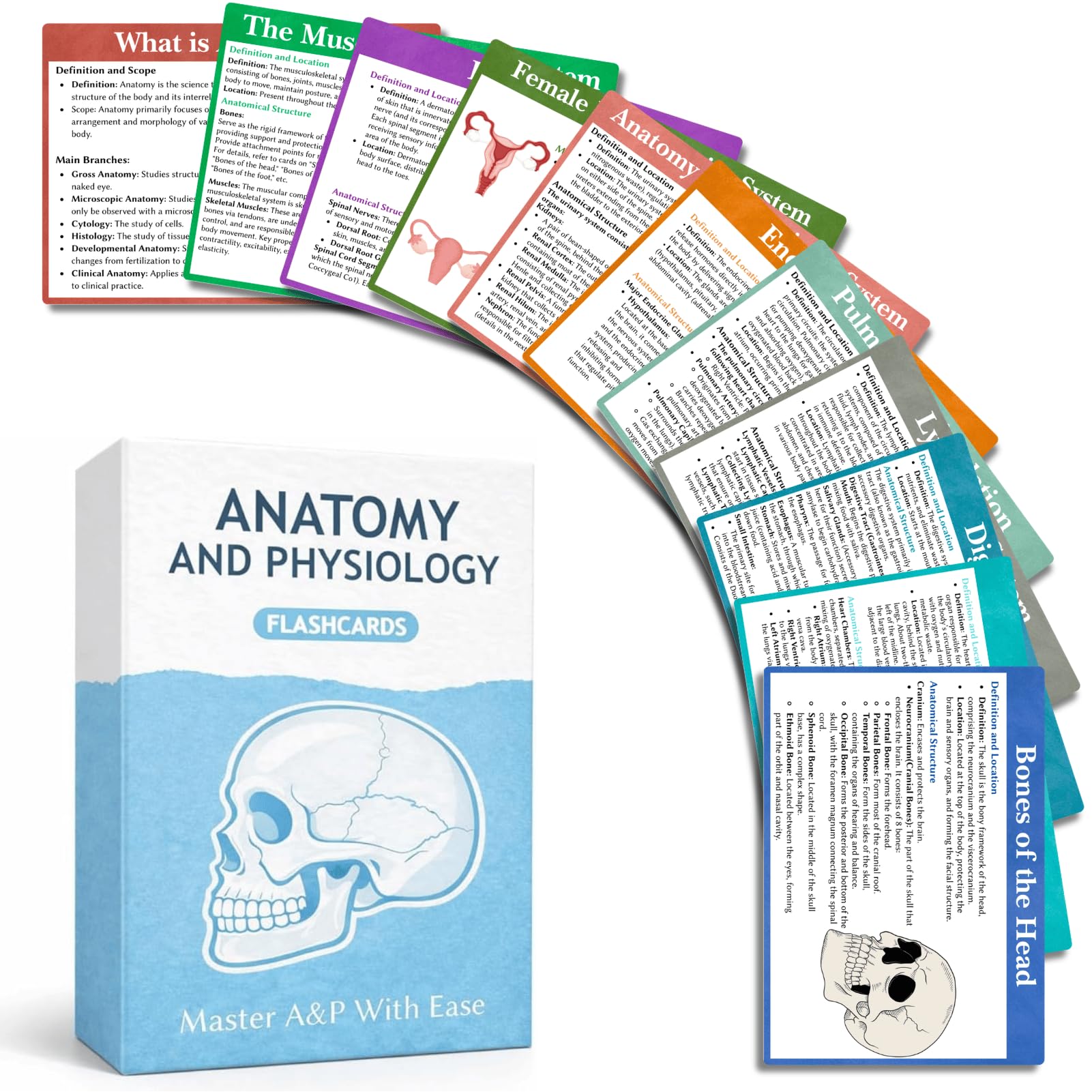
When the exam is close and the textbook will not be re-read, this deck gives you a fast sweep. It holds 53 double-sided summary cards, far fewer than the TribeRN deck, and that is the point — each card condenses a topic instead of testing a single term, so you cover a subject in a few flips. Cards are grouped by body system rather than alphabetically, so the nervous system sits together with the nervous system, matching how your exam is likely structured.
What you can read on them goes past bone labels into physiology: homeostasis, the cardiac cycle, and metabolism each get coverage. That matters if your course tests function as heavily as structure, since a deck of pure anatomy labels leaves that half untested. The diagrams are laid out with space around them rather than crammed edge to edge, which is what makes them workable as a visual review before clinicals.
The honest trade-off is the trade-off of any summary set: fifty-three cards cannot carry the term depth of a 320-card deck, so this one supports revision rather than replacing it. It is also the newest listing in this guide with the lightest review history behind it, so the 4.0+ star figure reflects fewer voices than the other two. Buy it as a refresher sitting alongside your main set, not as the only thing in your bag.
Where it earns its place: 53 condensed two-sided cards that fit a scrub pocket or a bag side pouch and let you turn dead time before a shift into review.
The limit to know going in: it is a summary layer, not a full semester deck — pair it with a term-heavy set if your exam goes deep.
Best suited to: EMT, paramedic, and A&P students who need a fast functional review before clinicals or a board exam.
Think twice if: you are starting from scratch and need every term in the syllabus on a card.
3. Medical Terminology Flashcards for Health Professionals

Five hundred large cards that cover the vocabulary half of your course.
Here is a set that goes wide rather than pictorial. The 500 double-sided cards are built around medical terminology, pharmacology, and med-surg, so the content is prefix-root-suffix language and drug and condition vocabulary rather than labeled body diagrams. If your grade depends on decoding unfamiliar terms quickly, this deck drills exactly that skill. The cards are the largest of the three at 7.5″L x 5.5″W, which gives the font room to stay readable across long study sessions.
Card stock is the standout. Each card is made from 280 gsm art paper with a glossy oil finish — a heavier, coated paper that resists the soft corners and fraying that thin cards develop after a few weeks of shuffling. A 1.5″ sorting ring is included, and the set lives in a lift-off lid box with rounded divider corners, so you can pull one section and leave the rest sorted. Three bonus divider cards — “Work in Progress,” “Almost There,” and “Mastered It!” — let you plan a study cycle instead of guessing where you stand.
Buyers consistently rate the build quality above everything else about this deck, and the ring is the feature that comes up when people describe carrying it around. Thirty multiple-choice question cards and access to a free resource library round out the package, and the clear font is built for fast scanning. Pricing sits in the middle of this group — above the compact summary deck, below the 320-card anatomy set. What it will not do is replace an anatomy deck, since it tests vocabulary rather than labeled structures.
The case for the 500-card stack
- 280 gsm art paper with a glossy oil finish for longer card life.
- 500 double-sided cards spanning terminology, pharmacology, and med-surg.
- 1.5″ sorting ring plus a lift-off lid box to keep sections apart.
- Three progress dividers and 30 multiple-choice question cards included.
What it does not solve
- It drills vocabulary, not labeled anatomy diagrams, so it complements rather than replaces a structure deck.
- Five hundred cards is a lot to work through if your exam is days away.
Pick this one when: terminology and pharmacology are the sections costing you points and you want cards that will not soften at the corners.
Look elsewhere if: you need color diagrams of body systems to study from.
Understanding the Specs
Card Count and Double-Sided Printing
“Double-sided” means each physical card carries content on both faces, so a set of 53 cards gives you twice the review surface of 53 single-printed cards. Card count tells you how long a deck will carry you: a 500-card set is a semester project, while a 53-card summary set is a targeted refresher. Match the card count to your exam timeline, not to the biggest box on the shelf.
Paper Weight and Finish
Paper weight is measured in gsm (grams per square meter — higher means thicker, stiffer stock), and a glossy oil finish adds a coating that resists the fraying thin cards pick up in a bag. Heavier coated stock keeps corners crisp through weeks of shuffling; lighter uncoated paper tends to soften faster.
Ring and Box Organization
A hole-punched corner with a ring lets you carry one body system at a time instead of the whole deck, which is what makes studying on a bus or between shifts practical. A divider box with a lift-off lid keeps the full set sorted at your desk. Both systems keep a 500-card deck from becoming a loose pile.
Anatomy Deck Versus Terminology Deck
An anatomy and physiology deck tests structures, systems, and functions with labeled diagrams. A medical terminology deck tests word roots, prefixes, suffixes, and drug and condition vocabulary. They overlap in usefulness for nursing and pre-med courses, but they train different exam skills, so know which one your syllabus weighs more heavily.
FAQ
How many anatomy and physiology flash cards do I actually need for one semester?
Will the TribeRN cards fit in a scrub pocket?
What is the difference between an anatomy deck and a medical terminology deck?
Are the TribeRN cards accurate enough to study from alone?
Do the cards come hole-punched with a ring included?
How long do paper flash cards hold up with daily use?
Can I use these cards for NCLEX and PTCB prep?
Are the diagrams large enough for visual learners?
Should I buy one big deck or two smaller ones?
Final Thoughts: The Verdict
Across the board, the anatomy and physiology flash cards winner is the TribeRN Anatomy and Physiology Flash Cards because it pairs 320 cards across every body system with a hole-punch and ring that make the deck genuinely portable. If your exam is close and you want a pocket-sized refresher, grab the Anatomy and Physiology Flashcards with its 53 double-sided summaries. And for terminology, pharmacology, and med-surg drilling on heavier 280 gsm card stock, the Medical Terminology Flashcards for Health Professionals is the one to reach for.
How We Picked
We do not accept paid placement. Every pick is matched to a real buyer and a real use-case; we do not hands-on test units.
Sources & Methodology
Specifications: manufacturer listings and product documentation. Review insights: verified customer reviews, as of November 2026. Pricing: not shown on this page (it changes often); check the current price via the retailer link.
As an Amazon Associate, Gadgets Feed earns from qualifying purchases. This does not affect which products we feature.