
Our readers keep the lights on and my morning glass full of iced black tea. As an Amazon Associate, I earn from qualifying purchases.
Specs are compiled from manufacturer listings and verified buyer reviews and can change over time — please confirm the key details on the product page before buying.
A 2-stroke tiller earns its keep in one place only: hard, compacted ground you need broken up fast. The Earthquake MC43 is the pick that best balances a 43cc engine, a 30 lb frame and a 5-year limited warranty — that combination is why it tops this list. Below are five gas cultivators that actually run on a 2-cycle engine, with the honest trade-offs spelled out so you buy the right one once.
I’m Min — the founder and writer behind Gadgets Feed. This guide is built by comparing the manufacturers’ published specifications and the patterns across verified customer reviews, so you get each pick’s real strengths and trade-offs instead of marketing spin.
Every machine here is gas-powered and every machine here uses a 2-cycle engine, so the real differences come down to engine size, tilling width and depth, weight and how the tines are built. These are the 2 stroke tiller picks worth your attention, ranked by engine, build and real owner experience.
Our Picks at a Glance


How To Choose The Best 2 Stroke Tiller
A 2-cycle engine mixes oil into the fuel, so it is lighter and simpler than a 4-stroke of the same size. That lightness is exactly why these machines are handheld-friendly. The wrong assumption most first-time buyers carry is that more cc always means better. It does not — a big engine on a frame that bounces or a transmission that quits is worse than a smaller engine that starts every time.
Engine size decides what ground you can break
Displacement is measured in cc (cubic centimetres — the swept volume of the cylinder, which is a rough stand-in for muscle). The Thunderbay runs a 52cc engine, while the Troy-Bilt TB225 runs a 25cc engine, so the Thunderbay carries roughly double the cylinder volume for the hardest ground. A 43cc engine like the one in the Earthquake MC43 or the VEVOR sits in the middle and handles most vegetable gardens without strain.
Tilling width and depth set the jobs it can do
Width tells you how wide a strip the tines chew in one pass. Depth tells you how far down they reach. The Earthquake MC43 adjusts from 10” to 6” wide with a drag stake for depth up to 8”. The GardenTrax runs a 10” width but only 4” max depth. Match depth to your job: weeding and aerating need shallow passes, breaking sod needs the full reach.
Weight and transport decide whether it stays in the shed
A 33-pound tiller you can lift into a truck bed gets used; a heavier one stays in the shed. The Earthquake MC43 lists at 30 lb in its own product copy and 33 pounds in its spec table, which is light enough to lift into a truck bed. Stow-away transport wheels and foldable designs matter just as much as the number on the scale.
Quick Comparison
| Model | Best For | Engine | Tilling Width | Max Depth | Amazon |
|---|---|---|---|---|---|
| Earthquake MC43 Cultivator★ Best Overall | All-round row gardens | 43cc 2-cycle Viper | 6”–10” adjustable | 8” | Amazon |
| GardenTrax Mini Tiller CultivatorCompact Pick | Small garden projects | 33cc 2-cycle | 10” | 4” | Amazon |
| Thunderbay 52cc Cultivator | Hard ground on a budget | 52cc 2-cycle | 6”–12” adjustable | 6” | Amazon |
| VEVOR 43CC 2-Stroke Cultivator | Long, flat garden rows | 43cc 2-stroke | 11.8” | 3.9” | Amazon |
| Troy-Bilt TB225 | Easy starting for lighter jobs | 25cc 2-cycle | Adjustable | 5” | Amazon |
In‑Depth Reviews
1. Earthquake MC43 Cultivator
Our pick — 4.0+★ from 100+ verified ratings; the strongest balance of quality and price.
A 43cc Viper engine on a frame light enough to lift one-handed — this is the one that earns its keep.
What you get for the money is control. The MC43 carries a 43cc 2-cycle Viper engine, and the handlebars are rigid with overhand grips and a variable-speed throttle. That lets you dial the throttle down to a crawl beside delicate plants instead of lurching through the row. The tilling width also shifts from 10” down to 6” in a hurry, so one machine handles a wide seed row and then a tight bed edge.
Depth is where it separates from the smaller picks. A drag stake adjusts for tilling depth up to 8”, which is the deepest reach in this group — the GardenTrax stops at 4” and the Troy-Bilt at 5”. The removable tines can also be flipped to dig more aggressively when soil is compacted. Bronze gears inside the transmission are there for smoother running, and Earthquake backs the whole thing with a 5-year limited warranty and a U.S.-based support team.
The trade-off is expected on a machine this light. Some buyers report the arm coming loose, so check fasteners after a hard session. Weight is listed as 30 lb in the product copy and 33 pounds in the spec table — either way it is manageable, though you will feel it after an hour of dragging it backwards. What wins people over is the size, which is the most-praised aspect of this machine by a wide margin.
Where It Pulls Ahead
- Adjustable width from 6” to 10” and tilling depth up to 8” — the deepest in this lineup.
- Variable-speed throttle and overhand grips give precise control near plants.
- 5-year limited warranty with U.S.-based customer support.
- No tools required for assembly, and stow-away transport wheels for moving it around.
Where It Asks Patience
- Fasteners on the arm need checking — some owners mention it working loose.
- Value is a split verdict: plenty rate it fairly priced, others disagree.
- You are carrying roughly 33 pounds by hand when the wheels are stowed.
Buy this for: a gardener who wants one machine to weed, aerate and break new beds without fighting the controls.
Pass if: you only ever work loose, already-broken soil — a lighter, narrower model does that job with less heft.
2. GardenTrax Mini Tiller Cultivator
The smallest engine here, but the worm-drive gearbox gives it a calm, non-bouncing bite.
The GardenTrax runs a 33cc 2-cycle engine — the smallest displacement in this group — yet it pairs that with a heavy-duty worm-drive transmission (a gear set that turns the tines through a threaded shaft rather than a chain). The practical result is tines that bite into loose or already-worked soil instead of hopping across the surface. It bites down in a straight, steady line instead of skipping, which is what a first-timer needs in loose soil.
It works a 10” cultivating width to a 4” max depth. That is the shallowest reach of any pick here, so treat this as a weeding and soil-preparation tool rather than a sod-buster. Where it earns its keep is the size — the most-praised quality of this model by a clear margin. It is small and light enough to haul in a car boot, and the U-turn handlebar design damps vibration so your hands are not buzzing after ten minutes.
Be honest about the engine. Functionality is the biggest talking point on this model and it splits both ways: plenty of machines run exactly as promised, and some arrive that will not start or quit early. The gearbox design is genuinely clever, but it cannot make up for a 33cc engine asked to dig deeper than 4”. Keep your expectations matched to the size.
What the worm drive buys you: steady, non-hopping tilling in loose or already-worked soil, with vibration-damped handlebars that make a long weeding pass far less tiring than a bouncy hoe-style machine.
The honest limit: 4” of depth is a weeding and prep tool, not a ground-breaker. If you need to cut sod or turn over untouched lawn, this is underpowered for the job.
Reach for this if: your garden is already in rotation and you want a compact, light machine for weeding beds and fluffing soil.
Look elsewhere if: you are buying your first tiller to break new ground — the shallow depth will frustrate you.
3. Thunderbay 52cc Cultivator

Fifty-two cubic centimetres of two-stroke muscle in a foldable frame — the hardest-hitting engine here.
If raw displacement is what you are after, the Thunderbay wins the day. Its 52cc 2-cycle engine doubles the 25cc engine in the Troy-Bilt TB225, which is the difference between grinding slowly through tough soil and powering through it. Four steel forged tines reach depths of 6 inches and adjust from 6 to 12 inches wide — the widest span in this lineup, beating the Earthquake MC43’s 10” maximum and the VEVOR’s fixed 11.8”.
The design is genuinely practical. It folds down, assembles without tools, and the reversible engine layout lets you set it down without spilling fuel. The same U-turn handlebars and vibration damping used on the GardenTrax appear here, so the bigger engine does not translate into a machine that shakes your arms to jelly.
Here is the caveat, and it is a real one: durability is the weak spot on this model. Multiple customers note the machine breaking within half an hour of use, and reliability splits both ways — some run it hard with no trouble, others have it quit almost immediately. Quality and value are both a mixed verdict. Buy this for the engine and the price, but go in knowing the engine carries only a 2-year limited warranty while the rest of the machine is a shorter bet.
What Earns The Slot
- 52cc 2-cycle engine — the largest displacement in this comparison.
- 4 steel forged tines with 6” depth and 6”–12” adjustable width.
- Foldable, tool-free assembly and a reversible design for spill-free storage.
What To Weigh First
- The most-reported issue is early failure — a handful of machines quit within the first session.
- Quality and value both split: as many buyers doubt it as praise it.
- Engine warranty is 2 years limited, the shortest coverage on this list.
Worth it when: engine size is your priority and you accept a gamble on build consistency.
Not for you if: you need a machine you can trust from the start for years — the Earthquake MC43 is the safer long bet.
4. VEVOR 43CC 2-Stroke Cultivator

A stand-up 43cc machine that chews an 11.8-inch strip in one pass — built for long, flat rows.
The VEVOR’s defining number is its 11.8” cultivation width. Four steel adjustable front tines cover that span in a single pass while cutting 3.9” deep, so a long vegetable row takes fewer walks up and down than it would with a 6” machine. It handles sowing and plowing both, and an adjustable skid assembly sets the height so you can trade depth for speed when the soil is loose.
It is also built to keep running. Enlarged heat dissipation holes are there to stop the engine stalling from heat on long jobs, and high-quality air filters keep dirt out of the intake. The alloy metal gearbox holds up across varied ground, and a protective shield over the tines stops rocks and debris spraying up. Setup is three steps, and the 5.8” drive wheels roll over rough ground with less drag.
Owner experience has two sides. Size is the most-praised aspect of this machine, and owners note it has a lot of power for its size. The recurring gripe is durability: tines breaking off, and transmission issues where the blades will not spin at all. Those are real risks worth weighing. The VEVOR is a solid row-garden workhorse when it holds together — and the frame, weight and engine are all fairly spec-matched.
Built for the long bed: 11.8” of cutting width, 3.9” depth and a 43cc 2-stroke engine make short work of flat, straight rows. At 33.1 pounds it is essentially the same weight as the Earthquake, and it does not require tools for assembly.
Where it can let you down: tine and transmission failures recur enough that this is the riskiest of the reliable-running picks. Treat it as a fair-weather workhorse, not a machine to abuse on rocky ground.
Pick it for: flat vegetable rows where a wide single pass saves time and the ground is not full of rocks.
skip it if: your plot is rough or stony — the tines and transmission are the reported weak points.
5. Troy-Bilt TB225 Gas Garden Tiller
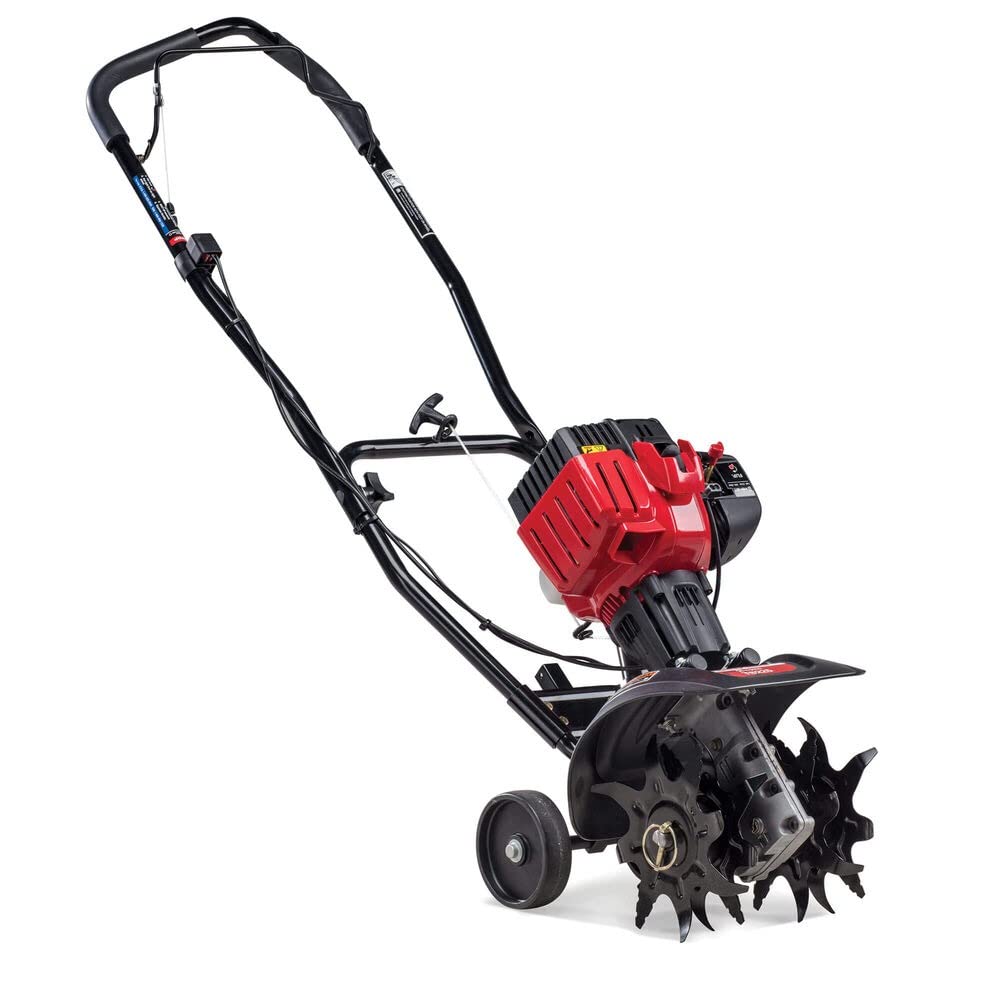
The smallest engine of the five, aimed at the gardener who is tired of yanking a starter cord.
Start-up is where the Troy-Bilt makes its case. SpringAssist technology reduces the pull needed to get the engine running — a real relief on a cold morning — and a Prime, Flip & Go system primes and starts the engine with fewer steps. The engine itself is a 25cc 2-cycle, half the displacement of the Thunderbay’s 52cc, so it is best matched to light cultivation and maintenance work rather than breaking new ground.
The tines set it apart. Four patented steel tines cultivate up to 5” of tilling depth with adjustable width and depth — one inch deeper than the GardenTrax’s 4” and a shallower reach than the Earthquake MC43’s 8”. The engine arrives with 2-cycle oil included, so you are not hunting for the right mix before the first run.
The 25cc engine on a lightweight frame is easy to manage, but it will feel underpowered if you ask it to break hard sod. It reads as a lighter-duty tool for a smaller plot — a raised bed, a flower border, a small vegetable patch. The generous starting aids are genuinely useful, but they add complexity at the carburettor end if the machine sits for a season.
Why It Works For Light Jobs
- SpringAssist and Prime, Flip & Go make cold starts easier than a plain pull cord.
- 4 patented steel tines up to 5” deep with adjustable width and depth.
- 2-cycle engine oil included in the box.
Where It Falls Behind
- 25cc engine is the smallest in this group and will struggle with hard, compacted ground.
- The extra starting systems add carburettor-side complexity if the machine sits unused.
The right call for: a small plot and a gardener who values an easy pull over raw digging power.
Think twice if: you are tackling sod or a big, overgrown plot — the 25cc engine is not built for that fight.
Understanding the Specs
Engine Displacement (cc)
Cubic centimetres measure the swept volume of the cylinder — a rough stand-in for muscle. A 52cc engine like the Thunderbay’s will grind through harder soil than a 25cc like the Troy-Bilt TB225. More cc also means more weight and more fuel burned, so match displacement to your ground rather than buying the biggest number you can find.
Tilling Width and Depth
Width is how wide a strip the tines turn in one pass; depth is how far down they reach. Wide and shallow suits flat vegetable rows. Narrow and deep suits breaking new beds and working close to established plants. A machine with both ranges — like the Earthquake MC43’s 6”–10” and 8” depth — handles the most jobs.
Transmission Type
A worm-drive transmission (a threaded shaft turning the tines, not a chain) gives smooth, non-hopping operation in loose ground. A metal gearbox adds durability on rough ground. The trade-off is that a chain or gear failure can leave the tines dead, so a machine with a known weak transmission is a risk on stony plots.
Weight and Transport
Two-stroke engines are lighter than four-stroke equivalents, and these machines land around 33 pounds. Transport wheels, foldable frames and U-turn handlebars are what make the weight manageable. A 33-pound machine lifts into a car boot; anything heavier tends to stay in the shed.
FAQ
What does “2 stroke” mean on a tiller?
How deep can these tillers actually dig?
Will a 2 stroke tiller handle hard, compacted ground?
How much does a tiller weigh and can one person lift it?
Can I use a 2 stroke cultivator for weeding between plants?
Why does my tiller bounce and jump instead of digging?
Do these gas tillers need tools to assemble?
How long is the warranty on a 2 stroke tiller?
Which is better for a long vegetable row, wide or narrow tilling?
Final Thoughts: The Verdict
The best 2 stroke tiller for most gardeners is the Earthquake MC43 — a 43cc Viper engine, adjustable 6”–10” width, 8” max depth and a 5-year limited warranty combine to make it the most complete machine here. If a big engine on a tight budget is your priority, grab the Thunderbay 52cc Cultivator and accept the build gamble. And for small plots where an easy pull matters more than raw power, the Troy-Bilt TB225 is the one to reach for. Match tilling depth to your soil, check the fasteners after each hard session, and buy the cc your ground actually needs.
How We Picked
We do not accept paid placement. Every pick is matched to a real buyer and a real use-case; we do not hands-on test units.
Sources & Methodology
Specifications: manufacturer listings and product documentation. Review insights: verified customer reviews, as of November 2026. Pricing: not shown on this page (it changes often); check the current price via the retailer link.
As an Amazon Associate, Gadgets Feed earns from qualifying purchases. This does not affect which products we feature.