
Our readers keep the lights on and my morning glass full of iced black tea. As an Amazon Associate, I earn from qualifying purchases.
Specs are compiled from manufacturer listings and verified buyer reviews and can change over time — please confirm the key details on the product page before buying.
Running lean under boost is how engines die quietly, and a wideband AFR gauge is the only dash instrument that tells you it is happening. Wideband means the sensor reads the actual air-to-fuel ratio across a broad range instead of just sniffing whether you are richer or leaner than 14.7:1. The Auto Meter 4379 Ultra-Lite is the pick for most people: it ships with a Bosch LSU4.2 sensor, a 304 stainless weld-in bung, and a 0-4v output feed for your ECU, and it holds a 4.5+ star rating across 200+ ratings.
I’m Min — the founder and writer behind Gadgets Feed. This guide is built by comparing the manufacturers’ published specifications and the patterns across verified customer reviews, so you get each pick’s real strengths and trade-offs instead of marketing spin.
Below you will find seven wideband kits sorted by what they actually do for your tune, from a value 52mm controller to an OBD-II pass-through unit. The right afr gauge turns a mystery misfire into a number you can read at a glance and fix.
Our Picks at a Glance


How To Choose The Best AFR Gauge
The gauge itself is a display; the sensor feeding it does the measuring. That single fact decides most of your buying decision. A kit built around a quality wideband oxygen sensor and a fast controller will tell you what is happening in the exhaust within milliseconds. A cheap controller paired with a slow sensor will lag behind the moment you lift off throttle — exactly when you need the number most.
Wideband first, everything else second
A narrowband gauge reads in a tiny window around 14.7:1 and only tells you rich or lean. A wideband controller reads a full sweep, so you see 11.2:1 under load or 15.8:1 at cruise as a real number. Every kit on this list is wideband. Wideband is the baseline here, not a bonus feature.
Sensor type — LSU4.2 versus LSU 4.9
You will see two Bosch sensor families in this roundup. The LSU4.2 is the older standard and still does the job in the Auto Meter kit. The LSU 4.9 is the newer unit found in several of the value kits, and with a matched controller it often needs no free-air calibration. Calibration is what trips up first-time installers, so if you want plug-and-play, look for a controller that ships pre-calibrated.
Analog output and datalogging
If you tune with a laptop, a piggyback, or an open-source platform, the analog output matters as much as the dial. A 0-5v linear output feeds a datalogger or standalone ECU directly. The Auto Meter kit offers a 0-4v data output feed; the Innovate 3796 offers two configurable linear 0-5v outputs; the FHRHRY offers 0-5v for data loggers and most engine management systems. If you only want a gauge to watch, any of them works. If you want a feed for your tune, check that number first.
Quick Comparison
| Model | Best For | Gauge Size | Analog / Data Output | Sensor Included | Amazon |
|---|---|---|---|---|---|
| Auto Meter 4379 Ultra-Lite★ Best Overall | All-round street and race tuning | 2.3125 in. | 0-4v data output feed | Bosch LSU4.2 | Amazon |
| AEM X-Series 30-0333Most Versatile Display | OBD-II pass-through tuning | — | OBD-II CAN-bus pass-through | UEGO wideband sensor | Amazon |
| GlowShift Tinted 7 Color | Matching a custom dash | 2-1/16″ 52mm | 3′ data logging wire | 4.9 LSU wideband | Amazon |
| Innovate Motorsports 3796 DB Red | Dual analog feeds for a standalone | — | Two configurable linear 0-5v | Bosch LSU4.9 | Amazon |
| Innovate MTX-L Plus 3918 | Long 8 ft sensor cable runs | 2-1/16″ | — | Wideband sensor | Amazon |
| FHRHRY 30-4110 Wideband UEGO | Low-cost 52mm digital display | 52mm (2-1/16″) | 0-5V analog output | 4.9 LSU | Amazon |
| Gledewen 30-0300 Wideband UGEO | AFR, lambda and O2% in one faceplate | 52mm (2-1/16″) | Analog output | LSU 4.9 | Amazon |
In‑Depth Reviews
1. Auto Meter 4379 Ultra-Lite Wide Band Air Fuel Ratio Kit, 2.3125 in.
Our pick — 4.5+★ from 200+ verified ratings; the strongest balance of quality and price.
A complete wideband kit in one box, sensor and bung included — the one that gets a street car tuned without a second order.
The number worth starting with is 2.3125 in. — the gauge diameter. That sizing means it drops into a standard Auto Meter pod or a custom dash cut without an adapter, so you are not hunting for a mounting ring mid-install. The rest of the box is unusually complete: a custom-tuned.1 AFR resolution Bosch LSU4.2 sensor, an 8ft. wiring harness, a 304 stainless steel weld-in bung, mounting hardware, and detailed installation instructions..1 AFR resolution means you read the ratio to a tenth of a point, which is the difference you are actually tuning to.
Owners consistently describe the install as straightforward, and the tuning crowd is the loudest cheerleader — the dial is credited with dialing in engine performance cleanly across idle, cruise and wide open throttle. Value holds up too, with buyers calling the extra spend over a bare gauge worth it since the sensor and bung come included. Where it gets less certain is accuracy; that aspect draws a mixed reaction rather than a chorus. Comparing it to the Innovate Motorsports 3796 pack: the Auto Meter measures 3.94 x 3.94 x 3.94 inches against 20.47 x 1.57 x 20.47 inches, and weighs 1.1 pounds versus 1.3 pounds, so it is the more compact of the two in the box.
What the dial does well
- Complete kit — sensor, 8ft. harness and 304 stainless weld-in bung all included.
- .1 AFR resolution digital segment display plus an LED radial bar graph for at-a-glance sweeps.
- Runs on 12 and 16 volt systems, so it suits nearly any street or race car electrical setup.
Where it asks more of you
- Accuracy feedback splits rather than unites; expect to verify against a known reading.
- Gasoline engines only — this one is not built for a flex-fuel setup.
- Weld-in bung means cutting and welding the exhaust, not a clamp-on fit.
Go with this one if: you are tuning a gasoline street or race car and want the sensor, bung and harness in one order.
Pass if: you run E85 or flex fuel, since this gauge is specified for gasoline engines only.
2. AEM X-Series Wideband UEGO AFR Sensor Controller Gauge with OBDII Connectivity
Routes the wideband signal into your factory ECU over CAN — the tuning nerd’s shortcut.
What sets this AEM apart is not the dial at all. It is the OBD-II pass-through, which feeds AFR readings into your factory ECU’s CAN-bus — CAN-bus being the car’s internal network the ECU already speaks. That matters if you run a piggyback programmer or open-source tuning software, because the AFR reading lands in your datalog without splicing a separate analog line. AEM rates it the quickest-responding wideband controller in its lineup.
The reputation here is a quality-first one. Owners put confidence in the build above anything else, with the accuracy and the ease of install singled out next. If you tune with HP Tuners or an MPVI2, this is the pairing that keeps coming up. Serial output functionality is the weak spot — some setups hit trouble reading out that way, so check your platform before you rely on it.
The honest read: value opinions divide sharply here, and the OBD-II route is a specific tool for a specific tuner rather than a universal fit. If your car’s CAN-bus does not cooperate, you are paying premium money for OBD-II features you cannot use.
Built for the CAN-bus crowd: pick it when your tuning software wants a clean ECU-side feed and you already trust your network integration.
Think twice if: you need a plain analog dial with no datalogging ambitions — a simpler kit covers that for far less.
3. GlowShift Tinted 7 Color Digital Wideband Air Fuel Gauge Kit, 2-1/16″ 52mm

Seven colors, a dimmer wire, and a smoked lens — the one that blends into a factory dash instead of shouting at it.
GlowShift targets the interior-first buyer. Seven solid color modes plus two color cycle modes — blue, red, green, teal, purple, white and yellow — let you match factory dash lighting or set your own look. The detail that lands best in daily driving is the dimmer wire: hook it to the headlight switch and the gauge dims 30% when the lights come on, so it stops glaring on a night drive.
The kit itself is thorough. Inside is a 4.9 LSU wideband oxygen sensor, weld-in bung, control box, 10′ sensor harness, 7′ gauge-to-control-box harness, 5′ power harness, 3′ data logging wire, gauge visor, mounting bracket and hardware, plus step-by-step instructions. That 4.9 LSU sensor is the newer Bosch family, and no free-air calibration is needed with the matched controller. The 2-1/16″ 52mm body fits the standard pod size.
Where it earns its keep: the harness lengths mean you can mount the gauge far from the sensor without extending anything.
The trade-off to size up: the tinted lens and color options add cost over a plain black-face kit. If you do not care how the dash looks, the tinted lens and color modes buy you nothing.
Dash-matching buyers, this is yours: the color and dimmer setup is the whole pitch.
No reason to bite if: you want the plainest gauge and the lowest spend — the tinted face is the premium you are paying for.
4. Innovate Motorsports (3796) DB RED Wideband Air/Fuel Gauge Kit includes LC-2 & Bosch LSU 4.9
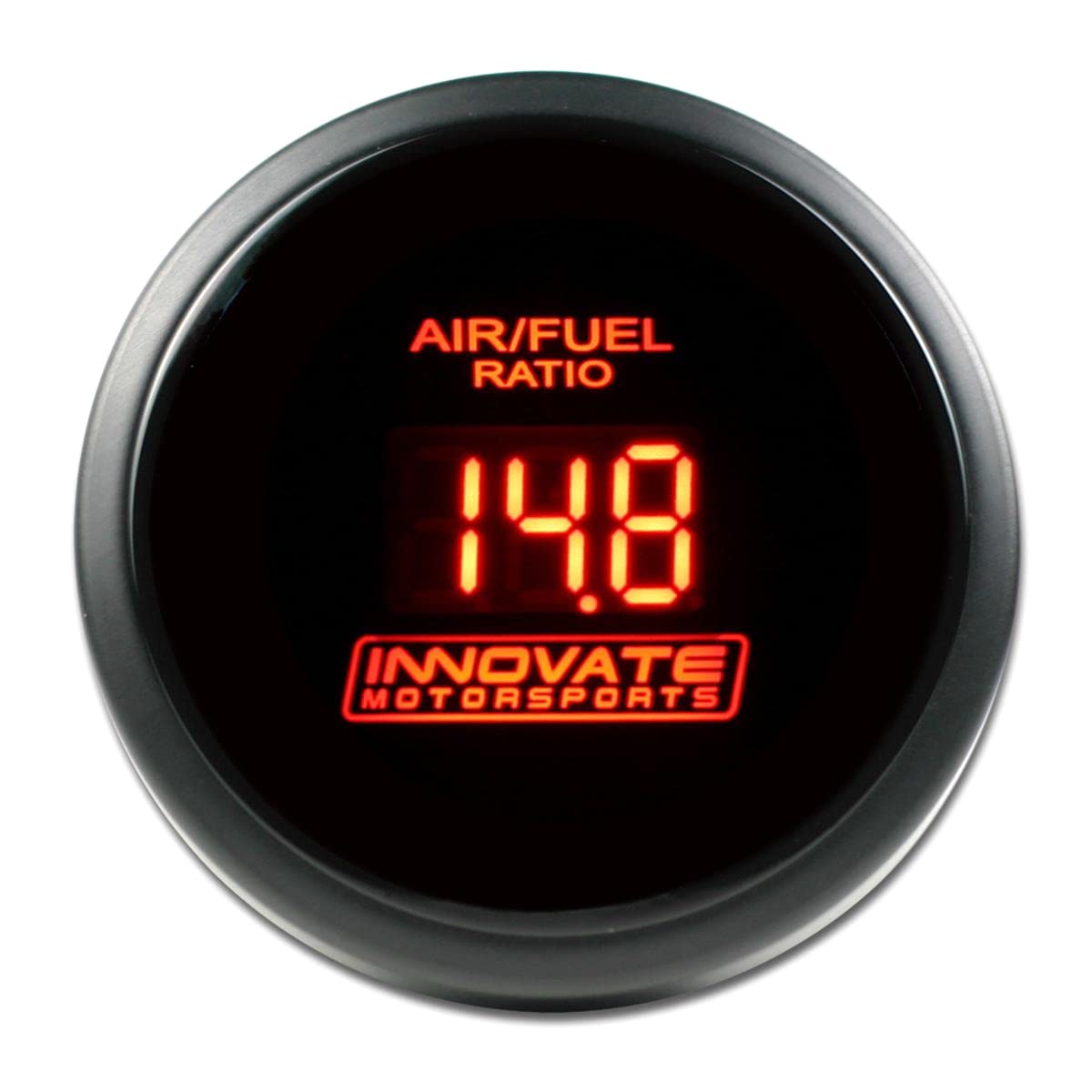
Two configurable 0-5v feeds and a Bosch LSU4.9 you can calibrate yourself — a standalone ECU’s best friend.
Innovate built the 3796 around the LC-2 controller, and the headline feature is the pair of configurable linear 0-5v analog outputs. Two feeds means you can wire one to your standalone ECU and one to a datalogger at the same time — analog output being the voltage signal a tuning device reads. The kit also includes the gauge, a Bosch LSU4.9, sensor cable, weld-on bung, programming cable and manual.
Calibration is in your hands here: the sensor can be recalibrated for maximum accuracy, which is what the Patented DirectDigital Wideband Technology is aimed at. The trade-off is bulk and weight. At 20.47 x 1.57 x 20.47 inches and 1.3 pounds, it is a larger box than the Auto Meter 4379 at 3.94 x 3.94 x 3.94 inches and 1.1 pounds. The wording on the listing is clear on install — the instruction manual walks you through it, and buyers report the setup is straightforward.
The pick for two-device rigs: dual linear outputs that keep the ECU and the logger both fed.
Careful if: you want a plug-in-and-go dial and no calibration routine — the manual calibration freedom cuts both ways.
5. Innovate Motorsports 3918 39180 MTX-L Plus: Advanced Digital Wideband Air/Fuel Ratio Gauge Kit, 8 FT. Sensor Cable

Eight feet of sensor cable solves the rear-mount problem that shorter kits hand you.
The defining spec is buried in the model name: MTX AIR/FUE2-1/16 8FT/. That 8 ft. sensor cable is the reason to shortlist it. If your wideband bung is at the back of the exhaust and the gauge lives up front, eight feet gives you the reach without a splice. The gauge is 2-1/16 inch, the same standard pod size as most of this list.
This one is the biggest seller in the roundup by a distance — 4.0+ stars across 400+ ratings. Owners like how it looks and how it goes in, and the functional side gets praise from the buyers it works for. The picture is genuinely split, though: reliability draws mixed feedback, with some units running well and others giving up in a couple of weeks. Sensor durability is the more serious recurring theme, with failures showing up inside a couple of months. Accuracy and value for money both lean negative on the review pages.
Why people still buy it
- 8 ft. sensor cable covers rear-mounted bung positions.
- Standard 2-1/16 inch gauge body drops into common pods.
- Appearance gets consistent approval from owners.
What you need to weigh up
- Reliability feedback splits — some units run, others fail around two weeks.
- Sensor durability is the more concerning pattern, failing within a couple of months for some.
- Accuracy and value for money both trend negative rather than positive.
Worth it for the cable run: an 8 ft. sensor lead that no other kit on this list matches.
Look elsewhere if: you want settled confidence on sensor longevity — the FHRHRY or the Auto Meter face less of that question.
6. FHRHRY Wideband UEGO Air/Fuel Ratio Gauge 52mm (2-1/16″) with 4.9 LSU Sensor

A 52mm digital face with a color-shifting needle and a real 4.9 LSU sensor inside.
FHRHRY keeps the parts list short and the price low, then puts the money into the display. The digital LED face carries an LED “needle” that shifts color as the ratio moves from rich to lean — so a glance tells you direction before you read the digits. Each unit ships with black and silver bezels plus black and white faceplates, so you can swap the look. The housing is 52mm (2-1/16 inch), which fits most instrument pods and can be mounted almost anywhere remotely.
The 4.9 LSU sensor is the same family used by pricier kits here, and it tracks even a 0.1 air-fuel ratio change. The 0-5V analog output feeds dataloggers and almost all engine management systems. Where it is weakest is the honest tune-up: reliability is genuinely split — some units run flawlessly, others quit almost immediately. The heaviest feedback by volume is reliability, and quality, value and accuracy all land mixed rather than clear. Sensor durability is the recurring sore point, with buyers reporting breakage inside a week of use.
The realistic picture: at entry-level money you get a real wideband sensor and a flexible display, and you accept a wider spread of outcomes.
What that means for you: if the gauge is a diagnostic aid and not the last line of defense for a built motor, the display and sensor here are a sensible trade.
Try this if: you want a 52mm color display and a documented 4.9 LSU sensor without paying premium money.
Hold off if: a failed sensor would strand a high-dollar build — this is a watching gauge, not a guarantee.
7. Gledewen 30-0300 Wideband UGEO Air Fuel Ratio Gauge 52mm (2-1/16″), AFR/Lambda Controller Kit with LSU 4.9 Sensor

One faceplate, three readouts — AFR, lambda or oxygen percentage at the tap of a button.
Gledewen wins on flexibility. The reversible two-sided faceplate carries a sweeping 24-color-coded LED display and a four-digit central readout. Flip between three display modes — air-fuel-ratio, lambda, or oxygen percentage — and you can watch your engine in whichever language your tune is written in. Lambda is the ratio form used by many standalone and wideband tuning platforms, so having it on the dial saves mental math.
The controller pairs a built-in LSU4.9 UEGO sensor with a quoted response of 20ms typical, and the measuring accuracy is specified at ±1% over a 0.55 to 2.00 Lambda range. The 52mm housing fits a standard pod. Two calibration modes — resistor trim (rCAL) or free air (ACAL) — are available, but for most users the unit arrives pre-calibrated via the trim resistor and needs no further action. A 12-month warranty covers replacement or refund if it fails.
What earns it a place
- Three display modes on one reversible faceplate.
- ±1% accuracy across 0.55 to 2.00 Lambda.
- 20ms typical response on the LSU4.9 sensor.
The part to go in wary of
- Durability is a genuine mixed bag — sensors breaking early is worth keeping in mind.
- Analog output is the only data route; no OBD-II pass-through.
- Accuracy feedback splits, so verify against a known reading.
Good fit for: tuners who switch between AFR and lambda readouts and want both on one gauge.
Not ideal if: you need a sensor you can count on long-term — the durability pattern makes this a monitoring tool rather than a set-and-trust unit.
Understanding the Specs
Air-Fuel Ratio and Lambda
Air-fuel ratio is the number of air parts to fuel parts in your exhaust — 14.7:1 is the theoretical ideal for gasoline at cruise, and rich mixtures under load read lower. Lambda expresses the same thing as a ratio to that ideal: 1.00 Lambda is the same as 14.7:1, 0.85 Lambda is rich, 1.10 is lean. If your tuning platform speaks lambda, a gauge that reads in lambda saves you converting in your head. The Gledewen reads from 0.55 to 2.00 Lambda.
Sensor Type and Response
The wideband oxygen sensor is the part that actually measures. The Bosch LSU4.2 is the older standard, while the LSU 4.9 is the newer unit used in several kits here. Response speed matters because the mixture changes the instant your foot moves — the Gledewen quotes 20ms typical on its LSU4.9, which is fast enough that you see the shift as it happens rather than after. Calibration is the companion question: some controllers calibrate themselves from a trim resistor, others ask for a free-air routine.
FAQ
Do I need a wideband AFR gauge or is a narrowband enough?
Will a 52mm gauge fit my existing instrument pod?
What does the LSU 4.9 sensor do differently from the LSU4.2?
Can I use an AFR gauge on an E85 or flex-fuel car?
What does a 0-5v analog output actually let me do?
Is the OBD-II AEM gauge better than an analog kit?
How long do these wideband sensors usually last?
Do I have to weld a bung onto the exhaust for every kit?
Can an AFR gauge show lambda as well as air-fuel ratio?
What should I do if the gauge reads lean at idle but fine under load?
Final Thoughts: The Verdict
The fullest package for most people is the Auto Meter 4379 Ultra-Lite: a matching Bosch LSU4.2, an 8ft. harness and a 304 stainless weld-in bung arrive together, and.1 AFR resolution carries the tuning table. If your tuning software lives on CAN-bus, take the AEM X-Series and its OBD-II pass-through. And if you want three readouts on one dial with a 12-month warranty behind it, the Gledewen 30-0300 puts AFR, lambda and O2% on the same faceplate. Whatever you pick, mount the sensor properly and expect the wideband sensor to be the part that wears — that is the normal cost of watching your mixture.
How We Picked
We do not accept paid placement. Every pick is matched to a real buyer and a real use-case; we do not hands-on test units.
Sources & Methodology
Specifications: manufacturer listings and product documentation. Review insights: verified customer reviews, as of November 2026. Pricing: not shown on this page (it changes often); check the current price via the retailer link.
As an Amazon Associate, Gadgets Feed earns from qualifying purchases. This does not affect which products we feature.