
Our readers keep the lights on and my morning glass full of iced black tea. As an Amazon Associate, I earn from qualifying purchases.
Specs are compiled from manufacturer listings and verified buyer reviews and can change over time — please confirm the key details on the product page before buying.
You want real bass thump on the couch, at an open mic, or in a small room without hauling a cabinet — and the right acoustic-electric gets you there. The short answer: buy for the neck and the pickup, not for the body size. A bass that fights your hands goes unplayed, and one with a weak preamp sounds thin the moment you plug in. This guide breaks down nine acoustic-electrics that actually hold their low end, and it tells you plainly which one is worth your money and which one fits a specific job.
I’m Min — the founder and writer behind Gadgets Feed. This guide is built by comparing the manufacturers’ published specifications and the patterns across verified customer reviews, so you get each pick’s real strengths and trade-offs instead of marketing spin.
Every pick below has a body that rings when unplugged and onboard electronics for the times you need volume. Here is the honest breakdown of the acoustic electric bass market, sorted by what each instrument genuinely does best.
Our Picks at a Glance


How To Choose The Best Acoustic Electric Bass
An acoustic-electric bass is two instruments in one. Unplugged, the hollow body gives you a warm woody thump you can practice with at night. Plugged in, an onboard pickup (a sensor under the saddle that reads string vibration) and preamp (a small powered circuit that shapes and boosts that signal) send your playing to an amp or a PA. The order you should care about things is not the order the listings show them.
Start with the neck, not the body
Your fretting hand decides whether you keep playing this thing. A slim neck profile and a comfortable scale length matter more than a fancy top. Scale length is the vibrating length of the string, measured from nut to bridge saddle, and it sets both your string tension and your reach. Full-scale acoustic basses use a 34-inch scale, which feels like an electric bass. Short-scale and mini basses shrink that number, and shorter means looser strings that need special string gauges to tune up cleanly.
Then look at the electronics
A passive piezo alone gives you a quiet, natural signal. An active preamp with an onboard tuner gives you volume control on stage and a tuning check without a pedal. If you plan to gig, the preamp is worth more than any cosmetic upgrade. Check that the output is a standard 6.35mm (quarter-inch) jack so any bass amp or DI box accepts it.
Match the body to how you actually play
A big full-size body projects more unplugged and feels like a traditional acoustic. A compact or mini body is easier to carry and to play seated, but it trades some acoustic volume for that convenience. Neither body size is better — a full-size body buys unplugged volume, a compact one buys portability. If the bass travels to gigs in a case, a compact body’s portability wins. If it never leaves the living room, a full-size body’s acoustic projection wins.
Quick Comparison
| Model | Best For | Body Wood | Scale / Size | Weight | Amazon |
|---|---|---|---|---|---|
| Fender CB-60SCE★ Best Overall | All-round first acoustic bass | Solid spruce top, mahogany back/sides | 3/4 size | 4 kg | Amazon |
| Ibanez AEGB24EStage Ready | Plugged-in stage work | Sapele top, back and sides | Full size | — | Amazon |
| Sawtooth Rudy Sarzo SignaturePlayer’s Reach | Fretted electric-style reach | Maple | 34″ scale, 24 frets | — | Amazon |
| Ibanez Acoustic-Electric Bass | Rich plugged-in tone on a budget | Spruce top, mahogany back/sides | Full size | 9 pounds | Amazon |
| Cordoba Mini II Bass MHE | Travel and small hands | All mahogany | 580mm (22 7/8″) scale | 2.4 pounds | Amazon |
| Oscar Schmidt OB100N-A-U | Full-size unplugged volume | Mahogany | Full size | 8.4 pounds | Amazon |
| TARIO Fretless 5 String | Fretless five-string feel | Laminated spruce top, mahogany back/sides | 34″ scale, 5 strings | — | Amazon |
| Harmonia Left-Handed 4 String | Left-handed players | Laminated mahogany | 34″ scale | — | Amazon |
| Kala U-BASS Nomad | Grab-and-go portability | All mahogany | Ukulele bass | 5.1 pounds | Amazon |
In-Depth Reviews
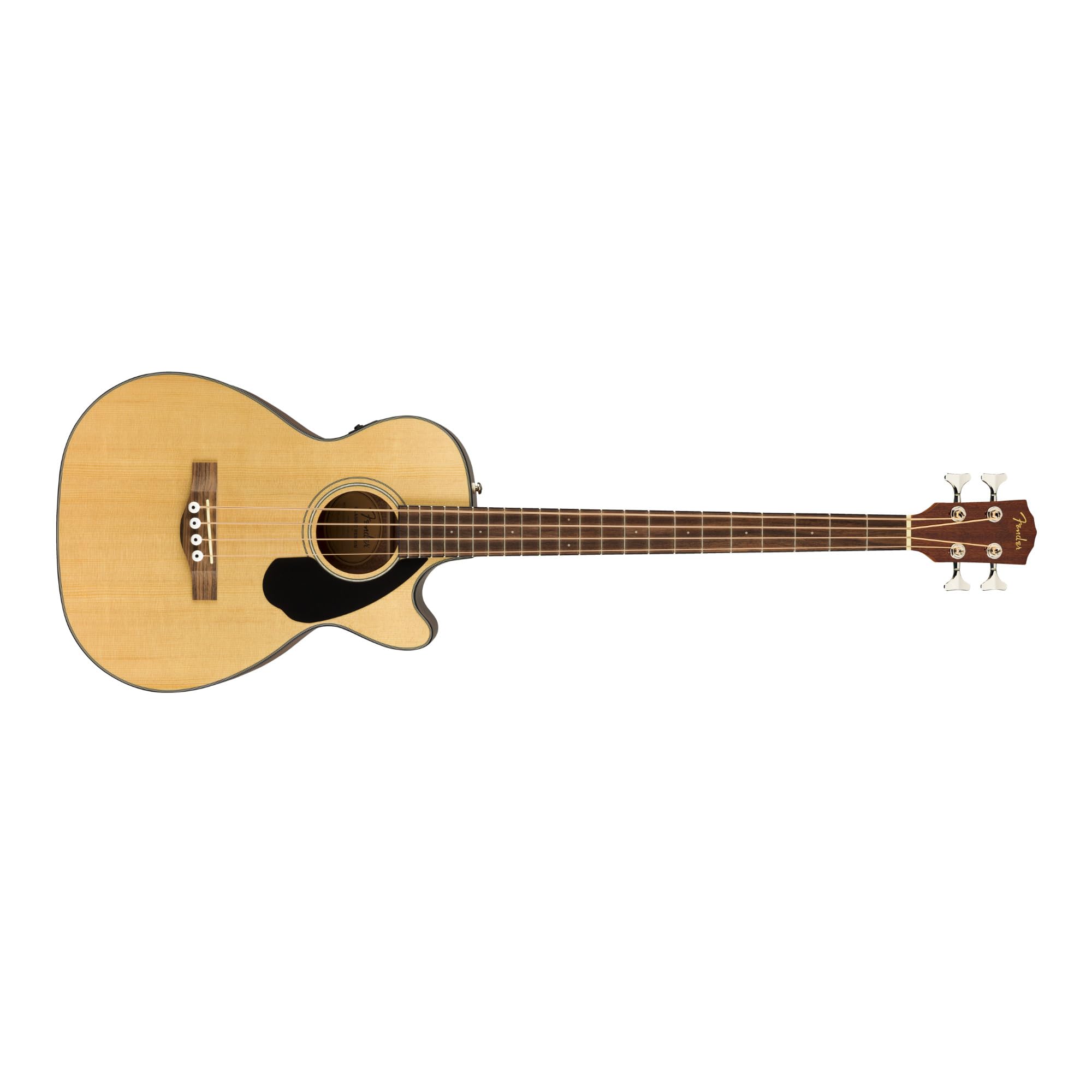
1. Fender CB-60SCE Acoustic Bass, Natural
Our pick — 4.5+★ from 500+ verified ratings; the strongest balance of quality and price.
A slim-taper neck and a real solid spruce top make this the one most people should buy first.
The thing that wins people over here is tone. A solid spruce top — a single piece of real wood rather than layered ply — vibrates more freely, so the bass sounds open and woody both unplugged and through an amp. Mahogany back and sides add warmth underneath that top end. The numbers back up the reputation: this model sits at 4.5+ stars across 500+ owners, which is the strongest combination of score and volume in this entire group.
Where it separates from the Oscar Schmidt and other full-size bodies is the neck. Fender puts its slim-taper, easy-to-play profile on this bass — the same shape used across its Classic Design guitars. Slim means your hand closes around it without stretching, so barre chords and long rehearsals cost you less. For a 3/4-size body, that plays smaller and friendlier than the scale label suggests. A flexible Fishman electronics system handles the plugged-in side, and a built-in tuner saves you reaching for a clip-on.
The honest catch is setup consistency. Action (string height off the fretboard) draws mixed feedback — some players find it quick and low, others find it high out of the case. Durability has also drawn scattered concern, including a report of a top cracking within a couple of years. Treat a solid top with normal humidity care and it is a non-issue for most owners. Also budget a proper setup if the strings feel stiff on day one.
full natural acoustic tone
- Solid spruce top with mahogany back and sides gives a warm, open voice unplugged and amplified
- Slim-taper neck profile keeps long practice sessions comfortable
- Fishman electronics with a built-in tuner for stage and rehearsal
- Natural finish on a 3/4-size body that is easier to handle than a full-size acoustic
needs setup patience
- Action varies from unit to unit — a professional setup may be needed
- A solid top needs sensible humidity care to stay crack-free
- Heavier than the compact basses in this list
pick for plugging in: you want one acoustic-electric bass that does practice, open mics and small gigs without a compromise.
skip for slap: you need something that fits in an overhead bin — the compact picks below handle that job.
2. Ibanez AEGB24E AEG Acoustic-electric Bass, Mahogany Sunburst
Built to be plugged in — a piezo under-saddle pickup and onboard tuner make this a stage tool first.
If your bass spends most of its life going into a PA, the AEGB24E is the most purpose-built instrument here. Ibanez fits an under-saddle piezo pickup — a thin sensor beneath the bridge that reads the strings’ pressure — paired with an Ibanez preamp and an onboard tuner. That combination means you can shape your tone and check your tuning from the bass itself, with no pedalboard in sight.
The body is sapele, a mahogany-family wood, on the top, back and sides. Sapele tends to sound focused in the mids, which is exactly where a bass needs to sit in a mix without turning muddy. The neck is a nyatoh/maple build with a walnut fingerboard. Across this list, only this Ibanez and the Fender put a tuner right on the instrument body. The Mahogany Sunburst gloss finish rounds it out visually.
What you give up is unplugged muscle. A full-size sapele body projects decently, but the real voice arrives through the electronics — the acoustic sound is the warm-up, not the show. That is a fair trade for a gigging instrument. Note also that this model has fewer published reviews than its sibling below, so you are buying on spec and design rather than a long track record.
stage-ready preamp: Piezo pickup, Ibanez preamp and an onboard tuner make this the least fuss to get gig-ready.
bulky body depth: Its strengths are electronic, so the unplugged tone is a bonus rather than the headline.
grab for gigs: your calendar is full of plugged-in sets and you want tuning and tone control on the instrument.
pass for couch: you mainly play unplugged and want maximum acoustic projection.
3. Sawtooth Rudy Sarzo Signature Acoustic-Electric Bass
A 34-inch scale and 24 frets give this the reach of an electric bass inside a maple acoustic body.
Full-scale reach is the story. A 34-inch scale length matches a standard electric bass, so anyone coming from an electric feels at home immediately — same fret spacing, same string tension habits. Add 24 frets and you get two full octaves, which is more upper-register room than most acoustic basses offer. The 12-inch fretboard radius gives the neck a comfortably flatter curve under your fingers, and a 43mm bone nut sets the string spacing at the top end.
Maple body and back push the voice brighter than the spruce-topped basses here — think punch and definition over deep warmth. The flame maple inlays and markers mark it out on a dark stage. Owners who have played it describe the low E string as rich and resonant, and the overall sense is of a bass that punches above its price bracket on build and tone.
The trade-off is simple: this is a player’s bass for fretted work, not a compact travel instrument. It runs full size and full scale, so it takes up real space and demands a proper strap. If you specifically want fretless mwah or a five-string, this is the wrong shape altogether.
choose for metal: a full-scale, 24-fret acoustic-electric for electric-bass players who want familiar reach.
avoid for folk: full size and full scale mean it is a bass you plan around, not toss in a backpack.
4. Ibanez Acoustic-Electric Bass Guitar, Dark Violin Sunburst

Spruce and mahogany with a real Fishman pickup chain — a mid-range bass that sounds like it costs more.
Here is where a spruce top changes the conversation. The spruce top over mahogany neck, back and sides delivers the woody authority players associate with traditional acoustic basses, and owners consistently describe the sound as the best they have played in this class. The electronics are the serious part: a Fishman Sonicore pickup feeding an SST preamp, a pairing that smooths the piezo’s natural harshness into something warm and controllable.
Details are thoughtful too — a rosewood fretboard and bridge, pearl dot inlays, die-cast chrome tuners and an onboard tuner. Die-cast tuners hold pitch better than cheap open-gear ones, which matters on a bass with heavy strings. The gloss Dark Violin Sunburst finish reads more like a stage guitar than a starter instrument.
Weight is the one number to note: 9 pounds. That is heavier than every compact bass in this list and it will remind you on long standing sets. It is also a full-size body, so it wants a good strap and a stand rather than a gig bag hook.
dark violin finish: A spruce top and a Fishman Sonicore/SST electronics chain for a warm, professional plugged-in tone.
heavy tuning pegs: At 9 pounds it is a full-size bass that asks for a proper strap.
go for looks: players who want classic spruce-and-mahogany tone with dependable Fishman electronics.
dodge for travel: anyone chasing the lightest possible carry — the compact picks here beat it on that score.
5. Cordoba Mini II Acoustic Electric Bass MHE

Two and a half pounds of bass you can play anywhere — the scale length is what makes it work.
The portability is almost silly. At 2.4 pounds, the Mini II is the lightest real bass here, and it is the one that lives in a carry bag instead of a case. The clever engineering is a 580mm (22 7/8-inch) extended scale length — short enough to stay tiny, long enough that it tunes perfectly to Standard E. That is the detail that separates a proper travel bass from a toy.
The body is deeper than most minis, which gives you a well-rounded tone when you play it unplugged. Plug in and the Cordoba MB103 pickup brings out a surprisingly rich voice. All-mahogany construction keeps the sound mellow, soft and balanced rather than boomy. Owners rank it high on quality and sound, and it is the pick for players who want to play anywhere without lugging gear — small hands and short reaches get on with it especially well.
Two things to know. First, tuning draws mixed feedback, which is normal for short-scale instruments — a little patience and a fresh set of the right strings settles it. Second, natural wood varies, so the color and grain of the bass you receive may be lighter or darker than the photo. Both are small gaps for a travel bass, not dealbreakers.
tiny travel frame
- 2.4 pounds makes it genuinely carry-anywhere
- 580mm scale length tunes to Standard E
- Cordoba MB103 pickup gives a rich plugged-in voice
- All-mahogany build stays mellow and balanced
quiet unplugged volume
- Short scale means tuning needs a little more attention
- Wood grain and color vary from the photo
- Less natural acoustic low-end than a full-size body
take on trips: travelers, small-handed players and anyone who wants a bass on the couch, the train or the hotel room.
leave for stage: you need full-size acoustic volume for an unplugged jam.
6. Oscar Schmidt OB100N-A-U 4-String Acoustic-Electric Bass

A full-size mahogany body that leans on unplugged volume and ships with its own gig bag.
This one is about mass and projection. A full-size mahogany body gives you the physical air movement that compact basses just do not make, so it is the bass to grab for an unplugged porch session. Steel strings and a standard bridge and pickup setup keep it conventional. It comes with a gig bag, which is one less thing to buy. For context on the weight question: at 8.4 pounds the Oscar Schmidt runs far heavier than the 2.4-pound Cordoba Mini II — that is the cost of all that acoustic body volume.
Compared with the spruce-topped Fender and Ibanez picks above, mahogany gives a deeper, warmer lean with less top-end sparkle. If you like a dark, thumpy upright-adjacent feel, that is a gift rather than a flaw.
The caveat here is track record. This instrument carries a modest 3.0+ star rating, and there is not much owner commentary to lean on, so you are buying on spec and reputation rather than a long pattern of reviews. That is not a sign of a bad bass, but it does mean checking it carefully on arrival and giving it a proper setup matters more than usual.
start here cheap: maximum unplugged acoustic thump from a full-size mahogany body, with a gig bag in the box.
upgrade past this: you want a long, well-documented review trail to back your purchase.
7. TARIO Fretless 5 String Electric Acoustic Bass

Fretless and five strings in one bass — a combination almost nobody else in this list offers.
Two choices set this apart instantly. Fretless means no metal frets on the fingerboard, so you slide into notes and get that vocal, sliding mwah that fretted basses cannot make. Five strings add a low B underneath your usual range. You get a 34-inch scale and a composite rosewood fingerboard, and the matte black laminated spruce and mahogany body gives it a stage-friendly look. Playability and sound draw praise, and the value reads strong for a fretless five.
It ships with a 9V battery for the active electronics, so it is ready to plug in. The matte black finish is a love-it look, and it stands out against the spruce-and-natural crowd. With a 1/4-inch jack, it goes straight into any bass amp.
The honest note: build quality divides opinion. Some owners love the feel; others find it cheaply made, and bridge durability has been raised. For a fretless instrument this is worth weighing — fretless playing relies on a precise, stable fingerboard — so check the neck and bridge carefully from the start. It is also not the bass for a beginner fretting-hand player, since the lack of frets demands good intonation.
try for jazz: a fretless player, or anyone adding a five-string with a distinctive sliding voice.
skip for beginners: beginners who still need frets to find their notes.
8. Harmonia Left-Handed 4 String Electric Acoustic Bass

Left-handed acoustic-electric basses are rare — this one gives southpaws a proper four-string option.
Availability is the headline. A left-handed 4-string acoustic-electric is a narrow slice of the market, and having a spruce-top, mahogany-back option at all is the win here. The build is a laminated spruce top with laminated mahogany back and sides and a composite rosewood fingerboard and bridge saddle. A polished black finish keeps it looking sharp.
A 34-inch scale length on a 48-inch overall length puts it in standard full-scale territory, and it ships with a 9V battery for the active electronics. Quality is what owners talk about, and the value proposition holds up — people describe it as not bad for what it costs. For a lefty who has been stuck with right-handed hand-me-downs, that is the point.
The subtle catch is that laminated woods (layered rather than solid) trade some of the responsive ring of a solid top for stability and cost. That is a fair compromise at this tier. Also note the fingerboard length runs 25 inches, so the upper-register reach is shorter than a 24-fret bass. And with a small review base, expect to check the action and intonation on arrival.
buy for lefties: left-handed players who finally want an acoustic-electric bass built the right way round.
avoid for righties: laminated woods and a small track record mean a hands-on check when it lands.
9. Kala U-BASS Nomad Mahogany U-Bass

A bass the size of a ukulele that still delivers real low end — and it fits in a carry-on.
Big tone in a tiny shell is the whole pitch, and it holds up. The all-mahogany body with round-wound metal strings produces a warm, articulate bass with clear note definition — the “lot of bass in a small package” line buyers keep coming back to. At 5.1 pounds and just 29.38 inches long, it slips into an overhead compartment and travels without drama. Set against the full-size Fender at 52 inches, the length difference is obvious and real.
The electronics make it stage-ready: a built-in preamp and tuner let you plug into an amp or PA and just play. Simplicity is the charm — a straightforward layout you do not have to fiddle with. Playability and portability are the two things owners single out most, and the satin natural finish looks better than its compact proportions suggest.
The things to know are inheriting from its size and its short scale. Tuning draws mixed feedback, which is standard for a ukulele-scale bass and settles with patience and the right strings. Expect a fatter low end through the electronics than unplugged; the acoustic voice is quieter than a full-size body. Both are simply the nature of a ukulele-scale bass.
ukulele-scale portability
- All-mahogany build with round-wound strings gives full, piano-like low end
- Built-in preamp and tuner for amp or PA without extra gear
- 5.1 pounds and 29.38 inches long — carry-on friendly
- Satin natural finish over a compact, easy-to-play body
rubber string tension
- Short scale needs more tuning attention than a full-scale bass
- Quieter unplugged than a full-size acoustic body
- Its voice is a niche one — not a full-size acoustic substitute
pack for jams: the gigging bassist with no space and the traveler who wants real low end in a carry-on.
not for arco: anyone who wants full-size acoustic projection in the living room.
Understanding the Specs
Scale length
This is the vibrating length of your string, measured from the nut at the top of the neck to the bridge saddle at the body. It sets how far you reach between notes and how much tension the string holds. A 34-inch scale mirrors a standard electric bass, so players moving over feel at home. Short scales like the 580mm (22 7/8-inch) on the Cordoba Mini II make a compact body playable in Standard E, but lighter tension means tuning needs more care. This single number predicts more about how a bass feels than any other spec.
Pickup and preamp
A piezo pickup is a thin sensor, usually under the bridge saddle, that reads how hard your strings press down and converts that into a signal. A preamp is the small powered circuit on the body that boosts and shapes that signal, and it usually includes controls and often a tuner. Passive means no battery and a natural but quieter output. Active means more volume and control for a battery. For stage work, the preamp earns its keep; for living-room playing, the acoustic body does the work.
Tonewoods
Spruce is stiff and light, so it drives the top and gives a bright, resonant voice — you see it on the Fender and both Ibanez picks. Mahogany and sapele are denser and warmer, pushing the low end forward and softening the top end. Maple, on the Sawtooth, brings punch and clarity. Solid tops vibrate more freely than laminated ones, which is why the Fender’s solid spruce top sounds open. Know that laminate, used on the left-handed Harmonia and the TARIO, trades some ring for stability.
Short-scale and fretless quirks
Short scales and fretless fingerboards change how you play, not how good the bass is. Shorter strings need a slightly lighter touch and more frequent tuning checks. Fretless has no metal frets, so you place notes by ear and slide for a vocal tone — that demands trained intonation. Five strings add a low B for extra range. None of these are defects; they are job descriptions, and matching them to your skill level is the spec to check before you buy.
FAQ
Will a short-scale acoustic bass like the Cordoba Mini II stay in standard tuning?
Do I need an amp to use an acoustic-electric bass?
What is the difference between a piezo pickup and a magnetic pickup?
Is a fretless acoustic bass harder to play than a fretted one?
Will a five-string acoustic bass need different strings?
Can I use a battery-powered preamp bass without changing the battery often?
How do I care for a solid spruce top so it does not crack?
What scale length should a beginner choose on an acoustic-electric bass?
Does an acoustic-electric bass work through a PA instead of a bass amp?
Why do some acoustic basses sound thinner unplugged than plugged in?
Final Thoughts: The Verdict
For most players, the acoustic electric bass to buy is the Fender CB-60SCE because a solid spruce top, a slim neck and Fishman electronics cover practice, open mics and small gigs in one instrument — and it carries the strongest score in this group. If you plan to live on stage, the Ibanez AEGB24E puts the preamp and tuner on the body where you need them. For a bass that travels in a carry-on, reach for the Cordoba Mini II. And left-handed players finally have a proper four-string acoustic-electric in the Harmonia. Pick the one whose body size and scale length match where you actually play — that is the choice that keeps the bass out of the case.
How We Picked
We do not accept paid placement. Every pick is matched to a real buyer and a real use-case; we do not hands-on test units.
Sources & Methodology
Specifications: manufacturer listings and product documentation. Review insights: verified customer reviews, as of November 2026. Pricing: not shown on this page (it changes often); check the current price via the retailer link.
As an Amazon Associate, Gadgets Feed earns from qualifying purchases. This does not affect which products we feature.