
Our readers keep the lights on and my morning glass full of iced black tea. As an Amazon Associate, I earn from qualifying purchases.
Specs are compiled from manufacturer listings and verified buyer reviews and can change over time — please confirm the key details on the product page before buying.
A 1 1/2-inch hole is a big bite, and the wrong bit makes it obvious — scorched wood, a wandering start point, or a shank that spins in the chuck. The fix isn’t a bigger drill; it’s picking the bit shape that matches your material. A Forstner for clean wood, a diamond core for tile, an annular cutter for steel plate, a twist bit for general metal. That single match decides whether the hole comes out smooth or scrapped.
I’m Min — the founder and writer behind Gadgets Feed. This guide is built by comparing the manufacturers’ published specifications and the patterns across verified customer reviews, so you get each pick’s real strengths and trade-offs instead of marketing spin.
Below you’ll find nine verified 1-1/2 inch bits sorted by material and shank type, so you can skip the guesswork and buy the one your job actually needs. Every pick here is a true 1.5-inch cutting diameter, which is the first thing to confirm before you spend a cent on a 1 1/2 drill bit.
Our Picks at a Glance


How To Choose The Best 1 1/2 Drill Bit
A 1-1/2 inch bit is where drilling stops being casual and starts demanding the right tool for the material. The single most important decision you will make is bit style — because a wood bit will not survive steel, and a diamond core will not cut a clean cabinet hole. Match the style to the material first, then check the shank against your chuck, and the rest falls into place.
Match the bit style to the material
For clean, flat-bottomed holes in hardwood, a Forstner bit is the tool of choice — its serrated rim and spur keep the edge crisp. For deep holes through framing lumber or landscape timber, a ship auger with a self-feeding screw point pulls itself through. For tile, porcelain, or stone, you need a diamond core bit, not a steel edge. For steel plate and pipe, an annular cutter or a cobalt twist bit cuts a large hole with far less force than a standard bit.
Check the shank against your drill
The shank is the part the chuck grips. A 1/2-inch reduced shank with three flats locks into a standard drill chuck without slipping, while a 3/8-inch shank fits smaller chucks. Annular cutters use a Weldon shank and are built for magnetic drill presses, though some can run on a drill press with an extra arbor that is often sold separately. Diamond cores usually thread onto a 5/8-11 arbor, so confirm your grinder or polisher matches that thread.
Understand the point angle on metal bits
Metal-cutting twist bits list a point angle. A 135-degree split point self-centers and reduces the push you need, so it is less likely to walk across the surface than a conventional 118-degree tip. For a hole this wide in steel, a 135-degree split point saves you a pilot-hole step and a lot of frustration.
Quick Comparison
| Model | Best For | Cutting Diameter | Shank | Material | Amazon |
|---|---|---|---|---|---|
| Freud PB-011 Forstner★ Best Overall | Clean woodworking holes | 1-1/2″ | 3/8″ | Forged steel | Amazon |
| DKIBBITH Diamond Core BitTile Specialist | Tile, granite, stone | 1-1/2″ | 5/8-11 thread + 3/8″ hex adapter | Diamond grain | Amazon |
| NICAVKIT Ship AugerDeep Bore Pick | Deep holes in wood | 1-1/2″ | 7/16″ hex | 1045 high carbon steel | Amazon |
| OSCARBIDE Annular Cutter | Steel plate on a mag drill | 1-1/2″ | 3/4″ Weldon | M2AL HSS | Amazon |
| Greycore Tools Reduced Shank | Mixed-metal DIY drilling | 1-1/2″ | 1/2″ 3-flat | HSS with titanium coating | Amazon |
| VALYRIANTOOL Cobalt Bit | Stainless steel drilling | 1-1/2″ | 1/2″ reduced shank | M35 HSSCO cobalt | Amazon |
| DaduoRi Dry Core Bit | Concrete, brick, masonry | 1-1/2″ | 5/8-11 thread + SDS Plus, SDS Max, 1/2″ hex adapters | Diamond | Amazon |
| SALI Annular Cutter | Deeper steel cuts (2″) | 1-1/2″ | 3/4″ Weldon | M30AL HSS | Amazon |
| Drill America KFD3F | General metal, contractor grade | 1-1/2″ | 1/2″ 3-flat | M1 high speed steel | Amazon |
In‑Depth Reviews
1. Freud PB-011: 1-1/2″ Forstner Bit
Our pick — 4.5+★ from 400+ verified ratings; the strongest balance of quality and price.
The woodworker’s bit that leaves a flat-bottomed hole with no torn edges.
If you are cutting a 1-1/2 inch hole in a cabinet door, a workbench top, or a piece of hardwood and you want the rim to stay crisp, this Forstner is the benchmark pick. Its razor-sharp serrated edge does the cutting in a shearing motion, so the wood is sliced clean rather than ripped. The ultra-sharp spur bites in first and holds the starting point, which is why big holes from this bit start where you put them instead of skating across the grain.
The numbers that matter here are the 1-1/2″ diameter, the 3-1/2″ overall length, and the 3/8″ shank that fits a standard drill chuck. That length keeps the bit stable through a thick board without putting the chuck close to the surface. The steep angled cutting edges are the part you feel in use — they curl the chips into chisel-like spirals and clear them fast, so the bit is not fighting its own waste. Compare that to a ship auger’s single flute: this two-flute Forstner packs two cutting edges into the same hole and trades raw speed for a cleaner wall.
What wins people over on this one is the forged body and the ground edge — owners talk about those first, and the clean cutting performance follows directly from them. It holds an edge through repeated hardwood work, and the finish on the walls is flat and even with no tear-out. The trade-off is honest: this is a wood-specific tool. Feed it into steel or concrete and you will ruin the edge fast, so it belongs in your woodworking kit and nowhere else.
What earns the top spot
- Serrated rim cuts clean, splinter-free edges in hardwood and softwood.
- Ultra-sharp spur locks the start point so the hole does not wander.
- Steep cutting edges clear chips fast and leave a flat bottom.
- Backed by a limited lifetime guarantee from Freud.
Where it stops
- Built for wood — not for metal, tile, or masonry.
- The 3/8″ shank needs a chuck that closes down to that size.
Reach for this if: your job is a clean 1-1/2 inch hole in wood and you care about the edge finish.
Look elsewhere if: you need to bore through steel or tile — a twist, annular, or diamond bit is the correct tool.
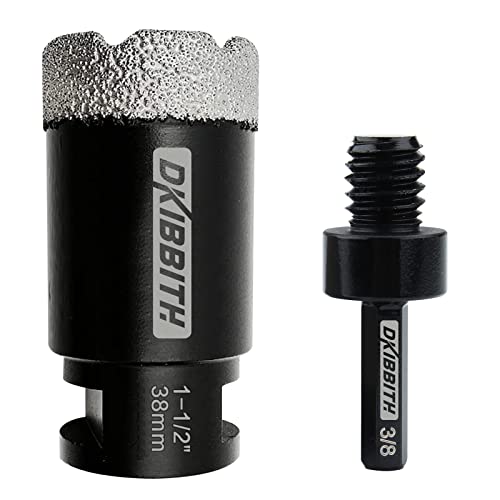
2. DKIBBITH Dry Diamond Core Drill Bit 1-1/2 Inch
For porcelain, granite, and stone, this is the edge that actually bites.
Cutting a faucet hole through a granite vanity or a porcelain tile without cracking it calls for diamonds, not steel. This core bit uses a diamond-grain cutting edge that works dry or wet through porcelain, tile, granite, marble, stone, masonry, block, brick, and non-reinforced concrete. The 1-1/2 inch diameter is what you want when the hole is for plumbing or a large fitting, and the rounded corners come out clean because the diamond edge grinds rather than chips.
The arbor is 5/8-11 threading, which fits most angle grinders and wet polishers, and DKIBBITH throws in a 3/8-inch hex adapter so the same bit mounts on a standard drill too. One rule matters more than any spec: never run this in hammer mode. The bit grinds; a hammer action will crack the tile and pound the diamond edge to death. What the crowd cares about most is quality, and cutting performance sits right behind it — granite and quartz slice cleanly with steady pressure and a little water.
Here is the honest limit. Durability and reliability come up as fair points rather than praise — this is a grinding accessory, and abuse or dry-running it hot shortens its life. Keep the feed light, add water on the hard stuff, and the bit keeps cutting. For a single bathroom remodel or a handful of sink holes, it handles the work well.
Why it earns its place: it is the only pick here built specifically for tile and stone, and the included 3/8-inch hex adapter means one bit covers both your grinder and your drill.
Best matched to: anyone drilling faucet or sink holes in countertops, tile, or stone.
Think twice if: you plan to drill reinforced concrete — non-reinforced only is the stated limit here.
3. NICAVKIT 1-1/2 Inch x 12 Inch Long Ship Auger Drill Bit
Twelve inches of reach for framing, timber, and PVC runs where a short bit cannot go.
When you are boring through a thick landscape timber, running PVC pipe, or drilling a stud deep inside a wall cavity, reach is the whole problem. This ship auger solves it with a 12-inch overall length and a 7/16-inch hex shank, so your drill and hand stay clear of the work. The body is 1045 high-carbon steel, hardened for wear, and the single-tooth cutting edge scores the rim before the screw point pulls the bit through.
The self-feeding coarse screw point is the feature you notice first — it positions on the wood and drags the bit in with minimal push. Measured against the Greycore twist bit, this auger runs 12 inches versus 6 inches and carries a more aggressive feed, though it gives up the Greycore’s three flutes for a single large chip flute. That big flute is why shavings clear fast and the hole stays smooth. NICAVKIT is direct that it wants a high-power corded drill or a bench drill, not a tired cordless, to hit its best results.
What people praise most is the build and the value — quality leads the feedback and value comes close behind. The mixed side is worth knowing before you buy: sharpness and durability draw split opinions, so treat this as a bit for soft and hard wood, MDF, plywood, and lumber rather than abrasive material. It does not drill metal. Keep the feed steady and let the screw point do the work.
The buy-in: if your job is deep holes in wood or pipe runs, the 12-inch reach is hard to get any other way at this tier.
The caution: a handful report early dulling, so pair it with a powerful drill and steady pressure instead of forcing it.
Grab this for: deep wood boring, pipe installation, and timber work.
Pass on it for: metal, tile, or masonry — this one is wood-only.
4. OSCARBIDE 1-1/2″ x 1″ Annular Cutter
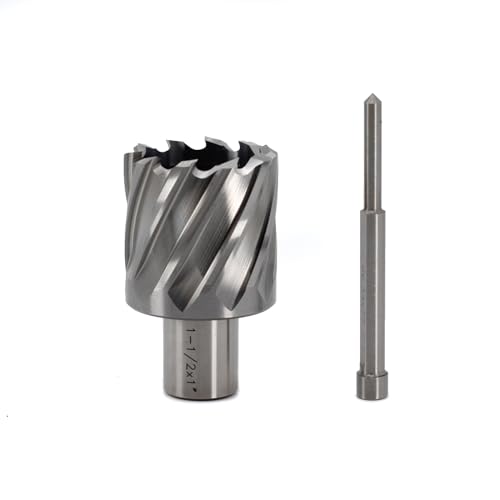
A hollow-core cutter that bores a 1-1/2 inch hole through steel without hogging out the middle.
If you are punching a large hole through a steel plate or pipe on a magnetic drill press, an annular cutter is the right tool and this one is built for it. The cutting geometry matters: a thin-walled body with dual alternating teeth slices the rim of the hole instead of drilling the whole disc, which is why this style needs far less force than a twist bit. OSCARBIDE rates it to drill large holes up to ten times faster than regular drill bits, and its hollow core leaves burr-free, smooth holes that can be re-sharpened.
Specs here line up for metalwork: 1-1/2″ cutting diameter, 1″ cutting depth, a 2-flute M2AL high-speed steel body, and a 3/4″ Weldon shank with two flats that clamps securely in a mag drill. It fits most standard magnetic drills, mills, and large drill presses with the right tool holder. It works ferrous and non-ferrous metals, cast iron, stainless, aluminum, copper, plus plastic and wood, so it covers a lot of shop jobs.
The feedback lands where you would want it for a premium cutter: quality leads, performance is right there with it, and the cutting performance and sharpness read positive. The genuinely strong note is that it keeps cutting after multiple uses. Durability is a fair point rather than a rave — treat it as a cutting tool that rewards steady pressure and the right speed, not brute force, and it stays sharp for the long haul.
The straightforward verdict: a magnetic-drill annular cutter for clean, fast 1-1/2 inch holes in steel and pipe.
Not for you if: you only have a hand drill — this needs a mag drill or a drill press with the right holder.
5. Greycore Tools 1-1/2 Inch Reduced Shank Drill Bit

One bit that hops from wood to aluminum to steel without a shank swap.
For the DIYer who drills a little of everything, this Greycore twist bit is the practical middle pick. The 1/2-inch reduced shank with three flats grips a standard drill driver or drill press chuck without spinning, and the 118-degree cutting head starts the hole cleanly with less wandering. High-speed steel plus an industrial titanium coating gives it heat resistance for the mixed-material jobs that fill a weekend.
The head-to-head against the NICAVKIT auger is telling. The Greycore runs 6 inches versus 12, and it carries three flutes to the auger’s one, so it clears chips and finishes a shallower hole faster. It suits metal, iron, aluminum, wood, and plastic, which is why owners reach for it as a do-all bit rather than a one-trick tool.
Buyers report that it holds its own against pricier brands, and it has cut through material like 3/16 steel on the first go. Quality and functionality are what the reviews land on most, and the sharpness gets consistent credit. The fair caveat is durability — most find it sturdy, but treat very hard steel with steady speed and it rewards you, while forcing it hot shortens the edge. For general shop and home drilling, it is a confident, budget-friendly reach.
What it brings
- Reduced 1/2-inch 3-flat shank stops slipping in the chuck.
- Titanium coating adds heat resistance for mixed-material work.
- Handles metal, iron, aluminum, wood, and plastic.
- 118-degree head starts holes with reduced wandering.
What to keep in mind
- Durability draws a fair bit of mixed feedback on hard steel.
- A general-purpose bit rather than a specialist for any one material.
Suits the generalist: home and shop work across wood, plastic, and light metal with one bit.
Not the specialist’s pick: if you are boring deep timber or cutting steel plate all day, reach for the auger or annular cutter instead.
6. VALYRIANTOOL 1-1/2 Inch Cobalt Drill Bit
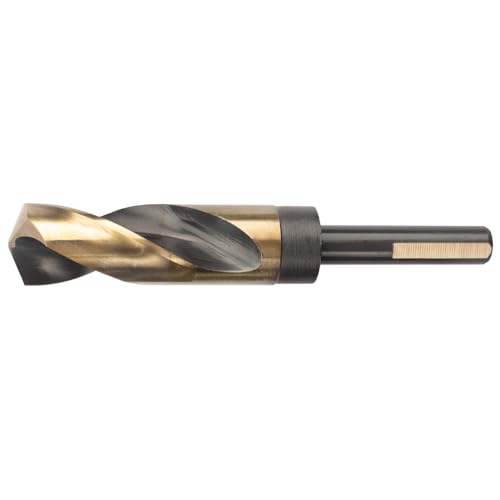
Cobalt steel and a 135-degree point for the stainless-steel jobs that eat ordinary bits.
Stainless steel is the material that separates bits, and this one answers it with M35 HSSCO cobalt steel — a blend built for hardness and toughness under wear. The 135-degree split point self-centers and cuts in fast, so a wide 1-1/2 inch bit goes where you aim it instead of walking. The black-and-gold polished finish is not just looks: it adds lubricity and holds coolant near the cutting edge, which matters on hot stainless work. It lists cast iron, zinc alloy, copper, and stainless as its home materials, with a 6-inch overall length and a 1/2-inch reduced shank.
Read the reviews honestly and you see a bit with real fans and real dissenters. The value gets credit as a great buy, and the machining looks clean from the start. But the quality, sharpness, cutting performance, and durability all draw split opinions — some say it stays sharp and finishes the job, others report it going dull or failing under load. That spread usually points to technique and material: cobalt rewards low speed, steady pressure, and coolant, and punishes anyone who runs it fast and dry in stainless.
This is the pick if you specifically need to drill stainless or hard cast iron and you know to baby the speed. It is fair to say the results vary more than they do on the woodworking Forstner up top, so approach it as a capable metal bit that wants a careful hand.
The appeal: cobalt steel plus a self-centering split point is the right combination for stainless and hard alloys.
The reality check: results divide — run it slow, wet, and steady in stainless, and expect a normal wear curve, not magic.
Made for: stainless steel, cast iron, and copper where a standard bit gives up.
Skip if: you want a forgiving bit for fast, dry drilling — slow and lubricated is how cobalt survives.
7. DaduoRi 1 1/2″ Dry Core Drill Bit with Adapters

A concrete core bit that arrives ready for whatever drill you own.
Drilling a vent or conduit hole through a concrete wall usually means hunting for the right adapter. This DaduoRi core bit skips that step — it ships with a 5/8-11 thread plus adapters to SDS Plus, SDS Max, and 1/2-inch hex, so it slots onto rotary hammers and standard drills alike. The diamond cutting edge runs dry, though the maker recommends water on reinforced concrete or high-hardness material to prevent tooth breakage.
The working numbers are generous: a 1.5-inch diameter and a maximum working depth of 9.5 inches, deep enough for passing pipe or cable through a masonry wall. It is built for concrete with no rebar, brick, stone, and masonry — common in HVAC, electrical, and plumbing work. The critical warning is plain: never use hammer mode. The bit grinds through; hammering destroys the diamond teeth.
What works in its favor is that it is compatible with brick and cinder block and reads as worth the money. But quality, durability, and cutting performance draw fair rather than glowing feedback, and stability shows up as a real concern — the honest read is that this is an entry-level core bit that does the job for occasional masonry holes if you feed it patiently. Run it too hot or force it and the mixed durability reports are what you will run into.
Good match for: occasional brick, block, and masonry holes where the included adapters save you a separate buy.
Not the right fit if: you are drilling reinforced concrete daily — get a heavier core rig for that.
8. SALI Annular Cutter 1-1/2 Inch, 2″ Depth
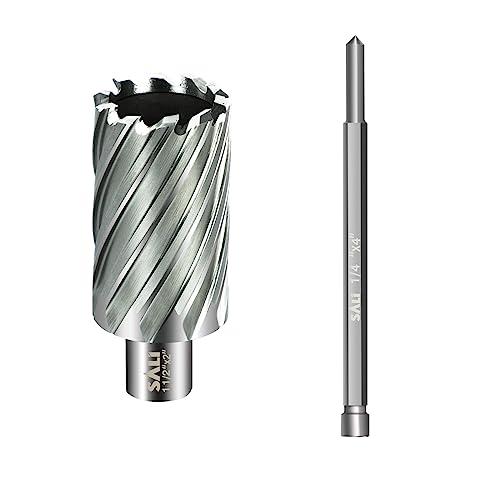
The cutter with double the depth for thick steel plates and I-beams.
Where the OSCARBIDE cuts 1 inch deep, this SALI cuts 2 inches deep on the same 1-1/2 inch diameter — worth knowing if you are boring thick plate or I-beam webs and a shallow cutter would stall halfway. It is formed from M30AL high-speed steel and CNC-machined for a 3/4-inch Weldon shank with two flats, so it clamps securely and leaves smooth, burr-free edges. A 1/4″ x 4″ pilot pin and a plastic case come in the pack.
It fits common magnetic drill brands including ALFRA, BDS, DeWalt, Euroboor, Hougen, and Ruko. One compatibility note matters: to run it on a drill press you need a separate annular cutter arbor, and that is not in the box. On a mag drill it goes straight to work. Functionality is the clear positive — it cuts through steel I-beams effectively, so structural and fabrication jobs are its home ground.
The rest of the picture is a mixed but honest one. Quality and cutting performance read both ways, and durability draws the most concern, with some reporting it breaking on the first hole. A cutter this hard in thick steel rewards firm, steady pressure and the right speed; forcing it or letting it chatter is what kills annular teeth. Treated right, it is a solid deep-cut option; run it carelessly, and the durability reports are real.
Where it shines: 2-inch depth lets it cut steel too thick for the shallower 1-inch cutters.
Where to be careful: durability is the recurring hard point — keep the pressure firm and even and match the RPM to steel.
Choose it for: thick steel plate and structural work on a magnetic drill press.
Look elsewhere if: you need a drill-press cutter from the start — the required arbor is sold separately.
9. Drill America 1-1/2″ Reduced Shank Bit, KFD3F
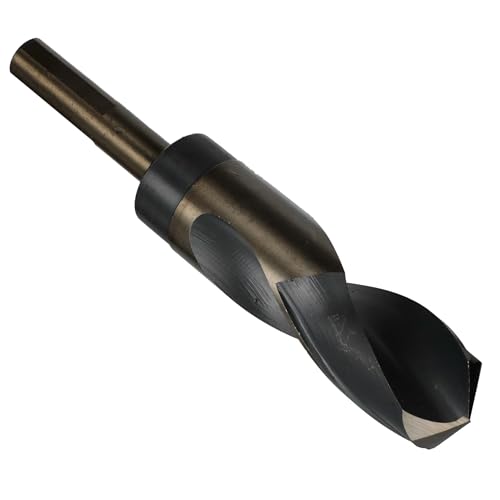
A contractor-grade metal bit with a self-centering point and a no-slip 3-flat shank.
If your work is steel, iron, and aluminum and you want one reliable metal bit, this Drill America KFD3F is built for it. The M1 high-speed steel body is contractor grade, and the 135-degree split point self-centers while reducing the push you need — a real edge over a conventional 118-degree tip, which tends to go walking across a smooth surface. The 1/2-inch reduced shank has three flats for an extra-secure hold in the chuck, and at 6 inches overall with 3 inches of flute length it keeps tool changes to a minimum.
Set this against the Greycore above and the differences are practical: both use a 1/2-inch 3-flat shank, but this one carries two flutes to the Greycore’s three and runs a longer 3-inch flute length, so it clears deeper metal cuts while the Greycore favors faster shallow work. The reduced shank saves you buying a specialty chuck, which is the point of the design.
Drill America is a known name in contractor drilling, and this bit is built to be the dependable workhorse rather than a bargain experiment. For general metal, iron, steel, and aluminum jobs, the self-centering point and secure shank do the heavy lifting. Bring steady speed and a little cutting fluid to large holes, and it behaves the way a contractor bit should.
Why metalworkers like it
- 135-degree split point starts holes without walking.
- 3-flat 1/2-inch reduced shank holds tight in the chuck.
- M1 high-speed steel for steel, iron, and aluminum.
- 3-inch flute and 6-inch overall length cut deeper with fewer changes.
Where to set expectations
- Built for the iron and steel family, not tile or masonry.
- A large metal bit still wants low speed and cutting fluid on thick stock.
The dependable choice: a contractor-grade metal bit for steel, iron, and aluminum with a self-centering start.
Not the one for: wood, tile, or concrete — keep this in the metalworking drawer.
Understanding the Specs
Cutting diameter and why 1.5 inches matters
Every bit here has a 1-1/2 inch cutting diameter, which is the width of the hole it leaves. Confirm this figure before you buy — a “1-1/2” listing that is really 1-3/8 is the wrong tool for a 1.5-inch fitting. This diameter is common for plumbing, conduit, faucet mounts, and large hardware, and it is wide enough that bit style and shank strength start to matter as much as the edge.
Shank types and which drill holds them
The shank is what your chuck or arbor grips. A 3/8-inch shank fits standard chucks on the Freud Forstner. A 1/2-inch reduced shank with three flats (Greycore, Drill America) locks into most drill drivers without slipping. A 7/16-inch hex shank (NICAVKIT auger) suits high-power drills. A 3/4-inch Weldon shank (OSCARBIDE, SALI) is built for magnetic drill presses and needs an extra arbor on a standard drill press. Diamond cores thread onto 5/8-11 arbors.
Point angle and self-centering
Metal twist bits list a point angle. A 135-degree split point (VALYRIANTOOL, Drill America) self-centers and reduces thrust, so the bit is less likely to walk than a conventional 118-degree tip (Greycore). On a hole this wide in steel, a self-centering point saves a pilot step and keeps the hole where you laid it out.
Flutes, coating, and material
Flutes are the grooves that carry chips out. More flutes (three on the Greycore) clear chips faster in shallow work, while a single large flute on the NICAVKIT auger clears deep holes. Coatings and steels set the material: titanium coating (Greycore) adds heat resistance for mixed work, cobalt steel (VALYRIANTOOL) handles stainless, and diamond grain (DKIBBITH, DaduoRi) grinds tile and masonry rather than cutting it.
FAQ
Will this 1-1/2 inch bit fit my standard cordless drill?
What is the difference between a Forstner bit and a ship auger bit?
Can I use a diamond core bit on porcelain tile without cracking it?
What is the difference between a 135-degree and 118-degree drill point?
Why do I need a magnetic drill for an annular cutter?
Will a ship auger bit drill through a nail-embedded board?
Should I use water when dry core drilling concrete?
Can cobalt bits drill through stainless steel without dulling?
What material can a 1-1/2 inch reduced shank bit handle?
How do I stop a large drill bit from wandering on metal?
Final Thoughts: The Verdict
For most woodworking jobs that need a clean 1-1/2 inch hole, the Freud PB-011 Forstner bit is the one to buy — its serrated rim and sharp spur leave a flat, splinter-free edge in hardwood and softwood, and it is the strongest all-rounder here. If your material is tile or stone, grab the DKIBBITH Diamond Core Bit with its included 3/8-inch hex adapter. And for fast, clean holes in steel plate on a mag drill, the OSCARBIDE Annular Cutter is the specialist’s answer.
Match the bit style to your material and the shank to your chuck, and a 1-1/2 inch hole stops being a headache. Every pick here is verified at a true 1.5-inch cutting diameter, so the only decision left is which material your job puts in front of you.
How We Picked
We do not accept paid placement. Every pick is matched to a real buyer and a real use-case; we do not hands-on test units.
Sources & Methodology
Specifications: manufacturer listings and product documentation. Review insights: verified customer reviews, as of November 2026. Pricing: not shown on this page (it changes often); check the current price via the retailer link.
As an Amazon Associate, Gadgets Feed earns from qualifying purchases. This does not affect which products we feature.