
Our readers keep the lights on and my morning glass full of iced black tea. As an Amazon Associate, I earn from qualifying purchases.
Specs are compiled from manufacturer listings and verified buyer reviews and can change over time — please confirm the key details on the product page before buying.
Most car scuffs are not paint damage at all — they sit in the clear coat, the thin transparent layer over your colour, and that is exactly the kind you can rub out at home in a driveway. The one test that decides everything: drag a fingernail across the mark. If your nail glides over it, a compound or a pen has a real chance. If it catches, you are into the colour or the primer and no bottle on this list will fix it.
I’m Min — the founder and writer behind Gadgets Feed. This guide is built by comparing the manufacturers’ published specifications and the patterns across verified customer reviews, so you get each pick’s real strengths and trade-offs instead of marketing spin.
Nine options sit below, sorted by what they actually do. Heavy compounds cut faded panels, gentle one-step polishes lift swirls, and pen formats handle the tiny kerb rash you want gone before a weekend wash. Match one to your paint, your tools, and how much elbow grease you will spend on a car scuff remover.
Our Picks at a Glance


How To Choose The Best Car Scuff Remover
Choosing properly starts with one honest look at the mark rather than the bottle. The depth of the damage decides the product type, and the product type decides whether you spend ten minutes or a whole afternoon.
The fingernail test comes before anything else
Run your nail across the scuff at a right angle. If your nail cannot feel the mark, it sits in the clear coat (the thin clear top layer over your paint), and that is the balance for compounds, polishes, and scratch pens. If your nail drops into the mark, colour has been removed, and the fix there is touch-up paint matched to your code, not a polish.
Paint transfer is the other easy win. That grey or white smear left by a pillar or another bumper is often sitting on top of your paint rather than through it, so a fine compound lifts it cleanly and the panel underneath is untouched.
Match the cut to the damage, not to the label
Compounds are graded by grit, and a lower grit number means a coarser abrasive that cuts faster but leaves a duller finish behind. A higher grit number polishes finer and leaves more gloss but takes longer to shift a defect. The full details are in the specs section further down.
Think of it as sandpaper logic. You would not start a job with the coarsest paper you own, and you should not attack a faint swirl with the most aggressive compound either — you would be removing clear coat you want to keep.
Hand pad, drill pad, or pen
A hand pad is the beginner-safe choice because your arm simply cannot generate the friction heat that burns through thin paint. A drill-mounted pad spins consistently and clears a light defect in a few guided passes, but it asks you to keep the pad moving at all times. A pen is for a single small mark on a car you otherwise do not want to set up a whole detailing session for.
Finish the job or it comes back
Compounding leaves the corrected area bare and unprotected. Wiping on a wax, sealant, or ceramic coating afterwards is what keeps the gloss and stops the same spot weathering dull again. Many kits bundle protection into the same step — read each listing to see whether yours does.
Quick Comparison
| Model | Best For | Grit Number | Format / Size | Hand or Machine | Amazon |
|---|---|---|---|---|---|
| Griot’s Garage Complete Compound 10862★ Best Overall | All-round paint correction | 120 (medium) | 16 oz bottle | Both | Amazon |
| ABRO Rubbing Compound RC-295Best for Faded Paint | Oxidized, chalky paint | Fine clay abrasive | 10 oz tube | Both | Amazon |
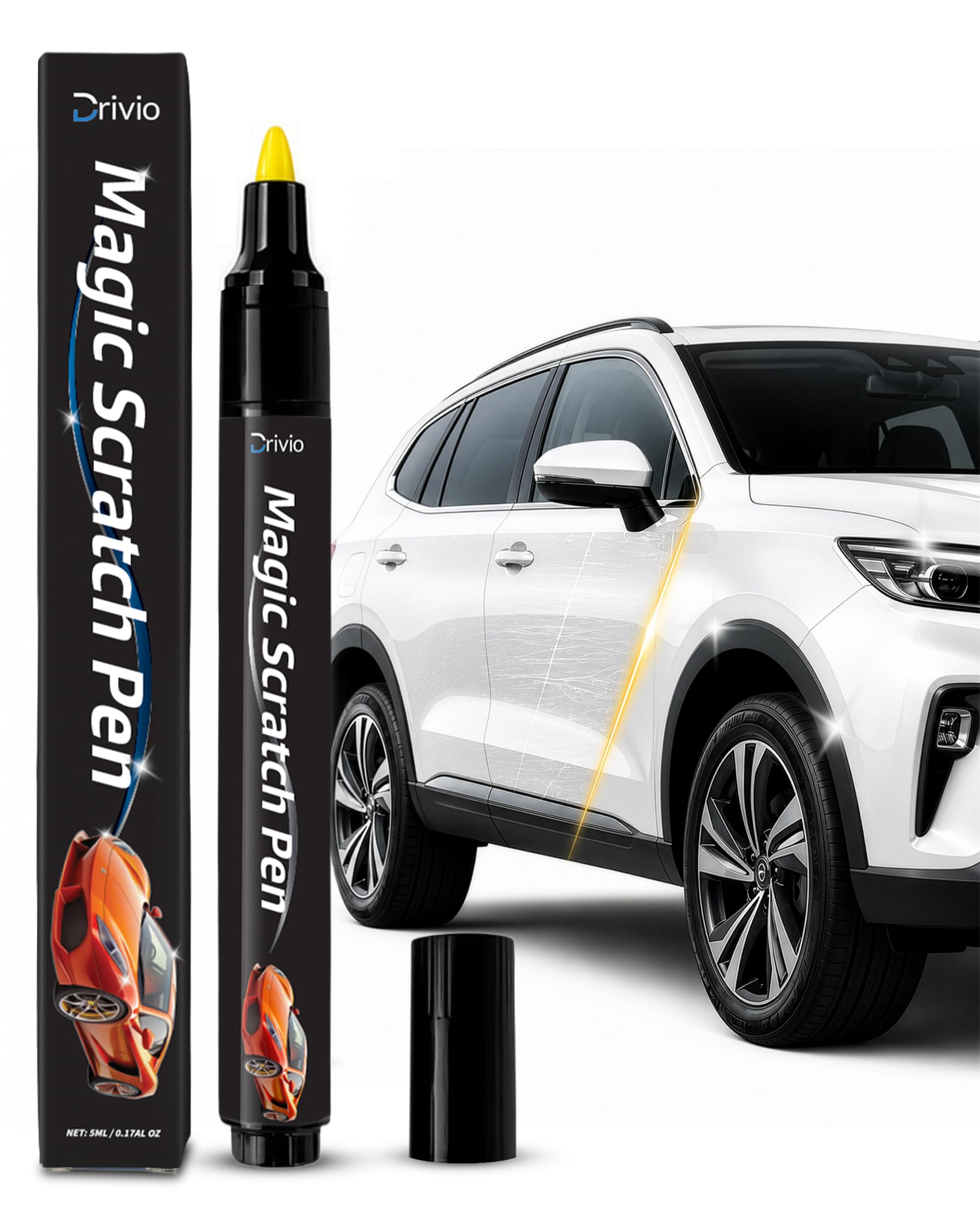
| Drivio Car Scratch Remover PenGlovebox Pick | Glovebox touch-ups | — | 5 mL pen | Hand only | Amazon |
| Carfidant Scratch Repair and Swirl Remover Kit | Polish plus ceramic protection | 1000 (fine) | 8.4 fl oz bottle + pad | Both | Amazon |
| Chemical Guys VSS One-Step | Swirls on ceramic-coated paint | 1500 (fine) | 16 oz bottle | Both | Amazon |
| SPTA Mix Polishing Compound | Three-step sanding mark removal | Coarse/Medium/Fine | 4.06 oz (120 ml) | Both | Amazon |
| Chemical Guys Insynchro Hand Polishing Kit | Beginners with no machine | Fine | 8 oz + pad and towel | Hand only | Amazon |
| Carfidant Scratch and Swirl Remover Kit | Complete starter kit | Fine | 8 oz + pad and towel | Both | Amazon |
| Meguiar’s Quik Scratch Eraser Kit 2 Pack | Drill-driven speed, two kits | — (ScratchX micro-abrasive) | 2 kits, 4 oz ScratchX each | Drill-mounted pad | Amazon |
In‑Depth Reviews
1. Griot’s Garage Complete Compound 10862, 16oz
Our pick — 4.5+★ from 2,500+ verified ratings; the strongest balance of quality and price.
A medium-cut compound that clears swirls and oxidation and still wipes off clean without dust.
What wins people over here is sheer, repeatable effectiveness — it handles deep clear-coat scratches and light scuffs and leaves a mirror-like shine behind. At 4.5+ stars across 2,700+ owners, it tops the list on both score and volume of owner feedback.
The abrasive is aluminum oxide graded at 120 grit, a medium cut. In plain terms, that is coarse enough to flatten a real defect and fine enough to finish glossy rather than hazy. That 120 grit is the number to weigh against the Carfidant kit’s 1000 grit — far more aggressive, which is exactly why it shifts deeper damage the fine polishes cannot touch.
The bottle holds 16 ounces and is silicone-free with no fillers, so it stays safe for repaint and touch-up work. You can work it by hand with a pad for a spot fix or pair it with a dual-action polisher for a full panel. Finish with wax or a sealant, because the compound leaves the paint ready for protection but does not apply any.
Where this compound earns its keep
- 120 grit medium cut tackles swirls, water spots, and oxidation in one pass
- Silicone-free and filler-free, so it is body shop safe on fresh paint
- Wipes off with no dust left behind to clean out of trim
- Works by hand for a spot or on a dual-action polisher for a whole panel
Where it asks more of you
- The 16 ounce bottle is a two-hand pour, so decant a little onto the pad at a time
- A 120 grit cut is not the tool for a faint swirl on fragile paint — step down to a fine polish
Reach for this if: you have real swirls, oxidation, or water spots and you want one bottle that handles both hand and machine work.
Hold off if: your paint is soft or nearly perfect — a medium grit cut is more correction than a light refresh needs.
2. ABRO Rubbing Compound RC-295, 10 oz
Built for the chalky, sun-bleached panel that a gentle polish just slides over.
If your paint has gone dull and faded rather than picked up a single scratch, this is the correction step you want first. ABRO’s formula is aimed at weathered and oxidized finishes and cuts through that surface layer to bring back a cleaner, brighter panel. The consistency lands well for that job — it spreads smoothly and buffs off cleanly with little residue left to wipe.
Coverage runs from automotive paint out to motorcycle and boat finishes, and the silicone-free formula keeps it usable in paint-prep workflows. You can apply it by hand for a spot of correction or take a buffer to a whole panel. On the practical side, the tube weighs 300 grams against the Carfidant bottle’s 250 grams and the Griot’s 16 ounces, so it is a chunkier product to handle but a straightforward one to store.
The part to be realistic about is where the line sits. This is not a true heavy rubbing compound for chasing out deep scratches, and several buyers find the scratch-removal side of it inconsistent. Read it as a fade and oxidation product with scuff-lifting as a bonus, then follow with a polish or wax to refine the gloss. Sold as a fade-and-oxidation step that needs a polish or wax after, it delivers on that job.
The honest framing: effectiveness is what draws people to this tube and quality holds it there, but the scratch-removal side is genuinely mixed. Judge it on how it handles oxidation and you will be pleased.
One extra step: because it leaves the finish corrected rather than protected, plan to seal the panel afterwards so the restored gloss stays put.
Buy this one for: a faded, weathered, or oxidized panel that needs waking up before a wax.
Pass on it for: a single deep scratch you can feel with a nail — this is not the product built for that depth.
3. Drivio Car Scratch Remover Pen for Light Scuffs
Five millilitres of pen-sized fix for the kerb rash you spot on the way to the shops.
The whole appeal is the format. A 5 mL pen lives in a glovebox or a garage cabinet and comes out for one small scuff without you unrolling a full detailing kit on the driveway. Clean and dry the mark, shake the pen, press the tip and lay down light controlled coats, then buff with a microfibre once it dries.
Two things earn it a place here rather than the bin. The first is build quality — it feels like a proper tool rather than a disposable marker. The second is that it does real work on paint transfer and clear-coat blemishes. The formula is clear, so it works across multiple vehicle colours. That is also its honest limit: it does not add missing colour, repaint, or rebuild damaged paint, so anything showing primer or metal is out of scope. It is not touch-up paint and should not be sold to you as such.
The harder truth is that pen format is a compromise, not a cure. Whether it does anything useful depends heavily on how deep your specific mark runs, and the results reflect that — some buyers find small marks improved while others see no change at all. Treat it as the tool for a mark your nail glides over and nothing deeper.
Why it lives in the glovebox
- 5 mL pen fits in a glovebox with no kit to set up
- Clear formula suited to light marks on any vehicle colour
- Feels well built rather than disposable in the hand
Set your expectations here
- Does not add colour or rebuild paint — surface marks only
- Results swing widely from mark to mark, so a deep scuff stays visible
It fits: a daily driver with one faint scuff or a paint-transfer smear you want to soften between washes.
Look elsewhere if: you need colour restored — missing paint calls for touch-up in your code, not a clear pen.
4. Carfidant Scratch Repair and Swirl Remover Kit, 8.4 fl oz

Cuts the defect and lays a ceramic sealer in the same pass, so there is no wax step waiting.
With tens of thousands of owners behind it, this is the most-reviewed bottle on the list, and it earns that on light clear-coat scuffs, swirls, and water spots. Light scratches, swirls, scuffs, water spots and oxidation all come out, and the car reads as new again with a good shine left on the panel. Unlike the heavier compounds above, the 1000 grit fine abrasive is gentle enough that you are unlikely to overcorrect while you learn the motion.
Grit math is where this kit differs sharply from the Griot’s bottle — 1000 grit fine versus 120 grit medium. The Carfidant works slower but finishes glossier and is the safer starting point on a panel you care about. Apply a few drops to the pad, work in small circles, wipe with microfibre, and expect stubborn marks to need two or three passes. It also steps up to a machine polisher if you want the fastest correction.
Where it wins quietly is prep. The built-in ceramic sealer leaves a slick protective layer behind, so you skip the separate wax stage and the corrected spot stays protected rather than bare. If you have ever compounded a scuff and watched it haze over a fortnight later, that one-step protection is the part worth having. The recurring gripe is on expectations rather than function — some buyers want more out of a single bottle than a fine polish can give.
The quiet advantage: a ceramic sealer built into the same bottle means the corrected area is protected the moment you finish wiping.
What to budget for: two to three passes on a stubborn mark, and a dual-action polisher if you want the correction to go faster than your arm can manage.
This is your bottle: for light clear-coat scuffs on any paint colour, with protection included and no wax to remember.
Think twice for: a defect your fingernail catches — that needs a heavier cut than a 1000 grit fine polish provides.
5. Chemical Guys VSS One-Step Scratch & Swirl Remover, 16 oz
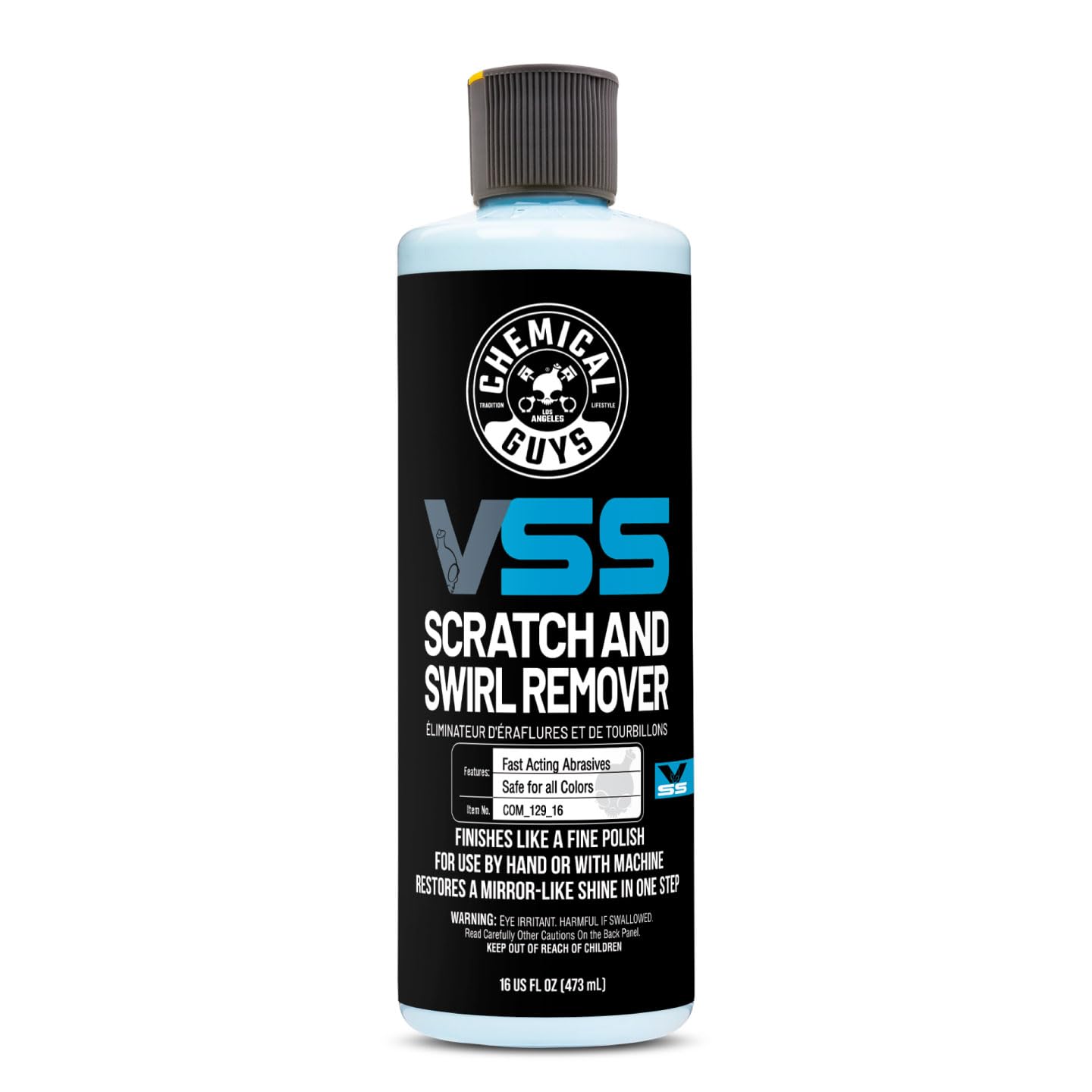
The gloss chaser — a 1500 grit fine polish that finishes as it cuts, no second pass required.
Where this earns a spot is the shine. Panels come up glossier than before, and the cut-and-finish formula removes a whole polishing stage from the detail. Cut and finish live in the same formula at a 1500 grit fine grade, which is the finest number on this list and the reason it leaves a clear high-gloss finish instead of a hazy one.
The compatible surfaces span clear coat, single-stage and ceramic-coated paint, and it works by hand or with a machine polisher. It is also silicone-free and body shop safe, so it does not interfere with repaint or touch-up work. On volume it sits alongside the Griot’s bottle as a larger-format product — both are 16 ounces of working material that will outlast several one-scuff jobs. That makes it the last bottle you buy for a while rather than a single-use purchase.
Set your expectations on the correction side honestly. This is a finishing polish, not a damage eraser. Complete removal of a swirl or a scratch depends on how severe that particular defect is, and plenty of owners find their specific mark improved rather than gone. As a 1500 grit gloss restorer for light swirls and holograms, it does exactly what the label says. Bought as a scratch eraser, it will disappoint on the deep ones.
What sells this bottle
- 1500 grit fine cut leaves a clear high-gloss finish in a single step
- Silicone-free and body shop safe on clear coat, single-stage, and ceramic paint
- Goes by hand or machine, so it scales from a spot fix to a full panel
- 16 ounces of product stretches across many separate correction jobs
The realistic limit
- A fine finishing polish cannot erase a scratch your nail can feel
- Swirl removal is inconsistent — a deep swirl may soften but stay visible
Pick it when: you want gloss back and light swirls softened on a well-kept car, in one pass and one bottle.
Not the tool for: chasing out a real defect — reach for a medium cut compound for that job instead.
6. SPTA Mix Polishing Compound, 4.06oz (120ml)

Three grades of cut in one small tub, for someone chasing sanding marks rather than a single scuff.
This is the pick for a panel that has been sanded and needs stepping back up to a mirror finish. The compound runs a coarse, medium and fine grit in a graded system. The coarse stage handles 1500 grit sanding marks, the medium stage covers 2000 to 2500 grit, and the fine stage polishes out to a deep gloss while clearing holograms and polishing marks.
The formula is water-based with diminishing abrasives, which is worth translating: the particles break down as you work them, so a single pass starts aggressive and finishes gentle. It carries no waxes, silicones or fillers and stays safe on clear coat, single-stage, and multi-stage paint. Optimised for SPTA pads, it still works across cutting, microfibre, wool, foam, and finishing pads, so a mixed drawer of pads is not wasted on it. Multi-vehicle use covers trucks, RVs and motorcycles as well as cars.
Be clear about scale before you commit. Owners who know their way around a polisher rate the quality of the abrasive highly. If you are correcting a fresh paint job or a sanded panel it is the right material; if you just want the kerb scuff on your door gone, it is more system than you need.
Where it shines: the graded coarse-to-fine system takes a sanded panel from 1500 grit marks up to a gloss finish in three deliberate stages.
Know before you buy: 4.06 ounces goes fast across a whole vehicle, and three stages is a learning curve rather than a ten-minute driveway fix.
Made for: the home detailer correcting a sanded or freshly painted panel who wants graded cut in one product.
Overkill for: one small scuff on a daily driver — a single kit covers that with far less fuss.
7. Chemical Guys Insynchro Scratch & Swirl Remover Hand Polishing Kit, 8 oz

An all-in kit for the owner who has never corrected a panel and does not want to learn on a machine.
The selling point is the safety margin. Your hand simply cannot spin fast enough to generate the heat that burns through thin paint, so there is no burn risk and no learning curve to survive. Everything needed sits in the box — an 8 ounce bottle of compound, a Hex-Logic hand pad, and a microfibre towel — and the formula stays workable long enough to finish a panel properly instead of drying out halfway through a pass.
It suits clear coat and single-stage paint in every colour and finish, and it preps the surface for sealing once you are done, so the corrected area can be protected with a wax or a ceramic spray. Application is a work-the-defect motion with the pad rather than a machine pass. Where this kit is best matched is the fingernail test failure and lighter — the scuffed door or the swirled hood that your nail glides across.
The honest caveat is that hand correction has a ceiling. It is real work, and the results track the depth of the mark rather than the effort you put in — some owners get a clear win, others find their mark unchanged. The included pad is also the whole apparatus, so a whole car done by hand will wear your arm out long before the bottle empties. It also suits a beginner who wants a low-risk start far better than a seasoned detailer.
The right first kit: if you have never corrected paint and want a hand-safe start with the pad and towel already included.
Not for you if: you are correcting multiple panels — hand work gets tiring and a machine setup covers ground faster.
8. Carfidant Scratch and Swirl Remover Kit with Pad and Towel
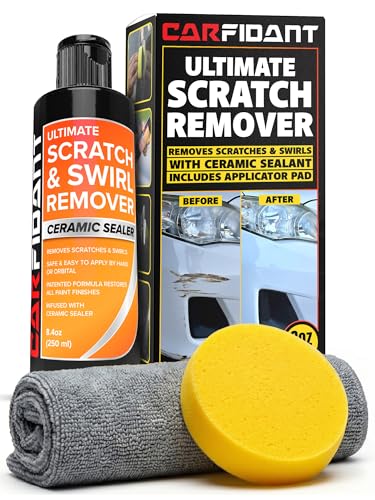
Everything to start in one box — compound, foam pad, and microfibre towel.
For a first-time buyer who does not want to assemble a kit piece by piece, this is the clean answer. The 8 ounce compound comes with the foam pad and the microfibre towel, so the correction, the application, and the final wipe are all covered. It works on clear coat, single-stage, and multi-stage paint, and the formula carries no unnecessary colour dyes or scents.
The job it handles widens once you look past scratches. Swirls, water spots, oxidation and other surface contaminants all come out, and the gloss comes back to the panel rather than sitting flat. That is a broader remit than the Drivio pen, which is strictly a surface-mark product — here a faded section of paint gets a proper reset rather than a softening. The fine grit also keeps it forgiving for a beginner learning the motion on a panel they care about.
The one limit worth repeating is the fingernail test. Anything your nail catches is likely beyond this kit, and it will not perform on that depth. Weigh that against the effort — a small mark clears in a quick pass, but a whole car is an afternoon of work. Property of the kit rather than a flaw, but it is the thing that decides whether it feels easy or endless on your particular car.
Why it works as a first purchase
- Foam pad and microfibre towel included, so no extra shopping
- Handles swirls, water spots, oxidation, and contaminants, not just scratches
- Fine grit is forgiving for a beginner learning the motion
- No dyes or added scent in the formula
Know the ceiling
- A mark your fingernail catches is beyond what this kit can correct
- Doing a whole vehicle by hand is slow work despite the easy single-mark passes
Grab this kit: when you want compound, pad and towel in one box for light clear-coat scuffs on any paint type.
Skip past it if: the defect runs into the colour — a fine-grit kit will not close a scratch your nail drops into.
9. Meguiar’s Quik Scratch Eraser Kit 2 Pack
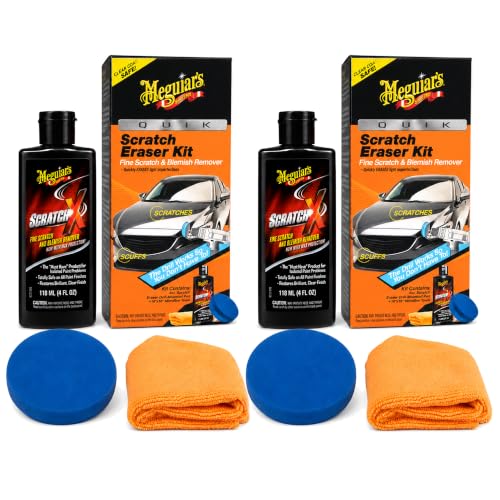
Chuck the pad into your drill, and a light defect clears before your coffee cools.
This is the fast lane for someone who already owns a drill. Each of the two kits carries a 4 inch drill pad, a 4 ounce bottle of ScratchX compound, and a microfibre towel. The pad chucks into any standard household drill, the steady spin does the cutting, and a light defect clears in a few guided passes with no tedious hand polishing to wear out your arm.
What the micro-abrasive ScratchX does well is lift the tricky marks without hazing — scuff marks, paint transfer, and the fingernail marks that collect around door handles. That last one is the classic everyday case: the half-moons left by a hundred key scratches on the same spot. The kit preps the panel for a finishing coat of wax afterwards, so the repaired area can be protected. Two complete kits in the box also means one stays in the garage and one travels with you.
The trade-offs are about control rather than capability. A spinning drill pad demands that you keep it moving across the surface, because using it as an eraser in one spot is not what it is built for. Drill speed is then regulated by your trigger rather than a fixed setting. Keep the drill pad moving and this is the quickest route on the list from scuffed to clean.
The speed case: a drill-mounted 4 inch pad plus ScratchX clears a light scuff in a few guided passes with none of the arm work of hand polishing.
The control cost: you have to keep the pad moving and regulate spin with your trigger, so technique matters more than it does with a hand pad.
Best fit: a drill owner chasing door-handle marks and paint transfer who wants the repair done in minutes.
Wrong choice if: you would rather not manage a spinning tool on your paint — a hand pad kit removes that risk entirely.
Understanding the Specs
Grit Number and Cut
Grit is the size of the abrasive particles in the compound, and a lower number means a coarser, faster cut. The Griot’s bottle runs 120 grit and cuts hard to shift real defects. The Carfidant kit runs 1000 grit and the Chemical Guys VSS runs 1500 grit, both of which polish slowly but leave far more gloss behind. A coarse cut removes more clear coat, so start with the finest grade that will do the job and step up only if the mark survives.
Format, Size, and Weight
The format decides how you work. A 16 ounce bottle is a session product for a whole panel. An 8 ounce kit pairs the polish with a pad and towel for a first-time buyer. A 5 mL pen is a single-mark tool kept in the glovebox. Weight in the hand tracks volume — a heavier tub means more product to spread across a car, which matters when a whole vehicle needs correcting.
Hand vs Machine
Machine work spins a pad at a steady speed and clears defects faster, but the pad has to keep moving or friction heat builds up. Hand polishing is slower and safer with no burn risk, which is why beginner kits ship a hand pad rather than a drill attachment. Many compounds here work either way, so the same bottle can serve a careful hand spot fix and a full machine pass.
Protection After Correction
Compounding leaves bare, corrected paint behind. That area will haze and dull again unless it is sealed with wax, a sealant, or a ceramic coating. Some kits, like the Carfidant polish, build a ceramic sealer into the same step. Others leave protection as a separate job. Either way, check before you finish that the panel has some lasting protection on it.
FAQ
How do I know if a scuff is removable at home?
Will a scuff remover work on paint transfer from another car?
Can a scratch remover pen replace touch-up paint?
Is a medium cut compound too aggressive for regular use?
Do I need a machine polisher to correct paint?
Why did my corrected area go dull a week later?
Can I use these compounds on ceramic-coated paint?
Will a scuff remover work on headlights and trim?
Is a drill-mounted pad safe for a beginner?
How much product does a full car take?
Final Thoughts: The Verdict
For most people, the car scuff remover winner is the Griot’s Garage Complete Compound because its 120 grit medium cut handles swirls, oxidation, and real clear-coat damage, works by hand or machine, and wipes off without dust. It holds the highest rating on the largest pool of owner feedback, which is why it takes the top slot.
If you would rather have protection built in and a gentler cut you cannot overdo, the Carfidant Scratch Repair and Swirl Remover Kit adds a ceramic sealer and an applicator pad in the same box. And for the scuff you spot on the way out of a car park, the Drivio pen lives in the glovebox and needs no setup at all. Run the fingernail test first and the rest of this list sorts itself.
How We Picked
We do not accept paid placement. Every pick is matched to a real buyer and a real use-case; we do not hands-on test units.
Sources & Methodology
Specifications: manufacturer listings and product documentation. Review insights: verified customer reviews, as of November 2026. Pricing: not shown on this page (it changes often); check the current price via the retailer link.
As an Amazon Associate, Gadgets Feed earns from qualifying purchases. This does not affect which products we feature.