
Our readers keep the lights on and my morning glass full of iced black tea. As an Amazon Associate, I earn from qualifying purchases.
Specs are compiled from manufacturer listings and verified buyer reviews and can change over time — please confirm the key details on the product page before buying.
You do not need to spend a fortune to get real, chest-moving bass from a 15-inch subwoofer. The trick is knowing which one actually delivers the low notes your amplifier is feeding it — and which one just prints a big number on the box. This guide covers nine genuine 15-inch subs across the budget, mid-range, and premium tiers, so you can match one to your amp, your enclosure, and your ears.
I’m Min — the founder and writer behind Gadgets Feed. This guide is built by comparing the manufacturers’ published specifications and the patterns across verified customer reviews, so you get each pick’s real strengths and trade-offs instead of marketing spin.
Some of these are raw car-audio drivers that need an amp and a box, while others are self-powered cabinets ready for a stage or a garage. Here is how each one earns its place, so you can pick the right budget 15 inch subwoofer.
Our Picks at a Glance


How To Choose The Best Budget 15 Inch Subwoofer
Start with the amplifier you already own or plan to buy. A subwoofer’s RMS rating (the power it handles continuously) and its ohm load (the electrical resistance the amp sees) decide whether the pair will work together cleanly. Get those two numbers right and the rest is fine-tuning.
Read RMS Before You Read Peak
Peak power is a brief burst a sub can survive; RMS is the number it can run all day. A driver rated at 500 watts RMS on a 500-watt amp plays cleaner than one rated for a 5000-watt peak on the same amp. Look at the RMS number first, then treat the peak as a ceiling, not a target.
Match the Ohms to Your Amp
Dual voice coils let you wire a sub in different ohm configurations to suit your amplifier. A dual 2-ohm sub can present either a 1-ohm or 4-ohm load, while a dual 4-ohm sub can go to 2 or 8 ohms. Check what your amp is stable at before you commit, because the wrong wiring can either starve the sub or overwork the amp.
Car Driver or Powered PA Cabinet
Raw car subs are the bare driver — you supply the enclosure and the amplifier. Powered cabinets have the amp built in and plug straight into a mixer or wall outlet. If you are building a trunk system, you want a raw driver. If you are setting up for a party, a wedding, or a church hall, a powered cabinet saves you a pile of wiring.
Quick Comparison
| Model | Best For | RMS Power | Peak Power | Voice Coil / Impedance | Amazon |
|---|---|---|---|---|---|
| Rockville W15K9D2★ Best Overall | All-round car bass | 1250W | 5000W | Dual 2-Ohm | Amazon |
| CT Sounds Bio 15”Best Value | Entry-level clarity | 500W | 1000W | Dual 4-Ohm | Amazon |
| Kicker 43CVR154Proven Build | Simple, proven build | — | 1000W | Dual 4-Ohm | Amazon |
| Audiopipe TXX-BDC2-15 | Tight, controlled bass | 900W | 1800W | 3″ Dual 4-Ohm | Amazon |
| American Bass XD 15″ | SPL punch | 1000W | 2000W | 3″ Dual 4-Ohm | Amazon |
| Power Acoustik BAMF-154 | Raw output on a big amp | 3800W | — | Dual 4-Ohm | Amazon |
| NVX VCW152v3 | Serious power and longevity | 1500W | 3000W | 3″ Dual 2-Ohm | Amazon |
| Sound Town METIS-15PWG | Mobile DJ and PA rigs | 500W | 1800W | 4″ Voice Coil (powered) | Amazon |
| PRORECK SP-15X | Events and venues | 460W | 2000W | 3″ Voice Coil (powered) | Amazon |
In‑Depth Reviews
1. Rockville W15K9D2 15″ Car Audio Subwoofer, Dual 2-Ohm, 1250W RMS CEA Rated
Our pick — 4.5+★ from 950+ verified ratings; the strongest balance of quality and price.
A CEA-rated 1250 watts of real, continuous power that the crowd favorite keeps delivering.
This is the sub to start with if you want the most bass your amplifier can realistically feed a 15-inch driver. The 1250W RMS figure is CEA-rated — an industry measurement standard, not a hopeful marketing number — so it tells you what the sub handles continuously, not just for a split second. The 5000W peak and 2500W program figures sit above that as headroom. It is also the best-loved sub in this group, holding 4.5+ stars across 900+ ratings.
The hardware backing those numbers is serious for the money. A double-stacked 190 oz magnet (the heavy motor that drives the cone) sits inside a cast aluminum basket, and the paper cone is reinforced with red stitching and a thick foam surround. A 30mm XMAX (the distance the cone can travel in and out) is what pushes the deep notes into the cabin rather than just buzzing. The dual 2-ohm voice coils let you wire to either a 1-ohm or 4-ohm load, so it plays nicely with a wide range of amplifiers.
The catch worth knowing: this is a deep driver that wants a properly sized enclosure, and some buyers find it a tight fit in off-the-shelf boxes. Durability gets mixed feedback too — most owners treat it well and get years of service, while a few push past its rated power and pay for it. Feed it within its RMS rating and keep the box right, and it holds up. As owners put it, it “handles 1200 watts just fine.”
Where It Wins
- CEA-rated 1250W RMS means real, sustained power handling, not a hype figure
- Double-stacked 190 oz magnet and cast aluminum basket give it a solid, durable feel
- Sound quality is what owners rave about most — the deep, clean thump is the whole point
- Dual 2-ohm coils wire to 1 or 4 ohms for broad amplifier compatibility
What To Weigh
- Wants a correctly sized enclosure, and a few find it snug in generic boxes
- Pushed beyond its RMS rating, durability gets mixed reports
Pick this if: you want maximum clean output per dollar and can build or buy a proper box for it.
Think twice if: you plan to drive it hard on an amp well above its 1250W RMS rating.
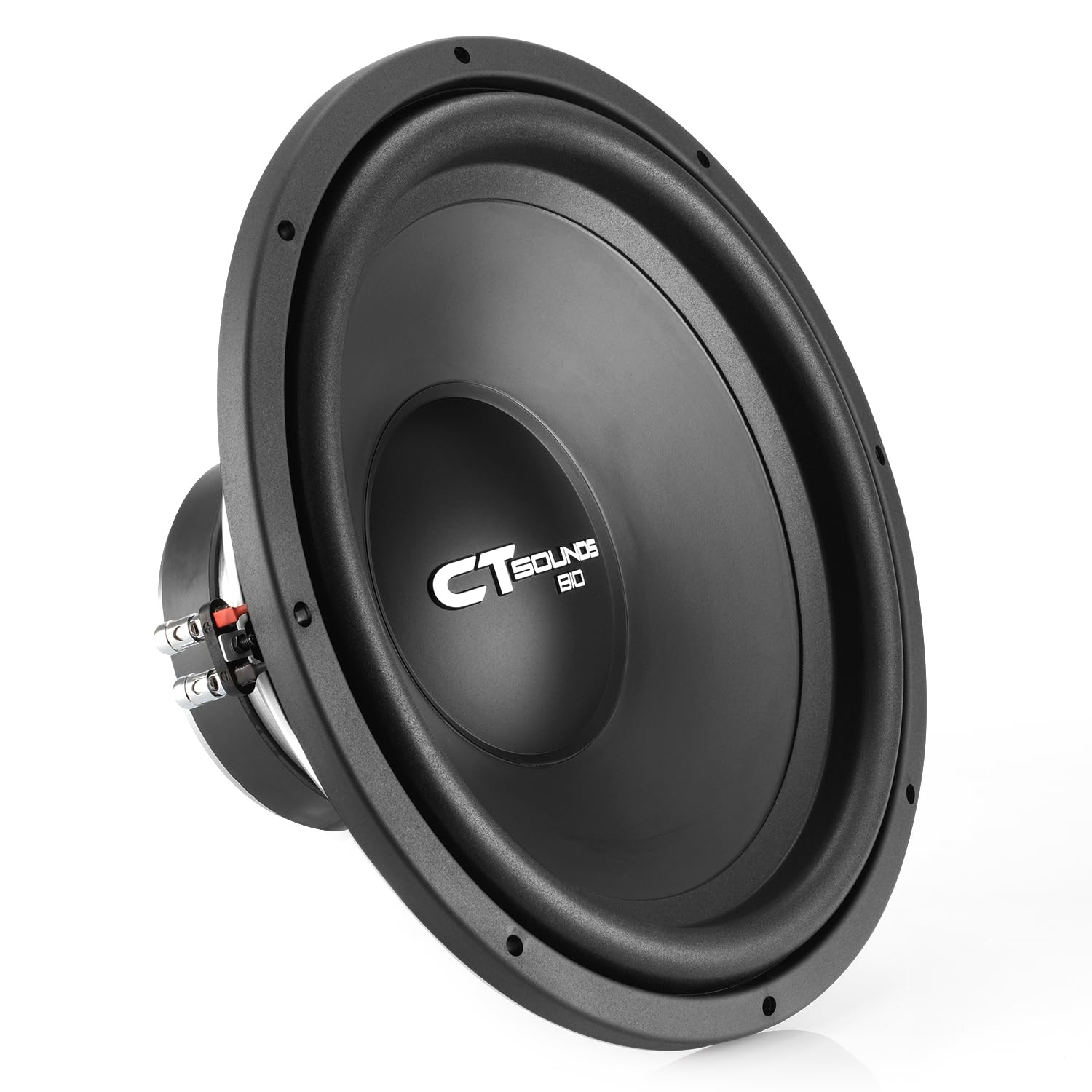
2. CT Sounds Bio 15” 1000-Watt Dual 4-Ohm Car Subwoofer
The entry-level sub that punches like it costs more — and keeps the bass tight.
If your amplifier is a modest one, this is the smart match. It handles 500 watts RMS with a 1000-watt peak ceiling, so it plays cleanly on the kind of amp most budget builds run. The 2.4-inch, 4-layer copper voice coil and single-stacked motor assembly are built for controlled motion rather than brute force. And a 6.42-inch mounting depth means it drops into a lot of common enclosures without a fight.
what separates it is composure. The bass stays tight and clear rather than turning to mush when you push it hard — no muddiness, no sloppy flapping. Buyers report it performs beyond what the price suggests. The dual 4-ohm coils (two separate wire windings) wire to a 2-ohm or 8-ohm load, so you can match it to more amplifiers.
Why it earns the spot: for a first sub build, the clarity-per-watt here is the headline. It does not chase big peak numbers; it just plays clean notes.
Honest limit: at 500W RMS it will run out of steam before the Rockville does, so if you are feeding 1000+ watts, size up.
Reach for this if: you are building a first system on a modest amp and want clean, tight bass over raw volume.
Look elsewhere if: you already own a high-power amp that needs a driver rated well past 500W RMS.
3. Kicker 43CVR154 CompVR 15″ Inch Car Subwoofer 1000W Dual 4 Ohm
A straightforward 15 that leans on build quality rather than headline specs.
The number that matters here is 89.2 dB sensitivity — that tells you how efficiently the sub turns amplifier watts into sound. A higher sensitivity means the sub gets loud without demanding as much power, so a mid-tier amp can drive it to satisfying volume. The 1000-watt peak handling pairs with a dual 4-ohm coil setup for flexible wiring.
The construction is where this earns trust. An injection-molded polypropylene cone resists moisture and wear far better than raw paper, and the stamped steel basket gives the motor a rigid frame to work against. The feedback from owners centers on exactly that — the build quality and the sound quality get nearly equal praise, with the sub described as holding no compromises in how it is put together.
What Owners Like
- 89.2 dB sensitivity means it plays loud without eating huge amplifier power
- Polypropylene cone and stamped steel basket hold up to daily driving
- Dual 4-ohm coils give you 2-ohm or 8-ohm wiring options
Mind The Gaps
- No RMS figure published in its listed specs, so match power conservatively
- Smaller review base than the top picks here
Go for it if: a clean, well-covered cone and rigid basket matter more to you than chasing peak numbers.
Pause if: you want a published RMS rating to match against your amp before committing.
4. Audiopipe 15″ Double Stack Composite Cone Subwoofer (TXX-BDC2-15)

A composite cone and 3-inch coil built to stay controlled when the bass gets heavy.
The 900W RMS / 1800W peak pairing puts this right in the mid-power zone most budget builds aim for. What makes it distinctive is the 3-inch, 4-layer BASV voice coil — a larger coil than the CT Sounds’ 2.4-inch one, and plenty of copper winding area to shed heat under load. That extra coil size is why it can take 900 watts continuously without cooking. A double-stack 160 oz magnet motor adds control, and the composite cone resists flex so the bass stays tight instead of slopping around.
The frequency response reaches down to 18Hz, which is where you feel bass more than hear it, and the 90 dB sensitivity means it makes good use of amplifier power. Audiopipe’s patent pipe multi-connect terminals make series or parallel wiring genuinely easy. The aluminum basket is ventilated to cut heat buildup, so a hard session on the road does not push the coil toward the risk-reduction zone.
It does not have the biggest RS cluster of feedback on this list, but owners describe the bass as hitting hard and the value as strong. If your enclosures already run a 14-inch cutout and a deep basket, this slots into a known fit.
The standout: that 3-inch voice coil is the length of the whole build — bigger coil, controlled bass, more headroom before things get hot.
This suits: anyone chasing tight, controlled low end who wants a beefy coil and easy multi-connect wiring.
Second-guess it if: you need a large, richly documented review history before you buy.
5. American Bass XD 15″ 4 Ohm 2000 Max Watts Car Subwoofer

A 170 oz magnet and 7.6-inch-deep motor built to shake the whole cab.
Where the CT Sounds tops out at 500W RMS, the American Bass is rated for 1000W RMS with a 2000-watt peak — double the continuous handling of the smaller entry sub. A 170 oz magnet and 3-inch voice coil are unusually substantial for this tier, and that heavy motor is what gives the low end its physical punch. The dual 4-ohm coils let you wire to 2 or 8 ohms, giving you room to match your amp.
Check the physical fit closely: the listed 7.6-inch mounting depth and 14-inch cutout mean this driver needs a genuinely deep box. It is not a drop-in for a shallow enclosure. For a proper truck or car build with trunk space to spare, that depth is the price of the big magnet, and it is worth it. Drivers who are feeding it 500 watts report it already moves their truck nicely, which tells you how efficient the motor is at lower power.
The white cone gives it a distinctive look for anyone running a visible install. It is a build-quality pick for the SPL crowd, not a stealth drop-in.
Best matched to: a deep-box SPL build where a heavy magnet and real 1000W RMS handling are the priority.
Not for you if: you only have a shallow or space-tight enclosure — the 7.6-inch mounting depth needs room.
6. Power Acoustik BAMF-154 15″ Dual 4 Ω 3800W RMS Subwoofer
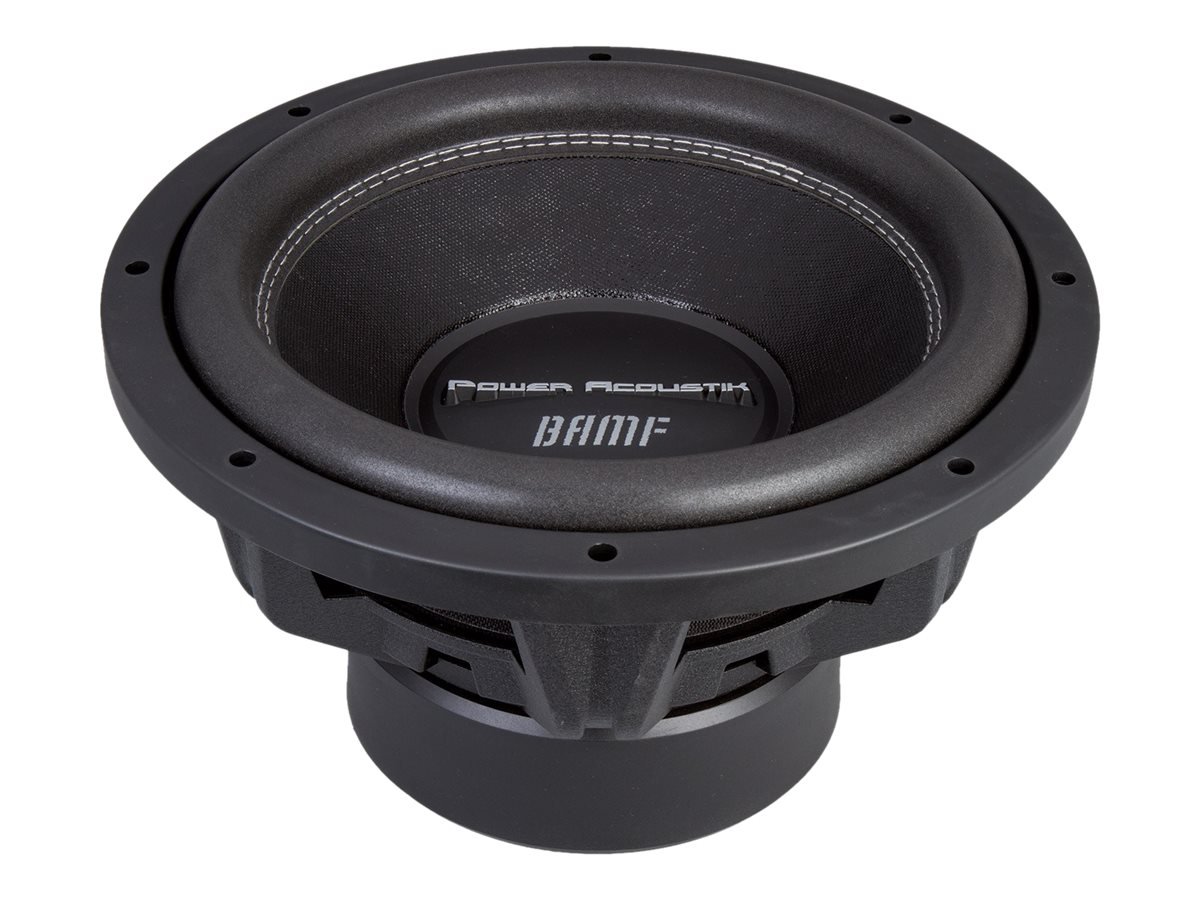
The rated-power king of this list — an 3800W RMS rating for big-amp builds.
The headline here is raw rated output: 3800W RMS, which is far and away the highest continuous rating in this group — the American Bass XD tops out at 1000W by comparison. If you already own a monster amplifier and want a driver that will survive its output, this is the one built for that job. The overcompensating motor structure and 12mm T-yoke with top plate are engineered to keep low-frequency dynamics intact when the amp is working hard.
The trade-off is honest and worth taking seriously: raw rated power is no guarantee of measured reliability under stress. Sound quality and value both get solid praise, and the power handling is appreciated for the money, but durability and power consumption get mixed reports — including the odd unit that gives out early when pushed. Treat that 3800W figure as a ceiling and drive it sensibly below it. Pair it with the right amplifier and it delivers the output it promises.
What you are paying for: the biggest rated RMS figure in this roundup, backed by a 12mm T-yoke built for sustained low-end work.
The real caveat: that rating demands a capable amp and disciplined tuning — run it within limits and it rewards you; overdrive it and a few have learned the hard way.
Choose this if: you have a high-output amplifier and want the driver with the highest continuous power rating here.
Walk past if: you want a forgiving sub that tolerates being run hard near its ceiling.
7. NVX VCW152v3 15″ 3000 Watt Max (1500W RMS) Dual 2-Ohm Car Subwoofer

Carbon fiber, a 202 oz magnet, and a rated life measured in years.
Compare this to the Audiopipe next to it: the NVX is rated 1500W RMS versus the Audiopipe’s 900W — a far higher continuous rating — while keeping a comparable 3-inch voice coil on both. That extra headroom comes from the hardware. A 202 oz triple-stacked Y35 ferrite magnet (a heavy multi-layer motor that drives the cone with force) sits behind a carbon fiber dust cap and carbon-fiber-enhanced paper cone. A die-cast aluminum vented basket and dual progressive roll spiders keep everything rigid under load.
The cooling design is the durability story. The 3-inch, 4-layer high-temperature black aluminum voice coil and flat braided tinsel leads shed heat so the sub lasts. Owners mention exactly that longevity — some describe NVX units still playing after eight years. Response reaches down to 20Hz, and it plays well in either a sealed box (2.00 cubic feet) or a ported one (3.00 cubic feet), so you can tune it to taste. Dual 2-ohm coils wire to 1 or 4 ohms.
This is a premium pick, and it is priced like one. But if you are building a system you plan to keep, the carbon fiber build and multi-year durability make the long view reasonable.
Why It Stands Out
- 1500W RMS handling — well above most of this list — with a 3000W peak
- 202 oz triple-stacked magnet and carbon fiber cone for rigid, controlled output
- Vented die-cast basket and high-temp 3-inch coil keep it running for years
- Plays in sealed (2.00 cu ft) or ported (3.00 cu ft) boxes down to 20Hz
The Counterweight
- Premium tier pricing puts it above most budget builds
- All that magnet weight means a solid, non-standard box build
Built for: the long-term build where carbon fiber rigidity and multi-year lifespan justify the premium.
Not the one if: you are on a tight budget and just need basic bass this month.
8. Sound Town METIS Series Powered Subwoofer 1800 Watts 15”

A self-powered PA sub that sets up in minutes and punches above its weight on gig night.
Unlike every raw driver above, this one has its own Class-D amplifier built in — no external amp to buy or wire. It handles 500W RMS with a 1000W program and 1800W peak rating, and a 4-inch voice coil inside the 15-inch driver, which is the biggest coil of any sub here. The 5/8-inch birch plywood front and rear panels resist the cabinet rattle that plastic enclosures suffer from, so the bass stays punchy and focused even at high output.
Connection options are generous for a mobile rig: two XLR-1/4-inch combo inputs, two RCA inputs, two XLR through and 100Hz high-pass outputs, and two RCA outputs. A 35mm pole-mount socket lets you stack a satellite speaker on top for a full-range PA. Two recessed handles make it carryable, and the black carpet finish with heavy-duty metal grille and corners is built to survive loading in and out of a van.
The honest wrinkle: the power claims draw mixed reaction. Some mobile DJs find it works perfectly for their gigs, while others balk at the peak rating being advertised. Judge it by the 500W RMS figure, which is what it sustains, and it makes sense for wedding and party duty. A few also find it heavy to haul, so plan for a hand truck on bigger shows.
Made for: the mobile DJ or solo entertainer who wants amplified bass with no separate amp to haul.
Skip if: you are building a car system — this is a powered cabinet, not a raw driver.
9. PRORECK SP-15X Active Powered PA DJ Subwoofer Cabinet 15 inch 2000W

Three DSP presets and a plywood cabinet made for weddings, churches, and party rooms.
This one is built for event spaces rather than car trunks. Its 15-inch woofer runs a 70 oz magnet and 3-inch voice coil, and the built-in Class-D amp (a lightweight, efficient amplifier type) pushes 460W RMS (continuous power) with a 2000W peak rating. What separates it from the Sound Town is the three DSP presets (digital sound-processing modes) — Monitor and DJ Live among them — so you can switch the tonal character to suit the room with one setting instead of fiddling with an EQ.
Wiring is XLR in and out, so it connects cleanly to a mixer or another amp. The electronic crossover is adjustable from 40Hz to 120Hz, with an XLR high-pass output from 120Hz to 20KHz, so you can hand the mids and highs off to your tops. The plywood housing is there to cut resonance compared with a plastic cabinet, which keeps the low end accurate rather than boomy. Two side handles make it manageable to move.
It is the priciest cabinet in this group, and it is built for venue use rather than daily driving. If you want a plug-in sub for a reception hall or a church sanctuary, the DSP presets and plywood construction are what you are buying.
The deciding feature: three DSP presets and a 40–120Hz crossover mean you tune the bass to the room in seconds, not with a rack of outboard gear.
Right for: event and venue setups where quick tonal switching and a solid plywood cabinet matter more than portability.
Reconsider if: you want a compact, easy-carry rig — this is a substantial cabinet built to stay put.
Understanding the Specs
RMS Power vs. Peak Power
RMS is the continuous wattage a sub can handle all day; peak is a brief burst it survives. When you match an amp to a sub, match the RMS figures. A driver rated 500W RMS on a 500W amp plays cleanly, while one chasing a 5000W peak figure on the same amp may never reach its potential.
Voice Coils and Ohms
A voice coil is the copper winding inside the sub that the amplifier pushes current through to move the cone. Dual voice coils let you wire the sub to different ohm loads. A dual 2-ohm driver can present 1 or 4 ohms, and a dual 4-ohm can present 2 or 8 ohms. Check your amplifier’s minimum stable ohm rating before you wire it up.
Magnet Size and Sensitivity
The magnet is the motor that drives the cone, measured in ounces — bigger magnets generally mean more force and deeper bass. Sensitivity, measured in dB, tells you how efficiently the sub turns watts into sound. At the same amplifier power, a sub rated 90 dB plays louder than one rated 85 dB.
Powered vs. Passive Cabinets
A passive sub is a bare driver that needs an external amplifier and a box. A powered cabinet has the amplifier built in and plugs into a mixer or wall socket. Car builds use passive drivers; DJ and event rigs often run powered cabinets to skip buying a separate amp.
FAQ
Will a dual 2-ohm 15-inch sub work with my amplifier?
What is the difference between RMS and peak power on a subwoofer?
Do I need a separate amplifier for a budget 15 inch subwoofer?
How do I match an amp to a sub without blowing it up?
How big a box does a 15 inch subwoofer need?
Can I use a car subwoofer at home or in a PA setup?
Is a 3-inch voice coil better than a smaller one?
What does XMAX mean and why does it matter?
Are powered PA subwoofers as loud as passive car subs?
How long will a budget 15 inch subwoofer last?
Final Thoughts: The Verdict
For most car builds, the winner is the Rockville W15K9D2 — its CEA-rated 1250W RMS, dual 2-ohm coils, and 30mm XMAX are the most complete package in this group. If you want the best value on a modest amp, grab the CT Sounds Bio 15” for clean, tight bass at 500W RMS. And for a stage or party setup, the self-powered Sound Town METIS saves you wiring an external amp. If you are set on the highest-rated driver here, the Rockville tops the pack at 4.5+ stars across a crowd of satisfied owners.
How We Picked
We do not accept paid placement. Every pick is matched to a real buyer and a real use-case; we do not hands-on test units.
Sources & Methodology
Specifications: manufacturer listings and product documentation. Review insights: verified customer reviews, as of November 2026. Pricing: not shown on this page (it changes often); check the current price via the retailer link.
As an Amazon Associate, Gadgets Feed earns from qualifying purchases. This does not affect which products we feature.