
Our readers keep the lights on and my morning glass full of iced black tea. As an Amazon Associate, I earn from qualifying purchases.
Specs are compiled from manufacturer listings and verified buyer reviews and can change over time — please confirm the key details on the product page before buying.
A 5.1 receiver’s room calibration matters more than its wattage in a normal living room. A 5.1 receiver sends sound to five speakers plus a subwoofer, and the gap between a good and a bad one usually depends on how well it tunes itself to your room. The Yamaha RX-V385 wins here because it comes with its own room-tuning system, while the JBL MA310 and Sony STRDH590 are strong alternates depending on your cabinet space and how much power you want.
I’m Min — the founder and writer behind Gadgets Feed. This guide is built by comparing the manufacturers’ published specifications and the patterns across verified customer reviews, so you get each pick’s real strengths and trade-offs instead of marketing spin.
You do not need an audio engineering background to pick well. You need to know which specs change your daily listening and which are just numbers on a box, and this breakdown covers exactly that. Below you will find the picks that make the most sense for a real living room setup with an av 5.1 receiver.
Our Picks at a Glance

How To Choose The Best AV 5.1 Receiver
A 5.1 receiver powers five speakers and a subwoofer, and it sits between everything you watch and everything you hear. The mistake almost every first-time buyer makes is shopping by wattage alone. In a normal living room, a well-calibrated 60W amp beats a badly placed 145W one.
The calibration system is the real headline
Calibration means the receiver plays test tones and adjusts each speaker’s level and distance so sound arrives at your seat together. The Yamaha RX-V385 does this automatically with YPAO (Yamaha Parametric room Acoustic Optimizer) and includes the microphone in the box. Skip calibration and your surrounds stay louder or later than your front pair, smearing dialogue on action scenes.
Count your HDMI devices before you buy
Every box, console, and streamer needs an input. The JBL MA310 offers 4 HDMI inputs and 1 output with ARC (Audio Return Channel, which sends TV audio back down the same cable). Sony’s STRDH590 matches that with HDMI 4-in/1-out and ARC too. Three devices is fine on any of these. Five is not.
Measure your shelf, then read the depth figure
Receivers are deep boxes with vents that need breathing room. The Yamaha is 12.6″D x 17.12″W x 6.35″H. The Sony is 11.75″D x 17″W x 5.25″H. That gap matters if your cabinet has a fixed back panel or a low shelf, so measure before you commit.
Quick Comparison
| Model | Best For | Channels | HDMI In/Out | Video Pass-Through | Amazon |
|---|---|---|---|---|---|
| Yamaha RX-V385★ Best Overall | Hands-off setup in any room | 5.1 | — | 4K Ultra HD, HDR10, Dolby Vision, HLG, BT.2020 | Amazon |
| JBL MA310 | Compact white-rack builds | 5.2 | 4 in / 1 out | 4K | Amazon |
| Sony STRDH590 (Renewed) | Low-profile cabinets and raw power | 5.2 | 4 in / 1 out | 4K HDR, Dolby Vision, HDCP 2.2 | Amazon |
In‑Depth Reviews
1. Yamaha RX-V385 5.1-Channel 4K Ultra HD AV Receiver with Bluetooth
Our pick — 4.5+★ from 3,000+ verified ratings; the strongest balance of quality and price.
The one that tunes your room for you and gets the surround right first try.
If your living room is an odd shape — a sofa off to one side, a doorway eating the left channel — this is the receiver that fixes it without you touching a menu. YPAO auto-calibration listens to test tones through the supplied microphone and balances each of the five speakers plus the sub. That is the single biggest reason it takes the top spot: you set it up in minutes and dialogue stays locked to the screen.
Video handling is fully covered for a modern TV. It passes 4K Ultra HD with HDR10, Dolby Vision, hybrid log-gamma and BT.2020 (the wide colour range used by 4K movie masters), so your picture arrives at the TV unchanged from the disc or stream. Bluetooth is on board for phone and tablet streaming, and the box includes the AM antenna, FM antenna, remote, YPAO microphone and two batteries — nothing extra to buy on day one.
Where owners push back is consistency over time. Functionality and Bluetooth connectivity come in mixed rather than glowing, and a slice of buyers report dropouts or a unit that quits. That is a fair caveat rather than a verdict — the fundamentals are solid, and the quality and sound-quality reports are the strongest signals in the whole review base for this model. Set it up once with good ventilation around the vents and it does the job quietly.
What earns it first place
- YPAO calibration with the mic in the box balances all five channels automatically
- Full HDR ladder covered: HDR10, Dolby Vision, HLG and BT.2020
- Bluetooth plus AM/FM antennas, remote and batteries included
- At 12.6″D x 17.12″W x 6.35″H it needs a deeper cabinet than the Sony’s 11.75″D, so measure before you buy
The honest trade-offs
- Bluetooth and long-term functionality land in the mixed bucket in owner feedback
- Deepest chassis of the three, so a shallow cabinet is a genuine no-go
- No Dolby Atmos expansion — it is a true 5.1 box, not a stepping stone
Reach for this one: a first surround build, a rental, or any room where the seating is not centred.
Pass it by: your cabinet is under 12.6 inches deep or you already plan to move up to an Atmos layout.
2. JBL MA310 5.2 Channel (60 Watt x 5) 4K AV Receiver (White)

A white, five-channel amp that hides its watts behind a modest frame.
Sixty watts across five channels is the spec that tells you most about this one — it is a music-and-movie amp for a normal room, not a cinema barn. Native 5-channel decoding of Dolby and DTS formats means a standard disc or stream is decoded properly rather than folded into a stereo mix. If you are building around five bookshelf speakers and a sub, that is the whole job done.
You get four HDMI inputs and one output plus ARC (audio return channel, which sends TV sound back down one cable), so a console, a streaming stick and a cable box can all live on the back with one cable to the TV. Bluetooth v5.1 with Low Energy (a low-power wireless standard) handles phone streaming. In the box: a Bluetooth antenna, IR remote, power cord, quick-start guide and safety sheet. The white finish separates it from the sea of black boxes — worth real thought if your shelving or TV stand is light.
Crisp sound is what carries this model’s reputation, and the reviewers who like it describe it exactly that way. The catch is scale: a lean review base means you are buying somewhat on faith, and connectivity and value land in mixed rather than unanimous territory. It weighs 5.1 kg, so it is easy enough to lift onto a shelf alone. If you want a big crowd-tested safety net, the Yamaha has one; if you want a tidy, pretty, compact amp for a small-to-mid room, this is the cleaner-feeling choice.
Where it fits: four HDMI inputs and a white chassis make it the natural pick for a light-coloured media unit in a lounge or a bedroom cinema setup.
The thing to weigh: 60 watts across five channels is honest about its ceiling — it will not fill a large open-plan room the way more power does, and the reviewer pool behind it is still small.
Suits you if: you want a very visible-looking receiver that matches a pale shelf and still decodes Dolby and DTS natively.
Think twice if: your room is big and open, or you would rather buy behind thousands of ratings than a modest handful.
3. Sony STRDH590 5.2 Multi-Channel 4K HDR AV Receiver with Bluetooth (Renewed)
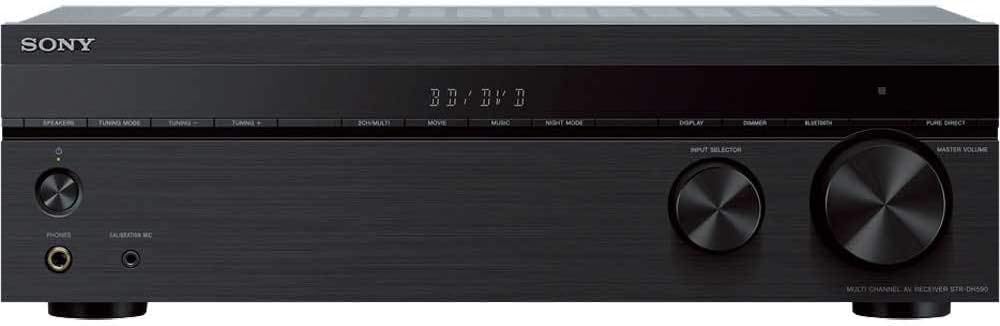
Five channels at 145 watts a piece, squeezed into a cabinet-friendly 5.25 inches.
Power is the argument for this one, and it is not a vague one: 145W per channel at 6 ohms, 1kHz, 1ch THD 0.9%. In plain terms that is a lot of push per speaker, so a demanding front pair gets driven without the amp running out of breath during loud action scenes. The low-profile 5.25-inch height is the other headline — it slides into conventional AV cabinets where taller boxes simply will not go. For reference, the Yamaha RX-V385 is 6.35 inches tall.
Setup is friendly for a renewed unit. HDMI 4-in/1-out with Audio Return Channel, HDCP 2.2 support for copy-protected 4K sources, and 4K HDR with Dolby Vision compatibility keep the picture path intact. S-FORCE PRO front surround is there for virtual surround from the front pair when you are not running full speakers. You also get a 1/4″ full-size headphone jack, 4 stereo RCA inputs, 2 digital audio inputs (one optical, one coaxial), an FM radio with 30-station presets and a calibration mic in the box.
The real question with any renewed receiver is longevity, and it is the one place this pick asks you to accept risk. Owner feedback splits on reliability, with some units reportedly giving out and several noting roughly a year of service. Treat that as the trade-off for the power and price tier, and check the renewed warranty path before you buy. The sound quality, value and setup reports are positive, and HDMI ARC CEC compatibility gets called out as working well with modern TVs.
Why the power people choose it
- 145W x 5 at 6 ohms drives hungry front speakers comfortably
- 5.25″ height vs the Yamaha’s 6.35″ — a real advantage under a low shelf
- Extensive input set: 4 HDMI, 4 stereo RCA, optical and coaxial digital
- Full-size 1/4″ headphone jack, which most slim receivers leave out
What to accept going in
- It is a renewed unit — reliability is the split topic in owner feedback
- Deeper and wider than the JBL, so small racks still need measuring
- Only one optical and one coaxial digital input total
Buy this when: your cabinet height is the hard limit and your speakers want real wattage behind them.
Look elsewhere when: you need a factory-sealed unit with a long track record rather than a renewed one.
Understanding the Specs
What “5.1” actually means for your room
The 5 is five speakers: front left, front right, centre, and two surrounds. The 1 is the subwoofer, which handles the low rumble you feel more than hear. Together they put dialogue in the centre channel where it belongs and effects around your seat. A 5.2 unit simply adds a second subwoofer output for a bigger, more even low end — useful in a large room, harmless in a small one.
Why wattage alone does not decide sound quality
A watt rating tells you how hard the amp can push, not how clean it sounds at your listening volume. Sensitivity and impedance of your speakers matter just as much. A receiver with high per-channel wattage will drive demanding speakers more comfortably, while an efficient pair of bookshelf speakers can sound superb on a modest amp. Match the wattage to your speakers’ sensitivity and impedance, not to the biggest figure on the shelf.
HDR10, Dolby Vision and BT.2020 in plain words
These are the video formats a receiver must pass through untouched. HDR10 is the baseline high-dynamic-range format. Dolby Vision is a more advanced version that adjusts scene by scene. BT.2020 is the wide colour range modern 4K masters are graded in. If the receiver does not support the format your TV and source both use, the picture drops back to a plainer version. Check that all three match across your chain.
Calibration microphones and why they matter
A calibration mic sits at your seat while the receiver plays test tones and measures how each speaker sounds from that spot. It then sets distance and level per channel so sound arrives together. Without a calibration mic you are setting delays and channel levels by ear behind a menu screen. A bundled mic in the box, like the ones shipped with these units, saves you buying one and removes the most common setup mistake.
FAQ
Will a 5.1 receiver work with my existing TV and streaming stick?
Do I need a subwoofer to use a 5.1 receiver?
How deep does the cabinet need to be for a receiver?
Is a renewed AV receiver risky to buy?
Does YPAO calibration really change how a 5.1 setup sounds?
What is the difference between Dolby Vision and standard HDR on a receiver?
Can I stream music to these receivers from my phone?
How much power do I need for a medium living room?
Will a 5.1 receiver pass 4K through to my TV without losing quality?
Final Thoughts: The Verdict
For most people the pick is the Yamaha RX-V385. Its YPAO auto-calibration (a built-in setup system that measures your room and adjusts the sound) does the tuning your ears would otherwise do by trial and error. And 4K HDR and Dolby Vision pass-through (high-dynamic-range picture formats passed through untouched) keeps your picture chain intact. If you want a compact white amp with four HDMI inputs for a smaller room, the JBL MA310 keeps things tidy at 60 watts per channel across five. And if cabinet height is your hard limit, the Sony STRDH590 fits in 5.25 inches and pushes 145W per channel — just go in knowing it is renewed.
How We Picked
We do not accept paid placement. Every pick is matched to a real buyer and a real use-case; we do not hands-on test units.
Sources & Methodology
Specifications: manufacturer listings and product documentation. Review insights: verified customer reviews, as of July 2026. Pricing: not shown on this page (it changes often); check the current price via the retailer link.
As an Amazon Associate, Gadgets Feed earns from qualifying purchases. This does not affect which products we feature.