
Our readers keep the lights on and my morning glass full of iced black tea. As an Amazon Associate, I earn from qualifying purchases.
Specs are compiled from manufacturer listings and verified buyer reviews and can change over time — please confirm the key details on the product page before buying.
You want real stereo sound in a normal-sized room, but you do not want a receiver, an amplifier box, and a nest of speaker cable on your floor. Self-powered bookshelf speakers solve that: the amplifier is built into one of the cabinets, so you plug in power, connect the second speaker with the supplied cable, and stream from your phone. The hard part is that “wireless” means different things from brand to brand — some pairs stream over Bluetooth only, others add Wi-Fi, AirPlay 2 (Apple’s wireless streaming standard), or Chromecast (Google’s streaming standard), and a few add a phono stage (a built-in circuit for turntables) so a turntable plugs straight in. Below are eleven pairs worth your attention, each matched to a different room and a different habit.
I’m Min — the founder and writer behind Gadgets Feed. This guide is built by comparing the manufacturers’ published specifications and the patterns across verified customer reviews, so you get each pick’s real strengths and trade-offs instead of marketing spin.
Some pairs are tuned for a desk and a laptop, others are built to fill a living room beside a television, and one is a genuine streaming hub with its own app. The list below covers the full spread of wireless bookshelf speakers so you can match a pair to your room rather than to a spec sheet.
Our Picks at a Glance


How To Choose The Best Wireless Bookshelf Speakers
The first decision is not brand or budget — it is what you will actually plug into them. A pair that only streams over Bluetooth is perfect for a phone-first setup. A pair with optical, USB-C, or HDMI ARC inputs is the right call if a television or a turntable is part of the picture. Pick the input list before you pick the speaker.
Decide between Bluetooth-only and Wi-Fi streaming
Bluetooth is the simplest path: pair once, and your phone or laptop remembers the speaker. The trade-off is range and stability — a Bluetooth pair typically lists a range in meters or feet, and walls eat into that number. Wi-Fi streaming is a different animal. On a pair that supports Apple AirPlay 2 or Google Chromecast, your phone acts as a remote rather than the source, so audio keeps playing when a call comes in. If you plan to listen for hours on a couch, Wi-Fi support is worth seeking out.
Match driver size to your room
The woofer is the round cone that handles bass and lower midrange, and its diameter tells you roughly how much air the pair can move. A 3.5-inch mid-low driver suits a desk and a near field listener sitting an arm’s length away. A 5-inch or 5.25-inch driver moves noticeably more air and is the better fit for a living room where you sit several feet back. Bigger is not automatically better — a 5-inch driver in a tiny room can sound boomy and muddy.
Check the amplifier power and what it powers
Powered pairs quote output in RMS watts, which is the continuous figure rather than a peak number. It is a rough guide to headroom, not a volume guarantee, because cabinet design and driver efficiency matter just as much. Do not dismiss an 18W pair on the number alone; a well-tuned monitor at modest power can be cleaner than a louder budget box.
Look for the inputs you will actually use
Optical (TOSLINK) is the digital connection that pairs cleanly with most televisions. USB-C is the modern computer connection and, on a streaming speaker, also a way to send high-resolution audio from a laptop. RCA handles older gear and many turntables, but a turntable with a moving-magnet cartridge needs a phono stage — either built into the speaker or as a separate box. A subwoofer output is the most useful expansion port because it lets you add a powered sub later without replacing the pair.
Quick Comparison
| Model | Best For | Amplifier Power | Main Driver | Wireless | Amazon |
|---|---|---|---|---|---|
| Audio-Technica AT-SP3X★ Best Overall | Small rooms and turntable owners | — | 7.6 cm | Bluetooth (multipoint) | Amazon |
| Edifier MR3Budget Champion | Desktop monitoring on a tight budget | 18W × 2 RMS | 3.5 in | Bluetooth V5.4 (multipoint) | Amazon |
| PreSonus Eris Accent BTMost Versatile | Replacing three sets of speakers | 30W per channel | 4 in | Bluetooth 5.3 | Amazon |
| Edifier R1280DB | First powered pair on a budget | 42W RMS | 4 in | Bluetooth, 10 m range | Amazon |
| Fluance Ai41 | Turntable and TV in one room | 90W amplifier | 5 in | Bluetooth 5.0, 15 m range | Amazon |
| Klipsch Reference R-40PM | Big horn sound in a small box | — | 4 in | Bluetooth, 10 m range | Amazon |
| Audioengine A5 Plus | Desk and den with room to grow | — | 5 in | aptX HD Bluetooth, 100 ft | Amazon |
| Kanto YU6 | Plugging in a turntable directly | — | 5.25 in | aptX Bluetooth, 10 m range | Amazon |
| Audioengine HD6 | High-resolution desktop listening | 150W total (50W RMS per channel) | 5.5 in | aptX HD Bluetooth, 100 ft | Amazon |
| Triangle AIO Twin | Whole-home multiroom streaming | 2 × 50W | — | Wi-Fi and Bluetooth, 10 m | Amazon |
| KEF LSX II | Streaming everything from one shelf | — | — | Wi-Fi, AirPlay 2, Chromecast, Bluetooth | Amazon |
In‑Depth Reviews
1. Audio-Technica AT-SP3X Bookshelf Speakers
Our pick — 4.5+★ from 450+ verified ratings; the strongest balance of quality and price.
Compact cabinets that stay paired to two devices at once, so nothing gets unplugged.
Audio-Technica’s smallest powered pair is a 7.6-centimeter dynamic driver (about three inches) inside a plastic cabinet, tuned to deliver full-range sound from a shelf rather than a floor stander. That size is the point: it slides onto a bookshelf, a side table, or a desk without eating the surface. The pair runs on Bluetooth for wireless and adds dual RCA jacks for anything wired, so a turntable or a CD player can live alongside a phone without a switcher.
The feature that earns this pair the top spot is multipoint pairing — the ability to hold a connection to two Bluetooth devices at the same time. Your laptop stays linked while your phone is also paired, so a video call on one does not mean re-pairing the other. Sound quality is what wins people over, and it is where the tuning shows. Owners describe these as clear and genuinely loud for the size, and pairing with an Audio-Technica turntable is a common route into them.
The catch is physical: a plastic cabinet and a roughly three-inch driver will not pressurize a large living room the way a 5-inch pair does. There is a bass boost control on the cabinet, and it helps, but it cannot manufacture low end the driver cannot produce. Also budget for placement — the included 6.6-foot (2.0 m) speaker cable sets the maximum distance between the two cabinets, so plan where both will sit before you commit. The box ships with an AC adapter and three international plug adapters, which makes it a reasonable travel or relocation pick as well.
quiet nearfield detail
- Two Bluetooth devices stay connected at once — no re-pairing between laptop and phone.
- Dual RCA jacks let a wired turntable or player sit beside the wireless stream.
- 7.6 cm drivers in a plastic cabinet keep the footprint small enough for a shelf.
- Volume dial and LED power button on the cabinet are simple to operate by hand.
needs burn-in time
- Bass boost helps, but a ~3-inch driver will not fill a large room.
- No optical or USB input — you are working with Bluetooth and RCA only.
- The 6.6-foot speaker cable limits how far apart the two cabinets can sit.
desk nearfield pick: your setup is a shelf, a desk, or a small den and you want a turntable and a phone both connected without swapping cables.
loud room weak: you need optical for a television or you want genuine low-end weight in a big room.
2. Edifier MR3 Powered Studio Monitor Speakers
A desk monitor that certifies its frequency response and costs less than most Bluetooth-only pairs.
Edifier builds the MR3 around a flat-response promise: Hi-Res Audio certification and a stated 52Hz to 40kHz window. In plain terms, that means the speaker is voiced to reproduce what is in the recording rather than to flatter it, which is why it suits editing, mixing, and guitar practice. Each channel runs 18W RMS (continuous watts) with a peak sound pressure level of 92.5dB, pushed through a 3.5-inch mid-low driver and a 1-inch tweeter. The MDF cabinet — a dense particle board that resists resonance — is there to keep distortion down.
For a pair this affordable, the connection list is unusually complete: balanced TRS, RCA, and AUX inputs, a headphone output, and Bluetooth with multi-point support so two devices stay linked. RCA and AUX can be connected at the same time, which makes it easy to leave a computer wired in permanently and still stream from a phone. There is a genuine ceiling here, though. Compared with the Edifier R1280DB further down this list, the MR3 runs 18W against 42W of RMS output — so if you need to fill a room rather than a desk, the bigger pair is the better call.
Three modes — Music, Monitor, and Custom — plus the EDIFIER ConneX app for EQ give you a real say in the voicing. The honest caveat is that adjustability and volume draw the most divided feedback in owner reports, and the touch controls take some learning. Fresh from the start it may not sound immediately impressive if you are used to a bass-forward speaker; give the neutral tuning a few days before judging it.
true monitor lineage: a 3.5-inch driver and an 18W-per-channel amplifier are sized for near-field listening — you sit close and it delivers detail, exactly what a desktop setup needs.
small desk only: flat and neutral is the goal, so buyers chasing thump in a large room should look at the 42W R1280DB instead.
mix at low volume: a producer, editor, or student who needs an accurate near-field monitor and streams from a phone between sessions.
want deep bass: a living-room-only listener who wants the cabinets to shake on a movie night.
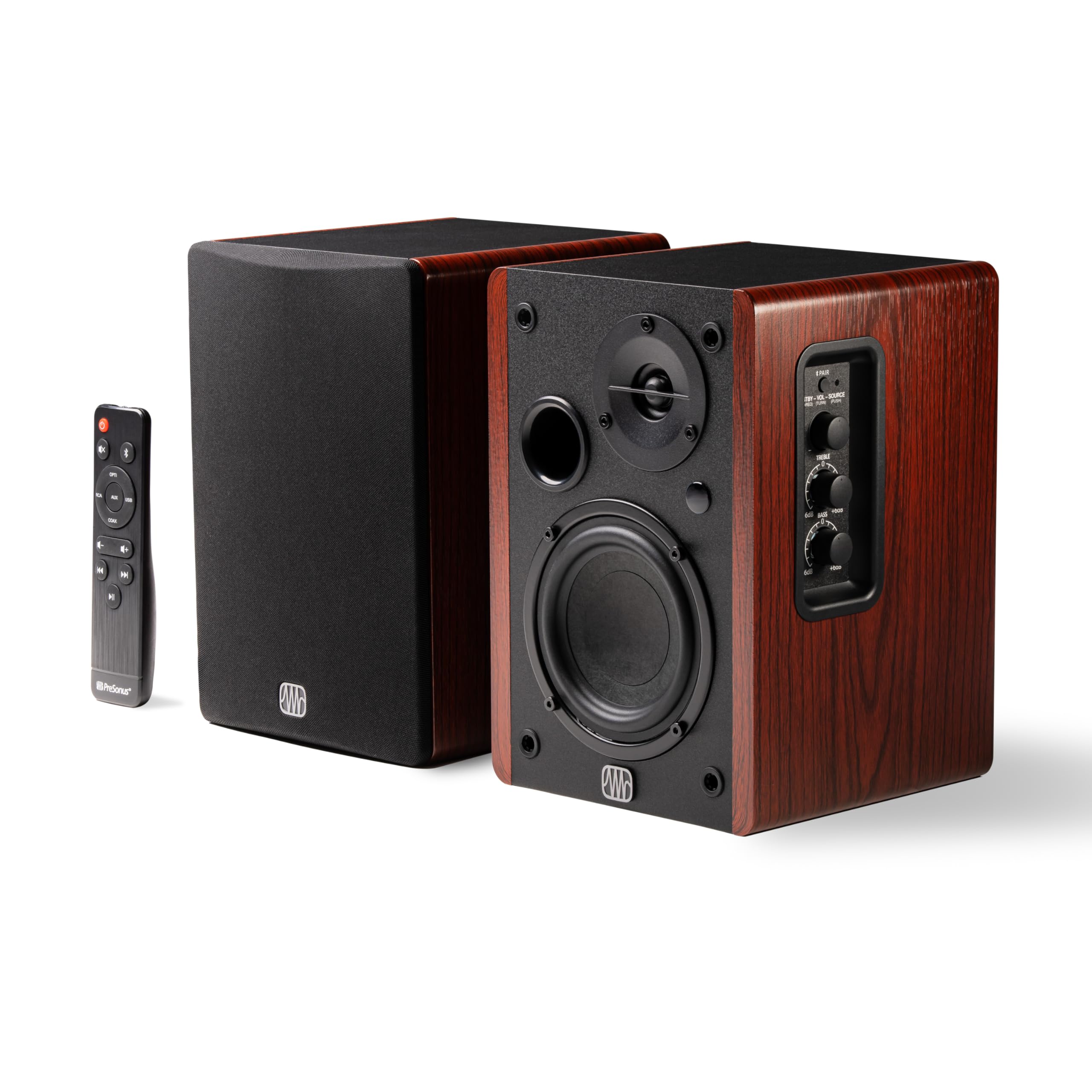
3. PreSonus Eris Accent BT Powered Bluetooth Bookshelf Speakers
One pair that replaces the desktop speakers, the TV bar, and the turntable setup.
The input list is the reason to buy this pair. You get Bluetooth 5.3 for streaming, plus USB-C, optical, coaxial, RCA, and a 1/8-inch AUX jack — six ways in, all on the same two cabinets. Streaming over Bluetooth 5.3 is stable and the wired options cover nearly any source you own. That combination is why it works as the only speaker in a room: the television goes in over optical, the turntable over RCA, and the laptop over USB-C.
Power is 60W total with 30W driving each channel, feeding a 4-inch woofer and a 13mm silk-dome tweeter through a 2.8kHz crossover. The stated range is 55Hz to 20kHz, so the low end reaches down far enough for music and dialogue without a subwoofer. There is an RCA sub-out for later, which is the right kind of upgrade path. Front-panel Volume, Bass, Treble, and Source controls mean you can tune it without opening an app, and the included remote handles it from the couch.
What wins people over is the sound relative to the outlay — owners describe these as a masterclass in audio engineering, which is high praise for a pair in this bracket. They are clean, well built, and the stained wood-grain finish reads more expensive than the cabinet actually is. The one thing to know before you buy is that the pair is physically small: the cabinet measures 7 inches deep, 6.3 wide, and 9.2 tall. That helps on a desk, but if you sit far back in a large room, a bigger 5-inch pair will project further.
budget studio start: you want a single pair to serve a TV, a computer, and a turntable, and you would rather not buy a receiver to switch between them.
need loud output: your room is big enough that you need a 5-inch driver to project to the far wall.
4. Edifier R1280DB Powered Bluetooth Bookshelf Speakers

The wood-grained workhorse that out-powers smaller monitors and takes an optical cable.
Where the MR3 aims at a desk, the R1280DB aims at a room. It pushes 42W RMS (42 watts of continuous power) through a 4-inch near-field driver (a woofer designed for close listening) in an MDF cabinet (a dense wood-fiber board) finished in walnut wood-effect vinyl — versus the 18W RMS of the smaller Edifier. That extra power is what lets it hold together at higher volume without thinning out. Bluetooth range is listed at 10 meters (about 33 feet), which is plenty for a phone across a living room, and audio latency (the delay before sound plays) is listed at 200 milliseconds, so lip-sync on video is worth checking before you commit to it as a TV speaker.
Inputs cover Bluetooth, optical, coaxial, and dual RCA, and there is a side-panel set of knobs on the powered cabinet for tone adjustments. A remote handles power, input switching, volume, and mute, and it can drop the pair into a low-power standby. The classic wood finish is a big part of the appeal — it looks like furniture rather than a computer peripheral, and the compact size means it disappears on a shelf.
Two things to weigh honestly. The remote and long-term reliability draw the most divided feedback in owner reports, so treat the remote as a convenience rather than the main control — the side knobs are there as backup. And with the MR3 on this same list, this is the pair to choose specifically when you want optical for a television and more wattage for a bigger room.
classic shelf value
- 42W RMS across a 4-inch driver gives it real headroom in a mid-sized room.
- Optical, coaxial, dual RCA, and Bluetooth cover a TV, a player, and a phone at once.
- Walnut wood-effect MDF cabinet reads as furniture, not gear.
modest top end
- Remote control reliability is the most divided point in owner reports.
- Listed audio latency of 200 milliseconds means checking lip-sync on video.
- Bluetooth range is a listed 10 meters, so walls will cut into it.
first real speakers: a first powered pair for a bedroom or mid-sized living room where a television needs an optical connection.
critical listening: you plan to control everything from the couch remote rather than the cabinet knobs.
5. Fluance Ai41 Powered 2-Way 2.0 Stereo Bookshelf Speakers

Ninety watts and a five-inch driver, in a braced walnut cabinet that reaches 15 meters.
This is the biggest jump in scale on the list before you reach the premium tier. The Ai41 pairs an integrated 90W amplifier with a 5-inch woven glass fiber driver and a neodymium tweeter, in an internally braced MDF cabinet with a rear bass port. The 5-inch driver versus the 3.5-inch unit in the Edifier MR3 — which is the physical reason this pair moves more air and carries bass further into a room. A rear port means you want some breathing room behind the cabinet, so do not push it flush against a wall.
In practice that means you can leave your phone on a kitchen counter and keep playing on the couch without a dropout. RCA and optical handle wired sources, and a subwoofer output lets you add low end later without replacing the pair. The remote, 8-foot 18-gauge speaker wire, and 2-year manufacturer warranty are all in the box.
The sound field is wide, the cabinet is solid, and setup is straightforward. What splits opinion is volume headroom: some listeners find it full at every level, while others want more output than it delivers. If you listen at low levels in a quiet room, that will not bother you; if you like to push a party, audition it against a horn-loaded pair. It is also the largest cabinet here to place, so measure your shelf before ordering.
big sound per dollar: 90W and a 5-inch glass fiber driver put it in a different weight class from the compact monitors above, and the sub-out keeps the door open for later.
size needs space: how loud you listen — the mixed reports on volume headroom are the dividing line for this pair.
living room value: a turntable, a television, and a phone all sharing one pair in a living room, with a subwoofer planned down the line.
tiny desk setup: you want to run it at neighbour-annoying levels, or your shelf is tight against a back wall.
6. Klipsch Reference R-40PM Powered Bookshelf Speakers
Horn-loaded tweeters and copper woofers for a soundstage that spreads wider than the cabinets.
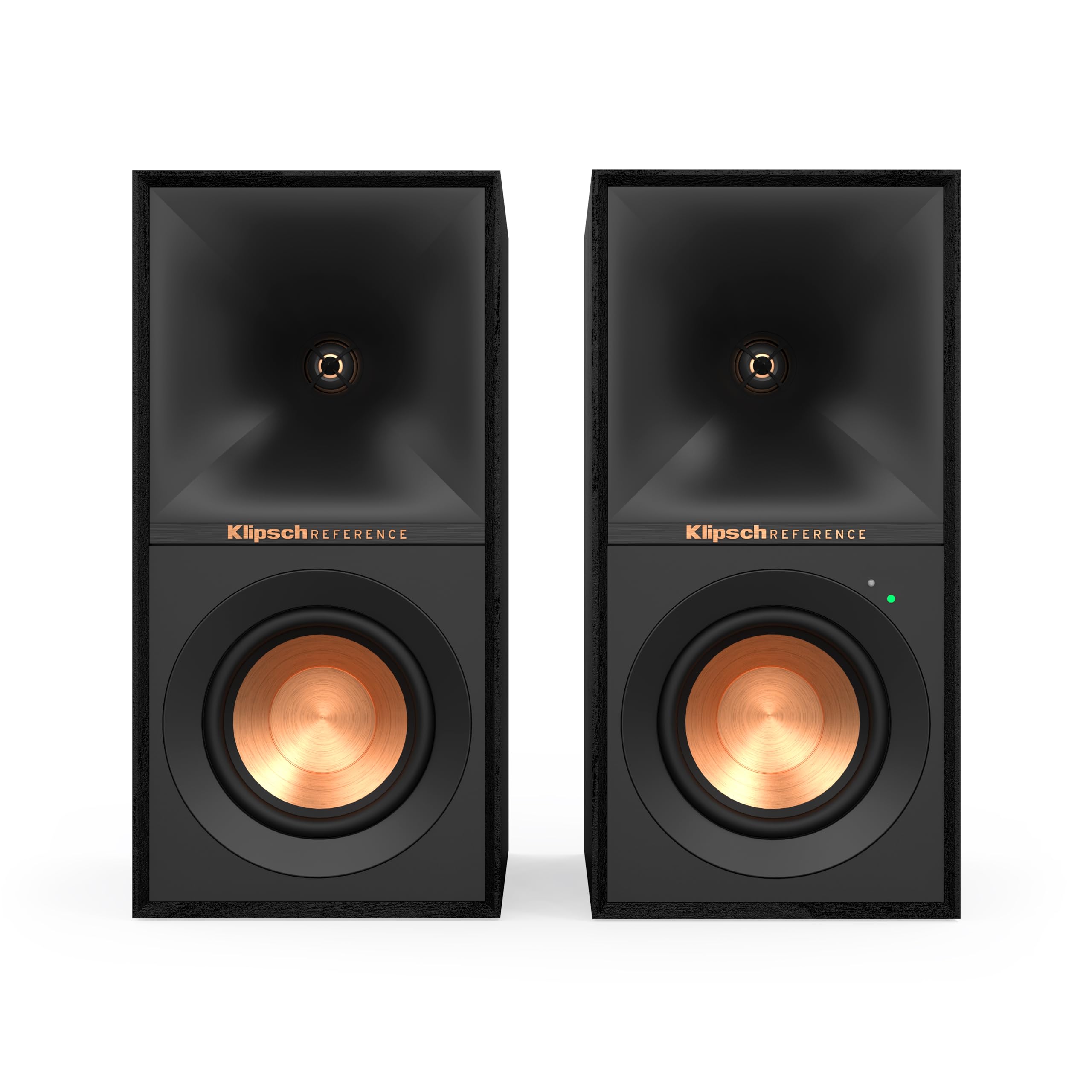
Klipsch takes a different route to the same room. Instead of a dome tweeter, each cabinet uses a 1-inch aluminum LTS tweeter behind a Tractrix horn, paired with a 4-inch copper-spun woofer. The horn spreads high frequencies across a wider listening area, so you can move around the room and still hear the detail. Bass reaches down to a stated 60Hz via rear-firing bass-reflex ports, and the cabinet depth is increased deliberately to warm the low end without a subwoofer. There is an RCA line-level output if you change your mind about the sub.
The connection set is smart for a mixed household: Bluetooth for streaming, a phono input with a ground screw terminal for a turntable, plus digital and analog inputs for everything in between. A customized amplifier is built in, so no AV receiver is needed. Setup is genuinely plug-in: power one cabinet, run the supplied cable to the other, then add sources.
Horn speakers are not neutral by design — they are lively, forward, and unforgiving of harsh recordings. That is a taste decision rather than a fault, and the pair is loved for its Klipsch sound, compact size, and easy setup. The genuine caution is electronics reliability and Bluetooth connectivity, which draw the most divided feedback in owner reports. Buy from a seller with a clean return path and test the wireless link in the first week.
rock and movies: you want a forward, energetic sound and a turntable plugged straight into the speaker with no phono box.
fatigue sensitive ears: you prefer a flat, neutral monitor voicing or you want the wireless link to be the primary connection.
7. Audioengine A5 Plus Wireless Bookshelf Speakers

Silk dome tweeters, a five-inch woofer, and a hundred-foot Bluetooth leash.
Audioengine builds the A5 Plus as a do-everything desktop and den speaker. A 5-inch custom woofer sits under a silk dome tweeter in a hand-tuned cabinet, and the built-in amplifiers mean you add power and go. Bluetooth here supports aptX HD, a higher-quality codec that carries more detail than standard Bluetooth, and the listed range is 100 feet. That long leash is the practical difference: you can leave the source in another room and keep streaming. Dual analog inputs and a subwoofer output round out the back panel.
Owners describe a small footprint with a large output, which is the A5 Plus’s whole argument — it does not look like it should sound this big. Stereo imaging is precise enough to serve as a desk monitor, and it doubles as a turntable speaker or a compact home theater front pair. A remote is included, and audio latency is listed at 30 milliseconds, which is low enough that video lip-sync is not a practical concern.
The fair warning is value and wireless consistency. The aptX HD link works nicely when it works, but Bluetooth stability is one of the more divided points in owner reports, so plan on the analog inputs as a reliable fallback. At this outlay, also compare against the Audioengine HD6 below it — the HD6 adds a bigger 5.5-inch woofer and a built-in 24-bit DAC for buyers who want a wired digital path.
wireless plus analog: a 5-inch driver, aptX HD streaming, a 100-foot range, and a subwoofer out in a cabinet small enough for a desk.
premium over rivals: Bluetooth consistency is the recurring complaint — keep an analog cable nearby as your reliable route.
all-in-one system: a desktop or den where the phone stays in another room and the pair needs to go loud without a sub.
budget constrained: a cable-free link has to be bulletproof for you, or you want a built-in DAC for wired digital sources.
8. Kanto YU6 Powered Bookshelf Speakers

A phono stage inside the cabinet, so a turntable plugs straight in with no extra box.
For anyone rebuilding a vinyl setup, the YU6 removes a component from the chain. An integrated phono preamp means any turntable — vintage or modern — connects directly, with no separate phono box to buy or power. The rest of the hardware is serious: 5.25-inch Kevlar drivers under 1-inch silk dome tweeters, inside handcrafted MDF cabinets standing 10.7 inches tall. Kevlar is a stiff, light material, and the upshot is a balanced midrange that holds its shape at higher volume.
Streaming runs through Bluetooth with Qualcomm aptX, a codec that carries more detail than baseline Bluetooth. Signal detection is the quietly clever part: the pair drops to automatic standby when nothing is playing and powers back up the moment audio arrives, so you are not hunting for a switch. A remote covers volume, input, tone, and balance, plus playback controls when streaming. Rubber feet, an AUX cable, and speaker cable are all in the box.
Two real caveats. The YU6 has more mixed owner feedback than most of this list — durability and hiss at idle are the recurring themes, so check it early and use a clean power source. And the 10.7-inch cabinet height means this is a furniture commitment, not a desk afterthought. Compare against the Fluance Ai41 if you want a 5-inch driver and a subwoofer out instead of a phono stage.
turntable friendly pair: you own a turntable and want it plugged straight into the speaker with zero extra boxes on the shelf.
no room depth: you need a tall cabinet to fit a low media unit, or you are upgrading from a pair with a silent noise floor.
9. Audioengine HD6 Powered Bookshelf Speakers
The pair that skips your laptop’s sound card entirely, with a DAC and real wood veneer.
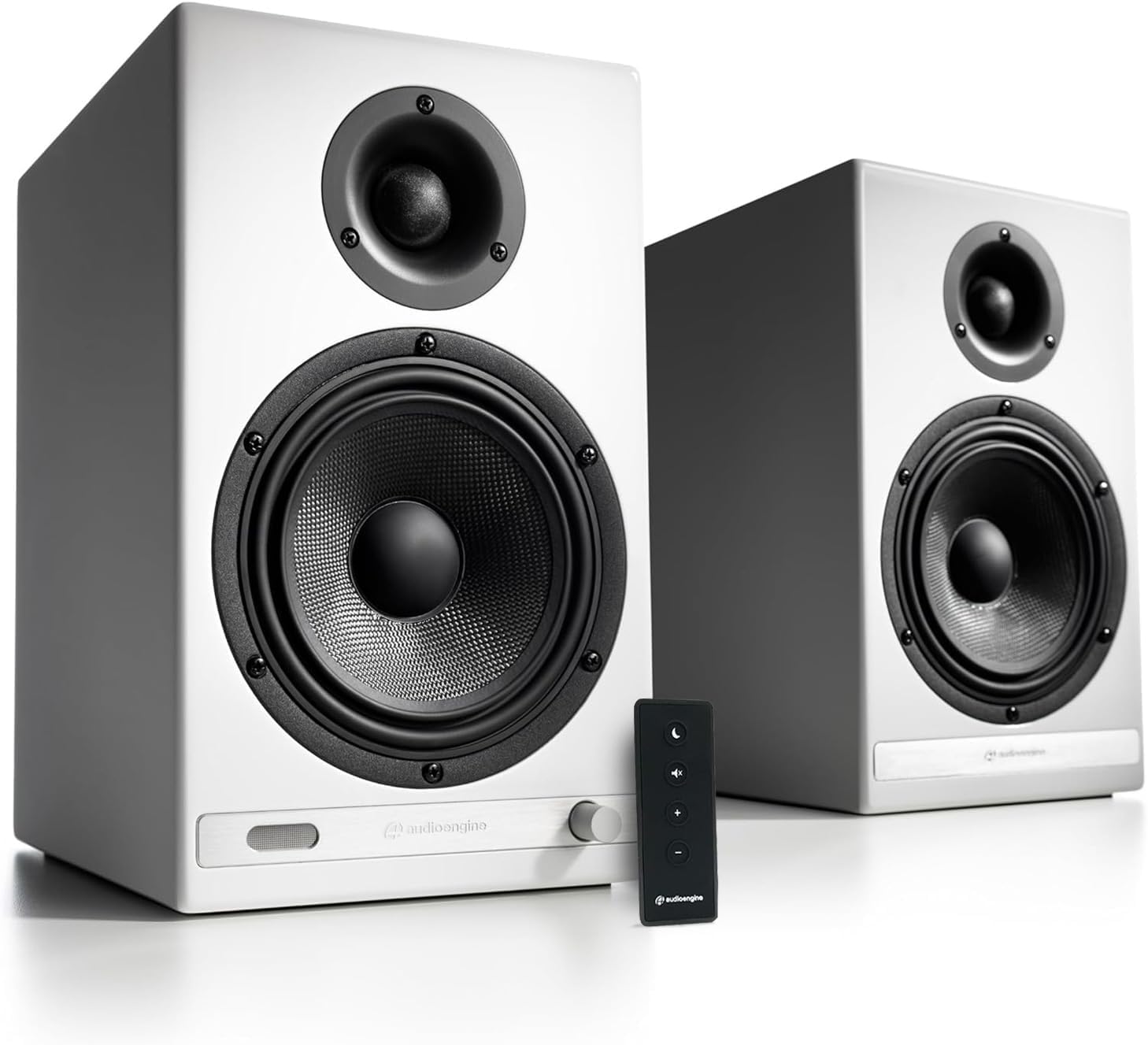
The headline here is the DAC — a digital-to-analog converter that turns digital files into sound. The HD6 has one built in, processing up to 24-bit/192kHz, which means an optical feed from a computer bypasses its internal sound card and arrives already converted. A 5.5-inch custom woofer and 1-inch silk dome tweeter cover a stated 50Hz–22kHz range, backed by 150W total with 50W RMS per channel. That is the largest wattage figure on this list, and it is why the pair fills a medium-sized room without strain.
Wireless runs on Bluetooth 5.0 with aptX HD and a listed 100-foot range. Wired options are optical, RCA, and 3.5mm. The cabinets are wrapped in real wood veneer with magnetic grilles and aluminum trim — owners consistently point to the veneer as the detail that makes them look like furniture rather than speakers. Cables, an aluminum remote, and a 3-year warranty come in the box.
The price is the honest sticking point, and it is the one thing buyers split on — some call it fair for the driver quality and DAC, others feel it. There is also low-level noise flagged in a slice of owner reports, so listen for hiss in a quiet room during your return window. Pair it with a good source and it earns its keep; pair it with a weak one and you are paying for resolution you will not hear.
built-in DAC quality
- Built-in 24-bit DAC up to 24-bit/192kHz bypasses a laptop’s sound card.
- 5.5-inch woofer and 50W RMS per channel fill a medium room with ease.
- Real wood veneer cabinets with magnetic grilles look the part in a living room.
pricey for passive fans
- Value is the most divided point in owner reports at this outlay.
- Low-level noise shows up in a slice of reports — test in a quiet room.
- You need a decent source to hear what the DAC is doing.
premium desktop rig: your desk or den has a computer, a turntable, and a phone to serve, and you want high-resolution files handled properly.
want separates path: a strong built-in DAC is not something you will use, or you want wireless to be the only connection.
10. Triangle AIO Twin Wi-Fi and Bluetooth Active Bookshelf Speakers

Wi-Fi and Bluetooth in one pair, and an app that builds a whole-home system around them.
Wi-Fi is the feature that changes how you use a speaker. On the AIO Twin, your phone acts as a remote rather than the audio source, so a notification or a call does not interrupt playback, and the link reaches across the house on your network. Bluetooth is there as well for quick ad-hoc streaming. High-resolution streaming is stated at 24 bits/192 kHz. The pair carries 2 × 50W of built-in amplification, so both cabinets are powered and no receiver is needed.
Two details make it a genuine hi-fi hub. There is a dedicated phono input, so 33 and 45-rpm records play from a turntable plugged straight in, and there is an optical input for a television. Multiroom support lets you add more AIO speakers and either play the same track in every room or different music in each one. The cabinets sit on aluminum feet with rubber pads, which decouple them from the shelf and protect the furniture surface.
It is the least-reviewed pair here, so tread with proportionate caution — there is not the same depth of owner feedback behind it as the Edifiers and Audioengines. All controls run through the app, so your phone is the interface, and if you would rather have knobs and a remote, this is the wrong shape. What it offers in return is the most complete streaming feature set below the KEF, plus the phono input the Wi-Fi-only competition usually skips.
streaming first setup: you want Wi-Fi streaming, a turntable input, and a path to adding speakers in other rooms.
prefer wired only: you want physical knobs and a handset remote rather than a phone app in charge.
11. KEF LSX II Wireless Active Bookshelf Speakers

Every streaming standard you own, in a cabinet smaller than most soundbars.
The LSX II is the most connected pair on this list. Built in are Apple AirPlay 2, Google Chromecast, Spotify Connect, and Bluetooth, so an iPhone, an Android phone, and a computer all stream without a dongle or a bridge. Physical inputs cover HDMI ARC for a television, USB-C for a computer, TOSLINK optical, 3.5mm auxiliary, and RJ45 Ethernet if you would rather wire the network. That is an unusual spread for a pair this size.
The sound comes from KEF’s 11th-generation Uni-Q driver array (a tweeter mounted in the center of the woofer), which mounts the tweeter at the acoustic centre of the woofer so both radiate from a single point. The result is a wider balance — a seat off to the side of the room still hears a properly phased image. Setup and EQ (tone adjustment) run through the KEF Connect app, which also handles firmware updates, and a remote is included. The cabinet measures 7.1 inches deep, 9.5 wide, and 6.1 tall, so it sits on a desktop or a TV console without dominating, and weighs 15.6 pounds.
Two fair caveats. The compact cabinet is the trade-off — small drivers in a small box will not pressurize a large room like the 5-inch Fluance pair, so this is a near-to-mid field speaker despite the price. And wireless connectivity plus app behaviour are the divided points in owner reports, particularly around USB-C. Set it up over a stable network in the first week and confirm every input you need actually handshakes before the return window closes.
room correction smarts: AirPlay 2, Chromecast, Spotify Connect, HDMI ARC, and USB-C in one pair means no receiver, no streamer box, and no dongle.
high asking price: the compact cabinet keeps it near field, and the app-led setup is the piece to prove out early.
small room streaming: a TV console or a large desk where you want one pair to handle every streaming service and a wired computer at once.
analog purist wants: a big open living room that needs physical volume, or a household that wants buttons instead of an app.
FAQ
Can I connect my turntable directly to these speakers without a receiver?
Do I need an amplifier or receiver with powered bookshelf speakers?
What is the difference between Bluetooth-only and Wi-Fi streaming on speakers?
How far apart can I place the speakers from the powered cabinet?
Will these work as TV speakers, and do I need an optical cable?
Can I add a subwoofer to these speakers?
Are these speakers good enough for a desktop computer setup?
What does aptX HD on a Bluetooth speaker actually change?
Do these speakers work with AirPlay or Chromecast?
Why do the compact speakers cost more than the bigger ones on this list?
Final Thoughts: The Verdict
The winner for most people is the Audio-Technica AT-SP3X, because it nails the one thing that makes a wireless bookshelf pair genuinely convenient: multipoint Bluetooth (lets two devices stay connected at once) lets a phone and a laptop stay connected at once, and dual RCA jacks (standard analog inputs) mean a turntable sits alongside the wireless stream without a switcher. It is a compact pair built for a shelf or a desk, and that is the honest scope of it.
If your room is bigger and you want a 5-inch driver with a subwoofer output (a jack for adding a bass box), the Fluance Ai41 is the pair to reach for — its 90W amplifier and 5-inch glass fiber driver give it real scale in a living room. For a turntable with nothing else in the chain, the Kanto YU6 removes the phono box (the separate turntable preamp) entirely. And if you want every streaming service on one shelf, the KEF LSX II is the only pair here that answers to AirPlay 2, Chromecast, and an HDMI ARC cable (a single cable that sends TV sound to the speakers) at once.
Before you commit to any of them, measure the surface where the pair will sit and decide honestly whether a television, a turntable, or a phone will be the main source. That one answer narrows this list from eleven pairs to two or three faster than any spec sheet. Pick the inputs first, then let driver size and cabinet fit settle the rest.
How We Picked
We do not accept paid placement. Every pick is matched to a real buyer and a real use-case; we do not hands-on test units.
Sources & Methodology
Specifications: manufacturer listings and product documentation. Review insights: verified customer reviews, as of November 2026. Pricing: not shown on this page (it changes often); check the current price via the retailer link.
As an Amazon Associate, Gadgets Feed earns from qualifying purchases. This does not affect which products we feature.