
Powered speakers eliminate the need for a separate amplifier and receiver, delivering high-fidelity audio directly from a single pair of cabinets. For the discerning listener, this means a cleaner setup without compromising on the sound quality that reveals every layer of a recording.
I’m Min — the co-founder and writer behind Gadgets Feed. I’ve spent hundreds of hours analyzing the latest digital-to-analog converters, amplifier topologies, and driver materials that define modern powered speakers to separate true high-end performance from marketing hype. This guide focuses on the models that deliver reference-grade clarity and imaging.
After evaluating amplifier wattage, frequency response curves, and connectivity options, I’ve curated the definitive selection of the best audiophile powered speakers that justify every watt and every dollar.
How To Choose The Best Audiophile Powered Speakers
Powered speakers integrate the amplifier directly into the cabinet, which simplifies your signal path and saves space. But to get true audiophile performance, you need to look deeper than just the advertised wattage. Factors like the type of tweeter, the crossover design, and the quality of the built-in DAC will determine whether a pair of speakers sounds lifeless or lifelike.
Driver Configuration and Tweeter Type
The tweeter is the most critical component for high-frequency detail. Silk dome tweeters offer a smooth, non-fatiguing response ideal for long listening sessions, while titanium or aluminum dome tweeters provide more bite and sparkle. Planar magnetic tweeters and Air Motion Transformer (AMT) designs deliver exceptional transient response and wider dispersion, making them a favorite for critical listeners. For the midrange and bass, look for woven glass fiber or aluminum alloy cones that combine stiffness with low mass to reduce breakup and distortion.
Amplifier Architecture and Power Handling
Not all amps are created equal. High-efficiency Class D amplifiers are common in modern powered speakers because they run cool and save space, but the best implementations include sophisticated DSP to manage crossover slopes and room correction. Bi-amped systems, where separate amplifier channels drive the woofer and tweeter, offer superior control and clarity. Pay attention to the continuous RMS power rating rather than peak output, as sustained headroom prevents compression during dynamic passages.
Input Versatility and DAC Quality
A true audiophile powered speaker must handle multiple source types. Look for a high-resolution DAC supporting 24-bit/192kHz playback over USB, optical, or coaxial inputs. Bluetooth with aptX HD or LDAC is essential for wireless streaming without sacrificing detail. HDMI ARC is a major advantage for TV integration, while a phono input with a built-in preamp simplifies turntable connections. A subwoofer output also future-proofs your system for deeper low-end extension.
Quick Comparison
On smaller screens, swipe sideways to see the full table.
| Model | Category | Best For | Key Spec | Amazon |
|---|---|---|---|---|
| HiVi-Swans M300MKII | Premium | 3-Way Clarity & Soundstage | 360W RMS / 3-Way / Ribbon Tweeter | Amazon |
| SVS Prime Wireless Pro | Premium | TV & Wireless Streaming | 200W (50W x 4) / HDMI eARC | Amazon |
| Audioengine HD6 | Premium | Natural Vocal Reproduction | 150W / Silk Dome Tweeter / Built-in DAC | Amazon |
| Yamaha HS8 | Professional | Flat Reference Monitoring | 120W Bi-Amp / 8″ Woofer / 38Hz – 30kHz | Amazon |
| Edifier S2000MKIII | Mid-Range | Balanced Hi-Fi for Small Rooms | 130W Tri-Amp / Planar Tweeter / aptX HD | Amazon |
| Edifier S1000W WiFi | Mid-Range | Multi-Room & Voice Control | 120W / AirPlay 2 / Spotify Connect | Amazon |
| Yamaha HS7 | Professional | Accurate Mixing in Small Studios | 95W Bi-Amp / 6.5″ Woofer / 43Hz – 30kHz | Amazon |
| Klipsch R-51PM | Mid-Range | Dynamic Movies & Casual Listening | 120W / Phono Preamp / Horn Tweeter | Amazon |
| Fluance Ri71 | Mid-Range | High-Frequency Detail & TV Use | 120W / AMT Tweeter / HDMI ARC | Amazon |
| Edifier S1000MKII | Entry-Level | Versatility & Value | 120W (60W x 2) / Titanium Tweeter / aptX HD | Amazon |
| Klipsch Heresy IV | High-End | Critical Listening & Heritage Sound | 99dB Sensitivity / Horn Loaded / Passive | Amazon |
In‑Depth Reviews
1. HiVi-Swans M300MKII
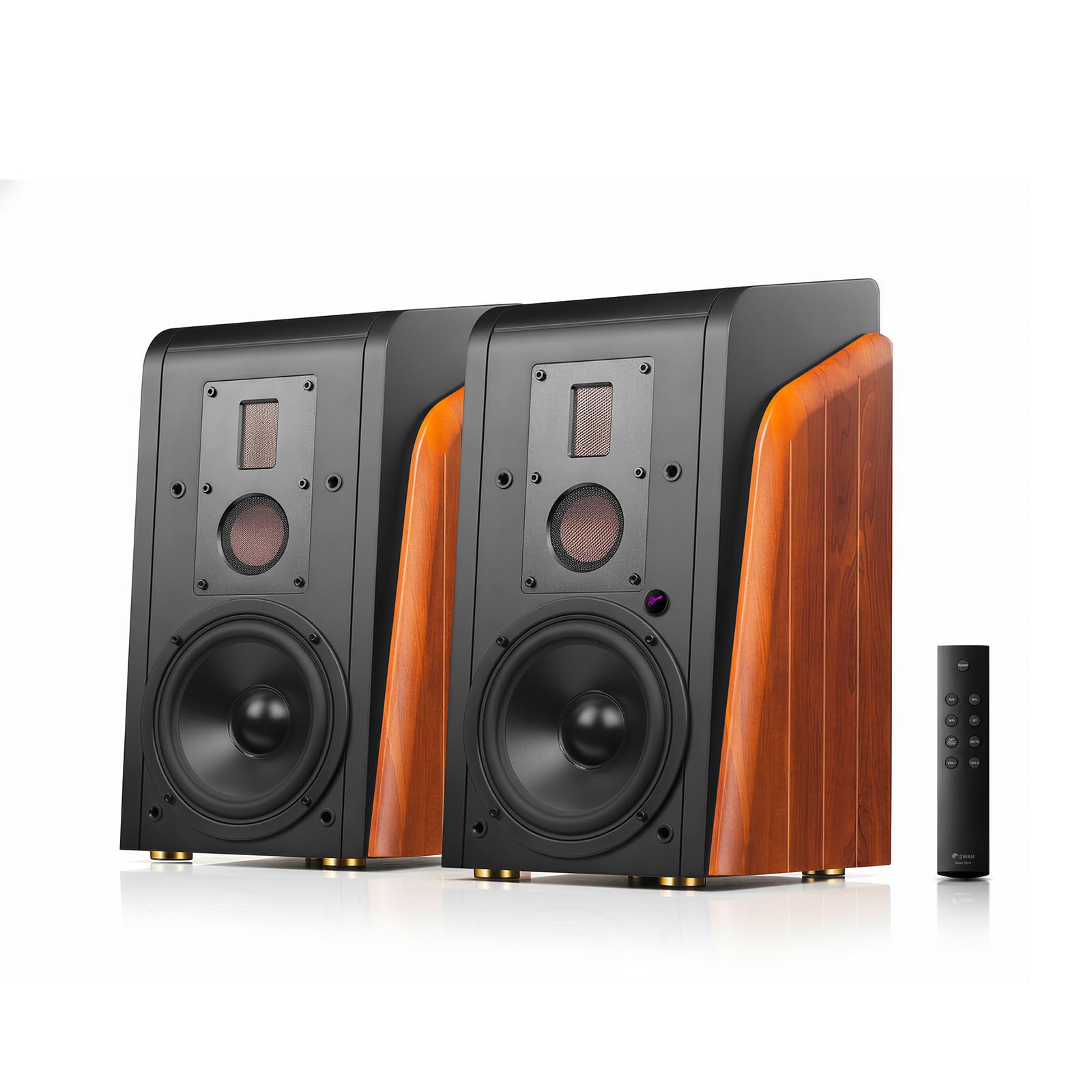
The HiVi-Swans M300MKII is a true three-way system in a compact footprint, combining a patented isodynamic ribbon tweeter that extends to 40kHz, a dedicated 2-inch metal midrange driver, and a 6.5-inch woofer. This dedicated midrange driver gives vocals and string instruments a presence and texture that two-way designs simply cannot match, while the 360W RMS total power provides headroom for orchestral peaks without compression.
Connectivity is comprehensive with Wi-Fi, Bluetooth 5.0, optical, coaxial, and balanced XLR inputs. The 4-degree angled front panel time-aligns the drivers to the listening position, improving imaging coherence. The M300MKII delivers a wide, immersive soundstage with bass that reaches down to 38Hz, making it a serious contender for both music and home theater use in medium to large rooms.
Some users note the included speaker-to-speaker cable is short at 10 feet, which may restrict placement in wider setups. The rear-panel bass and treble controls offer ±3dB adjustment, but the lack of front-panel controls means the remote is essential for daily operation. Despite these quirks, the M300MKII’s driver integration and sheer detail retrieval set a benchmark in the powered speaker category.
Why it’s great
- Exceptional three-way driver separation with dedicated midrange
- Ribbon tweeter offers vanishingly low distortion at high frequencies
- High 360W RMS power allows effortless dynamic range
Good to know
- Included inter-speaker cable is too short for wide placements
- No front-panel buttons; remote is mandatory for input changes
- Plastic cabinet veneer can scratch more easily than solid wood
2. SVS Prime Wireless Pro

The SVS Prime Wireless Pro is engineered for ultimate convenience without sacrificing sound quality. Its 200-watt amplifier (50 watts x 4 channels in a bi-amp configuration) drives a 5.25-inch woofer and 1-inch aluminum dome tweeter, with a precision-tuned digital crossover and 24-bit/192kHz DAC. The result is a clean, balanced presentation with bass extension down to 45Hz, suitable for near-field and midfield listening alike.
What sets the Prime Wireless Pro apart is its connectivity. HDMI eARC allows a direct, high-quality connection to your TV, while Wi-Fi streaming supports Apple AirPlay 2, Chromecast, and Spotify Connect. The DTS Play-Fi app provides full control and multi-room grouping. Voice control via Siri, Alexa, or Google Assistant adds hands-free convenience that few competitors match at this level.
Some users have reported occasional wireless connectivity hiccups with older routers or TVs, and setting up the Play-Fi app can require patience. There is no built-in equalizer, so tonal adjustments must be made upstream. However, for a user who wants a single, versatile hub for both music and home theater, the SVS Prime Wireless Pro delivers a polished, high-resolution experience.
Why it’s great
- HDMI eARC input simplifies TV audio with lossless quality
- Bi-amp design ensures clean driver control and high headroom
- Multi-platform wireless streaming with AirPlay 2 and Chromecast
Good to know
- Wireless connectivity can be finicky with certain network setups
- No onboard EQ or tone controls for fine-tuning
- Does not include a subwoofer output for deeper extension
3. Audioengine HD6

The Audioengine HD6 is built around a custom 5.5-inch Kevlar woofer and a 1-inch silk dome tweeter, powered by a 150W analog amplifier. The silk dome tweeter delivers a smooth, detailed high end that avoids the harshness associated with metal drivers, making the HD6 ideal for long listening sessions. The integrated 24-bit DAC handles optical and USB inputs, preserving clarity from digital sources.
The cabinets are furniture-grade real wood veneer with aluminum trim and magnetic grilles, adding a aesthetic appeal that stands out in a living space. The HD6 requires a 50-hour break-in period to reach its full potential; initially, the sound can seem tight and reserved. After break-in, the midrange opens up with exceptional vocal clarity and natural instrument timbre.
Bluetooth connectivity uses aptX HD for near-lossless wireless streaming, though some users have reported occasional connection drops requiring re-pairing. Bass is taut and controlled, but those seeking sub-40Hz rumble will want to add a subwoofer via the RCA output. The HD6 is a premium, no-compromise solution for listeners who prioritize natural, fatigue-free sound.
Why it’s great
- Non-fatiguing silk dome tweeter with airy detail
- Furniture-grade real wood cabinets reduce unwanted resonance
- Integrated 24-bit DAC for high-resolution digital playback
Good to know
- Requires 50-hour break-in before sound signature fully develops
- Bluetooth connections may require occasional re-pairing
- Subwoofer recommended for deep bass extension below 50Hz
4. Yamaha HS8

The Yamaha HS8 is the industry-standard reference monitor for a reason. Its 8-inch cone woofer and 1-inch dome tweeter are powered by a 120W bi-amp system (75W LF + 45W HF), delivering a flat, uncolored frequency response from 38Hz to 30kHz. This neutrality is essential for mixing and critical listening, revealing recording flaws and room interactions without exaggeration.
The HS8’s room control and high-trim switches allow fine-tuning to compensate for boundary effects and listening position, making them adaptable to imperfect acoustics. The large magnet structure in the Advanced Magnetic Circuit design provides tight bass control and reduced distortion at high output levels. In a treated room, the imaging is precise and the soundstage is well-defined.
These monitors are large — the 8-inch woofer and deep cabinet require substantial desk or stand space. They also lack built-in Bluetooth or Wi-Fi, remaining strictly analog via XLR and TRS inputs. They are designed for the user who wants truthful playback above all else, not convenience. For pure analytical accuracy, the HS8 remains an unmatched value.
Why it’s great
- Flat, uncolored frequency response ideal for mixing and mastering
- Room control switches adapt to placement and boundary effects
- High SPL capability with low distortion from advanced magnetic circuit
Good to know
- Large footprint requires significant desk or stand space
- No wireless connectivity or built-in DAC
- Can reveal harshness in poorly recorded material
5. Edifier S2000MKIII
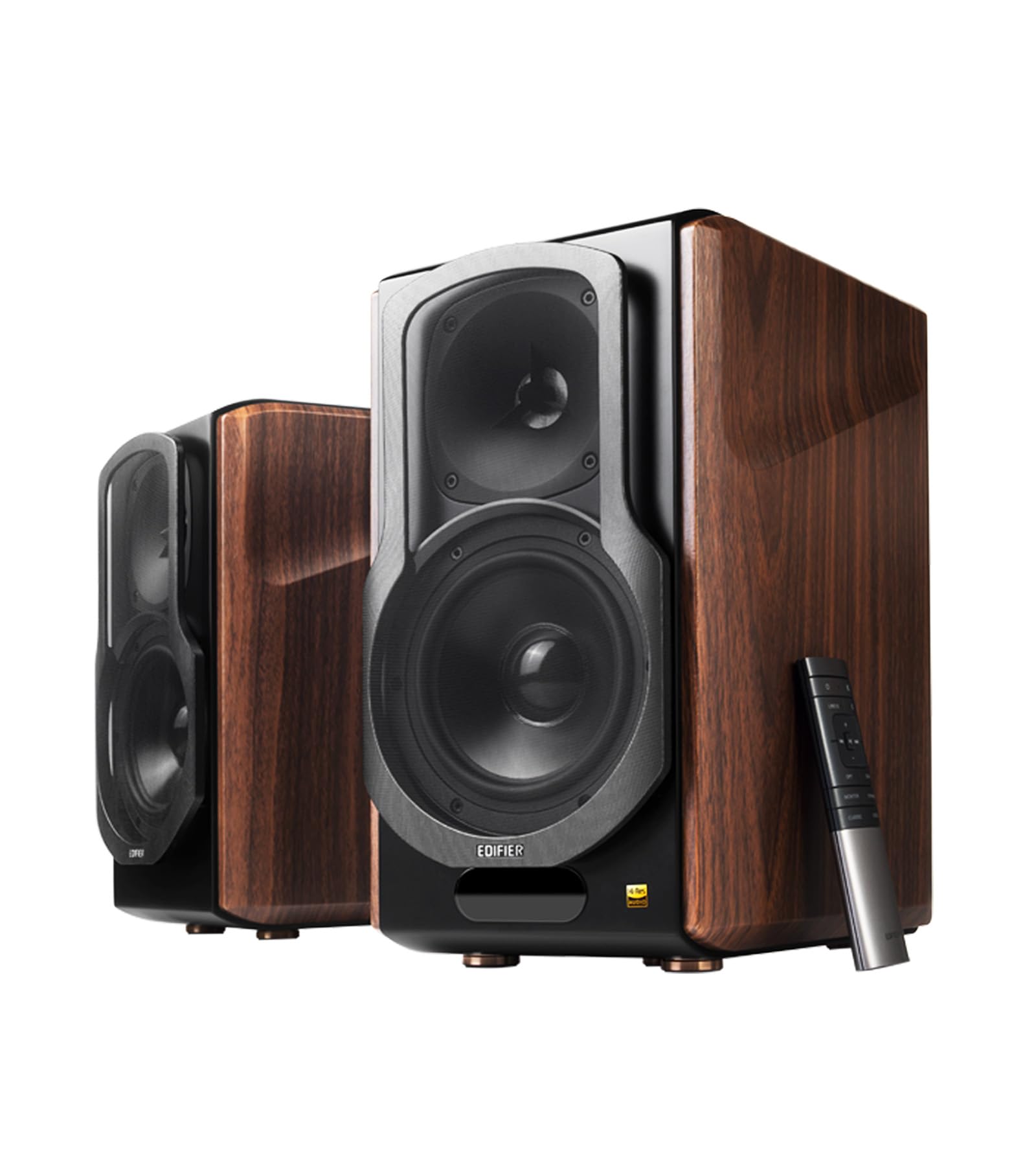
The Edifier S2000MKIII punches well above its price point by incorporating a planar diaphragm tweeter typically found in speakers costing several times more. This tweeter delivers fast, detailed highs with excellent transient response. The 5.5-inch aluminum diaphragm woofers are driven by a tri-amped 130W total system, with separate amplifier channels for the tweeter and woofer, minimizing intermodulation distortion.
Connectivity covers all the bases: Bluetooth 5.0 with aptX HD, optical, coaxial, and line-in. The included wireless remote allows control from across the room. The sound signature is engaging and dynamic, with deep, tight bass that belies the 5.5-inch driver size. Many users report that these speakers compete with systems in a higher price tier, especially in small to medium rooms.
The remote control’s symbols are nearly impossible to read in low light, a common gripe among users. The soundstage and separation, while very good for the price, do not quite reach the holographic precision of more expensive three-way designs. But for those seeking a serious hi-fi upgrade without breaking the bank, the S2000MKIII is a formidable contender.
Why it’s great
- Planar magnetic tweeter offers exceptional high-frequency detail
- Tri-amped design for superior driver control
- Deep, well-controlled bass for the driver size
Good to know
- Remote control is nearly unusable in dim lighting
- Soundstage width is decent but not class-leading
- Rear placement on a desk may require 6-inch minimum distance from wall
6. Edifier S1000W WiFi

The Edifier S1000W WiFi is a powered bookshelf speaker that brings full smart-home integration without compromising on audio fidelity. With support for AirPlay 2, Spotify Connect, and Alexa voice control, it fits seamlessly into a modern wireless ecosystem. The 120W amplifier drives a 5.5-inch aluminum alloy mid-bass driver and a 1-inch titanium dome tweeter, producing a clear, detailed sound.
The S1000W supports high-resolution audio up to 24-bit/192kHz and can be grouped for multi-room playback via the Edifier app. The build is robust, with real wood side panels that reduce cabinet resonance and add a premium aesthetic. Users report that the sound is uncolored and natural, with bass response that extends effectively despite the modest driver size.
Some users have noted that the remote is small and easily misplaced, and input switching can be a hassle without it. The Wi-Fi setup process is smoother than most, though some legacy network configurations may cause initial pairing issues. For someone building a voice-controlled multi-room audio network, the S1000W is a versatile and capable centerpiece.
Why it’s great
- AirPlay 2 and Alexa integration for hands-free whole-home audio
- Supports high-resolution 24-bit/192kHz streaming
- Real wood side panels enhance aesthetics and dampen resonance
Good to know
- Small remote is easy to lose, reducing usability
- Wi-Fi setup may require troubleshooting with older routers
- Input switching is remote-dependent, no front panel controls
7. Yamaha HS7

The Yamaha HS7 offers the same reference-grade neutrality as the HS8 but in a more manageable 6.5-inch woofer package. The bi-amped 95W system (60W LF + 35W HF) provides ample headroom for near-field monitoring, with a frequency response of 43Hz to 30kHz. The white cone and black cabinet aesthetic is iconic in recording studios worldwide.
Like its larger sibling, the HS7 features XLR and TRS balanced inputs and rear-panel room control and high-trim switches for acoustic adaptation. The bass is less extended than the HS8 but remains tight and articulate, making the HS7 easier to place in smaller rooms without overwhelming the space with low-end boom.
Some users have reported that the HS7 can sound slightly forward or analytical with poor-quality source material, which is the nature of a flat-response monitor. They also lack any wireless connectivity, requiring an external DAC or audio interface for digital sources. For the budget-conscious producer or the audiophile who wants honest playback, the HS7 is a proven workhorse.
Why it’s great
- Accurate, flat response trusted by professional engineers worldwide
- Bi-amped design for clean, powerful amplification
- Compact footprint fits small to medium studios and desks
Good to know
- No Bluetooth or Wi-Fi; requires external DAC for digital audio
- Can sound analytical and unforgiving with poorly mastered tracks
- Bass extension is limited compared to larger 8-inch monitors
8. Klipsch R-51PM

The Klipsch R-51PM brings the brand’s signature Tractrix horn-loaded tweeter to the powered speaker format, delivering high efficiency and dynamic, lively sound. The 1-inch tweeter and 5.25-inch copper-spun woofer are powered by a 120W amplifier. The horn design provides high sensitivity, meaning the speakers sound energetic even at low volumes without becoming harsh.
A standout feature is the integrated phono preamp with a ground screw terminal, allowing direct connection to a turntable without an external phono stage. Input options also include Bluetooth, USB, optical, and a 3.5mm aux. The R-51PM is incredibly easy to set up for a vinyl-based or TV-connected system.
The frequency response is not flat — it is intentionally voiced with a slight boost in the highs and lows for a more exciting, consumer-friendly sound. Users who prefer a neutral reference for mixing may find it too colored. Additionally, the remote requires direct line-of-sight and is unresponsive at wider angles. For casual listening, movies, and gaming, the R-51PM offers engaging, room-filling audio.
Why it’s great
- Horn-loaded tweeter provides high efficiency and dynamic liveliness
- Built-in phono preamp simplifies turntable connection
- Multiple inputs (USB, optical, phono, aux) for versatile use
Good to know
- Voiced for excitement, not flat reference accuracy
- Remote requires direct line-of-sight, poor performance at angles
- Bass is hyped but lacks deep extension; subwoofer recommended
9. Fluance Ri71
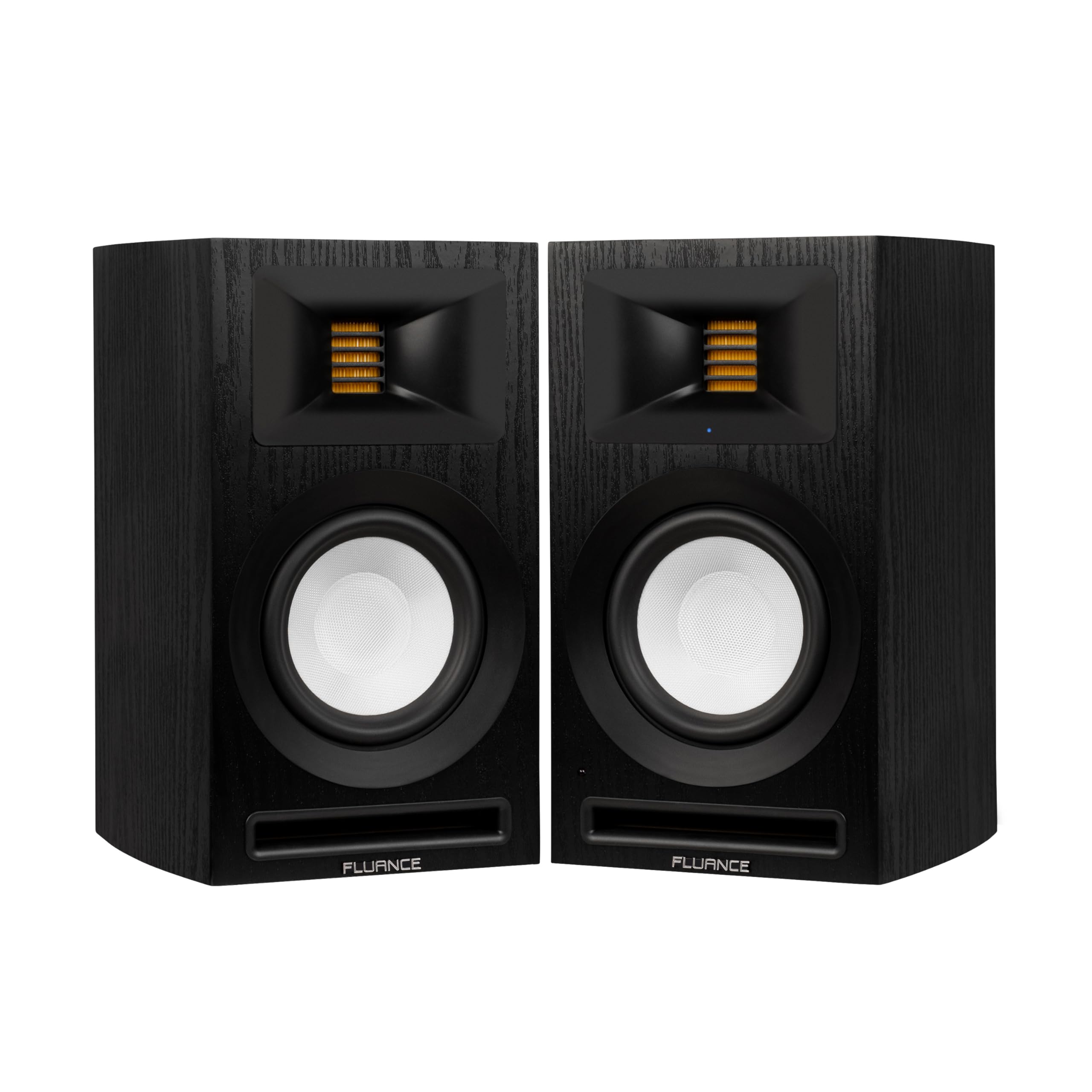
The Fluance Ri71 features high-performance Air Motion Transformer (AMT) tweeters, which use a folded ribbon design to move air more efficiently than traditional dome tweeters. This results in exceptionally clear and extended high frequencies with wide off-axis dispersion, creating a spacious and immersive soundstage. The 5-inch woven glass fiber woofers deliver warm, detailed midrange and deep, controlled bass.
The integrated 120W amplifier provides plenty of clean power, while the front-firing ports reduce placement constraints — these can be placed closer to walls than rear-ported designs. Inputs include Bluetooth aptX HD, HDMI ARC, and RCA, making the Ri71 a versatile choice for both music and TV. The inert MDF cabinet with internal bracing minimizes vibration and distortion.
Some users have reported occasional Bluetooth disconnection issues, though firmware updates have improved stability. The bass, while punchy and defined, may not satisfy those seeking subwoofer-level rumble without adding an active sub via the dedicated output. For listeners who prize clarity and detail, particularly in vocal-heavy genres, the Ri71 is a strong mid-range contender.
Why it’s great
- AMT tweeter delivers outstanding high-frequency detail and air
- HDMI ARC for seamless TV audio integration
- Front-firing ports allow flexible placement near walls
Good to know
- Bluetooth stability can be inconsistent without updates
- Bass is detailed but not chest-thumping without a subwoofer
- Needle drop on vinyl with built-in preamp not supported; turntable needs preamp
10. Edifier S1000MKII

The Edifier S1000MKII offers an excellent introduction to audiophile-grade powered speakers without a prohibitive entry cost. Its 1-inch titanium dome tweeter provides crisp, articulate highs with good detail retrieval, while the 5.5-inch aluminum alloy woofer delivers punchy, well-defined bass. The 120W RMS amplifier (60W per channel) provides ample volume for room-filling sound.
Connectivity is generous for this tier, with Bluetooth 5.0 and aptX HD, optical, coaxial, and dual RCA inputs. The speakers feature bass and treble controls on the front panel, plus a wireless remote. Many users praise the S1000MKII’s ability to reveal new details in familiar recordings, citing clear separation between instruments and a wide soundstage for the price.
Some quality control variance has been reported, with isolated cases of a faulty left speaker requiring return or exchange. The wood veneer finish is attractive but is not real wood, and the remote requires direct line-of-sight. For budget-conscious buyers seeking genuine hi-fi sound, the S1000MKII remains a proven and popular choice.
Why it’s great
- Excellent detail retrieval and instrument separation for the price
- Versatile inputs including aptX HD Bluetooth and optical
- Front-panel bass and treble controls for quick tuning
Good to know
- Quality control can be inconsistent; verify unit on arrival
- Wood finish is veneer, not solid wood
- Remote requires direct line-of-sight to operate
11. Klipsch Heritage Series Heresy IV

The Heresy IV is a passive, floorstanding speaker from Klipsch’s legendary Heritage series, designed and assembled in the USA. It uses a three-way horn-loaded design with a 12-inch woofer, a K-702 midrange compression driver mated to a Tractrix horn, and a K-107-TI titanium diaphragm high-frequency driver. Its 99dB sensitivity means it produces huge sound from very modest amplifier power, making it extremely efficient.
The Heresy IV delivers a sound that is immediate, open, and transparent. The horn-loaded midrange and tweeter create a sense of presence and immediacy that is difficult to achieve with conventional cone-and-dome speakers. The bass is tight and articulate, though it does not extend as deep as larger ported designs — it trades ultimate extension for speed and punch.
These speakers require an external amplifier and are not powered, which means they are outside the strict definition of a powered speaker but remain a top-tier option for those building a separates system. They are large and heavy, with a footprint that demands dedicated floor space. For the purist seeking high-efficiency, high-resolution sound with a timeless aesthetic, the Heresy IV is an investment that pays dividends in listening enjoyment.
Why it’s great
- 99dB sensitivity requires very little amplifier power for loud output
- Horn-loaded midrange and tweeter deliver unmatched clarity and presence
- Handcrafted in the USA with furniture-grade cabinet finishing
Good to know
- Passive design requires a separate amplifier
- Large footprint demands dedicated floor placement
- Bass roll-off is higher than many modern ported speakers; subwoofer integration recommended
FAQ
What is the difference between active and powered speakers?
Do I need a subwoofer with audiophile powered speakers?
Should I use a USB DAC with my powered speakers?
Final Thoughts: The Verdict
For most users, the best audiophile powered speakers winner is the HiVi-Swans M300MKII because its three-way driver configuration with a dedicated midrange and ribbon tweeter delivers unmatched clarity, imaging, and vocal presence at a competitive price point. If you want extensive multi-room streaming and TV integration, grab the SVS Prime Wireless Pro. And for pure analytical monitoring, nothing beats the Yamaha HS8.