
That dashboard warning light or a squishy corner at highway speed is your car telling you something is off. Guessing at tire pressure with a wobbly pencil gauge or eyeballing the sidewall bulge is a recipe for uneven wear, lower fuel economy, and a blowout risk you don’t want. A reliable gauge that reads in tenths of a PSI transforms tire maintenance from a chore into a precise, five‑second check.
I’m Min — the co‑founder and writer behind Gadgets Feed. I’ve combed through accuracy certifications, chuck designs, battery life specs, and hundreds of user reports to separate the gauges that deliver repeatable results from the ones that drift on the second pull.
If you want to stop wasting fuel and rubber, the right tool starts here with the best auto tire gauge that matches your garage setup and driving habits.
How To Choose The Best Auto Tire Gauge
Buying the wrong inflator gauge means you’re either chasing a drifting needle or fighting a chuck that won’t seal on your valve stem. Focus on three things: the accuracy standard, the chuck style, and whether digital or analog suits your typical lighting conditions and temperature range.
Accuracy grades and what they actually mean
Most budget gauges claim “within 1 %” but have no certification behind it. Look for ANSI B40.1 Grade B (2 % tolerance) as a baseline. For serious owners who want to match their TPMS sensors, ANSI B40.7 Grade 2A (±0.5 %) gives you repeatable readings down to 0.1 PSI — essential for race trailers, RVs with dual wheels, or anyone who tracks fuel economy obsessively.
Chuck design and thread compatibility
A straight chuck works fine for passenger cars, but if you own a truck with inner dually wheels or a motorcycle with recessed stems, a 30° reverse head or a 360° rotating nozzle saves contorting your wrist. Lock‑on chucks seal instantly without holding tension, while clip‑on chucks are faster for repeated checks but can leak if the rubber seat wears. Most air compressors use 1/4” NPT threads, and many gauges include both 1/4” and 1/2” adapters — double check before buying.
Display readability and power source
A digital backlit screen wins in dim garages or nighttime roadside checks, but only if the battery is replaceable without tools. Analog gauges with a magnifying window never need batteries and work in sub‑freezing temperatures where LCD screens can slow down. Consider the temperature range listed in the specs — cheap digital units may not wake up below 14 °F, while a brass and steel analog gauge works in any weather.
Quick Comparison
On smaller screens, swipe sideways to see the full table.
| Model | Category | Best For | Key Spec | Amazon |
|---|---|---|---|---|
| ETENWOLF T600 | Premium Digital | Ultra‑high accuracy | ±0.5 % (ANSI B40.7 Grade 2A) | Amazon |
| AstroAI T3 | Mechanical Mid‑Range | Dual‑wheel trucks | 30° reverse chuck, 10–120 PSI | Amazon |
| AstroAI Digital 250 PSI | Digital Premium | All‑in‑one shop tool | 3–250 PSI range, 0.1 resolution | Amazon |
| Milton 507KIT | Premium Digital | Pistol‑grip ergonomics | 14” hose, brass lock‑on chuck | Amazon |
| Milton S‑505 | Premium Analog | Lifelong durability | 10–160 PSI, magnifier lens | Amazon |
| CZC AUTO Digital | Budget Digital | Basic home garage | Frosted aluminum handle, dual chuck | Amazon |
| PINKJOY Digital | Budget Digital | Entry‑level value | Brass/stainless body, 3–250 PSI | Amazon |
In‑Depth Reviews
1. ETENWOLF T600 Digital Tire Pressure Gauge
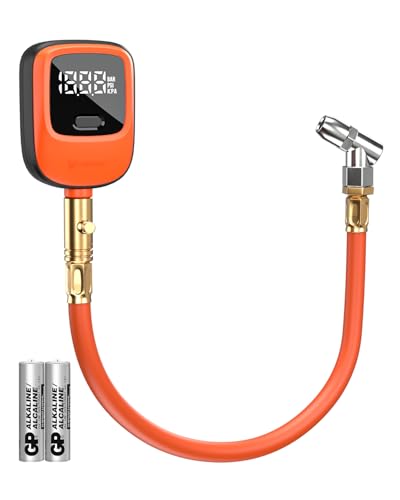
The ETENWOLF T600 is manually calibrated to ANSI B40.7 Grade 2A, delivering ±0.5 % accuracy — the tightest tolerance in this roundup. That means when your TPMS reads 38 PSI, the T600 matches it within a couple tenths, every time. The 360° rotating nozzle lets you attach at any angle, and readings lock on the display until you press the reset button, so you never lose the number while pulling the chuck off.
A single button handles power, zero reset, and unit switching (PSI, BAR, KPA). The flexible rubber hose and replaceable 1/4” NPT chuck make it compatible with any standard compressor fitting. Users consistently report readings within 0.5 PSI of calibrated analog gauges, and the bleed button lets you drop pressure in tenths while the gauge stays attached — no back‑and‑forth guessing.
The 0–250 PSI range covers everything from bicycle tires to heavy‑duty truck duals. Powered by two AA batteries (included), the unit auto‑shuts off to save power. If you want laboratory‑grade repeatability without spending triple digits, this is the gauge to buy.
Why it’s great
- ANSI B40.7 Grade 2A certification means factory‑calibrated accuracy right out of the box.
- 360° rotating chuck reaches awkward valve stems on trucks and motorcycles without kinking the hose.
- Replaceable AA batteries and a 2‑year warranty make long‑term ownership simple.
Good to know
- Plastic housing feels less rugged than all‑metal units, though users report it surviving garage drops.
- Bleed button requires steady finger pressure — not ideal for rapid deflation of large truck tires.
2. AstroAI T3 Heavy‑Duty Tire Pressure Gauge
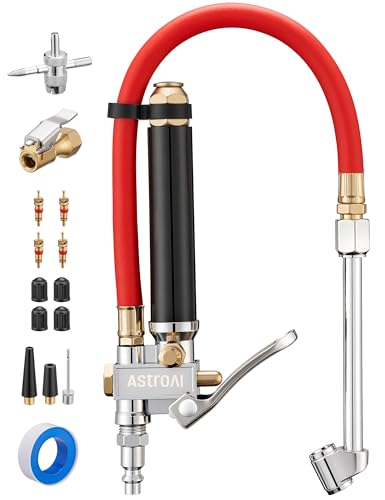
The AstroAI T3 is a mechanical gauge built for the shop floor, not the glovebox. Its straight chuck and 30° reverse chuck let you reach the inner valve on a dually pickup without swearing — a detail most gauges ignore. The indicator bar gives a clear mechanical readout between 10 and 120 PSI, calibrated to ANSI B40.1 international accuracy standards (±2 PSI above 80 PSI, ±3 below).
Construction is stainless steel and brass throughout, with a 1/4” quick‑connect fitting that locks onto your air hose instantly. The T3 also functions as an inflator and deflator: squeeze the thumb trigger to add air, press the bleed valve to release. Included accessories — valve cores, core tool, sealing tape, and two cone nozzles for inflatables — make it a complete inflation station in one handle.
Users praise its consistency in cold weather down to -14 °F, where digital screens often go black. The only compromise is the analog readout lacks the 0.1 PSI precision of a digital unit, but if you work on trucks, tractors, or heavy equipment, the T3’s toughness and dual‑head design make it the most versatile mechanical inflator here.
Why it’s great
- Dual‑head chuck (straight + 30° reverse) is a must for inner dually wheels on trucks and RVs.
- All‑metal stainless steel and brass body survives drops and extreme cold without failing.
- Includes valve core tool, sealing tape, and inflator nozzles — ready to work immediately.
Good to know
- Mechanical gauge is limited to 10–120 PSI, so it won’t read truck tires inflated beyond 120 PSI.
- Accuracy drifts below 80 PSI — not the best choice for low‑pressure off‑road or bicycle work.
3. AstroAI Digital Tire Pressure Gauge with Inflator (250 PSI)
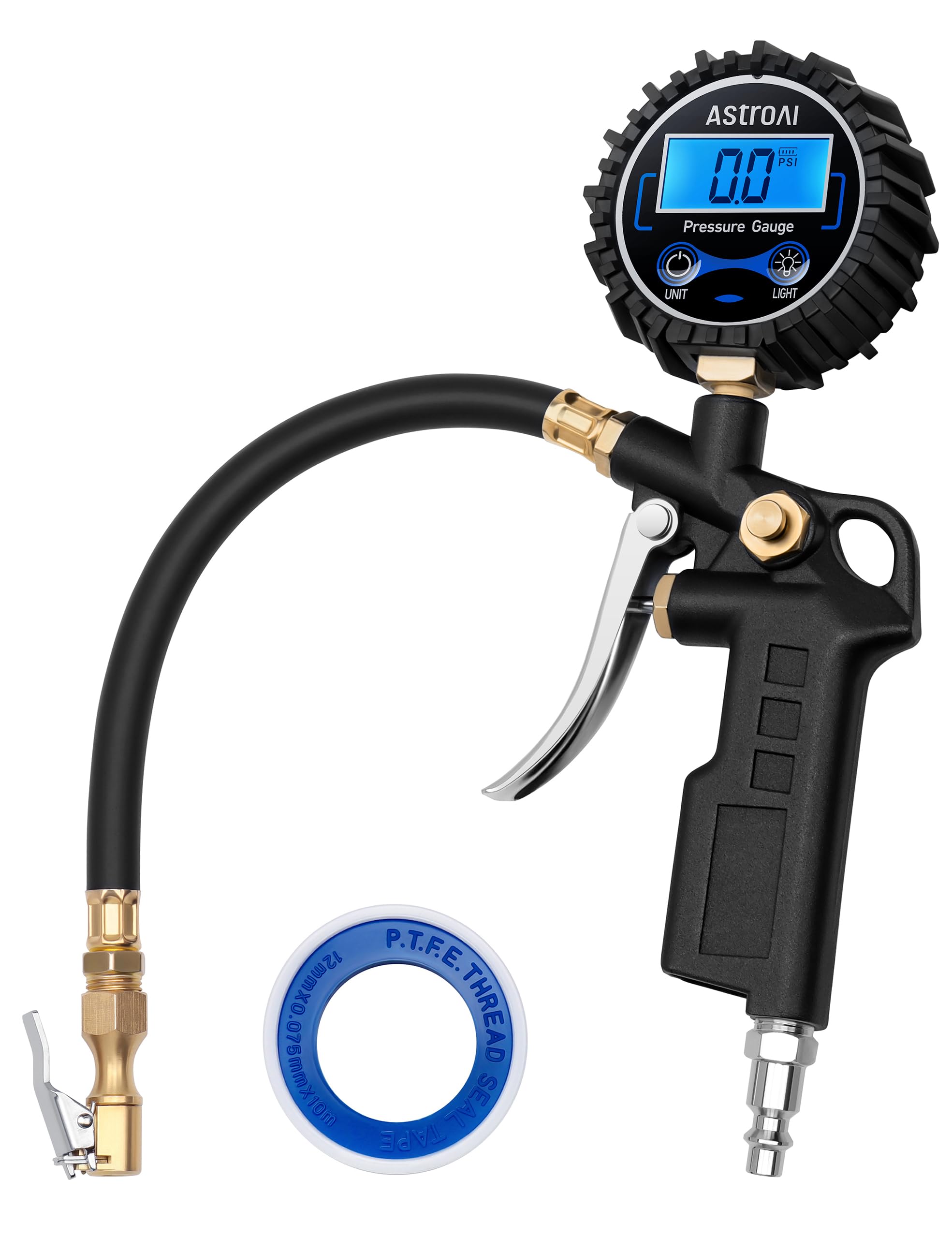
This AstroAI digital inflator has been a consistent best‑seller for good reason: it combines a 3–250 PSI measurement range with an integrated inflator, deflator, and bleed valve in one stainless steel and brass body. The digital display reads in 0.1 PSI increments, and the unit auto‑powers on when pressurized air hits the sensor — no button fumbling with dirty hands.
The locking chuck creates a leak‑free seal on Schrader valves, and the included quick‑connect coupler fits both 1/4” and 1/2” NPT air compressor outputs. Users note that readings match their vehicle’s TPMS within 1 PSI consistently, and the 3‑year warranty backs up the build quality. The hose is flexible enough to reach recessed stems on large SUVs and trucks without pulling the gauge off the valve.
After 20 seconds of inactivity, the gauge shuts itself off to save the internal battery. The all‑in‑one design eliminates the need for a separate inflator and gauge — you clip on, read, add or release air, and walk away. If you want a single tool that does everything for a mid‑range price, this is the standard.
Why it’s great
- Wide 3–250 PSI range covers everything from bike tires to heavy‑duty commercial truck applications.
- Auto‑power function means no batteries wasted — the gauge wakes up when you clip onto the valve.
- Stainless steel and brass construction with a 3‑year warranty shows confidence in durability.
Good to know
- The body is partly ABS plastic — the metal is concentrated in the inline heads, not the entire housing.
- Some users report the lock‑on chuck can be hard to disengage on tight valve stems without wiggling.
4. Milton 507KIT Digital Tire Inflator

The Milton 507KIT packs a digital gauge into a compact pistol‑grip body that feels more natural than a straight wand when you’re bending down to reach a low valve stem. The backlit LCD display auto‑illuminates when it senses pressure, making nighttime or dim‑garage readings trivial. Accuracy is rated to within 1.0 PSI over the 0–250 PSI range, meeting ANSI/ASME B40.1 standards.
The 14” rubber hose is paired with a brass lock‑on clip chuck that seals without constant hand pressure — a genuine advantage for arthritic hands or anyone inflating multiple vehicles in a row. The integrated deflate button is seamlessly molded into the handle, so you can drop pressure without repositioning your grip. Users also appreciate that the gauge shows both supply pressure and tire pressure, so you can see what your compressor is delivering.
Two AAA batteries power the digital readout, and auto‑off after 15 seconds conserves them. The all‑steel handle and brass fittings give it a substantial feel that justifies the premium price point. Just be aware that the 1/4” NPT fitting is tight on some compressor hoses — a little PTFE tape solves that.
Why it’s great
- Pistol‑grip design reduces wrist strain compared to inline inflators, especially on low valve stems.
- Lock‑on brass chuck frees your hands — clip it and walk away while the gauge reads.
- Dual‑reading display shows compressor supply pressure alongside tire PSI.
Good to know
- The gauge housing is zinc and plastic — not as drop‑tough as a full stainless steel body.
- The pre‑applied sealant on the NPT threads can make the connection stubborn to disassemble.
5. Milton S‑505 Analog Tire Inflator

The Milton S‑505 is the analog choice for people who never want to worry about dead batteries or frozen LCDs. Made in the USA with a stainless steel body and a magnifying window lens that makes the 2‑lb PSI increments readable even without glasses, this inflator is built to outlast any digital competitor. It measures from 10 to 160 PSI and uses a single‑head chuck ideal for motorcycles and tight valve access.
The 15” rubber hose swivels freely at the body, and the chuck threads are replaceable if they wear. Gauge and valve cartridges can be swapped independently (Milton #507 and #512), so you never throw away the entire tool when a seal goes. Owners consistently report units lasting 20+ years — some are still going strong after six decades in the family.
Three‑eighth inch (3/8‑24) threads connect to most standard shop air hoses, though the ball chuck uses a custom thread that may require an adapter for NPT systems. For a one‑time purchase that eliminates every battery and sensor failure mode, the S‑505 is the most durable auto tire gauge you can buy.
Why it’s great
- All‑metal construction made in the USA — zero plastic parts that can crack or degrade.
- Replaceable gauge and valve cartridges mean you can repair it instead of replacing it.
- Magnifying lens makes the analog scale easy to read in direct sunlight or dim shops.
Good to know
- Single‑head chuck is less convenient for dual‑wheel trucks; you’ll want the S‑505 with a dual head.
- Ball chuck uses a non‑standard thread — converting to 1/4” NPT requires an adapter like Lock ‘N Lube LNL65197.
6. CZC AUTO Digital Tire Inflator Gauge

The CZC AUTO digital inflator brings a frosted aluminum handle and dual brass chucks to the entry‑level segment, giving you a 3‑in‑1 tool that measures, inflates, and deflates without swapping connectors. The LED backlit display shows four units (PSI, kg/cm², bar, kPa) with 0.1 resolution, and the sensor auto‑wakes when connected to the valve, then shuts off after 20 seconds of inactivity.
It’s calibrated to ANSI B40.1 Grade B (2 % accuracy), which is the industry baseline — fine for typical passenger car maintenance where 1–2 PSI margin won’t affect performance. The chrome‑plated iron thumb trigger handles inflation smoothly, and the brass bleed valve works even when the inflator is still connected to the compressor. A 13” rubber hose gives enough reach for most sedan and SUV valve stems.
Users praise the light weight and comfortable grip, though some note the chuck can leak slightly on older valve stems. It takes two AAA batteries (not included). If you need a functional digital inflator for occasional home use and don’t require lab‑grade tolerance, this is a capable, affordable starting point.
Why it’s great
- Frosted aluminum handle stays cool to the touch, even after multiple back‑to‑back inflations.
- LED backlit display is easy to read in low‑light conditions without washing out.
- Dual head chucks give you a straight and angled option for different valve orientations.
Good to know
- ANSI B40.1 Grade B (2 %) accuracy is adequate, but not precise enough for matching OEM TPMS sensors.
- AAA batteries not included — keep spares in your glovebox because the auto‑off doesn’t save you from the first dead set.
7. PINKJOY Digital Tire Pressure Gauge with Inflator
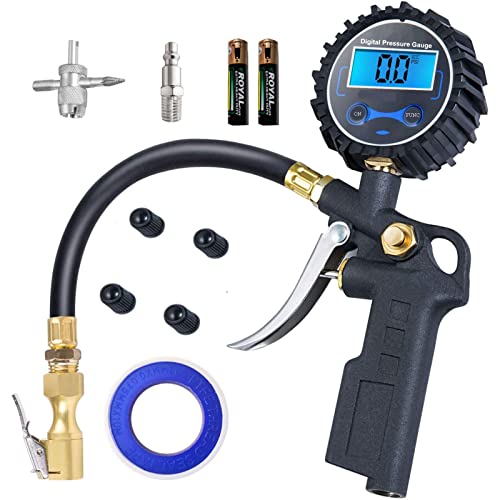
The PINKJOY digital gauge is the most straightforward entry into an inflator‑gauge combo, offering a 3–250 PSI range with 0.1 resolution at a price that undercuts most competitors. The body uses heavy‑duty stainless steel and brass components — unusual for this price tier — and the locking chuck seals well enough for daily driving checks.
Like the pricier AstroAI digital, it auto‑wakes when it detects pressurized air and sleeps after 20 seconds of inactivity. The integrated inflator works with both 1/4” and 1/2” NPT compressor outputs, and the bleed valve lets you dial back pressure without removing the chuck. Users report that the readings are consistent within 1 % of the true pressure when checked against a separate analog gauge.
A few buyers noted that the clip‑on chuck can develop a slow leak after heavy use, and the plastic backlight cover is not as robust as the metal housing. But if you need a functional digital inflator for a basic home garage or roadside kit and want to spend as little as possible, the PINKJOY gives you the essential features without cutting the operating range.
Why it’s great
- Stainless steel and brass construction at an entry‑level price — unusual for this budget bracket.
- Auto‑power on/off means no battery drain from forgetting to switch it off.
- Wide 3–250 PSI range handles passenger cars, motorcycles, SUVs, and light trucks.
Good to know
- Clip‑on chuck may not seal properly on older or worn valve stems without manual adjustment.
- Some units ship with the gauge slightly out of calibration — verify against a known gauge before trusting it for critical applications.
FAQ
Is a digital or analog tire gauge more accurate for cars?
What PSI range do I need for my truck or RV?
How often should I check my tire pressure with a gauge?
Final Thoughts: The Verdict
For most users, the best auto tire gauge winner is the ETENWOLF T600 because its ANSI B40.7 Grade 2A accuracy delivers lab‑grade repeatability without the bulk of a shop‑grade inflator. If you want a dual‑head mechanical gauge for dual‑wheel trucks and heavy equipment, grab the AstroAI T3. And for a lifelong analog tool that never needs batteries, nothing beats the Milton S‑505.