
Our readers keep the lights on and my morning glass full of iced black tea. As an Amazon Associate, I earn from qualifying purchases.
Specs are compiled from manufacturer listings and verified buyer reviews and can change over time — please confirm the key details on the product page before buying.
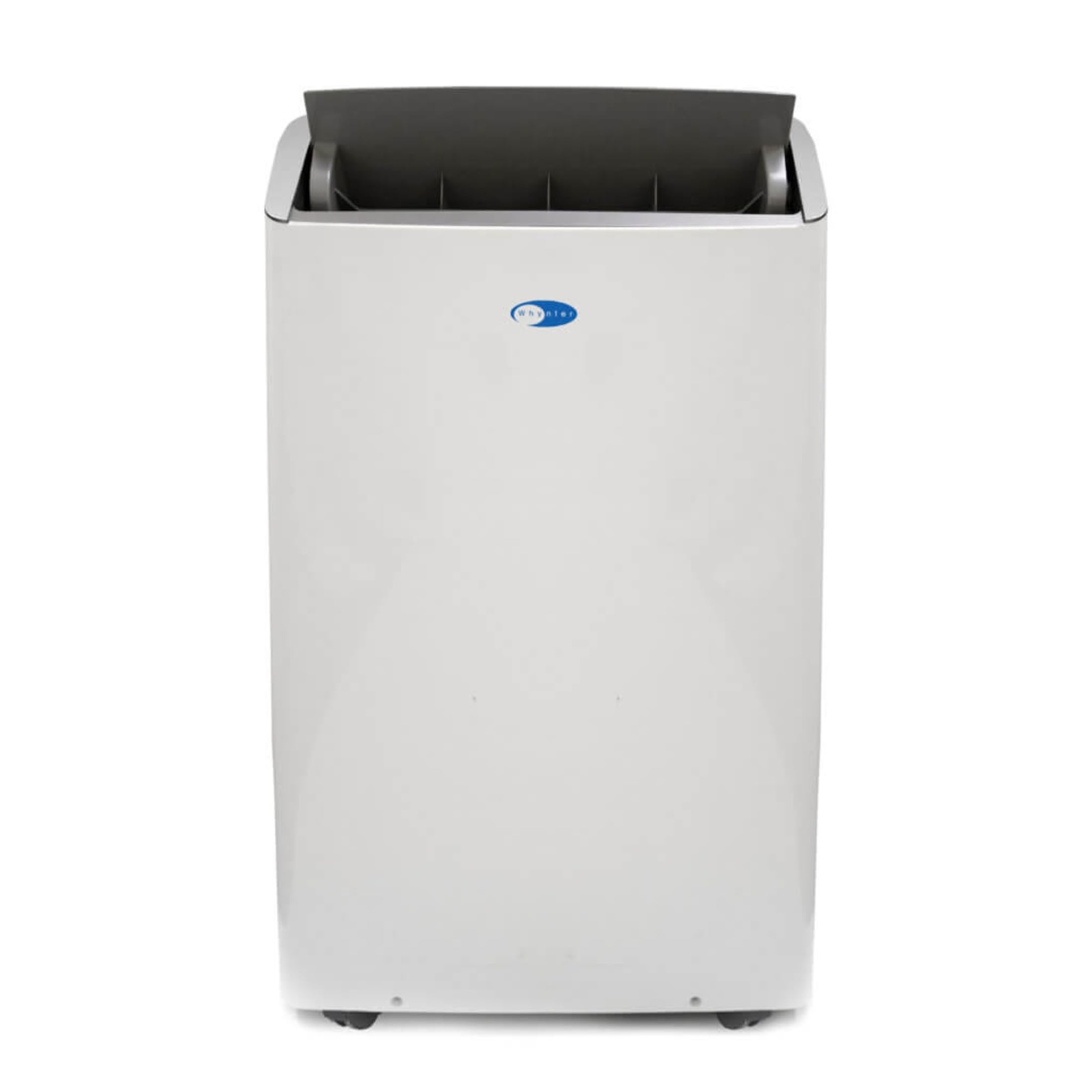
If you want one machine that cools a bedroom in July and warms it in November, the Whynter ARC-1230WN is the safest buy on this list — a dual-hose inverter unit rated at 14,000 BTU that owners describe as surprisingly quiet. Everything below is ranked by how well the heating side actually works, how much floor it takes up, and whether conditioned air gets thrown out the window while it runs.
I’m Min — the founder and writer behind Gadgets Feed. This guide is built by comparing the manufacturers’ published specifications and the patterns across verified customer reviews, so you get each pick’s real strengths and trade-offs instead of marketing spin.
Read on for the portable AC heater picks that hold a set temperature instead of chasing it.
Our Picks at a Glance
How To Choose The Best Portable AC Heater
The buying decision here is not “which cools hardest” — it is “which one heats without wasting the cooling you paid for.” A portable AC heater is a single box with a compressor for summer and a heat pump for winter, and those two jobs have very different requirements.
Dual hose versus single hose
A single-hose unit pulls air from your room, uses it to cool the compressor, and blows it out the window. That means your treated air leaves the room and outside air creeps in to replace it. A dual-hose design — like the one on the Whynter ARC-1230WN and the Hisense twin-hose tower — takes outside air in through one hose and dumps heat out the other, so the room you cooled stays cooled. It is the single biggest efficiency gap in this category.
Read both BTU numbers
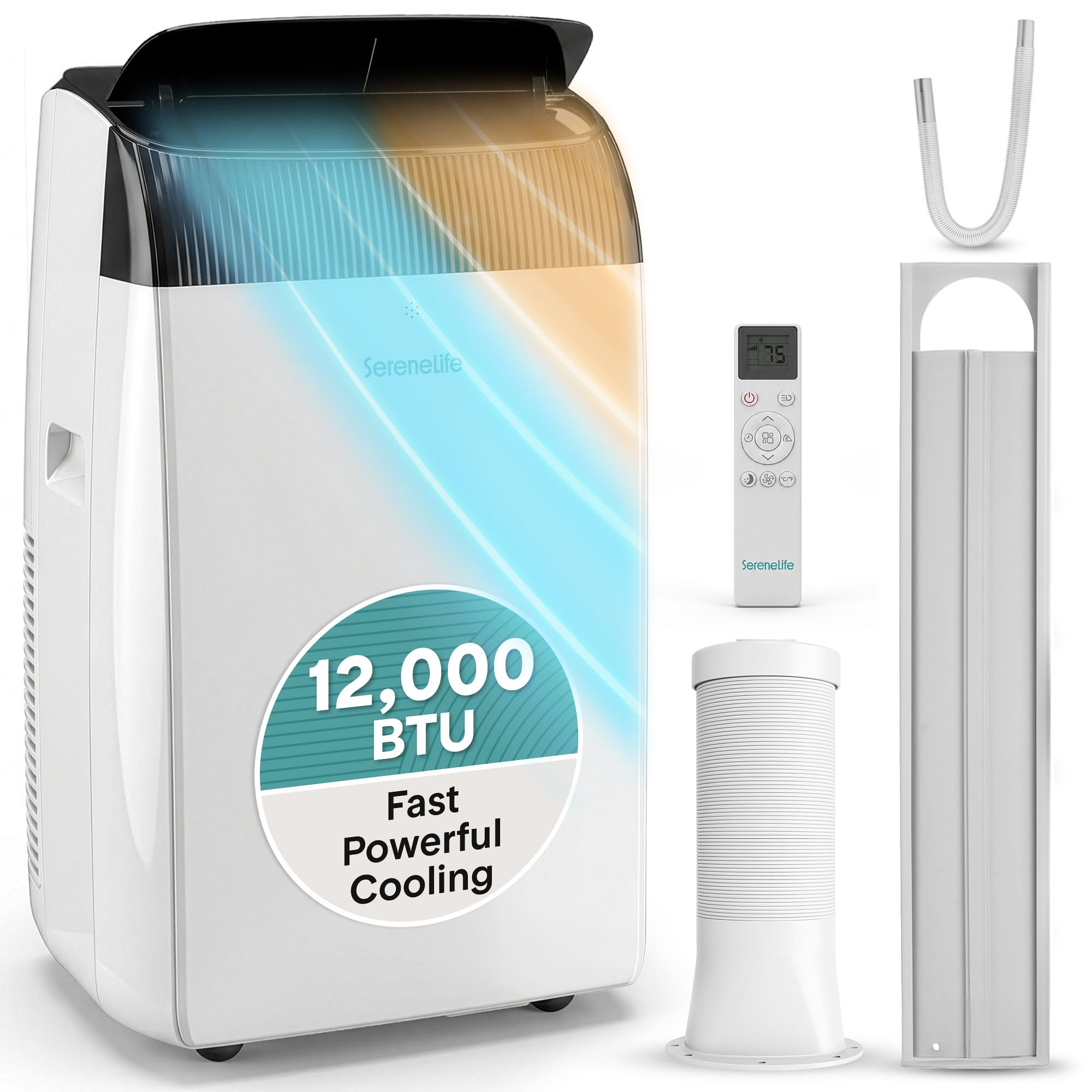
Most listings print an ASHRAE rating and an SACC rating. ASHRAE is the lab number, SACC is the one that better reflects real-room performance. The SereneLife unit, for example, lists 12,000 BTU ASHRAE and 7,000 BTU SACC — the same box, two very different figures. Compare SACC to SACC whenever both are published.
Confirm the heating type
Some units warm with a heat pump, which moves heat rather than generating it and usually publishes a heating BTU figure. Look for that number. A heater mode with no published heating capacity is often a small resistive element that will struggle once the room drops near freezing.
Plan for drainage
Cooling produces condensation. Self-evaporation handles most of it in dry climates, but humid summers and heating mode both push more water than the unit can evaporate. A unit with a garden-hose drain connector saves you from emptying a tank mid-season.
Quick Comparison
| Model | Best For | Cooling Power | Heating / Coverage | Hose Design | Amazon |
|---|---|---|---|---|---|
| Whynter ARC-1230WN★ Best Overall | Year-round main room | 14,000 BTU | Heat mode, dual hose | Dual hose | Amazon |
| SereneLife 12,000 BTUCrowd Favorite | Budget bedroom setup | 12,000 BTU ASHRAE / 7,000 BTU SACC | 10,500 BTU heat, 550 sq. ft. | Single hose | Amazon |
| Hisense API0825UW1DBest for Small Rooms | Small rooms, quiet nights | 8,000 BTU | Heat pump, 350 sq. ft. | Twin hose | Amazon |
| Westinghouse 14,000 BTU | Big family rooms | 12,000 BTU ASHRAE / 8,150 BTU DOE | Heat mode, 700 sq. ft. | Single hose | Amazon |
| BLACK+DECKER BPT10HWTB | Follow-me remote control | 14,000 BTU | 12,000 BTU heat, 700 sq. ft. | Single hose | Amazon |
| AC Infinity AC-TFH8 | Smart automations | 12,000 BTU | Heat mode, 600 sq. ft. | Single hose | Amazon |
| Midea Duo 14,000 BTU | Quiet inverter cooling | 14,000 BTU | Heat pump | Dual hose-in-hose | Amazon |
| Midea 14,000 BTU | App and voice control | 13,500 BTU | Heat pump, 450 sq. ft. | Single hose | Amazon |
| AIRPLUS 12,000 BTU | Big rooms on a budget | 12,000 BTU | Heat mode, 700 sq. ft. | Single hose | Amazon |
| TCL 10,000 BTU | Tight floor space | 10,000 BTU | Heat mode, 450 sq. ft. | Single hose | Amazon |
In‑Depth Reviews
1. Whynter Portable Air Conditioner Inverter 14000 BTU Smart Wi-Fi ARC-1230WN
Our pick — 4.0+★ from 650+ verified ratings; the strongest balance of quality and price.
The dual-hose one that stops paying to cool the neighborhood.
Here is the gap that matters: this Whynter pushes 14,000 BTU of cooling while the Hisense below tops out at 8,000 BTU. That is the widest cooling spread in this whole lineup, and it is why a large open-plan room stops feeling like a losing battle once this unit goes in.
The dual-hose setup is the real story. One hose draws outside air to cool the compressor, the other dumps the heat back out — so the air you already paid to cool stays in the room. Buyers report it drops a room by around 8 degrees, and the rotary scroll compressor ramps up and down instead of cycling on and off.
It is a quiet machine for its output, and installation is genuinely a one-person job with the included window kit. The honest catch is longevity — the compressor and electronics have a mixed record in owner reports, with a share of units failing early and others running for years. Treat it as a machine worth a warranty-extension decision rather than a buy-and-forget appliance. It holds 4.0+ stars across 600+ ratings, strong for a category where reliability complaints are routine.
Where it pulls ahead
- Dual hose keeps conditioned air indoors instead of venting it outside
- 14,000 BTU is the highest cooling rating here — the Hisense below manages 8,000
- Inverter compressor holds a set temperature instead of cycling hard
- App, remote, and voice control all work on the same unit
What to weigh first
- Longevity is the weak spot — some units fail well before you would expect
- No Energy Star rating, so efficiency sits in the middle of the pack
- Dual hoses need two window openings or a wider panel than single-hose kits
Worth it for: a main living room where you want one box handling summer and winter and you care about not bleeding cool air out the window.
Think twice if: your window is narrow enough that a second hose is awkward to route — the single-hose picks further down solve that.
2. SereneLife Portable Air Conditioner With Heat & Built-in Dehumidifier 12,000 BTU
Ten thousand five hundred BTU of heat in a wheeled box that covers a bedroom twice over.
This is the one most people end up with, and the numbers explain why it works. The heating side is rated at 10,500 BTU, and the cooling side covers 550 square feet — 200 more square feet of floor than the Hisense below, which tops out at 350. For a spare bedroom or a converted garage, that spread is the difference between cool and almost cool.
Setup is where this unit wins people over. The window kit and exhaust hose ship in the box, the wheels make it easy to shove from room to room, and the self-evaporation system means you are not babysitting a drain pan in average humidity. It also pulls up to 1.5 liters of moisture an hour in dehumidifier mode, which is a real benefit in a damp basement.
Two things to know before you buy. It runs at 48–51 dBA, which is noticeable in a bedroom at night, and the single-hose design means some of your cooled air goes out the window with the exhaust heat. The recurring note in owner feedback is reliability — most units run for years, but a minority stop cooling after a season. At 4.0+ stars across 13,000+ ratings, the satisfied majority is very large.
Heating that earns its badge: a published 10,500 BTU heat output is not a token warm-air mode — it is a genuine second season of use from the same footprint.
Reach for this if: you want the most-proven combo unit in the mid-range and 550 square feet matches your room.
Look elsewhere if: silence is non-negotiable for a nursery — the 48–51 dBA range is audible at night.
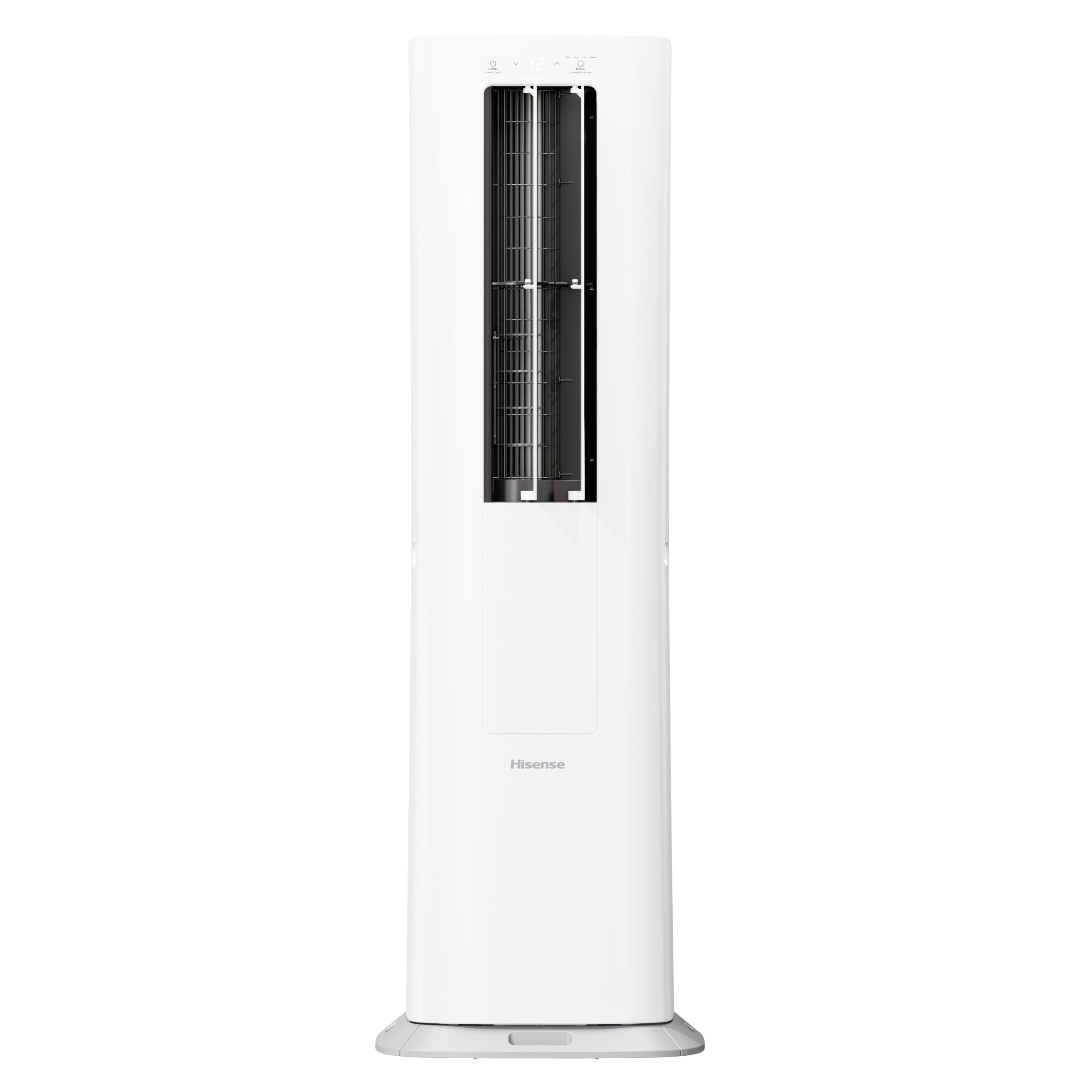
3. Hisense API0825UW1D Smart Inverter Twin Hose 8,000 BTU Heat/Cool Tower
A tall tower that throws cold air 21 feet across a small room.
Where most portable units blast straight ahead, this Hisense uses a vertical cross-flow fan to push air up to 21 feet with 60-degree coverage. In a long, narrow room that means one unit at the end can actually reach the far wall instead of just chilling the first three feet.
The twin-hose system does the same job as the Whynter’s dual hose at a smaller scale — separate intake and exhaust keep your cooled air indoors. It draws 910 watts against the AIRPLUS’s 1,120, so it is the lighter load of those two on a warm month. The vertical format also fits into a corner where a wide box would not.
The trade-off is capacity and layout. At 8,000 BTU it covers 350 square feet, which is a bedroom or a small office and not much more — the SereneLife reaches 550. And the tall tower body is divisive; plenty of owners note it stands noticeably higher than a traditional box unit, so check ceiling-adjacent window space before ordering. Cooling performance is the thing people rave about, with temperature holding steady overnight. It is the quietest pick here too, which is why it lands in bedrooms.
Best fit for: a bedroom or narrow office where quiet operation and long air throw matter more than covering a big footprint.
Second-guess it if: you need to cool 500 square feet or more — 350 square feet is the honest ceiling here.
4. Westinghouse 14,000 BTU Air Conditioner with Heat Mode, Cools 700 Sq. Ft.
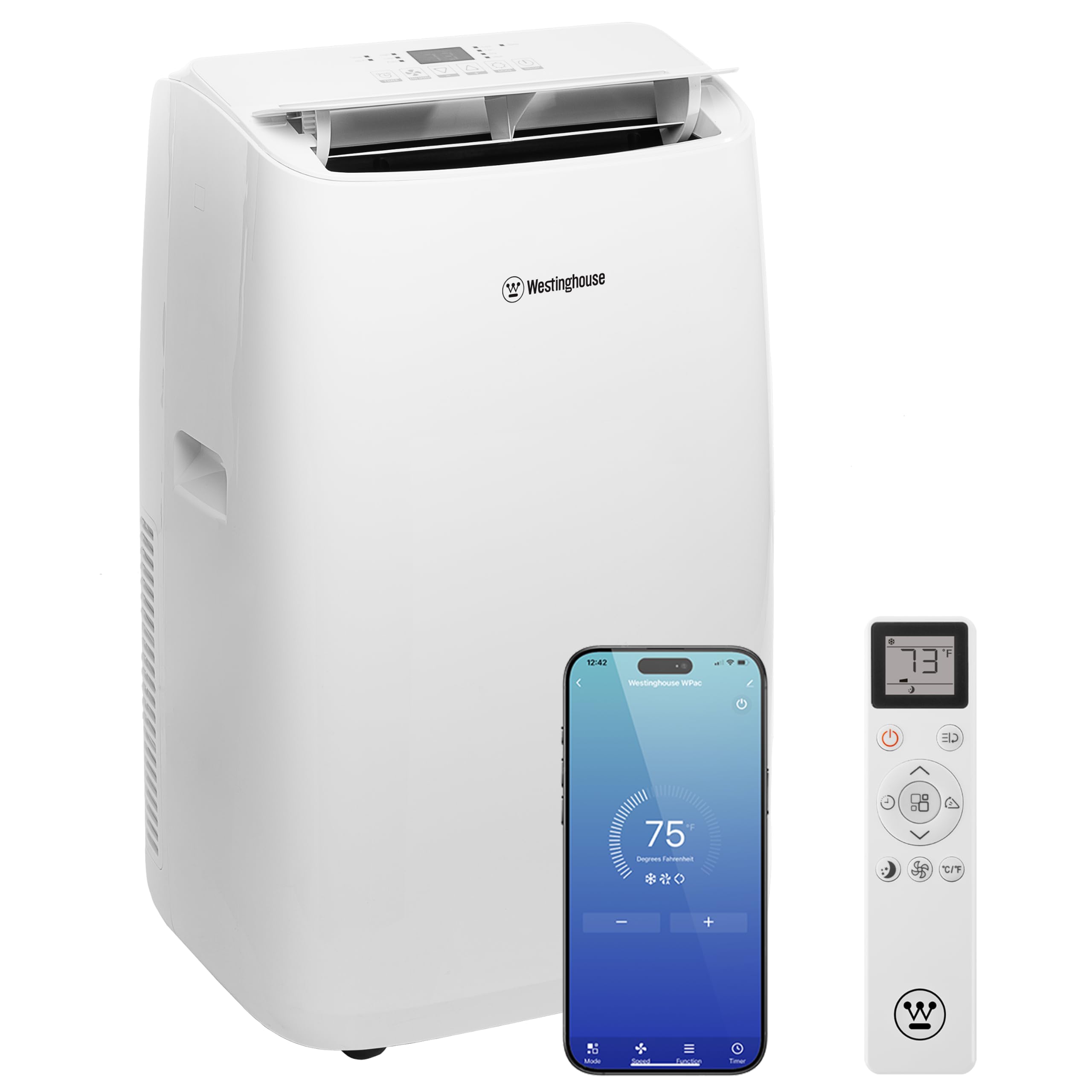
Seven hundred square feet of coverage from a unit that sips electricity.
Here is a rare combination in this category: 700 square feet of coverage and an annual energy figure of 500 kilowatt hours per year, the lowest published draw on this list.
It runs four modes — cool, fan, dry, and heat — and the single-hose window kit installs in a few minutes with a quick-adjust panel. There is a cleanable filter, a programmable timer, and app plus remote control. Dehumidifier capacity is listed at 90 pints, which is a serious moisture-handling figure for a basement setup.
The honest limit is the compressor’s track record. Reliability is the most-discussed topic around this unit and the split is real — plenty of owners mention it runs fine for years, and a smaller group hit failures, some outside the warranty window. Noise also splits opinion: some call it near-silent, others find it loud on high. Cooling and heating both work better than the spec sheet suggests, with owners noting the heat mode warms effectively and holds the set temperature. It averages 4.0+ stars from 150+ buyers.
The efficiency headline: 500 kilowatt hours per year is the smallest annual draw here, and every bit of it comes from a unit that still covers 700 square feet.
The one to weigh: the compressor is the question mark — a warranty extension is a smart add-on here rather than an upsell.
Pick it when: you are cooling a large family room and want the lowest running cost in the lineup.
Pass if: you cannot tolerate a compressor that may need service — a simpler box unit is the lower-risk route.
5. BLACK+DECKER Portable Air Conditioner with Heat, 14,000 BTU, BPT10HWTB

The remote becomes the thermostat, so the cold follows you around the room.
The Follow Me function is the reason to look here first. The handset carries a temperature sensor, so the unit reads the air around you rather than the air by the machine — useful in a room with a hot spot by the window and a cool spot by the sofa. Set it on the coffee table and the unit chases you, not the wall.
The rest of the spec sheet is generous: 14,000 BTU of cooling, 12,000 BTU of heating, four modes and 700 square feet of coverage. That is the same 700 square feet the Westinghouse claims, but with a published 12,000 BTU of heat rather than a vague warm mode. Auto water evaporation cuts down on bucket duty, and the window install uses the standard exhaust hose and adapter.
Where it gives ground: thermal performance splits owners sharply — some find the heater works well, others report the heat barely warms a room. Cooling is similarly polarised in feedback, with a portion of owners saying it does not cool as expected. Volume is mixed too, though several note it runs quieter than a window unit. At 4.0+ stars from 450+ buyers, most are content, but the split on the heater makes the return window worth using.
What stands out
- Follow Me remote acts as a portable thermostat for the spot you sit in
- 14,000 BTU cooling and a published 12,000 BTU heating figure
- Covers up to 700 square feet with a simple wheel-and-window install
The fine print
- Owner experience with the heater is genuinely split — test early
- Some report the remote buttons are confusing at first
- Noise on high is louder than a window unit for some households
Go for it if: you want the remote to control temperature at your seat rather than the corner of the room.
Leave it if: heating is your main reason for buying — the heater feedback here is too inconsistent to be the deciding factor.
6. AC Infinity Smart Portable Air Conditioner 5-in-1, All-Season Cool & Heat
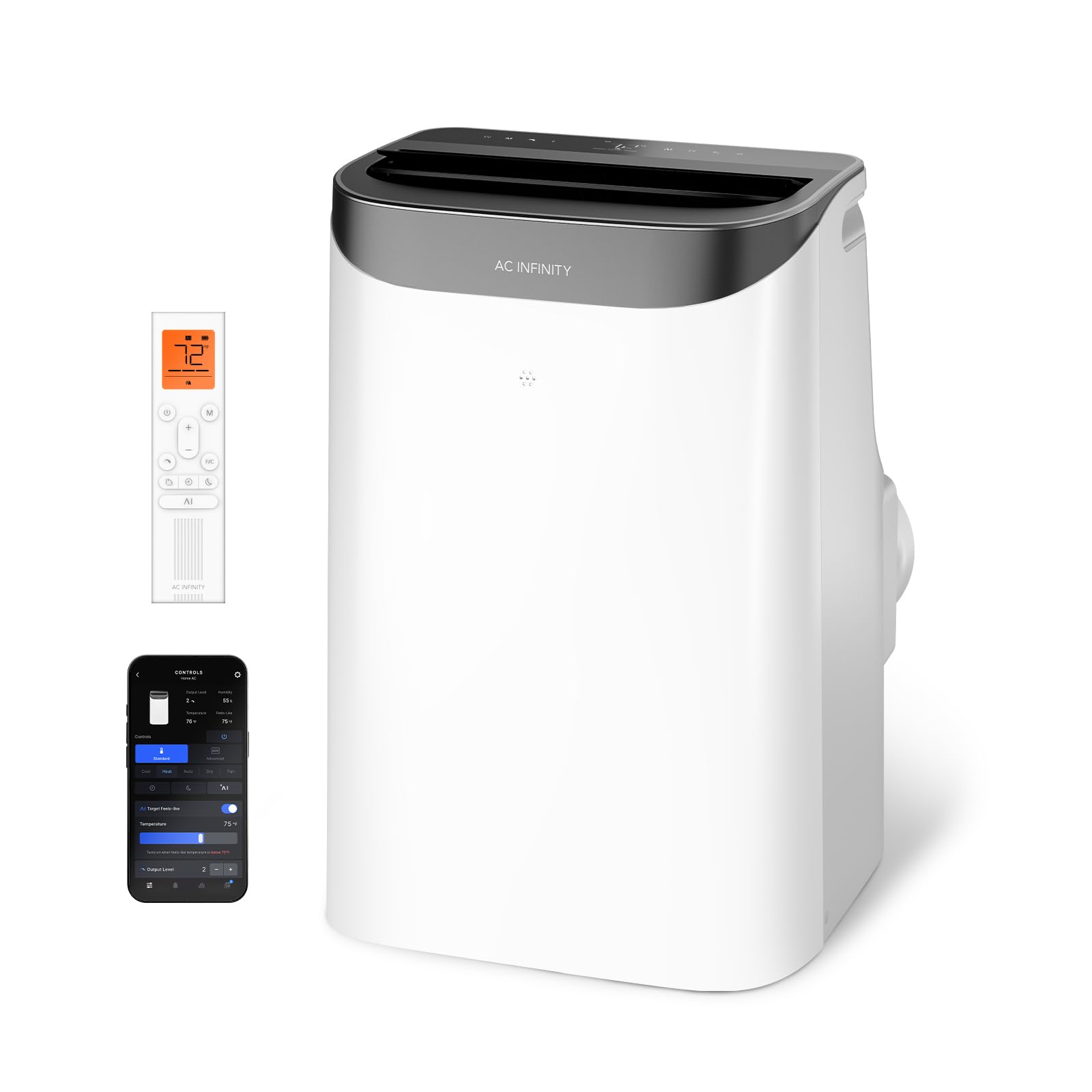
A climate controller that happens to cool, with a two-year warranty behind it.
Most of these units hand you a remote and call it smart. This AC Infinity reaches 12,000 BTU of cooling and adds a “True Comfort AI” that factors in both temperature and humidity to work out how the room actually feels. If you have ever set a thermostat to a number and still felt clammy, that distinction is the whole point.
It has five settings under the hood — cool, heat, dry, fan, auto, and a combo mode that toggles between them automatically — across a 600-square-foot room. The noise-isolated compressor holds steady at 48 dB, and there is a wide-angle oscillator to push air around the room rather than in a beam. Alexa and Google Home both work, and the app adds data charts and scheduling.
The caveat is history. This is a very new listing with a thin track record, so the long warranty does the heavy lifting where owner proof is short. Early feedback on reliability and heating has been positive so far, but there simply is not the volume of long-term data you find on the SereneLife or the Midea Duo. What you are buying is the control layer and the warranty length, not a decade of user testimonials.
Why the app matters here: humidity-aware climate control is the genuine differentiator — a plain thermostat cannot tell you why the room still feels muggy at the set temperature.
The right pick for: a smart-home household that wants automations, schedules, and voice control baked in from day one.
Skip the leap if: you prefer a unit with years of owner history behind it — the warranty is the safety net, not the crowd.
7. Midea Duo 14,000 BTU Portable Air Conditioner with Heat, Inverter Quiet

Two hoses inside one jacket, and the quietest inverter setup in the lineup.
The Duo’s trick is physical: both hoses run inside a single sleeve, so the unit pulls outside air in and pushes exhaust out through one window opening. That solves the biggest headache of dual-hose design — no need for a second window or a wider panel. The Whynter and Hisense both need more window real estate to do the same job.
The inverter compressor is the second half of the story. Midea rates it at more than 40% less energy use than the U.S. federal standard, with faster cooling than a traditional cycling unit. Owners back up the noise claim too — the inverter is what makes this one of the quietest units at this output. Heating is a proper heat pump rated for 41°F–86°F, which covers most of a mild winter without reaching for a space heater.
The honest downside is installation and long-term reliability. Going from a single hose to a hose-in-hose system takes more effort, and a chunk of owners describe the setup as fiddly. On reliability, the split is familiar from this category — most units run well, a minority develop faults. At 4.0+ stars across 200+ ratings, with cooling and heating both praised, it is a strong buy if quiet matters most.
Why it earns its spot
- Hose-in-hose design keeps conditioned air indoors through one window
- Inverter compressor runs noticeably quieter than a standard unit
- Heat pump rated across 41°F–86°F for year-round use
- App and voice control alongside the remote
Setting expectations
- Hose-in-hose installation is more involved than a simple single hose
- Reliability is a mixed picture, as with most compressor units here
- The remote needs two AAA batteries that are not always included
An excellent match for: a bedroom or home office where you want a dual-hose design without cutting a second window hole.
Not the one if: you want a setup you can do in five minutes without reading the manual twice.
8. Midea 14,000 BTU Portable Air Conditioner with Heat, Cools up to 450 Sq. Ft.

A 14,000 BTU unit with a smaller footprint and a full app in your pocket.
Reading the fine print pays off here. The headline says 14,000 BTU ASHRAE, but the SACC figure — the one closer to real-room performance — is 10,000 BTU. That still covers up to 450 square feet, so it is a solid bedroom or apartment unit, not a whole-floor solution.
What it does well is control. The SmartHome app works on iOS and Android, so you can switch modes and set a schedule from anywhere, and it pairs with Alexa or Google Assistant for voice commands. Digital controls, an LED display, and a compact remote with batteries included round out the package. The heat pump is rated for 41°F–86°F, which keeps it useful through most of the year rather than just peak summer.
What tempers the appeal is the noise and reliability record. Volume splits opinion, with some finding it quieter than expected and others finding it loud in operation. Reliability is the same mixed picture, and a portion of customers note failures within the first year. At 3.5+ stars from under 100 ratings, this is a smaller crowd and a more divided one than the SereneLife. Cooling speed and ease of install are solid.
The app is the sell: scheduling and voice control work reliably enough that you may rarely touch the unit itself.
Watch the number two: 10,000 BTU SACC is the realistic figure — plan your room size around that, not the 14,000 headline.
Suits you if: you want a 450-square-foot unit you can control entirely from your phone.
Look past it if: you need quiet above all — the noise reports here are too split to promise a silent bedroom.
9. AIRPLUS 2026 Upgraded Portable Air Conditioner 12000 BTU with Heat, 4-in-1
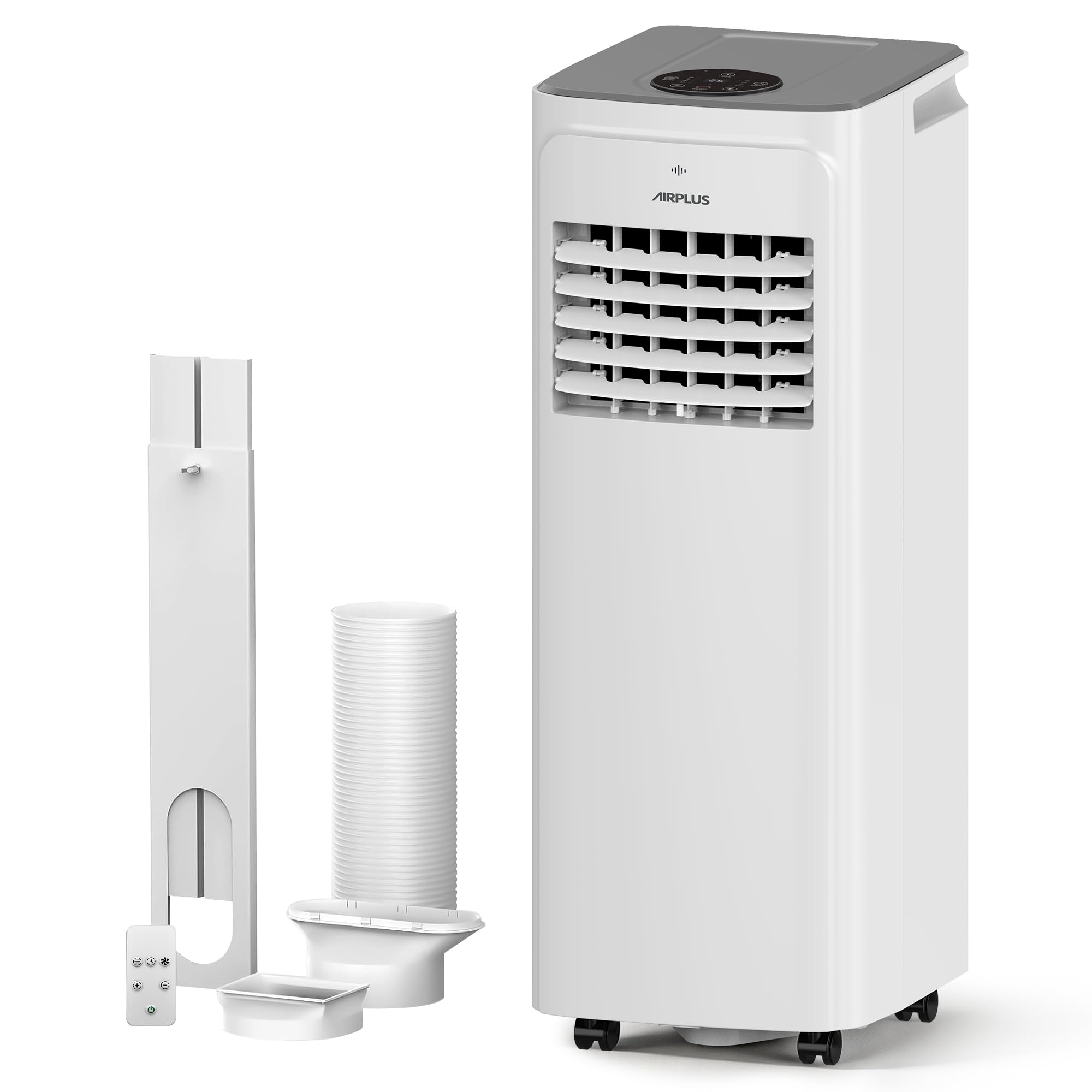
Big-room coverage at a budget-tier starting point, with defrost built in.
For a unit at this tier, the 700-square-foot coverage is the headline. It runs 12,000 BTU of cooling and a heating mode across four settings — cool, heat, dry, and fan — which is more room than the Midea or Hisense reach at twice the footprint cost.
The automatic defrost is a real winter feature on a budget unit. When the outdoor coil ices up in cold weather, the unit cycles itself to clear it instead of stalling, which is what a lot of bare-bones heat modes do. Fan speeds bring it down to 45 dB on low, and there is a 24-hour programmable timer plus a remote.
Be clear about the trade-offs. There is no inverter here, so the compressor cycles rather than modulating, which usually means more temperature swing and a higher running cost than the Midea Duo. The annual energy figure of 1,120 watts is the highest on this list. And the review base is very thin, so you are buying on spec and warranty rather than a proven long-term record. Set expectations to match the tier.
Built for: a large room where coverage matters more than fine-grained temperature control.
Skip the savings if: you run it all summer — the non-inverter compressor is the more expensive unit to operate long term.
10. TCL 10,000 BTU Smart Portable Air Conditioner with Heat, Fan, Remote
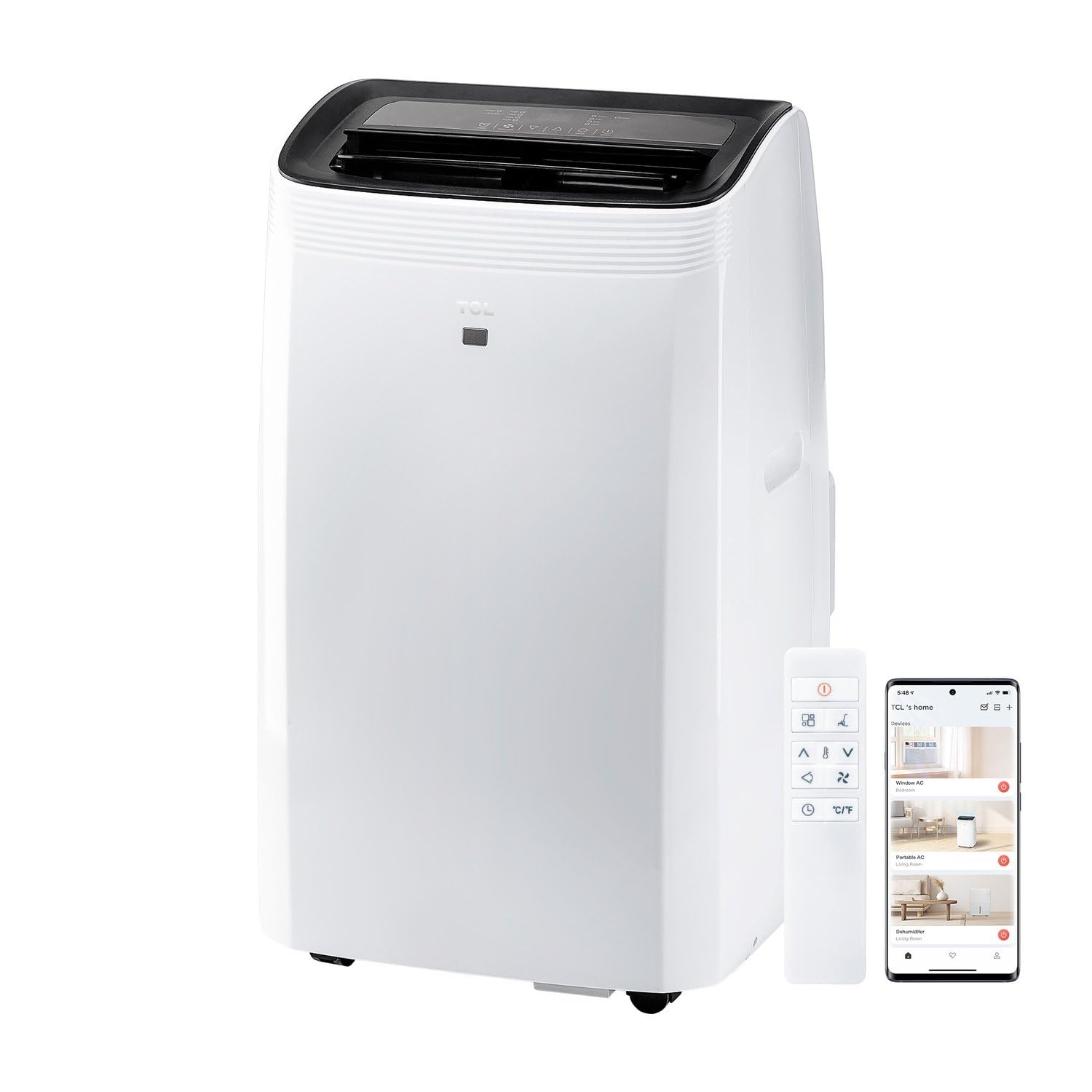
A genuinely small box for people with nowhere to put a full-size unit.
The footprint is the whole pitch. This TCL measures 14.1 by 16.05 inches, so it fits beside a bed or under a desk where a 14,000 BTU tower would not. It still cools up to 450 square feet and runs four modes: cool, heat, fan, and dehumidifier.
The control layer is thorough for a compact unit — the TCL Home app, Alexa or Google voice, and a physical remote all work, plus Sleep and Eco modes to trim running cost. The LED display makes on-unit adjustment simple. It scores 4.5+ stars, the highest here, though from a small set of ratings.
At 10,000 BTU it is the least powerful pick on this list, and the annual energy figure of 1,270 watts is not the lowest. Coverage stops at 450 square feet. If you have a 700-square-foot open plan, this is not the one; if you have a compact bedroom or a studio, it is a sensible choice with a good control setup.
The compact advantage: at 14.1 by 16.05 inches it goes where most portable AC units simply cannot, and it still manages 450 square feet of coverage.
Made for: a studio, dorm, or small bedroom where floor space is the hard limit.
Not the right call if: you need to move serious air in a large living room — 10,000 BTU has a ceiling.
Understanding the Specs
BTU and SACC
BTU (British thermal units) is a measure of how much heat a unit can remove or add. In this category you will often see two figures: an ASHRAE rating and a SACC rating. ASHRAE is the lab number; SACC is the more realistic one for a room that is not a sealed box. The SereneLife, for example, lists both — 12,000 BTU ASHRAE and 7,000 BTU SACC. Compare SACC when you can, because that is closer to what the unit will actually deliver.
Dual hose vs single hose
This is the biggest efficiency lever in a portable unit. A single-hose design uses room air to cool the compressor and exhausts it outside, which pulls in replacement air from outside. A dual or twin hose design brings outside air in for the compressor and dumps heat through a separate hose, so your cooled air stays indoors. The Whynter ARC-1230WN, the Hisense twin-hose tower, and the Midea Duo all take this approach.
Heat pump vs heater mode
A heat pump moves heat rather than generating it, and usually publishes a heating BTU figure. A bare “heater mode” without a published figure can be a smaller element. The SereneLife lists 10,500 BTU of heating, the BLACK+DECKER lists 12,000 BTU, and both Midea units publish a heat pump operating range of 41°F–86°F. If winter warmth is a main reason for buying, look for a real heating figure.
Noise in decibels (dBA)
dBA is a measure of sound pressure as the human ear perceives it. In this category most units sit between 45 and 52 dBA. The AIRPLUS reaches as low as 45 dB on low, the AC Infinity runs at 48 dB, and the SereneLife sits at 48–51 dBA. Lower numbers are better for bedrooms, but the gap between high and low fan speed is often larger than the gap between brands.
FAQ
Do portable AC heaters actually work in winter?
What is the difference between ASHRAE BTU and SACC BTU?
Do I need a dual hose portable AC?
Will a portable AC heater fit in a sliding window?
How often do I need to drain a portable AC heater?
How loud is a portable AC heater at night?
Can I leave a portable AC heater running unattended?
What size room can a portable AC heater actually cool?
Does heating mode use more energy than cooling?
Why do some portable AC heaters leak water?
Final Thoughts: The Verdict
For most homes, the portable ac heater that makes the most sense is the Whynter ARC-1230WN — its dual-hose design keeps the air you paid to cool inside the room, and 14,000 BTU is the strongest cooling figure on this list. If your room is a bedroom rather than a living space, the SereneLife pairs 10,500 BTU of real heat with 550 square feet of coverage and the deepest owner history of any pick here. And if you want a dual-hose setup without widening your window, the Midea Duo routes both hoses through one sleeve and runs quietly enough for a bedroom.
Before you commit, measure your window opening and your room’s square footage — those two numbers decide more of this purchase than any brand name. Then check whether the listing publishes a heating BTU figure, because a heat mode without one is the most common letdown in this category.
How We Picked
We do not accept paid placement. Every pick is matched to a real buyer and a real use-case; we do not hands-on test units.
Sources & Methodology
Specifications: manufacturer listings and product documentation. Review insights: verified customer reviews, as of November 2026. Pricing: not shown on this page (it changes often); check the current price via the retailer link.
As an Amazon Associate, Gadgets Feed earns from qualifying purchases. This does not affect which products we feature.