
Free over-the-air TV is a beautiful thing — unless your antenna delivers pixelated ghosts of your local news during a light breeze. The difference between a glorified paperweight and a reliable signal receiver comes down to honest engineering, real gain figures, and an antenna designed for the actual VHF and UHF frequencies broadcasting in your area.
I’m Min — the co-founder and writer behind Gadgets Feed. I’ve spent hundreds of hours analyzing antenna specifications, cross-referencing customer signal reports with claimed range numbers, and separating the Yagi designs that actually work from the omnidirectional compromises that leave you frustrated.
If you want to cut the cord without losing your mind adjusting rabbit ears every time a weather front moves through, this guide to the best vhf/uhf antenna will help you lock onto the stations that matter.
How To Choose The Best VHF/UHF Antenna
The first thing to understand: an antenna claiming 200+ miles is lying to you. TV broadcast signals are limited by the curvature of the earth and FCC power restrictions — 70 to 80 miles is the realistic ceiling for any consumer antenna. Beyond chasing inflated range numbers, focus on three factors that actually determine reception quality in your home.
Directional vs. Omni-Directional Design
If all your broadcast towers cluster in one direction, a directional Yagi or multi-element antenna offers significantly higher gain and better rejection of multipath interference. If towers surround your home, an omni-directional antenna sacrifices raw gain for 360-degree coverage but will struggle with distant or weaker stations. Most cord-cutters in suburban and rural environments benefit from directional designs aimed precisely at the nearest tower cluster.
VHF Reception Capability
Many flat-panel and budget antennas are UHF-only in practice, missing channels 2 through 13 entirely. If your local ABC, NBC, or CBS affiliate broadcasts on VHF-Lo (channels 2–6) or VHF-Hi (channels 7–13), you need an antenna with physical elements long enough to resonate at those frequencies. Yagi antennas with distinctly longer rods on the rear are specifically tuned for VHF and will pull in channels that tiny indoor panels cannot touch.
Built-in Amplification and Filtering
A preamplifier helps overcome cable run loss and splitter signal division, but too much amplification in a strong signal area causes overload and pixelation. The best designs use automatic gain control (AGC) to adjust dynamically, and integrated LTE/5G filters prevent cellular towers from injecting noise into your TV signal. For homes within 30 miles of towers, a passive (unamplified) antenna often delivers cleaner results than a cheap amplified model.
Quick Comparison
On smaller screens, swipe sideways to see the full table.
| Model | Category | Best For | Key Spec | Amazon |
|---|---|---|---|---|
| Televes Ellipse Mix 148883 | Premium | Fringe reception with auto gain control | 36.5 dBi Hi-VHF / 40 dBi UHF | Amazon |
| Antennas Direct ELEMENT | Premium | Uni-directional UHF/VHF from 60+ miles | 44.5″ boom length for focused gain | Amazon |
| Antennas Direct ClearStream MAX-V | Mid-Range | Multi-directional UHF/Hi-VHF with wall mount | 60+ mile range, 27″ wide double-loop | Amazon |
| RCA Compact Outdoor Yagi | Mid-Range | Reliable attic installation with proven brand | 75 mile rated, pre-assembled elements | Amazon |
| CeKay Outdoor Yagi HD | Mid-Range | Budget Yagi with 40ft RG6 and J mount | 70 mile max, all-metal construction | Amazon |
| 1byone Omni-Directional 360° | Mid-Range | No-aim 360° reception with built-in preamp | 100+ mile claim, 39ft RG6 cable | Amazon |
| PIBIDI UHD-8903 | Budget | Extreme range claims for curiosity seekers | 200 mile claim, extended receiving elements | Amazon |
In‑Depth Reviews
1. Televes Ellipse Mix 148883
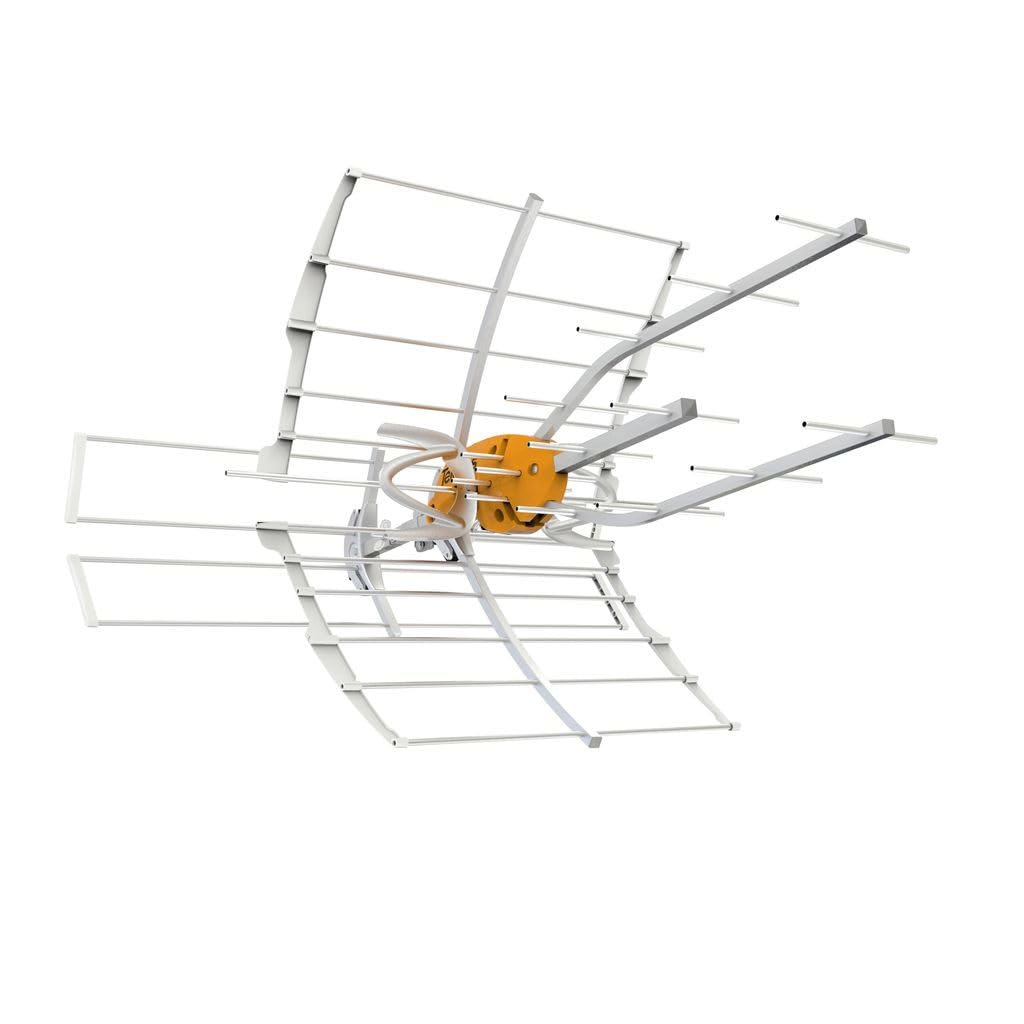
The Televes Ellipse Mix redefines what a consumer antenna can do by bringing professional broadcast engineering into a compact package. Its TForce BOSS-Tech amplifier adjusts gain independently per band — 36.5 dBi on Hi-VHF and 40 dBi on UHF — so you never clip strong local signals or miss weak distant ones. The triple-boom curved reflector design focuses reception with a 40-degree beamwidth that rejects multipath ghosting better than any planar antenna on this list.
In real-world deployments, users pulling 113 channels from 40 miles away in Central Florida and solid reception at 70 miles in Nebraska confirm that Televes delivers on its 75-mile rating without the fantasy numbers competitors use. The integrated LTE/4G/5G filter above 608 MHz stops cellular interference cold, and the dual-output power inserter lets you feed two rooms without a separate distribution amplifier. Assembly takes under 60 seconds with no tools required — a rarity for antennas at this performance tier.
The 7.8-pound weight and 38.8-inch length mean you need a sturdy mast, but the corrosion-resistant aluminum elements and stainless steel hardware will outlast cheaper antennas by years. For fringe-zone viewers who refuse to compromise on channel count or picture stability, this is the antenna to beat.
Why it’s great
- Automatic gain control prevents both weak signal and overload scenarios
- Built-in LTE/4G/5G filtering eliminates cellular interference
- Tool-free assembly in under 60 seconds
Good to know
- Premium pricing reflects the advanced amplifier and European engineering
- Heavier than budget alternatives at nearly 8 pounds
- Directional design requires precise aiming toward towers
2. Antennas Direct ELEMENT

The Antennas Direct ELEMENT is a modern take on the classic Yagi, designed to pull UHF and VHF signals from 60-plus miles with a beamwidth wide enough to accommodate towers slightly off-axis. Its 44.5-inch boom and 35.5-inch wingspan provide the physical aperture needed for real gain at VHF frequencies, and the snap-together assembly requires no tools — a welcome improvement over traditional Yagis that demand bolt-by-bolt construction.
Users report excellent weak-signal performance at 70 to 80 miles when paired with a low-noise amplifier, and the design handles high-VHF and UHF reception without the low-VHF gaps that plague many antennas. One reviewer noted the wide beam captured a station 55 degrees off the aim point, giving you more margin for error during installation than highly-directional competitors. The all-weather mounting hardware and corrosion-resistant materials mean this antenna survives years outdoors without degradation.
At 2.6 pounds and a compact profile for its class, the ELEMENT is manageable for a single-person installation. If your towers cluster in one direction and you need focused gain without paying for superfluous electronics, this antenna delivers honest performance with no funny business in the range ratings.
Why it’s great
- Wide beamwidth captures stations well off the main aiming axis
- Lightweight at 2.6 pounds with easy snap-together assembly
- Excellent weak-signal performance from 70+ miles
Good to know
- Uni-directional design requires a clear line of sight to tower cluster
- Largest antenna on this list at 44.5 inches long
- No built-in preamp; external amplifier needed for long cable runs
3. Antennas Direct ClearStream MAX-V
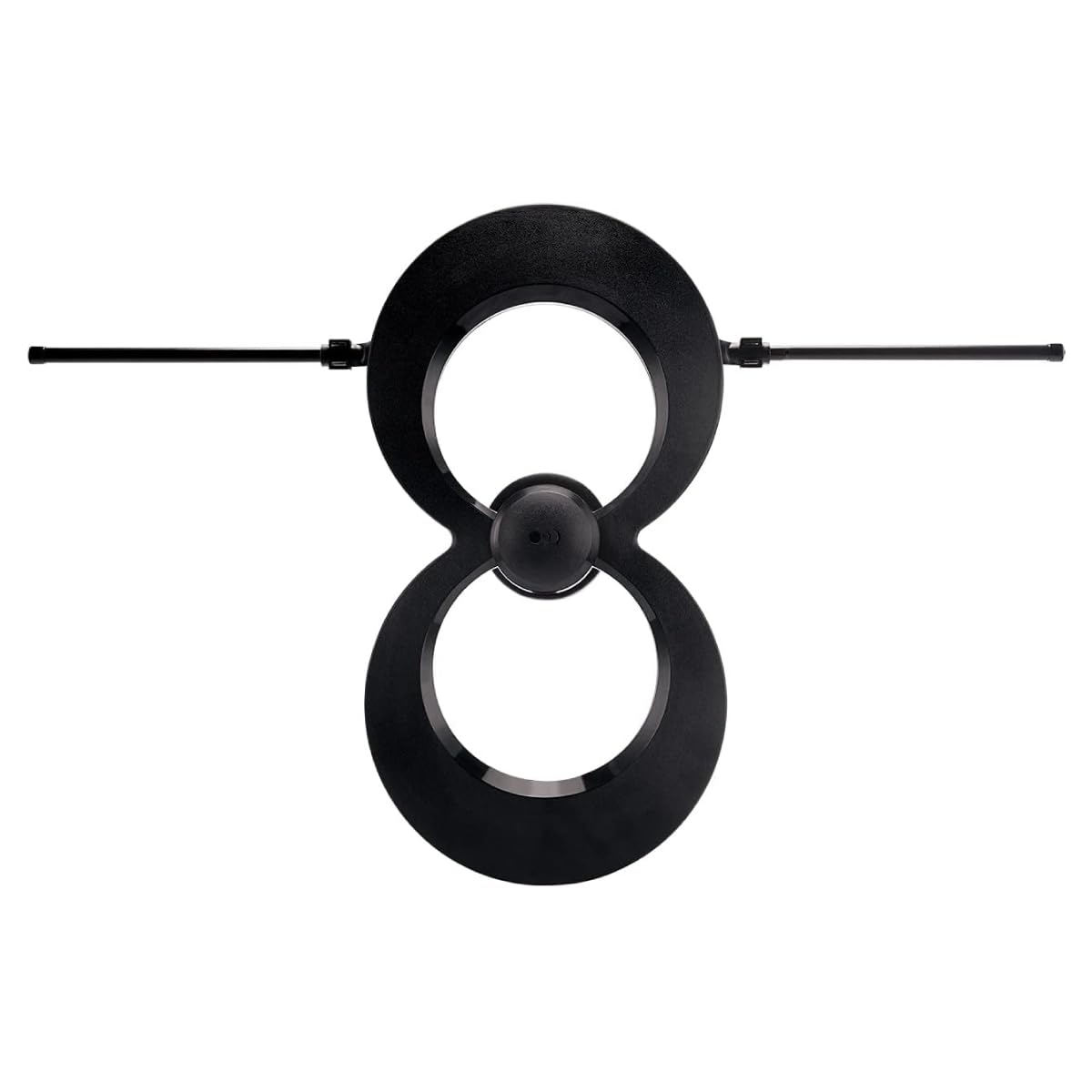
The ClearStream MAX-V bridges the gap between directional and omni-directional designs with its double-loop UHF and Hi-VHF elements that offer a 65-degree beam angle. This wider capture pattern means you can aim it generally toward your tower cluster and still lock onto stations without the micro-adjustments required by narrow-beam Yagis. The included steel wall bracket makes low-profile outdoor mounting genuinely easy, and the 17.4-by-27-inch footprint fits neatly under eaves or on a balcony railing.
Testers who compared ten antennas side-by-side ranked the MAX-V as the clear winner for VHF reception, reliably pulling WABC and CW from 28 miles away where other designs fell short. Indoor installations in Charlotte, NC yielded 20 to 30 stations, while attic mounts in suburban areas routinely delivered 50 to 70 channels. The antenna requires no amplifier for most installations under 40 miles, though adding one extends reach into the 60-mile fringe zone without introducing noise.
The lifetime manufacturer warranty backs up the build quality, and the free RCA Signal Finder app helps you find the optimal aiming direction. If you want an antenna that looks designed rather than industrial, works well indoors or out, and handles multi-directional reception with minimal fuss, the ClearStream MAX-V is the benchmark.
Why it’s great
- 65-degree beamwidth gives flexibility in aiming direction
- Lifetime manufacturer warranty provides peace of mind
- Attractive low-profile design with included wall bracket
Good to know
- Rated range of 60 miles is conservative but honest
- Low-VHF channels may still require a separate external element
- Coaxial cable not included in the package
4. RCA Compact Outdoor Yagi

The RCA Compact Outdoor Yagi proves that a decades-old brand can still design a winner for the modern cord-cutter. The pre-assembled UHF reflector folds out with easy-lock snap elements that eliminate the frustration of tiny screws and washers. At 75 miles maximum range, RCA doesn’t inflate numbers the way no-name brands do, and the compact size makes it a favorite for attic installations where weather protection is built in by default.
Users consistently report signal strengths in the 80 to 100 percent range on major networks when mounted in an attic within 25 to 40 miles of towers. The antenna pulls both VHF and UHF frequencies effectively — one reviewer who switched from a flat Leaf antenna saw ABC on VHF-Lo jump from unwatchable to 92 percent signal quality. The free RCA Signal Finder app guides you through aiming using GPS and local tower data, removing guesswork from the installation process.
Note that the antenna requires mandatory electrical grounding (wire, clamps, and grounding block sold separately) and does not include coaxial cable. But for the price, you get a proven Yagi design that delivers reliable reception without the gimmicks. If you want a no-nonsense antenna from a recognizable brand that actually stands behind its products, this is the one.
Why it’s great
- Pre-assembled snap-lock design for tool-free setup
- Reliable VHF-Lo reception for channels 2-6
- Proven brand with wide availability and support
Good to know
- Grounding equipment not included in the package
- Coaxial cable sold separately
- May require amplifier for runs over 50 feet
5. CeKay Outdoor Yagi HD

The CeKay Outdoor Yagi HD punches above its price point with an all-metal construction that withstands heat, rain, wind, and snow without the plastic fatigue common on budget models. The 70-mile rated design uses a classic Yagi-Uda layout with clearly separated VHF and UHF elements, and users report picking up 30 to 78 channels even in challenging basement or attic environments. The included 40-foot RG6 coaxial cable and J mount means you get everything needed for a roof or attic install right in the box — no surprise trips to the hardware store.
Real-world verification from customers 20 miles from towers shows 90 to 100 percent signal metrics, with several reviewers noting the antenna outperformed expensive amplified flat panels that couldn’t lock onto VHF stations at all. Assembly is mostly pre-completed, though the tube elements fit extremely tightly into rubber holders — a few reviewers used a hammer to seat them, which indicates tolerance stacking that could be tighter.
For under , this antenna delivers genuine Yagi performance that rivals antennas costing twice as much. The included hardware and long cable make it the best value proposition for cord-cutters on a tight budget who don’t want to compromise on channel reception quality.
Why it’s great
- All-metal construction for long outdoor durability
- Includes 40ft RG6 cable and J mount in the box
- Excellent VHF/UHF reception at an entry-level price
Good to know
- Tight element fit may require force during assembly
- Included RG6 cable is thin and may kink
- No amplification; external preamp needed for long runs
6. 1byone Omni-Directional 360°

The 1byone Omni-Directional antenna solves a specific problem: you live in an apartment or home where towers surround you in multiple directions and you don’t want to aim anything. Its 360-degree design uses a built-in Smart Pass amplifier to capture UHF and VHF signals from every direction simultaneously, and the moisture-proof, flame-retardant housing survives outdoor exposure that would kill a cheap plastic panel.
In urban environments like Manhattan, users pulled 60 channels from a Harlem window within 15 minutes of setup. Suburban installations outside Boston and Chicago routinely captured 50 to 70 channels with clear HD quality. The built-in 4G LTE filter prevents cellular interference, and the 39-foot RG6 coaxial cable lets you position the antenna in a high window or on a balcony without an extension.
The trade-off for omni-directional convenience is lower gain compared to a properly aimed Yagi. Users further than 30 miles from towers may see signal dropouts in bad weather, and the preamp introduces some noise floor that passive antennas avoid. If your situation demands no-aim simplicity and you have towers within a moderate radius, this antenna delivers that convenience effectively.
Why it’s great
- True 360-degree reception with no aiming required
- Built-in preamp and LTE filter for cleaner signals
- Compact footprint ideal for apartments and balconies
Good to know
- Lower gain than directional Yagi designs
- Not waterproof for long-term outdoor exposure
- Signal may fluctuate with weather conditions
7. PIBIDI UHD-8903

The PIBIDI UHD-8903 stretches its physical elements longer than many competitors in the same price range, theoretically providing better phase capture for VHF frequencies. The lightning-protected design and weather-resistant construction make it suitable for outdoor mounting, and the tool-free assembly requires only sliding the elements into their pre-drilled positions. Users in rural areas reported pulling 64 to 86 channels compared to the 15 to 50 they got from previous antennas, with stations captured from 40 to 100 miles away.
That said, the 200-mile range claim printed on the box is fantasy — no consumer antenna can achieve that due to the curvature of the earth and FCC power limits. Realistic performance caps around 70 to 80 miles, and even that requires a preamplifier and clear line of sight to towers. The included mast clamp and hardware are adequate, but the antenna lacks a built-in rotator, requiring manual roof adjustments if you need to change direction.
At the budget end of the market, the PIBIDI works well for its real-world price if you calibrate your expectations to the actual physics of OTA reception.
Why it’s great
- Extended receiving elements for better wavelength capture
- Lightning-protected design for outdoor safety
- Tool-free assembly with minimal components
Good to know
- 200-mile range claim is physically impossible to achieve
- No built-in rotator for multi-directional tower clusters
- May require manual roof adjustments for optimal aim
FAQ
Do I need a preamplifier for my VHF/UHF antenna?
Can I install a VHF/UHF antenna in my attic instead of on the roof?
Why do some channels work and others don’t with the same antenna?
Final Thoughts: The Verdict
For most users, the best vhf/uhf antenna winner is the Televes Ellipse Mix 148883 because its intelligent automatic gain control and built-in filtering deliver reliable reception in both urban and fringe environments without manual tuning. If you want a high-performance directional antenna that doesn’t need a separate preamplifier, grab the Antennas Direct ELEMENT. And for attic installation with proven VHF-Lo reception at a reasonable price, nothing beats the RCA Compact Outdoor Yagi.